Tagged: Derek Jeter
Bloomberg Sports Fantasy Baseball 2012 Recap: Shortstops
Twitter: @RobShawSports and @BloombergSports
Bloomberg Sports Anchor Rob Shaw and Analyst Alex Burwasser recap the top five shortstops this fantasy season as well as the top three busts.
TOP FIVE PERFORMERS
5. Starlin Castro, SS, Cubs
After a fantastic sophomore campaign in the big leagues which saw him lead the league in hits (207) and make the All-Star team, Starlin Castro put together another solid year for the Cubs. He did not hit .300 this year but he hit a very respectable .283 while stealing a career-high 25 bases. A good sign going forward for him is his consistency against left and right-handed pitching, hitting over .280 against both this year. However, an area where Castro needs work is his plate discipline, where for the third straight year he drew less than 40 walks (36).
4. Jose Reyes, SS, Marlins
It would have been really difficult for Jose Reyes to duplicate his 2011 season when he won the NL batting title. A season that turned out to be his last with the Mets when he signed as a free agent with the new-look Marlins. A lot was expected of Reyes and the Miami team as a whole moving into a brand new ballpark and it seemed both were wilting under those expectations. Unlike the team, however, Reyes redeemed himself by hitting .312 after the All-Star break and ending the season with his standard double-digit triples (12) and 40 steals. In fact, he was hitting in the three hole for the Marlins by the end of the year, so if that continues in 2013, expect even more production for Reyes.
3. Ian Desmond, SS, Nationals
One of the best stories in baseball this year was the Washington Nationals, and one of the leading characters in that story was 26 year old shortstop Ian Desmond taking the next step and becoming an All-Star player. Not only did his batting average drastically improve from last year moving from .253 to .292 but he had an enormous spike in power hitting 25 home runs this year as compared to only 8 in 2011. Added with his speed, swiping over 20 bases for the second year in a row (21), Desmond looks like he is a player on the rise for the Nationals and possibly for your fantasy leaderboards next year.
2. Derek Jeter, SS, Yankees
Derek Jeter has been around the top of this list for basically the past fifteen years, so why would 2012 be any different? He had 216 hits this season, which was his most since 1999, as well as 47 extra base hits which was his most since 2007. He also hit over .300 (.316) for amazingly the twelfth time in his sure-to-be Hall of Fame career. The only question with Jeter is how long he can possibly keep this up, especially given his unfortunate ankle injury in the ALCS against Detroit, but it would be hard to start counting him out now.
1. Jimmy Rollins, SS, Phillies
Jimmy Rollins, much like Derek Jeter, has been at the top of this list for over a decade now, but Rollins went mostly under-the-radar this season because his team was such a huge disappointment. Obviously, Rollins was not the reason why, blasting his most home runs since his MVP season of 2007 (23) as well as knocking in a solid 68 RBI. A very underrated part of Rollins game has always been his speed, and that was certainly on display this year when he stole 30 bases for the second year in a row and added over a hundred runs scored (102). Rollins is only 33 years old, so there could be a few more years of these type of numbers coming from a premium fantasy position like shortstop.
TOP THREE BUSTS
3. Jhonny Peralta, SS, Tigers
A first time All-Star in 2011, Jhonny Peralta had his best season as a pro for Detroit hitting just under .300 (.299) while providing some serious power with 21 home runs and driving in 86 runs as his Tigers won the AL Central. Detroit again won the AL Central again in 2012 but Peralta was not nearly as big a factor seeing his batting average dip 60 points to .239 as well as his home runs (13) and RBI (63). Peralta needs to hit for power and drive in runs to provide any fantasy value whatsoever because he does not steal bases or hit for a high average.
2. Yunel Escobar, SS, Jays
In a somewhat surprising move given his potential, the Braves traded Yunel Escobar to the Jays after a disappointing start to the 2010 season. It was looking like a steal of a trade for Toronto after a 2011 season that saw him hit .290 with 11 home runs and 77 runs scored. However, he really declined this past season when his average dropped 37 points to .253, but what was most alarming were his walks almost being cut in half from 61 to 35 which left his on-base percentage at a measly .300. For a player expected to be at the top of the lineup for years to come, getting on base three out of ten times will just not cut it for the Jays and for your fantasy team.
1. Dee Gordon, SS, Dodgers
Every year fantasy owners seem to fall into the trap of falling in love with a player who comes up from the minors and excels at a particular statistical category whether it is home runs or strikeouts. In Dee Gordon’s case, it was stolen bases. After being called up in June 2011, he burst onto the scene by hitting .304 and stealing 24 bases in 56 games for the Dodgers. In 2012, he was the opening day starter at shortstop for the Dodgers but he never really got off the ground getting sent to the minors in early July after hitting only .228. He still has a ton of speed — he stole 32 bases — but he cannot provide any value if he cannot get on base in the future.
For more fantasy insight, visit BloombergSports.com.
Bloomberg Sports American League Fantasy All-Star Team
Twitter: @RobShawSports and @BloombergSports
Bloomberg Sports Anchors Julie Alexandria and Rob Shaw discuss whether or not the fans’ selections for the American League All-Star team were right and who should be starting the All-Star Game in Kansas City on July 10.
Catcher
Mike Napoli of the Rangers was the fan choice, but White Sox backstop A.J. Pierzynski should be starting in the All-Star Game. Pierzynski is not one of the more popular players in baseball and was actually expected to lose his job coming into this season. However, he is hitting .285 this year with 14 home runs and 45 RBI.
First Base
Edwin Encarnacion of the Blue Jays should be starting instead of Prince Fielder. Encarnacion has always had great potential but has been inconsistent in the past. This season, however, he is deserving of a starting spot in Kansas City with a .291 average, 22 home runs, 55 RBI and eight stolen bases.
Second Base
The fans got this one right, voting in Robinson Cano of the Yankees. He’s batting .310 with 20 home runs and 46 RBI. Not only is he an All-Star but he is clearly the Yankees’ MVP.
Third Base
The fans chose Adrian Beltre of the Rangers, which is a good pick because he is one of the best defensive players in baseball. Miguel Cabrera, however, is the best third baseman in the American League with a .314 average, 16 home runs and 62 RBI.
Shortstop
Derek Jeter is having a good season, but Elvis Andrus of the Rangers is the best shortstop in the American League right now. He is not a power hitter with just one home run but he’s batting .307 with 32 RBI and 16 stolen bases. The fans should have voted in Andrus instead of Jeter.
Outfield
Of the three outfielders voted in, only one was the right pick by the fans. It wasn’t a surprise that Josh Hamilton was selected, and he is the right choice. He’s on pace for more than 50 home runs and 140 RBI this season.
Angels rookie Mike Trout should be starting in place of Curtis Granderson. Trout is batting .339 with nine home runs, 33 RBI and 22 stolen bases, and keep in mind that he started this season in the minor leagues.
Adam Jones of the Orioles should have been selected in place of Jose Bautista. Jones has a .302 average, 19 home runs, 42 RBI and 11 stolen bases. He has a bright future and is likely one of the next big stars in baseball.
Designated Hitter
David Ortiz was the right pick by the fans. He continues to put up big numbers with a .302 average, 21 home runs and 54 RBI this season. This is Ortiz’s eighth All-Star selection.
For more fantasy baseball insight, visit BloombergSports.com.
Ballpark Figures: Hall of Fame Predictions Part One
Twitter: @RobShawSports and @BloombergSports
Bloomberg Sports Anchors Julie Alexandria and Rob Shaw discuss players who they think will definitely be inducted into the Hall of Fame and players who are debatable.
Definites
Based on his statistics, Manny Ramirez should be a Hall of Famer. He has 2574 hits, 1831 RBI and 555 home runs in his career. He is a 12-time All-Star and has two World Series rings (’04, ’07) and nine Silver Slugger awards. However, his use of PEDs has tarnished his statistics and will keep him out of the Hall of Fame.
Though Albert Pujols is struggling a bit this season with the Angels, he has already cemented a spot in the Hall of Fame. He has 2,142 hits, 456 home runs and a .325 batting average in his career. He is a three-time MVP (’05, ’08, ’09) and a nine-time All-Star and has won two World Series (’06, ’11), six Silver Slugger awards and two Gold Glove awards.
Like Pujols, Ichiro Suzuki‘s numbers are down this season, but he deserves induction into the Hall of Fame based on his past performances. He has 2,504 hits, 432 stolen bases and a .323 average in his career. The 10-time All-Star also won MVP and Rookie of the Year honors in 2001 and has earned 10 Gold Gloves and three Silver Sluggers.
Derek Jeter is another player who is a shoe-in for the Hall of Fame. The 12-time All-Star has 3,177 career hits, 344 stolen bases and a .313 career average, as well as five Gold Gloves and four Silver Sluggers. Above all, he is a big-time winner with five World Series rings.
Chipper Jones, set to retire at the end of this year after 19 seasons, is certainly Hall of Fame-bound. He has 2,650 hits, 459 home runs and a .304 average in his career, in addition to an MVP award (’99), seven All-Star selections and two Silver Sluggers.
Alex Rodriguez, a 14-time All-Star and three-time MVP, is another player whose Hall of Fame candidacy is in question due to PEDs. However, it can be argued that after the steroid era ended, A-Rod still put up good enough numbers to warrant induction. He has 2,841 career hits and 640 home runs, and is 76 RBI away from 2000 for his career. He has one World Series ring (’09), 10 Silver Sluggers and two Gold Gloves.
Jim Thome is headed for the Hall of Fame with his 608 career HR. The five-time All-Star has had 12 seasons of 30+ HR and 100+ RBI but he is not just a home-run hitter. He has 1,710 walks, ranking 10th all-time.
Mariano Rivera is another player already in the Hall of Fame. He is the all-time saves leader with 608 and has a 2.21 career ERA, good for 13th all-time. He is the greatest closer of all time and one of the most clutch performers in sports. Despite being 42 years old, Rivera was as good as ever before his season was cut short by a torn ACL.
Questionable
Jamie Moyer sits at 269 wins as he is currently pitching in AAA and trying to make another comeback, this time with the Baltimore Orioles. If he returns shortly and assuming he pitches every fifth day, he could potentially start 19 games and could pick up the six wins he needs to reach 275 for his career. If the 49-year-old can somehow keep pitching into his fifties, he could have a shot at 300 wins and the Hall of Fame.
Johnny Damon‘s easiest path to the Hall of Fame is to get another 254 hits to reach 3,000 for his career. If he gets just 54 more hits and 17 more home runs, he would join Rickey Henderson, Barry Bonds and Craig Biggio as the only players to have 2,800 hits, 250 home runs and 400 stolen bases. At the moment, he is one of five players to have 230 home runs, 400 stolen bases and 2,700 hits.
Scott Rolen is one of three third basemen to hit above .280 and hit 300 or more home runs, and one of four third basemen to have 8,000 or more plate appearances and an OPS of .850 or better. At 37 years old, if Rolen can collect 77 hits the rest of this season and average 100 hits over the next four years or 133 hits over the next 3 years, he would reach 2,500 hits. In addition to his defense, position and more than 300 HR, he would have a very strong candidacy.
Todd Helton‘s chances to make it into the Hall of Fame may be hurt by playing at Coors Field. However, if the 38-year-old can hit 46 more home runs over the next five years, he’d reach 400 home runs and have a strong case with 2,500 hits and 400+ home runs, a feat only 25 Major Leaguers have accomplished. He has hit 227 home runs at home and just 138 home runs on the road, so he may need to do more than most for people to believe in his Coors-tainted candidacy.
Vladimir Guerrero needs just 51 home runs to reach 500 for his career. Among players with at least 8,000 career plate appearances since 1950, his average of .318 ranks sixth behind Tony Gwynn, Wade Boggs, Rod Carew, Ichiro Suzuki and Todd Helton. he is one of only seven players in history with at least 350 home runs, a batting average of at least .310 and at least 2,500 career hits. Among the six others, only Manny Ramirez is not already in the Hall of Fame.
If Lance Berkman stays healthy and plays into his early 40s, he has a shot at reaching 500 home runs. If he can hit nine home runs the rest of this season, he’ll have 132 to go, which would mean four full seasons at his career pace of 33 per 162 games.
Tim Hudson has one of the 10 lowest ERAs of any pitcher with at least 2,000 innings pitched since 1990 and is tied for the fourth-most wins among active pitchers with 185. He also has the lowest home-run rate of any pitcher with at least 2,000 innings pitched since 1950.
For more baseball insight, visit BloombergSports.com.
Aging Gracefully: Jeter, Big Pappi, Chipper, Ibanez, and Lowe
Twitter: @RobShawSports and @BloombergSports
Rob Shaw and Julie Alexandria discuss five veterans aging gracefully:
Derek Jeter, SS, Yankees
With a .342 average and five home runs, Derek Jeter has far exceeded expectations this season, as he is now surpassed 3,150 hits for his career. Now it may be time to sell high on the Yankees legend. Despite the early power showing, Jeter has just one extra base hit since May 6. He is starting to look like the singles machine that boasted just a .370 slugging percentage in 2010. Furthermore, the stolen bases are way down with just three swipes this season. Jeter has been great so far, but there are some serious questions about the sustainability of this hot start from the 37-year-old shortstop.
David Ortiz, DH, Red Sox
Though he seems to be getting bitter with age, claiming he doesn’t get respect in Boston, David Ortiz is as dangerous as ever with the stick in his hand. Ortiz is on pace for 40 home runs and 120 RBI while batting .305. Ever since everyone predicted his decline in 2009, Ortiz has bounced back and is once again one of the best designated hitters in baseball.
Chipper Jones, 3B, Braves
Sadly this is the swan song for Chipper Jones, who will one day find himself inducted in the Baseball Hall of Fame. A bruised left calf had forced Jones out of the lineup for the time being, but when he is healthy this season, he has blasted five home runs with 24 RBI and a .307 average. Jones is unlikely to have much more than 400 at bats this season, but if you are willing to change your roster on a daily basis, you can end up with an oldie, but goodie.
Raul Ibanez, OF, Yankees
The Phillies thought Raul Ibanez was done after a less than stellar 2011 season. The Yankees took an inexpensive gamble on the New York City native and so far the 39-year-old designated hitter has blasted nine home runs with 27 RBI. Yankees Stadium seems perfect for the left-hander, as he already has seven home runs at home. Additionally, the solid Yankees lineup has led to many run-producing opportunities and so far Ibanez has capitalized.
Derek Lowe, SP, Indians
It’s very rare for a pitcher to have success with more walks than strikeouts, but lo and behold, Derek Lowe is having a bounce back season with the Indians. Lowe had allowed just seven runs over his last six starts before getting pummeled this weekend. Even still, the ERA is a solid 3.25. Again, the strikeouts are a concern, and it makes you wonder how long this could last.
The Bloomberg Sports Fantasy Factors Part 2
BY ROB SHAW
With more than 20 of the Major League Baseball teams turning to Bloomberg Sports as a business solution, fantasy managers can rest assured that their fantasy teams are in good hands.
Offering a trade analyzer, lineup manager, and projections for every single player in the Big Leagues, Bloomberg Sports uses an algorithm that takes into account nine Fantasy Factors.
In a previous article, we focused on ballpark, durability, age, and contract status. Now the focus is on the remaining five Fantasy Factors.
In fantasy baseball, career trends are an important aspect to be considered when evaluating players. In essence, fantasy managers like investors have to know what’s a growing stock and what’s a mature stock. A player on the rise would be a growing stock and two examples are Baltimore Orioles rising stars Adam Jones and Matt Wieters. Both players are in their mid-20s and have been improving their statistics consistently over the last few seasons.
On the other hand, Yankees veteran Derek Jeter and Alex Rodriguez are far from their prime and have recently suffered their worst seasons of their legendary careers. It’s perfectly fine to invest in a player on the decline, as long as you are realistic about what they can produce in the upcoming season.
Next, luck is a Fantasy Factor that can help forecast performance. Using an advanced statistic: BABIP, it is possible for baseball fans to find out if a player had luck on their side or if it worked against him over a given period.
BABIP is the batting average for balls in play and takes into account whether a player enjoyed a higher percentage than usual of balls in play falling for hits. For instance, if a player offers a BABIP that is significantly higher than their career norm, it is often a safe bet that in the following period his performance will regress to the previous rate.
On the other hand, if the BABIP is abnormally low, it is safe to assume the player will have better luck ahead and his batting average and other statistics will improve. The statistic can also be used for pitchers when looking at BABIP against the opposition.
Next, team support is an important fantasy factor for hitters and pitchers. For hitters, it is a matter of whether they have players around them in the lineup that they can drive in and players who will drive them in. In other words, team support has a direct impact with RBI and runs. For pitchers, it’s a matter of having run support to earn wins, plus a solid defense behind them to keep runs off the board.
Strength of schedule is the next factor, and this is all about what ballparks and teams an opponent faces. Pitching in the AL East is no easy task for pitchers who have to deal with the Red Sox offense in Fenway Park, the Yankees offense in Yankees Stadium, and additional hitters parks in Toronto and Baltimore. On the other hand, the NL West calls home to several pitcher parks and limited offenses including in San Francisco, San Diego, and Los Angeles.
Consistency is a fantasy factor, as fantasy managers have to decide whether to gamble on a player who has great potential, but also great volatility. A player like Geovany Soto seems to alternate between good years, while Torii Hunter and Yadier Molina are examples of players who seem to produce consistent numbers every given season.
To see the Fantasy Factors in action visit BloombergSports.com.
The Bloomberg Sports Fantasy Factors Part 1
BY ROB SHAW
When it comes to evaluating player performance and creating projections for the upcoming season, Bloomberg Sports takes several factors into account. Here’s a breakdown of four of the nine factors that allow Bloomberg Sports to offer the most accurate projections in fantasy sports while attracting more than 20 Major League teams to turn to the company for scouting and advanced analytical solutions.
The first factor to consider is ballpark. Over the last five years it seems like we have shifted back to the big ballparks that favor pitchers. That is certainly the case for Citi Field, PETCO Park, and Target Field. As a result, just about any Mets, Padres, or Twins hurler performs better at home than on the road.
On the other hand, there are power alleys in Yankee Stadium, Coors Field, and most definitely the Ballpark in Arlington. Fantasy managers want to invest in the pitchers from the large cavernous and the hitters in the bandboxes.
On that note, be wary of pitchers who thrived in pitcher’s parks such as Mat Latos and Heath Bell who now join more hitter-friendly confines and definitely invest in hitters such as Michael Cuddyer making the move from Target Field to Coors this season.
The next fantasy factor to keep in mind is durability. Fantasy managers expecting full seasons from Jose Reyes, Nelson Cruz, and Chipper Jones are playing against the odds. There are durable hitters out there such as Yadier Molina and Roy Halladay. Their durability is a fantasy asset since you know what to expect from them on a day-to-day basis.
Next, fantasy managers should consider the age of their players. Bloomberg Sports has found 26-31 to be the prime age for baseball players. A younger player should be approaching his peak, while older players are typically on the decline. It should not shock you that Ichiro, Derek Jeter, and Alex Rodriguez are slowing down with age.
Finally, fantasy managers should consider the impact of a long-term deal. It is very rare that the player delivers shortly after signing such a deal. While we hate to question motivation, we have noticed that stars such as Jason Bay, John Lackey, Carl Crawford, and Jayson Werth were not nearly as productive after signing long-term deals compared to the season prior to the negotiation. On that note, Jose Reyes and Albert Pujols may not be as safe as you thought.
For all nine Fantasy Factors visit BloombergSports.com.
A Look at the Young and Old On the Rise
Follow us on Twitter: @BloombergSports @RobShawSports @MicheleSteele
Kyle Seager, 2B/3B, Mariners
The Mariners have surprised us in recent weeks with an offense we did not know could exist in Safeco. While we’ve discussed Dustin Ackley and Mike Carp, another fine hitter to emerge this season is Kyle Seager. A third round pick in the 2009 draft out of North Carolina, Seager boasts a .313 average after a hitting binge that included 15 hits over six games. In 24 games at Triple-A Seager hit .387 with a .585 slugging percentage. So success at the dish is nothing new for the 23-year-old prospect.
John Mayberry, OF, Phillies
While everyone drafted Dominic Brown in their fantasy drafts this season, it’s instead the 2005 first round pick John Mayberry who is enjoying the better season in the Phillies outfield. The 27-year-old slugger has blasted 12 home runs with 41 RBI through 77 games. Best of all, Mayberry is not a one-trick pony, as he has swiped six bases already this season. Mayberry has blasted 18 home runs in 266 career at bats in the Big Leagues and while he can still improve his plate discipline and lift the average some, Mayberry has earned his way to your fantasy roster.
Chipper Jones, 3B, Braves
The Braves legend will not go away. Chipper Jones has been written off a number of times this season because of his usually array of injuries, but right now he is putting together a nice little hot streak with plenty of power. The batting average is up to .281 on the season with 13 home runs and 58 RBI. Since the All-Star break, Jones is batting .387 with five home runs. 51 home runs shy of 500 for his career, the 39-year-old Jones has already stated that he intends to come back for another season.
Derek Jeter, SS, Yankees
Since the All-Star break, Derek Jeter has hit .355 with 26 runs in 37 games. While that’s nice and all, what’s more remarkable to me is that on the season his average has soared all the way up to .299. So is Jeter back to being Jeter? Yes and no. The average is good and the 13 steals isn’t bad, but the limited power he once had is all but gone. During his hot streak, Jeter has just 10 extra bases including one home run. While he’s not a power guy, it seems that a lot of his hits are coming on grounders with eyes. Regardless, Jeter has played a large part of keeping the Yankees afloat with A-Rod. He also took away a lot of the pressure for next season, as fans will not be clamoring for a position switch.
Three Fantasy Sleepers, and An Injury Report on Jeter, Santana, and Zimmerman
Jarrod Saltalamacchia, C, Red Sox
After a slow start to the season Jarrod Saltalamacchia is red-hot for the Red Sox. He is batting .400 this month with a home run, two doubles, and a triple. His season average is now a respectable .252 with five home runs. Remember, as bad as he was early in the season, Salty was once a mega prospect who was traded for Mark Teixiera. He may never reach that potential, but if he can hit .280 with 15 home runs in Boston, the run production will pile up. My only warning is that his defense is still not very good, so it will remain a platoon with Jason Varitek.
Charlie Blackmon, OF, Rockies
Lost in the rookie rush a few days ago was the call-up of Rockies outfielder Charlie Blackmon. A former second round pick out of Georgia Tech, the 24-year old has the highly sought combination of power and speed. He was hitting .337 in Colorado Springs with 10 home runs and 12 steals. With Dexter Fowler injured, Blackmon will enjoy a shot at playing everyday. If he contributes, look for him to become an everyday player, which means tons of fantasy value.
Carlos Carrasco, SP, Indians
Before the season began we asked Jay Levine from LetsgoTribe.com who was the top hurler on the staff and he surprised us with Carlos Carrasco. At first we questioned his call since Carrasco was just 1-2 with a 5.29 ERA through six starts into the season, but since then, Carrasco has gone 5-1 while lowering his ERA to 4.09. He has not allowed a run in either of his two starts while fanning season highs six and then seven batters. What was most impressive about his last win was that it came in Yankee Stadium against the hot-hotting Bombers. At just 24 years old, Carrasco is a great long-term investment.
Injuries-
Ryan Zimmerman, 3B, Nationals
After more than a month on the DL, Ryan Zimmerman will be activated to play tonight. Zimmerman was batting .357 through eight games when he got hurt. His presence should help the entire lineup that has struggled to replace their third baseman as well as their injured first baseman Adam LaRoche.
Johan Santana, SP, Mets
The idea was for the Mets to simply be competitive for the next few weeks until David Wright, Ike Davis, and Johan Santana returned. Well it looks like Johan is not on the path to recovery as fast as we all thought. He has been dealing with soreness and now at the earliest, the Mets ace will not make it back until August. By then, a lot of his teammates could be traded.
Derek Jeter, SS, Yankees
What does it mean that Derek Jeter is nearing 3,000 hits. Sure, he’s an all-time great, but he is also really old at 36-years old. Well age may have gotten the better of him this week as he strained his calf. This makes the guessing game even harder to play about when he will hit number 3,000. My guess is that because of his age the Yankees will be conservative and place him on the DL, though this could end up being just a day-to-day issue. My guess is that the New York media will keep you updated on his status.
Derek Jeter Will Be Valuable For Fantasy Owners in 2011
By Eriq Gardner //
Not Bullish On Jeter In a New Uniform
by Eno Sarris //
Things are getting heated in the negotiations between Derek Jeter and the Yankees. Over the holiday week, Brian Cashman dropped this bomb in typically understated fashion:
“We understand his contributions to the franchise and our offer has taken them into account,” Cashman said. “We’ve
encouraged him to test the market and see if there’s something he
would prefer other than this. If he can, fine. That’s the way it
works.”
That is the way it works, but of course the baseball blogosphere took the tidbit and ran with it. Some of the fake baseball cards created by Beckett.com were chilling, and the prospect of Jeter in another uniform should be doubly chilling to fantasy players planning on snapping up Jeter as a bounce-back shortstop in 2011.
R.J. Anderson did a fine job taking a look at the historical precedent that 37-year old shortstops have provided in his article on Jeter earlier in the month. The most damning paragraph:
In June, Jeter will turn 37. No shortstop (defined by
having played at least 50% of their games at the position along with 300
plate appearances) aged at least 37 has ever hit more than nine home
runs in a season. Since 1970, only 20 shortstops met that qualification
after turning 37, with the highest batting average being .295, the
highest on-base percentage being .367, and the highest slugging
percentage being .419. Over the last three seasons, Jeter’s line:
.301/.369/.414. Meanwhile, only two of those players finished with an
OPS above the league’s average.
Looking at Jeter’s combination of BABIP and batting average last year (.307 BABIP, .270 batting average), you might wonder where some optimistic batting average projections are coming from. Bill James has him projected at .295, for example. On the other hand, Jeter is still athletic, has a much better career BABIP (.356), and could easily find himself batting closer to .300 next year.
And yet, if Jeter ends up in a different uniform, he probably won’t be a great bounceback pick. Three important statistics that have always been in Jeter’s favor could then work against him: plate appearances, runs and RBI.
If Jeter were to don a new uniform in 2011, the most vulnerable statistic would be runs scored. Since Jeter joined the Yankees’ lineup for good fifteen years ago, he’s averaged 112 runs per season. That’s meant that even in his worst seasons, he’s been a boon in the category. The Yankees lineup has driven him in prolifically, and last year that offense scored the most runs in baseball (859). The offenses on the two teams that have been linked to Jeter, the Giants and Orioles, weren’t even close. In fact, the Giants (697 runs) scored only 81% of the runs that the Yankees scored.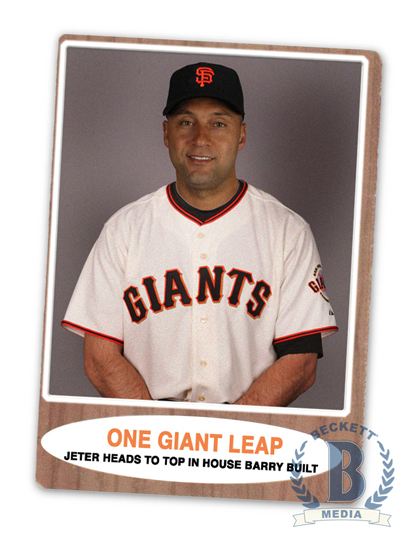
Let’s say we walk the runs and RBI projections for Jeter back 15% – after all Jeter would improve those two lineups ostensibly – and the package looks a little worse. Now we’re talking about a player that will gather around 85 runs and 50 RBI.
And there’s one last caveat. The projections we’ve been using here – Bill James’ on FanGraphs – use 703 plate appearances. A 37-year-old shortstop has never amassed 700 plate appearances. Omar Vizquel‘s 659 plate appearances in 2006 is tied with Luke Appling‘s effort in 1946 as the most ever by a 37-year-old at the position. Only nine other men have ever crossed the 600 plate appearance threshold. If we remove another 50 plate appearances to place Jeter in the middle of the best old shortstops ever, now we’re hoping that Jeter can get to double-digits in homers and steals, and worrying that he might not garner even 80 runs and 45 RBI.
Later in 2011 drafts, you may be looking at Jeter among some shortstops that are at least five years younger than him. Would you pick Jeter over Alexei Ramirez (.280, 18 HR, 80 R, 78 RBI, 12 SB), Stephen Drew (projected for .270, 16 HR, 82 R, 67 RBI and 8 SB), or Elvis Andrus (.274, 2 HR, 82 R, 43 RBI, 34 SB)?
The answer to that question will depend, of course, on the actual draft positions required to grab each of the shortstops in question. But, looking at the runs and RBI totals of this projected crew, it doesn’t look like Jeter would be the same old Jeter in a new uniform. Fantasy managers looking to grab Jeter as a value should join the throng hoping that Jeter will re-up with the Yankees.
For more on Derek Jeter and other shortstops, check out Bloomberg Sports’ Front Office.

