Tagged: Milwaukee Brewers
Ballpark Figures: Top Five Fantasy Baseball Players Over the Past Two Weeks
Twitter: @RobShawSports and @BloombergSports
Bloomberg Sports Anchor Rob Shaw breaks down the five baseball players who have been making a huge fantasy impact over the past two weeks.
5) Alex Rios, OF, White Sox
Rios struggled with the White Sox in 2011, batting just .227. However, he has bounced back this season with a .316 AVG, 18 HR and 67 RBI. In the past two weeks alone, he hit .353 with 14 runs, five home runs, 15 RBI and one stolen base. He is a five-tool talent and his hot streak could continue, especially considering that he plays at hitter-friendly U.S. Cellular Field. Be aware, however, that Rios is known for his inconsistency.
4) Adam LaRoche, 1B, Nationals
Like Rios, LaRoche has struggled with inconsistency. Last year was a disaster for him, as he only played in 43 games and had just a .172 average. He is known for getting hot in the second half of the season and he is living up to that right now. In the past two weeks, LaRoche has a .429 average, 10 runs, seven home runs and 14 RBI.
3) Carlos Gomez, OF, Brewers
Gomez is a solid outfielder defensively but is not known for his offense. He hasn’t been able to play every day in the past but he’s been given a chance in Milwaukee and is putting up huge numbers. Over the last two weeks, Gomez is batting .348 with 14 runs, four home runs, 10 RBI and six stolen bases. At 26 years old, he could get a chance to play full time next season.
2) Drew Stubbs, OF, Reds
Stubbs is known to be unpredictable at the plate. He steals a lot of bases and has some power but he kills your batting average. His currently has a .239 season average, but in the last two weeks, he has a .362 average with 17 runs, four homers, 11 RBI and five steals. Stubbs is a streaky hitter, so ride out this hot streak while you can.
1) Albert Pujols, 1B, Angels
Pujols had a slow start to the season but he’s been on fire recently, and it couldn’t come at a better time for the Angels. Over the past two weeks, he has a .365 average, 11 runs, seven home runs, 19 RBI and two stolen bases.
For more fantasy insight, visit BloombergSports.com.
Fantasy Baseball: MLB Debuts and The Five Players Most Likely to be Traded
Twitter: @RobShawSports and @BloombergSports
Bloomberg Sports Anchor Rob Shaw breaks down the fantasy implications of two players’ MLB debuts and the potential trades of five players who are most likely to be moved.
The Big Debuts
Matt Harvey, SP, Mets
Finally some good news for Mets fans as 2010 first-round pick Matt Harvey made his debut Thursday night and it was a memorable one to say the least. Harvey set a Mets record for a debut with 11 strikeouts and did not allow a run to score in 5.1 innings.
Harvey touched 98 MPH on the radar gun and got some K’s with high fastballs while also getting some weak swings by putting sliders in the dirt. Don’t expect all of his starts to go this smoothly, but Harvey is a strikeout artist who should continue to rack up the K’s, though it could come with some walks as well.
Starling Marte, OF, Pirates
On the first Major League pitch he saw, Starling Marte made his mark, blasting a home run. The 23-year-old outfielder is an instant upgrade for the contending Pirates. Marte has some power, as he blasted 12 home runs with 13 triples and 21 doubles at Triple-A. He lacks plate discipline, but also has some speed. I do not see Marte having too much fantasy value this year aside from what could be a hot start since the Major Leaguers lack an in-depth scouting report on him. Regardless, the future is now for the Pirates and Marte only makes the team more interesting.
Five Players Most Likely to be Moved
1) Zack Greinke, SP, Brewers
The Brewers have come out and acknowledged that they are going to trade their ace, which makes it clear that no long-term commitment could be reached with Zack Greinke. Ultimately, a trade to a contender will do fantasy managers some good, but at varied levels.
If he goes to the Rangers: The hitter’s ballpark is bound to lead to some extra runs so Greinke’s ERA may spike, but he will also enjoy the best run support possible. This is the trading partner that makes the most sense for everyone. Greinke owns a sensational 2.38 lifetime ERA at Rangers Ballpark.
If he goes to the Angels: Greinke should continue to post similar numbers but with a few extra wins thanks to the offensive star power of Albert Pujols, Mike Trout and Mark Trumbo. You can expect a big second half from the ace who is 44-45 in the first half of seasons and 41-31 following the All-Star break.
If he goes to the Braves: This is the best ballpark for Grienke, plus in the NL he faces opposing pitchers, which will keep his ERA lower. Greinke is 25-9 in 49 starts with a National League club.
2) Jonathan Broxton, RP, Royals
The interest in Jonathan Broxton has been limited on the trade market and it may be for a couple of reasons. First, few contenders are desperate for a closer or late reliever right now. Also, Broxton’s numbers are not as good as they appear. He is not getting many strikeouts, which is a reversal of his career trend. He is also allowing 1.40 runners on base each inning, which is a recipe for destruction in late innings. The Royals are wise to put him on the block.
3) Jason Vargas, SP, Mariners
With the demands so high for front-of-the-rotation hurlers such as Greinke and James Shields, alternatives such as Jason Vargas are becoming attractive for teams. Vargas has won four straight starts and now owns a career high 11 wins this season. So when he does get traded, what does this mean to his fantasy value? The run support will increase, but his ERA will also soar. He has a 4.67 ERA on the road this season compared to 2.63 at home, which explains everything you need to know about the 29-year-old southpaw.
4) Francisco Liriano, SP, Twins
When the Twins dealt their ace Johan Santana to the Mets a few years back, they not only assumed that some of the prospects from the trade would turn into stars, but the hope was that Francisco Liriano would step up as an able replacement at the top of the rotation. Though he did enjoy some success in 2010 with 14 wins, a 3.62 ERA and a career high 202 strikeouts, the following two seasons have been disastrous.
Liriano has found himself in the bullpen and even in the minors over the last two seasons while sustaining an ERA north of 5.00 in the Majors. The positive signs this season are that the opposition is hitting just .239 against Liriano and he is fanning more than a batter per inning. On the other hand, his control is lacking, which makes him a major gamble for whoever brings him in via trade.
5) Yunel Escobar, SS, Blue Jays
After a strong 2011 season that included 11 home runs, a .290 average and .369 on-base percentage, Escobar has struggled this season. His average is down to .255, his OBP is .299 and his 19 extra-base hits have resulted in a .342 slugging percentage.
Escobar has shown some life recently with a five-game hitting streak, but there is growing concern about his character according to ESPN’s Buster Olney, which may scare off some suitors. Keep in mind that Toronto is a favorable hitter’s park and the Blue Jays lineup has posted a lot of runs. The 29-year-old Cuban does not make for a very good fantasy investment.
For more fantasy insight, visit BloombergSports.com.
Ballpark Figures Trade Deadline Breakdown
Twitter: @RobShawSports and @BloombergSports
Bloomberg Sports Anchors Julie Alexandria and Rob Shaw break down some of the major storylines in baseball as the trade deadline approaches.
Trade Analysis: Hanley Ramirez to the Dodgers
The Dodgers made a splash by acquiring former Marlins sensation Hanley Ramirez for Nathan Eovaldi and a willingness to take on Ramirez’s salary. First of all, this is the way it should be for Los Angeles. The Dodgers are supposed to be the West Coast Yankees, so it’s good to see them open the check book to bring in some star potential.
The move also makes baseball sense. The team already has two of the best hitters and pitchers in baseball, so it’s not a bad idea to go for the gold now. Eovaldi is too young to be depended on, while, even at his worst, HanRam is scoring runs and offering some pop and speed. On a side note, of all stadiums where Ramirez has played at least 65 games, his .388 average at Dodgers Stadium is easily the highest.
On the Market: Alfonso Soriano
With 19 home runs and 58 RBI, Alfonso Soriano is once again a solid slugger at the big-league level. He is also due to make $18 million in each of the next two seasons. His high performance provides the Cubbies with a window to trade him. Ken Rosenthal reported that at least one team has interest in the veteran outfielder.
Sellers: Philadelphia Phillies
The Phillies are in a very interesting situation right now. They have some very bad contracts, though their huge investment in Cole Hamels is not one of them. He is still young at 28 years old and was developed within the Phillies system. The team is out of contention this season and must rebuild in the next few years. The only way players such as Shane Victorino could be dealt is if the Phillies get back prospects who will be ready to start next year.
Sellers: New York Mets
After a great first half, the Mets have won just one game since the All-Star break and could try to make a move. Johan Santana’s injury hurts them, as he is due so much money andcould have been traded. The Mets would have been happy to deal him in return for prospects.
With Santana injured, if there is a Mets player to be traded, it’s infielder Daniel Murphy. Jordany Valdespin has been incredible this season and offers more versatility and better defense than Murphy. However, the Mets will only make a trade if they get something back which they are really able to use, such as a power arm for the bullpen.
Sellers: Milwaukee Brewers
The Brewers have been buyers recently, bringing in players such as Zack Greinke and Aramis Ramirez, but it has not worked out. The best case scenario for them is that Greinke decides to stay in Milwaukee, which may not be very realistic. The Brewers were also shopping reliever Francisco Rodriguez and tried to increase his value. K-Rod, however, imploded with blown saves in consecutive appearances against the Phillies, likely costing the Brewers some prospects.
For more insight, visit BloombergSports.com.
Ballpark Figures: Top Second-Half Storylines
Twitter: @RobShawSports and @BloombergSports
Bloomberg Sports Anchors Rob Shaw and Julie Alexandria discuss the top five stories in baseball after the All-Star break.
Will R.A. Dickey win 20 games?
Baseball fans are trying to figure out if R.A. Dickey is Tom Candiotti or Phil Niekro. At 12-1, Dickey is enjoying a banner season and arguably would be the NL Cy Young award winner if the season ended today. The problem for Dickey is that the season does not end today and he still has about 15 starts to go. Can he possibly continue his dominance and nab another eight wins for an even 20?
Hall of Fame knuckleballer Phil Niekro attained three different seasons with 20 or more wins. On the other hand, Dickey might only win another 3-5 games this season and finish with a solid, but more expected total that is more in line with a solid hurler, such as knuckleballer Tom Candiotti, who won 14, 15 and 16 games in his career.
What becomes of Tim Lincecum?
The good news is that Tim Lincecum is on pace to strikeout 200 batters. The bad news is that he is also approaching 100 walks, which could lead to some time in the bullpen. We’ve had some surprises this year that fill the bust category. As of now both Jose Reyes and Albert Pujols join a recent trend of major free agents struggling with new franchises.
Lincecum is pitching for the very franchise he came up with and has dominated for the last five seasons. However, he is getting hit often and hard, and with a 3-10 record and 6.42 ERA you have to wonder if he will stick in the starting rotation all season long. Lincecum hasn’t made it out of the fourth inning in back-to-back outings.
Where will Zack Greinke end up?
The Brewers have had their struggles and perhaps for that reason, Zack Greinke’s performance has gone under the radar. He is 9-3 with 111 K’s and a 3.32 ERA. With the Brewers five games out of first place, the team will be in sell mode especially if Greinke does not indicate that he wants to stick there.
So what teams could be interested? How about the Baltimore Orioles, or the St. Louis Cardinals? Greinke’s presence could make a world of difference in how this ost-season shapes up.
Are the Phillies buyers or sellers?
The Phillies are in dead last place in the National League East. They opened the season without Chase Utley and Ryan Howard, and now that they are coming back, the pitchers have been out: Cliff Lee and Roy Halladay.
The big question for the Phillies is figuring out whether or not Cole Hamels will stay as a free agent. There have been rumblings that he could be destined to the Dodgers, which would leave the Phillies in a bind if they do not get anything in return for his services aside from draft picks. Hamels, by the way, is 10-4 with a 3.20 ERA with 118 K’s and a 1.10 WHIP. He has been the ace for the Phillies this season.
Are the Pirates playoff bound?
The Pirates are in first place late in the season for a second straight year. The question is whether they can stick this time and if they learned from last year’s collapse. It looks like they could actually stick this time for a couple of reasons. Firstly, they have an ace with James McDonald boasting a 2.37 ERA with much better control this season. Next, their gamble with AJ Burnett seems to be paying off as he’s been a solid number two. Though the starting rotation lacks depth, the bullpen is strong enough to let leads stick.
Finally, on offense there are several solid players, then an MVP candidate in Andrew McCutchen and a potential star in Pedro Alvarez. The Pirates lack some depth, but so far they have been good enough, and with extra wild card spots available, this team could advance.
For more insight, visit BloombergSports.com
Zack Greinke Injures Rib, Will Open Season on DL
by Eno Sarris //
He wasn’t washing his car or riding a motorcycle. Instead, it was a pickup basketball game that slayed Zack Greinke this offseason. Aaron Boone sends his condolences. Now that Greinke has a fractured rib and will open the season on the injured list, what does that news mean for his prospects in fantasy baseball circles?
The first instinct is to take the team’s prognostications – that Greinke will miss only two-to-three starts – and say the whole thing is not a big deal. Just a few starts less from the ace, so you could drop him a couple points in the rankings and maybe pounce on him if he falls further than his third-round ADP (42.7 by the Bloomberg Sports Front Office tool).
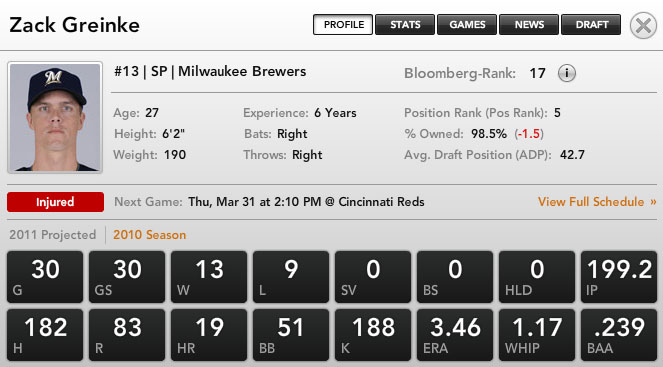 Then again, even just three starts is a tenth of a pitcher’s season. Should he miss five starts – the likely situation if he misses the first month – he’ll miss a full sixth of his season. Take away a sixth of his Bloomberg Sports projection, and you get 166 innings with 11 wins and 157 strikeouts. Sure, he is still projected for a 3.46 ERA and 1.17 WHIP, but the whole package is just a little less valuable because of the lower innings projection. A rosier projection – that he misses three starts – moves him from about the fifth-best at his position to about the 10th-best. Take another two starts away, and he’ll slide down somewhere between 15th and 20th on the list.
But there might be reason to drop him a little further even.
The rib cage is a tricky place for an injury in baseball. A pitcher’s motion is tantamount to his success, and pain in the ribs will keep him from completing his motion as he’d like. Phil Hughes fractured a rib and missed 136 days. We saw what happened to Jacoby Ellsbury last year. We aren’t doctors here, but we also know that we’ve seen players recently miss extended time with the same injury. That means there’s a risk that he puts in fewer than 166 innings, and a risk he he won’t even be a top-25 pitcher this year.
We know that Greinke will drop in drafts now. We know that he deserves to drop some, and that there’s risk that he should drop even further than he will. The tricky part is knowing when exactly to pick him up. Use conservative projections for his output this season, though, and you’ll probably find the right time. At least it wasn’t an elbow!
For the best fantasy baseball analysis and insight please visit BloombergSports.com
Milwaukee Brewers Upgrade Bullpen, Sign Takashi Saito
By Tommy Rancel
The 2010 nightmare of Trevor Hoffman was not enough to scare off the Milwaukee Brewers from signing another 40-year-old reliever this off-season – this time Takashi Saito. In terms of performance, Saito is a much safer signing, since the righty has a more recent track record of success than Hoffman did, having been one of the best relief pitchers since coming to the United States in 2006.
After spending three seasons with the Los Angeles Dodgers (much of it as a closer) Saito has spent the past two seasons as a set-up man in Boston and then Atlanta. Regardless of his role, he has been dominant over those five seasons. In fact, he is just one of six relievers in baseball to throw at least 250 innings with an ERA below 2.25 since 2006. You may recognize the other names on that list: Joakim Soria, Mariano Rivera, Joe Nathan, and the two men he has set up for recently: Jonathan Papelbon and Billy Wagner.Of those names, only Saito and Wagner have done so with a strikeout rate of 11.0 or greater per nine innings.
Saito features a fastball, slider, and a curveball. He induces more swings and misses than league average with all three pitches, fueling his fantastic strikeout rate. He has also excelled at limiting walks and home runs allowed.
The one negative on Takashi Saito is health. Although he has pitched at least 45 games and topped 47 innings in each of his five seasons, he has dealt with a variety of ailments, including several arm issues. As he advances in age, those concerns will not go away; however, he did throw a respectable 99.2 innings over the past two years.
Saito won’t have the closer job to start, which severely limits his fantasy value in standard mixed leagues, even with his strong ratios. That said, if something should happen to incumbent closer John Axford, be it injury or ineffectiveness, Saito is the most likely replacement for saves.
Because of his fantastic peripheral stats, low ERA, and status as the Brewers’ plan B, Saito is still worth either a reserve-round pick in standard 12-team mixed leagues, and a slightly higher draft slot in deeper mixed and NL-only leagues. If your league counts holds, Saito’s value rises considerably.
Royals Trade Zack Greinke To Brewers
By Tommy Rancel //
Following weeks of speculation, requests, and an agent change, Zack Greinke finally got his wish. The Kansas City Royals traded their ace to the Milwaukee Brewers for a package of players including: outfielder Lorenzo Cain, shortstop Alcides Escobar, and pitchers Jake Odorizzi and Jeremy Jeffress. The Brewers will also receive shortstop Yuniesky Betancourt and $2 million in cash.
Going by both traditional and advanced metrics, Greinke took a step back from his Cy Young season of 2009. He went just 10-14 with a 4.17 ERA after going 16-8 with a 2.16 ERA the year before. Meanwhile, FIP (fielding independent pitching) and xFIP (expected fielding independent pitching) – two metrics that strip away luck and defense from a pitcher’s performance – suggest that Greinke was closer to a run worse in 2010 and not the full two runs that his ERA showed.
While Greinke pulled back from 2009, he regressed toward his career level, which is still that of a really good pitcher. His strikeout-to-walk ratio (K/BB) of 3.29 was nearly identical to his career 3.33 K/BB. His home run rate was also within striking distance of his career number.
Discounting bad luck from the equation, his batting average on balls in play (BABIP) of .314 was basically identical to his .315 career average. That said, his strand rate or LOB% (percentage of base runners left on base) was just 65.3%. That’s about 7% lower than the league average and his career rate. Strand rate often depends on factors such as relief pitchers’ support; the sharp drop in Greinke’s rate suggest bad luck more than a big drop in skill.
A large part of Greinke’s 2009 success was fueled by strikeouts. His K/9 (strikeouts per nine innings) topped 9.0 for the first time in ’09. That number dipped to 7.40 in 2010, but again was in line with his career 7.56 K/9. Not surprisingly, his percentage of swinging strikes also dropped, from 9.9% to 7.5%.
Another change for Greinke was groundballs. A historically neutral pitcher, his groundball rate was an even 46%. According to Baseball Info Solutions, he threw more change-ups and fewer breaking balls than usual, which could explain the shift in batted ball data.
Unlike last season, Greinke will not be saddled with the expectations of repeating 2009’s performance next season. Instead, look for double-digit wins, 200+ innings, and an ERA of 3.75 or lower (possibly much lower). Like the recently acquired Shaun Marcum, moving from the American League to the National League should also help. Some will shy away from his 2010 numbers, but you shouldn’t make that mistake. Treat Greinke as a true SP1 option, even in mixed leagues.
For Kansas City, Alcides Escobar will become the team’s everyday shortstop, while Lorenzo Cain should roam center field on most days. Escobar’s slash line of .235/.288/.326 ranked among the worst by any full-time hitter. A lower than expected BABIP (.264, vs. league average of about .300) does suggest some bad mojo involved. The Brewers did not let Escobar run much (14 attempts, 10 steals), but he showed a lot of speed with 10 triples. If the Royals let him roam free, he could post 25-30 extra-base hits, with matching steals. His weak batting eye could harm his batting average and also runs scored, though.
On the flip side, Cain’s positive slash line of .306/.348/.415 was largely influenced by his .370 BABIP. That number will likely regress in 2011. Like Escobar, though, Cain should be another decent speed option, especially in AL-only formats.
Brewers, Blue Jays Swap Shaun Marcum for Brett Lawrie
By Tommy Rancel //
Tucked behind the announcement of Jayson Werth‘s monster contract with the Washington Nationals, the Milwaukee Brewers acquired starting pitcher Shaun Marcum from the Toronto Blue Jays in exchange for top prospect infielder Brett Lawrie.
Marcum returned in 2010 after missing the entire 2009 major league season due to Tommy John surgery. Once a death sentence for pitchers, Marcum is the latest in a long line of post-Tommy John success stories. He made 31 starts for the Jays, tossing 195.1 innings – both career highs. He never had much of a fastball to begin with, but his velocity returned to the high 80s.
Had Marcum been able to make 30 starts and toss 200 innings with mediocre results, it would’ve still been considered a successful comeback. Meanwhile, he not only returned healthy, but very effective. After posting a 3.39 ERA in 25 starts back in 2008, he went 13-8 with a 3.64 ERA in 2010. The 13 victories also qualify as a career high.
Without the natural ability to blow hitters away with a blazing fastball, Marcum has relied on one of the best change-ups in the game to get hitters out. While throwing the pitch more than 25% of the time in 2010, he was able to get a swing and a miss a jaw-dropping 28.1% of the time.
Because of the pitch’s effectiveness, Marcum has been able to have great success against left-handed batters, defying the usual platoon disadvantage. Last season, LHB hit just .190/.233/.299 against him. So pronounced was Marcum’s reverse split that Tampa Bay Rays manager Joe Maddon employed a reverse-platoon lineup against him that featured mostly right-handed batters.
In addition to the unhittable change-up, Marcum exhibited above-average control. His strikeout rate near 7.5 strikeouts per nine (K/9) was slightly above the league average (7.13) while his walk rate of 1.98 was well below (3.28).In fact Marcum posted the 6th-best strikeout-to-walk ratio in the league, topping even the likes of Cy Young winner Felix Hernandez – while pitching in a tougher ballpark, in a tougher division.
Marcum, 29 as of opening day, should be on your list of #2 starters headed in 2010 – he’s that good. The recovery from surgery looked complete last year. Also, consider that the shift to the National League – more specifically the NL Central – should benefit Marcum going forward.
On the Toronto side, it is unknown who replaces Marcum in the rotation; in Brett Lawrie, they did receive Milwaukee’s top prospect. Last season as a 20-year-old in Double-A, Lawrie hit .285/.346/.449. He hasn’t shown much home run power, yet still smacked 59 extra-base hits last year.
Thus far, Lawrie has played second base exclusively in the minor leagues. That said, there are some who say he is destined for the corner outfield in the future. There is also some speculation that Toronto may have acquired the native Canadian in order to flip him in a package for another piece. In any event, there is little chance that he has a significant fantasy impact in 2011 – outside of a potential September call-up.
MLB Season in Review: Milwaukee Brewers Hitters
By R.J. Anderson //
Biggest Surprise: Jim Edmonds
When the 40-year-old joined the Brewers’ camp in spring, few people
expected him to make the team. Even fewer expected him to play well,
yer that’s he did. Sure, .276/.342/.504 pales in comparison to his
career numbers (which are Hall of Fame-worthy, even if few people are
talking about him in that light). At age 40, after a year away from the
game, that’s an impressive feat. That he enjoyed the postseason ride
with the Cincinnati Reds is a nice touch as well.
Biggest Bust(s): Alcides Escobar and Carlos Gomez
Gomez’s best baseball-related skill remains his speed. That’s why it
has to be disappointing for the Brewers that he cannot get on base at
all, leaving his ability to cause havoc on the basepaths untapped.
Meanwhile, Escobar struggled in his first full season in the bigs.
These two are still young enough to turn it around in time to
contribute to a winning Brewers team, but for 2010 you have to label
both disappointments.
2011 Keeper Alert: Lorenzo Cain
And the reason Gomez might never get another starting chance in
Milwaukee is Cain. The 24-year-old only got a little over 150 plate
appearances, but he hit .306/.348/.415 while showing solid defensive
chops. He’s probably the Brew Crew’s Opening Day center fielder in
2011.
2011 Regression Alert: Corey Hart
1) Hart’s BABIP was well above his career average (.324 instead of
.310) and 2) his home runs per flyball ratio was too (16.7% instead of
12.4%). Maybe Hart is just maturing as he heads into his statistical
prime seasons, but more likely, he’s not quite as good as he showed in
2010. A drop to 20-25 home runs is a more reasonable projection than a
repeat of 30.
MLB Season in Review: Milwaukee Brewers Pitchers
By R.J. Anderson //
Biggest Surprise and 2011 Keeper Alert: John Axford
Axford will begin the 2011 season as the Brewers’ closer. That’s the only thing in the 27-year-old’s career that seems like a given, as he’s had one heck of a ride to this point. A former Yankee farmhand with a handlebar mustache, Axford had seven Major League appearances before appearing in 50 games last season and saving 24 games with a 2.48 ERA. A devastating strikeout rate (11.79 K/9 innings) points to a closer with staying power, even if his walk rate (4.19 BB/9 IP) is a bit worrisome and his flukishly low home run rate’s likely to edge higher next year.
Biggest Bust: Trevor Hoffman
Hoffman managed to break the 600 career saves mark in 2010, which represents a high point in his season. Otherwise, 50 appearances and 31 earned runs suggests the man who made “Hells Bells” a ballpark anthem is near the end of his career.
2011 Regression Alert: Randy Wolf
Give Wolf some credit, as he was able to squeak out one more inning in 2010 than he did in 2009, despite making 34 starts both years. Unfortunately, for Wolf and the Brewers, his ERA shot up nearly a full run, and his peripherals suggest he just didn’t pitch as well as that 4.17 figure might suggest. The National League Central is not a good division and Wolf’s history suggests he should bounce back in 2011. The problem being, of course, folks will overvalue his 2010 performance based on the ERA, innings, and wins. Let someone else overbid.

