Tagged: Chicago White Sox
Ballpark Figures: Top Five Fantasy Baseball Players Over the Past Two Weeks
Twitter: @RobShawSports and @BloombergSports
Bloomberg Sports Anchor Rob Shaw breaks down the five baseball players who have been making a huge fantasy impact over the past two weeks.
5) Alex Rios, OF, White Sox
Rios struggled with the White Sox in 2011, batting just .227. However, he has bounced back this season with a .316 AVG, 18 HR and 67 RBI. In the past two weeks alone, he hit .353 with 14 runs, five home runs, 15 RBI and one stolen base. He is a five-tool talent and his hot streak could continue, especially considering that he plays at hitter-friendly U.S. Cellular Field. Be aware, however, that Rios is known for his inconsistency.
4) Adam LaRoche, 1B, Nationals
Like Rios, LaRoche has struggled with inconsistency. Last year was a disaster for him, as he only played in 43 games and had just a .172 average. He is known for getting hot in the second half of the season and he is living up to that right now. In the past two weeks, LaRoche has a .429 average, 10 runs, seven home runs and 14 RBI.
3) Carlos Gomez, OF, Brewers
Gomez is a solid outfielder defensively but is not known for his offense. He hasn’t been able to play every day in the past but he’s been given a chance in Milwaukee and is putting up huge numbers. Over the last two weeks, Gomez is batting .348 with 14 runs, four home runs, 10 RBI and six stolen bases. At 26 years old, he could get a chance to play full time next season.
2) Drew Stubbs, OF, Reds
Stubbs is known to be unpredictable at the plate. He steals a lot of bases and has some power but he kills your batting average. His currently has a .239 season average, but in the last two weeks, he has a .362 average with 17 runs, four homers, 11 RBI and five steals. Stubbs is a streaky hitter, so ride out this hot streak while you can.
1) Albert Pujols, 1B, Angels
Pujols had a slow start to the season but he’s been on fire recently, and it couldn’t come at a better time for the Angels. Over the past two weeks, he has a .365 average, 11 runs, seven home runs, 19 RBI and two stolen bases.
For more fantasy insight, visit BloombergSports.com.
Fantasy Baseball Hot Topics: Greinke, Liriano, Shields, Johnson, Broxton, and League
Twitter: @RobShawSports and @BloombergSports
Bloomberg Sports Anchor Rob Shaw discusses the top stories about pitchers at the trade deadline.
Zack Greinke is an Angel
There were many teams vying for Zack Greinke this week. The former Brewers ace was considered the best available arm, assuming some of the other elites won’t get moved. The Angels made the most sense since they can re-sign him and had the prospects to force the Brewers’ hand. The Angels did give away a young shortstop and two top pitching prospects, but in Greinke, they now have the deepest starting rotation with Jered Weaver backed up by Greinke, Dan Haren, C.J. Wilson and Ervin Santana.
In his debut, Greinke went seven strong while fanning eight and allowing just two runs to score. The Angels offense, however, did not show up with just four hits and no runs in a 2-0 loss to the Rays.
The big question is what this trade does for Greinke’s fantasy value. The answer is nothing at all. He already pitched for a decent offense with the Brewers and had the advantage of opposing fellow pitchers in the National League. Now he faces a designated hitter, has to deal with the big AL offenses such as the Rangers and has to adjust to a new team and a new city mid-season. Yes, the added adrenaline of a playoff run is exciting for him, but I think he was pumped up plenty on every fifth day in Milwaukee.
Francisco Liriano Joins the White Sox
The White Sox have been eager to keep up with the Tigers and the rest of the American League this season, and since they lack the prospects needed to get someone like Zack Greinke, they will have to roll the dice on Francisco Liriano.
The 28-year-old southpaw is as talented as anyone but he has had control issues that have plagued him the last few seasons. It’s interesting that he joined the White Sox, since he actually helped them in his final Twins start, surrendering seven hits and seven runs with three home runs on July 23 at Chicago.
This is an interesting trade for the entire White Sox starting rotation since they will now go to a six-man staff. This alleviates concerns for the innings for Chris Sale but could have a negative impact on the veterans. As for Liriano, the added run support will certainly be a positive though US Cellular is very much a hitter’s park. His career ERA at US Cellular is 5.77 in 48.1 innings.
Still On the Trading Block
Rays SP James Shields will come at a very heavy price since the Rays still control him for a few years at a reasonable rate. He is 8-7 with a 4.52 ERA and 1.46 WHIP.
Marlins starter Josh Johnson is injury prone and inconsistent, and his velocity is down. However, the Marlins will only trade him if they can get a major talent back in return. Johnson is 6-7 with a 4.04 ERA and 1.35 WHIP this season.
The Royals would be happy to trade reliever Jonathan Broxton while his value is soaring. The Rangers seem interested, but he will no longer close if dealt. The Royals would likely turn to Greg Holland or Tim Collins. Broxton will lose his fantasy value since he will turn into a middle reliever with a contender.
The Mariners would love to get some value back from former closer Brandon League. He got hit hard on Sunday but had been pitching well. With Tom Wilhelmsen dominating as the team’s closer, however, League is clearly expendable. It is unlikely that he will close for whichever team acquires him unless it’s a surprise team like the Mets.
For more fantasy insight, visit BloombergSports.com.
Ballpark Figures All-Star Interviews: Ian Kinsler, Miguel Cabrera, and Mark Trumbo
Twitter: @RobShawSports and @BloombergSports
Bloomberg Sports Anchor Rob Shaw discusses the best teams in baseball right now and checks in with some of their top players at the All-Star Game.
Coming into the season it seemed like everyone was high on the Angels and Tigers, two of the more active teams in the off-season. It turns out that the Yankees are the best in baseball and the Nationals are not far behind.
The All-Star break provided a chance to check in with some of the top players from contending teams, and one player we got to chat with was Ian Kinsler, the 42nd-best fantasy player accoring to Bloomberg Sports with 65 runs, 10 home runs and 15 steals. He was one of eight All-Stars from the Rangers, a franchise that has made it to back-to-back World Series.
“It was a good first half,” Kinsler said. “I think as a team we played well. We went through a lot more ups and downs than we wanted to but we played well and we’re in first place right now. And we have eight guys here at the All-Star Game, so we’re happy.”
Another team expected to contend for the title is the Detroit Tigers. Prince Fielder was the major off-season acquisition, but this is Miguel Cabrera’s team. Cabrera is enjoying an MVP-caliber season and right now ranks as the seventh-best fantasy player. He made it clear that the start to the second half will be big.
“We feel okay, you know. We want to feel more comfortable at the end of the season, like win the division, get into first place,” Cabrera said. “I think we’re in good position. I think we’re feeling good right now. We want to start good in the second half, start to be more aggressive and win more games.”
Finally, the Angels are putting some heat on the Tigers. Jered Weaver has pitched like an ace and Albert Pujols has turned things around. While everyone is talking about the superstar rookie Mike Trout, it’s the second-year star Mark Trumbo who ranks as the top surprise. He’s batting .305 with 26 home runs and 65 RBI.
“It’s been really special,” Trumbo said. “The first month of the season is probably forgettable. We were out there competing, just the results weren’t coming in. Sometimes that happens. But since then we’ve been rolling pretty well. People are playing to their capabilities and we’ve had a lot more wins to show for it.”
The Tigers, Angels and Rangers were supposed to be the teams competing for an AL pennant this season and so far they have. If the season ended today, all three would advance to the postseason thanks to the multiple Wild Card spots. However, there is still a lot of baseball to play and several surprise teams are still out there, including the A’s, White Sox and Indians. A big move at the trade deadline or even a key promotion could make the difference.
For more insight, visit BloombergSports.com.
A Carlos Quentin Check-Up

Is Peavy Worth a Look?
By R.J. Anderson //
Jake Peavy is one of the most difficult, yet intriguing pitchers in the field this season. A few years ago, Peavy was one of the finest pitchers in the league while benefitting from the spacious environment of San Diego’s cavernous ballpark. Injuries have since crept into Peavy’s life, leaving his status as an annual question mark. Peavy’s below league-average ERA certainly did not help his draft value and neither will the reports suggesting he is set to miss the beginning of the season. Not everything is so dire, though, as when Peavy pitched in 2010, he was actually solid.
Peavy’s first five starts were nothing short of disasterous as he allowed nearly as many earned runs (25) as innings pitched (28.2) with a strikeout-to-walk ratio barely topping 1. Over his next 12 starts, Peavy allowed 30 earned runs in 78 innings while posting a strikeout-to-walk ratio over 5. The exact reasoning for the turnaround is unknown. Perhaps Peavy adjusted to his new surroundings or finally began to feel healthy after missing most of the previous season. The important thing is whether Peavy can continue the success once he returns this season.
Most projection systems say yes, but are without knowledge of Peavy’s injury history. The exact effect of the ailments are impossible to know. Perhaps he bounces back just fine, or maybe he loses some zip on his fastball and some command. There’s no safe expectation to be had. In which case, the best approach is cautionary. Peavy could prove to be a waiver wire steal upon his return, but for now, treat his status delicately.
Chicago White Sox (Finally) Acquire Adam Dunn
By Tommy Rancel //
Following what seems like years of courting by the Chicago White Sox, as well as years of resisting becoming a designated hitter in the American League, Adam Dunn signed a four-year deal, $56 million to slug on Chicago’s South Side. Whether it was a change of heart or the $56 million being waved in front of his 31-year-old eyes, Dunn now says he’s not only willing to DH, but play whatever position the White Sox ask of him.
Dunn could be asked to use his butcher’s knife glove at first base along with his time at DH. Luckily for fantasy owners, his defense is not a factor. He’ll keep his first base eligibility for 2011 at least; his offensive game is so strong that he’s well worth a spot in mixed league lineups even if he eventually loses that eligibility.
In seasons past, Dunn has been one of the more underrated hitters in the game. This is largely because his batting average has been mediocre (or worse), despite the many home runs launched from his bat. Dunn also walks a lot and strikeouts a ton. The walks are underrated in many circles and the strikeouts are seen as a huge negative to some. Still, the total package is a valuable one, in fantasy and even more so in real life.
The Big Donkey has hit at least 38 home runs in each of the last seven seasons. He is the only major leaguer who can say that. Over those seven seasons, he’s averaged 40 bombs a season with 101 runs driven in. Even though he is as slow as his nickname would suggest, his fantastic on-base skills (.381 career OBP), frequent homers and underrated durability (he’s missed 10 games or less in each of the past seven seasons) have helped him average 94 runs scored a year since 2004.
Also working in Dunn’s favor this season will be a switch to one of the more hitter-friendly parks in the AL. His new home, U.S. Cellular Field, rated as the top home run ballpark in 2010. Nationals Park ranked 15th last season.
On the other hand, there are some concerns about Dunn going into next season. He will be playing in the AL for the first time and will also be DHing for the first time on a regular basis. Add in the fact that old-player skills (walks, strikeouts, home runs) do not tend to age gracefully, and there are some concerns about a Pat Burrell-like slide.
Still, we must give Dunn the benefit of the doubt. His durability and colossal power – in conjunction with a move to “the Cell” – put him among the game’s top projected sluggers in 2011. His position in the field and lineup are to be determined; however his status as a top fantasy option remains intact as a member of the Chicago White Sox.
MLB Season in Review: Chicago White Sox Pitchers
By Tommy Rancel //
Biggest Surprise: Edwin Jackson
Ever the tease with his talents, Edwin Jackson looked like a top pitcher in his time with the White Sox. In 11 starts on the south side, E-Jax went 4-2 with a 3.24 ERA. Even more impressive, he struck out 77 batters and walked just 18 in 75 innings. Without many fluky stats, and under Don Cooper’s instruction, maybe, just maybe, Jackson is finally living up to the hype.
Biggest Bust: Bobby Jenks
Since saving a career-best 41 games in 2006, Jenks has seen his saves and innings totals drop in each subsequent season. This year he saved just 27 games and tossed 53.1 innings. He dealt with injuries and landed in Ozzie Guillen’s doghouse throughout the season on his way to a career-worst 4.44 ERA.
2011 Keeper Alert: Chris Sale
When the 2010 season started Sale was a starting pitcher for Florida Gulf Coast College. He ended it as a relief pitcher in the Chicago White Sox bullpen. Chicago’s first-round pick in this June’s draft made just 11 minor league appearances before his call-up. The tall, lanky lefty was impressive in 21 appearances – going 2-1 with a 1.93 ERA and four saves. With a mid-90s heater, he struck out 32 batters in just 23 innings. His role for 2011 has yet to be determined (the White Sox drafted him as a starter), but he has a chance to thrive in either role.
2011 Regression Alert: Bobby Jenks
Despite mediocre traditional stats, Jenks had a good season in several peripheral categories. He struck out 10.4 batters per nine innings while walking just 3.1. With favorable control rates, he allowed just three home runs in over 50 innings. Jenks was extremely unlucky on batting average on balls in play: His .368 BABIP was well above the league average of .302 as well as his career number of .306. His future in Chicago is uncertain, but Jenks is a prime bounceback candidate in 2011, assuming he hasn’t lost the faith of his manager.
For more on Chris Sale and the Chicago White Sox pitching staff, check out Bloomberg Sports’ Fantasy Kits.
MLB Season in Review: Chicago White Sox Hitters
By Tommy Rancel //
Biggest Surprise: Alex Rios
Following last season’s mid-summer waiver claim by the White Sox, Rios hit just .199/.229/.301 for his new club for the rest of 2009. However, the 29-year-old rebounded to post numbers above his career average across the board in 2010. His .284/.334/.457 slash line slightly bests his career .281/.331/.446. More importantly from a fantasy perspective, he regained his great power/speed combo, smashing 21 home runs while stealing 34 bases. He also crossed the plate 89 times and added 88 RBI. With 2009 looking like the outlier, expect numbers close to career averages again in 2011.
Biggest Bust: Gordon Beckham
Beckham impressed in his first 400 major league plate appearances by hitting .270/.347/.460 as a rookie second baseman. In nearly 500 PA this year, he hit just .252/.317/.378. His home runs dropped from 14 to nine and his RBI from 63 down to 49 – despite playing in 28 more games. There’s nothing that screams fluke in either season, which leaves Beckham’s owners scratching their heads moving forward. If he’s valued as a .250 hitter with light power at the draft table next year, though, he’s well worth grabbing at that price.
2011 Keeper Alert: Dayan Viciedo
A Cuban defector, Viciedo showed some of the power the White Sox hoped to see when they signed him. After hitting 20 home runs in 86 games at the Triple-A level, the 21-year-old was promoted to the big leagues. There, he it .308/.321/.519 with five home runs in just 106 PA. His average is fueled by a rather unsustainable BABIP (batting average on balls in play) and his plate discipline leaves much to be desired (two walks and 25 strikeouts). But with plus power at the hot corner, the Chicago third baseman of the future is one to keep.
2011 Regression Alert: Paul Konerko
Konerko has been one of the most underrated hitters of the past few seasons, but pardon me for being a little wary of a 34-year-old posting a career-best .977 OPS. While playing in one of baseball’s home run havens, nearly 20% of Konerko’s flyballs hit went over the wall. In addition to a favorable home run rate, his BABIP .326 was well above his career .285 level. A free agent this off-season, Konerko’s next destination is unknown. But it is very unlikely his OPS approaches 1.000 again next year. Don’t overbid.
For more on Alex Rios and the Chicago White Sox lineup, check Bloomberg Sports’ Fantasy Kits.
Manny Being Manny In New Places
by Eno Sarris //
Judging by his inglorious exit from from a Los Angeles Dodgers team that sits five and a half games out of the wild card (before four other teams), one might be forgiven for comparing Manny Ramirez to chopped liver. The prevailing attitude vis-a-vis the mercurial slugger is that he’s injured too often and that at 38 years old, his offensive skills are just not what they used to be.
The prevailing view is wrong on this one. Ramirez has sported an OPS over .900 the past two years in Los Angeles, showing relatively little deterioration in his skills as a batter. There’s also reason to believe that he may be able to stay healthier in his new digs.
First, he’s still a great hitter. Ramirez’s walk rate, strikeout rate, and BABIP have held steady his whole career at above-average levels, making him an excellent bet for a strong OBP and batting average. Even in this ‘down’ period of his career, he should still put up a batting average near .300 and an OBP near .400 – benchmarks he’s hit more often than not in his illustrious career. These two facts alone make him an above-average real-life batter and a decent fantasy baseball option in many leagues.
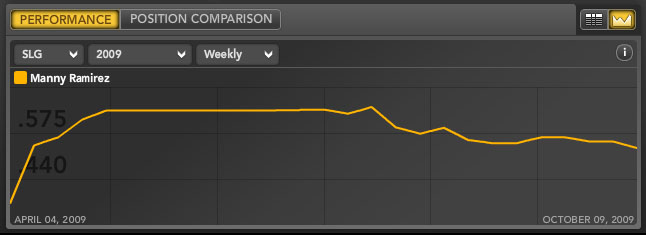 Power is the real question mark, admittedly. After putting up isolated slugging numbers (slugging percentage minus batting average, ISO is a statistic that focuses on extra-base hits) near .300 for most of his career, Ramirez dipped to .241 last year and has a .199 ISO this year. His positive test for performance-enhancing drugs in 2009 has been blamed for this power outage, but Ramirez still had an ISO of .204 after he returned, which would put him on par with players like Brian McCann (.197 ISO), Aramis Ramirez (.201 ISO) and Rickie Weeks (.203 ISO) this year.
If a .200 ISO does not seem exciting enough, there are reasons to think he can do better in Chicago. According to StatCorner.com, the park factor for home runs for right-handed hitters in Los Angeles was 92. Compare that to U.S. Cellular, home of the White Sox, which has a 134 park factor for home runs for right-handed hitters. That is a serious swing in fortunes. In 213 earlier-career at-bats at the Cell, he’s had a .338/.448/.601 line that suggests he feels comfortable there.
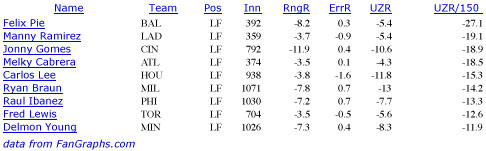 The last piece of optimism arises when we consider defense. Not normally important when considering fantasy baseball, Ramirez has been so poor defensively that it had begun to cost him playing time. Since defensive statistics have been kept at FanGraphs.com, he has ranked in the very bottom of the outfield defensive rankings. Only one player with as many as 350 innings in left field this year has performed worse than Ramirez, for example. With the benefit of the DH – his new full-time position – he won’t have to stumble around the outfield anymore and should get his full share of at-bats. Maybe he’ll even stay healthier without the added stress on his legs and back.
Ramirez probably should have signed with an AL team before the 2009 season, but the Dodgers thought he had enough in the tank to help, even in the outfield. Now that it’s Manny time again in the AL and Ramirez is a DH, he should have enough left to help your fantasy team down the stretch.
For more on Manny Ramirez and other DHs, check out Bloomberg Sports’ Fantasy Tools.
Is it Time to Trust Gavin Floyd?
By Tommy Rancel //
Despite his obscurity on a national level, Gavin Floyd has been one of the more polarizing figures in fantasy baseball over the past couple seasons. Few have teased and burned owners like Floyd has. This season has been more of the same. Still, it’s time to give Floyd another chance.
As in seasons past, Floyd has toyed with owners’ emotions in 2010. He started out awful, but has since rebounded nicely. Jason Collette of fanball.com notes that Floyd’s 1.27 ERA over the past 30 days rivals that of another Bloomberg Sports’ favorite, Josh Johnson (1.22).
So what has changed since those lousy first few weeks? Mostly luck.
In early May, Eriq Gardner noted at Bloomberg Sports that Floyd was one of baseball’s “unlucky” pitchers due to a below-average left on-base percentage (LOB%), also known as strand rate. On average, pitchers strand 72% of men who reach base. For his career, Floyd has stranded 69% of baserunners.
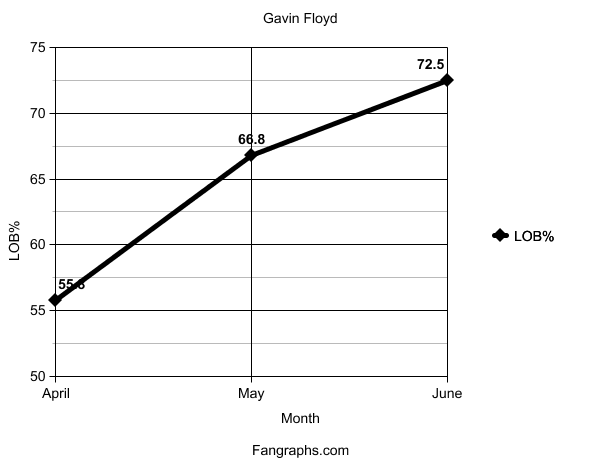 In the early stages of the season, Floyd’s LOB% was around 56%. Because of that, his numbers – most notably ERA – suffered. However, as the season has progressed, Floyd’s strand rate started to regress toward league average, an occurrence which has positively affected his stats, especially ERA.
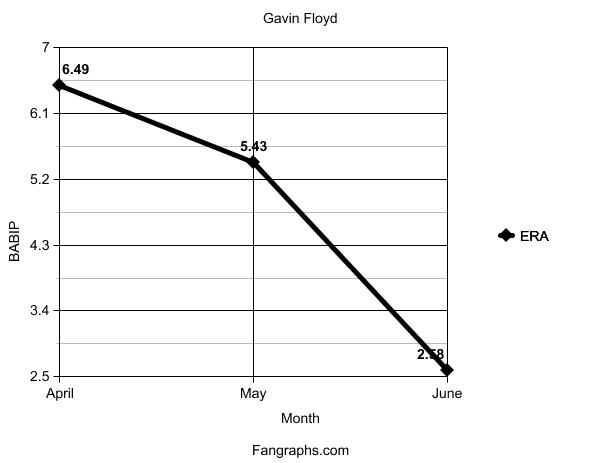 In conjunction with his LOB% regression, Floyd has seen a regression in terms of batting average on balls in play (BABIP). The league average BABIP is .302. In April, Floyd’s BABIP was .369. To date, his BABIP has dropped down to .322 — but it’s still well above his career mark of .295.
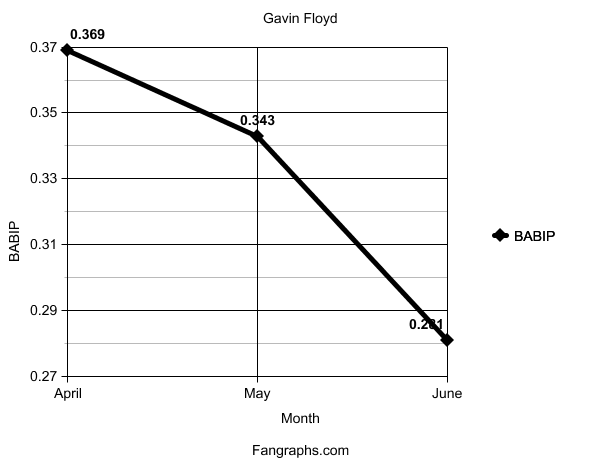 Looking at events he can control, such as home runs, walks and strikeouts, Floyd is enjoying the best season of his career. His strikeout per nine innings rate (K/9) of 7.47 tops his career K/9 rate of 6.84. He’s walking fewer batters per nine innings (BB/9) in 2010 (2.78) than in previous years (3.22). The righty has also cut his home runs per nine innings rate dramatically, from a 1.25/9 IP career mark to 0.61/9 IP in 2010.
Looking at home run-to-flyball ratio, home runs might be the only category in which Floyd sees a shift toward the negative (an unusually low 7.3% HR/FB rate this season, vs. 12.4% for his career).
While Floyd has been a poster child for regression, his raw statistics still show an average pitcher. He is just 4-7 on the year with an ERA of 4.43. There is a chance that his LOB% and BABIP – which are still higher than usual – could regress even further. Couple that with his other peripheral stats that remain above-average in a positive way, and now is the time to strike on Floyd. He is available on waivers in nearly 10% of fantasy leagues. But even if he’s owned in your league, he’s worth a trade request.
For more on Gavin Floyd and other regression ready candidates, check out Bloomberg Sports’ fantasy kits.

