Tagged: Detroit Tigers
Bloomberg Sports Fantasy Baseball 2012 Recap: Shortstops
Twitter: @RobShawSports and @BloombergSports
Bloomberg Sports Anchor Rob Shaw and Analyst Alex Burwasser recap the top five shortstops this fantasy season as well as the top three busts.
TOP FIVE PERFORMERS
5. Starlin Castro, SS, Cubs
After a fantastic sophomore campaign in the big leagues which saw him lead the league in hits (207) and make the All-Star team, Starlin Castro put together another solid year for the Cubs. He did not hit .300 this year but he hit a very respectable .283 while stealing a career-high 25 bases. A good sign going forward for him is his consistency against left and right-handed pitching, hitting over .280 against both this year. However, an area where Castro needs work is his plate discipline, where for the third straight year he drew less than 40 walks (36).
4. Jose Reyes, SS, Marlins
It would have been really difficult for Jose Reyes to duplicate his 2011 season when he won the NL batting title. A season that turned out to be his last with the Mets when he signed as a free agent with the new-look Marlins. A lot was expected of Reyes and the Miami team as a whole moving into a brand new ballpark and it seemed both were wilting under those expectations. Unlike the team, however, Reyes redeemed himself by hitting .312 after the All-Star break and ending the season with his standard double-digit triples (12) and 40 steals. In fact, he was hitting in the three hole for the Marlins by the end of the year, so if that continues in 2013, expect even more production for Reyes.
3. Ian Desmond, SS, Nationals
One of the best stories in baseball this year was the Washington Nationals, and one of the leading characters in that story was 26 year old shortstop Ian Desmond taking the next step and becoming an All-Star player. Not only did his batting average drastically improve from last year moving from .253 to .292 but he had an enormous spike in power hitting 25 home runs this year as compared to only 8 in 2011. Added with his speed, swiping over 20 bases for the second year in a row (21), Desmond looks like he is a player on the rise for the Nationals and possibly for your fantasy leaderboards next year.
2. Derek Jeter, SS, Yankees
Derek Jeter has been around the top of this list for basically the past fifteen years, so why would 2012 be any different? He had 216 hits this season, which was his most since 1999, as well as 47 extra base hits which was his most since 2007. He also hit over .300 (.316) for amazingly the twelfth time in his sure-to-be Hall of Fame career. The only question with Jeter is how long he can possibly keep this up, especially given his unfortunate ankle injury in the ALCS against Detroit, but it would be hard to start counting him out now.
1. Jimmy Rollins, SS, Phillies
Jimmy Rollins, much like Derek Jeter, has been at the top of this list for over a decade now, but Rollins went mostly under-the-radar this season because his team was such a huge disappointment. Obviously, Rollins was not the reason why, blasting his most home runs since his MVP season of 2007 (23) as well as knocking in a solid 68 RBI. A very underrated part of Rollins game has always been his speed, and that was certainly on display this year when he stole 30 bases for the second year in a row and added over a hundred runs scored (102). Rollins is only 33 years old, so there could be a few more years of these type of numbers coming from a premium fantasy position like shortstop.
TOP THREE BUSTS
3. Jhonny Peralta, SS, Tigers
A first time All-Star in 2011, Jhonny Peralta had his best season as a pro for Detroit hitting just under .300 (.299) while providing some serious power with 21 home runs and driving in 86 runs as his Tigers won the AL Central. Detroit again won the AL Central again in 2012 but Peralta was not nearly as big a factor seeing his batting average dip 60 points to .239 as well as his home runs (13) and RBI (63). Peralta needs to hit for power and drive in runs to provide any fantasy value whatsoever because he does not steal bases or hit for a high average.
2. Yunel Escobar, SS, Jays
In a somewhat surprising move given his potential, the Braves traded Yunel Escobar to the Jays after a disappointing start to the 2010 season. It was looking like a steal of a trade for Toronto after a 2011 season that saw him hit .290 with 11 home runs and 77 runs scored. However, he really declined this past season when his average dropped 37 points to .253, but what was most alarming were his walks almost being cut in half from 61 to 35 which left his on-base percentage at a measly .300. For a player expected to be at the top of the lineup for years to come, getting on base three out of ten times will just not cut it for the Jays and for your fantasy team.
1. Dee Gordon, SS, Dodgers
Every year fantasy owners seem to fall into the trap of falling in love with a player who comes up from the minors and excels at a particular statistical category whether it is home runs or strikeouts. In Dee Gordon’s case, it was stolen bases. After being called up in June 2011, he burst onto the scene by hitting .304 and stealing 24 bases in 56 games for the Dodgers. In 2012, he was the opening day starter at shortstop for the Dodgers but he never really got off the ground getting sent to the minors in early July after hitting only .228. He still has a ton of speed — he stole 32 bases — but he cannot provide any value if he cannot get on base in the future.
For more fantasy insight, visit BloombergSports.com.
Bloomberg Sports Fantasy Baseball 2012 Recap: First Basemen
Twitter: @RobShawSports and @BloombergSports
Bloomberg Sports Anchor Rob Shaw and Analyst Alex Burwasser recap the top five first basemen this fantasy season as well as the top three busts.
TOP FIVE PERFORMERS
5. Albert Pujols, 1B, Angels
In an offseason move that shocked many, Albert Pujols decided to leave St. Louis, his home for a decade where he won two championships, for the bright lights of Los Angeles in Anaheim. To the delight of jilted Cardinals fans, Pujols got off to a rough start for the Angels, even hearing some cat calls in his home park, but he more than made up for it over his final 105 games where he hit .319 with 26 home runs and 86 RBI. You can make a case that he may not be as dominant a hitter as he once was but he still put up his typical 30-HR, 100-RBI season, which always has fantasy value.
4. Billy Butler, 1B, Royals
Billy Butler has always been a very productive hitter throughout his career for the Royals but has consistently flown under the radar because he plays in relative obscurity in Kansas City. However, this year he was the subject of a national controversy when Robinson Cano decided not to pick him for the Home Run Derby in front of his home fans at Kauffman Stadium. Butler took the high road and did the talking with his bat the rest of the year when he finished with 29 home runs and 106 RBI, both career highs, all while hitting above .300 at .313.
3. Prince Fielder, 1B, Tigers
Much like Albert Pujols, Prince Fielder moved from the top of the NL Central to the opposite league in the offseason. Fielder signed a massive nine-year contract which left many worrying about the long-term injury risk of signing a man of his size, but his performance in the first year of that deal quieted all the critics when he blasted 30 home runs and knocked in 108 RBI leading the Tigers to their second consecutive AL Central crown. Though Prince has had more powerful years, he hit over .300 for the first time in his career, checking in at a very impressive .313 on the season.
2. Edwin Encarnacion, 1B/3B, Jays
Encarnacion had been a solid player for Toronto since acquiring him from the Reds in 2009, putting up seasons of 20 home runs and a little more than 50 RBI on average in 2010 and 2011. This season, however, he completely obliterated those numbers with 42 home runs and 110 RBI, more in each category than the previous two years combined. In addition, Encarnacion also improved in other categories, setting career highs in stolen bases (13) and walks (84). What makes this rapid improvement all the more impressive is that he did it without Jose Bautista in the lineup who missed about half the year injured. Next year could be very intriguing for the Jays with those two bats healthy and producing in the middle of that lineup.
1. Miguel Cabrera, 1B/3B, Tigers
There really is not much else you can say about the year Miguel Cabrera had for the American League champion Tigers. He was the first Triple Crown winner since 1967 (led the AL in batting average, home runs and RBI) and he did it before the age of 30! In fact, Miguel Cabrera leads all active major leaguers under the age of 30 in hits (1802), home runs (321), and RBI (1123). We are not sure Cabrera is on his way to his second championship ring this year, but it sure looks like he will be on his way to Cooperstown one day.
TOP THREE BUSTS
3. Mark Teixiera, 1B, Yankees
Every year in his career besides his rookie campaign in 2003, Mark Teixiera has had at least 30 home runs and 100 RBI, but not in 2012 when he hit only 24 home runs and knocked in only 84 RBI. Even more alarming for Teixiera is that he has seen his normally stellar batting average drop season after season. A perennial .280, and some years .300, hitter has not reached those numbers since 2009 when he hit .292. The last three seasons he has not hit above .256 including this year when he hit .251 and had a dreadful on-base percentage of .332. For the Yankees, he provides a lot of value with his defense at first base, but for fantasy owners, his value seems to be slipping fast.
2. Gaby Sanchez, 1B, Pirates
At the beginning of the year, many picked the Marlins and their revamped team with the acquisitions of Jose Reyes and Heath Bell among others to possibly win the NL East. Gaby Sanchez was one of the players set to contribute in the middle of that lineup, but much like the entire team, he was a gigantic disappointment. After the first 55 games of the season while hitting just above the Mendoza line at .202, Sanchez was sent down to the minors and subsequently traded to Pittsburgh. Though he fared better for the Pirates than for the Marlins, he still finished the year with a .217 average and only seven home runs, a huge dropoff from back-to-back 19 home run seasons in 2010 and 2011.
1. Eric Hosmer, 1B, Royals
During Spring Training, there was a lot of buzz around the Royals that they may be the team on the rise given their farm system and dearth of young talent. One of the centerpieces of this renewed hope was Eric Hosmer, and after his rookie campaign in 2011, it was easy to believe given that he hit .293 with 19 HR and 78 RBI in only 128 games. Much like his team, Hosmer severely underperformed his expectations this year hitting .232 in his first full season in the majors with less home runs (14) and less RBI (60). You would hope that this is just your classic sophomore slump for the third overall pick in the 2008 draft and 2013 is a year he can replicate or even outperform his 2011 numbers.
For more fantasy insight, visit BloombergSports.com.
Bloomberg Sports Ballpark Figures: World Series Preview
Twitter: @RobShawSports and @BloombergSports
Bloomberg Sports Anchors Rob Shaw and Julie Alexandria preview this year’s edition of the Fall Classic between the Detroit Tigers and San Francisco Giants.
TOP OFFENSIVE PLAYERS
Buster Posey, C, Giants
The clear frontrunner for the NL MVP this season has gotten off to a slow start in the playoffs hitting only .178 so far in 12 games. That being said, Posey did have perhaps the biggest hit of the year for the Giants when he took Mat Latos deep for a Grand Slam in the winner-take-all Game 5 in Cincinnati. San Francisco will be looking for more of that clutch hitting against Detroit in this series.
Miguel Cabrera, 3B, Tigers
For Miguel Cabrera, earning the first Triple Crown since 1967, and most likely an AL MVP award, was just not enough. He has now led his team to the Fall Classic as well. After hitting 44 home runs in the regular season, he has only hit one in nine games so far in the postseason, but that could change rather quickly given his prodigious power. Cabrera is back in the World Series for the first time since his rookie season in 2003 with the Marlins, and he is trying to add to his tremendous individual year with the highest team honor, a World Series ring.
OFFENSIVE SLEEPERS
Marco Scutaro, 2B, Giants
Scutaro has to be at the top of the list of best midseason acquisitions this year when he came from Colorado to San Francisco in late July. He was hitting .272 while he was with the Rockies, but he started out hot with the Giants and never cooled down, hitting .362 over the final 61 games of the season. It seems he is even hotter now heading into the World Series after a NLCS that saw him hit .500 (14 for 28) over the seven-game series against St. Louis, earning him MVP honors.
Delmon Young, DH, Tigers
It sure seems like Delmon Young enjoys playing in October. In the last two postseasons for Detroit, a total of 18 games, Young has seven home runs, which is a franchise record. Coming up as a prospect in the Tampa Bay system, Young was considered a five-tool player, but that notion is long gone since he has been the Tigers DH all season. However, it does appear that Young will need to channel his minor league days when he plays left field for the Tigers when they are in an NL ballpark in at least Games 1 and 2.
PITCHING STAFFS
By only allowing two runs in their four starts, the only adjective that you could use to describe the starting pitchers for the Tigers against the Yankees in the ALCS was dominant. It will obviously be tough to keep that up against a hot hitting team in the Giants, but you would not put it past the rotation of Justin Verlander, Doug Fister, Anibal Sanchez and Max Scherzer, who all had great numbers all season. The Giants will most likely try to get to the Tigers bullpen where they have struggled, most notably their closer Jose Valverde, who was replaced by Phil Coke after a blown save in Game 1 of the ALCS.
The starting pitching for the Giants was supposed to be their strength heading into the postseason, but it has been the offense and bullpen that has carried them through to this point. Madison Bumgarner, a 16-game winner this year, really struggled in his two postseason starts and has since been sent to the bullpen. On the other side of the coin, Barry Zito, has been a pleasant surprise for the Giants, last seen pitching 7 2/3 shutout innings with Giants facing elimination in Game 5 of the NLCS against the Cardinals. That being said, the goal for the Giants is clear. They want to get the game to their dominant bullpen for a chance to lock down four more wins.
For more fantasy insight, visit BloombergSports.com
Fantasy Baseball Top Headlines: Ichiro Suzuki, Colby Lewis, Anibal Sanchez, and Ryan Dempster
Twitter: @RobShawSports and @BloombergSports
Bloomberg Sports Anchor Rob Shaw breaks down four of the major stories in baseball right now that could impact your fantasy team.
Ichiro Suzuki Traded to the Yankees for Two Minor Leaguers
The Yankees added another legend to the fold in the form of right-fielder Ichiro Suzuki. The future Hall of Famer is in the midst of his second disappointing season, as his average dipped from .272 a year ago to .261 entering last night. He also isn’t drawing many walks, which explains the .288 on-base percentage.
The Yankees are hoping a move out of Safeco will do some good for Ichiro, who is hitting .297 on the road this season. Ichiro has also been great in his career at Yankee Stadium, with a .333 batting average and a.492 slugging percentage. The move is an absolute boon for fantasy managers.
Colby Lewis Out for the Season
The Rangers are in first place this season, which has as much to say about their pitching as their hitting. One of their top hurlers is Colby Lewis, who owns nearly a 7-to-1 strikeout-to-walk ratio. However, that ratio will not change as Lewis has been placed on the DL with an elbow injury and is lost for the season.
The loss of Lewis is a big blow, as he has been a star in the postseason with a 4-1 record and 2.34 ERA. The only good news is that Rangers fans will get a chance to see their top prospect Martin Perez again, but really, this is an injury that could force the Rangers hand to make a big deal.
Anibal Sanchez Going to Detroit
And just like that the Marlins are sellers again. Anibal Sanchez is just 28 years old, ranks among the top strikeout leaders and has really improved his control over the years. Regardless, the Marlins are not in the mood to pay him big this offseason, even though it did not stop them from acquiring Heath Bell last season.
A move to the American League is typically bad news for pitchers, but with the Tigers, Sanchez will have a lot of run support and play for a contender. Also dealt was Omar Infante, who offers some pop and speed from second base. Jacob Turner was moved to Miami but he is very much unproven, similar to a pitcher by the name of Andrew Miller, who never quite lived up to his hype despite being acquired for Miguel Cabrera from the Tigers several years ago.
Ryan Dempster Rumors
With a 2.11 ERA, Ryan Dempster is considered by many to be the best hired arm on the trading block. However, Dempster seems to enjoy Chicago and as a 10-5 player, he has the option of rejecting any trade. The Braves, meanwhile, see an opportunity to win an NL Wild Card spot and hope to acquire the veteran hurler. In the deal, Randall Delgado, who has mixed results, would be sent to Chicago. If Dempster does move to Atlanta, he is bound to do better than his current 5-4 record, while Delgado will see his value decrease even more.
For more fantasy insight, visit BloombergSports.com.
Ballpark Figures All-Star Interviews: Ian Kinsler, Miguel Cabrera, and Mark Trumbo
Twitter: @RobShawSports and @BloombergSports
Bloomberg Sports Anchor Rob Shaw discusses the best teams in baseball right now and checks in with some of their top players at the All-Star Game.
Coming into the season it seemed like everyone was high on the Angels and Tigers, two of the more active teams in the off-season. It turns out that the Yankees are the best in baseball and the Nationals are not far behind.
The All-Star break provided a chance to check in with some of the top players from contending teams, and one player we got to chat with was Ian Kinsler, the 42nd-best fantasy player accoring to Bloomberg Sports with 65 runs, 10 home runs and 15 steals. He was one of eight All-Stars from the Rangers, a franchise that has made it to back-to-back World Series.
“It was a good first half,” Kinsler said. “I think as a team we played well. We went through a lot more ups and downs than we wanted to but we played well and we’re in first place right now. And we have eight guys here at the All-Star Game, so we’re happy.”
Another team expected to contend for the title is the Detroit Tigers. Prince Fielder was the major off-season acquisition, but this is Miguel Cabrera’s team. Cabrera is enjoying an MVP-caliber season and right now ranks as the seventh-best fantasy player. He made it clear that the start to the second half will be big.
“We feel okay, you know. We want to feel more comfortable at the end of the season, like win the division, get into first place,” Cabrera said. “I think we’re in good position. I think we’re feeling good right now. We want to start good in the second half, start to be more aggressive and win more games.”
Finally, the Angels are putting some heat on the Tigers. Jered Weaver has pitched like an ace and Albert Pujols has turned things around. While everyone is talking about the superstar rookie Mike Trout, it’s the second-year star Mark Trumbo who ranks as the top surprise. He’s batting .305 with 26 home runs and 65 RBI.
“It’s been really special,” Trumbo said. “The first month of the season is probably forgettable. We were out there competing, just the results weren’t coming in. Sometimes that happens. But since then we’ve been rolling pretty well. People are playing to their capabilities and we’ve had a lot more wins to show for it.”
The Tigers, Angels and Rangers were supposed to be the teams competing for an AL pennant this season and so far they have. If the season ended today, all three would advance to the postseason thanks to the multiple Wild Card spots. However, there is still a lot of baseball to play and several surprise teams are still out there, including the A’s, White Sox and Indians. A big move at the trade deadline or even a key promotion could make the difference.
For more insight, visit BloombergSports.com.
Detroit Tigers Sign Victor Martinez To 4-yr, $50 Million Deal
By Tommy Rancel //
The Detroit Tigers continue to be the most aggressive team during the early stages of the off-season hot stove. Earlier today, they signed C/1B/DH Victor Martinez to a four-year deal worth a reported $50 million dollars. In addition to the money, the Tigers also surrendered their first-round pick to the Boston Red Sox because of Martinez’s Type-A status.
Martinez will be 32 by opening day 2011; however, he is one of the best hitting catchers in baseball. A career .300/.369/.469 hitter, he hit .302/.351/.493 in his first full season with the Red Sox. His patience at the plate dropped slightly, but that coincided with an increase in power numbers.
While it is unlikely he is still an everyday catcher at the end of this contract, one would assume the Tigers’ plan is to have the bulk of his playing time from behind the plate in 2011. They have the AL MVP runner-up in Miguel Cabrera at first base and paying Martinez to DH doesn’t make sense – at least at this point in his career. Sure, he’ll spell Cabrera at times and take a few hacks at DH, but he should be prepared to catch 100+ times in 2011.
This is good news for fantasy owners as Martinez will remain a top player at the position. Along with Joe Mauer and NL Rookie of the Year Buster Posey, Martinez provides a blend of average and power that is a rarity for the position.
There is some concern about him leaving the cozy dimensions of Fenway Park for the spacious Comerica Park; however, it shouldn’t be a huge factor. It is true Fenway is a haven for doubles hitters. In fact, 23 of Martinez’s 32 doubles in 2010 came at home, but the vast outfield in Detroit should lead to its fair share of extra bases as well. According to ESPN’s park factors, Detroit’s park was actually more home run friendly than Boston’s; another good sign for Martinez, who split his 20 home runs equally on the home and road.
The concerns of moving positions shouldn’t be a factor this season. And the change in ballparks isn’t as extreme as one might think. Because of his ability to hit for an average around .300 with upwards of 50 extra-base hits a season as a catcher, Martinez should once again be a primary target of fantasy owners in 2011.
For more on Victor Martinez and the catcher position, check out Bloomberg Sports’ Front Office.
MLB Season in Review: Detroit Tigers Pitchers
By Jonah Keri //
Biggest Surprise: Joel Zumaya
The injury-prone, fireballing right-hander was a wreck in 2009,
walking more than six batters per nine innings and posting an ERA near
5.00. Further removed from his latest breakdown, Zumaya rebounded
impressively this season, slashing his walk rate to 2.58/9 IP and
posting a strikeout-to-walk rate of better than 3:1. His 2.58 ERA was a
boon for fantasy players who wield relief pitchers to help with ratios.
Zumaya suffered a fractured elbow in late June though, costing him the
rest of the season and leaving his owners with only 38.1 innings of
fantasy goodness. Applaud the great comeback, but steer clear of Zumaya
at the draft table next season.
Biggest Bust: Rick Porcello
A 10-12 record and a 4.92 ERA for one of the most highly-touted young
pitchers in the game qualifies as a huge bust. But really, everyone
should have seen it coming. Porcello’s 14-9 record and 3.96 ERA came
despite an abysmal K rate of just 4.69/9 IP. It’s nearly impossible to
see sustained success when you strike out so few batters. Indeed,
Porcello’s 2010 K rate is virtually identical to his 2009 mark. It’s
just that he ran out of luck, his left on base rate plunging and his
batting average on balls in play climbing 30 points. Porcello’s not yet
22, and he actually sliced his walk rate all the way down to 2.1/9 IP
this season. He’s still got upside, just keep your expectations in check
until he starts missing more bats.
2011 Keeper Alert: Max Scherzer
After eight starts this season, Scherzer’s record stood at 1-4 with a
7.29 ERA, making the multi-team trade the Tigers pulled off last
off-season look like a potential bust. Though he’d been unlucky on balls
in play, Scherzer’s strikeout rate was also down sharply from his
stellar 2009 levels, raising concerns of an injury, or at least wonky
mechanics. Sent to Triple-A for two weeks, he straightened himself out,
then proceeded to destroy the American League. His 12-11 record and 3.50
ERA helped plenty of fantasy teams this season. But Scherzer’s
strikeout-inducting stuff (8.46 K/9 IP) could portend much bigger things
down the road, even Cy Young contention.
2011 Regression Alert: Armando Galarraga
People will remember Galarraga’s 2010 Perfect Game That Wasn’t for a
long time. Just don’t let it sway you into speculating on him in
fantasy. Galarraga’s K rate was even worse than Porcello’s this season,
and his walk rate is more than one per nine innings higher than
Porcello’s. The 4.62 ERA looks respectable and the near-perfecto might
tempt you to take a flyer next year. Don’t. His true talent points to a
pitcher whose true ability level suggests ERAs well over 5 in his
future.
For more on Max Scherzer and the Detroit Tigers pitching staff, check out Bloomberg Sports’ Fantasy Kits.
MLB Season in Review: Detroit Tigers Hitters
By Jonah Keri //
Biggest Surprise: Austin Jackson
One could easily make a case for Jackson as a regression candidate,
as his sky-high .399 batting average on balls in play is unsustainable
over the long haul, and suggests a possible pullback from his .295
average this year. But Jackson’s 103 runs scored and 26 steals to go
with the high average gave fantasy owners a big lift, and at just 23
years old, he could see gains in power and speed to help offset that
batting average regression, both next year and beyond.
Biggest Bust: Johnny Damon
We knew Damon’s numbers would pull back significantly from 2009
levels, going from possibly the friendliest park in baseball for his
slashing, left-handed swing to the vast expanses of Comerica Park, and
from the Yankees’ killer lineup to the Tigers’ collection of Miguel
Cabrera and a band of no-names. But the plunge was far more dramatic
than expected: 24 homers, 82 RBI and 107 runs scored in ’09, 8 homers,
50 RBI and 81 runs scored this year. Damon isn’t much of a basestealing
threat anymore either, swiping just 11 bags in 2010. Avoid him at next
year’s draft table.
2011 Keeper Alert: Ryan Raburn
First the negatives: Raburn’s .333 batting average on balls in play
might regress next year, making him a risk for a somewhat lower batting
average. He’s got a sizable platoon split on his track record and could
be vulnerable to tough right-handed pitching if given 600 plate
appearances. And he only qualifies at OF heading into next season. On
the other hand, Raburn should play meet the typical 5- or 10-game
in-season minimums needed to qualify at second base next year, and he’s
swatted 31 homers over about 700 plate appearances in the last two
seasons with the Tigers. Stash him as a cheap keeper at OF or UT, then
slide him to 2B when he qualifies there next year and you’ll have cheap
power at a position that doesn’t have a lot of it.
2011 Regression Alert: None
Miguel Cabrera was the only Tigers hitter to put up big
numbers this season, and he’s in his prime at age 27 and improving by
the year — meaning it’s tough to find a Tigers hitter due for a big
pullback. By the same token, few Tigers performed so poorly relative to
expectations that you’d expect a big positive regression either. You
could be generous and argue that Scott Sizemore is better than
the .224/.296/.336 line he mustered this season. But the man Detroit
originally ticketed for the starting second base job in 2010 sports a
track record of mediocre power and high strikeout rates in the minor
leagues; he may well be unable to hit enough to hold down an everyday
job, let alone help you in even a deeper mixed league.
For more on Austin Jackson and the Detroit Tigers lineup, check out Bloomberg Sports’ Fantasy kits.
Ordonez Goes Down, Raburn Comes Up?
by Eno Sarris //
When a player goes down, the first instinct is often to go to the wire and pluck the best year-to-date performer you can off waivers. Sometimes, though, the best move is to look at the real-life team and target the real-life replacement.
When Magglio Ordonez went down this weekend with a fractured right ankle, many fantasy teams (and the real-life Tigers) lost a resurgent run producer. Though he no longer has the gaudy power of yore, Ordonez has used his high (BABIP-neutral) batting average (.303) to plate his teammates (59), while still socking a respectable 12 home runs. Take a look at how Bloomberg Sports Fantasy Tools values Ordonez’s overall skill set.
 Replacing him in the Tiger outfield is a player who couldn’t be any more different, but still has the upside to provide some run production in Magglio’s stead. Ryan Raburn strikes out too much (25.8%) to put up the same superlative batting average, but his .208 AVG should rise if his .262 batting average on balls in play regulates toward his career mark of .314. Raburn still has some potential to make this comparison from the Bloomberg Sports Fantasy Tools look a little better over the next couple of weeks.
 In fact, Raburn’s upside is probably defined by his 2009 final slash line (.291/.359/.533), though his BABIP (.323) might have been a little high for a slugger-type with little speed (5/9 in stolen base attempts last year). Look at his minor league numbers, and you see that while he was usually at the average age or older in each league, he did consistently show solid power (.223 career minor league ISO, or slugging percentage minus batting average).
This year? He’s been reaching at 28% of pitches outside of the zone (26% career, 28.9% average across baseball), and walking a little less (5.6% walk rate this year, 7.3% career, 10.4% in the minors). He hasn’t been showing the same power as is his norm, but he’s only 162 plate appearances into this year, and his 831 career PAs with above-average power (.179 ISO, the average is around .150-.155 in any given year) are just more important to valuing him as a player.
Those looking for an Ordonez replacement in deeper leagues should consider Raburn. This might just be his chance to rediscover the abilities he showed just last year, which includes more power upside than the veteran he is replacing. In mixed leagues, though, there are probably surer things out there.
Is Armando Galarraga the Perfect Addition for Your Fantasy Team?
By R.J. Anderson //
With apologies to Ken Griffey Jr., Armando Galarraga is the hot story in the baseball world thanks to Wednesday’s near-perfect game. Whether the call on Jason Donald’s infield single was blown or not is irrelevant for fantasy purposes. The real question is whether Galarraga deserves a spot on your team. Short answer: probably not.
Galarraga broke onto the scene for the Tigers in 2008, making 30 starts. He would win 13 games and post a 3.73 ERA. Most pundits applauded the Tigers and bemoaned the Rangers – Galarraga’s previous employer – for grabbing yet another worthwhile arm. A season later Galarraga fell apart: He still managed to make 29 starts, but won only six games and held a 5.64 ERA. This led some to wonder what exactly went wrong; those who saw Galarraga’s 4.88 FIP in 2008 knew better – he was never all that good in the first place.
That’s not to say Galarraga wasn’t worse than expected last year – his FIP jumped more than a half run up to 5.47 in 2009 – but Galarraga’s skill set fails to inspire confidence in his ability to be an above-average pitcher. He’s a right-handed starter with a fastball that sits at just 90 miles per hour and he’s only a slight groundball pitcher. Generally pitchers with that profile need good command and control to make it in the majors, and Galarraga had never shown that ability in the majors. His career walk rate per nine innings is still over 3.5, giving him a mediocre 1.71 strikeout-to-walk ratio.
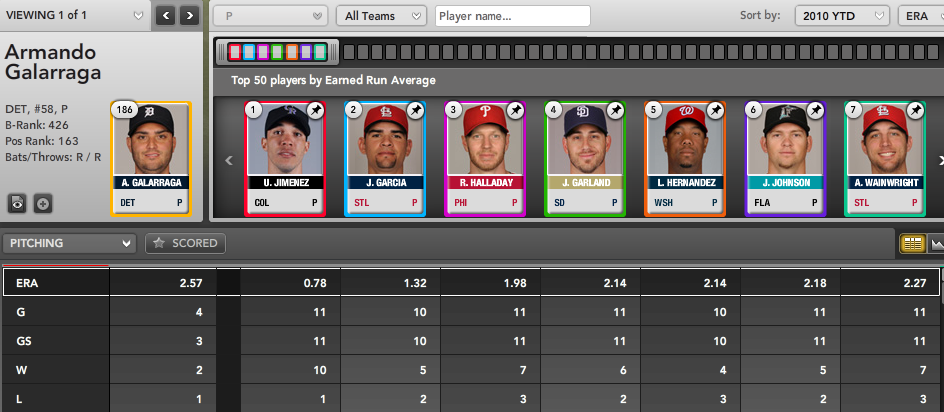
Getting back to the question at hand, Galarraga has made three starts this season, and has a 2.57 ERA and 3.86 FIP to show for it. He’s turning the corner, right? Don’t be so sure. One near-perfect game goes a long way, especially when it comes in the pitcher’s fourth appearance of the season.
Galarraga just wasn’t all that good in his previous starts this season. Against Boston he went just over five innings and allowed only one run. He made up for that good outing by allowing five earned runs against the Dodgers a week later. All told, he struck out eight batters, walked four, and allowed two homers in 10.1 innings. That’s a 5.34 FIP and 5.24 ERA, more along the lines of what we’d expect from him.
Galarraga’s classiness is worth applauding, given his reaction to umpire Jim Joyce’s blown call. He had a very special night on Wednesday, but unless something has changed for good, he’s just not rosterable in most mixed leagues.
For more on Armando Galarraga and other pitchers who do something amazing, check out Bloomberg Sports’ Fantasy Tools.

