Tagged: Chicago Cubs
Bloomberg Sports Fantasy Baseball 2012 Recap: Shortstops
Twitter: @RobShawSports and @BloombergSports
Bloomberg Sports Anchor Rob Shaw and Analyst Alex Burwasser recap the top five shortstops this fantasy season as well as the top three busts.
TOP FIVE PERFORMERS
5. Starlin Castro, SS, Cubs
After a fantastic sophomore campaign in the big leagues which saw him lead the league in hits (207) and make the All-Star team, Starlin Castro put together another solid year for the Cubs. He did not hit .300 this year but he hit a very respectable .283 while stealing a career-high 25 bases. A good sign going forward for him is his consistency against left and right-handed pitching, hitting over .280 against both this year. However, an area where Castro needs work is his plate discipline, where for the third straight year he drew less than 40 walks (36).
4. Jose Reyes, SS, Marlins
It would have been really difficult for Jose Reyes to duplicate his 2011 season when he won the NL batting title. A season that turned out to be his last with the Mets when he signed as a free agent with the new-look Marlins. A lot was expected of Reyes and the Miami team as a whole moving into a brand new ballpark and it seemed both were wilting under those expectations. Unlike the team, however, Reyes redeemed himself by hitting .312 after the All-Star break and ending the season with his standard double-digit triples (12) and 40 steals. In fact, he was hitting in the three hole for the Marlins by the end of the year, so if that continues in 2013, expect even more production for Reyes.
3. Ian Desmond, SS, Nationals
One of the best stories in baseball this year was the Washington Nationals, and one of the leading characters in that story was 26 year old shortstop Ian Desmond taking the next step and becoming an All-Star player. Not only did his batting average drastically improve from last year moving from .253 to .292 but he had an enormous spike in power hitting 25 home runs this year as compared to only 8 in 2011. Added with his speed, swiping over 20 bases for the second year in a row (21), Desmond looks like he is a player on the rise for the Nationals and possibly for your fantasy leaderboards next year.
2. Derek Jeter, SS, Yankees
Derek Jeter has been around the top of this list for basically the past fifteen years, so why would 2012 be any different? He had 216 hits this season, which was his most since 1999, as well as 47 extra base hits which was his most since 2007. He also hit over .300 (.316) for amazingly the twelfth time in his sure-to-be Hall of Fame career. The only question with Jeter is how long he can possibly keep this up, especially given his unfortunate ankle injury in the ALCS against Detroit, but it would be hard to start counting him out now.
1. Jimmy Rollins, SS, Phillies
Jimmy Rollins, much like Derek Jeter, has been at the top of this list for over a decade now, but Rollins went mostly under-the-radar this season because his team was such a huge disappointment. Obviously, Rollins was not the reason why, blasting his most home runs since his MVP season of 2007 (23) as well as knocking in a solid 68 RBI. A very underrated part of Rollins game has always been his speed, and that was certainly on display this year when he stole 30 bases for the second year in a row and added over a hundred runs scored (102). Rollins is only 33 years old, so there could be a few more years of these type of numbers coming from a premium fantasy position like shortstop.
TOP THREE BUSTS
3. Jhonny Peralta, SS, Tigers
A first time All-Star in 2011, Jhonny Peralta had his best season as a pro for Detroit hitting just under .300 (.299) while providing some serious power with 21 home runs and driving in 86 runs as his Tigers won the AL Central. Detroit again won the AL Central again in 2012 but Peralta was not nearly as big a factor seeing his batting average dip 60 points to .239 as well as his home runs (13) and RBI (63). Peralta needs to hit for power and drive in runs to provide any fantasy value whatsoever because he does not steal bases or hit for a high average.
2. Yunel Escobar, SS, Jays
In a somewhat surprising move given his potential, the Braves traded Yunel Escobar to the Jays after a disappointing start to the 2010 season. It was looking like a steal of a trade for Toronto after a 2011 season that saw him hit .290 with 11 home runs and 77 runs scored. However, he really declined this past season when his average dropped 37 points to .253, but what was most alarming were his walks almost being cut in half from 61 to 35 which left his on-base percentage at a measly .300. For a player expected to be at the top of the lineup for years to come, getting on base three out of ten times will just not cut it for the Jays and for your fantasy team.
1. Dee Gordon, SS, Dodgers
Every year fantasy owners seem to fall into the trap of falling in love with a player who comes up from the minors and excels at a particular statistical category whether it is home runs or strikeouts. In Dee Gordon’s case, it was stolen bases. After being called up in June 2011, he burst onto the scene by hitting .304 and stealing 24 bases in 56 games for the Dodgers. In 2012, he was the opening day starter at shortstop for the Dodgers but he never really got off the ground getting sent to the minors in early July after hitting only .228. He still has a ton of speed — he stole 32 bases — but he cannot provide any value if he cannot get on base in the future.
For more fantasy insight, visit BloombergSports.com.
Fantasy Baseball Waiver Wire Report: Michael McKenry, Grant Balfour, Josh Vitters, and Erik Kratz
Twitter: @RobShawSports and @BloombergSports
Bloomberg Sports Anchor Rob Shaw breaks down four players who fantasy managers may want to pick up off the waiver wire this week.
Michael McKenry, C, Pirates
The Pirates are trying to stay in contention for the playoffs and they have gotten some help on offense from an unlikely source in McKenry. In 47 games, he’s batting .285 with 11 home runs and 28 RBI. He has eight homers in his last 21 games alone. If you need a catcher and McKenry is available, he is a good pickup, though it’s unlikely that he will sustain these numbers.
Grant Balfour, RP, Athletics
The A’s have had some issues in the bullpen as rookie Ryan Cook has struggled recently. This opens the door for Balfour, who last gave up a run on June 29. He is 2-2 with seven saves, a 2.60 ERA and a 1.02 WHIP. The coaching staff has acknowledged that it has to consider moves within the bullpen as the team is in contention, and Balfour is a likely option for the closer role.
Josh Vitters, 3B, Cubs
Vitters was the third pick of the 2007 draft, selected ahead of Matt Wieters, Madison Bumgarner and Jason Heyward. The top prospect made his debut for the Cubs on Sunday. In 110 games at Triple-A, he had a .304 average, 17 home runs and 68 RBI.
Erik Kratz, C, Phillies
Kratz played seven years at Triple-A and had a .288 average with 15 homers last season. He’s making the most of his opportunity with the Phillies, batting .379 with four home runs and four doubles in 15 games. Kratz should do well as a backup while Carlos Ruiz is on the disabled list.
For more fantasy insight, visit BloombergSports.com.
Ballpark Figures Trade Deadline Breakdown
Twitter: @RobShawSports and @BloombergSports
Bloomberg Sports Anchors Julie Alexandria and Rob Shaw break down some of the major storylines in baseball as the trade deadline approaches.
Trade Analysis: Hanley Ramirez to the Dodgers
The Dodgers made a splash by acquiring former Marlins sensation Hanley Ramirez for Nathan Eovaldi and a willingness to take on Ramirez’s salary. First of all, this is the way it should be for Los Angeles. The Dodgers are supposed to be the West Coast Yankees, so it’s good to see them open the check book to bring in some star potential.
The move also makes baseball sense. The team already has two of the best hitters and pitchers in baseball, so it’s not a bad idea to go for the gold now. Eovaldi is too young to be depended on, while, even at his worst, HanRam is scoring runs and offering some pop and speed. On a side note, of all stadiums where Ramirez has played at least 65 games, his .388 average at Dodgers Stadium is easily the highest.
On the Market: Alfonso Soriano
With 19 home runs and 58 RBI, Alfonso Soriano is once again a solid slugger at the big-league level. He is also due to make $18 million in each of the next two seasons. His high performance provides the Cubbies with a window to trade him. Ken Rosenthal reported that at least one team has interest in the veteran outfielder.
Sellers: Philadelphia Phillies
The Phillies are in a very interesting situation right now. They have some very bad contracts, though their huge investment in Cole Hamels is not one of them. He is still young at 28 years old and was developed within the Phillies system. The team is out of contention this season and must rebuild in the next few years. The only way players such as Shane Victorino could be dealt is if the Phillies get back prospects who will be ready to start next year.
Sellers: New York Mets
After a great first half, the Mets have won just one game since the All-Star break and could try to make a move. Johan Santana’s injury hurts them, as he is due so much money andcould have been traded. The Mets would have been happy to deal him in return for prospects.
With Santana injured, if there is a Mets player to be traded, it’s infielder Daniel Murphy. Jordany Valdespin has been incredible this season and offers more versatility and better defense than Murphy. However, the Mets will only make a trade if they get something back which they are really able to use, such as a power arm for the bullpen.
Sellers: Milwaukee Brewers
The Brewers have been buyers recently, bringing in players such as Zack Greinke and Aramis Ramirez, but it has not worked out. The best case scenario for them is that Greinke decides to stay in Milwaukee, which may not be very realistic. The Brewers were also shopping reliever Francisco Rodriguez and tried to increase his value. K-Rod, however, imploded with blown saves in consecutive appearances against the Phillies, likely costing the Brewers some prospects.
For more insight, visit BloombergSports.com.
Fantasy Baseball Top Headlines: Ichiro Suzuki, Colby Lewis, Anibal Sanchez, and Ryan Dempster
Twitter: @RobShawSports and @BloombergSports
Bloomberg Sports Anchor Rob Shaw breaks down four of the major stories in baseball right now that could impact your fantasy team.
Ichiro Suzuki Traded to the Yankees for Two Minor Leaguers
The Yankees added another legend to the fold in the form of right-fielder Ichiro Suzuki. The future Hall of Famer is in the midst of his second disappointing season, as his average dipped from .272 a year ago to .261 entering last night. He also isn’t drawing many walks, which explains the .288 on-base percentage.
The Yankees are hoping a move out of Safeco will do some good for Ichiro, who is hitting .297 on the road this season. Ichiro has also been great in his career at Yankee Stadium, with a .333 batting average and a.492 slugging percentage. The move is an absolute boon for fantasy managers.
Colby Lewis Out for the Season
The Rangers are in first place this season, which has as much to say about their pitching as their hitting. One of their top hurlers is Colby Lewis, who owns nearly a 7-to-1 strikeout-to-walk ratio. However, that ratio will not change as Lewis has been placed on the DL with an elbow injury and is lost for the season.
The loss of Lewis is a big blow, as he has been a star in the postseason with a 4-1 record and 2.34 ERA. The only good news is that Rangers fans will get a chance to see their top prospect Martin Perez again, but really, this is an injury that could force the Rangers hand to make a big deal.
Anibal Sanchez Going to Detroit
And just like that the Marlins are sellers again. Anibal Sanchez is just 28 years old, ranks among the top strikeout leaders and has really improved his control over the years. Regardless, the Marlins are not in the mood to pay him big this offseason, even though it did not stop them from acquiring Heath Bell last season.
A move to the American League is typically bad news for pitchers, but with the Tigers, Sanchez will have a lot of run support and play for a contender. Also dealt was Omar Infante, who offers some pop and speed from second base. Jacob Turner was moved to Miami but he is very much unproven, similar to a pitcher by the name of Andrew Miller, who never quite lived up to his hype despite being acquired for Miguel Cabrera from the Tigers several years ago.
Ryan Dempster Rumors
With a 2.11 ERA, Ryan Dempster is considered by many to be the best hired arm on the trading block. However, Dempster seems to enjoy Chicago and as a 10-5 player, he has the option of rejecting any trade. The Braves, meanwhile, see an opportunity to win an NL Wild Card spot and hope to acquire the veteran hurler. In the deal, Randall Delgado, who has mixed results, would be sent to Chicago. If Dempster does move to Atlanta, he is bound to do better than his current 5-4 record, while Delgado will see his value decrease even more.
For more fantasy insight, visit BloombergSports.com.
Fantasy Baseball Twitter Trends: Arroyo, Rizzo, Ruiz, and Chapman
Twitter: @RobShawSports and @BloombergSports
Bloomberg Sports Anchor Rob Shaw discusses the performances of four players who were trending on Twitter Tuesday night.
Bronson Arroyo, SP, Reds
Arroyo brought a no-hitter into the eighth inning against the Brewers Tuesday night, but left with a no decision. He gave up three hits, one walk and three earned runs in 7.2 innings pitched. He is now 3-5 with a 4.13 ERA and 1.25 WHIP this season. The biggest surprise from Arroyo this season is his strikeouts. He has 60 strikeouts this year compared to just 14 walks.
Anthony Rizzo, 1B, Cubs
Rizzo made his debut with the Cubs Tuesday night against the Mets. He went 2-4 with one RBI and one double. In 70 games at AAA in Iowa this year, he had a .342 batting average, 23 home runs and 62 RBI. Rizzo was brought up to play first base, which moves Bryan LaHair to the outfield.
Carlos Ruiz, C, Phillies
Ruiz is having an incredible season. He went 3-4 Tuesday night with one home run, two runs and two RBI. He now has a career-high 10 home runs this season, as well as a .361 average and 41 RBI. Overall, Ruiz is providing much-needed offensive production to the Phillies lineup.
Aroldis Chapman, RP, Reds
Chapman bounced back from back-to-back blown saves Tuesday night. He had three strikeouts and one walk in one inning pitched to pick up his ninth save of the season. His numbers this year are still outstanding, especially his 64/12 K/BB ratio.
For more fantasy baseball insight, visit BloombergSports.com.
Matt Garza’s Potential Impact with the Cubs
By Jonah Keri //
Continuing their dramatic off-season makeover, the Tampa Bay Rays were
on the verge of trading Matt Garza to the Chicago Cubs as the linchpin
of an eight-player trade (none of the other players in the trade
project as worth rostering in 2011).
Opinions are split on
exactly what the Cubs are getting in the deal. One one hand, Garza’s
enjoyed great success in his three seasons with the Rays. He was the
key to another Rays blockbuster deal, coming over from Minnesota along
with Jason Bartlett as part of a six-player trade before the 2008
season. That year, Garza went 11-9 with a 3.70 ERA. In the postseason
he fared even better, going 2-0 with a 1.38 ERA in a thrilling LCS
against the Red Sox, capped by Garza’s dominant Game 7 performance that
lifted Tampa Bay to the first World Series in franchise history.
After an apparent pullback in 2009 (8-10, 3.95 ERA), Garza enjoyed
the best season of his career from a fantasy perspective in 2010, going
15-10 with a 3.91 ERA and 150 strikeouts over 204.2 effective innings.
Though he struggled at times with consistency, he also flashed the
brilliance that defined his 2008 LCS performance, tossing a no-hitter
against the Tigers in July – also a first in franchise history.
Some analysts hold a less rosy opinion of the big right-hander.
Garza’s xFIP (a stat that runs along a similar scale to ERA, but strips
out the impact of team defense, park factors, and other variables
beyond a pitcher’s control) has been fairly pedestrian over the past
three seasons, at 4.48, 4.21 and 4.51 (the 4.21 figure coming during
the season in which his more superficial fantasy stats looked worst).
His home run rates have climbed in each season with the Rays (0.93 HR/9
IP in 2008, 1.11 HR/9 IP in 2009, 1.23 HR/9 IP in 2010), just as his
groundball rates have been falling (41.7% GB% in 2008, 39.7% in 2009,
35.8% in 2010).
Dave Cameron of FanGraphs compared Garza to Aaron Harang, another
pitcher who’s eaten innings in the past (Garza’s topped 200 frames in
each of the past two seasons), owns a strong K/BB rate (2.17, 2.39 and
2.38 in the past three years for Garza) and also endangers his team
with high home run rates. With Adrian Gonzalez joining the AL East this
season, Garza would have faced an even scarier assortment of power
threats on a regular basis had he stayed with the Rays for 2011, making
those home run and groundball rates an even bigger concern.
On the other hand, Garza’s been called overrated so many times by
analysts wielding advanced stats that he may now be underrated.
Baseball Prospectus tracks
every pitcher in the big leagues by opponents’ OPS, seeking to assess
quality of competition. Of the top 60 opponents’ OPS by pitcher in MLB
last year, just one pitcher (Madison Bumgarner) hailed from the
National League. Three of the top four hailed from the AL East.
So even if you grant that Garza has looked like another incarnation of Harang over the past three seasons with the Rays, it’s reasonable
to project significant potential improvement if and when he’s dealt to
the weaker NL Central.
But not so fast! Even if we project improvement based on a divisional
move, let’s reconsider Garza’s increasingly extreme flyball trends.
With the Rays, Garza benefited from Gold Glover Carl Crawford playing
left field, the rangy B.J. Upton in center, and underrated defender
Matt Joyce (and before him, fellow underrated defender Gabe Gross)
chasing down flyballs and line drives hit into the gaps. The Cubs
ranked just 26th in MLB at converting balls in play into outs last year; the Rays ranked 3rd. Using Ultimate Zone Rating, the Cubs ranked 18th last year, the Rays
5th.
While advanced metrics reflect relatively kindly on projected Cubs
outfielders Alfonso Soriano and Marlon Byrd, those players rank well
below Garza’s past LF-CF tandem of Crawford and Upton. Right fielder
Tyler Colvin, meanwhile, projects as average or worse in right field.
Taking all of these factors into account, we project…fairly similar
results for Garza in 2011. He’ll post decent but not spectacular
numbers for a starting pitcher in a standard mixed league. Don’t get
too caught up with Garza’s flashes of brilliance. He’ll wield
occasional no-hit stuff. But he’s more of a #3 or even #4 fantasy
starter in standard leagues than anything approaching a #1.
The real-life take? The Cubs are still the 4th-best team in the NL Central. And the Rays are still a Wild Card contender, with Jeremy Hellickson poised to take Garza’s spot in the rotation and money now freed to sign a big bat at DH such as Jim Thome or Manny Ramirez. As I often note in The Extra 2%, my upcoming book about the Rays’ Wall Street-inspired approach, Andrew Friedman does not give a damn about public relations. To the Rays’ benefit.
UPDATE: Thanks to Twitter’s @AbPow for reminding us that Garza’s HR tendencies could be further magnified by Wrigley Field, which showed a 119 park factor for LH home runs in 2010 (100 is average, and Tropicana Field was below average).
Carlos Pena, First Base Bargain?
By Tommy Rancel //
Despite being the Tampa Bay Rays all-time home run leader, Carlos Pena was the second-most important Rays player to sign with a new team at the winter meetings. Carl Crawford got the big bucks from the Boston Red Sox, and Pena is looking to make a big comeback with the Chicago Cubs in 2011.
A crown jewel in the Andrew Friedman collection, Pena went from first-round bust to MVP candidate in the span of one season. In his first year (2007) with the (Devil) Rays, the first baseman smashed 46 home runs and drove in 121 runs – both single-season franchise records. Unsurprisingly, he was unable to top those numbers in any of the next three seasons, but still managed an impressive OPS of .884 in his time with the Rays.
Pena became the franchise all-time home run leader this past season. His 144 home runs in a Rays uniform also rank as the sixth highest total in baseball since 2007.
For all the good done – on and off the field – during his time with the Rays, Pena ended his career with the Rays on a down note. Just three years removed from his breakout campaign, Los hit just .195/.325/.409 in 2010.
Aside from the massive number of strikeouts which are typical for a three outcome hitter (home runs, walks, and strikeouts), groundball outs were also a problem for Pena this past season. His 44.9% groundball rate was his highest total in any full-season.
The last thing you want from primary home run hitter is nearly half the balls he puts in play staying on the ground. His slash line (AVG/OBP/SLG) on grounders was an abysmal .137/.137/.151. The .137 BA represents the second-lowest average on groundballs (min. 100 PA) in the majors, owing to Pena’s lack of speed, and teams shifting on him to prevent right-side grounders from scooting through the infield.
Though he may be on the downside of his career, Pena’s power is still a threat. Aside from the terrible slash line, the strikeouts, and high number of grounders, Pena still managed to hit 28 home runs last year. Also consider, he is moving from a below-average hitter’s park for left-handed batters to one of the friendlier parks for lefties. According to statcorner.com, Tropicana Field had a home run park factor of 89 for LHB (neutral is 100). Wrigley Field, on the other hand, had a park factor of 119. NL Central pitching is likely to be easier to handle than that seen in the AL East too.
After whiffing (literally) on his chance of a big payday this off-season, Pena gets another chance with this one-year, $10 million deal with the Cubs. With contract motivation, a ton of natural power, a home run friendly environment, and even reuniting with hitting guru Rudy Jaramillo, Pena could be poised for another 30-plus home run campaign.
For fantasy owners who don’t want to pay premium prices for a first baseman, Pena could be a good sleeper. At a stacked position, and coming of a down year, he could get lost in the shuffle in some leagues. While Adrian Gonzalez, Albert Pujols, and Joey Votto go early, you can focus on a weaker position (say, shortstop Troy Tulowitzki) in the first few rounds and target Pena as a mid-to-late-round selection in mixed leagues.
MLB Season in Review: Chicago Cubs Pitchers
By R.J Anderson //
Biggest Surprise: Carlos Silva & Tom Gorzelanny
Silva went from one of the worst pitchers in baseball to a guy with a 10-6 record and 4.22 ERA. Meanwhile Gorzelanny went from unemployable by the Pirates to a 4.09 ERA in 23 starts. The Cubs had a disappointing season, but they managed to turn broken eggs into soufflé twice during the same season. Both pitchers have dealt with injury issues throughout the season, including Gorzelanny breaking a finger and Silva enduring elbow tendinitis in September alone.
Biggest Bust: Carlos Zambrano
Not because he pitched poorly, mind you, but because his temporary stints on the inactive list and in the bullpen wasted away his value and held him to 19 starts.
2011 Keeper Alert: Carlos Marmol
One of the most incredible seasons in baseball this or any season, Marmol’s 77.2 innings pitched come with 138 strikeouts and 40 hits allowed. For his career, Marmol has struck out twice as many batters as hits given up. That’s just unfathomable. The only aspect of his game that prevents Marmol from being perhaps the most dominant reliever in baseball (if he isn’t already) is his tendency to lose the plate: No closer walked more batters more frequently than Marmol (6.03 BB/9 IP – though that was, amazingly, nearly two full walks per game lower than his 2009 mark).
2011 Regression Alert: Carlos Silva
Silva struck out 6.37 batters per nine innings this season. His career rate is a little over four. Maybe he’s discovered the key to fanning heaven, but probably not. Be careful about overvaluing the latest season, even though pitchers like Esteban Loaiza have broken out at a similar age.
For more on the Chicago Cubs, check out Bloomberg Sports’ fantasy kits.
MLB Season In Review: Chicago Cubs Hitters
By R.J. Anderson //
Biggest Surprise: Marlon Byrd
A surprise not in the sense that Byrd continued to hit, but that he continue to hit like he had never left Texas in the first place. His ISO dropped to .136 (his previous Rangers’ low was .152) but an increase on batting average in play (.335) and a drip in strikeouts helped buoy his line to .293/.346/.429. Byrd’s home runs and RBI totals predictably dropped sharply from Arlington levels. But Byrd’s runs scored total jumped to 84, the best result in seven years.
Biggest Bust: Aramis Ramirez
Ramirez reminded Cubs fans of washed-out prospect David Kelton more than himself while battling a thumb injury throughout the season. Ramirez’s power numbers (25 homers, 83 RBI) were excellent, but missing 38 games depressed his runs scored total, and Ramirez has now missed 30 games or more in three of the past four seasons. Worse from a fantasy perspective, Ramirez hit just .241 this season, his worst result in eight years. Ramirez’s .245 BABIP certainly hurt, but so too did his highest strikeout rate since 1998.
2011 Keeper Alert: Starlin Castro
The brightest spot of the Cubs’ season, Castro shot through the minors and made his major league debut in May. The 20-year-old hit .300 with 10 stolen bases and 53 runs scored. Someone with that kind of success at that age is usually setting himself up for a grand career. He’s probably a career keeper, especially at a scarce position.
2011 Regression Alert: Tyler Colvin
Colvin had a great year (20 homers, .500 slugging percentage in 135 games) despite never hitting well in the minors. The former first-round pick has talent, but expecting him to post those kinds of numbers heading forward might be a little much. As is, Colvin learns how to reach more often (.316 on-base percentage) or he risks losing playing time if/when his power numbers regress back to earth.
Lou Piniella’s New Nasty Boy: Carlos Marmol
By Tommy Rancel //
Lou Piniella is no stranger to flame-throwing relievers at the back end of his bullpens. As manager of the 1990 World Champion Cincinnati Reds, Piniella employed a trio of relievers, Norm Charlton, Rob Dibble and Randy Myers (a.k.a. the Nasty Boys), to close out games. Twenty years later, Piniella’s current club, the Chicago Cubs, are not World Series contenders, but their closer sure is nasty.
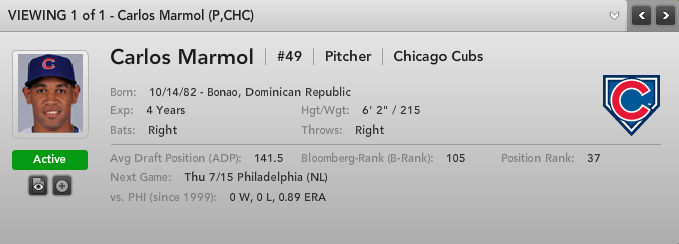
Carlos Marmol is a wild man. He has amazing stuff on the mound. While he owns a fastball that averages velocity in the mid-90s, the heater only serves as a compliment to his devastatingly successful slider. Despite the above-average offerings, he has a tendency to drive Lou (and Cubs) fans absolutely insane with his control issues. Meanwhile, he tiptoes around his shaky control just enough to be wildly successful.
If you looked at walk rate alone, you would think Marmol would be searching for employment rather than being the Cubs’ closer. In 43.1 innings of work this year, he’s handed out 33 free passes. That earns him a walks per nine inning (BB/9) rate of. 6.85! On the other hand, that’s a solid improvement over the 7.91 BB/9(!!) he posted last year – as Marmol walked 65 batters in 74 innings.
In spite of his immensely high walk rate, and a very high batting average on balls in play (.364), Marmol has maintained a sparkling 2.91 ERA, with an even better 2.26 FIP (Fielding Independent Pitching, which strips out luck, park factors and other elements beyond strikeout, walk and home run rates). Despite allowing 1.32 base runners per inning, he is stranding 79.2% of batters who reach base. All of these statistical oddities are made possible because Carlos Marmol will strike you out. In fact, he will strike you out and the guy behind you.
Marmol has struck out an unthinkable 83 batters in his 43.1 innings. Yes, he is striking out nearly two batters for every inning he pitches, 17.05 per nine innings, to be precise. If he maintains that insane pace throughout the course of the season, it would be a major league record for a reliever with a minimum of 50 innings pitched (Eric Gagne 14.98 K/9 in 2003).

The high amount of strikeouts and walks have severely limited the balls in play hit against Marmol. In fact, Marmol gets a swinging strike 15.3% of the time overall, and 19.6% on his slider. Because of this, the high number of walks, and high frequency of balls in play falling for hits, have not come back to haunt him.
Although Marmol has been successful, this path to success isn’t blueprint for others. On the plus side, there is there is an equal chance Marmol’s BABIP regresses toward career levels (.257). Regardless, Marmol’s unique processes should continue to provide above-average results – including an astronomical strikeout rates that’s going to equal more total Ks than many starting pitchers will rack up.
For more on Carlos Marmol and dominating closers, check out Bloomberg Sports’ Fantasy Kits.

