Tagged: New York Yankees
Bloomberg Sports Fantasy Baseball 2012 Recap: Shortstops
Twitter: @RobShawSports and @BloombergSports
Bloomberg Sports Anchor Rob Shaw and Analyst Alex Burwasser recap the top five shortstops this fantasy season as well as the top three busts.
TOP FIVE PERFORMERS
5. Starlin Castro, SS, Cubs
After a fantastic sophomore campaign in the big leagues which saw him lead the league in hits (207) and make the All-Star team, Starlin Castro put together another solid year for the Cubs. He did not hit .300 this year but he hit a very respectable .283 while stealing a career-high 25 bases. A good sign going forward for him is his consistency against left and right-handed pitching, hitting over .280 against both this year. However, an area where Castro needs work is his plate discipline, where for the third straight year he drew less than 40 walks (36).
4. Jose Reyes, SS, Marlins
It would have been really difficult for Jose Reyes to duplicate his 2011 season when he won the NL batting title. A season that turned out to be his last with the Mets when he signed as a free agent with the new-look Marlins. A lot was expected of Reyes and the Miami team as a whole moving into a brand new ballpark and it seemed both were wilting under those expectations. Unlike the team, however, Reyes redeemed himself by hitting .312 after the All-Star break and ending the season with his standard double-digit triples (12) and 40 steals. In fact, he was hitting in the three hole for the Marlins by the end of the year, so if that continues in 2013, expect even more production for Reyes.
3. Ian Desmond, SS, Nationals
One of the best stories in baseball this year was the Washington Nationals, and one of the leading characters in that story was 26 year old shortstop Ian Desmond taking the next step and becoming an All-Star player. Not only did his batting average drastically improve from last year moving from .253 to .292 but he had an enormous spike in power hitting 25 home runs this year as compared to only 8 in 2011. Added with his speed, swiping over 20 bases for the second year in a row (21), Desmond looks like he is a player on the rise for the Nationals and possibly for your fantasy leaderboards next year.
2. Derek Jeter, SS, Yankees
Derek Jeter has been around the top of this list for basically the past fifteen years, so why would 2012 be any different? He had 216 hits this season, which was his most since 1999, as well as 47 extra base hits which was his most since 2007. He also hit over .300 (.316) for amazingly the twelfth time in his sure-to-be Hall of Fame career. The only question with Jeter is how long he can possibly keep this up, especially given his unfortunate ankle injury in the ALCS against Detroit, but it would be hard to start counting him out now.
1. Jimmy Rollins, SS, Phillies
Jimmy Rollins, much like Derek Jeter, has been at the top of this list for over a decade now, but Rollins went mostly under-the-radar this season because his team was such a huge disappointment. Obviously, Rollins was not the reason why, blasting his most home runs since his MVP season of 2007 (23) as well as knocking in a solid 68 RBI. A very underrated part of Rollins game has always been his speed, and that was certainly on display this year when he stole 30 bases for the second year in a row and added over a hundred runs scored (102). Rollins is only 33 years old, so there could be a few more years of these type of numbers coming from a premium fantasy position like shortstop.
TOP THREE BUSTS
3. Jhonny Peralta, SS, Tigers
A first time All-Star in 2011, Jhonny Peralta had his best season as a pro for Detroit hitting just under .300 (.299) while providing some serious power with 21 home runs and driving in 86 runs as his Tigers won the AL Central. Detroit again won the AL Central again in 2012 but Peralta was not nearly as big a factor seeing his batting average dip 60 points to .239 as well as his home runs (13) and RBI (63). Peralta needs to hit for power and drive in runs to provide any fantasy value whatsoever because he does not steal bases or hit for a high average.
2. Yunel Escobar, SS, Jays
In a somewhat surprising move given his potential, the Braves traded Yunel Escobar to the Jays after a disappointing start to the 2010 season. It was looking like a steal of a trade for Toronto after a 2011 season that saw him hit .290 with 11 home runs and 77 runs scored. However, he really declined this past season when his average dropped 37 points to .253, but what was most alarming were his walks almost being cut in half from 61 to 35 which left his on-base percentage at a measly .300. For a player expected to be at the top of the lineup for years to come, getting on base three out of ten times will just not cut it for the Jays and for your fantasy team.
1. Dee Gordon, SS, Dodgers
Every year fantasy owners seem to fall into the trap of falling in love with a player who comes up from the minors and excels at a particular statistical category whether it is home runs or strikeouts. In Dee Gordon’s case, it was stolen bases. After being called up in June 2011, he burst onto the scene by hitting .304 and stealing 24 bases in 56 games for the Dodgers. In 2012, he was the opening day starter at shortstop for the Dodgers but he never really got off the ground getting sent to the minors in early July after hitting only .228. He still has a ton of speed — he stole 32 bases — but he cannot provide any value if he cannot get on base in the future.
For more fantasy insight, visit BloombergSports.com.
Bloomberg Sports Fantasy Baseball 2012 Recap: First Basemen
Twitter: @RobShawSports and @BloombergSports
Bloomberg Sports Anchor Rob Shaw and Analyst Alex Burwasser recap the top five first basemen this fantasy season as well as the top three busts.
TOP FIVE PERFORMERS
5. Albert Pujols, 1B, Angels
In an offseason move that shocked many, Albert Pujols decided to leave St. Louis, his home for a decade where he won two championships, for the bright lights of Los Angeles in Anaheim. To the delight of jilted Cardinals fans, Pujols got off to a rough start for the Angels, even hearing some cat calls in his home park, but he more than made up for it over his final 105 games where he hit .319 with 26 home runs and 86 RBI. You can make a case that he may not be as dominant a hitter as he once was but he still put up his typical 30-HR, 100-RBI season, which always has fantasy value.
4. Billy Butler, 1B, Royals
Billy Butler has always been a very productive hitter throughout his career for the Royals but has consistently flown under the radar because he plays in relative obscurity in Kansas City. However, this year he was the subject of a national controversy when Robinson Cano decided not to pick him for the Home Run Derby in front of his home fans at Kauffman Stadium. Butler took the high road and did the talking with his bat the rest of the year when he finished with 29 home runs and 106 RBI, both career highs, all while hitting above .300 at .313.
3. Prince Fielder, 1B, Tigers
Much like Albert Pujols, Prince Fielder moved from the top of the NL Central to the opposite league in the offseason. Fielder signed a massive nine-year contract which left many worrying about the long-term injury risk of signing a man of his size, but his performance in the first year of that deal quieted all the critics when he blasted 30 home runs and knocked in 108 RBI leading the Tigers to their second consecutive AL Central crown. Though Prince has had more powerful years, he hit over .300 for the first time in his career, checking in at a very impressive .313 on the season.
2. Edwin Encarnacion, 1B/3B, Jays
Encarnacion had been a solid player for Toronto since acquiring him from the Reds in 2009, putting up seasons of 20 home runs and a little more than 50 RBI on average in 2010 and 2011. This season, however, he completely obliterated those numbers with 42 home runs and 110 RBI, more in each category than the previous two years combined. In addition, Encarnacion also improved in other categories, setting career highs in stolen bases (13) and walks (84). What makes this rapid improvement all the more impressive is that he did it without Jose Bautista in the lineup who missed about half the year injured. Next year could be very intriguing for the Jays with those two bats healthy and producing in the middle of that lineup.
1. Miguel Cabrera, 1B/3B, Tigers
There really is not much else you can say about the year Miguel Cabrera had for the American League champion Tigers. He was the first Triple Crown winner since 1967 (led the AL in batting average, home runs and RBI) and he did it before the age of 30! In fact, Miguel Cabrera leads all active major leaguers under the age of 30 in hits (1802), home runs (321), and RBI (1123). We are not sure Cabrera is on his way to his second championship ring this year, but it sure looks like he will be on his way to Cooperstown one day.
TOP THREE BUSTS
3. Mark Teixiera, 1B, Yankees
Every year in his career besides his rookie campaign in 2003, Mark Teixiera has had at least 30 home runs and 100 RBI, but not in 2012 when he hit only 24 home runs and knocked in only 84 RBI. Even more alarming for Teixiera is that he has seen his normally stellar batting average drop season after season. A perennial .280, and some years .300, hitter has not reached those numbers since 2009 when he hit .292. The last three seasons he has not hit above .256 including this year when he hit .251 and had a dreadful on-base percentage of .332. For the Yankees, he provides a lot of value with his defense at first base, but for fantasy owners, his value seems to be slipping fast.
2. Gaby Sanchez, 1B, Pirates
At the beginning of the year, many picked the Marlins and their revamped team with the acquisitions of Jose Reyes and Heath Bell among others to possibly win the NL East. Gaby Sanchez was one of the players set to contribute in the middle of that lineup, but much like the entire team, he was a gigantic disappointment. After the first 55 games of the season while hitting just above the Mendoza line at .202, Sanchez was sent down to the minors and subsequently traded to Pittsburgh. Though he fared better for the Pirates than for the Marlins, he still finished the year with a .217 average and only seven home runs, a huge dropoff from back-to-back 19 home run seasons in 2010 and 2011.
1. Eric Hosmer, 1B, Royals
During Spring Training, there was a lot of buzz around the Royals that they may be the team on the rise given their farm system and dearth of young talent. One of the centerpieces of this renewed hope was Eric Hosmer, and after his rookie campaign in 2011, it was easy to believe given that he hit .293 with 19 HR and 78 RBI in only 128 games. Much like his team, Hosmer severely underperformed his expectations this year hitting .232 in his first full season in the majors with less home runs (14) and less RBI (60). You would hope that this is just your classic sophomore slump for the third overall pick in the 2008 draft and 2013 is a year he can replicate or even outperform his 2011 numbers.
For more fantasy insight, visit BloombergSports.com.
Ballpark Figures Trade Deadline Wrap Up
Twitter: @RobShawSports and @BloombergSports
Bloomberg Sports Anchors Julie Alexandria and Rob Shaw break down the moves made at the trade deadline and the implications for your fantasy team.
Reds Trade for Jonathan Broxton
For the Reds, Jonathan Broxton simply provides depth and some closer experience. However, he is destined for a middle relief role with the club in front of Aroldis Chapman. The Royals get two quality arms in return and Greg Holland becomes the closer in Kansas City.
Rangers Acquire Ryan Dempster
With the Angels breathing down their necks, the Rangers had to do something before the trade deadline, especially with Colby Lewis and Neftali Feliz lost for the season. Ryan Dempster had already been traded to the Braves but he rejected the move last week. He did, however, welcome a trade to the Rangers mere hours before the trade deadline. This is a move that will help Dempster quite a bit when you consider that he has won just five of his 16 starts despite a 2.25 ERA. His ERA is likely to rise in Texas, but I’m sure fantasy managers will welcome it with the additional wins due to the Rangers run support.
Shane Victorino Traded to the Dodgers
One of the better offensive outfielders in baseball, Shane Victorino ends his career with the Phillies now that he has been traded to the Dodgers. He gets plenty of steals, has some pop and reaches base often. However, in Los Angeles, he will likely lose some of that pop, which could keep his average down a tad. Originally drafted by the Dodgers in 1999, Victorino owns a .357 average at Dodgers Stadium and will benefit from having Matt Kemp and Andre Ethier in the lineup.
Hunter Pence Traded to the Giants
This is the big surprise, as Hunter Pence is 29 years old and clearly in his prime. Though Pence has lost some of his speed this season, he does have some pop and is a line drive hitter. A move to the Giants could cost him some home runs, but at least he will play some meaningful baseball this fall. Regardless, overall the move hurts Pence’s fantasy value.
Yankees Acquire Casey McGehee
For a second straight season, Casey McGehee has struggled at the plate but he is a fine Ty Wigginton type player who can contribute in big moments. What this acquisition does is hurt the fantasy value of Eric Chavez, as three is now a crowd with Jayson Nix also taking some at-bats away while filling in for the injured Alex Rodriguez.
Pirates Acquire Gaby Sanchez
The Pirates had nothing to lose and now hope that a change of scenery will do some good for Gaby Sanchez. After two straight seasons with 572 at-bats and 19 home runs, Sanchez struggled mightily this season with just three home runs and a .202 average before being relegated to the minor leagues. The 28-year-old moves to a more hitter-friendly ballpark and a surprisingly better lineup to resurrect his career.
Cardinals Acquire Edward Mujica
Last year the Cardinals brought in relief help including Octavio Dotel and it worked out well for them. This year, the Cardinals have a bit more work to do but they will not let the bullpen be the team’s unraveling. On Tuesday, the Cards acquired Edward Mujica, a hard-thrower with solid control. He does surrender some home runs but is another quality arm to help bridge the gap to Jason Motte.
Pirates Acquire Travis Snider
Another cheap pickup for the Pirates, Travis Snider has some serious potential, but it just did not work out in Toronto. On the other hand, Pittsburgh is a fine place for him to establish himself and at 24 years old, he has some time to reach his potential. I see Snider as a potential 30-homer guy with more than 10 steals and a respectable average. He is the big bat that the Pirates would love to team up with Pedro Alvarez and Andrew McCutchen.
Blue Jays Trade Steve Delabar for Eric Thames
A feel good story in Seattle, Steve Delabar went from a coach to a player in a little over a year and has averaged well over a strikeout per inning this season. He provides the Blue Jays with the power arm that they expected to have in the injured Sergio Santos. His value takes a minor decline since he moves from the pitcher’s haven Safeco Field to the hitter-friendly Rogers Centre.
Eric Thames makes the reverse move from Toronto to Seattle. There won’t be many complaints from Thames since he will likely get a crack at playing everyday with the Mariners. He has some power but really struggles when it comes to the strikeout-to-walk ratio.
Braves Acquire Reed Johnson and Paul Maholm
A .300 hitter for a second straight year, Reed Johnson is very much a utility player with no fantasy value. On the other hand, Paul Maholm has enjoyed his time in Chicago with a 9-6 record and a solid 3.74 ERA. He has surrendered a run or fewer in each of his last six starts. Maholm also boasts a 1.69 ERA in five career starts at Turner Field. Though the Braves only made this deal since Ryan Dempster rejected the trade to Atlanta, I do think this is a nice fit with Maholm as hot as any pitcher in baseball right now.
For more fantasy insight, visit BloombergSports.com.
Fantasy Baseball Injury Report: Teixeira, Grandal, Thome, Francisco, and Morales
Twitter: @RobShawSports and @BloombergSports
Bloomberg Sports Anchor Rob Shaw breaks down the injuries and comebacks of five players and how they affect your fantasy team.
Mark Teixeira, 1B, Yankees
The Yankees big bopper aggravated a wrist injury diving for a ball on Monday night. The injury first occurred Sunday, but now it looks like he will miss some time. An immediate X-Ray came back negative, but Teixeira will have an MRI Tuesday, which could dictate whether he has to spend some time on the disabled list.
Big Tex has 20 home runs and 71 RBI this season. Even with the recent swoon, the Yankees were thought of as a safe bet for the playoffs. However, if Teixeira joins A-Rod on the DL, things will change. Most notably, the Yankees could end up being buyers prior to the trade deadline.
Yasmani Grandal, C, Padres
In the midst of a rally against Reds hurler Mike Leake Monday, Grandal had to leave the game with a strained oblique. We’ve seen a lot of this injury this season and it usually ends with the player landing on the disabled list. The 23-year-old Cuban has been great in his rookie season, batting .312 with five home runs and 15 RBI in 24 games.
Jim Thome, DH, Orioles
Thome is one of the most dangerous sluggers in baseball, but nearing 42 years old, staying healthy has been a challenge lately. The Orioles have given him an opportunity to play everyday, and just when he was getting hot, Thome hurt his neck and is now getting an MRI in Baltimore to determine whether a stay on the DL will be necessary.
Frank Francisco, RP, Mets
While his 4.97 ERA may be ugly, Frank Francisco does have 18 saves in 21 attempts and was enjoying a fine June with a 2.16 ERA before he went down with an oblique injury. The 32-year-old veteran is now on the mend and could return as the Mets closer as soon as Friday. The Mets interim closer has been Bobby Parnell, who remains a bit too hittable despite a 100-MPH fastball. He has blown two of his last three saves.
Kendrys Morales, 1B/RF, Angels
Talking about injuries, Morales missed nearly two seasons, all because of a celebration after hitting a grand slam that resulted in a broken ankle. While he has been back all season, it wasn’t until Monday night that we saw a vintage performance. He blasted two home runs from both sides of the plate for six RBI in one inning.
Morales now has 11 home runs and 45 RBI through 84 games. He has been striking out too often and not walking enough, but it was a nice turn-back-the-clock performance for a player who could still have some solid years left in the tank.
For more fantasy inishgt, visit BloombergSports.com.
Fantasy Baseball Top Headlines: Ichiro Suzuki, Colby Lewis, Anibal Sanchez, and Ryan Dempster
Twitter: @RobShawSports and @BloombergSports
Bloomberg Sports Anchor Rob Shaw breaks down four of the major stories in baseball right now that could impact your fantasy team.
Ichiro Suzuki Traded to the Yankees for Two Minor Leaguers
The Yankees added another legend to the fold in the form of right-fielder Ichiro Suzuki. The future Hall of Famer is in the midst of his second disappointing season, as his average dipped from .272 a year ago to .261 entering last night. He also isn’t drawing many walks, which explains the .288 on-base percentage.
The Yankees are hoping a move out of Safeco will do some good for Ichiro, who is hitting .297 on the road this season. Ichiro has also been great in his career at Yankee Stadium, with a .333 batting average and a.492 slugging percentage. The move is an absolute boon for fantasy managers.
Colby Lewis Out for the Season
The Rangers are in first place this season, which has as much to say about their pitching as their hitting. One of their top hurlers is Colby Lewis, who owns nearly a 7-to-1 strikeout-to-walk ratio. However, that ratio will not change as Lewis has been placed on the DL with an elbow injury and is lost for the season.
The loss of Lewis is a big blow, as he has been a star in the postseason with a 4-1 record and 2.34 ERA. The only good news is that Rangers fans will get a chance to see their top prospect Martin Perez again, but really, this is an injury that could force the Rangers hand to make a big deal.
Anibal Sanchez Going to Detroit
And just like that the Marlins are sellers again. Anibal Sanchez is just 28 years old, ranks among the top strikeout leaders and has really improved his control over the years. Regardless, the Marlins are not in the mood to pay him big this offseason, even though it did not stop them from acquiring Heath Bell last season.
A move to the American League is typically bad news for pitchers, but with the Tigers, Sanchez will have a lot of run support and play for a contender. Also dealt was Omar Infante, who offers some pop and speed from second base. Jacob Turner was moved to Miami but he is very much unproven, similar to a pitcher by the name of Andrew Miller, who never quite lived up to his hype despite being acquired for Miguel Cabrera from the Tigers several years ago.
Ryan Dempster Rumors
With a 2.11 ERA, Ryan Dempster is considered by many to be the best hired arm on the trading block. However, Dempster seems to enjoy Chicago and as a 10-5 player, he has the option of rejecting any trade. The Braves, meanwhile, see an opportunity to win an NL Wild Card spot and hope to acquire the veteran hurler. In the deal, Randall Delgado, who has mixed results, would be sent to Chicago. If Dempster does move to Atlanta, he is bound to do better than his current 5-4 record, while Delgado will see his value decrease even more.
For more fantasy insight, visit BloombergSports.com.
Ballpark Figures All-Star Interviews: Ian Kinsler, Miguel Cabrera, and Mark Trumbo
Twitter: @RobShawSports and @BloombergSports
Bloomberg Sports Anchor Rob Shaw discusses the best teams in baseball right now and checks in with some of their top players at the All-Star Game.
Coming into the season it seemed like everyone was high on the Angels and Tigers, two of the more active teams in the off-season. It turns out that the Yankees are the best in baseball and the Nationals are not far behind.
The All-Star break provided a chance to check in with some of the top players from contending teams, and one player we got to chat with was Ian Kinsler, the 42nd-best fantasy player accoring to Bloomberg Sports with 65 runs, 10 home runs and 15 steals. He was one of eight All-Stars from the Rangers, a franchise that has made it to back-to-back World Series.
“It was a good first half,” Kinsler said. “I think as a team we played well. We went through a lot more ups and downs than we wanted to but we played well and we’re in first place right now. And we have eight guys here at the All-Star Game, so we’re happy.”
Another team expected to contend for the title is the Detroit Tigers. Prince Fielder was the major off-season acquisition, but this is Miguel Cabrera’s team. Cabrera is enjoying an MVP-caliber season and right now ranks as the seventh-best fantasy player. He made it clear that the start to the second half will be big.
“We feel okay, you know. We want to feel more comfortable at the end of the season, like win the division, get into first place,” Cabrera said. “I think we’re in good position. I think we’re feeling good right now. We want to start good in the second half, start to be more aggressive and win more games.”
Finally, the Angels are putting some heat on the Tigers. Jered Weaver has pitched like an ace and Albert Pujols has turned things around. While everyone is talking about the superstar rookie Mike Trout, it’s the second-year star Mark Trumbo who ranks as the top surprise. He’s batting .305 with 26 home runs and 65 RBI.
“It’s been really special,” Trumbo said. “The first month of the season is probably forgettable. We were out there competing, just the results weren’t coming in. Sometimes that happens. But since then we’ve been rolling pretty well. People are playing to their capabilities and we’ve had a lot more wins to show for it.”
The Tigers, Angels and Rangers were supposed to be the teams competing for an AL pennant this season and so far they have. If the season ended today, all three would advance to the postseason thanks to the multiple Wild Card spots. However, there is still a lot of baseball to play and several surprise teams are still out there, including the A’s, White Sox and Indians. A big move at the trade deadline or even a key promotion could make the difference.
For more insight, visit BloombergSports.com.
Fantasy Baseball Waiver Wire Report: Valdespin, Lind, Jones, and Brantley
Twitter: @RobShawSports and @BloombergSports
Bloomberg Sports Anchors Julie Alexandria and Rob Shaw break down four players worth picking up right now in your fantasy league.
Jordany Valdespin, 2B/LF, Mets
Valdespin is a middle infielder at heart, but the Mets have a need in left field with Jason Bay clearly a fragment of the slugger that he once was. While Bay is batting .179 with four home runs, Valdespin is now hitting .269 with five home runs and has a .354 average since June 10. Valdespin is far from perfect, as he does not draw many walks, but he does have an electric bat. In the minor leagues last season, he boasted 17 home runs with 38 steals.
Adam Lind, 1B, Blue Jays
Lind is hitting .339 with five home runs and 15 RBI in 18 games since his return from the minor leagues on June 25. He will suffer with Jose Bautista out of the lineup but he is swinging a hot bat and should be picked up by anyone in need of some power in their fantasy leagues.
Andruw Jones, LF, Yankees
Jones is now something of a one-trick pony, as he offers power but very little of anything else. He is batting .239 on the season but boasts 12 home runs in just 134 at-bats. Now that word has come out that the Yankees will likely be without Brett Gardner for the remainder of the season, Jones should get some decent playing time.
Michael Brantley, OF, Indians
On Tuesday, Michael Brantley was batting cleanup for the Indians. This was a major surprise for a batter with a .384 slugging percentage last season. However, Brantley is just 25 years old, and he is starting to hit with some power. In 28 fewer games played than last season, Brantley already has just one fewer extra base hit than a year ago, which places his slugging better than .430. He also has 10 stolen bases so far this season.
For more fantasy insight, visit BloombergSports.com.
The Abundance of Strikeouts and Fantasy Baseball
by Eno Sarris //
Strikeouts are up across baseball. Well, if you look at strikeouts per nine, that’s not necessarily true. The average K/9 this year is 6.98, last year it was 7.13 and the year before it was 6.99. But all three of those numbers are higher than the previous three years. And if you look at strikeouts as a percentage, as Christina Kahrl did on ESPN Insider today, they are up. Probably because walks are down. This year’s 2.21 K/BB ratio is the highest of the last seven years.
Anyway, it looks like pitching has taken a step forward. FIP, or fielding-independent pitching, is down to 3.84 around the league after at least 15 years of being over four. What does this mean for fantasy purposes? Easy: trade pitching for hitting because you can find pitching on the wire.
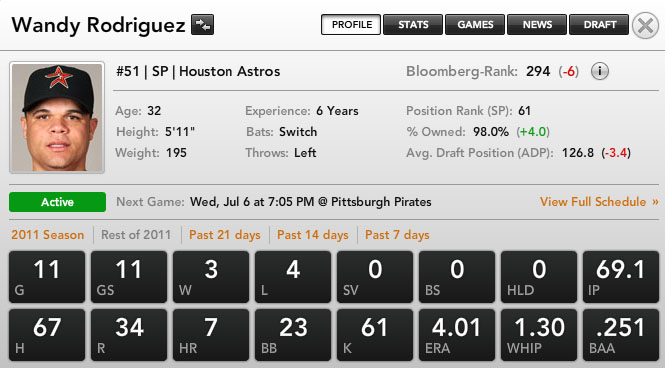 Let’s look at Wandy Rodriguez. He has a 3.88 FIP right now, and is striking out 7.33 batters per nine. He gets 45.6% of his contact on the ground, barely above the 44% average. His 2.6 BB/9 is good, but as the average walk rate has improved to 3.16 this year, it looks less exciting against the backdrop of the league. His 3.25 ERA right now is just about as exciting vis-a-vis the league (13% better than average) as his 3.60 ERA was last year (9% above average). He’s looking like the new average fantasy starter in mixed leagues.
Going into the season, my personal projections had Rodriguez going for a 3.49 ERA, 1.21 WHIP, 12 wins and 189 strikeouts. With his injury, the strikeout total might not come true, but going into the season, the package was worth $11.20 when compared to the replacement-level pitcher, Jorge De La Rosa and his projected 4.13 ERA and 1.33 WHIP with 168 strikeouts in 176 innings. That doesn’t look like the replacement-level pitcher this year. This year’s FIP is 6% better than last year’s. If we move the replacement level about 6% higher, that takes a $1 off of Wandy’s value.
All of this is to set up a conversation about the relative value of Wandy Rodriguez in a trade. Say you’re trying to get out in front of a possible trade to the Yankees and you want to capitalize on a player that might not know that pitching is more abundant this year. If you can sell him at $11 and get someone like Jayson Werth or Corey Hart in order to bolster your speed and power, it might make a lot of sense. Even at $10, more Andre Ethier and Nick Markakis territory, you might have to consider it.
After all, there’s more pitching on your wire this year, and we’ll be here to help you find it.
For the best fantasy baseball analysis and insight please visit BloombergSports.com
Curtis Granderson: Siren Call or Smart Pick?
by Eno Sarris //
According to the Bloomberg Sports Front Office tool, Curtis Granderson is the fourth-best center fielder and ranks at about 47th overall – and yet his ADP is hovering around triple-digits. Seems like a moment rife for opportunity. Except there’s the recent news about his health. And his ongoing platoon issues. Let’s take a look at these and see if they threaten to completely reduce his value to rubble.
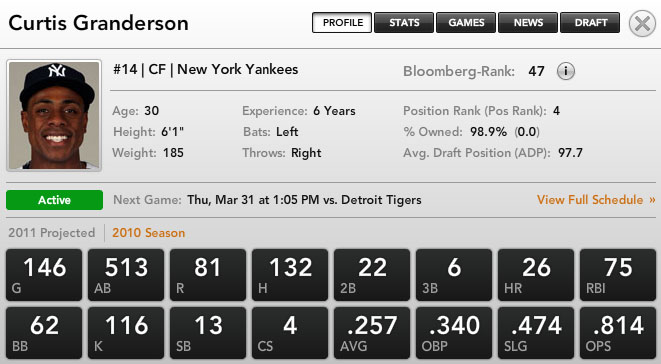 First, it’s true that Granderson is not a great batter against lefties. His .215/.275/.347 line against lefties is much worse than his .287/.363/.528 line against righties. And that lacking lefty line has come in 859 plate appearances, so it’s somewhat reliable. He’s not great against lefties.
The thing is, he still takes at-bats against them. It only seems like he’s a platoon outfielder. Take a look at the chart below, and you’ll see that he actually took more at-bats against lefties than the average player last year. The Yankees know that, with his glove, he’s still valuable. And fantasy fans should know that he still hits 3-5 home runs a year against lefties, and, as the chart shows, 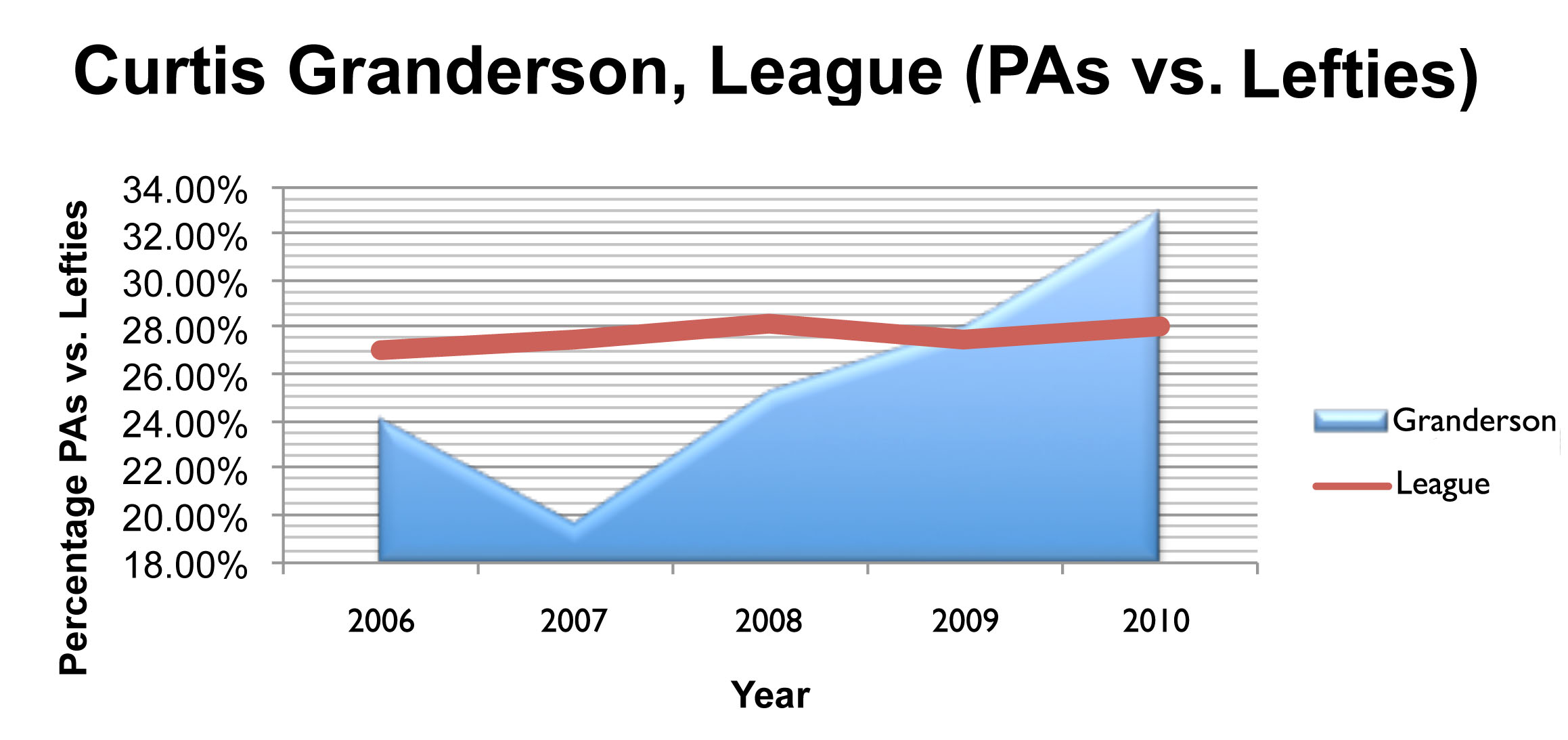 isn’t sitting versus them. If you’ve got a good fourth outfielder in your daily-lineup fantasy league, fine, put him in instead of Granderson versus a lefty. But don’t discount Granderson too far for having a slight flaw.
Now Granderson is hurting from an oblique strain, but during the last spring training game, manager Joe Girardi said that his center fielder said that he would have played if it was the season. There’s still a week left before the season opens, but obliques are tricky. It’s hard to know exactly how much time, if any, Granderson will miss, and watching the news wire in the next couple days will hopefully help.
The injury news, along with his struggles against lefties, will surely depress Granderson further than his current ADP. On Yahoo, Delmon Young‘s ADP is 101.1, Nick Markakis‘ is 111.6, and Granderson’s is 112.5. I’d take the chance at power and speed over those two outfielders, even if the batting average is not always there. On ESPN, Granderson’s ADP is higher (87.7), and he might not be a good option over a healthy Corey Hart (93.4), but I’d certainly take him over Torii Hunter (116.4) and Juan Pierre (115.6), more one-dimensional players at this point in their careers.
Curtis Granderson is not perfect. But at some point, he’s a value. In mixed leagues, start looking at him once you approach double-digit rounds.
For the best fantasy baseball analysis and insight please visit BloombergSports.com
Fantasy Baseball and the Yankees Fifth Starter
by Eno Sarris //
Most teams fudge the fifth starter from year to year, hoping that that a young prospect or retread veteran takes the reins and provides the team for just enough for the team to win games at a decent clip. The Yankees are no different in this regard – and yet they’ve had some decent fifth starters over the years. Some even rose to fantasy relevance.
Well, not many. Phil Hughes, in his 2007 debut and again in 2009, might have been the best. Sergio Mitre and Ivan Nova were decent enough to find a few spot starts in mixed leagues last season. Otherwise, it’s been a bad stretch.
Joining the fun over the past week are Bartolo Colon and Freddy Garcia. That’s a pretty terrible group of veteran options. The best strikeout rate of the crew over the past two years was Garcia’s 5.95 K/9 in 2009 (the average across baseball hovers around seven K/9). That’s being a little unfair to Mitre, who is a groundball inducer (58.7% groundballs career, 40% about average). But still, aside from Garcia’s 59 innings in 2009, Nova’s 4.36 FIP in 42 innings last year (a number on the ERA scale that attempts to strip out batted-ball luck) was the best of the bunch (4.10 is about league average).
It’s a tough group. Garcia’s lost about five MPH off of his peak fastball and now uses his 88 MPH four-seam heater only 30.2% of the time, or less than any non-knuckleballer in the league last year. His 157 innings were also almost 100 more than he’d managed in a single season since 2006. He’ll need help even if he’s decent, and Colon, who has only managed 200 total innings since 2007, might not be the one to manage it. Mitre might be the man, but his career 4.72 FIP is not impressive and he had the worst groundball rate of his career last year.
Could Ivan Nova or a young man behind him step to the fore? The problem with Nova is that he’s never shown the upside to approach the league average in either K/9 or BB/9, even in the minor leagues. If his control was better, he might be able to take advantage of an okay ground-ball rate, but he hasn’t shown strong control.
On the farm, Dellin Betances, has buckets of upside. He’s managed double-digit strikeout rates thanks to his mid-nineties fastball and impressive curve. He’s also 22 and has only pitched 14 1/3 innings of Double-A ball, so he needs more seasoning. Ditto for 19-year-old Manny Banuelos, who opened eyes at the Arizona Fall League last fall.
Considering how badly last year’s veteran fifth starter worked out (Javier Vazquez), it’s hard to put much stock in the reclamation projections (Garcia and Colon). Instead, expect Garcia and Mitre to split much of the time. If Mitre recovers his old groundball rate, he might actually be the best of the crew… until the young ones are ready.
 Bloomberg Sports