Tagged: Philadelphia Phillies
Bloomberg Sports Fantasy Baseball 2012 Recap: Shortstops
Twitter: @RobShawSports and @BloombergSports
Bloomberg Sports Anchor Rob Shaw and Analyst Alex Burwasser recap the top five shortstops this fantasy season as well as the top three busts.
TOP FIVE PERFORMERS
5. Starlin Castro, SS, Cubs
After a fantastic sophomore campaign in the big leagues which saw him lead the league in hits (207) and make the All-Star team, Starlin Castro put together another solid year for the Cubs. He did not hit .300 this year but he hit a very respectable .283 while stealing a career-high 25 bases. A good sign going forward for him is his consistency against left and right-handed pitching, hitting over .280 against both this year. However, an area where Castro needs work is his plate discipline, where for the third straight year he drew less than 40 walks (36).
4. Jose Reyes, SS, Marlins
It would have been really difficult for Jose Reyes to duplicate his 2011 season when he won the NL batting title. A season that turned out to be his last with the Mets when he signed as a free agent with the new-look Marlins. A lot was expected of Reyes and the Miami team as a whole moving into a brand new ballpark and it seemed both were wilting under those expectations. Unlike the team, however, Reyes redeemed himself by hitting .312 after the All-Star break and ending the season with his standard double-digit triples (12) and 40 steals. In fact, he was hitting in the three hole for the Marlins by the end of the year, so if that continues in 2013, expect even more production for Reyes.
3. Ian Desmond, SS, Nationals
One of the best stories in baseball this year was the Washington Nationals, and one of the leading characters in that story was 26 year old shortstop Ian Desmond taking the next step and becoming an All-Star player. Not only did his batting average drastically improve from last year moving from .253 to .292 but he had an enormous spike in power hitting 25 home runs this year as compared to only 8 in 2011. Added with his speed, swiping over 20 bases for the second year in a row (21), Desmond looks like he is a player on the rise for the Nationals and possibly for your fantasy leaderboards next year.
2. Derek Jeter, SS, Yankees
Derek Jeter has been around the top of this list for basically the past fifteen years, so why would 2012 be any different? He had 216 hits this season, which was his most since 1999, as well as 47 extra base hits which was his most since 2007. He also hit over .300 (.316) for amazingly the twelfth time in his sure-to-be Hall of Fame career. The only question with Jeter is how long he can possibly keep this up, especially given his unfortunate ankle injury in the ALCS against Detroit, but it would be hard to start counting him out now.
1. Jimmy Rollins, SS, Phillies
Jimmy Rollins, much like Derek Jeter, has been at the top of this list for over a decade now, but Rollins went mostly under-the-radar this season because his team was such a huge disappointment. Obviously, Rollins was not the reason why, blasting his most home runs since his MVP season of 2007 (23) as well as knocking in a solid 68 RBI. A very underrated part of Rollins game has always been his speed, and that was certainly on display this year when he stole 30 bases for the second year in a row and added over a hundred runs scored (102). Rollins is only 33 years old, so there could be a few more years of these type of numbers coming from a premium fantasy position like shortstop.
TOP THREE BUSTS
3. Jhonny Peralta, SS, Tigers
A first time All-Star in 2011, Jhonny Peralta had his best season as a pro for Detroit hitting just under .300 (.299) while providing some serious power with 21 home runs and driving in 86 runs as his Tigers won the AL Central. Detroit again won the AL Central again in 2012 but Peralta was not nearly as big a factor seeing his batting average dip 60 points to .239 as well as his home runs (13) and RBI (63). Peralta needs to hit for power and drive in runs to provide any fantasy value whatsoever because he does not steal bases or hit for a high average.
2. Yunel Escobar, SS, Jays
In a somewhat surprising move given his potential, the Braves traded Yunel Escobar to the Jays after a disappointing start to the 2010 season. It was looking like a steal of a trade for Toronto after a 2011 season that saw him hit .290 with 11 home runs and 77 runs scored. However, he really declined this past season when his average dropped 37 points to .253, but what was most alarming were his walks almost being cut in half from 61 to 35 which left his on-base percentage at a measly .300. For a player expected to be at the top of the lineup for years to come, getting on base three out of ten times will just not cut it for the Jays and for your fantasy team.
1. Dee Gordon, SS, Dodgers
Every year fantasy owners seem to fall into the trap of falling in love with a player who comes up from the minors and excels at a particular statistical category whether it is home runs or strikeouts. In Dee Gordon’s case, it was stolen bases. After being called up in June 2011, he burst onto the scene by hitting .304 and stealing 24 bases in 56 games for the Dodgers. In 2012, he was the opening day starter at shortstop for the Dodgers but he never really got off the ground getting sent to the minors in early July after hitting only .228. He still has a ton of speed — he stole 32 bases — but he cannot provide any value if he cannot get on base in the future.
For more fantasy insight, visit BloombergSports.com.
Fantasy Baseball Waiver Wire Report: Michael McKenry, Grant Balfour, Josh Vitters, and Erik Kratz
Twitter: @RobShawSports and @BloombergSports
Bloomberg Sports Anchor Rob Shaw breaks down four players who fantasy managers may want to pick up off the waiver wire this week.
Michael McKenry, C, Pirates
The Pirates are trying to stay in contention for the playoffs and they have gotten some help on offense from an unlikely source in McKenry. In 47 games, he’s batting .285 with 11 home runs and 28 RBI. He has eight homers in his last 21 games alone. If you need a catcher and McKenry is available, he is a good pickup, though it’s unlikely that he will sustain these numbers.
Grant Balfour, RP, Athletics
The A’s have had some issues in the bullpen as rookie Ryan Cook has struggled recently. This opens the door for Balfour, who last gave up a run on June 29. He is 2-2 with seven saves, a 2.60 ERA and a 1.02 WHIP. The coaching staff has acknowledged that it has to consider moves within the bullpen as the team is in contention, and Balfour is a likely option for the closer role.
Josh Vitters, 3B, Cubs
Vitters was the third pick of the 2007 draft, selected ahead of Matt Wieters, Madison Bumgarner and Jason Heyward. The top prospect made his debut for the Cubs on Sunday. In 110 games at Triple-A, he had a .304 average, 17 home runs and 68 RBI.
Erik Kratz, C, Phillies
Kratz played seven years at Triple-A and had a .288 average with 15 homers last season. He’s making the most of his opportunity with the Phillies, batting .379 with four home runs and four doubles in 15 games. Kratz should do well as a backup while Carlos Ruiz is on the disabled list.
For more fantasy insight, visit BloombergSports.com.
Fantasy Baseball Players Getting a Shot: Brown, Olt, Holland, Wallace, and Sanchez
Twitter: @RobShawSports and @BloombergSports
Bloomberg Sports Anchor Rob Shaw discusses five players who are getting a chance to play in the majors and how valuable they may be to fantasy managers.
Domonic Brown, OF, Phillies
With a couple of outfielders on the move, Dominic Brown has returned to the Phillies. The former top prospect hit .310 with 20 doubles in just 65 games in the minor leagues this season. A month shy of his 25th birthday, Brown’s window of opportunity is closing, so it makes a lot of sense for the Phillies to give him a shot. If you are in need of some offensive support, Brown should be able to offer a decent average and respectable on base percentage, though the power and speed have not developed the way we thought they would so far.
Mike Olt, 1B, Rangers
A late first-round pick in 2010, Olt is a big-time power hitter who slammed 28 home runs with 82 RBI in 95 games at Double-A this season. He was desired by all teams when it came to blockbuster deals at the trade deadline, but instead the Rangers plan to have him contribute in the big leagues now. This is bad news for Mitch Moreland, who offers great power but has not been given much of a shot to play everyday.
Greg Holland, RP, Royals
A 27-year-old right-hander who throws hard but does not surrender many long balls, Greg Holland picked up his first save on Wednesday night with a 1-2-3 inning. Holland can still get wild at times and is not nearly as dominant as he was a season ago, but the Royals are at least providing him with the opportunity to succeed in the high pressure role of closer.
Brett Wallace, 1B, Astros
It took Brett Wallace more than 330 at-bats to rack up five home runs last year. He already has four this year in fewer than 50 at-bats after blasting two in his last start. Though his plate discipline is lacking, Wallace did offer some power at Triple-A this season while offering a .300 average. The soon-to-be 26-year-old will have every shot to contribute for the remainder of the season with the Astros in what could be his last chance at being an everyday player.
Gaby Sanchez, 1B, Pirates
The Marlins found no more use for the struggling Gaby Sanchez while the Pirates are eager to give him an opportunity. Sanchez has a .200 average with just three home runs this season, but this is a player who hit 19 home runs in back-to-back seasons and was batting .302 with five home runs in 34 games at Triple-A. With Casey McGehee dealt to the Yankees, Sanchez has first base to himself in Pittsburgh.
For more fantasy insight, visit BloombergSports.com.
Ballpark Figures Trade Deadline Breakdown
Twitter: @RobShawSports and @BloombergSports
Bloomberg Sports Anchors Julie Alexandria and Rob Shaw break down some of the major storylines in baseball as the trade deadline approaches.
Trade Analysis: Hanley Ramirez to the Dodgers
The Dodgers made a splash by acquiring former Marlins sensation Hanley Ramirez for Nathan Eovaldi and a willingness to take on Ramirez’s salary. First of all, this is the way it should be for Los Angeles. The Dodgers are supposed to be the West Coast Yankees, so it’s good to see them open the check book to bring in some star potential.
The move also makes baseball sense. The team already has two of the best hitters and pitchers in baseball, so it’s not a bad idea to go for the gold now. Eovaldi is too young to be depended on, while, even at his worst, HanRam is scoring runs and offering some pop and speed. On a side note, of all stadiums where Ramirez has played at least 65 games, his .388 average at Dodgers Stadium is easily the highest.
On the Market: Alfonso Soriano
With 19 home runs and 58 RBI, Alfonso Soriano is once again a solid slugger at the big-league level. He is also due to make $18 million in each of the next two seasons. His high performance provides the Cubbies with a window to trade him. Ken Rosenthal reported that at least one team has interest in the veteran outfielder.
Sellers: Philadelphia Phillies
The Phillies are in a very interesting situation right now. They have some very bad contracts, though their huge investment in Cole Hamels is not one of them. He is still young at 28 years old and was developed within the Phillies system. The team is out of contention this season and must rebuild in the next few years. The only way players such as Shane Victorino could be dealt is if the Phillies get back prospects who will be ready to start next year.
Sellers: New York Mets
After a great first half, the Mets have won just one game since the All-Star break and could try to make a move. Johan Santana’s injury hurts them, as he is due so much money andcould have been traded. The Mets would have been happy to deal him in return for prospects.
With Santana injured, if there is a Mets player to be traded, it’s infielder Daniel Murphy. Jordany Valdespin has been incredible this season and offers more versatility and better defense than Murphy. However, the Mets will only make a trade if they get something back which they are really able to use, such as a power arm for the bullpen.
Sellers: Milwaukee Brewers
The Brewers have been buyers recently, bringing in players such as Zack Greinke and Aramis Ramirez, but it has not worked out. The best case scenario for them is that Greinke decides to stay in Milwaukee, which may not be very realistic. The Brewers were also shopping reliever Francisco Rodriguez and tried to increase his value. K-Rod, however, imploded with blown saves in consecutive appearances against the Phillies, likely costing the Brewers some prospects.
For more insight, visit BloombergSports.com.
Fantasy Baseball Injury Report: July 12, 2012
Twitter: @RobShawSports and @BloombergSports
Bloomberg Sports Anchor Rob Shaw discusses the injuries and set return dates of seven players who could have an impact on your fantasy team in the second half of the season.
Carl Crawford, LF, Red Sox
Crawford has not played this season due to left wrist surgery in March and a partial UCL tear in his elbow in April. In 2011, he had a .255 average with 11 home runs and 56 RBI. Crawford is set to return to the Red Sox lineup on Monday against the White Sox.
Jacoby Ellsbury, OF, Red Sox
Ellsbury played in just seven games before being sidelined by a separated shoulder in mid-April. In 2011, he had an incredible season with a .321 batting average, 32 home runs and 105 RBI. Ellsbury should return Friday against the Tampa Bay Rays.
Brandon Morrow, SP, Blue Jays
Morrow had a great start to the season. In 13 starts, he had a 3.01 ERA, 1.00 WHIP and 67 strikeouts. He was placed on the 15-day disabled list on June 13 due to a strained left oblique. The Blue Jays are hoping that he will return to the rotation this month.
Roy Halladay, SP, Phillies
Halladay has been sidelined since May 28 with a strained right lat. In 11 starts this season, he had a 3.98 ERA, 1.15 WHIP and 56 strikeouts. He is set to return to the mound Tuesday against the Dodgers.
Giancarlo Stanton, RF, Marlins
Stanton had surgery on July 8 to remove loose bodies from his right knee. This is a big loss for the Marlins, as he was hitting .284 with 19 home runs and 50 RBI. Stanton likely won’t return until late August.
Matt Kemp, RF, Dodgers
Kemp had an incredible start to the season, hitting .355 with 12 home runs and 28 RBI in just 36 games. However, he has battled a hamstring injury and was placed on the disabled list on May 31. He is set to return Friday against the San Diego Padres.
Troy Tulowitzki, SS, Rockies
Tulowitzki recently had surgery on his left groin muscle. He was batting .287 this season with eight home runs and 27 RBI. He likely won’t return to the Rockies’ lineup until mid-August.
For more fantasy insight, visit BloombergSports.com.
Ballpark Figures: Top Second-Half Storylines
Twitter: @RobShawSports and @BloombergSports
Bloomberg Sports Anchors Rob Shaw and Julie Alexandria discuss the top five stories in baseball after the All-Star break.
Will R.A. Dickey win 20 games?
Baseball fans are trying to figure out if R.A. Dickey is Tom Candiotti or Phil Niekro. At 12-1, Dickey is enjoying a banner season and arguably would be the NL Cy Young award winner if the season ended today. The problem for Dickey is that the season does not end today and he still has about 15 starts to go. Can he possibly continue his dominance and nab another eight wins for an even 20?
Hall of Fame knuckleballer Phil Niekro attained three different seasons with 20 or more wins. On the other hand, Dickey might only win another 3-5 games this season and finish with a solid, but more expected total that is more in line with a solid hurler, such as knuckleballer Tom Candiotti, who won 14, 15 and 16 games in his career.
What becomes of Tim Lincecum?
The good news is that Tim Lincecum is on pace to strikeout 200 batters. The bad news is that he is also approaching 100 walks, which could lead to some time in the bullpen. We’ve had some surprises this year that fill the bust category. As of now both Jose Reyes and Albert Pujols join a recent trend of major free agents struggling with new franchises.
Lincecum is pitching for the very franchise he came up with and has dominated for the last five seasons. However, he is getting hit often and hard, and with a 3-10 record and 6.42 ERA you have to wonder if he will stick in the starting rotation all season long. Lincecum hasn’t made it out of the fourth inning in back-to-back outings.
Where will Zack Greinke end up?
The Brewers have had their struggles and perhaps for that reason, Zack Greinke’s performance has gone under the radar. He is 9-3 with 111 K’s and a 3.32 ERA. With the Brewers five games out of first place, the team will be in sell mode especially if Greinke does not indicate that he wants to stick there.
So what teams could be interested? How about the Baltimore Orioles, or the St. Louis Cardinals? Greinke’s presence could make a world of difference in how this ost-season shapes up.
Are the Phillies buyers or sellers?
The Phillies are in dead last place in the National League East. They opened the season without Chase Utley and Ryan Howard, and now that they are coming back, the pitchers have been out: Cliff Lee and Roy Halladay.
The big question for the Phillies is figuring out whether or not Cole Hamels will stay as a free agent. There have been rumblings that he could be destined to the Dodgers, which would leave the Phillies in a bind if they do not get anything in return for his services aside from draft picks. Hamels, by the way, is 10-4 with a 3.20 ERA with 118 K’s and a 1.10 WHIP. He has been the ace for the Phillies this season.
Are the Pirates playoff bound?
The Pirates are in first place late in the season for a second straight year. The question is whether they can stick this time and if they learned from last year’s collapse. It looks like they could actually stick this time for a couple of reasons. Firstly, they have an ace with James McDonald boasting a 2.37 ERA with much better control this season. Next, their gamble with AJ Burnett seems to be paying off as he’s been a solid number two. Though the starting rotation lacks depth, the bullpen is strong enough to let leads stick.
Finally, on offense there are several solid players, then an MVP candidate in Andrew McCutchen and a potential star in Pedro Alvarez. The Pirates lack some depth, but so far they have been good enough, and with extra wild card spots available, this team could advance.
For more insight, visit BloombergSports.com
Fantasy Baseball Twitter Trends: Arroyo, Rizzo, Ruiz, and Chapman
Twitter: @RobShawSports and @BloombergSports
Bloomberg Sports Anchor Rob Shaw discusses the performances of four players who were trending on Twitter Tuesday night.
Bronson Arroyo, SP, Reds
Arroyo brought a no-hitter into the eighth inning against the Brewers Tuesday night, but left with a no decision. He gave up three hits, one walk and three earned runs in 7.2 innings pitched. He is now 3-5 with a 4.13 ERA and 1.25 WHIP this season. The biggest surprise from Arroyo this season is his strikeouts. He has 60 strikeouts this year compared to just 14 walks.
Anthony Rizzo, 1B, Cubs
Rizzo made his debut with the Cubs Tuesday night against the Mets. He went 2-4 with one RBI and one double. In 70 games at AAA in Iowa this year, he had a .342 batting average, 23 home runs and 62 RBI. Rizzo was brought up to play first base, which moves Bryan LaHair to the outfield.
Carlos Ruiz, C, Phillies
Ruiz is having an incredible season. He went 3-4 Tuesday night with one home run, two runs and two RBI. He now has a career-high 10 home runs this season, as well as a .361 average and 41 RBI. Overall, Ruiz is providing much-needed offensive production to the Phillies lineup.
Aroldis Chapman, RP, Reds
Chapman bounced back from back-to-back blown saves Tuesday night. He had three strikeouts and one walk in one inning pitched to pick up his ninth save of the season. His numbers this year are still outstanding, especially his 64/12 K/BB ratio.
For more fantasy baseball insight, visit BloombergSports.com.
Philadelphia Phillies Report with Jimmy Rollins and Dominic Brown
Follow us on Twitter: @BloombergSports @RobShawSports
Phillies Report:
Phillies Pitching
The Phillies are running away with the best record in baseball with a comfortable 8.5 game lead, and the lone reason for their success has been pitching. This certainly isn’t a surprising story for a team that offered four aces to open the season with Chase Utley on the disabled list.
However, things have not sailed as smoothly for the rotation as we originally expected. For starters, Roy Oswalt is enduring a tough season, recently spending nearly two months on the disabled list. His record stands at just 4-7 with a 3.84 ERA and horrendous 1.41 WHIP. The team has also had Brad Lidge, Ryan Madson, and Jose Contreras spend time on the disabled list. To put that in perspective, those were the top three expected closers coming into the season.
Considering the Phillies lack of offense and injury issues, this is by no means the team’s full potential. The fact that they still have put together an 8.5 game lead in the division says that the post-season could be a walk in the park for the Phillies.
Jimmy Rollins
The 32-year-old veteran Jimmy Rollins is neither as good as he was in 2007, when he earned the MVP with a career-high 30 home runs, nor as bad as he was last season when he batted .243. Rollins is somewhere in between with a .266 average, 71 runs, 13 home runs, and 26 steals.
Rollins has managed to stay away from the injury-bug this season, and he is significantly better at reaching base with a .340 OBP. In the field, Rollins is making a case for the Gold Glove award with just five errors, resulting in a stellar .989 fielding percentage.
If the Phillies are able to win the World Series and Rollins performs at a high level, considering he will likely enter next season just 100 hits shy of 2000 hits for his career, the conversation can begin about whether the Phillies shortstop will one day find himself in the Hall of Fame.
Dominic Brown (replaced by Hunter Pence)
It was certainly a difficult season for Phillies top prospect Dominic Brown. First sidelined with a broken hand, Brown hit just .246 with five home runs and three steals before returning to the Minor Leagues after the Phillies acquired Hunter Pence.
The good news for Brown is that the franchise has by no means lost hope in the 23-year-old phenom. The Phillies went to great lengths to keep him on the roster after the trade deadline, likely passing on Carlos Beltran in order to do so.
Some good news with Brown’s statistics is that even though he is struggling when it comes to his batting average, he is not getting outmatched at the plate. This is suggested by his healthy ratio of 25 walks to 34 strikeouts, as well as his 16 extra base hits in 183 at bats. Brown will certainly return to the Phillies in September, and when he does he will likely steal at bats from John Mayberry and Ben Francisco.
Top 3 in the Rotation for Playoffs
The Phillies have a problem on their hands, but it isn’t a bad one. The playoffs are quickly approaching for the first place franchise and the big question is who will start in a seven game series.
The obvious answers are Cliff Lee and Roy Halladay. The problem is that Cole Hamels is another fairly obvious starter. That means the veteran Roy Oswalt will have to pitch from the ‘pen, if at all. The same holds true for Kyle Kendrick and Vance Worley, two of the more impressive young pitchers in the league this season.
The Phillies do also have the option of going four-deep in the rotation for the post-season, but my guess is that with the season on the line they will want Halladay and Lee with the ball in their hands as much as possible.
Again, this problem is far off and injuries can end up answering the question, but for now the Phillies have a delightful problem on their hands.
What’s Brad Lidge’s Status Update After the Cliff Lee Signing?

Cliff Lee Finally Signs…with the Phillies
By R.J. Anderson //
Jayson Werth signing a $126 million deal with the Nationals figured to be the surprise of the off-season. Instead, Cliff Lee has outdone his former teammate by signing with the team they once shared. For all the talk about the Rangers and Yankees dueling over the ace’s services, in the end Philadelphia walked away with the biggest catch of the off-season.
Lee joins Roy Halladay, Roy Oswalt, and Cole Hamels to form possibly the best rotation in modern history (as Dave Cameron showed here, this rotation is comparable to the Atlanta Braves of the early-to-mid 1990s). Of course, fantasy owners are more interested in how Lee fares rather than the foursome as a whole. In particular, there’s a thought that looking at Lee’s time in Philly represents an accurate projection of what to expect from the 32-year-old.
Those stats include 12 starts in 2009, with 79 innings pitched (roughly six and a half innings per start, even though that’s impossible), a 3.39 ERA, a strikeout-to-walk ratio of 7.4, and a win-loss record of 7-4. Believe it or not, Lee is probably better than some of those stats suggest. Over the past three seasons he’s compiled a 2.98 ERA, a 48-25 record, and a 5.64 strikeout-to-walk ratio between four different teams.
A stretch of dominance like Lee’s is hard to replicate for too long. Even Greg Maddux couldn’t keep up the frantic pace he posted from 1995 to 1997 (96 starts, 687 innings pitched, 53-17 win-loss, 2.21 ERA, and a 7.46 SO/BB, while walking fewer than one batter per nine innings pitched); Maddux’s 1998 included a 2.22 ERA, 18-9 record, and a 4.53 strikeout-to-walk ratio. Fall off? Hardly, but expecting a slight stepback is safer for expectations than holding Lee to his own superhuman track record. The table below shows how each of the top five pitching seasons (as determined by K/BB ratio) fared in K/BB and ERA the next season. Each pitcher saw his strikeout-to-walk ratio decline and his ERA increase (with one exception), a sign that Lee probably won’t upon his historic 2010 season:
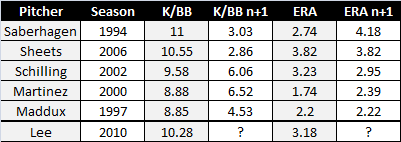
Double-digit wins (wins are heavily influenced by factors beyond a pitcher’s control), 200-plus innings, and a sub-3.50 ERA seem reasonable enough. And given that it’s Lee, there is a chance he might blow those conservative projections away. He’ll be one of the first pitchers off the board come draft time – as will three of his rotation mates. Deservedly so.

