Tagged: Seattle Mariners
Ballpark Figures Trade Deadline Wrap Up
Twitter: @RobShawSports and @BloombergSports
Bloomberg Sports Anchors Julie Alexandria and Rob Shaw break down the moves made at the trade deadline and the implications for your fantasy team.
Reds Trade for Jonathan Broxton
For the Reds, Jonathan Broxton simply provides depth and some closer experience. However, he is destined for a middle relief role with the club in front of Aroldis Chapman. The Royals get two quality arms in return and Greg Holland becomes the closer in Kansas City.
Rangers Acquire Ryan Dempster
With the Angels breathing down their necks, the Rangers had to do something before the trade deadline, especially with Colby Lewis and Neftali Feliz lost for the season. Ryan Dempster had already been traded to the Braves but he rejected the move last week. He did, however, welcome a trade to the Rangers mere hours before the trade deadline. This is a move that will help Dempster quite a bit when you consider that he has won just five of his 16 starts despite a 2.25 ERA. His ERA is likely to rise in Texas, but I’m sure fantasy managers will welcome it with the additional wins due to the Rangers run support.
Shane Victorino Traded to the Dodgers
One of the better offensive outfielders in baseball, Shane Victorino ends his career with the Phillies now that he has been traded to the Dodgers. He gets plenty of steals, has some pop and reaches base often. However, in Los Angeles, he will likely lose some of that pop, which could keep his average down a tad. Originally drafted by the Dodgers in 1999, Victorino owns a .357 average at Dodgers Stadium and will benefit from having Matt Kemp and Andre Ethier in the lineup.
Hunter Pence Traded to the Giants
This is the big surprise, as Hunter Pence is 29 years old and clearly in his prime. Though Pence has lost some of his speed this season, he does have some pop and is a line drive hitter. A move to the Giants could cost him some home runs, but at least he will play some meaningful baseball this fall. Regardless, overall the move hurts Pence’s fantasy value.
Yankees Acquire Casey McGehee
For a second straight season, Casey McGehee has struggled at the plate but he is a fine Ty Wigginton type player who can contribute in big moments. What this acquisition does is hurt the fantasy value of Eric Chavez, as three is now a crowd with Jayson Nix also taking some at-bats away while filling in for the injured Alex Rodriguez.
Pirates Acquire Gaby Sanchez
The Pirates had nothing to lose and now hope that a change of scenery will do some good for Gaby Sanchez. After two straight seasons with 572 at-bats and 19 home runs, Sanchez struggled mightily this season with just three home runs and a .202 average before being relegated to the minor leagues. The 28-year-old moves to a more hitter-friendly ballpark and a surprisingly better lineup to resurrect his career.
Cardinals Acquire Edward Mujica
Last year the Cardinals brought in relief help including Octavio Dotel and it worked out well for them. This year, the Cardinals have a bit more work to do but they will not let the bullpen be the team’s unraveling. On Tuesday, the Cards acquired Edward Mujica, a hard-thrower with solid control. He does surrender some home runs but is another quality arm to help bridge the gap to Jason Motte.
Pirates Acquire Travis Snider
Another cheap pickup for the Pirates, Travis Snider has some serious potential, but it just did not work out in Toronto. On the other hand, Pittsburgh is a fine place for him to establish himself and at 24 years old, he has some time to reach his potential. I see Snider as a potential 30-homer guy with more than 10 steals and a respectable average. He is the big bat that the Pirates would love to team up with Pedro Alvarez and Andrew McCutchen.
Blue Jays Trade Steve Delabar for Eric Thames
A feel good story in Seattle, Steve Delabar went from a coach to a player in a little over a year and has averaged well over a strikeout per inning this season. He provides the Blue Jays with the power arm that they expected to have in the injured Sergio Santos. His value takes a minor decline since he moves from the pitcher’s haven Safeco Field to the hitter-friendly Rogers Centre.
Eric Thames makes the reverse move from Toronto to Seattle. There won’t be many complaints from Thames since he will likely get a crack at playing everyday with the Mariners. He has some power but really struggles when it comes to the strikeout-to-walk ratio.
Braves Acquire Reed Johnson and Paul Maholm
A .300 hitter for a second straight year, Reed Johnson is very much a utility player with no fantasy value. On the other hand, Paul Maholm has enjoyed his time in Chicago with a 9-6 record and a solid 3.74 ERA. He has surrendered a run or fewer in each of his last six starts. Maholm also boasts a 1.69 ERA in five career starts at Turner Field. Though the Braves only made this deal since Ryan Dempster rejected the trade to Atlanta, I do think this is a nice fit with Maholm as hot as any pitcher in baseball right now.
For more fantasy insight, visit BloombergSports.com.
Fantasy Baseball Hot Topics: Greinke, Liriano, Shields, Johnson, Broxton, and League
Twitter: @RobShawSports and @BloombergSports
Bloomberg Sports Anchor Rob Shaw discusses the top stories about pitchers at the trade deadline.
Zack Greinke is an Angel
There were many teams vying for Zack Greinke this week. The former Brewers ace was considered the best available arm, assuming some of the other elites won’t get moved. The Angels made the most sense since they can re-sign him and had the prospects to force the Brewers’ hand. The Angels did give away a young shortstop and two top pitching prospects, but in Greinke, they now have the deepest starting rotation with Jered Weaver backed up by Greinke, Dan Haren, C.J. Wilson and Ervin Santana.
In his debut, Greinke went seven strong while fanning eight and allowing just two runs to score. The Angels offense, however, did not show up with just four hits and no runs in a 2-0 loss to the Rays.
The big question is what this trade does for Greinke’s fantasy value. The answer is nothing at all. He already pitched for a decent offense with the Brewers and had the advantage of opposing fellow pitchers in the National League. Now he faces a designated hitter, has to deal with the big AL offenses such as the Rangers and has to adjust to a new team and a new city mid-season. Yes, the added adrenaline of a playoff run is exciting for him, but I think he was pumped up plenty on every fifth day in Milwaukee.
Francisco Liriano Joins the White Sox
The White Sox have been eager to keep up with the Tigers and the rest of the American League this season, and since they lack the prospects needed to get someone like Zack Greinke, they will have to roll the dice on Francisco Liriano.
The 28-year-old southpaw is as talented as anyone but he has had control issues that have plagued him the last few seasons. It’s interesting that he joined the White Sox, since he actually helped them in his final Twins start, surrendering seven hits and seven runs with three home runs on July 23 at Chicago.
This is an interesting trade for the entire White Sox starting rotation since they will now go to a six-man staff. This alleviates concerns for the innings for Chris Sale but could have a negative impact on the veterans. As for Liriano, the added run support will certainly be a positive though US Cellular is very much a hitter’s park. His career ERA at US Cellular is 5.77 in 48.1 innings.
Still On the Trading Block
Rays SP James Shields will come at a very heavy price since the Rays still control him for a few years at a reasonable rate. He is 8-7 with a 4.52 ERA and 1.46 WHIP.
Marlins starter Josh Johnson is injury prone and inconsistent, and his velocity is down. However, the Marlins will only trade him if they can get a major talent back in return. Johnson is 6-7 with a 4.04 ERA and 1.35 WHIP this season.
The Royals would be happy to trade reliever Jonathan Broxton while his value is soaring. The Rangers seem interested, but he will no longer close if dealt. The Royals would likely turn to Greg Holland or Tim Collins. Broxton will lose his fantasy value since he will turn into a middle reliever with a contender.
The Mariners would love to get some value back from former closer Brandon League. He got hit hard on Sunday but had been pitching well. With Tom Wilhelmsen dominating as the team’s closer, however, League is clearly expendable. It is unlikely that he will close for whichever team acquires him unless it’s a surprise team like the Mets.
For more fantasy insight, visit BloombergSports.com.
Fantasy Baseball: MLB Debuts and The Five Players Most Likely to be Traded
Twitter: @RobShawSports and @BloombergSports
Bloomberg Sports Anchor Rob Shaw breaks down the fantasy implications of two players’ MLB debuts and the potential trades of five players who are most likely to be moved.
The Big Debuts
Matt Harvey, SP, Mets
Finally some good news for Mets fans as 2010 first-round pick Matt Harvey made his debut Thursday night and it was a memorable one to say the least. Harvey set a Mets record for a debut with 11 strikeouts and did not allow a run to score in 5.1 innings.
Harvey touched 98 MPH on the radar gun and got some K’s with high fastballs while also getting some weak swings by putting sliders in the dirt. Don’t expect all of his starts to go this smoothly, but Harvey is a strikeout artist who should continue to rack up the K’s, though it could come with some walks as well.
Starling Marte, OF, Pirates
On the first Major League pitch he saw, Starling Marte made his mark, blasting a home run. The 23-year-old outfielder is an instant upgrade for the contending Pirates. Marte has some power, as he blasted 12 home runs with 13 triples and 21 doubles at Triple-A. He lacks plate discipline, but also has some speed. I do not see Marte having too much fantasy value this year aside from what could be a hot start since the Major Leaguers lack an in-depth scouting report on him. Regardless, the future is now for the Pirates and Marte only makes the team more interesting.
Five Players Most Likely to be Moved
1) Zack Greinke, SP, Brewers
The Brewers have come out and acknowledged that they are going to trade their ace, which makes it clear that no long-term commitment could be reached with Zack Greinke. Ultimately, a trade to a contender will do fantasy managers some good, but at varied levels.
If he goes to the Rangers: The hitter’s ballpark is bound to lead to some extra runs so Greinke’s ERA may spike, but he will also enjoy the best run support possible. This is the trading partner that makes the most sense for everyone. Greinke owns a sensational 2.38 lifetime ERA at Rangers Ballpark.
If he goes to the Angels: Greinke should continue to post similar numbers but with a few extra wins thanks to the offensive star power of Albert Pujols, Mike Trout and Mark Trumbo. You can expect a big second half from the ace who is 44-45 in the first half of seasons and 41-31 following the All-Star break.
If he goes to the Braves: This is the best ballpark for Grienke, plus in the NL he faces opposing pitchers, which will keep his ERA lower. Greinke is 25-9 in 49 starts with a National League club.
2) Jonathan Broxton, RP, Royals
The interest in Jonathan Broxton has been limited on the trade market and it may be for a couple of reasons. First, few contenders are desperate for a closer or late reliever right now. Also, Broxton’s numbers are not as good as they appear. He is not getting many strikeouts, which is a reversal of his career trend. He is also allowing 1.40 runners on base each inning, which is a recipe for destruction in late innings. The Royals are wise to put him on the block.
3) Jason Vargas, SP, Mariners
With the demands so high for front-of-the-rotation hurlers such as Greinke and James Shields, alternatives such as Jason Vargas are becoming attractive for teams. Vargas has won four straight starts and now owns a career high 11 wins this season. So when he does get traded, what does this mean to his fantasy value? The run support will increase, but his ERA will also soar. He has a 4.67 ERA on the road this season compared to 2.63 at home, which explains everything you need to know about the 29-year-old southpaw.
4) Francisco Liriano, SP, Twins
When the Twins dealt their ace Johan Santana to the Mets a few years back, they not only assumed that some of the prospects from the trade would turn into stars, but the hope was that Francisco Liriano would step up as an able replacement at the top of the rotation. Though he did enjoy some success in 2010 with 14 wins, a 3.62 ERA and a career high 202 strikeouts, the following two seasons have been disastrous.
Liriano has found himself in the bullpen and even in the minors over the last two seasons while sustaining an ERA north of 5.00 in the Majors. The positive signs this season are that the opposition is hitting just .239 against Liriano and he is fanning more than a batter per inning. On the other hand, his control is lacking, which makes him a major gamble for whoever brings him in via trade.
5) Yunel Escobar, SS, Blue Jays
After a strong 2011 season that included 11 home runs, a .290 average and .369 on-base percentage, Escobar has struggled this season. His average is down to .255, his OBP is .299 and his 19 extra-base hits have resulted in a .342 slugging percentage.
Escobar has shown some life recently with a five-game hitting streak, but there is growing concern about his character according to ESPN’s Buster Olney, which may scare off some suitors. Keep in mind that Toronto is a favorable hitter’s park and the Blue Jays lineup has posted a lot of runs. The 29-year-old Cuban does not make for a very good fantasy investment.
For more fantasy insight, visit BloombergSports.com.
Fantasy Baseball Top Headlines: Ichiro Suzuki, Colby Lewis, Anibal Sanchez, and Ryan Dempster
Twitter: @RobShawSports and @BloombergSports
Bloomberg Sports Anchor Rob Shaw breaks down four of the major stories in baseball right now that could impact your fantasy team.
Ichiro Suzuki Traded to the Yankees for Two Minor Leaguers
The Yankees added another legend to the fold in the form of right-fielder Ichiro Suzuki. The future Hall of Famer is in the midst of his second disappointing season, as his average dipped from .272 a year ago to .261 entering last night. He also isn’t drawing many walks, which explains the .288 on-base percentage.
The Yankees are hoping a move out of Safeco will do some good for Ichiro, who is hitting .297 on the road this season. Ichiro has also been great in his career at Yankee Stadium, with a .333 batting average and a.492 slugging percentage. The move is an absolute boon for fantasy managers.
Colby Lewis Out for the Season
The Rangers are in first place this season, which has as much to say about their pitching as their hitting. One of their top hurlers is Colby Lewis, who owns nearly a 7-to-1 strikeout-to-walk ratio. However, that ratio will not change as Lewis has been placed on the DL with an elbow injury and is lost for the season.
The loss of Lewis is a big blow, as he has been a star in the postseason with a 4-1 record and 2.34 ERA. The only good news is that Rangers fans will get a chance to see their top prospect Martin Perez again, but really, this is an injury that could force the Rangers hand to make a big deal.
Anibal Sanchez Going to Detroit
And just like that the Marlins are sellers again. Anibal Sanchez is just 28 years old, ranks among the top strikeout leaders and has really improved his control over the years. Regardless, the Marlins are not in the mood to pay him big this offseason, even though it did not stop them from acquiring Heath Bell last season.
A move to the American League is typically bad news for pitchers, but with the Tigers, Sanchez will have a lot of run support and play for a contender. Also dealt was Omar Infante, who offers some pop and speed from second base. Jacob Turner was moved to Miami but he is very much unproven, similar to a pitcher by the name of Andrew Miller, who never quite lived up to his hype despite being acquired for Miguel Cabrera from the Tigers several years ago.
Ryan Dempster Rumors
With a 2.11 ERA, Ryan Dempster is considered by many to be the best hired arm on the trading block. However, Dempster seems to enjoy Chicago and as a 10-5 player, he has the option of rejecting any trade. The Braves, meanwhile, see an opportunity to win an NL Wild Card spot and hope to acquire the veteran hurler. In the deal, Randall Delgado, who has mixed results, would be sent to Chicago. If Dempster does move to Atlanta, he is bound to do better than his current 5-4 record, while Delgado will see his value decrease even more.
For more fantasy insight, visit BloombergSports.com.
Fantasy Baseball Surprising Base-Stealers: Molina, Kipnis, Saunders, and Beltran
Twitter: @RobShawSports and @BloombergSports
Bloomberg Sports Anchor Rob Shaw breaks down four players who have a surprising number of stolen bases this season.
Yadier Molina, C, Cardinals
Molina had a career-high nine stolen bases in 2009, which is impressive from a catcher. He already has seven steals this season, in addition to 11 home runs and a .319 batting average. It’s hard to believe, but the Cardinals may have picked correctly when it came to which free agent to give a big contract to in the offseason, Molina or Albert Pujols. So far, Molina is performing at a higher level this season.
Jason Kipnis, 2B, Indians
Kipnis’ career high in stolen bases was 17, which he achieved last year between AAA and the majors. He already has 17 steals this year and is on pace for nearly 40 by the end of the season. He’s also contributing in the power area with 11 home runs, 46 runs and 42 RBI.
Michael Saunders, OF, Mariners
Saunders stole 29 bases in 2009 in the minors and has 12 stolen bases so far this season. What is surprising is how much playing time he is getting, but he can’t be taken out of the lineup with a .267 average, eight home runs and 35 runs.
Carlos Beltran, OF, Cardinals
We know that Beltran has speed, as he became just the eighth player in MLB history to have 300 home runs and 300 stolen bases. However, he only had seven stolen bases in the past two seasons combined, making his seven steals this year so surprising. He is also batting .312 with 20 home runs and 57 RBI.
For more fantasy baseball insight, visit BloombergSports.com.
MLB Season in Review: Seattle Mariners Pitchers
By Tommy Rancel //
Biggest Surprise: Jason Vargas
When the season started, many wondered who would step up behind Cliff Lee and Felix Hernandez in the Mariners’ rotation. Despite his 9-12 record, Vargas has been a serviceable starter for Seattle this season. Although his strikeout rate was poor (5.42 K/9 IP), his walk (2.52 BB/9 IP) and home run rate (0.84 HR/9 IP) were excellent, fueling a 3.78 ERA. There was some luck involved: Vargas HR/FB rate was a low 6.1%, and his defense-independent numbers pointed to a pitcher whose true skill lay closer to a high-4s ERA than high 3s.
Still, if there’s such a thing as purposeful luck, Vargas is it. The Mariners have targeted left-handed pitchers with low walk rates and flyball tendencies to great success in the past couple years, as Jarrod Washburn and now Vargas have benefited from stellar outfield defense and a left-center field gap that makes homers nearly impossibly for right-handed hitters. In deeper leagues, you should be targeting Seattle pitchers with this skill set in the future.
Biggest Bust: Ian Snell
Not that the expectations for Snell were that high to begin with, but an 0-5 record and 6.41 ERA in 12 appearances fell below even the lowest of expectations. The former Pirates prospect registered just 26 strikeouts while walking 25 in 46.1 innings before being designated for assignment in mid-June.
2011 Keeper Alert: Felix Hernandez
Surprise! If you have one of the best – if not the best – young pitchers is all of baseball, you should keep him – even at a high price in a roto auction league. The man dubbed King Felix by the excellent Mariners website USSMariner.com when Felix was just a teenager put up a Cy Young-worthy season, win-loss record be damned. A strikeout-to-walk rate of better than 3-to-1, one of the top groundball rates in baseball on a perennial basis and tremendous durability yield one of the most reliable starting pitching commodities on the planet. Expect nothing less next year.
2011 Regression Alert: David Aardsma
One could say Aardsma experienced enough regression in 2010 after his monster breakout season of a year ago. Not only did his K/9 rate drop from 10.09 to 8.88, but his BB/9, as well as his HR/9, rose from 2009 levels. Yet somehow his batting average against dropped from .196 to .191. He can thank a friendlier than usual BABIP of .235 for that, despite just a 1% dip in line drives allowed. Walking a batter every other inning is a bad sign for a closer, and his BABIP is likely to creep up next season. As a result, expect Aardsma’s ERA to rise; the Mariners will also look to shop him this off-season, and a move to a less pitcher-friendly ballpark could further erode his fantasy value.
For more on Felix Hernandez and the Seattle Mariners’ pitching staff, check out Bloomberg Sports’ fantasy kits.
MLB Season In Review: Seattle Mariners Hitters
By Tommy Rancel //
Biggest Surprise: Russell Branyan
After leading the Mariners in home runs in 2009 (31), few expected Branyan to do it again in 2010. Why? Because he started the season with a nasty back injury (and as a member of the Cleveland Indians). After a few months in Cleveland, he was re-acquired by Seattle. In 57 games, he has hit 15 home runs for the M’s which is (sadly) good enough for the team lead. He also leads the team with a .802 OPS.
Biggest Bust: Chone Figgins
There were plenty of choices here: Milton Bradley, Franklin Gutierrez, Jose Lopez. But Figgins’ poor season comes with the biggest price tag. After signing a four-year deal in the off-season, Figgins is “hitting” .263/.344/.310 this year – a far cry from his career .287/.360/.376 line. He has just 24 extra-base hits in nearly 700 plate appearances and has rated as a below-average defender at second base. The one good thing from a fantasy perspective is Figgins stole 42 bases this season, though he still scored just 62 times in a historically awful Seattle lineup.
2011 Keeper Alert: Ichiro Suzuki
Even in what could be described as a down season for him, Ichiro, remained the Mariners’ top offensive weapon in 2010. His slash line dipped to .315/359/.394, but once again topped the 200-hit mark – becoming the first player in league history with 10 consecutive seasons of 200 hits. In addition to the hits, he also stole 41 bases and somehow managed to cross the plate 73 times – nearly 15% of the teams total runs scored. Another 200 hits and 40 steals should be doable for the great Ichiro in 2011.
2011 Regression Alert: Justin Smoak
As the big chip in the Cliff Lee trade, Smoak has been a disappointment in 2010. The young slugger is hitting just .201/.301/.364 in 356 plate appearances. On the plus side, he’s hit 13 homers in less than 400 plate appearances, and has found his stride in the last couple weeks of the season, hitting for power and showing a much better batting eye. He’s just too talented to be this bad next year, and he could be an excellent deep sleeper.
For more on Ichiro and the Seattle Mariners’ lineup, check out Bloomberg Sports’ fantasy kits.
More Fantasy-Relevant Prospects on the Way?
by Eno Sarris //
Last week, we started going down Baseball America’s mid-season Top 25 list looking for prospects who might actually accrue some significant playing time in the major leagues this year. Though the risk with all prospects getting their first shot at the bigs is significant, the upside is also very enticing. Staying on top of these players may be a boon to your team, especially if your league standings are close enough to be impacted by a big final six weeks.
Eleventh on Baseball America’s list is a very interesting name that dovetails with a piece R.J. Anderson just penned. Michael Pineda is a great prospect in the Mariners organization, the team is playing for next year, and Seattle recently traded away Cliff Lee, so it would seem that there might be a place for Pineda. Unfortunately for Pineda, David Pauley was the one who got the call first. But the fact remains that the fifth starter for the Mariners right now, Luke French, owns a poor 59/39 K/BB ratio in 100+ major league innings. French also owns underwhelming rates in the minor leagues (MiLB career 5.8 K/9, 2.7 BB/9), so he could leave the rotation at any time.
 If he does, Pineda could immediately become the newest impact pitching prospect, and an immediate pickup in most leagues. Right now, he’s putting up 8.9 K/9, 1.9 BB/9 and a 2.40 FIP in Triple-A, and that’s the worst strikeout rate he’s shown since he was 18 and in rookie ball. At 21, he’s always been precocious for his league, and the only (very slight) blemish on his record is a groundball percentage that has fallen slightly as he’s advanced levels. Still, at 43.4% right now, and 45.7% career, he could be fine. Just look at Tommy Hanson, who put up similar groundball rates (actually lower) in the minors, and is doing well with a 40% rate in the majors. Bryan Smith took a look at the evolution of groundball rates on FanGraphs recently, and it seems that the takeaway is that it’s not certain that Pineda will have the same struggles as flyballer Brian Matusz in Baltimore, just because they both had similar groundball rates in Triple-A. In fact, Bryan Smith provided this quote when asked about Pineda’s groundball rate: “It’s a normal trend for a right-handed power pitcher.”
It’s also worth noting that Pineda plays in a home park that suppresses home runs on flyballs, and that few teams can match the Mariners great outfield defense. Watch for his pickup and pounce if you need pitching.
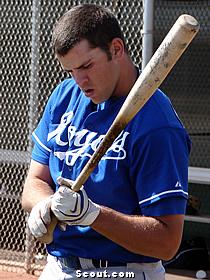 Next on the list is the Kansas City Royals’ Mike Moustakas, who has had a roller-coaster minor league ride. You might consider him in a dip right now, with a .266/.285/.432 battling line in Triple-A Omaha. But if you use MinorLeagueSplits.com to neutralize that line for bad luck (such as on balls in play) and park effects, it looks a lot nicer at .317/.333/.496. Moustakas once hit a trough like this before, as a 20-year-old in High-A ball (.254/.303/.432), but once again his adjusted line was much more palatable (.288/.334/.495). It looks like he runs into some park- and luck-created problems every once in a while, but the power has been there all along.
Two things you will notice when looking over his minor league record are his power and plate discipline. His isolated power for his minor league career is .209, which is already solid; it was an even more impressive .279 at Double-A last year, so his peak power is well above-average. The other thing you might notice is that he doesn’t walk much. His 7% rate in the minor leagues got as high as 8.7% in Double-A, but after the usually inevitable drop in the major leagues, he may not be a great option in leagues that use OBP. Given his intermittent struggles in the minor leagues – luck-oriented or not – Moustakas may also not take the league by storm in his debut. He makes for a better keeper league choice than short-term pickup.
For more on Michaels Pineda and Moustakas and the rest of the top prospects in baseball, check out Bloomberg Sports’ Fantasy Tools.
Who in the World is David Pauley?
By R.J. Anderson //
Quick, who replaced Cliff Lee in the Seattle Mariners’ rotation? Nope, not Erik Bedard or Michael Pineda. Try David Pauley. Who? The 27-year-old righty sports a 3.31 ERA through his first 10 appearances this season. With the Mariners already holding two fantasy league sleepers in their rotation this season – Jason Vargas and Doug Fister – could Pauley be the next pitcher to benefit from Seattle’s pitcher-friendly home park and excellent defense? Maybe.
Pauley has bounced around since being drafted in the eighth round of the 2001 draft by the San Diego Padres. Three years later, San Diego traded him to the Boston Red Sox in the Dave Roberts deal, who then sent him to the Baltimore Orioles five years later. After reaching minor league free agency this past winter, Pauley inked with the Mariners, where he probably did not expect to join a rotation stacked with names like Felix Hernandez, Bedard, and Lee. Yet, here he is.
Pauley had only 28 major league innings entering this season, with mixed results. His ERA was awful, and still is, but his underlying peripherals suggested he wasn’t that bad. For instance, his FIP this season is 3.91, whereas his career mark is 4.18. Even with a fastball that sits below 90 (check the chart below, he really does not throw hard), Pauley manages to get a league-average amount of whiffs, thanks to heavy usage of his change-up.

In 85 minor league innings this season, Pauley posted a 3.68 ERA. The last time he flashed an ERA over 4.50 in the minors came in 2006, during his first stint in Triple-A. Since then he’s posted ERAs of 4.33, 3.55, 4.37, and the aforementioned 3.68. Most projection systems have Pauley with a much higher ERA than league average, but that seems harsh considering his ability to get groundballs while pitching in front of a grade-A defense and in a park that restricts power.
That doesn’t mean Pauley is a must-get in your league. He’s hardly that, but he is owned in less than 1% of ESPN leagues. So if you’re in an AL-only or deep mixed league, Pauley is worth a shot.
For more on David Pauley and other potential pitcher pickups, check out Bloomberg Sports’ Fantasy Kits
Franklin Gutierrez’s 2009 Had a Twin
By R.J. Anderson //
Franklin Gutierrez‘s batting line this season should look familiar for owners who had Gutierrez last season. The 27-year-old center fielder for the Mariners is batting .278/.352/.418, compared to a very similar .283/.339/.425 last season. There have been some changes in Gutierrez’s game, though.
The most notable is his decreased frequency of balls put into play. Gutierrez (featured in the latest edition of “Ballpark Figures”, due up on the site later today) is walking nearly 11% of the time and striking out 26% of the time. Over the last two seasons he’s managed walk rates shy of 7.5% and strikeout rates below 22%. He’s just not swinging the bat as much, and as a result he’s taking some extra walks, but also taking more close pitches for strike three.
However, the added layer of patience hasn’t really affected Gutierrez’s power production. His ISO (slugging percentage, minus batting average) is .139, nearly identical to the last two seasons (.135 and .142). He’s hit seven home runs, and his home run per fly ball percentage (8.3%) is a little below his career average (9.7%), but he’s playing in Safeco Field, which is notorious for handcuffing right-handed batters’ power strokes. See for instance, Adrian Beltre‘s power surge in Boston, after Seattle.
Gutierrez is surrounded by a punchless lineup, despite the recent acquisition of Russell Branyan, meaning his chance at solid RBI totals are greatly diminished. He’s not going to score as many runs as he should either, even though he gets on base at a solid clip. The other cruel reality known well enough to any owner who thought of Gutierrez as the prototypical defensive wizard in center with outstanding range is that Gutierrez rarely steals bags. He’s only stolen 42 in his career, which stretches over 500 major league games.

There’s nothing all that new to report on Gutierrez’s status heading forward. There’s no reason to abruptly sell Gutierrez, but there’s not much of a reason to rush out and acquire him either. Everything is simply status quo.
For more on Franklin Gutierrez, check out Bloomberg Sports’ Fantasy Tools
var OutbrainPermaLink=’http://bloombergsports.mlblogs.com/wp-content/uploads/2010/07/franklin1-thumb-550×233-21987518.pngarchives/2010/06/why-it-too-early-to-give-up-on-jonathan-papelbon.html’;
var OB_Template = “mlbblogs”;
var OB_demoMode = false;
var OBITm = “1241712535489”;
var OB_langJS =’http://widgets.outbrain.com/lang_en.js’;
if ( typeof(OB_Script)!=’undefined’ )
OutbrainStart();
else {
var OB_Script = true;
var str = ”;
document.write(str);
}
 Bloomberg Sports