Tagged: Los Angeles Angels
Bloomberg Sports Fantasy Baseball 2012 Recap: First Basemen
Twitter: @RobShawSports and @BloombergSports
Bloomberg Sports Anchor Rob Shaw and Analyst Alex Burwasser recap the top five first basemen this fantasy season as well as the top three busts.
TOP FIVE PERFORMERS
5. Albert Pujols, 1B, Angels
In an offseason move that shocked many, Albert Pujols decided to leave St. Louis, his home for a decade where he won two championships, for the bright lights of Los Angeles in Anaheim. To the delight of jilted Cardinals fans, Pujols got off to a rough start for the Angels, even hearing some cat calls in his home park, but he more than made up for it over his final 105 games where he hit .319 with 26 home runs and 86 RBI. You can make a case that he may not be as dominant a hitter as he once was but he still put up his typical 30-HR, 100-RBI season, which always has fantasy value.
4. Billy Butler, 1B, Royals
Billy Butler has always been a very productive hitter throughout his career for the Royals but has consistently flown under the radar because he plays in relative obscurity in Kansas City. However, this year he was the subject of a national controversy when Robinson Cano decided not to pick him for the Home Run Derby in front of his home fans at Kauffman Stadium. Butler took the high road and did the talking with his bat the rest of the year when he finished with 29 home runs and 106 RBI, both career highs, all while hitting above .300 at .313.
3. Prince Fielder, 1B, Tigers
Much like Albert Pujols, Prince Fielder moved from the top of the NL Central to the opposite league in the offseason. Fielder signed a massive nine-year contract which left many worrying about the long-term injury risk of signing a man of his size, but his performance in the first year of that deal quieted all the critics when he blasted 30 home runs and knocked in 108 RBI leading the Tigers to their second consecutive AL Central crown. Though Prince has had more powerful years, he hit over .300 for the first time in his career, checking in at a very impressive .313 on the season.
2. Edwin Encarnacion, 1B/3B, Jays
Encarnacion had been a solid player for Toronto since acquiring him from the Reds in 2009, putting up seasons of 20 home runs and a little more than 50 RBI on average in 2010 and 2011. This season, however, he completely obliterated those numbers with 42 home runs and 110 RBI, more in each category than the previous two years combined. In addition, Encarnacion also improved in other categories, setting career highs in stolen bases (13) and walks (84). What makes this rapid improvement all the more impressive is that he did it without Jose Bautista in the lineup who missed about half the year injured. Next year could be very intriguing for the Jays with those two bats healthy and producing in the middle of that lineup.
1. Miguel Cabrera, 1B/3B, Tigers
There really is not much else you can say about the year Miguel Cabrera had for the American League champion Tigers. He was the first Triple Crown winner since 1967 (led the AL in batting average, home runs and RBI) and he did it before the age of 30! In fact, Miguel Cabrera leads all active major leaguers under the age of 30 in hits (1802), home runs (321), and RBI (1123). We are not sure Cabrera is on his way to his second championship ring this year, but it sure looks like he will be on his way to Cooperstown one day.
TOP THREE BUSTS
3. Mark Teixiera, 1B, Yankees
Every year in his career besides his rookie campaign in 2003, Mark Teixiera has had at least 30 home runs and 100 RBI, but not in 2012 when he hit only 24 home runs and knocked in only 84 RBI. Even more alarming for Teixiera is that he has seen his normally stellar batting average drop season after season. A perennial .280, and some years .300, hitter has not reached those numbers since 2009 when he hit .292. The last three seasons he has not hit above .256 including this year when he hit .251 and had a dreadful on-base percentage of .332. For the Yankees, he provides a lot of value with his defense at first base, but for fantasy owners, his value seems to be slipping fast.
2. Gaby Sanchez, 1B, Pirates
At the beginning of the year, many picked the Marlins and their revamped team with the acquisitions of Jose Reyes and Heath Bell among others to possibly win the NL East. Gaby Sanchez was one of the players set to contribute in the middle of that lineup, but much like the entire team, he was a gigantic disappointment. After the first 55 games of the season while hitting just above the Mendoza line at .202, Sanchez was sent down to the minors and subsequently traded to Pittsburgh. Though he fared better for the Pirates than for the Marlins, he still finished the year with a .217 average and only seven home runs, a huge dropoff from back-to-back 19 home run seasons in 2010 and 2011.
1. Eric Hosmer, 1B, Royals
During Spring Training, there was a lot of buzz around the Royals that they may be the team on the rise given their farm system and dearth of young talent. One of the centerpieces of this renewed hope was Eric Hosmer, and after his rookie campaign in 2011, it was easy to believe given that he hit .293 with 19 HR and 78 RBI in only 128 games. Much like his team, Hosmer severely underperformed his expectations this year hitting .232 in his first full season in the majors with less home runs (14) and less RBI (60). You would hope that this is just your classic sophomore slump for the third overall pick in the 2008 draft and 2013 is a year he can replicate or even outperform his 2011 numbers.
For more fantasy insight, visit BloombergSports.com.
Bloomberg Sports Ballpark Figures: Pennant Chase Players to Watch
Twitter: @RobShawSports and @BloombergSports
Bloomberg Sports Anchor Rob Shaw discusses both the American and National League playoff picture as we head towards the last few weeks of the regular season, while highlighting some of the possible key players that may help their team get into October.
Mark Reynolds, 3B, Orioles
He is trying to maintain his hot early start to September where he hit nine home runs and had 17 RBIs in only nine games. Though he still strikes out a ton, Buck Showalter will find a place for him in the lineup because of his prodigious power.
B.J. Upton, OF, Rays
In his all-important contract year, Upton has gotten very hot over his last 30 games up to Wednesday, where he has hit .292 with 12 home runs and 24 RBIs.
Torii Hunter, OF, Angels
At 37 years old, you would think Hunter would be slowing down, but he is having actually a career year hitting .309 with 15 home runs, nine stolen bases, 76 RBIs and 72 runs scored despite missing half of May with an injury. He is trying to hit over .300 for the first time in his career.
Josh Donaldson, 3B, Athletics
After starting out miserably this season with the major league ballclub, Donaldson was sent down to the minors on June 13th where he reaffirmed his potential by hitting .335 with 13 home runs in just 51 games. He quickly earned a call-up back with the A’s where he is now hitting .324 with six home runs and 17 RBIs through 28 games.
Kris Medlen, SP, Braves
This 26 year-old former top prospect missed all of last season while recovering from Tommy John surgery, but has re-emerged this year as one of the Braves best starting pitchers. He has been especially hot as of late, winning seven straight starts since July 31st.
For more fantasy insight, visit BloombergSports.com.
Ballpark Figures: Top Five Fantasy Baseball Players Over the Past Two Weeks
Twitter: @RobShawSports and @BloombergSports
Bloomberg Sports Anchor Rob Shaw breaks down the five baseball players who have been making a huge fantasy impact over the past two weeks.
5) Alex Rios, OF, White Sox
Rios struggled with the White Sox in 2011, batting just .227. However, he has bounced back this season with a .316 AVG, 18 HR and 67 RBI. In the past two weeks alone, he hit .353 with 14 runs, five home runs, 15 RBI and one stolen base. He is a five-tool talent and his hot streak could continue, especially considering that he plays at hitter-friendly U.S. Cellular Field. Be aware, however, that Rios is known for his inconsistency.
4) Adam LaRoche, 1B, Nationals
Like Rios, LaRoche has struggled with inconsistency. Last year was a disaster for him, as he only played in 43 games and had just a .172 average. He is known for getting hot in the second half of the season and he is living up to that right now. In the past two weeks, LaRoche has a .429 average, 10 runs, seven home runs and 14 RBI.
3) Carlos Gomez, OF, Brewers
Gomez is a solid outfielder defensively but is not known for his offense. He hasn’t been able to play every day in the past but he’s been given a chance in Milwaukee and is putting up huge numbers. Over the last two weeks, Gomez is batting .348 with 14 runs, four home runs, 10 RBI and six stolen bases. At 26 years old, he could get a chance to play full time next season.
2) Drew Stubbs, OF, Reds
Stubbs is known to be unpredictable at the plate. He steals a lot of bases and has some power but he kills your batting average. His currently has a .239 season average, but in the last two weeks, he has a .362 average with 17 runs, four homers, 11 RBI and five steals. Stubbs is a streaky hitter, so ride out this hot streak while you can.
1) Albert Pujols, 1B, Angels
Pujols had a slow start to the season but he’s been on fire recently, and it couldn’t come at a better time for the Angels. Over the past two weeks, he has a .365 average, 11 runs, seven home runs, 19 RBI and two stolen bases.
For more fantasy insight, visit BloombergSports.com.
Fantasy Baseball Injury Report: Teixeira, Grandal, Thome, Francisco, and Morales
Twitter: @RobShawSports and @BloombergSports
Bloomberg Sports Anchor Rob Shaw breaks down the injuries and comebacks of five players and how they affect your fantasy team.
Mark Teixeira, 1B, Yankees
The Yankees big bopper aggravated a wrist injury diving for a ball on Monday night. The injury first occurred Sunday, but now it looks like he will miss some time. An immediate X-Ray came back negative, but Teixeira will have an MRI Tuesday, which could dictate whether he has to spend some time on the disabled list.
Big Tex has 20 home runs and 71 RBI this season. Even with the recent swoon, the Yankees were thought of as a safe bet for the playoffs. However, if Teixeira joins A-Rod on the DL, things will change. Most notably, the Yankees could end up being buyers prior to the trade deadline.
Yasmani Grandal, C, Padres
In the midst of a rally against Reds hurler Mike Leake Monday, Grandal had to leave the game with a strained oblique. We’ve seen a lot of this injury this season and it usually ends with the player landing on the disabled list. The 23-year-old Cuban has been great in his rookie season, batting .312 with five home runs and 15 RBI in 24 games.
Jim Thome, DH, Orioles
Thome is one of the most dangerous sluggers in baseball, but nearing 42 years old, staying healthy has been a challenge lately. The Orioles have given him an opportunity to play everyday, and just when he was getting hot, Thome hurt his neck and is now getting an MRI in Baltimore to determine whether a stay on the DL will be necessary.
Frank Francisco, RP, Mets
While his 4.97 ERA may be ugly, Frank Francisco does have 18 saves in 21 attempts and was enjoying a fine June with a 2.16 ERA before he went down with an oblique injury. The 32-year-old veteran is now on the mend and could return as the Mets closer as soon as Friday. The Mets interim closer has been Bobby Parnell, who remains a bit too hittable despite a 100-MPH fastball. He has blown two of his last three saves.
Kendrys Morales, 1B/RF, Angels
Talking about injuries, Morales missed nearly two seasons, all because of a celebration after hitting a grand slam that resulted in a broken ankle. While he has been back all season, it wasn’t until Monday night that we saw a vintage performance. He blasted two home runs from both sides of the plate for six RBI in one inning.
Morales now has 11 home runs and 45 RBI through 84 games. He has been striking out too often and not walking enough, but it was a nice turn-back-the-clock performance for a player who could still have some solid years left in the tank.
For more fantasy inishgt, visit BloombergSports.com.
Fantasy Baseball Hot Topics: Greinke, Liriano, Shields, Johnson, Broxton, and League
Twitter: @RobShawSports and @BloombergSports
Bloomberg Sports Anchor Rob Shaw discusses the top stories about pitchers at the trade deadline.
Zack Greinke is an Angel
There were many teams vying for Zack Greinke this week. The former Brewers ace was considered the best available arm, assuming some of the other elites won’t get moved. The Angels made the most sense since they can re-sign him and had the prospects to force the Brewers’ hand. The Angels did give away a young shortstop and two top pitching prospects, but in Greinke, they now have the deepest starting rotation with Jered Weaver backed up by Greinke, Dan Haren, C.J. Wilson and Ervin Santana.
In his debut, Greinke went seven strong while fanning eight and allowing just two runs to score. The Angels offense, however, did not show up with just four hits and no runs in a 2-0 loss to the Rays.
The big question is what this trade does for Greinke’s fantasy value. The answer is nothing at all. He already pitched for a decent offense with the Brewers and had the advantage of opposing fellow pitchers in the National League. Now he faces a designated hitter, has to deal with the big AL offenses such as the Rangers and has to adjust to a new team and a new city mid-season. Yes, the added adrenaline of a playoff run is exciting for him, but I think he was pumped up plenty on every fifth day in Milwaukee.
Francisco Liriano Joins the White Sox
The White Sox have been eager to keep up with the Tigers and the rest of the American League this season, and since they lack the prospects needed to get someone like Zack Greinke, they will have to roll the dice on Francisco Liriano.
The 28-year-old southpaw is as talented as anyone but he has had control issues that have plagued him the last few seasons. It’s interesting that he joined the White Sox, since he actually helped them in his final Twins start, surrendering seven hits and seven runs with three home runs on July 23 at Chicago.
This is an interesting trade for the entire White Sox starting rotation since they will now go to a six-man staff. This alleviates concerns for the innings for Chris Sale but could have a negative impact on the veterans. As for Liriano, the added run support will certainly be a positive though US Cellular is very much a hitter’s park. His career ERA at US Cellular is 5.77 in 48.1 innings.
Still On the Trading Block
Rays SP James Shields will come at a very heavy price since the Rays still control him for a few years at a reasonable rate. He is 8-7 with a 4.52 ERA and 1.46 WHIP.
Marlins starter Josh Johnson is injury prone and inconsistent, and his velocity is down. However, the Marlins will only trade him if they can get a major talent back in return. Johnson is 6-7 with a 4.04 ERA and 1.35 WHIP this season.
The Royals would be happy to trade reliever Jonathan Broxton while his value is soaring. The Rangers seem interested, but he will no longer close if dealt. The Royals would likely turn to Greg Holland or Tim Collins. Broxton will lose his fantasy value since he will turn into a middle reliever with a contender.
The Mariners would love to get some value back from former closer Brandon League. He got hit hard on Sunday but had been pitching well. With Tom Wilhelmsen dominating as the team’s closer, however, League is clearly expendable. It is unlikely that he will close for whichever team acquires him unless it’s a surprise team like the Mets.
For more fantasy insight, visit BloombergSports.com.
Ballpark Figures All-Star Interviews: Ian Kinsler, Miguel Cabrera, and Mark Trumbo
Twitter: @RobShawSports and @BloombergSports
Bloomberg Sports Anchor Rob Shaw discusses the best teams in baseball right now and checks in with some of their top players at the All-Star Game.
Coming into the season it seemed like everyone was high on the Angels and Tigers, two of the more active teams in the off-season. It turns out that the Yankees are the best in baseball and the Nationals are not far behind.
The All-Star break provided a chance to check in with some of the top players from contending teams, and one player we got to chat with was Ian Kinsler, the 42nd-best fantasy player accoring to Bloomberg Sports with 65 runs, 10 home runs and 15 steals. He was one of eight All-Stars from the Rangers, a franchise that has made it to back-to-back World Series.
“It was a good first half,” Kinsler said. “I think as a team we played well. We went through a lot more ups and downs than we wanted to but we played well and we’re in first place right now. And we have eight guys here at the All-Star Game, so we’re happy.”
Another team expected to contend for the title is the Detroit Tigers. Prince Fielder was the major off-season acquisition, but this is Miguel Cabrera’s team. Cabrera is enjoying an MVP-caliber season and right now ranks as the seventh-best fantasy player. He made it clear that the start to the second half will be big.
“We feel okay, you know. We want to feel more comfortable at the end of the season, like win the division, get into first place,” Cabrera said. “I think we’re in good position. I think we’re feeling good right now. We want to start good in the second half, start to be more aggressive and win more games.”
Finally, the Angels are putting some heat on the Tigers. Jered Weaver has pitched like an ace and Albert Pujols has turned things around. While everyone is talking about the superstar rookie Mike Trout, it’s the second-year star Mark Trumbo who ranks as the top surprise. He’s batting .305 with 26 home runs and 65 RBI.
“It’s been really special,” Trumbo said. “The first month of the season is probably forgettable. We were out there competing, just the results weren’t coming in. Sometimes that happens. But since then we’ve been rolling pretty well. People are playing to their capabilities and we’ve had a lot more wins to show for it.”
The Tigers, Angels and Rangers were supposed to be the teams competing for an AL pennant this season and so far they have. If the season ended today, all three would advance to the postseason thanks to the multiple Wild Card spots. However, there is still a lot of baseball to play and several surprise teams are still out there, including the A’s, White Sox and Indians. A big move at the trade deadline or even a key promotion could make the difference.
For more insight, visit BloombergSports.com.
MLB Season in Review: Los Angeles Angels Hitters
By Tommy Rancel //
Biggest Surprise: Hideki Matsui
When Godzilla left the Bronx, no one knew how he would adjust to losing Yankee Stadium as his home park. Matsui answered those questions by hitting a solid .274/.361/.459. His batting average and on-base percentage were nearly identical to the numbers he posted in 2009 (.274/.367). As expected, his slugging dropped from .509 to .459, but he still hit 21 home runs while driving in 84, giving fantasy owners who trusted their utility slot to Matsui a lift.
Biggest Bust: Brandon Wood
Once a top prospect in the Angels’ system, Wood, 25, got his first real chance to start in 2010. He responded by putting up one of the worst offensive seasons in baseball. Over 81 games, he “hit” .146/.174/.208 with four home runs and 14 RBI. Making matters even worse, Wood showed no plate discipline or pitch recognition. He walked less than 3% of the time while striking out more than 30%. Of the swings he took, nearly 15% ended up in a whiff. There is still time for him to improve, but don’t hold your breath waiting.
2011 Keeper Alert: Mike Napoli
Mike Scioscia’s fetish for catching defense over offensive production pushed Napoli out of the Angels’ lineup more often than not at the beginning of the season. However, after injuries to Jeff Mathis and then Kendry Morales, Napoli found his way into a career-best 140 games. In those games, he hit .238/.316/.468 with a career-high 26 home runs; those 26 homers led all catcher-eligible players. With Morales coming back to man first next season, Napoli is likely to hit another 20-plus bombs with catcher eligibility next season. He should also see a boost in batting average with some simple BABIP regression.
2011 Regression Alert: Erick Aybar
Aybar was a pleasant surprise in 2009 when he hit .312 with 37 extra-base hits for Los Angeles. In 2010, he hit just .253 with 27 XBH, despite 30 more at-bats. In June, Aybar dealt with a knee injury and his season was cut short in mid-September due to a sports hernia. In addition to the injuries, Aybar’s BABIP was nearly 20 points less than his career number. This is due in part to a decline in line drives hit. He has hit 17% liners in his career, but managed just 15.3% this year. A healthy, luckier Aybar would make for a nice late-round pick in deeper leagues, with multi-position eligibility next season.
For more on Mike Napoli and the Los Angeles Angels lineup, check out Bloomberg Sports’ Fantasy Kits
MLB Season in Review: Los Angeles Angels Pitchers
By Tommy Rancel //
Biggest Surprise: Jered Weaver
Can it be considered a “good” surprise when a 16-game winner drops to 13 wins? In the case of Weaver, yes. Although his win total dropped, the righty was at his best in 2010. His strikeout rate was a career best 9.35 per nine innings, while his walk and home run rates dropped to career-low levels. He also made a career-high 34 starts and threw 224 innings. Once the owner of ace potential, Weaver has now reached ace status.
Biggest Bust: Scott Kazmir
Once upon a time, Kazmir had that ace status. Now, he’s more like a soft-tossing 35-year-old than a 26-year-old former foundation player. Making matters worse, he spent a total of 42 days on the DL with shoulder issues. When healthy, Kazmir made 28 starts going 9-15 with a 5.94 ERA in his first full season with the Angels. He struck out fewer than six batters per nine innings while walking nearly five per nine. Many cried foul when the Rays traded Kazmir last August, but it looks like Andrew Friedman made the deal just in time.
2011 Keeper Alert: Jered Weaver
It will be interesting to see if Weaver can maintain his high strikeout rate from this season. Even if it falls back to his career rate of 7.82 per nine, Weaver is one of the better pitchers in the American League. With nothing suggesting his 3.01 ERA was a product of luck, the 28-year-old appears to be entering the prime of his career.
2011 Regression Alert: Dan Haren
When the Angels acquired Haren, he was 7-8 with 4.60 ERA in 21 starts for Arizona. However, we informed you that Haren was due for some positive regression. With an above-average strikeout rate (9.0 K/9) and a minuscule walk rate (1.85 BB/9), the righty was getting some ridiculous bad luck on BABIP (.350) and home runs (1.47 HR/9). Although his Ks dropped (7.18 K/9) and his walks increased a bit (2.39 BB/9) as a member of the Angels, his home run rate was lowered to 0.77 per nine while his BABIP dropped to a manageable .286. The normalization of those two stats gave him a 2.87 ERA in 14 starts with the Angels. You can expect more of the same in 2011, even while others balk at his inflated overall numbers.
For more on Jered Weaver and the Angels pitching staff, check out Bloomberg Sports’ Fantasy Kits.
Los Angeles Angels Acquire Dan Haren
By Tommy Rancel //
With Cliff Lee off the market, the Arizona Diamondbacks held one of the few aces (Dan Haren) left on the market. Instead of getting a king’s ransom in return, they settled for a ten (Joe Saunders), a five (Rafael Rodriguez), and a pair of wild cards (Patrick Corbin and a player to be named later). The Dan Haren trade is a blow to NL-only owners; however, to members of AL-only leagues…welcome to Christmas in July.
On the surface, Haren doesn’t look like a “significant” upgrade over Saunders. Both pitchers have sub-.500 win-loss records and near-matching ERAs around 4.60. That’s where the similarities end.
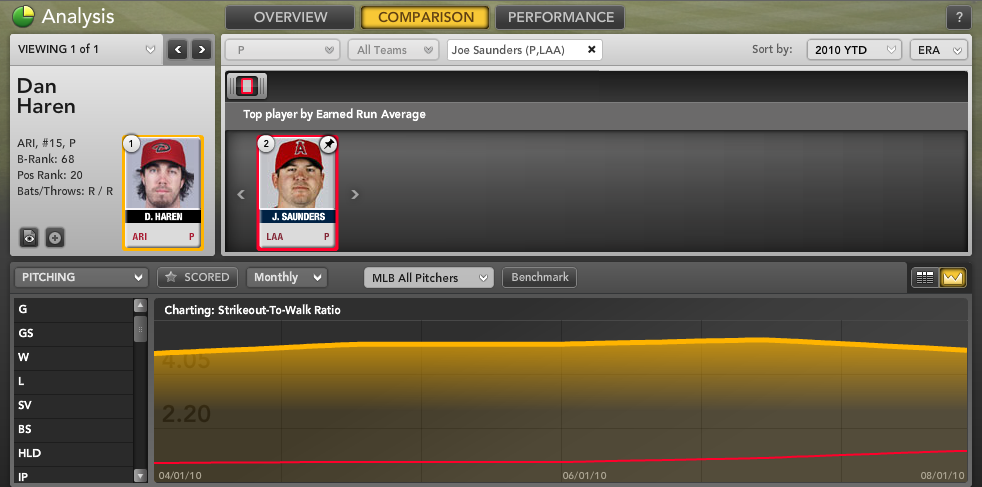
Unlike Saunders, Haren is actually better than his ERA suggests; much better. Despite the high ERA, Haren is striking out a batter per inning. His smooth 9.00 K/9 rate is a career high. Also unlike Saunders, Haren does not walk many batters. He’s handed out just 29 walks in 141 innings (1.85 BB/9), and owns a career walk rate below 2.0. According to those metrics, Haren has been a top-five pitcher in the NL. Where he has struggled in 2010 is home runs allowed, batting average on balls in play (BABIP), and strand rate.

It’s true that Haren deserves partial blame for his rather high home run rate. He has allowed nearly as many home runs (23) as walks (29). His home run per nine rate (HR/9) of 1.47 is a career worst and nearly half a homer higher than his career 1.07 rate. Outside of bad luck, Haren’s (former) home ball park is not helping matters either.
According to ESPN’s park factors, the 29-year-old is moving from a home ball park that ranks among the most generous in home runs per game to one that ranks near the bottom (22nd). Digging even deeper into park factors, Statcorner.com tells us Chase Field is extremely friendly to left-handed batters in terms of the long ball.
Looking at Haren’s splits for 2010, he is allowing more home runs to lefties (1.81 HR/9) than righties (1.22 HR/9). His home run rate at home (1.57 HR/9) is also higher his road rate (1.35). In fact, 17.1% of flyballs hit against Haren in Chase Field clear the wall. That number drops to 11.2% on the road. For his career, his HR/FB rate is 11.1%. It is not a guaranteed fix for the gopherball problems that have plagued Haren, but a move to Angels Stadium certainly won’t hurt.
In addition to the home run rate, Haren has been ridiculously unlucky on balls in play. His current BABIP of .350 is nearly 50 points higher than his career .304 level. This is odd given the rates in types of balls put in play against him (line drives, flyballs, groundballs) have not drastically changed.
His line drive rate (LD%) of 20.3% is nearly identical to his 20.0% career number. Since line drives are the type of batted ball most likely to fall for hits, it is strange that Haren’s BABIP has climbed so high. If Haren’s current BABIP regresses toward career levels, expect a significant drop in ERA.
Meanwhile, Haren’s strand rate has fallen to 70.9% from 2009’s 77% and his career 73.2%. Pitchers will often see more of the runners they put on base score as a result of a shaky bullpen. Arizona’s pen owns a stratospheric 6.50 ERA, the worst mark in the majors and a full run and a half higher than the next worst team. Better bullpen support could help Haren’s strand rate, and also his wins total, with fewer saves likely to be blown once he leaves the game (although the Angels rank a poor 25th in MLB themselves with a 4.50 bullpen ERA).
Normally, when a pitcher moves from the NL to AL, we worry about league adjustment. Haren made 102 starts for the Oakland Athletics. In those three years he went 43-34 with a 3.64 ERA. He also struck out 531 batters while walking just 153 in more than 600 innings of work.
If you’re in a mixed league, hold the line for all the reasons above. In NL-only leagues, I’m sorry. On the other hand, in a competitive AL-only format, you might as well break your free agent budget.
Lost: A Look At Scott Kazmir’s Declining Velocity and Decreasing Sliders
By Tommy Rancel //
Last season, Scott Kazmir‘s potential became too expensive for the Tampa Bay Rays. Through injuries and inconsistency, Kazmir was never able to regain his pre-2008 ace form. With more than $20 million guaranteed to the lefty, Rays General Manager Andrew Friedman could no longer bank on just potential.
In a semi-controversial move, the organization traded the most successful pitcher in the franchise’s history to the deeper-pocketed Los Angeles Angels in what many casual fans considered a “salary dump.” However, looking at the quality of the three players Tampa Bay received — Sean Rodriguez, Alex Torres, and Matt Sweeney — and the early-season struggles of Kazmir, it seems the Rays pulled the trigger just in time.
In Los Angeles, Kazmir has reunited with former pitching coach Mike Butcher. Butcher spent one season with the (Devil) Rays in 2006. It just so happened to be one of Kazmir’s best seasons; his 3.24 ERA that season is still a career best. Looking at fielding independent pitching (FIP), which takes defense out of the equation, instead measuring walks, strikeouts and home runs, his 3.36 mark that season was a career best as well.
There was hope that once re-united with Butcher, some of the inconsistencies that plagued Kazmir in 2008 and 2009 would disappear. More importantly, there was hope that his once dominant slider as well as his mid-90s fastball would reappear.
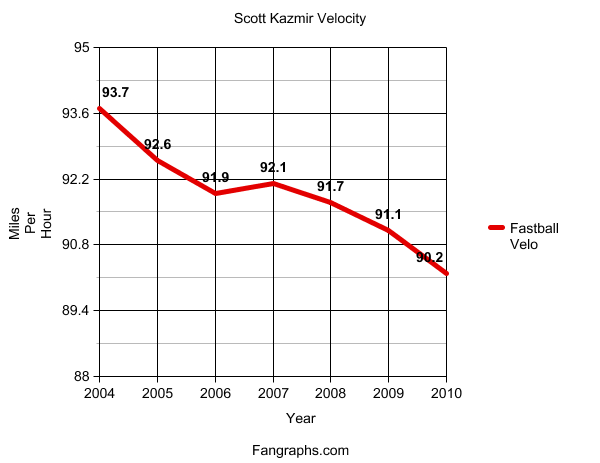
The early returns on Kazmir in Los Angeles were very good. In six starts down the stretch last season, he went 2-2 with a 1.73 ERA and 2.93 FIP. He used his slider a healthy 19.1% of the time and his fastball velocity jumped from 90.7 with the Rays to 92.5 with the Angels; potential signs that Kazmir might put it together in 2010.
Unfortunately, things are not going according to plan this season. Despite his respectable 2-2 record, Kazmir has a 7.11 ERA and a 6.43 FIP thus far. A former American League strikeout champion (2007), Kazmir is on pace to strike out fewer than eight batters per nine innings for the second straight season. While his strikeouts have slightly faded, his walk rate is climbing. He has handed out 16 free passes in just 25.1 innings – a walks per nine innings rate of 5.7.
Kazmir is throwing his fastball around 90 mph right now and is using his slider just 8.2% of the time – a career low. In a slight bit of good news, Kazmir has developed a pretty good change-up. However, between the change-up and fastball, he’s basically a two-pitch starter right now.
It should be noted that Kazmir did battle with a hamstring and (another) arm injury this spring, but one would think the Angels wouldn’t send him out there if he wasn’t 100%. After all, he is still owed more than $20 million. Whether the problem is physical (meaning delivery) or mental, Scott Kazmir just isn’t very good right now.
If you drafted Kazmir, hopefully you took past history into account and didn’t select him with the intent of anchoring your rotation. Despite the ups and downs of the past few seasons, he has won double-digit games five straight years. With two wins already, he should get there again. Meanwhile, if you’re expecting the Kid K of 2007, you’re going to end up disappointed. At this point of the season, it is too early to dump him outright, but it may be time to take a page out of Andrew Friedman’s book, and get what you can in a trade instead of banking on potential that may never pay off.
For more on Scott Kazmir and the Los Angeles Angels, check out Bloomberg Sports’ fantasy kits.

