Category: Dailies
Running with the Wolf (Pack)?
By Eno Sarris
Because of the volatility of the position
and the sheer number of available starters, it’s usually a good idea to
wait to draft your pitching in the middle rounds. Finding a 13th-round starter that cam match Randy Wolf‘s 2009 performance is the goal. Let’s look at one starter who could match Wolf’s ’09 numbers this season: Wolf, again.
The
33-year-old left-handler owns a B-Rank (Bloomberg’s proprietary ranking
of all players) of 160. That’s slightly ahead of his 174.70 average
draft position as supplied by the Bloomberg Fantasy Sports Engine.
That means Wolf he figures to come reasonably cheap despite posting
strong numbers in 2009: a 3.23 ERA, 1.10 WHIP, 11 wins and 160
strikeouts. Compare those numbers to Gavin Floyd, who owns a 136
B-Rank on the heels of his 4.06 ERA and 1.23 WHIP last season, and you would be
forgiven for thinking that Wolf is a value pick.
You’d be forgiven, but you’d probably be wrong.
There
are plenty of warning signs emanating from this Wolf in wolf’s
clothing. The first should be obvious from his injury history. Take a
look at Corey Dawkin’s Pitch f/x Injury Tool,
and
you’ll see an extensive list of elbow problems (seven separate
trips to the DL over his 11-year career, 453 days lost to the DL,
and three arm and shoulder surgeries, including Tommy John surgery in
2005). Per his Bloomberg player card, you can also see that Wolf threw
the second-most pitches of his career last year (3,286); the last time
he threw that many pitches in a season, he lost 40 innings to injury
the next
year.
The warning signs are not only injury-related. There are plenty of
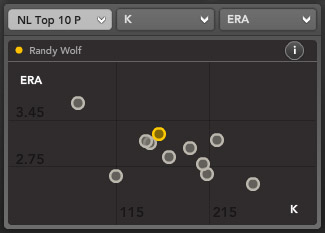
worrisome numbers too. Check out this chart from the Bloomberg’s Fantasy
engine, which shows Wolf’s strikeouts and ERA versus the top ten NL
pitchers.
As
you can see, Wolf sports a decent, but not great strikeout rate: 6.72
strikeouts per 9 IP, vs. the major-league average of 6.99 in 2009.
MLB’s average batting average on balls
in play (BABIP) usually comes in around .300 – it was .303 in 2009. Wolf’s career number in that category is
.294. Last year? Wolf posted a career-best .257 BABIP, tied for the lowest in baseball among qualified starting pitchers with Jarrod Washburn. That’s likely an unsustainable figure.
And
it gets worse – Wolf is moving
from a park with a .876 park factor for home runs (meaning Dodger
Stadium suppressed home runs by 12.4%) to a park with a 1.069 park
factor for home runs (hitters gain a 6.9% edge with the long ball).
That means that just based on park factor alone,
Wolf is likely to yield several more home runs in 2010. When you
consider that Wolf’s home run rate last year (1.01 HR/9) was better
than his career mark (1.13 HR/9), you’ll see how he benefited from
pitching in Dodger
Stadium. Lastly, Wolf stranded 77.5% of base runners
last year, which was much better than the league average (71.9%).
Wolf’s strand rate was 16th-highest in the majors, and much higher than
his career
number (73.5% LOB).
So, once you take a harder look at Randy
Wolf, you realize that much of his success last year was
context-specific. He had a great defense behind him in a great
pitcher’s park last year, and had
some good luck on balls in play. Look somewhere else for your mid-round
value starting
pitcher in 2010.
For more information on pitchers that are better values than Randy Wolf, and hundreds of other players, check out Bloomberg Sports’ fantasy application.
Cole Hamels and the Verducci Effect
By Tommy Rancel
Sports Illustrated writer and MLBNetwork contributor Tom Verducci recently released his annual list of red-flagged pitchers for the 2010 season. The list is comprised of pitchers under the age of 25 who saw increases of 30 innings or more from 2008 to 2009. The so-called “Verducci Effect” holds that such pitchers are at greater risk of injury or weaker performance the year after their big innings jump.
The theory has been questioned in numerous places. I’ll leave the broader criticism to others. For now, I’m more interested in one particular pitcher: Cole Hamels.
Before the 2009 season, Hamels appeared on Verducci’s list. Going by superficial stats, Verducci appeared to have nailed his prediction on the Phillies left-hander. Hamels followed up his very good 2008 season (14-10, 3.09 ERA at age 24), by going just 10-11 with a 4.32 ERA in 2009 at age 25.
Hamels looked like a classic case of the Verducci Effect. But was he really?
One of my favorite statistics to use when evaluating pitchers is Fielding Independent Pitching, or FIP. The method created by Tom Tango measures on-field events pitchers can control, independent of defense: strikeouts, walks, and home runs.
Despite the big ERA from 2008 to 2009, Hamels saw a slight increase in his strikeout rate, from 7.76 to 7.81 per 9 innings, and a decrease in his walk rate, from 2.1 to 2.0 per 9 IP. His HR/9 IP rate ticked up just slightly, from 1.11 to 1.12. Hamels’ fielding independent stats tell the story:
Hamels 2008 FIP: 3.72
Hamels 2009 FIP: 3.72
These statistics suggest that factors outside Hamels’ control led to the downturn in his fantasy stats. One of the biggest factors working against him was a higher batting average on balls in play (BABIP).
In 2008, Hamels yielded a .270 BABIP, a figure that ranked substantially below league average, and suggested good luck, good defense or both helping Hamels. That number jumped to .325 in 2009, a figure well above average that likely suggested bad luck, given that the Phillies didn’t make many changes to their defensive alignment.
Hamels career BABIP now sits at .295. The smart money then, all other factors being equal, is on his 2010 ERA finishing above his 3.09 mark in 2008 and below the 4.32 finish in 2009. Hamels’ career ERA of 3.67 sets a reachable goal.
Take a look at Hamels’ profile using Bloomberg’s Spider Chart (bottom center). You’ll note that he measures well in every category except ERA and Wins, both categories that could be much improved in 2010 with better luck.

As for the attitude and mental side of the game, reports out of Philadelphia say Hamels is in a much better frame of mind headed into this season. As for Hamels’ innings count, the Phillies might ask a little less of their young lefty, with new teammate Roy Halladay on board for an entire season to serve as the kind of workhorse that Cliff Lee was for Philly after last summer’s trade.
When putting together your 2010 rotation, be sure you use Hamels’ poor 2009 campaign to your advantage. Feel free to cite last season’s rise in ERA and his sub .500 win percentage to your fellow league members. Remind them that Johan Santana is coming back and has declared himself the best pitcher in the National League East.
Santana’s average draft position (ADP) is 39.5. This means in most 10- or 12-team leagues he is off the board by the end of round four. Hamels’ ADP, meanwhile, is 86.2, putting him in the eighth or ninth round in a 10-team league. Despite the four-round difference in ADP, the two left-handers are separated by just 11 spots in B-Rank. Only four starting pitchers fall in between the pair.

This is not a knock on Santana, but more an indication of how you can steal Hamels in the mid-rounds as your SP2, or even SP3, while others shy away due to last year’s ERA jump and mediocre won-lost record. Use the Verducci Effect to your advantage, and you could snag a bargain.
For more information on Cole Hamels and hundreds of other players, and for dozens of tools to help you dominate your fantasy league check out Bloomberg Sports’ fantasy kits.
Ben Zobrist in 2010
By R.J. Anderson
The question most asked about a second baseman this off-season likely revolves around Ben Zobrist
and the likelihood of a repeat season. Few foresaw Zobrist blasting 27
home runs or posting a slash line of .297/.405/.543 (AVG/OBP/SLG) in
his first year as an everyday major league player.
Zobrist’s
B-Rank (Bloomberg’s proprietary ranking of all major league players)
comes in at 47, making him a potential value pick given his average
draft position of 58. The lower ADP could suggest that some see a
Zobrist regression. Certainly one factor that might be in play is his
gradual decline over the course of last season, particularly in his
slugging percentage. On June 1, Zobrist’s SLG stood at .624 – by
season’s end it had fallen 81 points. Zobrist’s season-ending mark
still led all full-time second basemen. But second-half performances
can often have a big impact on draft position the next spring.
The
other, more obvious concern is that Zobrist cracked 27 home runs in 599
plate appearances, after hitting 23 home runs in 1,642 minor league
plate appearances. Throughout the minors Zobrist was an on-base machine
who lacked power. Then he met up with an aspiring hitting instructor
named Jamie Cevallos – and something apparently clicked.
Perhaps
the most appealing attribute of Zobrist’s game is his versatility. He
qualifies at second and in the outfield in all leagues. Zobrist also
played 13 games last year at shortstop, making him a decent bet to
qualify at short at some point this season for leagues with five- or
10-game in-season thresholds. As demonstrated by the bold font in the
Position Eligibility chart below, Zobrist actually made starts at every
position except catcher, designated hitter, and pitcher last season –
and he did appear as a pinch-hitter in the DH slot once as well.
Zobrist
will see playing time throughout the season and should bat in the
middle of one of the better lineups in baseball. His impressive on-base
skills should create plenty of runs scores chances, and his lofty
contact rate and emerging power – even if it regresses somewhat –
should help his RBI total. Zobrist also stole a career-high 17 bases in
’09, and should get plenty of chances to run in Manager Joe Maddon’s
aggressive attack.
The influence of a hitting guru aside, the simple dynamics of regression to the mean – what Bill James called the Plexiglas Principle
– tell us that a player who sees a big jump in performance one year
should expect to pull back the following year. Expect Zobrist’s power
numbers to drop as a result. Still, his overall skill set makes him a
good get in the fifth round of your draft; especially if your
leaguemates think his ’09 breakout was really a fluke.
For more information on Ben Zobrist and hundreds of other players, check out Bloomberg Sports’ fantasy kits.
Need Another Outfielder? Choose Choo
By Tyler McKee
Many of the seats at The Jake – ahem, excuse me – “Progressive
Field'” are likely to sit empty this summer, as the Cleveland Indians
figure to muddle through another losing season.
The Tribe’s roster similarly contains some underexposed players. Shin-Soo Choo
continued to quietly emerge as one of the American League’s most
productive outfielders last season, easily outdistancing more heralded (and more desired)
players, such as teammate Grady Sizemore – despite Sizemore missing 56
games and putting up much weaker numbers than Choo in 2009.
Choo put himself in an elite class last season, becoming one of just
14 players to reach 20 home runs and 20 stolen bases. Choo is an elite outfield option with
an elite reputation, with few offensive holes in his game and
across-the-board contributions in 5X5 fantasy leagues – as shown in
this Bloomberg Sports Spider Chart.
The
chart shows Choo rating above league average in all five offensive
categories: 20 homers, 21 steals, 86 RBI, 87 runs scored, and a .300
batting average. Advanced metrics, which account for walks and other
non-fantasy contributions, show Choo with 116 Runs Created in 2009.
That total places him behind only one other MLB outfielder: Brewers hitting Ryan Braun.
Choo’s a safe
bet to play against any pitcher, given his reasonable splits. In 2009, he hit a stellar .312/.406/.504 (AVG/OBP/SLG) against right-handed pitching, and a still solid .275/.369/.456 vs. lefties.
Choo
does have one glaring weakness: he strikes out a lot – he whiffed 151 times last season. Few players can rack up strikeout totals that high and
still maintain a .300 average. A sky-high
.370 batting average on balls in play (BABIP) helped Choo pull off the feat last year; expect some BABIP
regression in 2010, and with it some downside batting average risk.
Even
with a potential batting average pullback, Choo’s all-around skills make him a great selection. It’s Choo’s potential value play that makes him most attractive, though. The 27-year-old right fielder is getting picked in the middle
rounds of drafts, with an Average Draft Position of 76. Compare
that number to Choo’s B-Rank: Bloomberg Sports’ proprietary overall
ranking slots him as #27 overall, eighth among OF. That 49-slot gap is
one of the largest for any player in our database.
Target Choo around the late-fifth or early-sixth round
in a 12-team mixed league. If you land him near that spot, you’ll have a big,
screaming bargain.
For more information on Shin-Soo Choo and hundreds of other
players, and for dozens of tools to help you dominate your fantasy
league, check out Bloomberg
Sports’ fantasy kits.
E-Jax’s Fantasy Value
In 2007, Jackson suffered through a seemingly miserable season, posting a 5-15 record and 5.76 ERA, the kind of stats that will torpedo a fantasy season. Turns out Jackson was the victim of bad luck and especially bad defense that year. Pitching in front of noted defensive sieves such as Delmon Young and Brendan Harris, Jackson yielded a stratospheric batting average on plays in play of .351. His xFIP (expected Fielding Independent Pitching, a stat that runs along a similar scale to ERA, but strips out the impact of defense, park effects and other factors outside a pitcher’s control) was nearly a run lower than his ERA, at 4.95. This was a roughly league average pitcher thrust into the worst situation.
In 2008, Jackson appeared to take a huge step forward. The big right-hander upped his record to 14-11, with a 4.42 ERA, delighting fantasy owners who gambled a late-round pick on him. But a closer look revealed that he hadn’t changed at all. Jackson owed most of the improvement in his superficial stats to a vast improvement in the Rays’ defense. According to Ultimate Zone Rating, a stat which tracks fielders’ ability to make plays in and around their assigned positions, the Rays moved from dead last in baseball in 2007 with a mark of -57.7 to first in 2008, at 74.2. Put another way: Every 10 positive UZR points add up to roughly one more win in the standings for a given team.
So Tampa Bay’s defense went from costing the team nearly six wins in 2007 to adding more than seven wins to the ledger in 2008. That’s a gigantic, 13-win improvement – one of the biggest year-to-year changes in MLB history – before any Rays pitcher made a pitch or any Rays batter took a swing. Indeed, Jackson’s xFIP actually rose from 4.95 in 2007 to 5.03 in 2008, as some of Jackson’s peripheral stats, including his strikeout rate, got worse. It seems impossible to believe that a pitcher could go from 5-15 to 14-11 and actually prove slightly less valuable to his team on a per-inning basis – but Jackson turned the trick.
After the ’08 season, Rays management saw a chance to trade a pitcher whose perceived value likely outshone his actual value, and that’s exactly what the team did – shipping Jackson to Detroit for promising outfielder Matt Joyce.
At first glance, Jackson’s debut season in Motown
could be seen as a major breakout: His ERA dropped nearly another full run to 3.62 (7th in the American League), his strikeout-to-walk ratio jumped over the key 2:1 mark, and Jackson gave the Tigers a career-high 214 innings pitched (also 7th in the AL). His xFIP slid to 4.39. Combine his increased innings total with his improved performance, and FanGraphs estimates that Jackson’s season was worth 3.5 Wins Above Replacement — or three-and-a-half more wins than a fringe major league pitcher — for Detroit.
Even in a very good season, Jackson still showed his share of flaws. First, Jackson’s season reveals a massive chasm between his first and second
half numbers. In the first half he was one of the American League’s
top pitchers, walking just 35 batters in 121.2 IP and compiling a 2.52 ERA. The
second half wasn’t as kind, as Jackson allowed more hits, runs, and
home runs while walking the same number of batters in nearly 30 fewer
innings. His full season marked of 1.14 homers allowed per nine innings was higher than average among qualified starters, a puzzling and troubling sign at Comerica Park, which suppressed homers by 2.6% compared to league average in 2009, and rates as a pitcher-friendly park compared to other MLB stadiums.
This off-season, Jackson was involved in another trade, this one sending him to Arizona. So, which Edwin Jackson should we expect to see in 2010?
Here are some factors to consider when drafting Jackson:
1. He’s moving to Chase Field.
While moving out of the American League is generally a good thing for a pitcher due to lower run-scoring totals in the NL,
moving into one of baseball’s best hitters parks is not. Chase
Field consistently ranks among the leaders in run factor – it boosted offenses by 19.3% in 2009 and 13.5% in 2008. A mistake
pitch that may found a glove in the outfield of Comerica Park last
season may not have the same fate at Chase.
2. The defense playing behind him is good, though maybe not as good. Detroit had one of the league’s top defensive units playing behind
Jackson last season, ranking fifth in team UZR at 43.6; Tigers starters Adam Everett, Placido Polanco, Brandon Inge,
and Curtis Granderson all ranked among the best defenders at their respective
positions. As was the case with Tampa Bay in 2008, the stellar defense
gobbled up many of the mistakes Jackson may have made and helped to lower his
batting average on balls in play, which in turn saved runs and lowered his ERA. The Diamondbacks, meanwhile, ranked a solid 9th in team UZR in 2009, though just 23rd in 2008, while not making many changes to their everyday lineup.
3. The offense supporting him isn’t very good. Yes, Mark Reynolds is a big time power threat (44 homers in 2009), Justin Upton is a star
in the making, and Adam LaRoche’s bat should help stabilize the first
base position. Beyond those three, the DBacks trot out a group of 20-something hitters high on potential and low on results (to date). According to our Competitive Factors tool (see image below) the Diamondbacks ranked 19th
in batting in 2009, scoring just 720 runs despite playing in a great park for hitters. Jackson isn’t a good enough
pitcher to win many games by himself, like Zack Greinke had to do last
season playing for the hapless Royals. Jackson’s going to need help, and unless Chris Young and Stephen
Drew can finally live up to their outstanding potential, Jackson will
struggle to receive enough run support to match his win totals from the
previous two seasons.

4. The NL West. This factor could work out in Jackson’s favor. Thanks to an unbalanced schedule,
Jackson will get to face the Padres and Giants a lot. Those two
teams’ offenses finished 29th and 30th in our Competitive Factor batting rankings last
season, due to both their pitcher-friendly ballparks and talent-deficient lineups. Facing those offenses adds some instant value to a pitcher’s
worth, as will traveling to Petco Park and AT&T Park, as well as Dodger Stadium (Coors Field will be the one road park in the NL West that could significantly hurt Jackson’s performance).
Edwin
Jackson currently owns a B-Rank (Bloomberg Sports’ proprietary ranking of all players) of 55 among starting pitchers. This
number looks high to me, artificially inflated by one stellar
half of baseball. You’re more likely to find better value in someone
like Carlos Zambrano, who is ranked only a few places behind Jackson. Choose wisely, my friends.
For more information on Edwin Jackson and hundreds of other
players, and for dozens of tools to help you dominate your fantasy
league, check out Bloomberg
Sports’ fantasy kits.
-Erik Hahmann
Curtis Granderson Will Enjoy Yankee Stadium
A year after making the biggest splash(es) on the free agent market, the New York Yankees went a different route this off-season. One of the biggest moves of the off-season was a three-team, seven-player trade that landed Curtis Granderson in the New York Yankees’ outfield.
Granderson, 29 next month, is now tentatively penciled in as the number-two hitter in a talented Yankees line-up. After hitting 19 home runs in 2006, his first full season, Granderson posted back to back 20-plus home run seasons in 2007 and 2008, then reached the 30-HR plateau for the first time in 2009. For comparison, the major league average for outfielders was 19 in 2009. Take a look at Bloomberg Sports’ time-line based trend chart (bottom right).
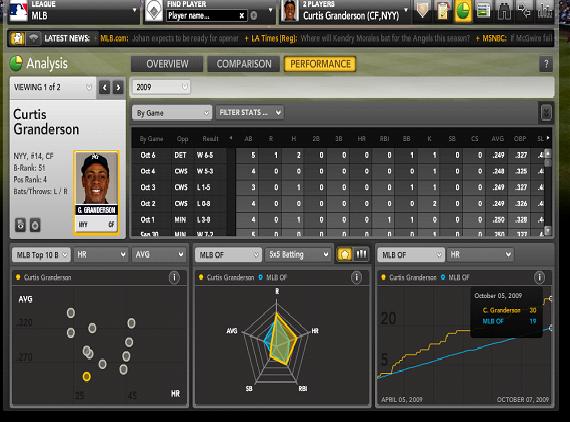
There are some concerns about Granderson’s declining batting average (career-high .302 in 2007, .280 in 2008, full-season career-low .249 in 2009). But Granderson has maintained a selective approach, pushing his walk rates over 10% in each of the past two seasons. In addition to the walks, he is due for some positive regression on balls in play. Granderson’s career batting average on balls in play (BABIP) is .323. That’s a little above the league average, but not extraordinarily high for a player with good speed. In 2009, though, his BABIP fell to just .276. Expect that number to rebound this season which would in turn improve his batting average.
Another area of concern is Granderson’s platoon splits. For his career, Granderson has hit an impressive .292/.367/.528 (AVG/OBP/SLG) against right-handed pitching, but just .210/.270/.344 vs. lefties. Last season showed an even more extreme split: .275/.358/.539 vs. RH, .183(!)/.245/.239 vs. LH. Still, several baseball analysts have argued that when a player’s platoon splits are as extreme as Granderson’s, there’s plenty of room for regression on both sides.
A true left-handed pull-hitter, Granderson’s slashing, line-drive power is a perfect match for his new home. Yankee Stadium fueled huge numbers for power hitters last year, especially left-handed pull hitters. In 2009, Comerica Park had a home run park factor of .974, the 18th-best figure for hitters in the majors (1.000 is neutral, meaning home runs were suppressed by 2.6%). The launching pad in the Bronx sported a home run factor of 1.261 (i.e. 26% above average), tops in all of baseball.
Looking at Granderson’s power numbers to each field further supports this theory. For his career, Granderson sports a slugging percentage of .510 on line drives and flyballs hit to left field, .556 to center field and a huge .744 to right field. Granderson’s home run-to-flyball ratios tell a similar story. Again moving from left to right field, here are his career HR/FB%: 4.4%, 5.9%, 29.1%(!!!) Nearly one in every three fly balls hit by Granderson to right field have gone for home runs in his career – and that’s without the benefit of Yankee Stadium’s friendly confines.
Of course you can’t mention Granderson without the player he is replacing in the Yankee lineup, Johnny Damon. Like Granderson, Damon’s slashing, left-handed swing was a perfect match for new Yankee Stadium. In his first and only season at the ballpark, Damon tied a career-high with 24 home runs and set a career high in isolated power (slugging percentage minus batting average).
Playing at old Yankee Stadium in 2008, Damon posted a .684 slugging percentage to right field, with a strong 23.5% HR/FB rate. In 2009, those numbers rocketed to .859 SLG and 31.5% HR/FB to right field. Once we factor in age, defense, contract and the likelihood that Granderson might have more natural power than Damon, you can see why the Yankees made the switch.
Currently, Granderson’s average draft position (ADP) is 56. His B-Rank of 40th overall suggests this is quite a bargain. Looking at the Demand vs. Scarcity chart, you’ll notice that Granderson is in the fourth tier of center fielders. Just to the right of Granderson’s yellow dot is another dot also located on the fourth-tier; this belongs to Grady Sizemore. Currently, Sizemore is being drafted around 13th overall, 43 spots before Granderson. However, Sizmore’s B-Rank of 32 pegs his value just eight spots ahead of Granderson. This means you can pass on Sizemore early, wait until the fourth or fifth round for Granderson, and still receive similar production.
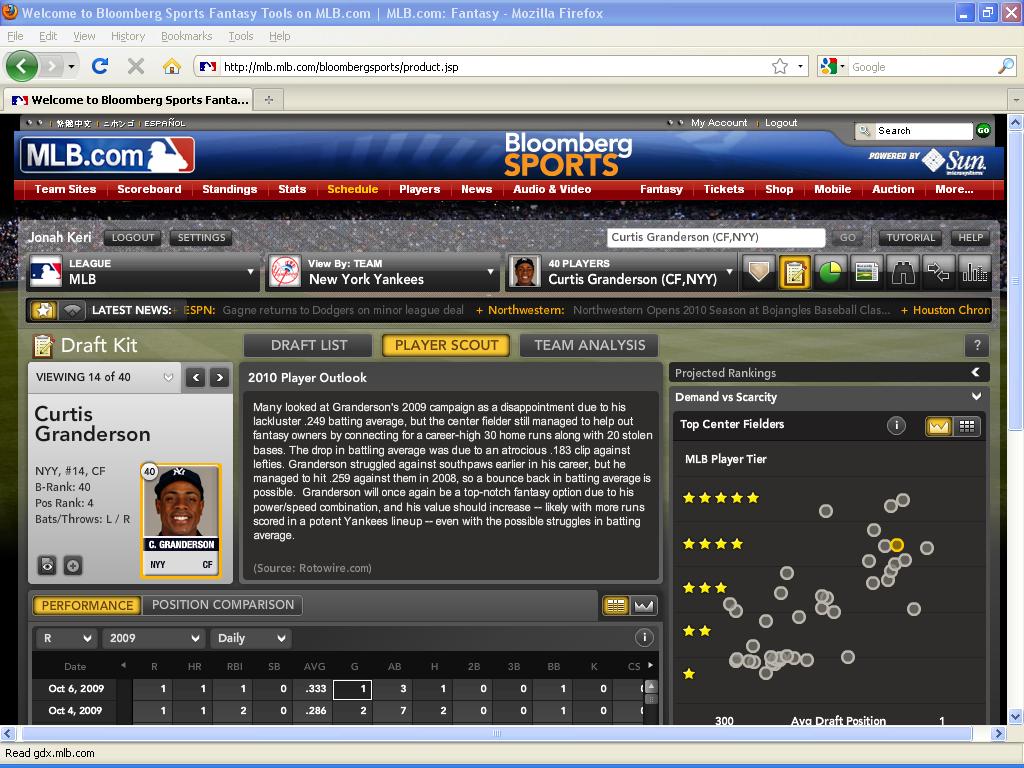
With the expected increase in home-park influenced power, potential BABIP regression, and being in the middle of his perceived physical prime, Granderson’s 2010 season projects to be his best yet. Throw in Granderson’s average of nearly 20 stolen bases a year since ’07 and his impressive blogging skills and you have a must-get player. Draft the man.
For more information on Curtis Granderson and hundreds of other players, and for dozens of tools to help you dominate your fantasy league, check out Bloomberg Sports’ fantasy kits.
–Tommy Rancel
Milton Bradley in Blue and Teal
Seattle’s star-inhaling, soul-exhaling off-season gained the Mariners praise throughout the baseball community. General Manager Jack Zduriencik combined obvious moves (like giving Felix Hernandez a contract extension and trading a stack of B+ prospects for Cliff Lee) with some inherently risky gambles. Those moves now have the Mariners in position to not only compete, but also to win the American League West this season. Such a premise seemed impossible just 12 months ago.
Acquiring Milton Bradley qualifies as both an obvious move and a risky gamble. Getting out from under Carlos Silva’s mammoth contract (and equally mammoth – as in, extinct – pitching ability) could’ve meant taking an equally poor contract in exchange. Instead, the Mariners received what could become a relative bargain – if Bradley can stay sane and healthy.
Second-year manager Don Wakamatsu has gained a reputation as a handler of diverse personalities and masseur of egos. The M’s also hope the presence of Ken Griffey Jr. as designated tickler and upbeat presence will help soothe Bradley’s volatile temper. The Mariners will accept injuries that happen in the heat of battle. What they don’t want are lengthy suspensions caused by their underestimating Bradley’s unique personality.
Enough about the mental aspect of things though, let’s talk about the quantifiable. Just once in the past five seasons has Bradley topped 500 plate appearances. The past couple years ranked among his most durable, though. After appearing in 126 games with the Rangers (just 20 as an outfielder) in 2008, Bradley nearly matched – and if not for a suspension, would’ve surpassed – that total while playing 109 games in the outfield.
The M’s plan to give Bradley playing time both in left field and at DH. The presence of Ryan Garko, Ryan Langerhans, Michael Saunders, and even Griffey, there’s enough alternatives that Wakamatsu can get really creative if he so wishes. Still, Bradley’s the cream of that crop, a switch-hitter with a line of .289/.398/.483 (AVG/OBP/SLG) in the past three seasons, with 61 home runs, 206 runs batted in, and 22 steals.
Bradley currently holds a B-Rank of 224th, a nod to injuries depressing his counting stats. Other factors are also conspiring against Bradley’s fantasy value. First, he turns 32 in April; the recent success of outliers like Barry
Bonds and Mariano Rivera aside, baseball players still peak most often
before their 30th birthday, with every subsequent year raising the risk
of injury, declining performance, or both. He’ll also now play half of his
games at Safeco Field, one of the toughest parks in baseball on hitters, doubly so on right-handed hitters with power, given the park’s spacious dimensions in left-center field. (Just ask Adrian Beltre.)
On the plus side, Bradley should see plenty of at-bats from the left side of the plate, where park factors aren’t as harsh and where players like Raul Ibanez and Russell Branyan have found success in recent years.
Bradley deserves ample consideration in AL-only and shallower mixed leagues. If he bats high in the order, he could see ample RBI opportunities behind speedy OBP machines Ichiro Suzuki and Chone Figgins. You can also get strategic in how you handle Bradley on your fantasy team. Drafting Bradley, then hedging with another outfielder with a little less ability but more durability, should allow you to get the best of his production, without taking a major hit in the event of an injury or – yes, we have to say it – possible suspension.
It’s easy to see why general managers – both in fantasy and real life – are willing to give Bradley additional chances. His upside is too good to push aside completely. But if you’re planning on drafting him, do what the Mariners plan to do: Handle with care.
— R.J. Anderson
Matt Kemp vs. Chase Utley
I’ll just get this off my chest. I love Matt Kemp. (Pause.) It’s okay, though. Because I also love Chase Utley. (And all of his pomade!)
Let’s say I’m coming up on my sixth pick in the draft, and B-Rank (the
proprietary Bloomberg ranking tool, spit out by gnome-like geniuses toiling in
the depths of the silver mountain that is Bloomberg headquarters on Lexington
Avenue), tells me Kemp is ranked fifth, and Utley is ranked 10th.
That’s just a start. Any tool worth its salt is not
trying to make decisions for you – instead it’s about giving you the
opportunity to make your (informed) decisions. And in this case, the question
is how much you value positional scarcity and consistency.
In one corner we have the rising star. Kemp’s on his way up
the charts and is projected to be the number-one center fielder in baseball
next year. He went from 12th at the position to fourth in
home runs last year, and he did it by slowly ramping up his flyball rates
(from 35.9% his first year to 38.3% last year) while still hitting line drives
in bunches (21.5% career). You can see on his scout page that his slugging
percentage was steady all year, and he didn’t hit a wall. His career
78% stolen base success rate bodes well for him to continue stealing bases at a
rate that has been top-ten in baseball at his position for two straight years. He’s
got the green light. The power is projected to continue its upward trajectory,
and his speed will stick around. What’s not to love? He’s got upside in
bunches.
In the other corner we have the steady veteran Utley, who also
offers a blend of power and speed. Take a look at Bloomberg Sports’ player scout tool, and you’ll see
that Utley’s been number one at his position since 2007. In the past three season, he’s ranked third, first,
and second in home runs; second, seventh, and twelfth in batting average; and 16th, 13th, and sixth in stolen bases among second basemen. If you want efficiency on the basepaths, Utley is your man: He owns an 88% career success rate – and
wasn’t caught once last year in 23 attempts. Of course, his game is still built around power; Utley’s SB total last year was the
best of his career, he’s 31 years old now and has likely peaked in the stolen base department.
Power and consistency are more likely to be lasting traits. Utley’s never hit lower than
.282 in a season, or slugged worse than .508 — he’s still the consensus best second baseman on the board. Bloomberg Sports’ Demand vs. Scarcity chart shows you that only Ian Kinsler joins Utley in the category of five-star second basemen. Only seven
second basemen rate as four-star or better.
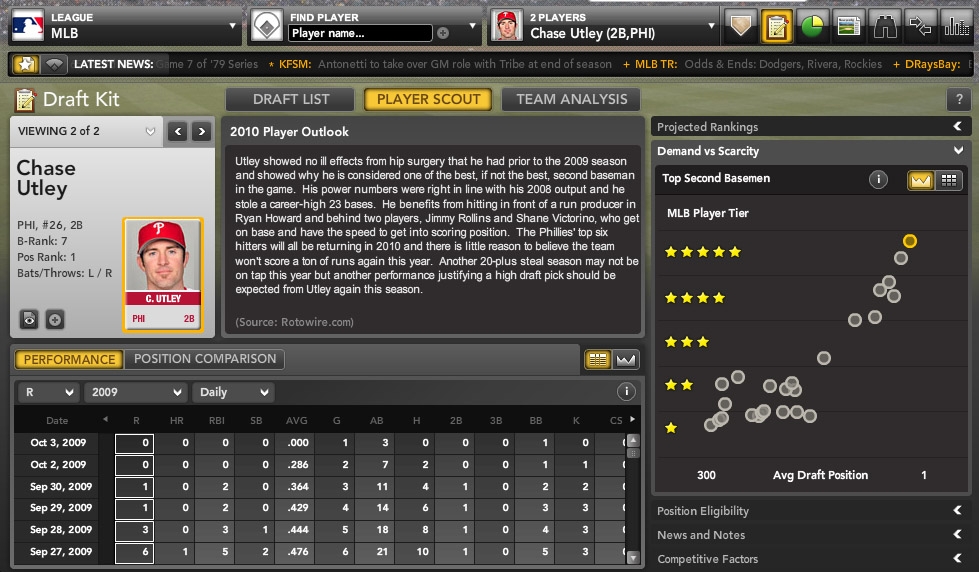
Let’s just go back to the Demand vs. Scarcity chart
for Kemp, because it’s my favorite tool in the tool belt. You’ll see that Kemp
is a five-star center fielder, like Utley is at his position, but that there are
three others in his tier. There are also 11 center fielders that are
four-star or better. If your league doesn’t break down outfielders into three
positions, Kemp’s talents become even less exceptional, as Bloomberg Sports rates 23 left fielders and
right fielders with four stars, and 11 with five stars.

If you value positional scarcity, the nod goes to Utley. If you want the young guy on his way up no matter where he plays, you
take Kemp.
For more information on Chase Utley, Matt Kemp and hundreds of other players, check out the new Bloomberg Sports fantasy application.
–Eno Sarris
Welcome to the Bloomberg Sports Blog
Welcome to the debut of the Bloomberg Sports blog, a partner of Major
League Baseball and part of the MLBlogs network. Starting today and
continuing through the final pitch of the World Series, we’ll cover all
the hot topics in baseball and fantasy baseball, with the help of Bloomberg Sports’ proprietary software and analytics.
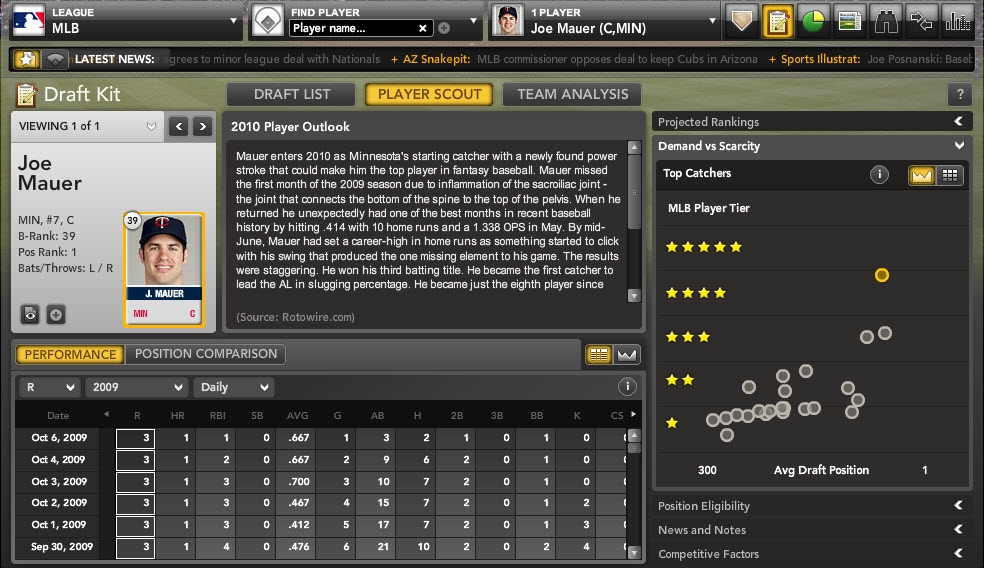
Say you’re preparing for your fantasy draft, targeting Joe Mauer as
your starting catcher. Bloomberg Sports’ Draft Kit includes rankings
for every player, called B-Rank. Using B-Rank, you’ll see how Mauer
stacks up against all other players.
You can then delve deeper. Say you want to eyeball a player’s value against others at the
same position, then make an informed decision on when in the draft to
grab him. Bloomberg Sports’ Scarcity vs. Demand graph shows you a graph
of the top 10 players at that position, how high each one should be
drafted, and where the best values might lie. If you’re scouting Mauer,
the yellow dot representing the Twins catcher will show up far above
all other catchers, a sign of his unique value.
Now let’s explore a player whose ranking isn’t as obvious, newly signed Arizona Diamondbacks first baseman Adam LaRoche.
According to B-Rank, LaRoche rates 17th among all major league first basemen for projected 2010 fantasy value, given standard 5×5 criteria. In a 12-team National League-only league or deep mixed league, LaRoche would be worthy of a starting job. He would project as a mid-to-late round pick, in a cluster with decent but unspectacular players like the Dodgers’ James Loney in the Scarcity vs. Demand graph.
Using our Spider Chart, you can see that LaRoche derives most of his value from counting stats such as home runs, runs scored and RBI, with less value derived from his batting average and virtually none from stolen bases. At a glance, you can spot LaRoche’s 2009 totals in every category against other players major league-wide, or just other first basemen. His 25 home runs, for instance, placed just below the average of 27 homers for qualifying MLB starters at first base, well below the MLB-leading total of 47 at that position.
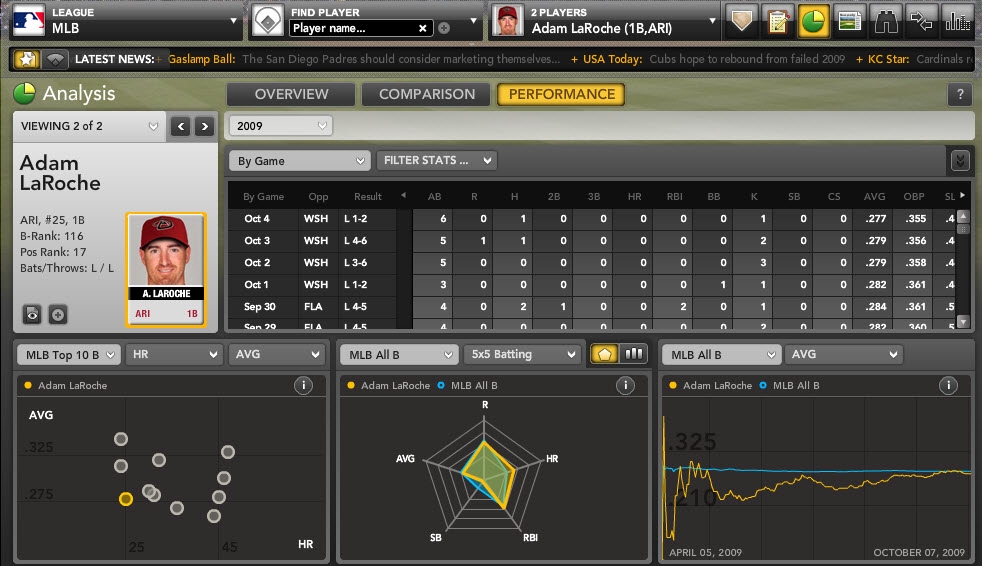
Using the Scatterplot tool, you can
compare LaRoche’s value across two categories at once, measured against the top 10 players
in that two-category combination — home runs and batting average, RBI and stolen bases, and other customizable combinations.
The Bloomberg Sports team of writers will then dig up more nuggets of information for your perusal. Say you’re satisfied with LaRoche as a low-end starter for your team. But you’re concerned about his large splits – for his career, LaRoche has batted .252/.326/.447 (AVG/OBP/SLG) in the first half, with a much stronger .300/.363/.546 line in the second half. You might then view LaRoche as someone to target in trade around the All-Star break, rather than spending a pick on him in your draft or auction.
Ascertaining why a player fares better in one half of the season compared to the other can be a tough task. Often it’s the equivalent of flipping a coin and landing on heads five times in a row: a rare but possible occurrence that’s based simply on random chance.
Occasionally there might be other reasons. Some players perform better in warmer weather, or at least hit for more power in warmer weather. In Pittsburgh and even Atlanta, where he played the bulk of his first six major league seasons, LaRoche’s power indicators jumped across the board as temperatures rose. For his career, he’s hit home runs on 12.7% of his flyballs in March and April, 11.7% in May and 12.8% in June. That number soars to 18.9% in July and 17.0% in August, making LaRoche a greater power threat in the warmer summer months. In sweltering Phoenix, LaRoche can expect average highs of 84 in April and 93 in May. By June, the Diamondbacks will likely close their retractable roof for most games, with average temperatures near or over 100 for the final four months of the season. The closed roof would in turn create cooler home playing conditions as the season wore on.
We can’t say for certain if LaRoche’s superior performance and higher power output in the second half is the result of warmer weather – it could simply be another way to look at the same random streak of better second-half performances. If it is weather-related, though, playing in Arizona, and facing warmer-weather opponents more often in the NL West, could portend a hotter-than-usual start for LaRoche.
LaRoche could also get a boost from more favorable ballpark effects. Chase Field consistently ranks as one of the most favorable stadiums in baseball for hitters – second behind Coors Field in run factor last season and second behind Rangers Ballpark in Arlington. Chase’s configuration also plays to one of LaRoche’s greatest strengths as a hitter. LaRoche has averaged 37.5 doubles per year in the past four seasons, ranking him among the league leaders in that category. Only Fenway Park, with its shallow, towering Green Monster, has yielded a higher doubles effect in the past two seasons than Chase Field.
Once the season starts, Bloomberg Sports’ In-Season tools let you
track a player’s day-today performance down to the finest details. Say
you drafted LaRoche and he got off to another slow start, hotter weather and all. The Visual Benchmark
tool lets you plot how LaRoche’s three home runs through the first 40
games of the season compare to different cohorts: other players at his
position, other National League players at his position, or the league
average for all players.
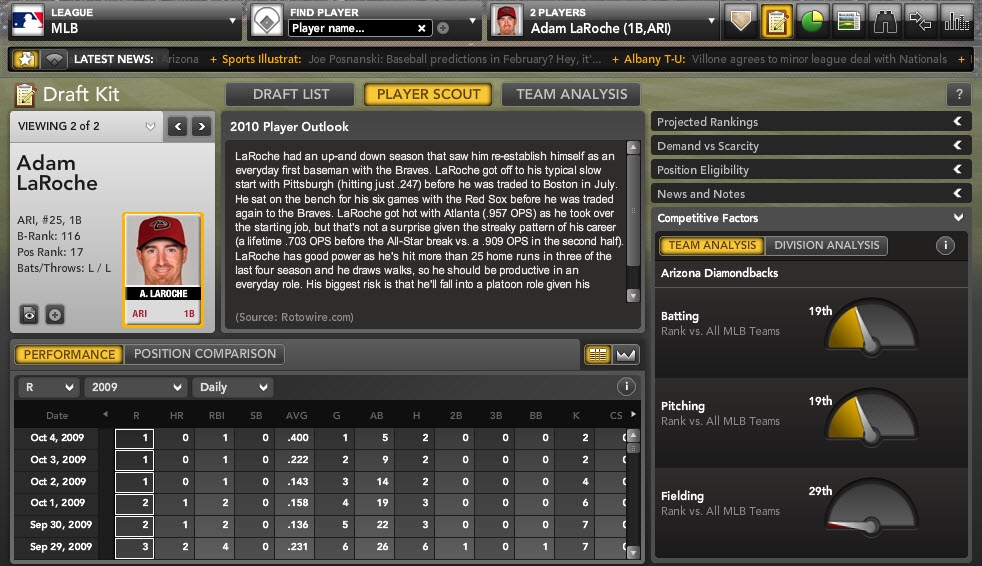
Still not sure if you should hold or cut bait? Using the
Competitive Factors tool, you can see how LaRoche’s new team stacks up
against the rest of the league. Last year, the Diamondbacks ranked 19th in batting average (20th in MLB in runs scored), despite their hitter-friendly home park. If Chris Young, Stephen Drew and other talented but erratic teammates don’t fare better in 2010, that suppresses LaRoche’s potential to score
and drive in runs – meaning you might want to consider a different option at first base.
This blog will help you leverage these and many other tools, by pairing Bloomberg
Sports analysis with the latest MLB happenings. Joining myself and
Bloomberg Sports’ Tyler McKee are the following writers:
R.J. Anderson:
His work has appeared in Baseball America, USA Today, ESPN.com, The Hardball
Times, FanGraphs, The Graphical Player, and RotoJunkie’s Annual
Baseball Draft Guide, The Fix.
Erik Hahmann: His baseball and fantasy baseball writing has appeared at Heater Magazine, DRaysBay and Beyond The Boxscore.
Tommy Rancel: He’s written for a number of publications, including Beyond The Boxscore, Inside the Majors and The Hardball Times.
Eno Sarris: He’s covered baseball and fantasy baseball for FanGraphs, Yahoo Fantasy
Baseball, RotoExperts and GodBlessBuckner on the Fanball network. He
won a Fantasy Sports Writers’ Association Award for his work at Fantasy
Lounge Sports.
Pitchers and catchers are reporting throughout the Grapefruit and
Cactus Leagues and we couldn’t be more excited to start the season.
Bookmark bloombergsports.mlblogs.com for the latest news and analysis. You’ll also find us as a Featured blog at MLBlogs.com, as well in the MLBlogs.com Pro Blogs pull-down menu, under Fantasy.
Also, follow us on Twitter @BloombergSports and Facebook.
Then, be sure to check out Bloomberg Sports’ Draft Kit and In-Season Tools.
Play Ball!
–Jonah Keri
 Bloomberg Sports