Top 10 (Or Eleven) Sources Of Power Up The Middle

By Tommy Rancel //

When you think of power positions in baseball you immediately gravitate toward the corners. In fact, last season nine of the top-10 home run hitters had fantasy eligibility at first base, right field, third base or left field. These four positions produced 15 hitters with at least 30 home runs including league-leader Jose Bautista, who started at three corner positions (1B, 3B, RF) in 2010. While the bulk of major league power will continue to come from these positions, there is some power to be had up the middle as well.

The following list is comprised of players with middle of the field (2B, SS, C, CF) eligibility who are projected to hit at least 25 home runs in 2011 by Bloomberg Sports’ proprietary system.

Dan Uggla
Troy Tulowitzki
Carlos Gonzalez
Curtis Granderson
Mike Napoli
Jayson Werth
Josh Hamilton
 Aaron Hill
Hanley Ramirez
Matt Kemp
Robinson Cano

Uggla has been a steady source of power from the second base position. He has hit at least 27 home runs in each of his five big league seasons and has topped 30 in each of the last four years. Although he changed uniforms this offseason, Uggla shouldn’t see much of a difference in home runs and is projected to top the 30 home run plateau for a fifth straight season.
Moving down the list, reigning AL MVP Josh Hamilton and NL MVP candidate Hanley Ramirez come as no surprise.  Both are ranked within the top-25 of all players according to Bloomberg Sports and will come off the board quickly on draft day.

While the list features some well-known names, there are two under-the-radar candidates among the bunch. After a breakout season in 2009, Aaron Hill hit just .206 with a .695 OPS last season. The good news is he still packed some punch and belted 26 home runs. His 62 home runs since 2009 are second behind Uggla (64) among second basemen. Bloomberg Sports’ projects him for another 27 home runs this year with a nice rebound in batting average as well.

The lone catcher on the list is Mike Napoli. Although he made a pit stop in Toronto, Napoli finds himself in a hitter-friendly environment with the Texas Rangers. He will spend some time at first base and DH, but Napoli’s value comes in his catcher eligibility. He led MLB catchers with 26 long balls last season and should have no trouble matching that number this year; especially in his new digs.

AL-Only LABR Experts Draft Recap

Normal
0

false
false
false

EN-US
X-NONE
X-NONE

/* Style Definitions */
table.MsoNormalTable
{mso-style-name:”Table Normal”;
mso-tstyle-rowband-size:0;
mso-tstyle-colband-size:0;
mso-style-noshow:yes;
mso-style-priority:99;
mso-style-qformat:yes;
mso-style-parent:””;
mso-padding-alt:0in 5.4pt 0in 5.4pt;
mso-para-margin:0in;
mso-para-margin-bottom:.0001pt;
mso-pagination:widow-orphan;
font-size:11.0pt;
font-family:”Cambria”,”serif”;
mso-ascii-font-family:Cambria;
mso-ascii-theme-font:minor-latin;
mso-fareast-font-family:”Times New Roman”;
mso-fareast-theme-font:minor-fareast;
mso-hansi-font-family:Cambria;
mso-hansi-theme-font:minor-latin;}

By Tom Trudeau      

         11
fantasy experts and one over-confident Bloomberg Sports analyst met in Phoenix
Saturday for the 18th draft of the League of Alternative Baseball
Reality (LABR). The AL-only, 12-team league uses standard 5×5 scoring, with
$260 to spend on 14 offensive positions and nine pitcher slots.

            My own confidence stemmed two
distinct advantages. First, I was using Bloomberg Sports’ Front Office tool to
get custom rankings based on the league settings. Second, at just 24 years old,
I can spend more time thinking about fantasy baseball. Sure, these guys work at
Rotowire and ESPN, but they have families and real world obligations.
Meanwhile, I live with my parents and it’s considered a rough day if I have to
walk the dog or unload the dishwasher, which leaves plenty of time for
roto-fun.   

Of
course sometimes there can be too much information out there, causing you to
second-guess yourself after every bad two-inning spring outing or report of a
stiff neck. That’s why it’s so valuable to have a projection tool such as Front
Office to remove all of the noise and ill-advised impulses that occur this time
of year. Sure, it’s nice to have read that Koji Uehara had a cortisone
injection in his elbow, but without the emotionless suggestions that Front
Office provides, it can be hard to remain disciplined and bid with confidence
in the heat of a draft.

            Having participated in hundreds of
fantasy drafts, I fully expected the biggest difference between LABR and any
other would be the skill level. Instead, it was the presence of Sirius XM’s
Fantasy Sports Radio. Located feet from the draft table, the Sirius guys broke
down each pick with colorful commentary (“Chris Liss getting involved with Josh
Hamilton,”) and sometimes clouds of doubt (“Lawr Michaels picking up proposed Oakland closer, Andrew Bailey”).

            As for the draft itself, I was
tempted to go all-in for two Front Office darlings: Adrian Gonzalez ($35) and Dan
Haren ($23), but I opted for a more conservative approach early on. The result
was a flurry of pick-ups in the middle of the draft (“Trudeau strikes again!”),
allowing me to pick up several B-level players at good value such as J.P.
Arencibia ($10), Alcides Escobar ($13) and Ryan Raburn ($16). I was the only
team without a $20-plus player, but I will get meaningful production from
almost all of my starting offensive spots. I had a league-high eighteen players
won for double-digit dollars (Jason Gray was second with fifteen).

            The headline of my draft may have been my dynasty of closers.
It was not my intention to finish with five guys who could get saves (Matt Thornton,
Joe Nathan, Chris Perez, Brandon League and Fernando Rodney), but I kept getting them for less than I felt
they were worth. The fantasy adage “don’t pay for saves” really means, “don’t
overpay” for saves. With the exception of Rodney ($7), I drafted guys that will
help me in rate stats, in addition to the saves category, all for reasonable
prices. I’ll have to be active in trades, but the strategy paid off right away
as the inevitable search for saves resulted in significant dollars spent on
Scott Downs ($6), Rafael Soriano ($8), Jake McGee ($12), Uehara ($6), Chris
Sale ($7), and Kevin Gregg ($10) among others.

            By the end of the draft I had wasted
about $5 (I spent my last $6 on Corey Patterson, who I could have had for a
buck). It was slightly less efficient than I would liked to have been, but it
still looked to be a below average figure in terms of waste. Other owners were
throwing their remaining dollars at whoever was left, such as J.J. Hardy ($18).

            To see Bloomberg’s Front Office tool
in action, go to
www.bloombergsports.com. Check out the complete results of the AL LABR
draft at:
http://content.usatoday.com/communities/fantasywindup/post/2011/02/labr-fantasy-draft-al/1

Follow Tom Trudeau on twitter @Tom_Trudeau and Bloomberg Sports @BloombergSports

Top 10 Safest Draft Bargains

By Eriq Gardner //

We’re all familiar with the concept of “sleepers,” players who represent draft day bargains because for whatever reason — a lack of track record, inconsistency, or injury concerns — aren’t going as high in drafts as their potential value.
Let’s be greedy for a second. 
Is it possible to find great players who are both cheap AND represent little risk?
Using the Bloomberg Sports Front Office Tool, I took this year’s list of sleepers (players whose B-Rank outpaces their average draft position) and filtered the group for “Durability” and “Consistency.” What follows are the Top 10 Safest Draft Bargains for the upcoming season:
  1. Josh Johnson
  2. Dan Haren
  3. Brandon Phillips
  4. Billy Butler
  5. Carlos Marmol
  6. Nick Markakis
  7. Joel Hanrahan
  8. Sergio Romo
  9. Rafael Soriano
  10. Daniel Bard

Josh Johnson has a little bit of a reputation for being injury-prone, having a Tommy John surgery a few years back, and missing the last month of last season with shoulder inflammation, but he’s also pitched nearly 400 innings these past two seasons as one of the elite hurlers in the game.

Dan Haren had a rough first half last season, and is known for some streakiness, but he always ends the season in good shape overall, with three consecutive seasons of at least 200 strikeouts, and an ERA in the 3s. He’s moving to the AL this year, but moves to a better pitcher’s ballpark.
Brandon Phillips is never a sexy option. He’s never finished as the top second baseman in baseball, and probably won’t ever. He’s just as consistent as they come in delivering positively in five categories every year.
Billy Butler and Nick Markakis probably represent disappointments to many competitors expecting better power numbers. Last season, each of these players languished in the power department, though it should be noted, they weren’t alone. Nevertheless, both hit in prime positions in the lineup, make good contact with the ball, and hold the promise of a very good average with nice runs and RBIs. The stock drop for the lack of demonstrated power may be a bit of an overreaction.
Carlos Marmol and Joel Hanrahan are two solid closers less favored than the supposedly elite ones in the league, yet both bring something tasty to the table in 2011. For Marmol, it’s his huge strikeout rate. Last season, Marmol had 138 strikeouts, which bested quite a few starters in baseball in nearly a third a starter’s workload. For Hanrahan, he’s probably overlooked because he closes for the Pirates, but he’s another reliever who hit the 100 K mark in 2010 while demonstrating good command and a bright future.
Sergio Romo, Rafael Soriano, and Daniel Bard are probably overlooked because they are middle relievers at the moment, and most competitors would rather take a bad closer than a great reliever who doesn’t get saves. The data says this is bad judgement. Each of these three relievers post ERA, WHIP, and strikeout rates that definitely hold strong value in each of these categories. The prospect of getting saves given a turn of good fortune is just a bonus for these three.

The Rise of Matusz

By R.J. Anderson //

The below graphic is taken directly from Brian Matusz‘s Bloomberg Sports Front Office profile. Within the graphic, there are plenty of little icons which give you easily referable information (like, whether the player pitches or hits within an offensive-friendly ballpark, whether the player is durable, or in his prime, and how the pitcher’s offense produces). As you can also see, Matusz also holds a B-Rank in the 500s and an ADP in the 180s. I have to say, I agree with the ADP’s take on Matusz’s value more than the B-Rank.

matusz1.png

Matsuz is a big lefty, at 6’4″, with a fantastic pedigree. The Orioles took him fourth overall in the 2008 draft out of the University of San Diego. The 24-year-old reached the majors in 2009 and has since made 40 starts in total, with the majority coming last season. He has a nice arsenal of pitches and seems unafraid to pitch inside on right-handed batters. Matusz’s draft stock received a boost based on his second half performance where he dropped his ERA from the 4.7’s (where it was at the end of the first half) down to 4.30 backed behind eight quality starts in 14 appearances.

The Orioles have improved over the offseason but remain likely to finish in fourth or fifth place within the division, that means Matusz is unlikely to rack up as many wins as he deserves, because the divisional foes are good enough to nudge the O’s in close games. Still, he’s likely to post a better than league-average ERA and his infield defense should be improved enough to help lower his WHIP. The projections suggest he’ll finish with an ERA over 4.00 and while those are based in good reason and numbers, they know not of Matusz’s scouting profile or prospect status.

It’s those very aspects of Matusz’s game that lead me to believe he can outpitch the projections. Maybe not by much, and perhaps the results won’t shine through on his fantasy value, but in a division with fellow young southpaws like David Price and Ricky Romero, Matusz stands his own.

Taking Matusz to be the ace of your staff is too much, but depending on the league size, he could be a very good second or third starter this year and a fantastic keeper option.

For the best fantasy baseball analysis and insight please visit BloombergSports.com

Top 10 Injury-Risk Starters

by Eno Sarris //

Pitchers get injured. We all know this, and Adam Wainwright serves as a fresh reminder. Still, you might be surprised to learn that the average starting pitcher is 39.1% likely to hit the disabled list? Yes, two out of five starting pitchers will hit the DL this year, and for an average of 66 days. Let that sink in.

So we know that all pitchers are fairly likely to be injured, and that helps us avoid spending too heavily on pitching early in our draft. But once a pitcher is tabbed as an injury risk and falls in drafts, he could become a value. Hey, if all pitchers are 39% likely to hit the DL, how much worse could an injury risk be?

With that in mind, I used the Bloomberg Sports Front Office Tool to make a list. Using “Negative Durability” as a factor, I sorted injury-risk pitchers by their B-Rank for the next year. What follows are the Top 10 Injury-Risk Starters for the upcoming season. Click here to see the full list.

B-Rank  /  Pitcher
152 Shaun Marcum
177 Ricky Nolasco
440 Josh Beckett
670 Anibal Sanchez
748 Edinson Volquez
752 Dallas Braden
777 Brett Myers
803 Kevin Slowey
814 Jake Peavy
840 Jordan Zimmermann

Obviously, all the entrants on this list are not created equal. Shaun Marcum has averaged 169 innings over the last three seasons, Ricky Nolasco 185 and Josh Beckett 171. They may be less durable than your average pitcher, but they are more durable than the rest of this list – and that’s probably why they rose to the top. All three are projected for around 170 innings this year, and all three are generally regarded as sleepers later in your draft.

Another type of pitcher that shows up on this list are the Tommy John returners, Edinson Volquez and Jordan Zimmermann. B-Rank is skeptical about their innings totals – it projects them both for just short of 140 innings – but thinks they might be useful enough at the back end of a rotation, with ERAs around four and WHIPs around 1.3. Both have the upside to better those numbers based on their best outputs to date, but they’re also coming off major injury. Wait a little bit longer for these guys, but if you need a home run pick late, they might be for you.

Maybe the least interesting group on the list consists of injury-ridden pitchers that with less upside. Brett Myers (161 three-year IP average), Dallas Braden (152) and Kevin Slowey (136) have all averaged fewer innings than the healthier group, and don’t have the upside of the TJ survivors.

And then there’s Jake Peavy. Projected for 123 innings after averaging 128 over the last three years, he might belong in the high-upside group if you believe he can approximate his early-career work in the American League. If you believe he was more a PetCo mirage that benefited from the environs of the NL West, you’ll probably stay away. The nice thing is, he’ll be cheap if you do deign to pick him up.

And there you have your list of injury-risk starters for 2011. Naturally, they should go after the more durable at their position. But they might also provide some nice value for their cost.

For the best fantasy baseball analysis and insight please visit BloombergSports.com

Mike Stanton: Sophomore Slam or Slump?

Bu Tommy Rancel //

Stephen Strasburg debuted, Jason Heyward shatter windshields, and Buster Posey won the rookie of the year award. Meanwhile, Mike Stanton quietly mashed in South Florida.  Perhaps the fourth or fifth prospect in terms hype, Stanton’s powerful rookie campaign took a backseat to his more well-known peers. While the world was consumed with Stras-mas, the Marlins’ outfielder hit 22 home runs, drove in nearly 60 runs, and scored 45 of his own in 100 games. Oh, did I mention he didn’t turn 21 until AFTER the season?

Obviously the most impressive part of Stanton’s rookie season was his home run power. Only 12 men – including Stanton – have hit at least 22 home runs in their age-20 season. Names like Ted Williams, Mickey Mantle, and Alex Rodriguez give Stanton pretty good company. Perhaps even more impression is the pace which he took the ball out of the yard.

Stanton needed just 100 games and 359 at-bats to launch his 22 home runs. Of the 12 man group from above, only former Atlanta Braves’ All-Star third baseman Bob Horner hit as many home runs in fewer games and at-bats.  The former top prospect’s ratio of a home run every 16 at-bats ranked fifth best in the National League last season.  Add in the 21 home runs hit before his call to the show, and Stanton showed off his home run trot a combined 43 times in 2010 in just 153 total games.

Of course, Stanton’s rookie season did not come without some bumps along the way. ). In his first 70 games, he hit just .235 and finished the season at with a .259 average despite a higher-than-normal batting average on balls in play (BABIP). In addition to the low average, his plate discipline – 123 strikeouts and 34 unintentional walks – is a work in progress. If you’re looking for some progress, he hit .312 with an OBP of .370 in the season’s final 30 games; however, that is a rather small sample size.

With a solid two-thirds of a season under his belt, expectations of 30-plus home run power over a full season now follow Stanton.  But home runs aren’t Stanton’s only source of value. In addition to the balls that went over the wall, he laced 21 doubles in ball parks across the country.  Also remember, Stanton racked up all these extra-base hits while playing his home games in a neutral park environment.

On top of the gaudy power potential, Stanton’s stock is on the rise because of his placement in the lineup. The Marlins decided to ease their younger in the lineup by placing him in the lower half of the order. Of his 359 at-bats last year, 87% of them came from the sixth slot or lower. In 2011, Stanton is slated to bat clean-up behind a talented trio of Omar Infante, Chris Coghlan, and MVP-candidate Hanley Ramirez.

Because he will not hit for a high average or swipe many steals keeps Stanton from the top-tier of fantasy outfielders. Add in the negative connotation of the strikeouts and his draft position varies from OF2 and OF3. Once again, tucked behind higher-profiled stars, this could leave Stanton as a mid-round steal.

With 30-plus home run power (35 projected by Bloomberg Sports’ Fantasy Tool), the likelihood of an equal amount of doubles, and an increase in RBI opportunities, Stanton could be a fantastic power and RBI source in 2011. Set your target around the eighth round in a standard 12-team mixed-league, but if there is a sudden run on outfielders don’t be afraid to pull the trigger a round earlier.

Update: Stanton was diagnosed with right-quad injury after coming up lame in Sunday’s contest. He is expected to miss two weeks, but continue to monitor his progress throughout the spring.

A Carlos Quentin Check-Up

By Eriq Gardner //
As spring training heats up in earnest, this is the time of year where we all play, “What if…”
For most optimists, this entails taking a player with potential — say, Jay Bruce — and imagining a forthcoming season where production finally matches potential. Bruce has never hit 30 HRs in a season before, but he’s only 23 years old, and given the glowing scouting reports and teased power prowess of the past, it’s easy to see Bruce knocking 35-40 HRs out of the park this season.
But that’s not the only way to play the game.
We can also look at a player who has already shown the skills and production, but simply can’t stay healthy. And what if

quentin.png

Perhaps the best example right now is Carlos Quentin
In 2008, Quentin had a fabulous year where he put up 36 HRs, 100 RBIs, 7 steals, and a .288 average. Going into the 2009 season, he was a hot commodity, but health didn’t cooperate. These past few seasons, Quentin has suffered from various ailments including a bruised hand, a sore knee, a fractured wrist, a plantar pasciitis, shoulder and hamstring problems, etc.
As a result, Quentin has missed considerable time these past two seasons and has developed the reputation as being brittle. That said, there’s hardly conclusive medical evidence out there that supports the idea that some batters are more injury-prone than others. And even if a tendency towards getting injured is real, that hardly means that a brittle player can’t have a healthy season every once in a while. Just ask Josh Hamilton, who entered 2010 with the same sort of injury-prone reputation as Quentin and then delivered an enormously productive, able-bodied year.
Quentin’s missed time has certainly impacted his projections, as most services lay the foundation of their projections on a three-year historical sample that factors past playing time. Bloomberg Sports projects just 459 at-bats this coming season for Quentin. Given his injury history, it’s certainly not an unreasonable call. 
And yet, Quentin still represents a potential value this upcoming season. Bloomberg Sports also projects 29 HRs, 65 RBIs, 4 SBs, and a .268 AVG for Quentin in 2011, which translates as the 70th best player in standard 5×5 leagues. As for where he’s going in drafts, Quentin’s average draft spot is 157th overall.
And remember, that’s just with 459 at-bats. Quentin is the only non-catcher in Blooomberg’s top 100 with less than 500 at bats.
What happens if Quentin stays healthy this season and gets 500 at-bats or even 600 at-bats? Simple math spells a possible 35-40 HR season. Potentially like Bruce, who is going in drafts around the 70th pick.
Quentin has also been bedeviled by a poor hit rate these past couple years. In 2009, his batting average on balls in play was .221. Last season, his batting average on balls in play was .241. Because he hits the ball in the air so often, we might expect a lower-than-normal BABIP, but those numbers still scream flukiness. Since his breakout 2008 season, no player with at least 800 plate appearances has suffered a more miserable hit rate than Quentin. His luck-neutral batting average these past two seasons was roughly .275, instead of .240 he actually hit.
Simply put, Carlos Quentin represents a draft value if he does what we expect him to do, a sleeper with more luck, a super sleeper with more health, and possibly one of the best players in baseball with more luck and health. Feel like rolling the dice?

For the best fantasy baseball analysis and insight please visit BloombergSports.com

The Ballpark Formerly Known as The BOB Was Made For Branyan

By R.J. Anderson //

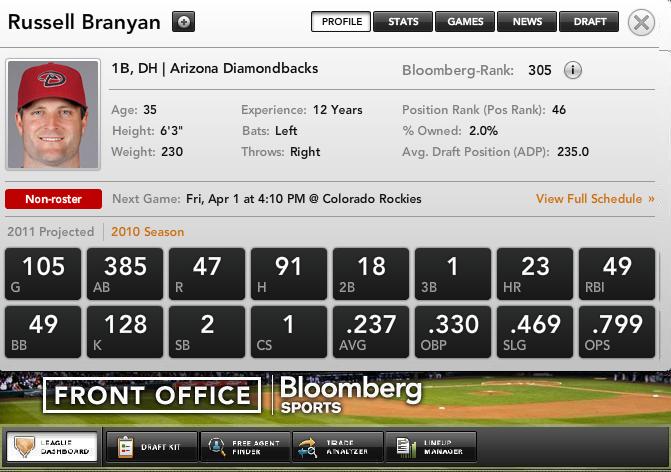
Russell Branyan has hit nearly 70 home runs over the last three seasons despite inconsistent and occasionally sparse playing time (just over 1,000 plate appearances). That’s a home run every 16 or so plate appearances, an average on par with Barry Bonds’ career rate (one every 16.5 plate appearances). There’s a chance Branyan can live up to (or exceed) that pace should he stay healthy this season, as he signed with the Arizona Diamondbacks.

The D-Backs play in Chase Field, formerly known as Bank One Ballpark, which is unfathomably kind to left-handed hitters. StatCorner provides a park factor for either handed batter at each ballpark in the majors and has the home run factor for lefties at The BOB at 114 -which is to say lefties see their homer tallies increase by 14 percent within this park relative to league average. Branyan has never been one to lead the league in cheapies, but the friendly confines should assist by turning some outs or doubles into round trippers.

branyan projected.jpg

Since Branyan figures to get the lion’s share of plate appearances, he also figures to play quite a bit at first base. This could be the snake in the bushes because Branyan does not have a strong health record. He’s missed at least 45 days due to various injuries over the last three seasons, including roughly the final month of the 2010 season. He turned 35 during December and there’s no reason to believe he suffers from the Benjamin Button abnormality of reverse aging. Put simply, Branyan is all but guaranteed to miss time with a back or trunk injury, the only question is how much that will affect his production.

If you do select Branyan in a deeper league, perhaps look to handcuff him with the player most likely to replace him during his downtime (at this moment, Brandon Allen, although his name could surface in trade talk). Otherwise, make sure Branyan is your fallback option rather than the primary. He’s going to mash when he’s healthy, but that could be less often than everyone involved would hope.

For the best fantasy baseball analysis and insight please visit BloombergSports.com

Jeremy Hellickson: The Next David Price or Wade Davis?

by Eno Sarris // 

The Rays, as seems to a yearly tradition, have a bright young pitching prospect hitting their rotation this year. Jeremy Hellickson comes off a stellar, if short, debut, already has a scintillating nickname in “Hellboy.” But we’ve seen this story before, and with varying results. How does Hellickson stack up against fellow young Rays David Price, Wade Davis and Jeff Niemann

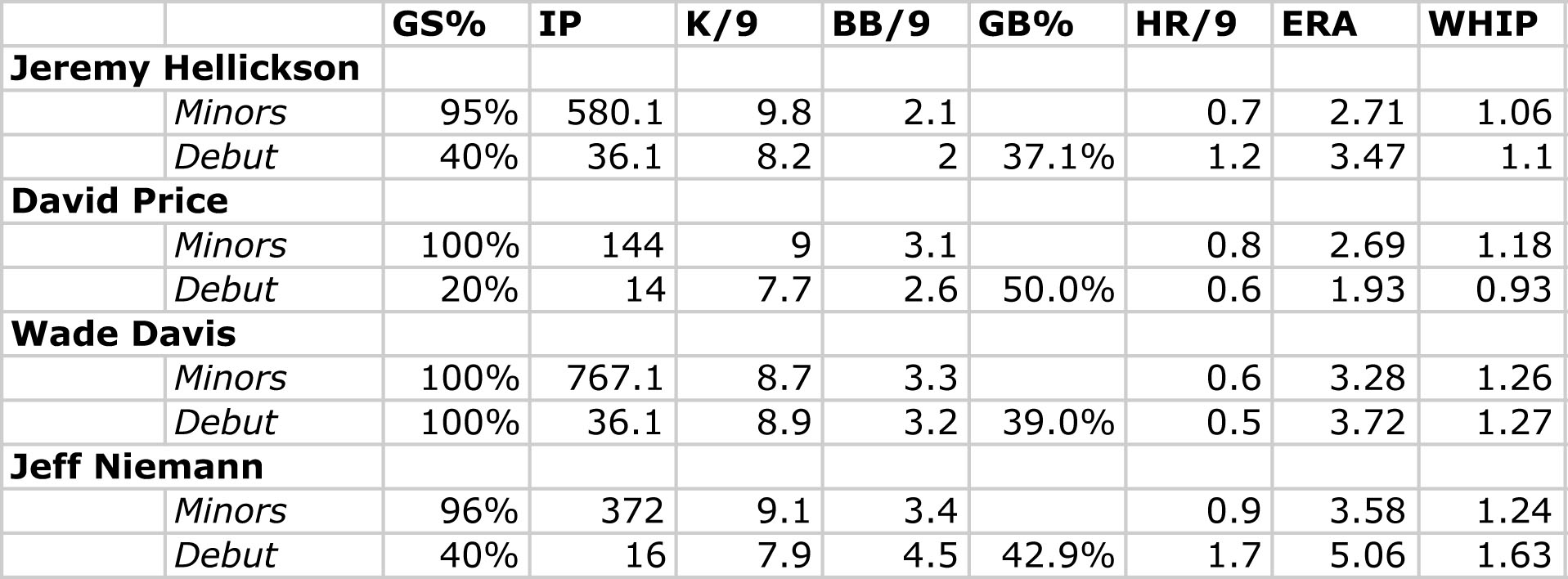
Take a look at the table below for a quick overview of the relevant statistics these young Rays accrued in the minor leagues and in their respective debuts. The percentage of games started is included because players always perform better in short stints out of the bullpen.

HellicksonChart2.jpgSome differences immediately step to the fore. Not all debuts were created equal. We can probably eliminate the chance that Hellickson ends up like Niemann based on a few factors, including his debut. Not only did Niemann show the worst control of the group in the minor leagues, but his strikeout rate dropped as he advanced through the minor leagues, eventually bottoming out in his debut.

But eliminating Niemann still leaves the possibility that Hellickson ends up more Wade Davis than David Price. Now, these pitchers are all different, and have varying arsenals, ages, and histories, but they all have the common misfortune of having to face the AL East from the get-go. David Price obviously did well, and Hellickson’s numbers compare favorably to Price’s. If only Hellickson used his left hand, we’d have a nice comparable player to point to.

hellickson.jpgWhy won’t Hellckson end up like fellow right-hander Wade Davis? Control is the easiest answer. Hellickson’s is elite, Davis’ average or below. Another answer lies in their comparative arsenals. Davis relied mostly on a fastball, while Hellickson has a plus-plus changeup and a solid curveball to go with his 91 MPH fastball. Bloomberg Sports has him putting up a 3.89 ERA and 1.24 WHIP, and he obviously has the upside to better that.

Given his elite control, strong off-speed arsenal, and historical record so far, Jeremy Hellickson is on track to be more David Price than Wade Davis. Expect a strong year from Hellboy, even if he hits a few bumps along the way.

For the best fantasy baseball analysis and insight please visit BloombergSports.com 

James Shields: Sink or Swim in 2011?

By Tommy Rancel //

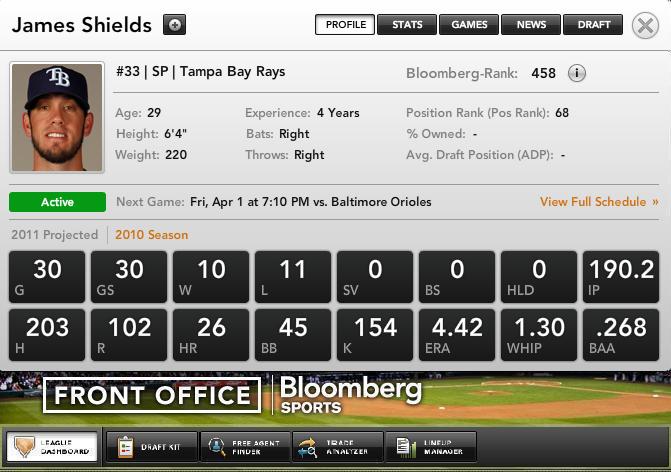
On the surface, James Shields had a poor season in 2010. The Rays’ opening day starter got off to a hot start with a 5-2 record, 2.99 ERA, and 71 strikeouts in his first 10 starts.  Unfortunately, he would go 8-13 the rest of the way with an ERA of 6.31 in his final 24 appearances. Many in the Tampa Bay area soured on Shields; however, the organization, manager Joe Maddon, and progressive analysts think Shields’ traditional stats will rebound in 2011.

Shields earned a dubious triple crown in 2010 by leading the league in hits, earned runs, and home runs allowed.  He watched 34 bombs leave the yard on the strength of a home run-to-flyball rate of 13.8%. This number is two percent higher than his career average and the highest among major league starters with at least 200 innings pitched. Shields has always given up his fair share of longballs, but is unlikely to get shelled like this going forward.

In addition to the home run issues, Shields was labeled as hittable with 246 hits allowed. His batting average on balls in play (BABIP) of .341 was nearly 40 points above the league average, more than 20 points higher than the next closest starter with at least 200 innings, and around 70 points higher than any of the other Rays’ starters. In fact, the next highest BABIP in the Rays’ rotation came from Wade Davis and Matt Garza at .272 apiece. This means Shields was extremely unlucky or was somewhat unlucky with other factors involved since he pitched with the same defense and in the same environment.

shields_projected.jpg

While luck was definitely involved, Shields also didn’t do himself any favors with pitch selection and location. He went to his fastball and cut-fastball far too often and in some cases left them in the nitro zone. Since it is the same fastball he has had success with in the past, a change in selection could go a long way; especially considering his change-up remains one of the premier pitches in the league.

The struggles with home runs and hits allowed have been documented. Meanwhile, Shields did quite well last season in other areas. He posted a career high in strikeouts (187 in 203.1 innings) and gave up just 2.3 walks per nine innings. According to his 3.72 xFIP (expected fielding independent pitching) – a metric that measures walks, strikeouts, and uses the leave average home run rate to further strip luck out of the equation- Shields actually had a very good season.

Shields is similar to Ricky Nolasco in a few ways. Both starters posted good strikeout rates, solid walk totals, but were bitten by the long ball. Not surprisingly, both had better showings in defensive independent metrics than their ERA. This may scare away prospective owners on draft day, leaving them as quality choices on the scrap heap.

In the case of Shields, regression to the mean will help, but he’ll also have to do a better job of mixing up his pitches and spotting the ball around the zone. He did this from 2007-2009 when he averaged 12 wins, a 3.85 ERA, and over 200 innings per season. His durability alone (four straight seasons of at least 31 starts and 200 innings) makes him a back-end of the rotation target, but the chance for regression could make him a real steal in the later rounds of a mixed-league draft.