Tagged: MLB
Sean Rodriguez Waits on Deck in Tampa Bay
By Tommy Rancel //
About a year ago, Sean Rodriguez was introduced to Rays fans. Acquired by Tampa Bay in the Scott Kazmir trade – a move some saw as a white flag on the 2009 season and a salary dump – Rodriguez is helping the Bay area forget about their one-time ace.
Coming into this year’s camp, Rodriguez remained a relative unknown around Tampa Bay. However, the 25-year-old put on a power display in the spring, announcing his arrival. In addition to the pop, Rodriguez showed defensive versatility – a key to the Rays’ roster construction.
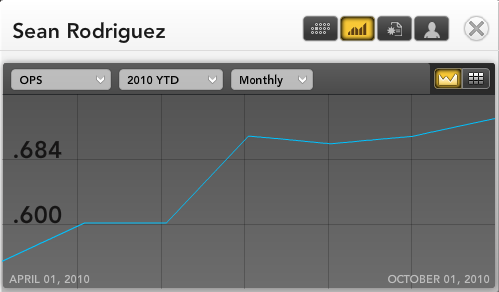
After that powerful spring that saw him rank among the Grapefruit League leaders in home runs and other categories, Rodriguez struggled early on. Through the end of May he was hitting just .224. The power we saw in spring did not translate, as he posted a .329 slugging percentage through the first two months. Not only was he lacking authority in his swing, Rodriguez was also hacking at every chance. In his first 219 at-bats, he struck out 64 times, while taking just six walks.
He’s made a charge since then, bumping his line up to he is hitting .257/.312/.411 in 351 PA. That’s while playing seven different positions for the Rays – making him one of just 36 players in MLB history to play seven positions and surpass 300 plate appearances in the same season.
Because of his positional flexibility and his smooth defensive abilities, the Rays may have granted Rodriguez more time than a player with less versatility. Their patience is paying off.
Since August 1, Rodriguez is hitting .250/.348/.425. After struggling with plate discipline early on, he walked 11 times in his last 91 plate appearances. His .227 Isolated Power (slugging percentage minus batting average), over the last 30 days ranks behind only the Pirates’ Neil Walker among second basemen.
Looking forward to 2011, the Rays are likely to have a few holes in their lineup. Without the ability to break the bank on the open market, the team will look to fill most of their vacancies from within. A full-time gig for Rodriguez could mean upwards of 20 home runs with multi-position eligibility, and some speed to boot. If you take that potential and add in his late-season surge, it would be a wise decision to start snatching up Sean Rodriguez in your keeper leagues right now.
For more on Sean Rodriguez and possible 2011 keepers in 2010, check out Bloomberg Sports’ Fantasy Kits
Rays Add Jake McGee to Major League Bullpen
By Tommy Rancel //
Before the 2008 season started, Jake McGee was named the 15th-best prospect in Major League Baseball by Baseball America. However, in the summer of ’08 McGee took a visit to a place no pitcher wants to go; Dr. James Andrews’ office. McGee would undergo Tommy John surgery – ending his season and wiping out nearly all of 2009.
Tommy John surgery is hardly a death sentence for young pitchers these days. Yes, the rehab is long and exhausting, but most come back and continue their careers. In 2010, McGee found himself where he left off in 2008, pitching for Double-A Montgomery. Although he went just 3-7 in 19 starts, his peripheral numbers were fantastic. He struck out 100 batters in 88.1 innings while allowing just 33 walks and 3 home runs.
After making his 19 Double-A starts, McGee was promoted to Triple-A Durham to work out of the bullpen. The Rays will likely say the move was made to limit the workload – and that is partially true – but one must wonder if this will end up as McGee’s permanent home.
Even before the injury, many had McGee pegged for a role in the bullpen. The lefty owns an excellent, mid-90s fastball, but has yet to find a consistent secondary offering. One really good pitch and two fringe pitches will get you by in a bullpen, but not a major league rotation.
In addition to the lack of secondary stuff, Jeremy Hellickson has risen through the ranks of the organization during McGee’s absence/return. Not only has Hellickson shot past McGee on prospect lists, he is also now blocking him in the pecking order of the Tampa Bay rotation.
That said, it is McGee who may be the most important Rays’ pitching prospect down the stretch in 2010.
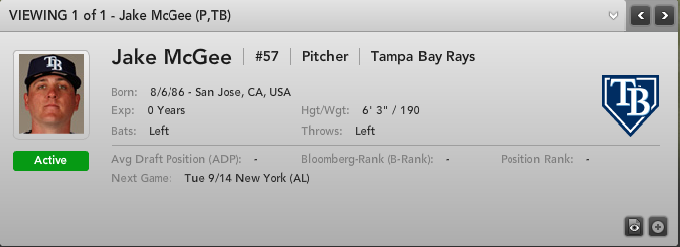
Upon his promotion to Durham, McGee was lights-out in the bullpen. In 17.1 innings, he allowed just one earned run while striking out 27 batters and giving up just three walks. Meanwhile, Hellickson has struggled in his transition to the bullpen.
Even before his struggles, Hellickson was not going to be used as your average relief pitcher. He was to pitch two or three times a week and was not expected to be brought into the middle of an inning. The rules for McGee are not likely to be the same.
With Randy Choate serving as the team’s only left-handed reliever, McGee should get some action as more than a lefty specialist – meaning coming into a game to face batters from either side of the plate, sometimes in the middle of an inning with runners on base. He will also likely to be used as needed instead of a pseudo schedule.
The one role the Rays have yet to fill this season is the one vacated by injured reliever J.P. Howell. Joaquin Benoit and Grant Balfour have been excellent set-up men, but neither is left-handed. In McGee, the Rays may finally have that lefty with the ability to get hitters of both handedness out.
If all goes well, it could be McGee and not Hellickson who plays the part David Price did in 2008. However, unlike Price, McGee’s time in the pen may not be temporary. There is no rush to add McGee in your single-year league right now. Indeed, McGee struggled mightily last night in his big league debut, throwing six straight balls before recording a strike, and generally looking very nervous.
But with the potential loss of Rafael Soriano as well as other key bullpen members like Benoit next season, McGee should be on your radar for fantasy bullpens of the future, and as a potential closer. He’s worth a pickup in keeper leagues.
For more on Jake McGee and the Tampa Bay Rays, check out Bloomberg Sports’ fantasy kits.
How to Make Enemies and Influence Standings
By now, many competitors have fallen out of contention in your fantasy baseball league, and may be chasing other pursuits, like fantasy football. For those of us still in the hunt, things can get very competitive and best yet, very strategic.
In rotisserie-format leagues, teams are looking to gain as many points possible. But that’s not the only way to win. If you’re sitting in second place, a few points out of the lead, any point your top rival loses is just as good as a point you yourself gain. It’s the points differential that counts. Not the total number of points accrued.
There are a few ways to indirectly influence your competitors’ standings position.
First, make sure your other leaguemates (the ones who have no real shot) are still paying attention to the league. They may not have a chance at first place, but in particular categories, they may still hold the power to beat your rival. So do whatever is necessary to get them engaged again. Attack their pride. Make fun of them for finishing last. Whatever. The point is that under certain circumstances, the indifference of others can be costly.
Second, pick your battles. For example, you might have an equal shot at gaining points in runs and RBI, but if you’re chasing your rival in runs but not RBIs you may wish to focus on the runs category. The upside there would be +1 for you and -1 for your rival. It’d be worth putting all your eggs in that basket with a high likelihood of success, rather than spreading risk by chasing both with a 50% probability of gaining +1 in runs and a 50% probability of gaining +1 in RBI.
Furthermore, you may wish to push your competitor to chase certain categories. For example, steals or wins — two categories that least correlate to the others. If you pick up a speedster to create the appearance you’re going after your rival in steals, he may respond by likewise doing the same. Perhaps his focus on steals might hurt his standing in RBI, since players who steal a lot of bases often don’t drive in many runs. In other words, examine every angle when considering the impact of your moves.
Third, and this may sound crazy, but there may be a time when it becomes prudent to drop a star player. Let’s say you comfortably have the lead in saves, but your rival is in the midst of a heated battle in that category. Heath Bell does less good for you on your team than he might do on another team, so long as it isn’t your rival’s team. If you play in a league that’s paying attention, and your rival doesn’t have a high waiver priority, it could be beneficial to just drop Heath Bell and hope someone other than your rival, competing with him in saves, picks up the Padres closer.
Clearly, not all of these tactics are “nice.” They won’t win many friends. But hopefully, there will at least be respect earned from a hard-fought season.
For more on fantasy baseball wisdom, check out Bloomberg Sports’ Fantasy Tools.
Rays Call Up Desmond Jennings
By Tommy Rancel //
Although he was just called up to the big leagues for the first time
on Wednesday, Rays fans have had Desmond Jennings on
the brain for a while. Even before his breakout minor league season of
2009 – in which he hit .318/.401/.487 with 52 steals and 92 runs scored –
Jennings was regarded as the stallion-heir apparent to Carl
Crawford in the Tampa Bay lineup.
After his fantastic ’09 campaign – including being named MVP of the
Southern League (Double-A) – Jennings went from the 80th-ranked prospect
according to Baseball America to the 6th-best prospect overall. He was
invited to his first big league camp this spring, but a wrist injury
wiped out most of that audition, as well as the first part of his minor
league season.
Once healthy, the 23-year-old played in 109 games for the Triple-A
Durham Bulls. His numbers were not as impressive as they were last
season, but he still hit .278/.362/.393. At this point in his career,
Jennings has not shown much power (29 home runs in 420 career minor
league games), but he still projects as a top-of-the-order hitter,
blessed with blazing speed and advanced plate discipline.
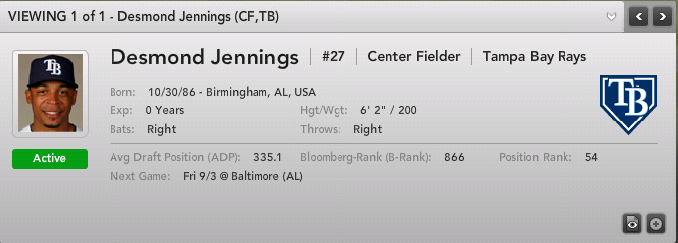
Despite the lack of power in Durham, Jennings still scored 82 runs in
100 games. His OBP (.362) wasn’t fantastic, but it was still above
average. He walked nearly 11% of the time and struck out in less than
17% of his plate appearances. Once on base, he swiped 37 bags in 41
attempts (90% success rate).
As a September call-up on one of the most talented teams in baseball,
Jennings probably won’t rack up many at-bats over the next 30 days,
unless the Rays unexpectedly clinch a playoff berth very early. His
value to the Rays, and potential fantasy owners, will be tied to speed
and baserunning ability. Similar to Fernando Perez in 2008,
Jennings is likely to be the Rays’ primary pinch-runner and a part-time
defensive replacement.
In his MLB debut on Wednesday night, Jennings went 0-3 with two
groundouts and a swinging strikeout. We did not get a chance to see him
glide around the bases, but we did get a chance to see his speed out of
the box and his trained batting eye.
Jennings had four plate appearances, but officially only had three
(4th inning appearance negated by a B.J. Upton caught
stealing). Overall he saw 19 pitches (14 officially) and worked three
full counts. In his final at-bat, Jennings came up with the bases
loaded. He grounded out on what amounted to a swinging bunt. On the
other hand, had the force play not been on at home – and a slow runner
in Dioner Navarro at third – Jennings would’ve been
easily safe as he burned through the chalk on the way to first base.
If you have the need for some steals and runs, then Jennings is worth
a spot in (really) deep mixed and AL-only leagues. They will come
sporadically, but he should provide a handful of both. If Jennings is
available in your keeper league, though, jump on him immediately.
For more on Desmond Jennings and other September call-ups, check
out Bloomberg Sports’ Fantasy
Kits
Like Jason Heyward? Why not Pedro Alvarez?
By Tommy Rancel //
While some fan bases prepare for a final month of playoff races, Pittsburgh Pirates fans are nearing the end of the franchise’s 18th consecutive losing season. This means the Pirates have been bottom dwellers for the entire life span of most high school seniors. However, we’re not here to focus on the past, but rather, the future. Namely, the future of Pedro Alvarez.
After years of misses at the top of the draft, the Pirates selected Alvarez in 2008. The former Vanderbilt teammate of Rays ace David Price is already a regular in the Pittsburgh lineup. Some questions remain about which side of the diamond he’ll play down the road, but for now, the 23-year-old the man at the hot corner for the Buccos.
Before signing his pro contract, Alvarez and his agent Scott Boras made plenty of headlines, In the end, though, he made his major league debut with relatively little hype. Despite lacking the media coverage of Jason Heyward (to say nothing of Stephen Strasburg) upon his debut, Alvarez has been one of this year’s most productive rookies, coming close to Heyward’s level of production.
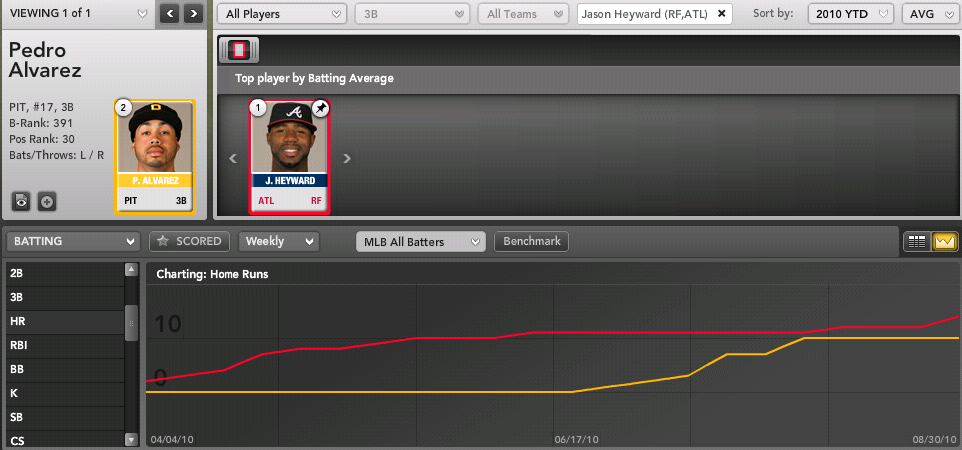
Heyward has hit 14 home runs in 105 games, while Alvarez has smashed 10 bombs in just 60 contests. The J-Hey Kid is currently hitting a home run once every 27 at-bats, while Alvarez is averaging one every 21 ABs.
In addition to the home runs, Alvarez is doing an above-average job of driving in runs. The league average for driving in baserunners is 14%. Heyward is at 16%, Alvarez at 18%. An 18% baserunners scored rate rivals that of Evan Longoria, Albert Pujols, Josh Hamilton, and Miguel Cabrera. If we were to expand his home run and RBI rate over a full season, we would be talking nearly 30 home runs and 100 RBI.
Of course, we only have about one-fifth of the season remaining, so full-season projections mean little right now. On the other hand, Alvarez could add another 5-7 home runs, and drive in another 15-20 runs over the final six weeks of the season.
Going back to the Heyward comparison, Hotbox.com says the Braves rookie is owned in 77% of leagues – while Alvarez is owned is less than 5%. If you need some production down the stretch in a deep mixed or NL-only league, make sure you sneak Alvarez onto your roster before the playoffs start.
For more on Pedro Alvarez and other talented rookies flying under the radar, check out Bloomberg Sports’ fantasy kits.
Is it Time to Trust Gavin Floyd?
By Tommy Rancel //
Despite his obscurity on a national level, Gavin Floyd has been one of the more polarizing figures in fantasy baseball over the past couple seasons. Few have teased and burned owners like Floyd has. This season has been more of the same. Still, it’s time to give Floyd another chance.
As in seasons past, Floyd has toyed with owners’ emotions in 2010. He started out awful, but has since rebounded nicely. Jason Collette of fanball.com notes that Floyd’s 1.27 ERA over the past 30 days rivals that of another Bloomberg Sports’ favorite, Josh Johnson (1.22).
So what has changed since those lousy first few weeks? Mostly luck.
In early May, Eriq Gardner noted at Bloomberg Sports that Floyd was one of baseball’s “unlucky” pitchers due to a below-average left on-base percentage (LOB%), also known as strand rate. On average, pitchers strand 72% of men who reach base. For his career, Floyd has stranded 69% of baserunners.
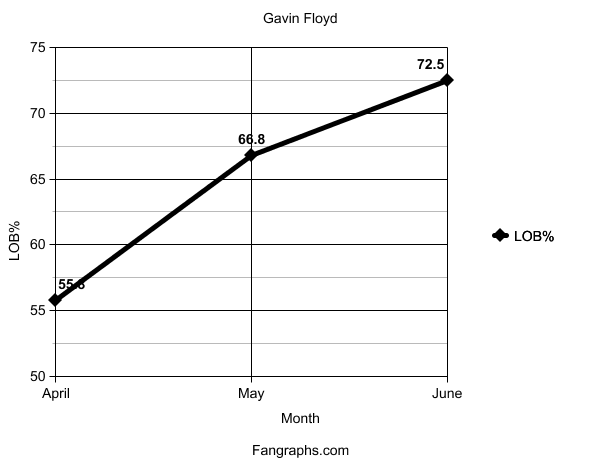 In the early stages of the season, Floyd’s LOB% was around 56%. Because of that, his numbers – most notably ERA – suffered. However, as the season has progressed, Floyd’s strand rate started to regress toward league average, an occurrence which has positively affected his stats, especially ERA.
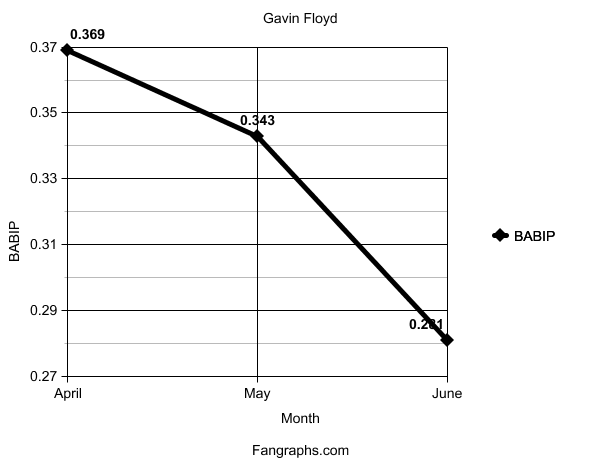
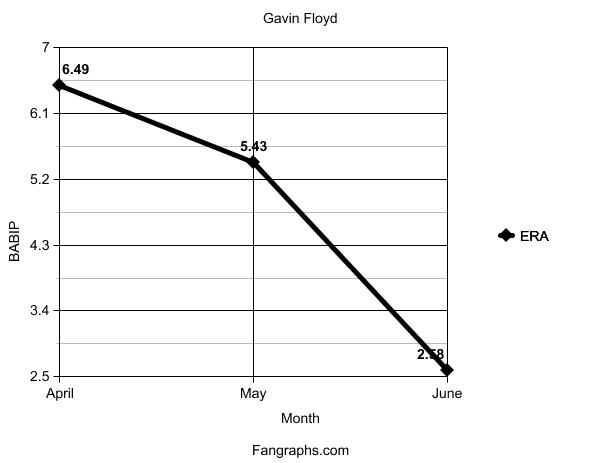 In conjunction with his LOB% regression, Floyd has seen a regression in terms of batting average on balls in play (BABIP). The league average BABIP is .302. In April, Floyd’s BABIP was .369. To date, his BABIP has dropped down to .322 — but it’s still well above his career mark of .295.
 Looking at events he can control, such as home runs, walks and strikeouts, Floyd is enjoying the best season of his career. His strikeout per nine innings rate (K/9) of 7.47 tops his career K/9 rate of 6.84. He’s walking fewer batters per nine innings (BB/9) in 2010 (2.78) than in previous years (3.22). The righty has also cut his home runs per nine innings rate dramatically, from a 1.25/9 IP career mark to 0.61/9 IP in 2010.
Looking at home run-to-flyball ratio, home runs might be the only category in which Floyd sees a shift toward the negative (an unusually low 7.3% HR/FB rate this season, vs. 12.4% for his career).
While Floyd has been a poster child for regression, his raw statistics still show an average pitcher. He is just 4-7 on the year with an ERA of 4.43. There is a chance that his LOB% and BABIP – which are still higher than usual – could regress even further. Couple that with his other peripheral stats that remain above-average in a positive way, and now is the time to strike on Floyd. He is available on waivers in nearly 10% of fantasy leagues. But even if he’s owned in your league, he’s worth a trade request.
For more on Gavin Floyd and other regression ready candidates, check out Bloomberg Sports’ fantasy kits.
Josh Willingham Laying Down The Hammer in D.C.
By Tommy Rancel //
When the Nationals acquired Josh Willingham and Scott Olsen from the Marlins in exchange for Emilio Bonifacio and a pair of minor leaguers before the 2009 season, it was Olsen who was thought of as the key player in the deal. After all, he was a 24 year-old left-handed starter who had made at least 30 starts in each of the previous three years without a trip to the disabled list.

Willingham was a throw-in perhaps, a soon-to-be 30 year-old serviceable outfielder with some okay offensive numbers. Marlins President of Baseball Operations, Larry Beinfest admitted money was one of the reasons the deal was made as both players were entering their first year of arbitration.
Things turned out a little differently. Although he escaped the DL in Florida, Olsen has been bit by the injury bug in Washington. He has made just 19 starts since the trade – tossing 105.2 innings with a 4-6 record in two seasons. On the other hand, Willingham has become one of the best offensive players in the National League no one is talking about.
After posting a more than respectable slash line (AVG/OBP/SLG) of .260/.367/.496 with 24 home runs, 61 RBI and 70 runs scored in 2009, Willingham is turning in his best work in 2010. The former catcher is hitting a modest .273; however, he is slugging .502, and is getting on-base at a .405 clip. Both would be career highs for a full-season.
Whenever a player has a breakout season beyond the age of 30, some will assume it is a fluke or an outlier. In a lot of cases this is true. That said, Willingham is on a steady four-year OPS incline suggesting that he maybe nearing – or right at – his career peak.

If you are looking for fluke stats – good luck. His batting average on balls in play (BABIP) of .295 is lower than his career .299 number. His ISO (Isolated Power), which indicates raw power by taking slugging percentage and subtracting batting average, is .229, or within 15 points of his career .215 average.
The biggest change for Willingham in 2010 is better plate discipline. He is walking 15.8% of the time (up from 11.5% career), and is striking out slightly less (22.1% in 2010, 23.1% career).
Despite the .907 OPS and a .403 weighted on-base average (wOBA), an advanced metric that measures multiple offensive numbers and is scaled to mirror OBP, “The Hammer” is only owned in 55% of leagues according to hotboxsports.com.
Because of his age and contract status (one more year of arbitration), Willingham could be a trade candidate in both leagues should the Nationals choose to sell. That would make him a slight risk in NL-Only formats. Nevertheless, there is no reason to wait on grabbing him off of waivers – if you’re lucky enough – or through a trade in mixed leagues right now.
For more on Josh Willingham and other breakout candidates, check out Bloomberg Sports Fantasy Tools
Welcome to the Bloomberg Sports Blog
Welcome to the debut of the Bloomberg Sports blog, a partner of Major
League Baseball and part of the MLBlogs network. Starting today and
continuing through the final pitch of the World Series, we’ll cover all
the hot topics in baseball and fantasy baseball, with the help of Bloomberg Sports’ proprietary software and analytics.
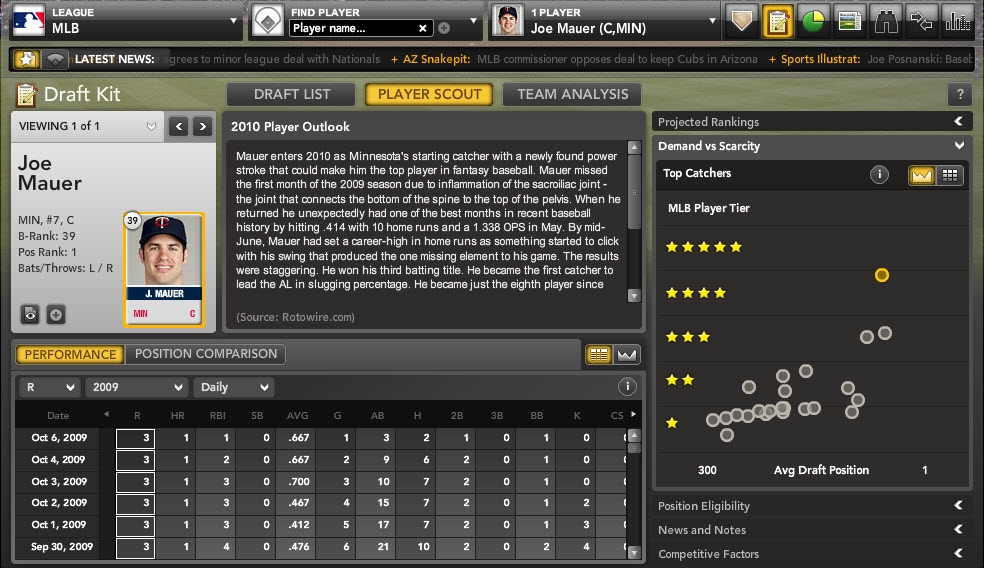
Say you’re preparing for your fantasy draft, targeting Joe Mauer as
your starting catcher. Bloomberg Sports’ Draft Kit includes rankings
for every player, called B-Rank. Using B-Rank, you’ll see how Mauer
stacks up against all other players.
You can then delve deeper. Say you want to eyeball a player’s value against others at the
same position, then make an informed decision on when in the draft to
grab him. Bloomberg Sports’ Scarcity vs. Demand graph shows you a graph
of the top 10 players at that position, how high each one should be
drafted, and where the best values might lie. If you’re scouting Mauer,
the yellow dot representing the Twins catcher will show up far above
all other catchers, a sign of his unique value.
Now let’s explore a player whose ranking isn’t as obvious, newly signed Arizona Diamondbacks first baseman Adam LaRoche.
According to B-Rank, LaRoche rates 17th among all major league first basemen for projected 2010 fantasy value, given standard 5×5 criteria. In a 12-team National League-only league or deep mixed league, LaRoche would be worthy of a starting job. He would project as a mid-to-late round pick, in a cluster with decent but unspectacular players like the Dodgers’ James Loney in the Scarcity vs. Demand graph.
Using our Spider Chart, you can see that LaRoche derives most of his value from counting stats such as home runs, runs scored and RBI, with less value derived from his batting average and virtually none from stolen bases. At a glance, you can spot LaRoche’s 2009 totals in every category against other players major league-wide, or just other first basemen. His 25 home runs, for instance, placed just below the average of 27 homers for qualifying MLB starters at first base, well below the MLB-leading total of 47 at that position.
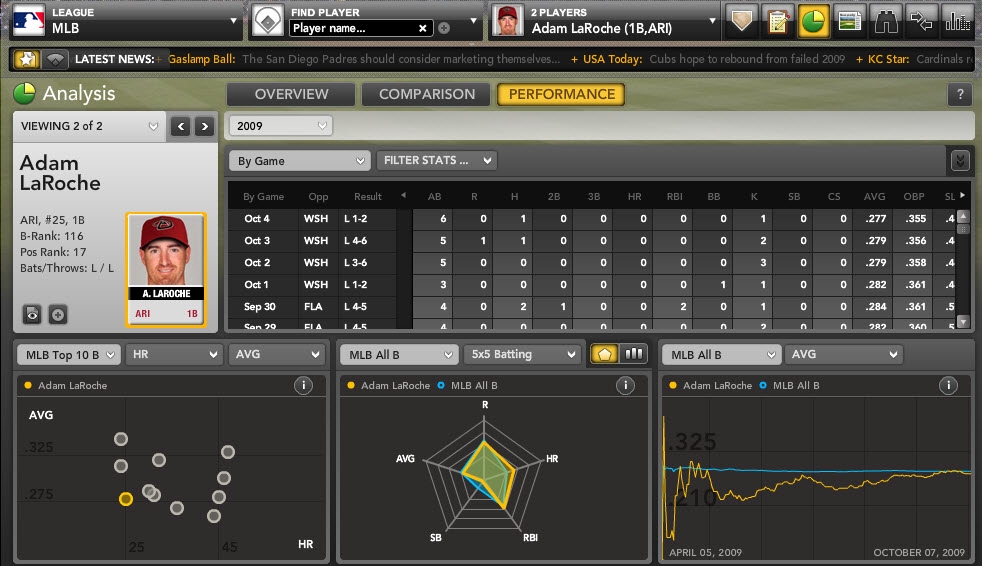
Using the Scatterplot tool, you can
compare LaRoche’s value across two categories at once, measured against the top 10 players
in that two-category combination — home runs and batting average, RBI and stolen bases, and other customizable combinations.
The Bloomberg Sports team of writers will then dig up more nuggets of information for your perusal. Say you’re satisfied with LaRoche as a low-end starter for your team. But you’re concerned about his large splits – for his career, LaRoche has batted .252/.326/.447 (AVG/OBP/SLG) in the first half, with a much stronger .300/.363/.546 line in the second half. You might then view LaRoche as someone to target in trade around the All-Star break, rather than spending a pick on him in your draft or auction.
Ascertaining why a player fares better in one half of the season compared to the other can be a tough task. Often it’s the equivalent of flipping a coin and landing on heads five times in a row: a rare but possible occurrence that’s based simply on random chance.
Occasionally there might be other reasons. Some players perform better in warmer weather, or at least hit for more power in warmer weather. In Pittsburgh and even Atlanta, where he played the bulk of his first six major league seasons, LaRoche’s power indicators jumped across the board as temperatures rose. For his career, he’s hit home runs on 12.7% of his flyballs in March and April, 11.7% in May and 12.8% in June. That number soars to 18.9% in July and 17.0% in August, making LaRoche a greater power threat in the warmer summer months. In sweltering Phoenix, LaRoche can expect average highs of 84 in April and 93 in May. By June, the Diamondbacks will likely close their retractable roof for most games, with average temperatures near or over 100 for the final four months of the season. The closed roof would in turn create cooler home playing conditions as the season wore on.
We can’t say for certain if LaRoche’s superior performance and higher power output in the second half is the result of warmer weather – it could simply be another way to look at the same random streak of better second-half performances. If it is weather-related, though, playing in Arizona, and facing warmer-weather opponents more often in the NL West, could portend a hotter-than-usual start for LaRoche.
LaRoche could also get a boost from more favorable ballpark effects. Chase Field consistently ranks as one of the most favorable stadiums in baseball for hitters – second behind Coors Field in run factor last season and second behind Rangers Ballpark in Arlington. Chase’s configuration also plays to one of LaRoche’s greatest strengths as a hitter. LaRoche has averaged 37.5 doubles per year in the past four seasons, ranking him among the league leaders in that category. Only Fenway Park, with its shallow, towering Green Monster, has yielded a higher doubles effect in the past two seasons than Chase Field.
Once the season starts, Bloomberg Sports’ In-Season tools let you
track a player’s day-today performance down to the finest details. Say
you drafted LaRoche and he got off to another slow start, hotter weather and all. The Visual Benchmark
tool lets you plot how LaRoche’s three home runs through the first 40
games of the season compare to different cohorts: other players at his
position, other National League players at his position, or the league
average for all players.
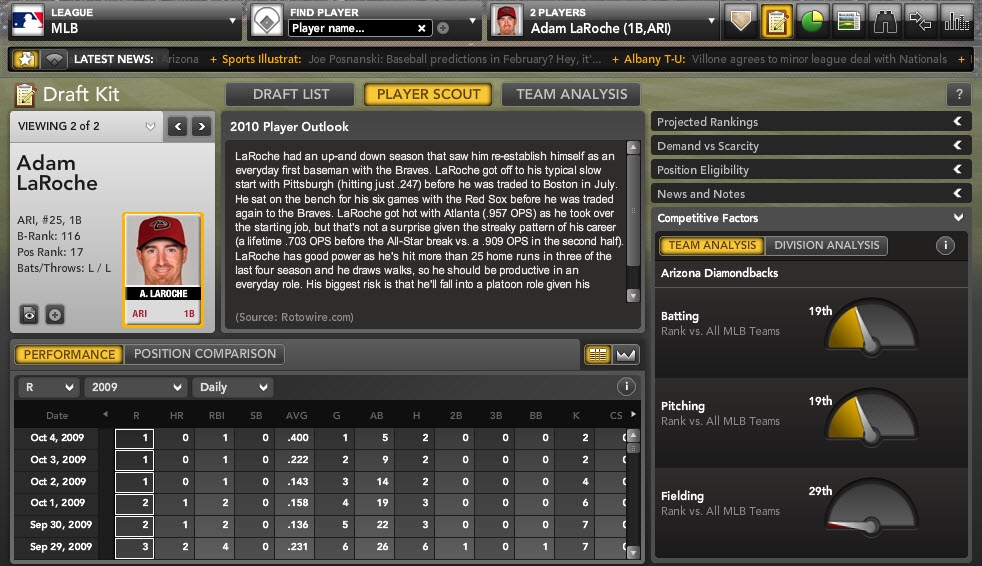
Still not sure if you should hold or cut bait? Using the
Competitive Factors tool, you can see how LaRoche’s new team stacks up
against the rest of the league. Last year, the Diamondbacks ranked 19th in batting average (20th in MLB in runs scored), despite their hitter-friendly home park. If Chris Young, Stephen Drew and other talented but erratic teammates don’t fare better in 2010, that suppresses LaRoche’s potential to score
and drive in runs – meaning you might want to consider a different option at first base.
This blog will help you leverage these and many other tools, by pairing Bloomberg
Sports analysis with the latest MLB happenings. Joining myself and
Bloomberg Sports’ Tyler McKee are the following writers:
R.J. Anderson:
His work has appeared in Baseball America, USA Today, ESPN.com, The Hardball
Times, FanGraphs, The Graphical Player, and RotoJunkie’s Annual
Baseball Draft Guide, The Fix.
Erik Hahmann: His baseball and fantasy baseball writing has appeared at Heater Magazine, DRaysBay and Beyond The Boxscore.
Tommy Rancel: He’s written for a number of publications, including Beyond The Boxscore, Inside the Majors and The Hardball Times.
Eno Sarris: He’s covered baseball and fantasy baseball for FanGraphs, Yahoo Fantasy
Baseball, RotoExperts and GodBlessBuckner on the Fanball network. He
won a Fantasy Sports Writers’ Association Award for his work at Fantasy
Lounge Sports.
Pitchers and catchers are reporting throughout the Grapefruit and
Cactus Leagues and we couldn’t be more excited to start the season.
Bookmark bloombergsports.mlblogs.com for the latest news and analysis. You’ll also find us as a Featured blog at MLBlogs.com, as well in the MLBlogs.com Pro Blogs pull-down menu, under Fantasy.
Also, follow us on Twitter @BloombergSports and Facebook.
Then, be sure to check out Bloomberg Sports’ Draft Kit and In-Season Tools.
Play Ball!
–Jonah Keri
 Bloomberg Sports