Tagged: MLB
Kansas City Royals Buy Low on Jeff Francis
The one-year pact comes with a $2 million guarantee and could be worth
$4 million with incentives. The signing comes with a small risk, but
could end up rewarding Kansas City for their minimal gamble.
(torn labrum). He returned to make 19 starts (20 appearances) in 2010, going
4-6 with a 5.00 ERA. With a career 55-50 record, and an ERA that sits at
4.77, Francis is not coming to Kansas City to replace Zack Greinke‘s production.
But he could be a league-average or better starter for the Royals.
Though his ERA in over 100 innings of work last season was 5.00,
advanced metrics suggest his pitching performance was closer to that of a
3.75-4.00 ERA.
left-on-base percentage (LOB%) was 64.5%. The league average is
generally around 72%, and Francis’s career mark is 70.5%. With outside factors
such as defense contributing to a pitcher’s LOB%, it seems Francis was a
bit unlucky here.
Francis’ style is that of a classic soft-tossing left-hander. His
fastball tops out in the high-80s, and he doesn’t rack up a ton of
strikeouts. In fact, he has largely been below average in the punchout
category. What he does do well is locate his average stuff and generate a
lot of groundballs. In 2010, he posted the highest groundball rate of
his career (47%) in addition to regaining what velocity he had before
the surgery.
Since he has no one particular strength, Francis has to do a couple
of things well in order to earn a rotation spot in fantasy leagues.
Outside the main concern of health, Francis must maintain his stellar
history of keeping baserunners to a minimum with a good walk rate.
Moving from Coors Field for Kauffman Stadium could also have a positive
effect on his home run rate. With the potential for a positive ERA
regression, the one-time 17-game winner becomes a buy-low candidate at
the end of AL-only drafts. You can leave him undrafted in standard mixed
leagues.
Fantasy Spot Starter: Brad Penny as a Tiger
by Eno Sarris //
Brad Penny once pitched in the American League, and the results were less than stellar. While it’s tempting to say his return to the harder league will go as poorly, there’s little black and white here. Let’s unpack what went so poorly for Penny in Boston, why he returned to grace in the National League, and what that might mean for him now that he’s a Detroit Tiger.
Penny had a 5.61 ERA in Boston and a 2.59 ERA in San Francisco in 2009 – and yet his performances were much closer to similar than would first appear in looking at ERA alone. In Boston, he struck out 2.12 batters for every one walk, and in San Francisco he struck out 2.22 batters per walk. He had an FIP (Fielding-Independent Pitching – a stat that runs on a similar scale to ERA, while stripping out defense and luck and focusing on factors the pitcher can control) of 4.49 in Boston; his FIP in San Francisco was a similar 4.35. The big difference was that Penny yielded a very lucky .211 batting average on balls in play while wearing black and orange, pushing his ERA much lower.
Oh, there was one difference worth mentioning. Penny had a 40.8% groundball rate in Boston, and a 53.8% number in San Francisco. As Penny’s strikeouts have tumbled over his career, his groundball rate has climbed – his three best years by groundballs have come in his last four years, for example. That went away in a short stint in Boston, but he re-found his ability to get grounders in San Francisco.
And he continued to coax ground balls in St. Louis last year, before a lat injury cut his season short. In those nine Cardinals starts, he managed a 52.8% groundball rate that would fit in with his recent work in the category. He did refine his cutter with Dave Duncan, and also threw far fewer four-seam fastballs than he had in the past. But let’s not count on the Duncan bounce lasting beyond the friendly confines of Busch Stadium; the Tigers’ curious roster could hurt his new team’s ability to turn grounders into outs as is.
Looking at some comparable American League pitchers given Penny’s statistical benchmarks, we find Fausto Carmona (5.31 K/9, 3.08 BB/9, 55.6% GB), Trevor Cahill (5.4 K/9, 2.88 BB/9, 56% GB) and possibly Rick Porcello (4.65 K/9, 2.1 BB/9, 50.3% GB). Those ERAs ranged from 4.92 (Porcello) to 2.97 (Cahill), but use FIP instead, and the range narrows to 4.11 to 4.31. The average FIP in baseball for qualified pitchers last year was 4.08.
The injury concerns are there, even if Penny lost most of the year to a non-arm injury. Given his mix of passable strikeout-to-walk ratios and good groundball rates, Penny should be able to approximate an average major league starter for the Tigers. From the list above, you can see that he might even luck into a stronger fantasy season. But his recent history also suggests that there’s no way you can depend on him. Put him in the leave-a-penny-take-a-penny tray on draft day in standard 12-team mixed leagues, and use him if/when you need him during the season.
Jays Dump Vernon Wells’ Contract, Receive Value
By R.J. Anderson //
The Toronto Blue Jays’ offensive philosophy last season revolved around one concept: Hit home runs. On Friday, the team acquired catcher/first baseman Mike Napoli and outfielder Juan Rivera from the Los Angeles Angels of Anaheim for outfielder Vernon Wells, plus Wells’ grandiose contract. Suffice to say, even after losing the 31 homers Wells hit last year, the Jays’ newest acquisitions can hold up their end of the philosophy.
Napoli alone creates an interesting dilemma, as the Jays already have two backstops under contract. Although Jose Molina possesses a strong defensive reputation, the real subplot is how this affects prospect J.P. Arencibia. Napoli is a lower-variance hitter and more expensive, meaning he should get the lion’s share of playing time. The keys to Napoli’s down season in 2010 (he still managed to hit .238/.316/.468) are a low BABIP (.279 while his career norm is .293); a decline in walk rate; more strikeouts (thus lowering his on-base percentage); and the Angels’ obsession with Jeff Mathis. To their credit, Napoli did play more games than he ever had before, though that was due to Napoli taking the place of injured first baseman Kendry Morales.
Moving into an offensive environment like Toronto should only assist in Napoli’s power production. That’s saying something for a guy with 66 home runs over the past three seasons, despite playing catcher and only once receiving more than 450 plate appearances in a season. Given his eligibility at catcher and the odds that he’s going to hit 25-plus home runs next season, he immediately becomes an excellent fantasy option in all leagues, doubly so in leagues that value on-base percentage and/or slugging percentage over batting average. Meanwhile, drafting Arencibia in anything but a keeper league will become determinable once new manager John Farrell’s usage strategy becomes evident.
Rivera’s health is always in question, but if he can rack up 500-plus plate appearances, he’s a good bet for 15-to-20 home runs. He’s not one for walks (although he has improved in recent years) or strikeouts, and his batting average seems to fluctuate more than normal (Last four years: .252, .287, .246, .279). He’s a fine late-round outfield pick in standard leagues that use five outfielders and a utility slot.
What is interesting is what will happen with the rest of the Jays’ first base/outfield/DH options, as Travis Snider and Adam Lind could see their playing time suffer a bit. Without knowing Farrell’s intended usage, it’s difficult to peg the exact draft stock for any of those involved. So hold out as long as possible, and when in doubt, be conservative in your estimates.
#avg_ls_inline_popup { position:absolute; z-index:9999; padding: 0px 0px; margin-left: 0px; margin-top: 0px; width: 240px; overflow: hidden; word-wrap: break-word; color: black; font-size: 10px; text-align: left; line-height: 13px;}
Tampa Bay Rays Sign Manny Ramirez
By Tommy Rancel //
After watching several key players leave via free agency, and a few others moved in trades for prospects, Andrew Friedman surveyed the market and decided it was time to play. What else would you expect from the guy who is quoted in Jonah Keri’s upcoming book, The Extra 2%, as saying “I am purely market driven. I love players I think I can get for less than they are worth.”
Signing arguably the greatest right-handed hitter of his generation to a one-year deal worth $2 million is right in Friedman’s wheelhouse. Sure, a 38-year-old Manny Ramirez is not the same Manny who dominated the American League for more than a decade. But for the bargain basement price of $2 million, the Rays are not paying him to be that guy. Better, that same 38-year-old Ramirez is still very productive.
Ramirez battled leg injuries and a hernia injury last year that limited him to just 90 games. However, he hit .298/.409/.460 and had a 141 wRC+ (an offensive stat from fangraphs.com which measures runs created by a hitter; a wRC+ of 100 is average). When he was in the lineup, he was still a near-elite hitter.
Though his home run power is not likely reach the 37 he hit in 2008, he still has enough power to belt 20-plus home runs and produce 20-plus doubles, if given 500 plate appearances. He continues to have a fantastic batting eye, which will help keep him on base nearly 40% of the time–huge in leagues that count OBP, but also helps with runs scored in standard 5×5 leagues. Batting in the middle of a lineup that features several other high-on-base hitters – including the newly signed Johnny Damon – he’ll have plenty of chances to drive in runs too.
By moving to designated hitter full-time, the concerns about Ramirez’s injuries should be eased a bit. He underwent hernia surgery in October and has been working out in Arizona in advance of spring training. (Peter Gammons Tweeted that Ramirez is in excellent shape.)
One of Andrew Friedman’s goals this off-season was to find a middle-of-the-order bat to replace Carlos Pena and team up with Evan Longoria in the heart of the Rays’ lineup. Ramirez might not replace all the power lost by Pena’s exit, but along with Matt Joyce, the Rays now have adequate pop surrounding their franchise player.
The age and injury concerns – along with the potential for Manny to be Manny – are understandable. That said, no one is counting on Ramirez to carry a lineup – real or fantasy. As an OF4 or Utility option in standard mixed leagues, Ramirez should provide plenty of value, considering the price tag should be a mid-to-late round pick. If you show the patience of Andrew Friedman on draft day, you too will love getting a quality player for less than what he is worth.
Tom Gorzelanny Goes to Washington
by Eno Sarris //
Lefty Tom Gorzelanny is moving again, this time from Chicago to our nation’s capital. Trying to figure out how he’ll fare in his new uniform will require some guesswork, but looking back might help us look forward.
For the past season and a half, Gorzelanny has been a decent pitcher underneath it all – an 8.2 K/9 IP and 4.2 BB/9 IP are good enough to exist on the back end of most fantasy rotations in most parks, even with a groundball rate right at average (40.7%). Looking back at his work in Wrigley Field may help us understand the effects his context may have had on his overall statistics, though, since his overall ERA the last two years has been pretty mediocre (4.47).
In his career, the southpaw has thrown 117 2/3 innings in the Friendly Confines. Those innings have produced a 5.43 ERA, 1.56 WHIP, 7.8 K/9 and 4.6 BB/9 – worse than his regular work. That’s not too surprising, given the park factors for home runs in the park (119 for lefties and 102 for righties). In both of his ‘resurgent’ seasons, he’s been better on the road than at home. It’s a beautiful park, but he may not miss it.
His new park should treat him better, but we can’t use past numbers to tell us much. He’s only pitched three total innings in the Nats’ new stadium. What we can see is that the home run park factors are much more friendly (94 for lefties and 100 for righties). That doesn’t really tell the whole story – look down the list of right-handed park factors for singles (98), doubles (95), and triples (82) are all pitcher-friendly. In general, the park suppresses right-handed offense by about three percent, while his former park inflated that same offense by three percent.
That swing in context should really work for Gorzelanny, who has been much better against lefties than righties over his career. Against lefties, he’s managed a 8.95 K/9 IP, 3.22 BB/9 IP and a 44.1% groundball rate. Against righties, those numbers drop to 6.05 K/9 IP, 4.38 BB/9 IP and a 41.5% groundball rate.
Gorzelanny is demonstrably better against lefties, and will get some help from the park against righties. It’s true that the Nationals scored 30 fewer runs than the Cubs last year, but in most categories other than wins, this southpaw will enjoy his trip south. He’s a fringe draft pick in mixed leagues, but his possible improvement makes him a decent, if later-round pick, in deeper leagues.
Mets Take A Chance On Chris Capuano. Should you?
By Tommy Rancel //
Two-time Tommy John surgery survivor and former 18-game winner Chris Capuano will try another comeback, after signing a one-year, incentive-laden deal with the New York Mets.
Capuano broke off talks with his former team, the Milwaukee Brewers, due to uncertainty over his future role. The Brewers did not want to commit a rotation spot, while Capuano is not yet ready to make a permanent move to the bullpen. The Mets have a few openings at the back end of their rotation and little financial flexibility with a top-heavy payroll. On paper, the pairing seems like a good marriage of ability and need.
Because of injury, Capuano did not pitch in the major leagues in 2008 and 2009. In 2010, the lefty returned to make 24 appearances (9 starts) for the Brewers. In most cases, results immediately following major arm surgery should be taken with a grain of salt. On the other hand, in 66 innings of work Capuano appeared to be very much the same pitcher he was pre-operation.
Looking at his 2010 peripheral stats most notably: strikeouts, walks, and home runs per nine innings (K/9, BB/9, HR/9), he was right in line with his career numbers.
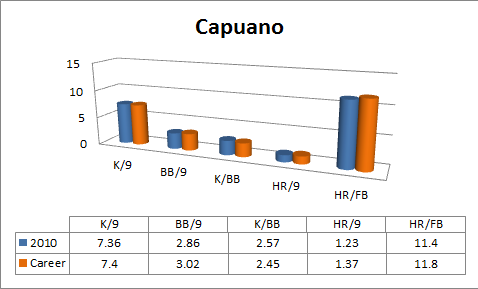
Also returning to career form was Capuano’s pitch selection and velocity. He remains a three-pitch starter, featuring a fastball, slider, and change-up. He was not a hard-thrower before the injuries, and his fastball remained in the upper-80s upon his return.
The Mets are taking a small risk on Capuano, who will earn a base salary of $1.5 million, but when healthy he is a league-average pitcher who could benefit from pitching his home games in the Mets’ spacious stadium. No stranger to the big fly (career 1.27 HR/9), a healthy Capuano could see his home run rate drop significantly in New York. After pitching most of his career in a noted launching pad (Miller Park), he moves to Citi Field, which ranked 27th in home runs per game in 2010 according to ESPN’s park factors.
Obviously, the concerns over another arm injury are real. And even if he remains healthy, there are questions about stamina (Capuano threw 100 or more pitches just once in 2010) over the course of an entire season. Meanwhile, there is the chance Capuano gives the Mets 150-plus innings of league average work or better thanks to the new digs.
It is a risk the Mets are willing to take and one you should consider at the back end of your NL-only draft. In standard mixed leagues, you can probably pass.
Rafael Soriano: The Most Expensive Holds Man In The League?
By Tommy Rancel //
Coming off a season in which he led the American League with 45 saves, Rafael Soriano headed into the free agent market as the best closer not named Mariano Rivera. After seeing lesser relievers sign multi-year deals, Soriano sat on the open market, looking for a big payday.
With nearly every closing vacancy filled – except the one he created in Tampa Bay – Soriano finally got his wish with a three-year, $35-million contract; however, he won’t be a closer. Instead, he signed with the New York Yankees to be the set-up man to the best closer who happens to be named Mariano Rivera.
Soriano stunned the Atlanta Braves last season when he accepted their offer of arbitration. This set off a chain of events that ended with him being the $7-million dollar closer the Tampa Bay Rays didn’t intend to have. Unafraid of the competition level in the AL East, Soriano racked up 45 saves while compiling a minuscule 1.73 ERA in 64 appearances. He is unlikely to replicate his low ERA in a hitter-friendly environment, but even if he regresses his career 2.73 ERA is very good.
Soriano limited the number of runs he allowed by limiting baserunners. Opponents hit just .170 off the righty and he walked just 2.02 batters per nine innings (BB/9). When a runner reached base, he was stranded nearly 82% of the time.After posting a career-high strikeout rate of 12.13 per nine innings (K/9) in 2009, he dropped down to 8.23 in 2010. The drop is significant, but is still above-average and his 11.7% whiff rate was also stellar.
All things considered, Soriano is still one of the best non-closing relievers to consider on draft day. Even if Rivera remains healthy, Soriano should post a sub 3.00 ERA with steady peripherals and get 8-10 saves. If Rivera should hit the DL, he would get even more. Additionally, if your league counts holds he should be considered higher than some potential AL closers like Octavio Dotel or Kevin Gregg.
The 2011 Marlins Depth Chart
by Eno Sarris //
The Marlins are used to plugging in young players around the diamond and watching them perform. This year will be no different, as the team faces unsettled situations at second base, third base, and left field. How those battle play out will be interesting in fantasy leagues – at least deeper ones.
Left field used to be the dominion of former Rookie of the Year Chris Coghlan. But after he hit the DL last season with a knee injury, former first base prospect Logan Morrison took over…and probably did well enough to keep the job. Though he didn’t show great power (.164 isolated slugging percentage, .150 ISO is about average), Morrison walked 14.3% of the time in his debut – and that number fit his minor league profile, as he walked 18.4% of time at Double-A and 16.4% in Triple-A. Morrison’s batting average on balls in play (.351 BABIP) was a little high, as he struck out 20.9% of the time last year in the majors (vs. 16.5% of the time in Double-A, and 14.7% of the time in Triple-A). Fewer strikeouts and a lower BABIP may just result in a similar batting average next year. Don’t expect the power to grow too fast, though – he only showed a .181 ISO in Triple-A, and power’s not the strongest part of his game.
But Morrison can play left, which pushes Coghlan to center field. It’s a curious move, given Coghlan spent all but one of his 289 minor league games at second or third base. Last year, Coghlan struck out much more than he ever had before (23.5% last year, compared to 15.3% in his rookie season, and 13.5% at Double-A), and his ISO fell (.115 last year, .139 in 2009, .130 in Double-A). If those numbers regulate a bit, Coghlan could break double-digits in both steals and home runs with a decent batting average; if he plays some third base as has been rumored, he’s add the bonus of dual outfield and infield eligibility.
The Marlins are expected to slide newcomer and 2010 All-Star Omar Infante in at second. Infante totaled his second-most plate appearances last year (506), but a high BABIP (.355 in 2010, .313 career) gave him a batting average (.321) that hid his lack of power (.096 ISO) or stolen base ability (seven stolen, six caught). These flaws, along with Infante’s value as a superutilityman and Wes Helms being the top third baseman on the Marlins’ depth chart right now, leave the door slightly ajar for other infielders in the Marlins system to step forward in spring training.
The top candidate on the farm for the third base job is Matt Dominguez, a solid gloveman who also has some power. The 20-year old might make for a better choice than Helms or the flawed Emilio Bonifacio, despite Dominguez’s lack of experience above Double-A. Still, the situation is so jumbled, cases have even been made for Ruben Gotay and his strong walk rate.
Infante, Coghlan and Morrison figure to see ample playing time one way or another this season. Despite their collective lack of power, each should find some use in fantasy leagues, if only because of their interesting eligibility and what will likely be decent batting averages. In standard leagues, they may not make great picks on draft day, but feel free to invest a draft pick in deeper mixed and NL-only leagues.
Watch the Throne: Albert Pujols vs. Joey Votto in 2011
By Tommy Rancel //
For years, Albert Pujols has reigned over the first base position in fantasy baseball. Sure, there are plenty of productive players at the position, but the order on most draft boards usually goes something like Albert Pujols…and no one else until several spots later. After posting a slash line (AVG/OBP/SLG) of .312/.414/.596 with 42 home runs and 118 RBI last year, Pujols is showing no signs of slowing down.
But a new challenger arrived in 2010. Playing the same position and battling for the same division title, Joey Votto exploded last season, hitting .324/.424/.600 with 37 home runs and 113 RBI. He took home the National League MVP – edging out the second-place Pujols in the process. Votto’s performance was so impressive that the Reds just signed him to a three-year, $38 million contract, despite him being years away from free agency.
The showdown for supremacy at the position will be a battle for years to come. Though it seems like he’s been around forever, Pujols will be just 31 this season. Votto, 27, will be entering his fourth major league season and likely hitting the prime years of his career.
So who’s the better choice headed into 2011?
If you’re lucky enough to be faced with the dilemma of choosing between the two, there is no wrong answer. Both players will give your team a ridiculous amount of production in power, run production, and runs scored. They’ll each swipe a few bases and have proven to be durable, even with Pujols’ recent injury scares. There are a few non-traditional categories that might tip the scale just a bit toward one side, though.
As mentioned, both hitters’ slash lines, home runs, RBI, and runs scored were pretty close to a push last year. This will likely be the case going forward, but while we know Pujols can sustain these gaudy numbers on an annual basis, Votto will be looking to repeat his MVP performance for the first time. In addition to the questions about duplicating his numbers from a season ago, Votto also had a bit more luck in 2010 than Pujols did.
First, Votto’s batting average on balls in play (BABIP) last year of .361 was well above the league average of around .300, as well as Pujols’ BABIP of .297. The good news is Votto’s line drive rate of 20% supports at least some of that spike. On the other hand, the fact that he held such a high BABIP with a high percentage of groundballs (45%) – without the speed of Carl Crawford – is a concern. His average could hover around the .300 mark going forward, but probably not as close to .330 as it was in 2010.
Also helping Votto in 2010 was a ridiculous home run-to-flyball rate (HR/FB). Though he hit a relatively low number of flyballs (under 35%), a full quarter of them found their way over the fence. This type of outcome is not impossible, but only four players (including Votto) had a HR/FB rate over 20% in the NL, and he was the only player with a rate above 22%. Playing in one of the most home run-friendly ballparks works in his favor, but Pujols’ 18.3% HR/FB is a number that is much more likely to be repeated.
Choosing between Votto and Pujols is like picking between a Mercedes Benz or a BMW as your mode of transportation. Each is a luxury item and each is almost guaranteed to produce at a high level. However, even though Votto is poised to make a run at the throne, Pujols is a safer bet to keep the crown.
Long live the king!
Octavio Dotel Signs with Toronto Blue Jays
By Tommy Rancel //
Octavio Dotel‘s tour of the major leagues continues. After splitting 2010 between three teams (Pittsburgh Pirates, Los Angeles Dodgers, Colorado Rockies), Dotel joined his 11th organization by signing a one-year deal (with 2012 team option) with the Toronto Blue Jays.
The Jays – like many teams – are in the process of remodeling their bullpen. They lost Scott Downs to the Los Angeles Angels and lost their 2009 closer Kevin Gregg as well (to the Orioles). Dotel will likely assume Gregg’s closer role, with Jason Frasor returning to Toronto as his set-up man.
Over his 12-year career, Dotel has served in a variety of roles. In fact, he is one of just four major leaguers to start at least 15 games and save 15 games in the same season. However, over the past nine seasons his work has come exclusively as a mid-to-late-inning reliever. Bouncing from city to city, he has notched 105 career saves, including 22 this past season.
We’ve used the term “three-outcome hitter” to describe players who take a lot of walks, hit a lot of home runs, and strike out a lot. This also describes Octavio Dotel. His career strikeouts per nine innings (K/9) rate of 10.95 is extremely impressive. So much so that he and Billy Wagner are the only pitchers in major league history to own a career K/9 of 10.95 or greater, with a minimum of 800 innings pitched.
The strikeouts are great, but there are those walks and home runs. In his career Dotel has walked 4.05 batters per nine innings (BB/9). He has also allowed more than a home run per nine innings (HR/9) with a career rate of 1.10. But because of his ability escape jams via swings and misses, he has been able to maintain a career ERA of 3.75.
One big red flag on Dotel as a closer is his platoon splits. Teams generally prefer a closer who is effective against both lefties and righties, to avoid late inning match-up problems. Dotel has the right-handed part down, as he has limited batters of his same hand to a slash line (AVG/OBP/SLG) of .205/.279/.375. But his OPS against left-handed batters rises to .754. Over the past three seasons, he has allowed 11 home runs to LHB in just 60.1 innings. This could be a major problem in the left-handed heavy American League East.
Dotel projects as one of the worst closer options in your 2011 draft. He’ll get picked up for his saves, even in standard mixed leagues. But a 37-year-old who can’t get lefties out, tangling with the likes of Robinson Cano, Mark Teixeira, Adrian Gonzalez, David Ortiz and others is a scary proposition. If you do draft Dotel, do it in the late rounds. And then keep Frasor in mind as a handcuff, as Dotel may not last the year as the Jays’ closer.
 Bloomberg Sports