Is Tommy Hanson the Next Great Atlanta Braves Pitcher?

By Tommy Rancel

Stephen Strasburg is the top pitching prospect in baseball, but he may not even be the most important young pitcher in his own division. Tommy Hanson of the Atlanta Braves is not only a major league starter right now; he’s also poised to become one of the National League’s best starting pitchers.
 
Even in his own backyard, Hanson plays second fiddle. Braves outfielder Jason Heyward is generally regarded as the top prospect in baseball. In addition to the top ranking, Heyward has been the most talked about player this March, highlighted by a windshield-shattering home run display.
 
Strasburg and Heyward have the hype, but Hanson is the only one with major league experience, and major league success.

In 2009, the 23-year-old right-hander won 11 games in his first 21 major league starts. According to baseball-reference.com, only 22 players (classified as first-year players, not necessarily rookies) other than Hanson won 11 games in their first 21 starts with a sub-2.90 ERA since 1901. Hanson posted a 2.89 ERA and 116 strikeouts in 127.2 innings.
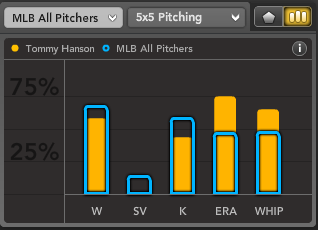
3-25-2010 8-46-50 am.png

Despite his young age, Hanson showed control usually found in a veteran starter. He struck out nearly a batter per inning (8.18 K/9) while keeping his walks at a manageable 3.24 per nine innings (BB/9). Hanson excelled at missing bats, with a swinging strike percentage near 10% (9.9%) and a contact rate (percentage of swings against that are put in play, including foul balls) of 77.2%.
 
Hanson has a good fastball that runs around 92 miles per hour. His secondary pitches–curve ball and slider–are even better. He induced 18.1% whiffs on his slider and 15.6% on his curveball. The major league average for a right-handed pitcher’s slider is around 13%, and 11% on a curveball.
 
While Hanson tossed just 127.2 innings at the major league level, he threw 194 cumulative innings in 2009. That increases the likelihood that he’ll be good for 30-plus starters this season. Bloomberg Sports’ projects him for exactly 30 starts and just over 180 innings. If that projection holds, Hanson could pass 15 wins in 2010, with some strong supporting numbers too.

3-25-2010 8-56-39 am.png One knock on Hanson would be his home run rate. As a neutral pitcher with a 40% flyball rate, Hanson allowed just 0.72 home runs per nine innings. This was due to a lower than normal home run-to-fly ball rate of 6.9%; a starting pitcher is usually around 10% to 12%. Hanson should give up a few more long balls in 2010, but his ability to keep men off base could limit some to solo shots.
 
When looking for other young pitchers with similar starts to Hanson, Clayton Kershaw comes to mind. In 2008, Kershaw made 21 starts, going 5-5 with a 4.26 ERA. He then made 30 starts last season, posting a sparkling 2.79 ERA over 171 innings. Hanson’s stuff rivals Kershaw’s, as does his upside in terms of strikeouts and swing-and-miss ability.
 
Hanson is getting a lot of respect in drafts this year. He is the 25th-rated starting pitcher and places 95th overall in B-Rank. His average draft position (ADP) is 67.8. The ADP looks a bit high, but Hanson is worthy of a seventh-round draft pick is shallow leagues. Don’t hesitate to pull the trigger on him in your draft.

For more on Tommy Hanson and other potential young aces, check out Bloomberg Sports’ fantasy kits.

Fantasy Baseball Intelligence, Episodes 3 and 4

By Jonah Keri

The next two episodes of Bloomberg Sports’ fantasy baseball podcast are now live.

In Episode 3, Mark Berniker, Wayne Parillo and I tackle top pitchers and mid-round values.

In Episode 4, we tackle the outfield crop beyond the first round of the draft.

For more fantasy baseball player rankings and draft tips, check out Bloomberg Sports’ fantasy kit.

Casey Blake: Boring but Effective Fantasy Option

By R.J. Anderson

Casey Blake will enter this season as the Los Angeles Dodgers’ starting third baseman for the second consecutive season. Blake, 36, qualifies as a solid if unspectacular player. Last season he hit .280, popped 18 homers, drove in 79 runs a season, scored 84 runs and stole all of three bases. He’s an above-average hitter, no doubt, but is he worth a roster spot in a 12-team mixed league?

blake1.png
Such a question would be so much easier if the Dodgers used Blake like the Cleveland Indians did for years. Last season, Blake appeared in 134 games at third and two at first and left. The year before he appeared in enough games to become eligible at third base and first base, and in the past he’s been eligible at three positions at once. But if a Manny Ramirez suspension wasn’t enough to get Blake out in the pasture, then the addition of Jamey Carroll and Garret Anderson almost certainly won’t lure Blake to another position.

blake2.png
That means Blake’s numbers matter only relative to other third basemen in the league. Bloomberg ranks him as the 13th-best third baseman, and one going well below his B-Rank slot of 152. Instead, Blake is being drafted, on average, at 282nd. That’s a gap of more than 100 slots, indicating that Blake is being undervalued. He’s projected to nearly match last year’s numbers, with 19 homers, a .276 average, and 79 RBI.

That makes Blake a more attractive option than other hot corner bearers like Jorge Cantu, Mark DeRosa, Alex Gordon (destined to start the season on the disabled list), Scott Rolen, and Miguel Tejada.

Is Blake worth a roster spot? He’s not a sexy option, but yes, he’s worth drafting in 12-team mixed leagues. Target him in the late rounds, and take advantage of the huge gap between his likely value and his perceived value.


For more
information on other good third base options, check out Bloomberg Sports’ fantasy kit
.

Debut of Fantasy Baseball Intelligence!

By Jonah Keri

Bloomberg Sports’ new podcast, Fantasy Baseball Intelligence, makes its debut today. Co-hosts Mark Berniker and Wayne Parillo will offer fantasy baseball analysis and commentary throughout the season, with Bloomberg Sports writers also contributing as guests.

In Episode 1, Mark, Wayne and I cover the top seven picks of the draft. Power? Speed? Early grab for a top pitcher? We weigh the options.

In Episode 2, we explore the rest of round one, round two, and strategies for planning the top of your draft.

For more fantasy baseball player rankings and draft tips, check out Bloomberg Sports’ fantasy kit.

The Blue Jays Closer Situation

By Erik Hahmann
 
Trying to predict who will end the season leading the Blue Jays in saves is like trying to beat the UConn women’s basketball team: It just can’t be done. Over the last five years there have been four different saves leaders for Toronto, with no one leading in back-to-back seasons. The 2009 season was especially rough on the closer position for the Jays, as the team leader had 11 saves. Here’s the list of the leaders over the past five seasons and their saves totals:
 
2009: Jason Frasor (11)
2008: B.J. Ryan (32)
2007: Jeremy Accardo (30)
2006: B.J. Ryan (38)
2005: Miguel Batista (31)
 
The Jays are staging a three-man competition for closer this spring, meaning there’s a good chance we will see another new face atop that list. The three men involved in this competition are Toronto stalwarts Jason Frasor and Scott Downs, along with the newly acquired Kevin Gregg. Let’s focus on Frasor and Downs first.
 
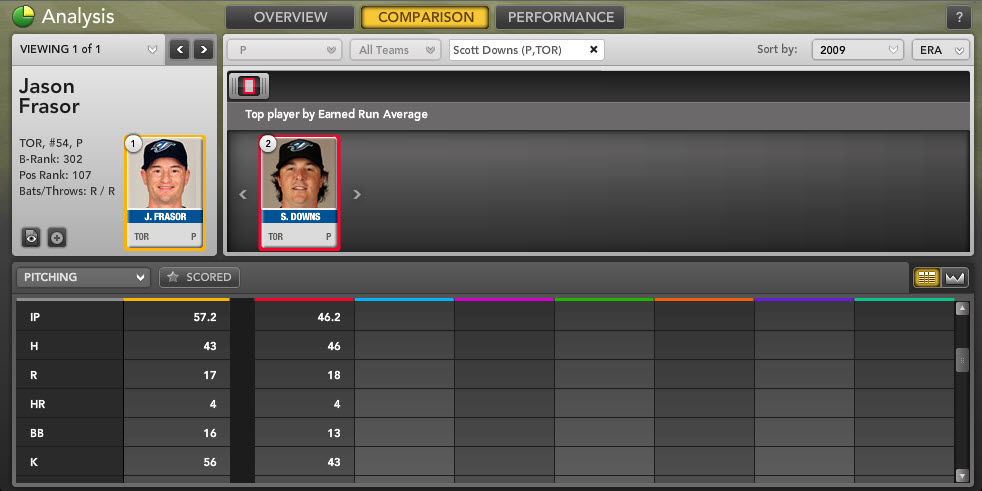
jasonfrasor.jpgThe Blue Jays turned to Frasor for their closing duties last season after releasing the oft-injured B.J. Ryan in early July. Frasor, who had closing experience from his 2004 rookie campaign, responded well to the promotion, putting up a 2.50 ERA, striking out 56 batters and walking just 16 in saving 11 games for a bad Blue Jays team. The 2.50 ERA is nearly two full runs lower than it had been over his three previous seasons, so some regression might be in order – despite some encouraging progress in his walk rate, which was by far the best of his career.

Since converting into a full-time reliever in the 2007 season, Downs has been one of the best set-up men in baseball. His ERA hasn’t finished above 3.09 and his Ground Ball Percentage (GB%) has never fallen below 55.7% in that time frame. That last part is important since keeping balls on the ground, and by extension in the yard, is an important part of a closer’s duties. Downs did save nine games a season ago, but Blue Jays Manager Cito Gaston seems like he’d rather Downs fill the type of roving reliever role that J.P. Howell has with the Rays, saying: “I’ve got a feeling that Scott, he’ll pitch anywhere you want him to pitch. He’s not going to be upset if he’s closing or not closing.” Not a good sign for the Scott Downs For Closer supporters out there.

 
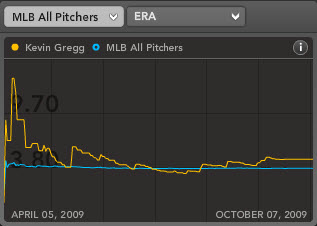
The Blue Jays signed Gregg to a one year, $2.75 million dollar contract this winter. Gregg is an experienced closer with 85 career saves under his belt. He had a rocky 2009 season with the Cubs – his ERA was over 5.00 in early June and ended at 4.72 – losing his closing to Carlos Marmol. That’s even though Gregg posted a 9.31 K/9 and his lowest walk rate since 2006, numbers which suggested some back luck on the ERA front. Home runs were his bugaboo, allowing 13 in only 68.2 IP after yielding just 10 in the previous two seasons combined. The 13 home runs are an outlier, likely to make their way back down this season, which would in turn make Gregg’s other numbers look respectable once again.
 

kevingregg.jpg 
If the Jays wanted to make a decision based solely on spring stats (a policy we would not advise given the issues of small sample size and uneven competition), Downs and his 0.00 ERA and 5 Ks would be the runaway winner to this point, with Gregg (5.40 ERA) second and Frasor (8.31) a distant third.

Taking everything into consideration, Gregg looks like the Jays’ most likely pick. Losing teams rarely spend nearly three million dollars on a reliever that’s not finishing games for them, and 20-plus saves for Gregg at the trade deadline could make him more attractive to a contender, potentially enabling the Jays to add prospects to their farm system. Gregg’s Average Draft Position is 329th, making him a cheap late-round pickup that could end up paying dividends – even if only for a few months.

 
For more information and tools on evaluating the closer position in your draft, check out Bloomberg Sports’ fantasy kit.

Rickie Weeks: Post-Hype Sleeper or Bust?

by Eno Sarris

Earlier this week, we took a look at the Post-Hype Sleeper label and some arguments for and against its existence. That led to an in-depth profile of Chris Davis and his hopes for a strong season. Now it’s time to take a look at a second baseman who has seemingly been all hype and disappointing performance for a decade now.

Will this finally be the year for Rickie Weeks? Seven years into his career, he’s still only 27, at an age when many players hit their prime. He’s been injury-prone and his batting average has oscillated between terrible and mediocre. But he’s also tantalized fantasy owners with good power and speed for stretches.

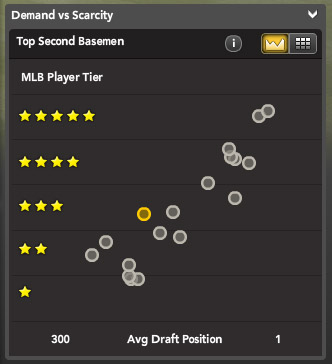
As you can see from the x-axis on the Demand vs. Scarcity chart from the Bloomberg Sports Fantasy Sports Tool below, Weeks is the latest-drafted three-star second baseman this year. Bloomberg Sports’ projections are pretty optimistic, as they predict a .267 average with 20 home runs and 19 steals. Those numbers result in a
B-Rank of 124; fantasy players have been more
WeeksGrab.jpg skeptical, drafting him
much later (183.1 ADP). The sweet spot for drafting him then could be in the 14th or 15th round, in 12- or 10-team mixed leagues.

Still, skepticism remains. Last season actually looked like it might be his breakout year. A bit more than one-quarter of the way into the season, Weeks had hit nine home runs with a .272 batting average. But on May 18th, Weeks learned he had torn the tendon sheath on his wrist and would miss the rest of the season. Wrist injuries can sometimes take a long time to heal; at least Weeks has youth, and time – nearly a full year from his surgery to Opening Day 2010 – on his side.

Because of the small sample size that Weeks created in 2009, we have to take his early-season success with a grain of salt. Let’s instead look at the three years that led up to 2009 and see if there was improvement in some underlying categories for Weeks: power and contact.

Though his power has jumped around a little, there are two reasons to be optimistic. His 2008 Isolated Slugging (slugging percentage minus batting average) of .164 was slightly above-average (the league-average ISO that year was .152). Weeks has shown the ability to put up near-.200 ISOs , though (.198 in 2007); both 2007 and 2008 were more powerful years than the first three of his career. Another reason for donning the rose-colored glasses is the fact that Weeks is hitting more balls in the air with every season. The general trend of his career has taken him from a worm-burner (30.8% flyball percentage in 2005) to more of a flyball hitter (43.5% last year). It wouldn’t take a big leap to make Weeks the cheapest 20-home-run second baseman in the game this year.

The biggest black mark on his career to date (save for his injury-prone nature) has been his struggle to make contact. Again, there’s reason for optimism. Save for last year’s small sample of a blip, Weeks has improved his contact rate every year he’s spent in the major leagues. Getting that rate up from 73.1% in 2005 to 78.1% in 2008 moved him from Adam Dunn territory (72.9% last year) to Kendry Morales‘ neighborhood (78.8% in 2009).

The fact that Weeks has improved his ability to make powerful contact is a real positive, and despite all the injuries, the upside is still there. Considering that he’s going just slightly before decent but unspectacular options like Orlando Hudson (B-Rank: 206) and still has the potential to double Hudson in the power and speed categories, the “Post-Hype Sleeper” label might just apply in this case.

For more information on Rickie Weeks, Orlando Hudson and all of the other second basemen in your drafts this year, check out Bloomberg Sports’ fantasy kit.


Billy Butler and the Notion of ‘Upside’

By Eriq Gardner

It’s well acknowledged that first base has always been and probably always will be the most offensively productive position. We expect a lot from our first basemen. Because first base is so deep, many people prefer to fill other roster positions on their squad first with the few players who are above average offensive players elsewhere. Especially if it’s possible to find a first baseman a bit later in the draft with the so-called “upside” to match the production of the first few first basemen taken.

Let’s flash back a couple years to the beginning of the 2008 season, when two highly touted first baseman arrived on the scene. We’re talking about Billy Butler of the Kansas City Royals and James Loney of the Los Angeles Dodgers.
Both came into the league with an extremely similar offensive profile: Elite batting eyes and questions over power potential.
Many people assumed that it was just a matter of time and maturity before Butler and Loney would transform their doubles into home runs. Only Nostradamus knew if we were talking 20-HR potential, 25-HR potential, 30-HR potential, or more for each.
butlerdemand.png
Last year, Butler made a solid leap forward, going from 11 HR to 21 HRs. Meanwhile, Loney didn’t go anywhere, reproducing his 13 HR line from the year before.
People like to look at trends and assume they will continue. So despite finishing 11 HRs short of Michael Cuddyer, Billy Butler is now viewed as having the upside to improve, whereas the opinion on James Loney is stuck in the mud. As a result, Butler has zoomed up to about the 6th to 8th round, whereas Loney has slipped down to about the 15th round in a 12-team mixed league.
But let’s take another look at last year. 
Here’s Bloomberg Sports’ value meter on the 2009 production of first basemen. As you’ll see, Butler hardly separated himself at all from Loney when we take all five offensive categories into account.
butler2.png

By this measure, Butler finished as the 170th-best player in baseball in 2009. Loney finished one slot below as the 171st player. Those six extra steals by Loney seem to have erased much of the advantage Butler had over him in the other categories.

butler3.png
There’s no doubt that Butler’s 21 HRs showed progress. His power growth is fully supported by a strong batting eye, more fly balls, and a better FB/HR rate.
However, for a first baseman, he’ll need to develop even more. The only category he’s thus far demonstrated above-average production compared to his positional peers is batting average. That gives him a pretty high floor as opposed to someone like Chris Davis. But does it give him “upside”?
We must again look at his average draft position. According to ESPN’s draft results, he’s going ahead of players like Lance Berkman, Derrek Lee, Carlos Pena, and Cuddyer. To justify this position, given the projections of the other players, Butler will need to hit at least 27 HRs, maintain a .300 batting average, and improve his run production in a woeful Kansas City Royals lineup. These things might happen, of course. But anybody drafting Butler at his current price should realize they are paying full price for that very expectation.
In other words, it’s hard to see Butler as a true “sleeper,” no matter what the crowds might think, and it’s hard to figure that Butler has more investment upside than investment risk. He’s a good player. Just not deserving of this draft valuation quite yet.
In the meantime, few are figuring James Loney for a power breakout this season, and odds say it’s less than 50% likely it’s going to happen in 2010. However, even if we peg the probability of Loney reaching 20-25 HR at just 25%, given both his current draft position and the fact that he’s coming off a season where he nearly matched Butler in value, he’s the one with the real “upside” here.
For more on Billy Butler, James Loney, and other first basemen, check out Bloomberg Sports’ fantasy kits

Who Replaces Huston Street?

By Tommy Rancel

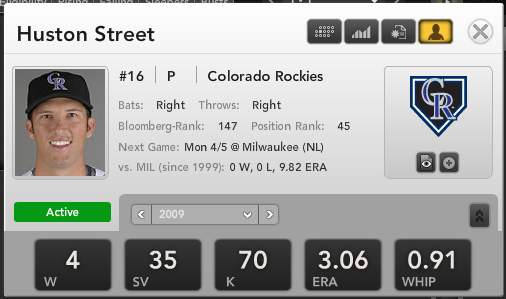
The Rockies are expected to start the season with closer Huston Street on the disabled list. Street has been battling shoulder stiffness this spring, and suffered a setback while playing catch on Tuesday. He  underwent an MRI on Wednesday, and although the results were clean, he is likely too far behind on his throwing program to be ready by opening day.

huston.png

Right-handers Rafael Betancourt and Manny Corpas would seem like obvious replacements, but both have issues of their own. Like Street, Betancourt has missed time with a shoulder issue this spring. Corpas, on the other hand, missed the second half of 2009 with a bone chip in his right arm.

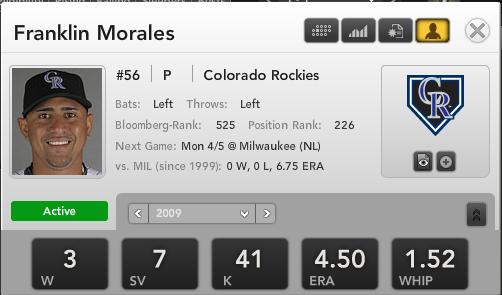
More likely, the Rockies will turn to left-handed former starting pitching prospect Franklin Morales to fill in for Street. Most baseball fans remember Morales, 24, as a promising rookie starter on the 2007 National League championship team. He dealt with a back injury and inconsistency in 2008, and had a shoulder problem of his own in 2009. Once healthy, he rejoined the Rockies as member of the bullpen. When Street went on the DL in September with biceps tendinitis, Morales closed out six games in his absence.
 
He made 40 appearances last season (38 in relief) and had a league average-ish 4.50 ERA. He also saved seven games in eight chances. Despite the ho-hum ERA, Morales showed traits of a good relief pitcher.

franklin.png 

In his brief time as a major league starter (72.2 innings), Morales had an unimpressive strikeouts per nine innings rate (K/9) of 5.4. Meanwhile, as a relief pitcher he struck out a batter per inning (32 strikeouts in 32 innings). He also allowed just one home run in 32 relief innings.
 
The knock on Morales has been control. In his major league career, he has a walks per nine innings rate (BB/9) of 4.6. In 2009, his BB/9 was over 5.0. While his control remains an issue, velocity is not. As a starter, Morales averaged low 90s on his fastball; as a reliever, he topped 93.0 mph, on average, in 2009.
 
Outside of his strikeout rate, Morales currently offers little to fantasy players. With a league average ERA and poor walk rates, his average draft position is just 335.5. That said, as a the potential closer on a promising team, those flaws become less relevant, and Morales becomes a serious late-inning target.

Grab Morales at the back end of your draft, especially in a deep NL-only league or a larger mixed league. Given Street’s injury history, as well as the medical and performance questions facing the rest of the bullpen, Morales presents the potential for some cheap save opportunities – and maybe more.

For more on Franklin Morales and other potential sleepers, check out Bloomberg Sports’ fantasy kits.
Chris Davis: Fantasy Post-Hype Sleeper or Bust?

by Eno Sarris

The concept of the post-hype sleeper is often bandied about in fantasy baseball circles. But its meaning is vague and even its very existence can be dubious. Most likely, it’s meant to apply to a player that had a pedigree coming up in the minor leagues that struggled upon facing the big boys at some point – and we all moved on.

Ron Shandler, fantasy baseball prognosticator extraordinaire and member of the inaugural Bloomberg Sports Fantasy Experts League, has his own famous saying that seems apropos:

Normal.dotm
0
0
1
1
6
Kumon Publishing
1
1
7
12.0

0
false

18 pt
18 pt
0
0

false
false
false

/* Style Definitions */
table.MsoNormalTable
{mso-style-name:”Table Normal”;
mso-tstyle-rowband-size:0;
mso-tstyle-colband-size:0;
mso-style-noshow:yes;
mso-style-parent:””;
mso-padding-alt:0in 5.4pt 0in 5.4pt;
mso-para-margin-top:0in;
mso-para-margin-right:0in;
mso-para-margin-bottom:10.0pt;
mso-para-margin-left:0in;
mso-pagination:widow-orphan;
font-size:12.0pt;
font-family:”Times New Roman”;
mso-ascii-font-family:Cambria;
mso-ascii-theme-font:minor-latin;
mso-fareast-font-family:”Times New Roman”;
mso-fareast-theme-font:minor-fareast;
mso-hansi-font-family:Cambria;
mso-hansi-theme-font:minor-latin;}

Once a player displays a skill, he owns it. That display could
occur at any time — earlier in his career, back in the minors, or even
in winter ball play. And while that skill may lie dormant after its
initial display, the potential is always there for him to tap back into
that skill at some point, barring injury or age. That dormant skill can
reappear at any time given the right set of circumstances.

So once a player shows us his prodigious power or excellent eye or speedy wheels, the argument goes, he can do it again – just give him the right set of circumstances and enough time. We all knew Russell Branyan had big power, for instance; it just took a black hole at first base in Seattle nine years into his career until he got a legitimate shot to launch 30-plus homers in a season. 

Our own Eriq Gardner has countered the argument, calling it merely the remnants of the hype label being “more sticky than people realize.” He points to one article in particular by Joe Sheehan where he put the label on Felix Hernandez, Jeremy Hermida, Anthony Reyes, Andy Marte, and Zack Greinke. Of course, that wasn’t the year Hernandez or Greinke broke out, and it does show the peril of applying the label, particularly in the case of Hermida.

Finally we come to Chris Davis, a player that showed oodles of pop on the way up in the minor leagues (.306/.366/.585 combined AVG/OBP/SLG line in the minors). Davis then exploded onto the major league scene, hitting .285/.331/.549 in his rookie year of 2008. When he fizzled to a .202/.256/.415 start in the first half last year, the hype flew by him like high cheese. Suddenly hype-less, he was sent back in the minor leagues trying to find his mojo. He mashed, was CDavisGrab.jpgpromoted, and mashed some more (.308/.338/.496). Check the Bloomberg Sports Fantasy Tool for a graphical representation of his slugging percentage by month last year. Roller coaster!

So, should we affix the post-hype sleeper label on Davis or not? Definitely maybe.

Allow me to explain. In the Shandler corner stands Davis’ power as an example of a skill that Davis has shown and can show again. Throughout the minors, Davis had an ISO (Isolated slugging percentage, or slugging percentage minus batting average) that never once dipped below .257 in a full year; it was a sky-high .279 over 1,345 minor league plate appearances. For comparison’s sake, putting that number up in the majors would land him between Adrian Gonzalez and Mark Reynolds on the power spectrum. Serious artillery there. In the major leagues, that number is still a high .230, with a peak of .264 his rookie year and a very respectable trough of .204 last year. Still, that’s the difference between, say, Nelson Cruz (.264 ISO last year) and Curtis Granderson (.204).

Whether he’s got ‘nice’ Granderson-esque power, or light-tower Gonzo power, it seems safe to say that Davis has shown power and owns it. The ride may get a little bumpy though, as we’ve seen. Does the fact that Davis had a .306 batting average in the minor leagues and batted .285 over 295 at-bats his rookie year mean that he ‘owns’ batting average as a skill? That’s tougher to say.

Beyond the small sample sizes inherent in using one season’s worth of plate appearances, there’s the fact that batting average is not a skill – it’s a result. The skills that go into batting average are legion. There’s plate discipline, contact, and speed – at the very least. So while Davis’ batting average – the result of these skills – has been divergent, his actual underlying component skills have been relatively constant. Check out the similarities in his two walk rates (a low 6.3% in his rookie year and 5.7% last year) and his two contact rates (a very low 68.1% in 2008 and even lower 63.2% in 2009). Those seem pretty similar, and they point to some serious holes in Davis’ game.

His strikeout rates concur (29.8% and 38.4% respectively). That puts Davis somewhere between Mark Reynolds (38.6% last year) and Mike Cameron (28.7%) on the strikeout scale. If he strikes out that often, Davis will struggle to put up respectable batting averages. A player like Carlos Pena provides you with a hopeful future for Davis, as he has similar contact (69.6%) and strikeout (31%) rates, but he also features a nicer walk rate (13.3%), and that selectivity is important. If Davis doesn’t start walking more, he may just end up like Brandon Inge (8.5% walk rate, 30.2% strikeout rate, 71.7% contact rate and a .230 batting average last year).

If power is all you seek, you can call Chris Davis a post-hype sleeper and pick him, although trying to get him closer to his B-Rank (214) than his ADP (172) might still be a good idea. If you are expecting 2008 all over again, you are better off not applying the label and avoiding him altogether.

For more information on Chris Davis and other big-whiffing sluggers this year, check out Bloomberg Sports’ fantasy kit for yourself. 
      

The Bloomberg Sports Experts League

By R.J. Anderson

Bloomberg Sports recently held a fantasy draft featuring six industry experts and six avid fantasy players from different walks of life. For more information make sure to check out the official league site.

Here’s a brief rundown of the rosters:

Harold Reynolds of the MLB Network loaded up on power arms and flashy hitters alike. The triumvirate of Chase Utley, Adrian Gonzalez, and
Justin Upton is a pretty solid top threesome on any squad. Reynolds
also seems to be a fan of Boston’s off-season additions, since he
popped both Mike Cameron and Adrian Beltre. Edwin Jackson, Carlos
Zambrano
, Roy Oswalt, Chris Carpenter, and Yovani Gallardo help
Reynolds’ projected total of 112 wins.

reynolds1.png
Lawr Michaels of Mastersball.com had the first selection and took Marlins shortstop Hanley Ramirez – one of two players generally accepted in that slot (along with Albert Pujols). He also features a strong set of relievers that project to finish with 100 saves, good for second-best in the league, backed by Brian Fuentes, Rafael Soriano, and Leo Nunez.

Ron Shandler of BaseballHQ.com jumped on Pujols at number two. He seemingly punted saves though, rostering Heath Bell as his only closer. Shandler is projected at a league-low 53 saves, which is seven saves fewer than the next-lowest team (Gardner).

USA Today’s Steve Gardner did a fine job knocking his own efforts. He did manage to grab Ian Kinsler, David Wright, and Andrew McCutchen, as well as promising rookie Jason Heyward. Gardner’s offense is projected to finish with the second-fewest homers, runs scored, and runs batted in. His pitching staff expects to fare better, though, with Cliff Lee, John Lackey, and Rich Harden leading a staff that projects to finish third in wins.

KFFL’s Tim Heaney loaded up on top-100 players, particularly those with odd facial hair. Kevin Youkilis, Jayson Werth, and Nelson Cruz, along with the clean-shaven Mark Teixeira, headline the offensive efforts. Heaney’s pitching staff projects relatively weakly, second-to-last in projected wins.

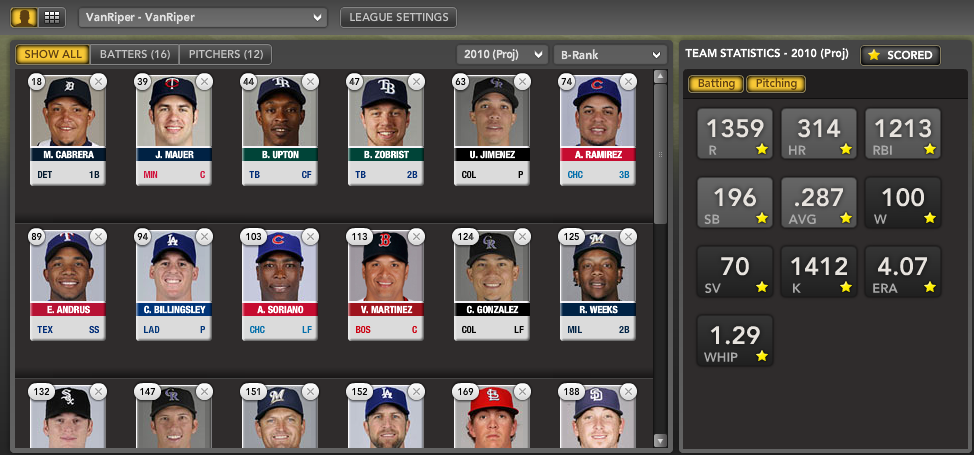
Rotowire’s Derek Van Riper loves him some upside. Miguel Cabrera and Joe Mauer are the big names here, and Van Riper also added Ben Zobrist, one of the most valuable players in baseball last year. Some interesting upside picks here include B.J. Upton, Rickie Weeks, and Elvis Andrus, who certainly has the defense to play in the majors, and could see an offensive boost come with age.

vanriper2.png


For more
information on these players and access to the team analysis tool, check out Bloomberg Sports’ fantasy kit
.