Diamondbacks’ Miguel Montero Hits DL; Chris Snyder To Start

By Tommy Rancel

Going into the 2010 season, Miguel Montero was considered a top-10 fantasy catcher. At Bloomberg Sports, we liked Montero’s chances just as much as anyone else. After belting 16 home runs and driving in 59 runs in just 425 at-bats last season, the expectations of a bigger season seemed attainable.

Unfortunately, Montero’s season is now in limbo, as we learned this weekend that he has a torn meniscus in his right knee. He will undergo further tests to determine if there is any more damage. Currently, there is no timetable for his return, but MLB.com is reporting that he will need surgery. At the very least, he’s on the 15-day disabled list.

With Montero on the shelf, the Diamondbacks will turn to former starter Chris Snyder to handle the workload behind the plate.

snyder.png

Snyder went into 2009 as Arizona’s primary backstop; however he suffered a back injury and was never able to regain his spot thanks to Montero’s breakout. The Diamondbacks tried shipping him to Toronto this off-season – a deal they are now lucky they didn’t make. It’s unlikely that Snyder will be able to permanently pry the position back from Montero’s grip. But for now, Snyder is definitely in play as a fantasy option, especially in a deeper mixed league.

From 2006 to 2008, Snyder racked up nearly 1,000 plate appearances for the D-Backs. Over the three-year span he averaged .251/.346/.438 (AVG/OBP/SLG) with 12 home runs a season. An OPS of .785 with double-digit home runs represent solid numbers for a catcher. Of the 29 catchers with at least 300 PAs last season, only six had an OPS greater than .785.

Due to the injury, and subsequent decrease in playing time, Snyder had a down season in 2009. He appeared in just 61 games, hitting .200/.333/.358. Those numbers are ugly in raw form; however, consider these stats as well.

Despite the Mendoza level-like batting average of .200, Snyder still reached base one-third of the time. Thanks to a career walk rate of 12%, he doesn’t need to hit .300 to get on base at a decent rate. Another thing to consider is his batting average on balls in play (BABIP). His 2010 BABIP of .237 represents a 37-point drop from his career .274 mark. With some regression, his batting average could see a significant rebound.

If you own Montero, especially in a mixed league of 12 teams or more, or an NL-only league, Snyder is a must-get. He should be available on the waiver wire in most leagues, but act quickly if you haven’t already snagged him. For non-Montero owners, Snyder is still worth a flier, especially since Montero needs surgery and the position is so physically demanding. At a thin position, Snyder provides a decent bat with a proven track record. If nothing else, grab him before the Montero owner in your league does, setting up a potential trade.

For more on Chris Snyder and other potential waiver wire catchers check out Bloomberg Sports’ fantasy kits

Tim Hudson: Comeback Kid

By Erik Hahmann


It’s easy to forget about Tim Hudson. After all, he did miss more than a full calendar year from July 2008-September 2009 recovering from Tommy John’s surgery. He’s back now, and fully healthy. After starting seven games at the end of last season, Hudson seems ready to make a name for himself once again.
 
When healthy, Hudson has been a near-perennial elite pitcher. In the seven seasons in which he started at least 25 games, Hudson averaged 217 IP and saw his ERA rise above 4.00 just twice – it was under 3.00 twice as well. Hudson has never been a high-strikeout pitcher; his career K/9 is just 6.13. But he’s consistently struck out at least twice as many batters as he’s walked, as his 2.22 career K/BB indicates.

Seeing Hudson go in for Tommy John surgery was troubling to his fantasy owners, and to the Braves. But the elbow replacement surgery carries strong recovery rates. In seven starts after returning from Tommy John last season, Hudson showed signs of a healthy recovery, posting an impressive 3.47 xFIP (a stat which strips out the effects of bad luck, defense, bullpen support, aberrant HR/FB rates, and other factors).


Hudson2.png 
 
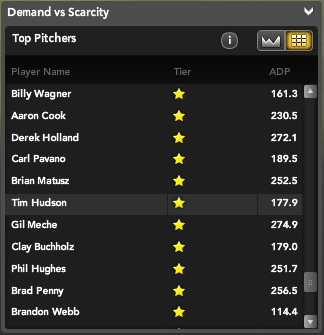
Still, as you can see in the Demand vs Scarcity chart above, the fact that Hudson underwent Tommy John’s surgery has indeed severely affected his fantasy value. For comparison’s sake, pitchers like Tim Lincecum, Roy Halladay and C.C. Sabathia are given five-star rankings. Even Ben Sheets, who missed the entire 2009 season, has a two-star ranking.

Hudson was ranked in the one-star group, with names like Carl Pavano, Gil Meche and rookie Brian Matusz, all of whom Hudson could easily outperform this season. Continuing his late-season dominance from last year, Hudson was dominant this spring, putting up a 1.35 ERA while striking out 17 batters and walking just 3 in 20 IP. While you must take spring training stats with a grain of salt, they can be instructive for young players, and especially for players trying to prove themselves after an injury. According to Braves catcher Brian McCann: “He look[ed] great. He’s putting his pitches right where he wants them. He’s definitely ready for the season.”


Hudson1.png 
 
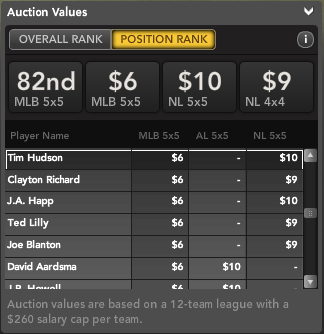
The newest addition to the Bloomberg Sports consumer product is the Auction Values tab. Now, instead of just listing a player’s Average Draft Position, you can see how much that player is worth in a standard 12-team, 5×5 auction style league, with a salary cap of $260. Hudson could prove to be a steal at the $6 under which he was listed. Bloomberg Sports is projecting Hudson’s 2010 season to look like this: 25 starts, 11-7, 3.62 ERA, 1.35 WHIP, 98 K, in 159 IP. If Hudson is indeed at full health, the could easily exceed those projections.

The 11-win total should be easily reachable now that the Braves have added more firepower in the forms of Jason Heyward and Troy Glaus to an already talented lineup. The defense behind Hudson as improved as well, with Heyward in right field, Melky Cabrera (career 4.0 UZR in LF) seeing time in left, and Garret Anderson (-16.5 UZR last season) no longer on the roster.

Hudson’s 2010 debut was an impressive one: 7 innings, 2 runs, 3 hits and no walks. A couple of caveats apply. First, he was facing the Giants, who have only one elite hitter in their entire lineup in Pablo Sandoval. Second, Hudson only struck out two batters in his inaugural 2010 start. Still, his best indicator of success, aside from his pinpoint, no-walk control, was his impressive groundball rate: Fourteen of the 21 outs Hudson rang up Friday against San Francisco came via groundballs. That’s a great sign for a pitcher who’s thrived on worm-burners his whole career.

Hudson’s probably owned in even the shallowest leagues, and his value spiked after his opening start, such that targeting him in trade now doesn’t make much sense. But if you already own him, resist the temptation to sell high. Unless someone bowls you over with an offer, hang onto Hudson and give him a chance to put up a big season.

 
For more information on Tim Hudson and other starting pitchers, check out Bloomberg Sports’ fantasy kit.
 

Chris Iannetta: Fantasy Post-Hype Sleeper or Bust?

by Eno Sarris

We close out our post-hype infield with Colorado Rockies catcher Chris Iannetta. Just to recap, that was Chris Davis at first base, Rickie Weeks at second base, Stephen Drew at shortstop, and Alex Gordon at third base.
As I mentioned before, this is not a strategy to try at home. I was
hoping to find one or two good, young and cost-controlled infielders in
a league with contracts and 15 keepers, so I had to try something. (Gotta love Weeks’ huge first week.)

Iannetta presents a mixed bag of positive and negative indicators. Yes, he has a slightly worrisome fellow backstop in Miguel Olivo. But Olivo has established himself as a prolific outmaker throughout his career.
As evidence that the team still believes in their young catcher, the Rockies gave Iannetta a three-year contract in January.

Iannetta came tearing through
the Rockies’ minor league system and has held the Catcher of the Future
title there for a while now. An accomplished college catcher that was around average age at each level of the minor leagues, his .303/.409/.511 career
line there was still impressive. After struggling to hit for power or
batting average in his first two attempts at the majors, he
IannettaGrab3.jpg

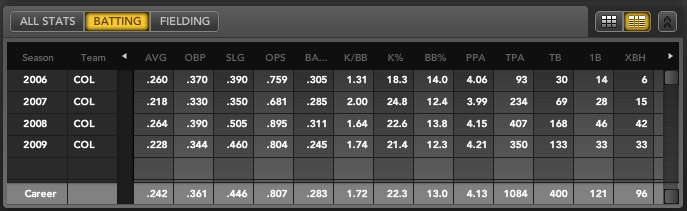
had a breakout 2008, hitting .264/.390/.505 with 18 home runs in
407 plate appearances. So, in fact, Iannetta has already been a
post-hype sleeper before and come through with a great year. Now, after
a less impressive .228/.344/.460 and just 350 PAs last season, he’s once again
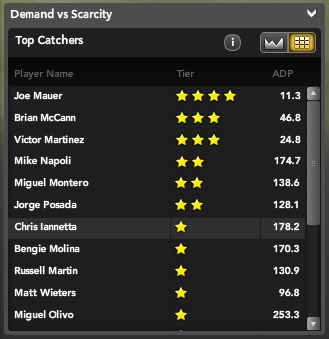
undervalued. Take a look at the Bloomberg Sports Fantasy Tool, which shows how cheap he is compared to other possible top-10 catchers this year – increasing the likelihood that he could be available on the waiver wire in your shallow league.

So
what changed in 2009? Why did Iannetta’s batting average suddenly plunge the year after establishing himself? Once again, the Bloomberg Sports Fantasy Tool,
with some recently added stats, gives us great insight into his 2009
struggles. As you can see from this screen shot, Iannetta suffered from
terrible luck on the balls in play last year. He walked with about the same
frequency as he did the year before, struck out a little less, had a similar
isolated slugging percentage (.241 in 2008, .232 in 2009) and looked
like the same hitter in general. However, he had a .245 batting average
on balls in play (BABIP) in 2009, and his career number in that
category is .283.

IannettaGrab2.jpg
Even though BABIP holds steady around .300 across all of baseball, each player has their own true level. Ichiro Suzuki‘s
BABIP (.357) is a great example of this. Using a players’ batted ball
profile and speed, however, we can estimate a player’s BABIP.
Iannetta’s xBABIP last year? .303. It seems that Iannetta had some
rotten luck last year.

Given that Iannetta held his power
steady in both 2008 and 2009, and showed the same control of the strike
zone both years, it seems to follow that he can put in another campaign
that looks like 2008, once the BABIP normalizes. With an
acceptable batting average (for a catcher, a position where the average
line was .253/.320/.394 last year), fantasy owners will benefit from
getting his above-average power cheaply.

And yet, there’s that pesky timeshare. If you’re an optimist, though, you can look at the current situation this way: Iannetta’s lack of playing time means he might not be owned in many shallow leagues. So if you’re a Miguel Montero owner and you’re looking for a replacement at catcher, don’t chase first-week stats by proven mediocrities like Rod Barajas. Take a shot on someone with real upside. Someone like Chris Iannetta.

For more information on Chris Iannetta and other underrated catchers this year, check out Bloomberg Sports’ fantasy kit for yourself.

Fantasy Baseball Intelligence, Episode 5

By Jonah Keri

In Episode 5 of Fantasy Baseball Intelligence, Eriq Gardner, Bloomberg Sports writer and founder of the Web site
Fantasyballjunkie.com, talks with Bloomberg’s Wayne Parillo about the
value of choosing quality relief pitchers for your fantasy team.

Here’s the direct link to the podcast. To subscribe to an RSS feed of Bloomberg Sports’ podcast, head here, or check out Fantasy Baseball Intelligence at iTunes.

For more on the value of relief pitchers in fantasy baseball, see Part 1 and Part 2 of Eriq’s series.

For more information on top relievers and other fantasy baseball topics, check out Bloomberg Sports’ fantasy kit.

The Boston Red Sox Pitchers and Run Prevention

By Tommy Rancel

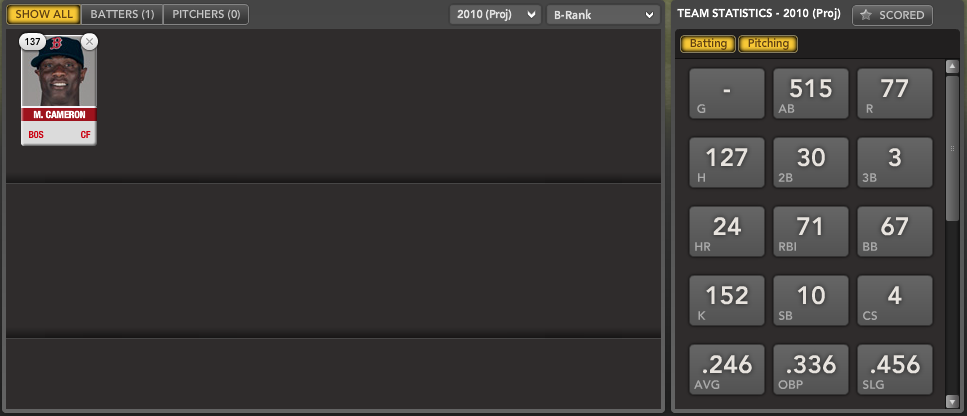
The Boston Red Sox made a conscious effort this off-season to improve the team in terms of run prevention. The highlights of the Red Sox off-season include the signings of respected defenders Mike Cameron in center field and Adrian Beltre at third base.

While Epstein is on record as saying he doesn’t agree with some publicly found defensive metrics (presumably Ultimate Zone Rating aka UZR, which rated Jacoby Ellsbury as one of the league’s worst center fielders last year), his actions suggest otherwise. Even before Jason Bay signed with the Mets, leaving a void in the Boston outfield, Epstein saw the need to sign an able defender like Cameron as an upgrade.

mike cameron.png

Despite Epstein’s support for Ellsbury as a center fielder, and the fact that Cameron is 10 years older than Ellsbury, it is Cameron who is patrolling center field for Boston this season.

Looking at UZR, Cameron is a perennial favorite of the metric. Even at his advanced age of 37, he is rated well above average (10.0 UZR in 2009). Ellsbury on the other hand has bounced around the spectrum, rating well above average in 2008 (+16.5) to well below in 2009 (-18.6).

The Ellsbury/Cameron moves highlight the outfield changes, but Beltre at third base is another gift to Boston’s pitching staff. Regardless of your fielding metric of choice, Beltre is a consensus top defender at the hot corner. His 14.3 UZR ranked fourth-best among major league third basemen, and he was runner-up at the position to Ryan Zimmerman in the 2009 Fielding Bible Awards. His plus/minus, a defensive statistic created by John Dewan, is also second to Zimmerman at third base over the past three seasons.

Looking at the Red Sox third basemen in 2009, Beltre will be a welcome addition to the left side of the infield – Mike Lowell (-10.4 UZR in 895 innings) and Kevin Youkilis (-1.6 UZR in 494.1 innings) were both below-average defenders in 2009. The Red Sox will also welcome Marco Scutaro to the left side. In his first full season at the position in 2009, Scutaro rated just above average at shortstop.

It is easy to pick out a few positions and point out the flaws, but the Red Sox as a team posted a UZR of -16.3 last year. This led to a highest-in-MLB batting average on balls in play (BABIP) of .320. For comparison’s sake, the Seattle Mariners led the league in team UZR with 85.5 runs above average. Not surprisingly, they also had the lowest team BABIP in the majors at .280. The design of Fenway Park leads to some quirky BABIP in itself, but the Red Sox maintained a .297 team BABIP in 2008, and .292 while winning the World Series in 2007.

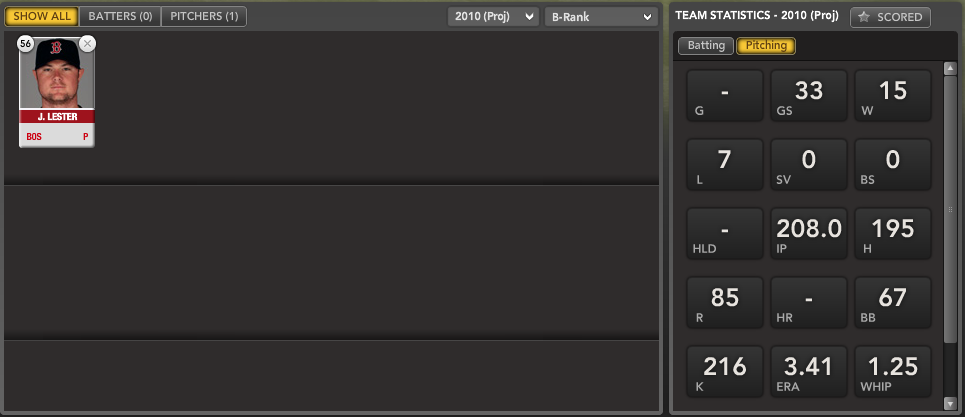
The Red Sox staff as a unit should benefit greatly from the improved defense, but Jon Lester especially. Fans of other AL East teams might want to close their eyes, but with a .323 BABIP in 2009, Lester was still good enough to maintain a 3.41 ERA. As a pitcher who yields comparable numbers of groundballs and flyballs, Lester should benefit from all the additions, and could see his BABIP fall this season. This could mean an improvement in his numbers, across the board.

jon lester.png

Beyond Lester, young righty Clay Buchholz and his career groundball percentage of nearly 49.9% should greatly benefit from the above-average infield defense of Beltre, Scutaro, Youkilis, and Dustin Pedroia.

Feel confident in Boston pitchers not only for their individual abilities, but also because of the imported vacuum cleaners brought in to upgrade the defense. That those pitchers figure to benefit from solid run support won’t hurt either.

For more on the Boston Red Sox pitching staff, check out Bloomberg Sports’ fantasy kits.

Bloomberg Sports’ 2010 National League East Preview


By R.J. Anderson

This division will likely a two-team race. The Phillies are the favorites, but Atlanta is better than most people would like to acknowledge. Don’t be surprised if both of these clubs make the playoffs, and be prepared for a possible National League Championship Series match-up.


braves.png


Atlanta Braves

Jason Heyward is already ahead of schedule, and the season just started. We wrote about him at Bloomberg Sports, calling him a shiny toy, and fretting that he might get sent to the minors. Clearly that last part was a little less than prescient. Heyward made headlines this week by hitting a home run in his first career at-bat, and has become a hot commodity; so much so that he’s probably overpriced as a trade target right now. Brian McCann, Nate McLouth, Yunel Escobar and Martin Prado project as less-hyped but still solid producers who are worth discussion, if you don’t already own them.

The starting rotation offers several interesting storylines. Can Jair Jurrjens repeat his amazing 2009 season? Will Tommy Hanson emerge as a 200-inning ace in his first full big league campaign? The biggest question mark is Tim Hudson. Prior to missing most of 2009 and part of 2008, Hudson had made 25+ starts in every season since 2000. He’s back and looked good in the spring, but he’s no sure bet to stay healthy all year. If his price is reduced due to injury concern, inquire about him; if he’s being priced like the Tim Hudson of old, pass.


phillies.png 
Philadelphia Phillies

Cole Hamels might be the only player on the two-time defending National League pennant winners who qualifies as a sleeper. Though his won-lost record and ERA turned much worse in 2009, his Fielding Independent Pitching (FIP) shows identical 3.72 marks in both seasons, making him a potential value pick. Everyone else is a known commodity, including newly-acquired ace Roy Halladay, Chase Utley, Ryan Howard, Jimmy Rollins, Shane Victorino and Jayson Werth


Ryan Madson is the man in waiting if closer Brad Lidge stumbles once more. Madson has typical closer velocity, checking in last season at 95 MPH, but also uses a cutter and change-up as his secondary pitches, rather than the commonplace slider. Raul Ibanez‘s hot entrance to the National League fraternity is what people will remember from last season, rather than his quick descent back into the real world. A year older, Ibanez has bust potential written all over him. Avoid.


marlins.png 
Florida Marlins

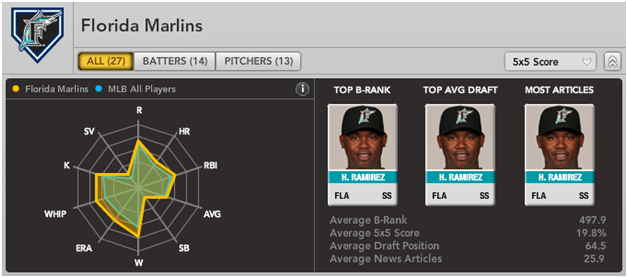
The Marlins are in the running for the most top heavy team in baseball. Hanley Ramirez is one of the best players in baseball. Last year, Josh Johnson appeared to be one of the best pitchers in baseball. Bloomberg Sports also loves number-two starter Ricky Nolasco.

After that, things get murky. Jorge Cantu provides some pop. Chris Coghlan is a decent sleeper. Dan Uggla had his name floated in trade rumors for what seems like the umpteenth year without a move happening; he’s a good bet to 25-30 home runs, but his low-batting average/solid on-base percentage is a lot more valuable in real life than in standard 5×5 fantasy leagues. The Marlins do have some strong outfield prospects on the rise. Cameron Maybin and his blend of power and speed potential are already on the major league roster, and Mike Stanton has Jason Heyward-like power potential.

nats.png 
Washington Nationals

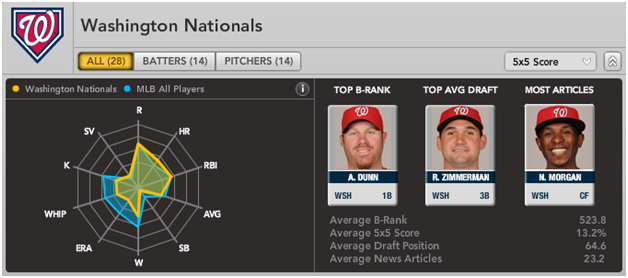
Well, there’s Ryan Zimmerman, Adam Dunn, Nyjer Morgan and … well … have you heard about Ryan Zimmerman? The good news about teams like the Nationals is that literally everyone besides the superstars qualify as sleepers Ian Desmond can sneak through the cracks. Desmond is the 24-year-old rookie shortstop who had a coming out party last season in Double- and Triple-A, with a .354 batting average in 55 Triple-A games. In National League-only leagues, he’s an intriguing upside play at shortstop – even more so in keeper leagues.


Brian Bruney is someone else we’ve profiled as a potential sleeper, but again, only in deep NL-only leagues, as he’s the closer in waiting for now.

mets.png 
New York Mets

Jose Reyes could be a good target is his asking price has crashed due to injury concerns. David Wright will probably cost full value though: Bloomberg Sports and other projection systems expect a full recovery, despite last year’s career-low 10 home runs. Assuming Citi Field doesn’t become a wasteland for hitters, Jason Bay should put up solid numbers too. Manager Jerry Manuel’s lineup fetishes will ding his RBI totals, though. Manuel had Bay batting fifth on Opening Day, behind an ugly collection of bats that included Alex Cora, Luis Castillo and Mike Jacobs.

On the pitching side, Johan Santana‘s value depends on his valuation: Do your leaguemates still see him as one of the top three starters in the game, or can he now be had at a discount? Santana’s rotation mates are avoidable in shallower leagues. Meanwhile, Francisco Rodriguez isn’t the dominant closer he used to be; don’t overpay.

For more on Hanley Ramirez and the rest of the NL East, check out Bloomberg Sports’ fantasy baseball kits.

Bloomberg Sports 2010 American League East Preview

By Erik Hahmann


newyorky.png

New York Yankees

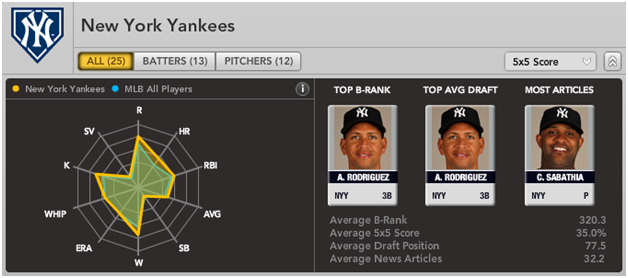
New York comes into the season as not only a juggernaut in real life, but in the fantasy realm as well. Their offense is anchored by the best infield in baseball, led by Alex Rodriguez, who fully healthy should go back to putting up MVP-type numbers. The infield is rounded out by Derek Jeter, Robinson Cano, and Mark Teixiera, each of whom is capable of ranking in the top 3 at their respective positions. New addition Curtis Granderson should flourish in hitter-friendly Yankee Stadium – he hit 30 homers in far less friendly Comerica Park last year. Home plate is once again manned by Jorge Posada, who even given his advanced age should put up above-average numbers.


CC Sabathia and A.J. Burnett lead a strong rotation, with newcomer Javier Vazquez making for an excellent number-three starter. Phil Hughes moves to the rotation and is a rare Yankees sleeper; he was once an elite SP prospect before he became a lights-out bullpen guy, and he’s the number-five starter to start the season. Joba Chamberlain should get a good amount of K’s in the 7th-8th inning role, setting the table for the always reliable Mariano Rivera to once again be the one of the best closers in the game.


boston.pngBoston Red Sox

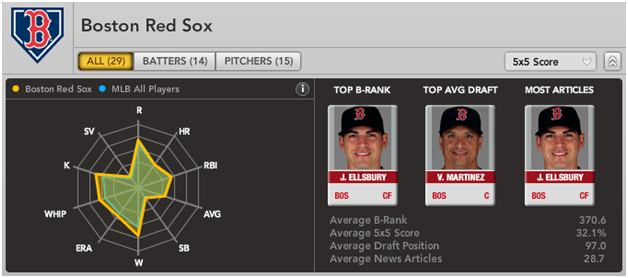
An emphasis on defense led the Sox to acquire several new players this off-season. Adrian Beltre could have a bounceback season at 3B now that he is in a more hitter-friendly park – assuming he’s finally healthy. Marco Scutaro is coming off a career year at age 35, so expect some regression from his 2009 season. Center field is now manned by Mike Cameron, with Jacoby Ellsbury and his 70-steal potential shifting to left. Expect regulars like Kevin Youkilis, Dustin Pedroia, and J.D. Drew to continue to put up their usual stellar numbers. Playing in Fenway for a full season, in a solid lineup, could also boost Victor Martinez‘s already high fantasy value.

The strength of the team is the rotation. Jon Lester and Josh Beckett lead the way as one of the top 1-2 punches in the game, with John Lackey a close third. Moving to the AL East should slightly hinder Lackey’s numbers, so downgrade him a bit. The closer position is filled by Jonathan Papelbon for now, with Daniel Bard poised to take over if Papelbon falters.


tampa.pngTampa Bay Rays

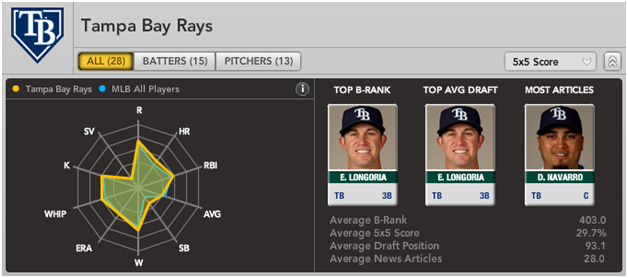
The Rays set a team record for runs scored last season, and this year’s offense could be even better. Evan Longoria has put up outstanding numbers in his first two seasons and could exceed them this year as he vies for the AL MVP. Last year’s fantasy darling, Ben Zobrist, moves up to third in the order (ahead of Longoria) though he might struggle to approach 2009’s monster numbers. Carl Crawford should make his (probable) last season in Tampa Bay a good one, getting on base and stealing 50 or more bases. Jason Bartlett enjoyed a career season in 2009 and should regress, as his BABIP was a sky-high .364. A player who should stick around all season is Sean Rodriguez, who was acquired in the Scott Kazmir trade last season. He’s hit the cover off the ball this spring and could provide strong multi-positional value at 2B/OF.

The pitching staff is once again led by James Shields and Matt Garza, with Garza a popular pick for a breakout season; both Shields and Garza ranked among the unluckiest pitchers in the baseball for run support, and could both win more games with a little more luck on that front. Jeff Niemann, David Price and Wade Davis all offer upside as well, with Davis penciled in as the fifth starter, with a chance to compete for Rookie of the Year honors. Rafael Soriano has looked shaky in his first outings as the Rays’ new closer and has a history of injuries. J.P. Howell could make a good insurance policy for Soriano, assuming Howell himself can return healthy in the near future.


baltimore.pngBaltimore Orioles

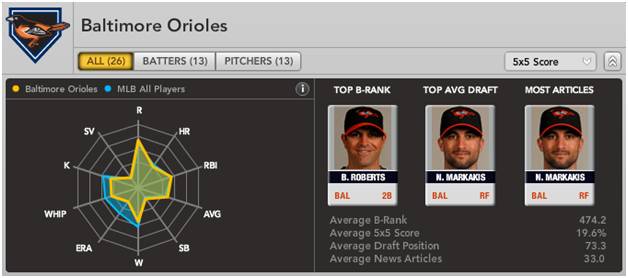
One of the more exciting teams to watch this season might well be the Baltimore Orioles. Rookie starter Brian Matusz has the skills to be an above-average performer this season, even in the rugged American League East. Veteran Kevin Millwood will start Opening Day for the Orioles. Millwood is a workhorse who should give Baltimore much needed innings at the top of the rotation.

What everyone will pay to see, however, is the O’s exciting young offense, led by Nick Markakis, Adam Jones, and Matt Wieters. Markakis drove in more than 100 runs last season and looks poised to do the same this year. While Jones had a slightly down 2009 season at the plate, he did lower his strikeout rate and up his walk rate, a very good sign for a young hitter. He could attain 20 HR/15 SB status this season. It was hard for Wieters to live up to the hype that preceded him last season, but he did an admirable job. It could all come together this season, with 20 HR and a .290 batting average very real possibilities – big numbers from the catching position.


toronto.pngToronto Blue Jays

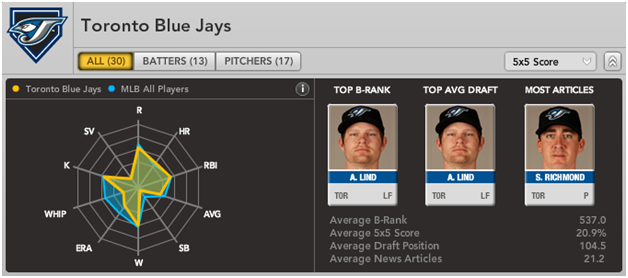
The Blue Jays might not have the talent to finish even fourth in the division, but they still have a few interesting fantasy options for this season. Aaron Hill was one of the biggest surprises in baseball last season, exploding for 36 HR and 108 RBI at second base. He did have a fairly low OBP (.330) and his 36 home runs were 19 more than his previous career high, so some caution is advised. The other member of the Jays’ lineup to enjoy a breakout season was Adam Lind. The 26-year-old seemed to finally put it all together during his first full year with the team, putting up a .300 AVG+, 30 HR+, 100 RBI+ season. He shouldn’t have an issue putting up similar numbers this season.
 
An inexperienced pitching staff is led by Shaun Marcum, who hasn’t pitched since 2008. Ricky Romero, a Rookie of the Year contender last season with a 13-9 record and 4.30 ERA, might be the safest play of any of the Blue Jays starters.

For more information on the AL East, check out Bloomberg Sports fantasy kits

Three-Layered Luke Hochevar Dip

by Eno Sarris

When Luke Hochevar put together his five-hit, no-run masterpiece against Detroit on Wednesday, it reminded people why he was a sleeper going into the season. What’s even more interesting about the start was that it raised questions about Hochevar on three layers. Like any good bean/queso/salsa three-layered dip, this deserves further contemplation.

The first layer concerns his competition. Perhaps the Tigers’ offense is not as good as we thought? Well, for one, Hochevar does not have the Tigers’ number. His 4.85 ERA, 1.38 WHIP and 1-2 record against them is slightly better than his career numbers (5.73 ERA, 1.45 WHIP), but not enough to start praying for more Tigers’ days on the schedule (small sample caveat applies). Looking at Hochevar’s career splits page on Fangraphs, you might notice he’s not as good against lefties (5.11 career FIP against lefties, 4.15 against righties). Could it just be that this year’s Tigers are missing a certain punishing lefty-hitting center fielder that could have put some line drives in play? Curtis Granderson certainly enjoyed hitting against the Royals’ starter (.984 career OPS vs. Hochevar in another small sample size), but that’s only one player.

So maybe this really was about Hochevar. The second layer of the dip might concern his strikeouts (or lack thereof). The former first pick in the draft struck out only two Tigers on Wednesday, and it might seem lucky for him to have kept the team scoreless with that sort of punchout rate. In fact, looking at last year, it took a heck of a rally for Hochevar to evenHochevarGrab.jpg approach an average strikeout rate. Take a look at this screen grab from the Bloomberg Sports Fantasy Tools – close but no cigar. Even after a two-game stretch late in the year which saw Hochevar strike out 22 batters in 13.1 innings (against zero walks!), he was below average in that facet of the game. So maybe this part of the dip doesn’t taste so good.

Why should the third layer treat us any better than the second one? Well, take a look at Hochevars’ ground balls and fly balls in the game on Wednesday. He had 15 ground balls to only five fly balls. That is what you might call “good.” So good, in fact, that the best GB/FB ratio in baseball last year (2.54, Joel Piniero) didn’t even come close. Of course, that’s over a whole season, and Hochevar’s best groundballing season so far was his 1.64 GB/FB ratio in 2008, which would have been good for 17th-best in baseball had he qualified for the ERA title. Of course, he took a step back (1.30 GB/FB) and we are left wondering if this is just a one-game wonder sort of thing. Head back over to his splits page on FanGraphs, and you’ll actually see that Hochevar improved his groundball rate over the final four months of the season. Can he continue to get better at inducing ground balls? How much impact would that have on his game?

Last year, Hochevar had better than twice as many groundballs as fly balls five times. In those five starts, he gave up 10 earned runs in 38.1 innings – good for a 2.34 ERA. Add in 2008, and you get another four starts that fit the criteria – the number jumps to 22 earned runs in 63.2 innings (a 3.11 ERA). You might be thinking, when was the last time a player with a career GB/FB ratio of under 1.5 put up a ratio over two for the year? Well, it happened just last year, and his name was Joel Piniero.

A season like that would make for some good three-layered Luke Hochevar dip.

For the sour cream on top of the dip, there’s Hochevar’s added
velocity. His fastball averaged over 95 MPH in that game, the first time it has
done so in his career.

For more on Luke Hochevar and other sleeper pitchers for 2010, check out the Bloomberg Sports Fantasy Tools.

Bloomberg Sports 2010 American League Central Preview

By Eriq Gardner
The AL Central isn’t the strongest division this year. The Minnesota Twins are accustomed to outperforming expectations on an annual basis, but this year, they start out as the favorites. The strongest competition comes from the Detroit Tigers, who will need a couple of aging veterans to hold up, and the Chicago White Sox, who have resisted full-scale rebuilding, sensing an opportunity to surprise given the lack of quality teams in the division. After trading the team’s best stars last season, the Cleveland Indians are certainly in rebuilding mode. And what can we say about the perennial woeful Kansas City Royals? A huge shocker if they were to make any noise.
Here’s a closer look at each of the teams:
min.png
Minnesota Twins
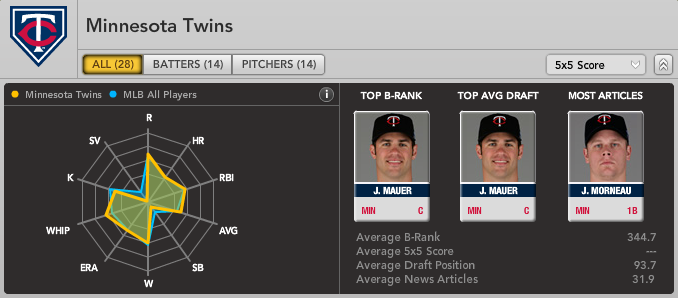
The Twins will be moving into a new ballpark, Target Field, this season. It’s hard to figure out exactly how the new field will play, but given the cold weather and park dimensions, it could lean toward being a pitcher’s park.
The team features a very underrated staff of pitchers who pound the strike zone and won’t give up too many walks. Scott Baker, Kevin Slowey, and even Carl Pavano are sabermetric-friendly starters with great strikeout-to-walk rates that foreshadow improving ERAs. After an extraordinary performance in winter league ball and spring training, Francisco Liriano is primed for a comeback season and may be key to any playoff run. The injury to Joe Nathan opens some questions about the team’s relief pitching. At the very least, all the team’s pitchers will get support from an improving defense with the additions of J.J. Hardy and Orlando Hudson in the middle infield.
At the plate, the team is extremely well-rounded, featuring the game’s top catcher in Joe Mauer. A core group of Mauer, Justin Morneau, the underrated Jason Kubel, and quietly efficient Michael Cuddyer provide good power and on-base skills. The additions of Hudson and Jim Thome in the off-season should further augment one of baseball’s best offenses outside the AL East.
det.png
Detroit Tigers
The team is managed by the always crafty Jim Leyland, who will need to overcome some issues such as age and a lack of depth to remain competitive.
Miguel Cabrera leads the offense. Some off-the-field troubles made headlines this off-season, but he’s always been a steady producer. The big question will be who produces behind him. New addition Johnny Damon will get on base and score a lot of runs. But the team’s success will largely depend on whether veterans like Magglio Ordonez and Carlos Guillen can come back from disappointing seasons and whether youngsters like new 2B Scott Sizemore and new CF Austin Jackson can step up. 
On the pitching side, few young pitchers are better than flame-throwing Justin Verlander. There’s no reason to expect anything less than dominance from him. But the team will need more. Much of the team’s pitching success last year came from a great campaign by Edwin Jackson, who was shipped out in a trade for Max Scherzer, a hard-throwing righty with great strikeout rates but also an injury history and some struggles with going deep into games. Rick Porcello had a great rookie season and projects as a solid mid-rotation guy, or better. Dontrelle Willis and Jeremy Bonderman make up the back end of the rotation; hold your breath.
chw.png
Chicago White Sox
Let’s start out with the big questions: Will Jake Peavy remain healthy? Can Alex Rios rebound? How quickly will emerging star Gordon Beckham adapt to second base? Will Bobby Jenks remain the team’s closer or does that role eventually go to elite set-up man Matt Thornton? What happened to the strong fantasy potential we saw from Alexei Ramirez in 2008? Does Juan Pierre at 32 have enough wheels left to be productive? Will Carlos Quentin recover from a post-breakout injury season? You could make a case for any of these answers going either way.
If all goes well, the team certainly has a good shot to contend. Beyond the majors sits some highly touted, major league-ready prospects, including catcher Tyler Flowers and starter Daniel Hudson. And the starting rotation is deep. John Danks is listed as the team’s #4 starter, behind solid fantasy options Mark Buehrle, Peavy and Gavin Floyd. Not too shabby.
cle.png
Cleveland Indians
Nobody is expecting a great deal from Cleveland this year, which might actually benefit the team. The club has experienced a lot of injuries over the years and were forced to shed superstars like CC Sabathia, Cliff Lee, and Victor Martinez.
For the team to take everyone by surprise, Grady Sizemore will need to come back and be healthy. From watching spring training, several scouts aren’t certain he’s 100% yet. Shin-Soo Choo was a great story last year. After years of teasing potential, Choo had a 20/20 season in 2009 with nearly a .400 OBP. Many of the team’s younger hitters, such as Matt LaPorta, Michael Brantley, and Asdrubal Cabrera, could take steps forward.
The Indians’ major weakness is its starting pitching. The fact that the team holds no pitcher owned by at least 50% of fantasy leaguers should say something. Maybe it’s because Cleveland has the kinds of pitchers (Fausto Carmona, Jake Westbrook, and Justin Masterson) who produce more real-life value than fantasy value: groundball artists instead of pitchers who whiff a lot of batters. That might be by design: Cabrera is one of the best defensive shortstops in the game.
kan.png
Kansas City Royals
The last time the Royals won a division title was in 1985, when starting pitching stud Zack Greinke was just two years old. It would be great to point to reasons why the team has any hope of turning it around soon, but we can’t find any evidence that would accomm
odate such optimism. Even local writers scratch their heads about whether the team has a plan.
The Royals have gone against the conventional wisdom about the value of getting on base, recruiting low-OBP retreads such as Rick Ankiel, Yuniesky Betancourt, and Scott Podsednik. Billy Butler is the one potentially elite offensive player on the roster right now. They’ll need big contributions from Alberto Callaspo, David DeJesus and the recently profiled Alex Gordon just to remain mildly competitive.
Of course, Greinke will give the team a good chance at victory every time he takes the mound. The rest of the rotation is suspect, though. Gil Meche needs to rebound from a disappointing year and mounting injuries, while Brian Bannister and Kyle Davies will be lucky to post league-average performance at the bottom of the rotation. The one wild card is Luke Hochevar, a talent former number-one pick who could benefit from further development and some better luck on balls in play this season.

The big storyline to follow in Kansas City may be what happens with Greinke and closer Joakim Soria. Might the team decide to trade either in the middle of this season? The Royals would get a ton in return, especially if Greinke is dealt. The smarter money’s on Soria being the one who goes, though.
For more on Joe Mauer and the rest of the AL Central, check out Bloomberg Sports’ kits

Bloomberg Sports 2010 National League Central Preview

By Tommy Rancel

The St. Louis Cardinals have won six of the past 10 NL Central titles. In 2010, they are once again the favorites, but will have to fend off the Milwaukee Brewers, the upstart Cincinnati Reds, and the Chicago Cubs, in what might be Lou Piniella’s last stand with the team. The Houston Astros are lacking enough firepower to make much noise and the Pittsburgh Pirates are improved, but not enough.

stl.png
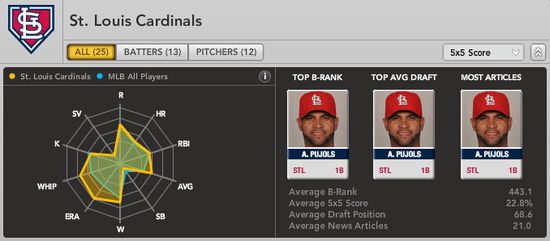
St. Louis Cardinals

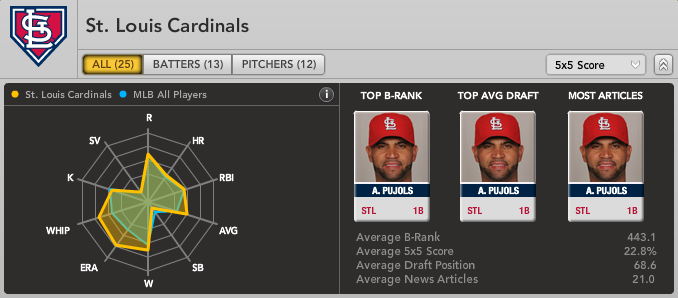
The Cards are the most complete team in the division, led by the greatest hitter on the planet in Albert Pujols. Nearly a consensus top pick in Fantasy drafts, Pujols will likely be the top hitter in baseball once again in 2010. St. Louis also re-signed Matt Holliday, who is likely to maintain his steady numbers in the senior circuit.

Keep an eye on a pair of youngsters to provide offense behind the superstar duo. Center fielder Colby Rasmus was merely average last season, but is talented enough to make the leap to All-Star status – his Opening Day home run was a monster shot that showed his prodigious power. Third baseman David Freese had a hot start to his career, but only has 17 major league games to his credit. Both will see significant playing time in 2010. The Cards lineup packs plenty of punch, but is not a good source of speed.

The Rotation is led by bona-fide aces in Chris Carpenter and Adam Wainwright. Behind them Brad Penny will try to replace Joel Pineiro as Dave Duncan’s new pet project. Ryan Franklin will reap the benefits of all the talent in front of him and is likely to top 30 saves pretty easily, assuming he keeps his job all year.
chc.png

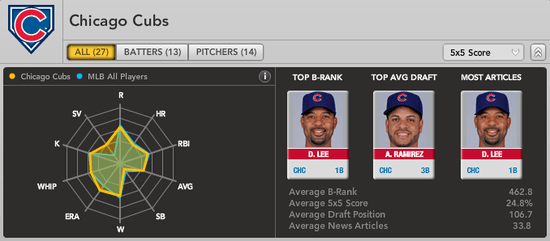
Chicago Cubs

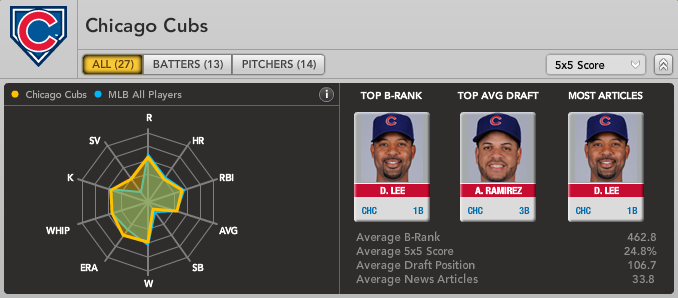
Derrek Lee remains among the game’s most underrated sluggers, though a pullback might be coming, given he’s into his mid-30s. Meanwhile, other high-profile Cubs players simply underperformed last season, for a variety of reasons.

The Cubs biggest off-season addition could be hitting coach Rudy Jaramillo. The former Texas Rangers hitting guru will be reunited with former pupil Alfonso Soriano in hopes of rejuvenating the aging left fielder’s career. Soriano is ripe for at least a small bounceback after seeing his batting average on balls in play (BABIP) drop nearly 30 points from his career total.

In addition to Lee and the potentially improved Soriano, the Cubs will need Aramis Ramirez back at full strength. If healthy, Ramirez is a legit 30-home run threat in the middle of the lineup.

On the pitching side, Carlos Zambrano is nowhere near the ace he used to be. Both Ted Lilly and Ryan Dempster are safer bets. Meanwhile, Carlos Marmol goes into the season as the unquestioned closer. His walk rate remains among the highest of any closer in baseball, though, making him something of a risk.

cin.png

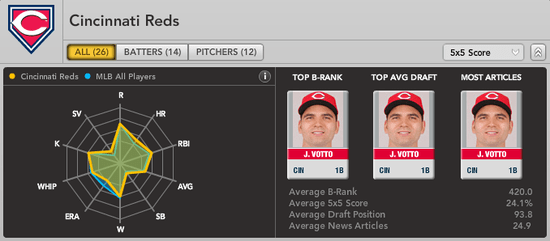
Cincinnati Reds

Led by elite young hitter Joey Votto, the Reds should put up plenty of runs at the Great American Ballpark, especially if young outfielder Jay Bruce follows with a breakout season of his own. Outside of Bruce and Votto, the Reds offense features a member of the 30/30 club in Brandon Phillips, as well as former All-Star Scott Rolen.

Phillips is a good bet for 20/20, a mark he has hit in each of the past two seasons. Rolen, 35, can still hit, as evidenced by his 2009 OPS of .823 – but he’s also an annual DL candidate.

The rotation, led by Bronson Arroyo and Aaron Harang, is pretty average across the board. Johnny Cueto has the stuff to stand out, but remains too wild and inefficient with his pitches. The wild card in the Reds rotation is prized off-season acquisition Aroldis Chapman. The Cuban national with a 100-mph fastball is the Reds player you must keep tabs on all season, especially in a shallow league where he may still be available on the waiver wire. He starts the season in the minor leagues.

mil.png
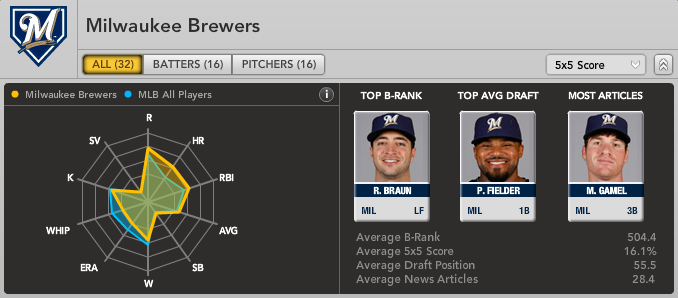
Milwaukee Brewers

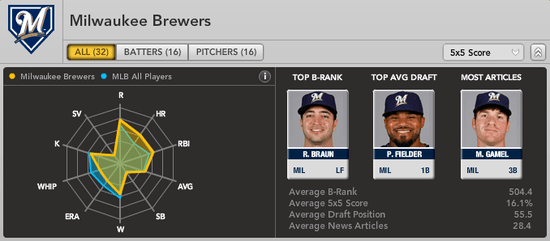
While Pujols and Holliday might be the NL’s top 1-2 punch, the Brewers duo of Ryan Braun and Prince Fielder are not far off. Braun has averaged 34 home runs in his three big league seasons, while Fielder has topped 45 home runs in two of the past three years. There is nothing to suggest anything less from each in 2010. New addition Carlos Gomez should provide fantasy value with his stolen bases, but he’s also an OBP drain who should be batting at the bottom of the order.

Rickie Weeks will return to the top of the order after missing most of last season with a wrist injury. Weeks looked poised to break out in 2009 before the injury, and had an excellent spring showing no ill-effects from the surgery. If he can finally play a full year, he could be primed for a breakout.

Yovani Gallardo is the unquestioned ace of the pitching staff, but he is followed by several question marks. Randy Wolf was signed to be the #2 starter, but buyer beware on Wolf this season. In the bullpen, At age 42, Trevor Hoffman is still going strong, but because of his age, he’s not a sure thing to last the season. One sneaky note about the Brewers: The addition of Gomez in center and slick-fielding Alcides Escobar at short should greatly improve the defense. Teams like Tampa Bay, Seattle and Texas have already shown us how a jump in a team’s defensive skill can go a long way toward improving run prevention – and thus the fantasy stats of a team’s pitchers.


hou.png
Houston Astros

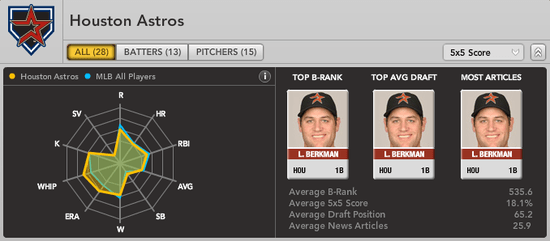
The Astros spent money this off-season, but on the wrong players. Pedro Feliz was signed to be the team’s third baseman, but he’s a lousy hitter who shouldn’t be rostered. The Astros also spent big bucks on Brandon Lyon and Matt Lindstrom, leaving Houston with two overpriced, undertalented options for the closer spot. Lindstrom gets first crack, but you might consider drafting a top set-up man like Chicago White Sox lefty Matt Thornton a few rounds later, and focusing on offense and starting pitching at that point in your draft.

Lance Berkman is in his contract year, and remains the team’s biggest offensive threat. He’ll start the season on the DL with a knee injury, though. Hunter Pence has 25-home run power and could be a 20/20 threat if improves his stolen base percentage (58% career). Michael Bourn is a budding lead-off man, and is a fantastic source of steals (102 steals since 2008), though he provides little power

The rotation is led by Roy Oswalt and Wandy Rodriguez. Oswalt battled injuries last year while Rodriguez was one of the few bright spots for the team in 2009. Both pitchers are likely to benefit from new shortstop Tommy Manzella’s slick fielding. The rest of the rotation looks shaky at best.


pit.png
Pittsburgh Pirates

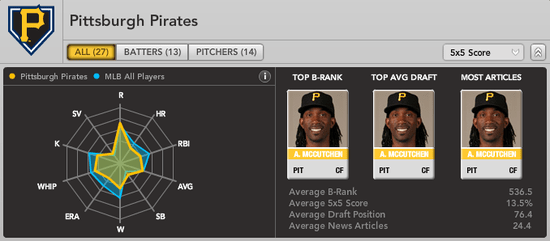
Andrew McCutchen is the team’s best offensive weapon after less than one full major league season. McCutchen showed decent power and has an outside chance of pulling off a 20-homer/40-steal campaign. Go get him.

Beyond McCutchen, the Pirates have some interesting former top prospects that have yet to live up to potential, as Lastings Milledge and Jeff Clement finally get chances to prove themselves as everyday players. Last year’s breakout Garrett Jones blasted 21 home runs in 82 games, but can he maintain a home run to fly ball rate of 21% over a full season? It’s a long shot, but you have to love his two homers on Opening Day.

The rotation has a few nice back-end guys like Paul Maholm, Ross Ohlendorf and Zach Duke, but none is a front-line starter. Beware of them in NL-only leagues, as there is a possibility of them becoming trade candidates come July – especially Duke. Octavio Dotel is the team’s closer, but has battled injuries this spring and is a trade candidate for the summer as well. If something should happen with Dotel, keep an eye on Evan Meek as a potential source of cheap saves.

For more on Albert Pujols and the rest of the NL Central, check out Bloomberg Sports’ kits.