(Vid) Behind The Numbers – Cramming for The Draft

Behind the Numbers – Season 2: Cramming for the Draft When You Don’t Have Enough Time to Prepare

Behind The Numbers Season 2 tries out a new video format which includes pop-up information about the guests and subject matter.

Jonah Keri, New York Times National bestsell author of the Extra 2%: How Wall Street Strategies Took a Major League Baseball Team from Worst to First joins Behind the Numbers co-host Wayne Parillo and Fantasy Analyst Rob Shaw for a pre-draft cram
session, helping out since Parillo is a new father and hasn’t exactly had time to prepare. Oh, and there is a special Front Office discount code for listeners.

Curtis Granderson: Siren Call or Smart Pick?

by Eno Sarris //

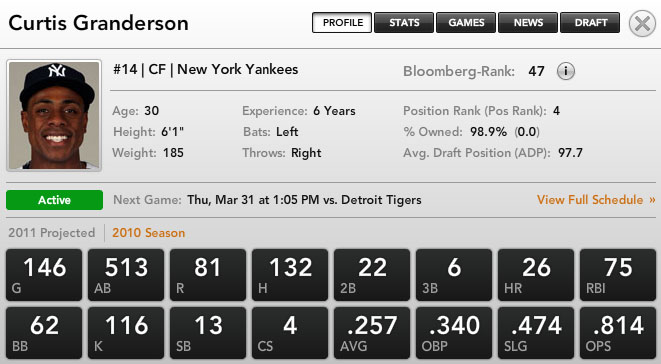
According to the Bloomberg Sports Front Office tool, Curtis Granderson is the fourth-best center fielder and ranks at about 47th overall – and yet his ADP is hovering around triple-digits. Seems like a moment rife for opportunity. Except there’s the recent news about his health. And his ongoing platoon issues. Let’s take a look at these and see if they threaten to completely reduce his value to rubble.

GrandoGrab.jpgFirst, it’s true that Granderson is not a great batter against lefties. His .215/.275/.347 line against lefties is much worse than his .287/.363/.528 line against righties. And that lacking lefty line has come in 859 plate appearances, so it’s somewhat reliable. He’s not great against lefties.

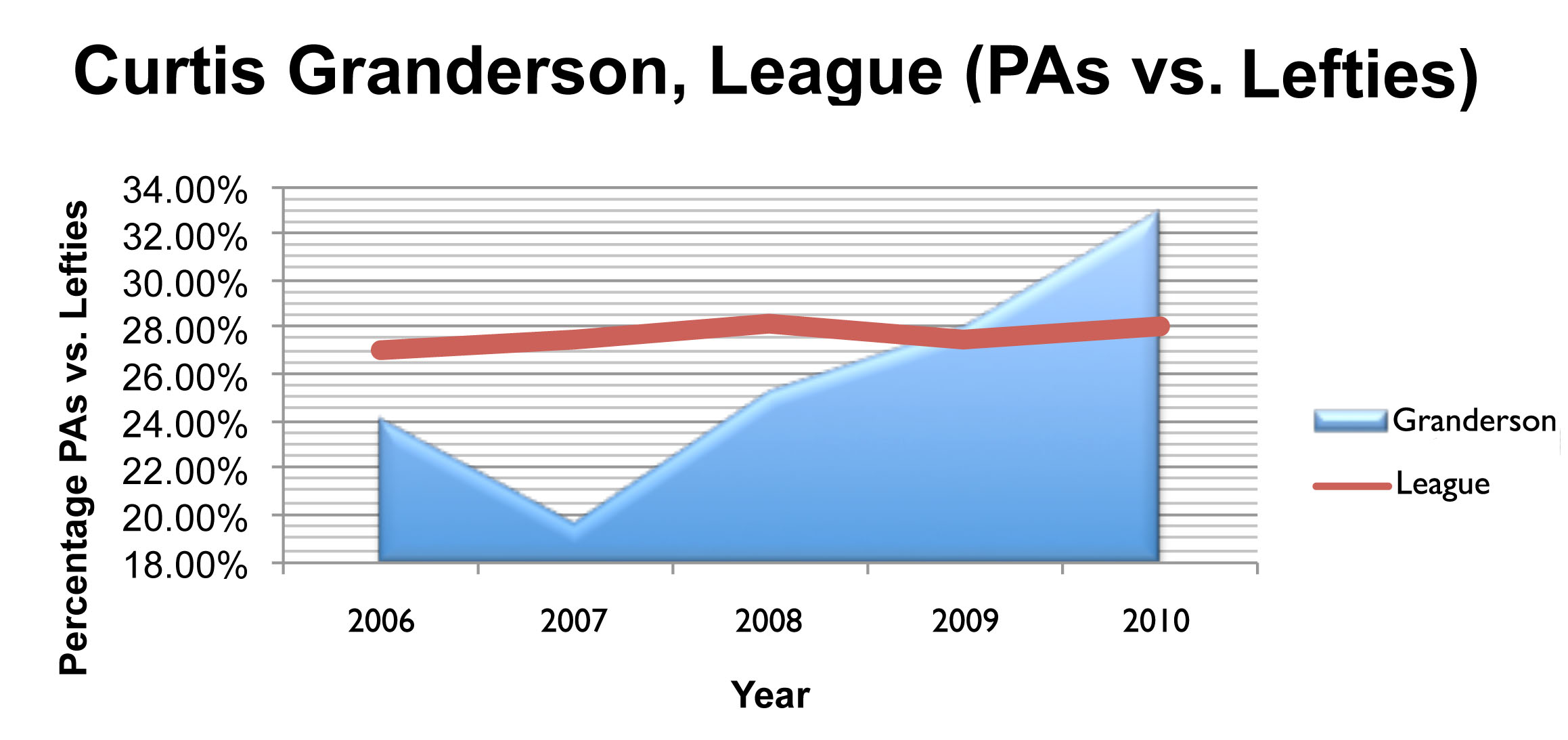
The thing is, he still takes at-bats against them. It only seems like he’s a platoon outfielder. Take a look at the chart below, and you’ll see that he actually took more at-bats against lefties than the average player last year. The Yankees know that, with his glove, he’s still valuable. And fantasy fans should know that he still hits 3-5 home runs a year against lefties, and, as the chart shows, GrandersonLefties.jpgisn’t sitting versus them. If you’ve got a good fourth outfielder in your daily-lineup fantasy league, fine, put him in instead of Granderson versus a lefty. But don’t discount Granderson too far for having a slight flaw.

Now Granderson is hurting from an oblique strain, but during the last spring training game, manager Joe Girardi said that his center fielder said that he would have played if it was the season. There’s still a week left before the season opens, but obliques are tricky. It’s hard to know exactly how much time, if any, Granderson will miss, and watching the news wire in the next couple days will hopefully help.

The injury news, along with his struggles against lefties, will surely depress Granderson further than his current ADP. On Yahoo, Delmon Young‘s ADP is 101.1, Nick Markakis‘ is 111.6, and Granderson’s is 112.5. I’d take the chance at power and speed over those two outfielders, even if the batting average is not always there. On ESPN, Granderson’s ADP is higher (87.7), and he might not be a good option over a healthy Corey Hart (93.4), but I’d certainly take him over Torii Hunter (116.4) and Juan Pierre (115.6), more one-dimensional players at this point in their careers.

Curtis Granderson is not perfect. But at some point, he’s a value. In mixed leagues, start looking at him once you approach double-digit rounds.

For the best fantasy baseball analysis and insight please visit BloombergSports.com

Young Starters To Target Late In Fantasy Drafts

By Tommy Rancel //

Names like Roy Halladay, Cliff Lee, Tim Lincecum, and Felix Hernandez dominate the top tier of starting pitching in fantasy leagues. While getting a bonafide ace to anchor your rotation is important, filling the final few spots of your staff is also key, especially if you can find some gems in the later rounds. One way to find value late in the draft is targeting young, yet talented arms. Here are the top 5 projected youthful starters with an ADP of 150 or later.

Jaime Garcia
Madison Bumgarner
Jhoulys Chacin
James McDonald
Jeremy Hellickson

Garcia is the latest disciple of St. Louis Cardinals pitching coach Dave Duncan. As a rookie, he finished with a 13-8 record and a ridiculous 2.70 ERA in 163.1 innings. Even with a strikeout to walk ratio of over 2.0 and a phenomenal groundball rate, he is not likely to produce another sub-3.00 ERA in 2010. That said, Bloomberg Sports’ projects him with another double-digit win season and a more than respectable ERA of 3.73.

Despite being just 21-years-old, Bumgarner will enter 2011 as a key member of the defending World Series Champions’ rotation. The young lefty went 7-6 in his first big league season with a nice round 3.00 ERA. He won’t provide you with a ton of strikeouts, but should top 10 wins with an ERA under 4.00.

Staying in the National League West, Jhoulys Chacin was a much better pitcher than his 9-11 record showed. The Rockies’ right-hander compiled a 3.28 ERA in his first full season while striking out more batters (138) than innings pitched (137.1). Like many other Colorado starters, Chacin’s ERA at home (3.98) was much higher than his road mark (2.44). Even with regression, he should still be an above-average starter who gets drafted after round 20.

James McDonald was stolen by the Pittsburgh Pirates from the Dodgers in exchange for a handful of innings from Octavio Dotel. In 11 starts for the Pirates, he earned an ERA of 3.52 with a strong strikeout rate of 8.58. The Pirates may finish with another 90 losses, however, McDonald should provide solid numbers at the top of their rotation and value at the back end of fantasy ones.

Our lone American League representative is the most inexperienced member of the list. Jeremy Hellickson made just four starts for the Tampa Bay Rays late last season. That said, arguably the top pitching prospect in baseball goes into 2011 entrenched as the Rays’ fifth starter. Although his time with the club was brief, Hellickson showed his trademark control should easily transition to the big leagues. He’ll probably be limited to 175-185 innings, but Bloomberg Sports says those innings will be quality ones as his ERA projects to be under 4.0 (3.89).

Filling the front end of your rotation with the Halladay’s of the world is essential. But remember the Bumgarner types as you look for value from the SP4 and SP5 spots. All five of our pitchers have ADP’s in the triple-digits with the potential to provide double-digits in the win column.

Why Fly-Ball Pitchers May Be Better Bets Than Ground-Ball Pitchers

By Eriq Gardner //

One of the fundamentals in evaluating starting pitching is to focus on three key areas where pitchers hold a measure of control over their statistical production:
  1. The ability to retire batters via strikeouts
  2. The ability to limit base-runners by avoiding the issuance of walks
  3. The ability to limit home runs by keeping the ball on the ground

Pitchers who do a good job at these three things are commonly assumed to be very skilled. Pitchers who do these things well but don’t have a superb ERA to match are seen as unlucky.

Makes sense. However, we’re not quite certain that ground-ball pitchers are better fantasy baseball assets than fly-ball pitchers. Perhaps slightly more valuable, yes, but not as profitable. Confused? Read on…
We examined statistics from starting pitchers between 2006 and 2010 to get an idea what kind of production we could expect from starters who were elite at keeping the ball on the ground versus starters who were terrible at keeping the ball on the ground. We put the pitchers into four quartiles:
  • Pitchers with elite ground-ball skills (above 47 GB%) including stars like Felix Hernandez and Chris Carpenter and lesser ones like Paul Maholm and Aaron Cook.
  • Pitchers with above-average ground-ball skills (about 44.5%-47%) including stars like Tim Lincecum and CC Sabathia and lesser ones like Joe Saunders and Jeff Suppan.
  • Pitchers with below-average ground-ball skills (about 40.5%-44.5%) including stars like Jake Peavy and Cole Hamels and lesser ones like Kevin Millwood and Kyle Lohse
  • Pitchers with terrible ground-ball skills (below 40.5%) including stars like Jered Weaver and Matt Cain and lesser ones like Jarrod Washburn and Oliver Perez.

Now, let’s look at each of the categories.

First up, here’s a look at ERA for each of these groups. You’ll notice that the ground-ball “elite” have a superior advantage over the rest of the field. It’s easy to understand why. Pitchers who don’t give up a lot of fly balls save themselves from the trouble of allowing many home runs, which tends to very unhealthy to a pitcher’s ERA. 
However, also notice that pitchers with “terrible” ground-ball rates perform better in ERA than pitchers with “below-average” and nearly as well as “above-average” ground-ball rates.
GBvsERA.png
It should be no surprise that the category of WINS tracks similarly. After all, there’s a pretty strong correlation to preventing runs and getting wins. Pitchers with “elite” ground-ball skills do best in wins, but perhaps surprisingly, pitchers with “terrible” ground-ball skills don’t do as badly as pitchers in the 25%-75% range.
GBvsW.png
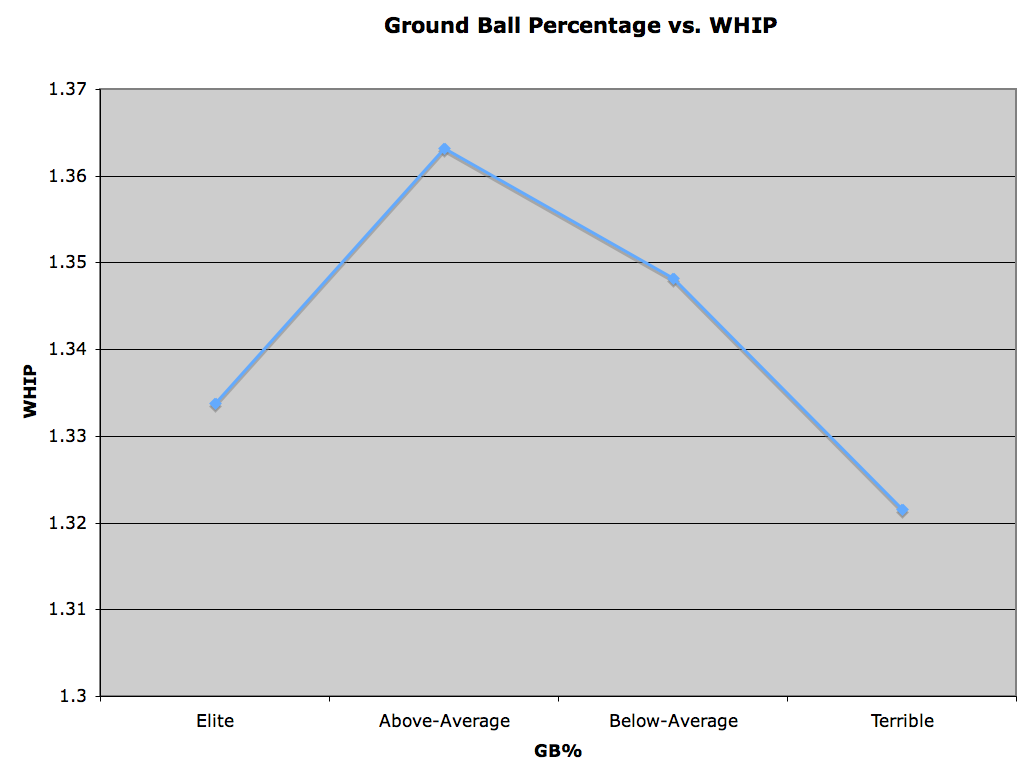
So far, we’ve shown that elite ground-ball pitchers have the edge. Let’s now turn our attention to WHIP. Surprise! Pitchers with “terrible” ground-ball rates are the best of the bunch:
GBvsWHIP.png
Maybe non-HR fly balls are easy to field than ground balls and that’s why pitchers with terrible ground-ball rates have good WHIPs. 
Here’s another theory: These pitchers tend to pound the middle of the strike zone instead of nibbling near the bottom of the strike zone. As supporting evidence, we now present a look at how each of these four groups of pitchers perform in the STRIKEOUT category. As you’ll see below, pitchers with terrible ground ball rates typically get the most strikeouts:
GBvsKs.png
Obviously, ground-ball rate doesn’t always go hand-in-hand with strikeout rate. There are definitely pitchers like Ubaldo Jimenez who do a great job of keeping the ball on the ground and getting strikeouts. But the norm tends to be that fly ball pitchers do better at inducing whiffs.
Add it up and we have two categories (ERA, W) favoring pitchers with elite ground-ball rates and two categories (WHIP, K) favoring pitchers with terrible ground-ball rates. Based on the fact that wins tend to be most scarce, the edge in overall fantasy value goes to pitchers with elite ground ball rates. But do fantasy folks overestimate that edge?
Many competitors tend to focus on the sexy stats of wins, strikeouts, and ERA and give short shrift to a category like WHIP. The pitchers commanding top prices in fantasy drafts do very well in those first three categories.
How about some fly ball pitchers? The top pitchers include Cliff Lee and Jered Weaver. As for the potentially longer list of draft day bargains, think Ted Lilly, Ricky Nolasco, Scott Baker, Javier Vazquez, and Aaron Harang. Each of these players are fly ball pitchers who project to have great WHIPs and strong strikeout rates. 
At very least, there’s a floor to their prospective value that makes them good bets to at least earn back their draft investment. 
The upside for more is also there. As demonstrated above, pitchers with terrible ground-ball rates don’t do as badly in ERA and wins as one might assume. Furthermore, each of these pitchers play home games in pitcher’s parks, which may dampen the number of home runs they give up and might, very possibly, make them just as valuable as elite pitchers going very early in drafts.

Oakland: A Bullpen In Flux

by Eno Sarris //

Since about a third of opening day closers lose their jobs to injury or poor play every year, it’s not the greatest position in which to invest heavily. Instead, waiting to the end of the draft and using the quantity-not-quality approach to supplement an elite closer can provide the best return on investment. Mix the risk in your closer portfolio, in other words. This spring, we’re seeing the merits of this approach already.

In Oakland, Andrew Bailey saw Dr. James Andrews on Tuesday, and though it’s just a right forearm strain, he is known to be slightly frail. The former starter and ROY had Tommy John surgery in 2005 and only managed 49 innings last year because of an intercostal strain and some elbow surgery to get rid of loose bodies in the joint. Add the current forearm strain in, and he is a substantial injury risk.

Fuentes.jpgThat is, perhaps, why the Athletics stocked up on bullpen talent last year despite having a strong bullpen in 2010. Brian Fuentes has managed to put up more than 20 saves in each of the last six years, but comes with some flaws of his own. He’s an extreme fly-ball pitcher (33.5% career GB) who doesn’t do as well against righties as he does against similar-handed pitchers (11.34 K/9, 2.86 BB/9 versus lefties, 9.24 K/9, 4.16 BB/9 against righties).

Fellow new acquisition Grant Balfour will figure in the mix somehow if Bailey goes down for an extended period of time. Since he’s a righty, Balfour could contribute some saves as part of a platoon (10.10 K/9, 4.11 BB/9 versus righties). But Balfour, despite the unfortunate last name, is also pretty good against lefties (10.48 K/9, 4.51 BB/9), and if the team can stomach his occasional control blips, he might be the closer all by his lonesome.

Last year, five pitchers accrued saves for the Athletics, and Michael Wuertz was second to Bailey with six. If the 35-year old Fuentes declines further (he used to put up strikeout rates closer to ten than to eight) or the inconsistent Balfour can’t find the zone, Wuertz may again put up some saves. Either way, it’s likely that another half-dozen Oakland pitchers will accrue saves in 2011.

We all have to chase the save, and yet it’s the only stat that usually rewards a specific role on each team. Since pitchers are already more likely to get hurt than position players, and the closer role is so volatile on it’s own, it’s a good idea to spread your risk around as much as possible. Sure, get a stud closer early on, but then mitigate your risk late by taking fliers on pitchers like Fuentes and Balfour. If it doesn’t work out, you didn’t spend much on them, and then you can easily drop them for the next pitcher that starts accruing saves.

For the best fantasy baseball analysis and insight please visit BloombergSports.com

Top Dual Threat (Power & Speed) Sleepers

By Tommy Rancel //

Players who offer power and speed are given premium price tags on both the real and fantasy levels. Hanley Ramirez, Ryan Braun, Carlos Gonzalez, Matt Kemp and Carl Crawford will go within the top 50 picks of most leagues. If you are unable to land one of these primetime players, don’t worry. There are dual threats to be found even as we pass the 100th selection in most standard drafts.

Using Bloomberg Sports’ projection system, here are the top-5 power and speed sleepers with an average draft position of 100 or greater.

Drew Stubbs
Andres Torres
Ian Desmond
Franklin Gutierrez
Ben Zobrist

In his first full-season at the big league level, Drew Stubbs became one of the game’s true power and speed threats. He was one of just three major leaguers with at least 20 home runs and 30 steals. The other two players -Hanley Ramirez and Alex Rios– are being selected well before Stubbs. His batting average is rather pedestrian and he racked up a ton of strikeouts, but the potential for another 20/30 season is a steal in the double-digit rounds.

Andres Torres experienced a breakout season at the age of 32. In addition to playing a career-high 139 games, the outfielder posted good marks in both home runs (16) and steals (26). As the projected leadoff hitter for the defending world champions, Torres could provide similar results at the cost of a late-round tender.

On the other side of the age spectrum, Ian Desmond emerged as a rookie fantasy option at shortstop last season. After posting double-digits in both home runs and steals last season, Bloomberg Sports’ projects 15 home runs and 20 steals for the Nationals’ shortstop. Over the past three years, only five shortstops have hit those marks in the same season (Ramirez, Tulowitzki, Jeter, Rollins, Reyes).

Rounding out the list is a pair of players who regressed a bit in 2010. After finishing in the top-10 of MVP voting in 2009, Ben Zobrist hit just .238 with 10 home runs last year. The good news is Zobrist still got on-base regularly and stole 24 bases. Bloomberg Sports predicts Zobrist’s power will rebound to the 18-20 home run area with the potential for an equal number of steals if not more. The Rays are thinking about hitting the versatile player in the leadoff spot meaning the potential for runs scored also increases.

After his breakout season of 2009, the Mariners signed Franklin Gutierrez to a four-year extension. He rewarded the team with a near 40-point drop in batting average and an on-base percentage barely over .300. That said, he did hit 12 home runs and stole a career-high 25 bases in 2010. This year he is projected to put up similar numbers. That is far from OF1 production, but with an ADP in the 230’s, Gutierrez is worth the late-round pick.

Finding players that can give you value in multiple categories is the mark of a good fantasy baseball manager. Finding these players in the mid-to-late rounds is even better.


The Top 10 Pitching Prospects

Young  starting pitching is always at a premium in the real world, and often in the fantasy world. As such, serious leagues demand its owners possess knowledge of the top prospects near and far the stage of the majors. With that stated, here are the 10 arms considered the finest pitching prospects in the land by Bloomberg Sports’ Front Office Tool:

1. Mike Minor
2. Jeremy Hellickson
3. Kyle Drabek
4. Chris Archer
5. Manuel Banuelos
6. Zachary Britton
7. Christian Friedrich
8. Kyle Gibson
9. Casey Kelly
10. John Lamb

The top three already have big league experience. Minor started eight games for the Braves last season, completing 40 innings while striking out 43 and walking 11. The former Vanderbilt attendee figures to start the season in the rotation and while he’s unlikely to replicate his 2010 numbers, he’s better than most fifth starters. Hellickson impressed as well, with a similar strikeout and walk rate. Although he’s hampered with a hamstring injury now, if healthy, the Des Moines native will open the season as the Rays’ fifth starter. Drabek’s entrance to the majors did not fare as well, but he’s a top prospect for a reason and could open the season in the Jays’ rotation too.

Archer is one of the jewels the Rays received in return for Matt Garza, he should open the season in Triple-A, but a big league stint near season’s end -perhaps in the bullpen–is not out of the question. Banuelos received hype for a recent appearance, but he’s just now turning 20 and it’s unlikely he’ll get much more than a cup of coffee this season. Britton, on the other hand, should debut this season, as he spent last season in the high minors and pitched fairly well, with sub-3 ERAs at both Double- and Triple-A and peripherals to match.

As for the rest, Gibson shot through the system and stands the best chance of appearing in the bigs this season. That doesn’t mean you should ignore arms like Lamb and Kelly in keeper leagues, though, as again, they have the pedigree for a reason.  Just don’t get too infatuated with these guys, as pitching prospects are more volatile than hitting prospects. 

Another Look at the Value of Starters vs. Relievers

By Eriq Gardner //

How do you measure an elite closer versus an elite starter in drafts?
For those who see closers as largely one-category contributors, the answer is you don’t. You measure a closer’s stability and job security and make a determination whether that closer is going to produce enough saves to justify picking one in high rounds versus a lesser closer in late rounds. Often that formula yields the conclusion that it’s imprudent to invest much in fickle relievers.
As we tried to show last year, though, closers can contribute just as strongly as starters in ERA and WHIP. 
This topic comes up every year, however, and can lead to a lot of puzzlement. In response to our post last week on safe draft bargains, one reader questioned whether Carlos Marmol should really be ranked ahead of elite starters like Justin Verlander, Jon Lester, and CC Sabathia.
Keep in mind that there’s always a margin of error when it comes to projections. The degree of confidence that the 48th ranked player will best the 49th ranked player in value by the season’s end is small. Still, the question of whether Marmol and Verlander belong in the same ballpark is definitely a valid one. 
Having considered the relative value of a starter’s ERA/WHIP vs. a reliever’s ERA/WHIP last year, let’s take a look at another category in the equation — strikeouts. 
Bloomberg Sports projects Carlos Marmol to have 105 strikeouts (most among closers) and Justin Verlander to have 198 strikeouts (second most among starters) in 2011. Both projections are on the conservative side. Bloomberg cuts 33 strikeouts from Marmol’s 2010 total and 21 strikeouts from Verlander’s 2010 total.
At first glance, Verlander’s 198 projected strikeouts seems to be more valuable than Marmol’s 105 strikeouts, but is that really true? Or stated another way, is a 200-K starter more special than a 100-K reliever?
In a standard 12-team 5×5 league, there will typically be about 60 starters drafted, or about five per team. According to Bloomberg’s projections, the average top-60 starter will have 159 strikeouts. This means that Verlander is projected to have about a 40 strikeout advantage over an average starter. That’s the difference between Verlander and someone like Ricky Romero, both in Bloomberg’s projections and 2010 totals.
How does Marmol compare to other closers? Bloomberg projects that among the 30 players projected with at least 5 saves this coming season, the average closer’s strikeout total will be 64. This means that Marmol is projected to have a 40 strikeout advantage over an average closer. Keep in mind how conservative this projection represents. Last season, Marmol had more than a 60 strikeout advantage over closers like Jonathan Papelbon, John Axford, and Francisco Rodriguez.
But assuming the projections are valid, it means that if you choose Marmol and Romero instead of Verlander and K-Rod, you should end up with roughly the same amount of strikeouts.
Strikeouts are just one category. There’s obviously ERA and WHIP too, though we think it’s been exaggerated to suggest that a reliever who only appears in about 75 innings as Marmol has the last three seasons can’t have as much value as a starter who appears in 200 innings. Not when the ERA difference is a whole run.
Let’s stipulate to the fact that that projecting wins and saves is pretty tough. No pitcher — this goes for both starters and relievers — can control the situational and opportunity factors like run support that influence a season’s win and save totals. But there are ton of starters who get wins. The number of pitchers who get saves is quite more limited. It’s a scarcer commodity, meaning that even 35 saves is typically worth more in a typical year than 20 wins. 
This is hard for many people to stomach. It’s counterintuitive to everything we know about the value of pitchers in real-life baseball. But pay attention to any fantasy baseball player rater during the course of the season and you’ll notice that top relievers rank right up there with top starters. There’s a reason.
For the best fantasy baseball analysis and insight please visit BloombergSports.com

The Top 10 Draft Board Risers

 By R.J. Anderson //

With fantasy draft season in full bloom, have you wondered whose stocks are rising and whose are falling? Using the Bloomberg Sports Front Office Tool, those answers (and more) can be yours in a matter of seconds. Here are the top 10 moving up draft boards:

1. Juan Pierre
2. Colby Lewis
3. Matt Garza
4. Chris Carpenter
5. Tim Hudson
6. John Danks
7. Tsuyoshi Nishioka
8. Dan Haren
9. Adam Jones
10. Jeremy Hellickson

Nobody noticed, but Pierre set a career high in stolen bases last season at 68, impressive on 33-year-old wheels and a .341 on-base percentage. While he won’t give you much in the way of power, Pierre is generally okay for steals and a decent batting average. His playing time could be interfered with, depending on how manager Ozzie Guillen deals with Carlos Quentin in wake of the Adam Dunn addition and Paul Konerko re-signing.

Only two other position players make the list, in Nishioka (recently named as the Twins’ stating second baseman) and Jones, who seems to be a perpetual breakout candidate. Nishioka figures to bat in the two-hole for Minnesota, which could lead to a ton of runs scored with Joe Mauer and (possibly) Justin Morneau following him.

The rest of the list is pitchers. There are all kinds of red flags around Garza’s presence in the National League Central and Wrigley Field. If anything, Garza’s stock should be dipping, but alas, he looks like an overdraft at this point. Lewis, Hudson, and Danks are solid pitchers on playoff contenders, so wins should be plentiful, while Haren is stuck on a suddenly mediocre Angels team with questions about how his strike-heavy approach leads to a more homer-prone stat line. He’s a good pitcher, though, so it’ll be interesting to see whether his ERA regresses entirely to his peripherals, or only mostly.

Carpenter and Hellickson are odd risers, as both have suffered injuries during the exhibition season. The last Cardinals’ ace standing left a start with a hamstring injury, but should be fine for Opening Day. Hellickson is also dealing with a gimpy hammy, irritated during pitcher fielding drills. He should return to the mound within the next few days, but represents a bit of a question mark for his first two starts. You would think those two would slide down boards with concern, but that doesn’t seem to be the case.

If nothing else, these are the players to analyze and reaffirm your beliefs about. Don’t buy into the hype without having a good reason for doing so -and as we all know, “everyone else is doing it” doesn’t cut it.

For the best fantasy baseball analysis and insight please visit BloombergSports.com

Zack Greinke Injures Rib, Will Open Season on DL

by Eno Sarris // 

He wasn’t washing his car or riding a motorcycle. Instead, it was a pickup basketball game that slayed Zack Greinke this offseason. Aaron Boone sends his condolences. Now that Greinke has a fractured rib and will open the season on the injured list, what does that news mean for his prospects in fantasy baseball circles?

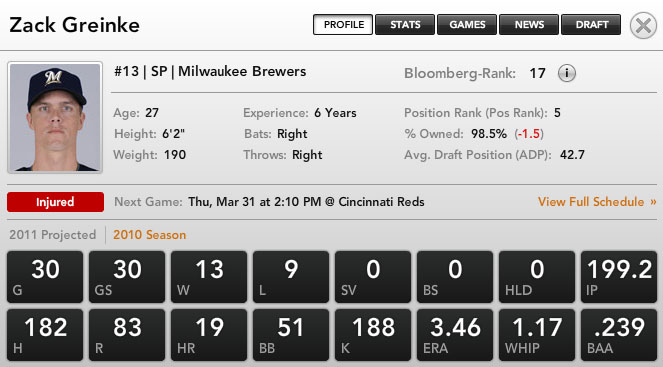
The first instinct is to take the team’s prognostications – that Greinke will miss only two-to-three starts – and say the whole thing is not a big deal. Just a few starts less from the ace, so you could drop him a couple points in the rankings and maybe pounce on him if he falls further than his third-round ADP (42.7 by the Bloomberg Sports Front Office tool).

Greinke.jpgThen again, even just three starts is a tenth of a pitcher’s season. Should he miss five starts – the likely situation if he misses the first month – he’ll miss a full sixth of his season. Take away a sixth of his Bloomberg Sports projection, and you get 166 innings with 11 wins and 157 strikeouts. Sure, he is still projected for a 3.46 ERA and 1.17 WHIP, but the whole package is just a little less valuable because of the lower innings projection. A rosier projection – that he misses three starts – moves him from about the fifth-best at his position to about the 10th-best. Take another two starts away, and he’ll slide down somewhere between 15th and 20th on the list.

But there might be reason to drop him a little further even.

The rib cage is a tricky place for an injury in baseball. A pitcher’s motion is tantamount to his success, and pain in the ribs will keep him from completing his motion as he’d like. Phil Hughes fractured a rib and missed 136 days. We saw what happened to Jacoby Ellsbury last year. We aren’t doctors here, but we also know that we’ve seen players recently miss extended time with the same injury. That means there’s a risk that he puts in fewer than 166 innings, and a risk he he won’t even be a top-25 pitcher this year.

We know that Greinke will drop in drafts now. We know that he deserves to drop some, and that there’s risk that he should drop even further than he will. The tricky part is knowing when exactly to pick him up. Use conservative projections for his output this season, though, and you’ll probably find the right time. At least it wasn’t an elbow!

For the best fantasy baseball analysis and insight please visit BloombergSports.com