Selling Kevin Correia’s Wins

By Tommy Rancel //

A quick check of the pitching leaderboards and you’ll find quite a surprise at the top of the wins column. With eight victories in 12 starts, Kevin Correia is two-third of the way to his career-high in victories (12); and it’s early June.

Signed in the offseason by the Pirates to a modest one-year deal, Correia was named Pittsburgh’s opening day starter. Since then he has rattled off a league leading eight wins with 3.40 ERA in 76.2 innings. While Correia has been a pleasant surprise to fantasy owners who picked him up early on, he is a definite sell high candidate.

Correia has been a nice source of wins, ERA, and WHIP; however, he offers little in the way of strikeouts (career low 3.99 K/9) and has some areas where regression may set in. His .265 batting average on balls in play is low, but not flukishly low. In terms of home runs allowed, his 0.82 HR/9 is below is career 1.03 rate while his home run-to-flyball rate of 7.4% should be closer to 10%.

If and when he regresses, it will not be as steep as some might think. Meanwhile, it will certainly lower his value which is at an all-time high. Correia should easily end up with double-digit victories; however, his ERA is likely to spike from the 3.40 level. It shouldn’t go as high as his career mark of 4.46, but somewhere in the low 4.00 range is likely. He has also been the beneficiary of offensive run support with nearly 22% of the Pirates total runs coming with Correia on the mound.

A good team manager is one that is able to identify sell-high opportunities in on area in order to strengthen another area of weakness. Moving Correia at his current value allows for that to happen. In every league, there is someone who is starving for pitching and may be willing to overpay.

If you can get back a productive position player at weak position (shortstop, catcher) for Correia’s early season hot streak, do it now. Looking around the waiver wire, you should be able to replace Correia rather easily with a lesser known player like Josh Collementer in NL-Only leagues or Matt Harrison in mixed formats.

For access to the top baseball analytics and fantasy tool Bloomberg Sports Front Office visit BloombergSports.com
Fantasy Baseball Waiver Wire Report: Dillon Gee, Mitch Moreland, Allen Craig


Miguel Olivo, C, Mariners

A move to Seattle is usually enough to limit your fantasy production for power hitters, but not Miguel Olivo.  The veteran backstop has blasted home runs in three straight games (all at home).  He now boasts seven bombs on the season with 26 RBI, 26 runs, and even two steals.  Olivo has been a model of consistency averaging greater than 16 home runs over the last five seasons.  He’s a solid fantasy pick up. 


Dillon Gee, SP, Mets

He’s been treated as a low potential prospect by the Mets over the last few years, a franchise often giving opportunities to Pat Mitsch over Dillon Gee, but this Gee knows how to pitch.  The 25-year old has now made 16 appearances and the numbers are sensational: 8-2 record, 2.90 ERA, and a .209 average against.  Gee is 6-0 this season and is a must-start at home where he is 4-0 with a 1.77 ERA.  His next start will be this weekend at Pittsburgh. 


Mitch Moreland, 1B, Rangers

Get to Know Rangers first baseman Mitch Moreland.  The 25-year old left-handed slugger is riding a six-game hit streak with two home runs over that stretch.  Those six-games, by the way, have all come on the road, so this is a bit different than usual for a Rangers pick up.  Moreland was supposed to be a platoon option for the Rangers, but his .313 average ad eight home runs are leading to extended action.  Though he has struggled this season against southpaws, he may get some extra opportunities as the Rangers look to keep his bat in the lineup.


Josh Collmenter, SP, Diamondbacks

Similar to the Mets Dillon Gee, Diamondbacks hurler Josh Collmenter has shocked everyone with a stellar start to his Major League career after less than stellar results in the Minor Leagues.  Through 43.1 innings, Collmenter is 4-1 with a 1.25 ERA and 0.67 WHIP.  He hides the ball well in his delivery, which may explain how he has only surrendered runs in three of his 12 appearances this season.  Similar to Gee, Collmenter’s next start will come against the Pirates, which makes him a solid pick-up this week. 


Allen Craig, 2B, Cardinals

If you’re looking for a sleeper in the middle infield, I really like Cardinals 26-year old Allen Craig.  He is the ultimate utility man and a heck of a bat.  Through 106 at bats this season, Craig is batting .340 with four home runs, 23 RBI, and four steals.  If this doesn’t sound sustainable to you, consider that in two seasons of Triple-A baseball, Craig hit .321 with 40 home runs and 164 RBI.  He is a fine hitter and he’s finally getting his chance.

The Cheapest Way To Make Up Statistical Ground

We’ve come to the point in the season where fantasy competitors begin taking a hard look at the standings and their rosters in an attempt to figure out how to make up ground.

Often, a competitor might see his or her struggles in a particular category, and with advancement in mind, begin thinking of players who are statistical superstars. Figuring out the players who are strongest in a particular category is one way towards making up statistical ground —  but not the only way. In fact, there’s something to be said for identifying one’s weakest players in  the category in question — and then looking to replace them with merely average ones.

Why?

League leaders in categories like HRs get a lot of attention. (Hello, Jose Bautista!) And if you want to trade for them, prepare to open up your wallets. It’ll be costly and likely open up other deficiencies for your team.

One of the overlooked aspects of a statistical chase, however, is that certain players deliver negative value. These players are like megaton weights chained to the ankles of one’s statistical drive.

For example, in most leagues at the moment, there are currently 12 players who qualify as second-basemen with seven or more HRs. Those who drafted Brian Roberts, who only has three HRs so far, are getting negative value in power from their second baseman.

This team might be suffering in HRs and begin thinking about a trade. The smart move, though, might not be to pay top dollar by trading for a Jay Bruce, Curtis Granderson, or Mark Teixeira, but rather to erase the negative.

Think about it.

The team with Mark Teixeira/Brian Roberts isn’t getting any more HRs from this combo than the team with Paul Konerko/Neil Walker. Neither Konerko nor Walker are doing anything above the norm at their respective positions, but by keeping pace, they aren’t hurting either. A guy like Roberts, meanwhile, drags down the value of the collective.

If Walker isn’t attainable for the team looking to upgrade on Roberts’ power, there are other options: Howie Kendrick has 7 HRs and is coming back from the disabled list this week. Or check out guys like Ryan Roberts (8 HRs) or Allen Craig (4 HRs in 102 ABs and now getting regular PT), who are both just a couple games from qualifying at the second-base position. Not only would Kendrick, Roberts, and Craig offer power advancement over a guy like Brian Roberts, but they are adequate enough to represent positive value in the other categories too.

We’re not trying to pick on Roberts, of course. Almost every team has weaknesses that can be salved. Understanding negative value is the key here. In sum, remember basic calculus from your school days: Subtracting a negative equates to an addition.

–Eriq Gardner

For the best fantasy baseball analysis and insight sign-up at BloombergSports.com

(Vid) Behind the Numbers – Confessions of an Autograph Enthusiast

Celebrating the Fan Experience Part 2, Collecting Autographs

Hosts:  Wayne Parillo and Brendan McGrail

Behind the Numbers is a series of conversations and discussions with baseball, blog, sabermetric, and fantasy experts.

Guest: Tom Tomae

At some point all of us have tried to get an autograph from a player. Self professed “autograph enthusiast” Tom Tomae takes us inside the sub-cultures within the autograph collecting world, the time Bernie Williams called security, trying to get David Wright’s signature, and a few tips for people who are hunting for autographs.

Watch the entire episode, or use the links below to jump to the exact point you want.

For the best fantasy baseball analysis and insight please visit BloombergSports.com

Follow us on twitter at:

In Need Of Pop? Add Espinosa

By R.J. Anderson //

Entering Tuesday’s game, Cliff Lee had allowed six home runs in his first 11 starts. Danny Espinosa added a pair, as the Nationals routed Lee and the Phillies—booting the free agent signee after 5 1/3 innings pitched and tacking on six earned runs.  For Espinosa, it is a feat sure to garner him some publicity, as the former Long Beach State attendee now has 10 home runs on the season, tying him with Kelly Johnson for the second most home runs by a National League middle infielder.

It is an interesting development for Espinosa, who at 6-feet tall does not have the typical build of a slugger. What he lacks in size he makes up for in violence. With a high leg kick leading into a fierce twist, Espinosa is able to generate enough torque to thrust the ball beyond the fences. As you would expect, Espinosa’s unique swing antics result in some strikeouts too, as he fanned in nearly 27 percent of his first 280 or so major league at-bats.

Those strikeouts assist in diluting Espinosa’s fantasy value because his batting average so far is nothing to write home about (.216) and his on-base percentage suffers because of the diminished batting average (.299). Most of the time, a batter with two-thirds of a career line of .216/.299 isn’t worth fantasy or real world considerations, but Espinosa’s pop makes him an intriguing option in the fantasy world, and his ability to field and run the bases makes him a real world starter too.

Espinosa may be available in your league because of his strikeouts, horrid batting average, and terrifying on-base percentage. Truthfully, he doesn’t fit every team—as those who can sacrifice some pop for average and walks should do so—but if your team could use a little thunder and has some average to spare, Espinosa is a nice little pickup.

For the best fantasy baseball analysis and insight sign-up at BloombergSports.com

Is Roy Oswalt a Sell-High?

by Eno Sarris //

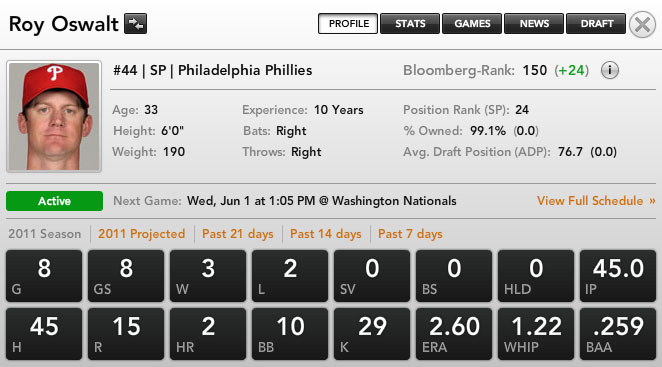
By all accounts, Roy Oswalt is dealing. He’s got an ERA under three, a good WHIP, and is pitching for a contender that should get him wins. If you drafted him to be your number two, you’re probably happy with his performance. Why should you consider selling high on the second-best Roy in Philadelphia?

In a word, swinging strikes. The average swinging strike rate across baseball is usually around 8.5% in any given year. Oswalt has been average or better in the statistic for eight of his last nine years, and that’s how he’s built a strikeout rate that’s usually average or better. This year, Oswalt has a 6.9% swinging strike rate, the lowest of his career, and far below average. That’s behind his 5.8 K/9, again the lowest of his career and far below the 7 K/9 that is average across baseball right now.

There are other facets to pitching well. Oswalt still has his patented control, as his two walks per nine inning show (3.25 BB/9 is average this year). That should continue, and it will help him keep his WHIP and ERA manageable even if he regresses. He just won’t have a ton of baserunners even if he isn’t racking up the strikeouts.

Oswalt also gets about half of his contact on the ground, which is ahead of the 44% league average. But that’s not an elite ground-ball rate, and it’s not enough for him to ‘deserve’ his current home run rate. He is giving up the fewest home runs of his career in Philadelphia (0.4 HR/9 this year, 0.76 HR/9 career). This is because only 4.5% of his fly balls are leaving the park. That number trends towards 10% yearly across baseball, and Oswalt himself has an 8.9% number in the category. More home runs are coming.

At 33 years old, there’s a little less gas in Oswalt’s tank. He’s lost a tick off his fastball (down to 91+ MPH from 92+ MPH) and he’s foresaken the slider so far this year. He’s using the slider 5% of the time after using it around 15% of the time the last three years. Sliders are known to cause stress on arms – but we haven’t heard from Oswalt that his arm is hurting. His back was the issue earlier in the year, but that’s just the sort of thing he’ll deal with as he gets older.

The point is, he doesn’t look like a true-talent mid-twos ERA guy at this point in his career. He’s not getting the swinging strikes, and some luck is covering up his lack of strikeouts. He’ll be good going forward – don’t sell him too low. But consider an ERA in the high threes much more likely from this point on. That means that if someone is willing to pay ace prices, you should listen.

For the best fantasy baseball analysis and insight sign-up at BloombergSports.com

Josh Willingham Producing Runs In Oakland

By Tommy Rancel //

With a slash line of .244/.328/.446, Josh Willingham appears to be having a pretty average season. Meanwhile, his 35 RBI in 48 games puts him in the top 10 of American League run producers – just one RBI behind notable sluggers like Jose Bautista, Miguel Cabrera, and Mark Teixeria. Considering he has around 20 plate appearances less than those names, Willingham has been quite the run producer while flying below the radar in most fantasy leagues.

Playing for a team that scores less than four runs a game, Willingham has made the most of his opportunity to drive runs in. In fact, Willingham’s at-bat-to-RBI ratio is second best in the league behind Jose Bautista. Of all his baserunners, 17% of them have scored which is above the league average of 14%.

Although the Oakland A’s have struggled to score, Willingham is projected for some benchmark fantasy numbers. With nine home runs in 171 at-bats, he is on pace for more than 25 bombs should he get 500 at-bats this season. If he continues to drive in runs as he has during the first two months, he will top the 100 RBI mark while scoring 60-plus runs on his own.

While several outfielders like Jason Bay, Austin Jackson, and Nick Swisher, are hitting the waiver wire for performance issues, Josh Willingham provides a cheap alternative. Mike Morse currently leads the rush for waiver wire outfield eligible players; however, Willingham comes with a larger track record of success and more job security. Considering Melky Cabrera –a player with less home runs, RBI, and lower on-base percentage – is owned in nearly 100% of leagues, you could be missing production that is just waiting to be claimed.

Not everything about Willingham is good. For one, he does have some injury concerns. He has played more than 130 games just once over the past three seasons, but appears to be healthy now. He will not hit for much more than a .250 average, but has shown a willingness to walk in the past giving him a solid on-base percentage. He has hit more than 20 home runs in a season three times, and as mentioned above, he is on pace to do so once again.

The negative injury history could manifest at some point; especially considering his age (31). Meanwhile, the cost of a waiver claim and an OF3 spot does not come with a hefty price tag. With the opportunity for 50-plus extra-base hits, 100 RBI, and another 60 runs scored, Willingham could be one of the sneakier pickups in 2011. If you have an opening, strike now. If not, keep an eye on his progress and if/when the opportunity presents itself (injury or trading a similar player on your roster to strengthen a position of weakness), remember Josh Willingham’s name as a low-cost run-producing source with decent power on top of that.

For the best fantasy baseball analysis and insight sign-up at BloombergSports.com

Rubby De La Rosa as Closer?

By R.J. Anderson //

The end-game portion of the Dodgers bullpen has been a mess this season. Jonathan Broxton, formerly one of the game’s better closers, has struggled with his control (walking more than six batters per nine innings pitched) while allowing too many home runs and watching his strikeout rate recede. If that isn’t enough, top set-up man Hong-Chih Kuo is on the 15-day disabled list with anxiety disorder. Even makeshift closer Vicente Padilla is on the DL with right forearm irritation.

In recent times, the Dodgers have turned to Mike MacDougal and Javy Guerra to close down games. There is bad, then there is “MacDougal in for the save” bad. On Tuesday, the Dodgers took some action by promoting one of their top prospects to the majors. Rubby De La Rosa is not a household name yet, but he could be in due time. The 22-year-old made his debut in the eighth inning of Tuesday’s game and here were the results:

Struck out Hunter Pence (six pitches)
Forced Carlos Lee to groundout (two pitches)
Struck out Brett Wallace (five pitches)

It was only Houston, sure, but striking out Pence and Wallace in your first appearance is a nifty start and if De La Rosa’s minor league stats are any indication, there will be plenty more Ks flashing on the Dodgers scoreboard in the years to come. Beyond just his stats, De La Rosa has the stuff of a closer too—with a high 90s fastball and power slider. There are whispers of his ability to occasionally hit triple digits, which just adds to his mystique.

That Don Mattingly was willing to toss De La Rosa into the eighth inning immediately feels like a sign he may go to him in the ninth sooner than later too. In which case, scoop De La Rosa up if you have the space, because he could be a source of saves by the end of the season.

For the best fantasy baseball analysis and insight please visit BloombergSports.com

Is Chone Figgins a Buy-Low?

By Eno Sarris //

The Mariners are surprisingly close to first in their division despite having amassed the second-least runs in the American League. Some of the blame for the scoring woes rests on their second-highest-priced position player, Chone Figgins. With the injury problems at third base across the league, baseball fans both real and fantasy want to know if Figgins can provide value this year.

This early in the season it’s hard to say much about certain aspects of a player’s game. Power, for example, doesn’t become reliable until the season is basically over. Power swings happen to players all the time. But, thanks to a famous article by “Pizza Cutter,” we can know which aspects of a game are reliable at this point. Mr. Cutter ran the numbers and found plate appearance thresholds at which stats could predict future performance from that player at a 70% reliability or better. Here are the stat thresholds that Figgins has passed:

50 PA – swing percentage
100 PA – contact rate, response bias (both just missed at 50… the real number is probably around 70)
150 PA – K rate, line drive rate, pitches/PA
200 PA – BB rate, grounder rate, GB/FB ratio

So basically we can best look at Figgins’ approach at the plate and batted ball mix right now. Looking solely at these numbers, there is reason for some cautious optimism.

At the plate, Figgins is swinging more than ever (43.5% this year, career 40.2%, average is 45.5%) and making more contact than he ever has (90.9% this year, career 86.7%, average is 80.9%). That’s right, in those two categories he’s sporting career highs. Since he’s not swinging more than the average player, it seems like this approach is a good thing. We see that his strikeout rate is also a career best (11.2% this year, 17.1% career), and since it’s backed up by his per-swing numbers and he’s had 192 plate appearances so far, we can believe he’s made strides there. Lower strikeout rates mean more balls in play and more opportunities for hits.

The unfortunate thing is that his walk rate is also at a career-low (5.2% this year, 10% career). Perhaps we can say that he will have more opportunities for hits, but since he’s walking less, his base-stealing opportunities should remain static. For every walk he loses, he gains at least a chance at a hit.

Of course, not every chance at a hit is equal. Line drives are the best batted ball in terms of batting average, then grounders, then fly balls. Since Figgins has very little power (.089 ISO, .150 is average), it would be best for him to hit the ball on the ground. Well, he’s showing his career-best ground ball percentage, and he’s only 8 PAs short of reliability there. It’s paired with the worst line drive rate of his career, though, so once again we have a mixed bag.

Then there’s the matter of Figgins’ batting average on balls in play (BABIP), which is very low at .226. Using Figgins’ mix of batted ball types – which are mostly reliable at this point – we can find an expected BABIP for Figgins – .312. (Check here for a more detailed explanation of the xBABIP calculator.) Given his lack of power, batted ball mix, and xBABIP, we could expect Figgins to hit as well as .260 going forward. He’s still attempting steals, and though his success rate has fallen this year, he’s going to get the green light from his team.

It’s reasonable to expect a middling batting average and a solid amount of steals from Figgins going forward, just like the Bloomberg Sports fantasy projections predicted before the season. At 33, he may be declining, but he’ll still help teams, fantasy and real, with his play this year.

For the best fantasy baseball analysis and insight please visit BloombergSports.com

(Vid) Behind the Numbers – Jason Fry and his favorite Mets memories

The Grand Slam Single & Other Baseball Stories

Hosts:  Wayne Parillo and Brendan McGrail

Behind the Numbers is a series of conversations and discussions with baseball, blog, sabermetric, and fantasy experts.

Watch the entire episode, or use the links below to jump to the exact point you want:

Guest: Jason Fry

Celebrating the fan experience with Faithandfearinflushing.com co-founder and NY Times best selling author as he gives us with his craziest Mets story while watching a Mets game at a bar in New Orleans, his most emotional Mets memories, why he goes to games live, and R.A. Dickey and the Darth Vader outfit.

Follow him a @jasoncfry

For the best fantasy baseball analysis and insight please visit BloombergSports.com

Follow us on twitter at: