Category: Dailies
When To Target Pitching In Your Fantasy Baseball Draft
By Jonah Keri
Most of the fantasy baseball cognoscenti like to wait to draft
pitchers. Let others expend high picks on an inherently riskier
commodity, the theory goes, while they rack up sure-thing offensive
counting stats in the early rounds.
Contrarians have a different take. If everyone else is going to
zig, then why not zag? If teams are so desperate to pile up offense
that they’ll draft the number-five first baseman before the number-one
starting pitcher, then why not sneak in and grab Tim Lincecum as a
second-round bargain?
I prefer an in-between approach. Top pitchers are in fact more
prone to injury and general attrition than top position players, so it
does pay to wait. But rather than waiting too long, then scraping the
bottom of the barrel, it’s best to jump in at opportune times. That
means targeting specific pitchers at specific times, rather than
letting others’ whims dictate the kind of pitching staff you’re going
to build. When a pitcher’s likely value exceeds his perceived value,
all the better.
No pitcher’s a better number-one target for a strategic
bargain-hunting approach than Ubaldo Jimenez. The 26-year-old
right-hander enjoyed a breakthrough season last year, hurling 218
innings (6th in the National League) winning 15 games (4th) and posting
a 3.47 ERA (16th).
Despite that breakthrough season, Jimenez remains underrated by
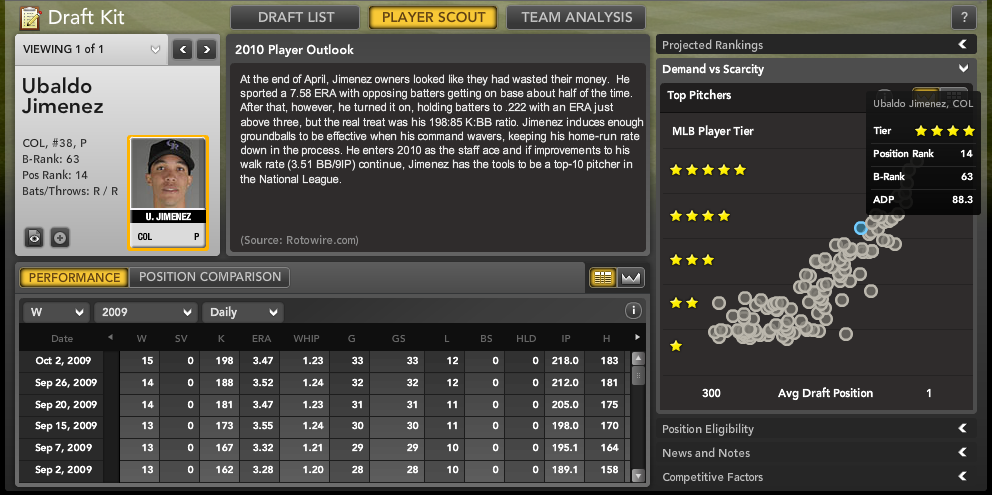
fantasy players. His Average Draft Position is 88.3, making him a
9th-round pick in a 10-team mixed league, and an 8th-round pick in a
12-team mixed league. His B-Rank (Bloomberg Sports’ proprietary ranking
of all players) is 63, meaning his expected value is significantly
higher than his perceived value.
The optimal spot to draft Jimenez, then, lies between his B-Rank
and his ADP. In a 12-team mixed league, that makes a good target in the
sixth or seventh round. Jimenez is rated as a four-star pitcher
according to his Demand vs. Scarcity chart. As shown below, that places
him in a tight cluster with fellow aces like Chris Carpenter and Josh
Beckett – but without an ace’s price tag.
Jimenez has several factors working in his
favor that portend continued success. As shown in the Competitive
Factors tab (under Draft Kit – Player Scout), Jimenez could benefit
from facing a batch of weak opponents in an unbalanced NL West
schedule. The Diamondbacks ranked 20th in runs scored last year, the Giants 26th and the Padres 29th. Only the Dodgers (11th) scored more runs than average
among non-Colorado teams in the NL West.
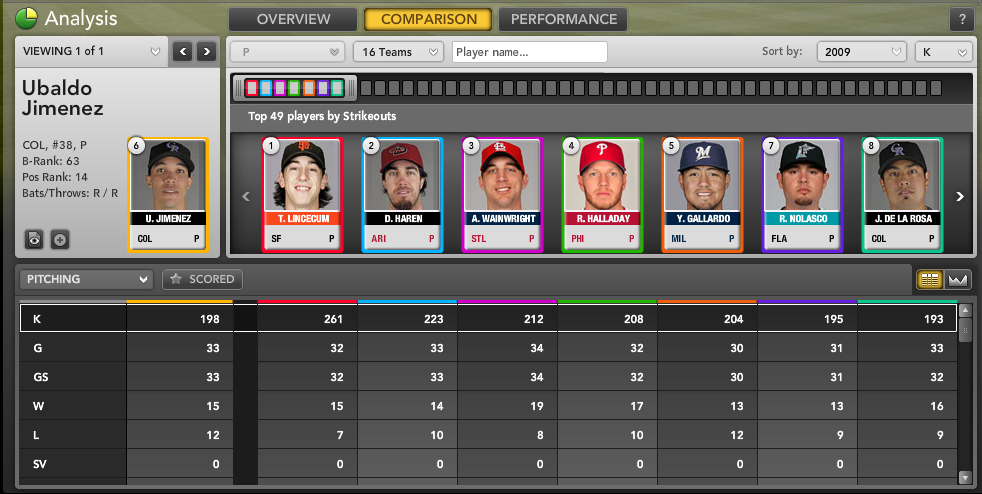
Jimenez also possesses the one skill most crucial to a pitcher’s
success: an ability to miss bats. He ranked 6th in the NL in strikeouts
in 2009.
All of these factors
point to a pitcher who could be an anchor for your pitching staff, but
still allow you to load up on hitting early. Assuming a mid-first round
pick in a mock 12-team mixed league, we picked six hitters, stockpiling
offense early on: Matt Kemp, Ian Kinsler, Justin Upton, B.J. Upton,
Chone Figgins and Carlos Pena (yes, B-Rank loves Uptons). We then
pulled the trigger on Jimenez.

You’ll want to fill your pitching staff fairly quickly from this point on, to ensure across-the-board quality. Wandy Rodriguez, Tommy Hanson and Ricky Nolasco
could be good picks along those lines. In general, take a close look at
pitchers who fit Jimenez’s profile: lots of strikeouts, ideally in the
National League (where offensive levels tend to be lower), ideally in
the NL West. Jimenez teammate Jorge de la Rosa, another top-10 finisher in NL strikeouts last year, could be a great late-round snag to round out your staff.
For more information on Ubaldo Jimenez and hundreds of other players check out Bloomberg Sports’ fantasy tools.
Undervalued Third Basemen: Beltre, Stewart, and Glaus
By Erik Hahmann
The third base position is one of the more top-heavy in fantasy baseball this season. Alex Rodriguez, David Wright, and Evan Longoria lead the charge with B-Ranks (Bloomberg Sports’ proprietary fantasy ranking of all players) of 3rd, 14th, and 16th respectively. Those three should be off the board early, and shouldn’t be available after the mid-second round in standard 12-team mixed leagues.
Seeing these players disappear quickly might make you rush to select a third basemen before you need to. Have no fear, here are a few third basemen who could present great value deeper into your draft.
Adrian Beltre: The move to Boston and Fenway Park should be a boon for Beltre. Last season, playing 81 games in cavernous Safeco Field – a pitcher-friendly park that’s especially tough on right-handed power hitters – Beltre posted a home/road OPS split of .646/.717. Compare that with Fenway, where the only Red Sox player to have a lower OPS at home than on the road was Victor Martinez (minimum 200 AB).
Joining a Red Sox offense that ranked in the top three in runs scored and OPS last season should also provide Beltre with ample opportunities to pad his offensive numbers. The 2009 season was the worst of Beltre’s career at the plate; a shoulder injury sapped his power, caused him to miss 30 games and hit just eight homers all season. If fully healthy, playing in Fenway and flanked by multiple good hitters, Beltre could easily approach his 2005-2008 numbers, when he averaged 25 home runs and 83 RBI a year.
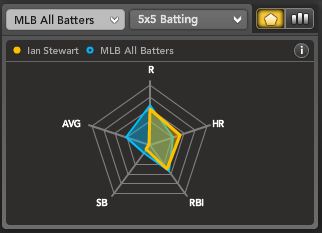
Ian Stewart: At just 24, Ian Stewart enjoyed a breakout year in his first full season, hitting 25 homers and driving in 70 runs in just 425 ABs. However, things could, and probably should, have been much better. Stewart’s batting average on balls in play (which is like regular batting average, only stripping strikeouts from the equation) was just .270 – 35 points below his career average. Stewart’s fantasy value is centered entirely around his power numbers, as you can see in his spider chart below. His BABIP should rebound, making him a cheap power source who won’t kill your batting average as he ascends to full-time duty.
For more information on Adrian Beltre, Ian Stewart, Troy Glaus and hundreds of other players check out Bloomberg Sports’ fantasy tools.
Cliff Pennington: Another Cheap Steals Source at SS
By R.J. Anderson
Last week, Jonah Keri profiled San Diego Padres’ shortstop Everth Cabrera,
noting Cabrera’s cheap price/late draft position for potentially
premium stolen base production. Let’s look at another candidate to the
list of cheap shortstop SB candidates: the Oakland Athletics’ Cliff Pennington.
Ranked 366th overall and behind such names as Juan Uribe and Cristian Guzman,
Pennington projects to finish with the 44th most steals in all of
baseball. That’s not quite Cabrera level, but it’s more than Rafael Furcal and Erick Aybar,
two mid-level shortstops. Furcal is being drafted more than 100 spots
ahead of his 254th B-Rank and Aybar nearly 60 spots ahead of his 269th
rank. Pennington is ranked as the 21st-best shortstop, just slots
behind these two, and he’s not even being drafted in most leagues.
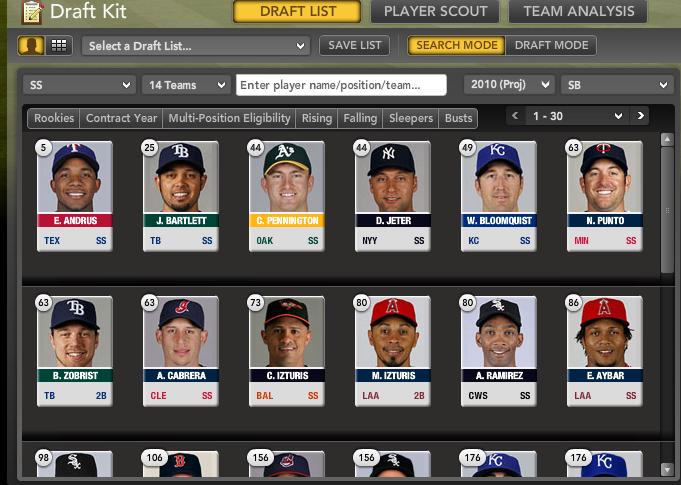
Using the 2010 Projected Stolen Bases filter for American League
shortstops, we find that Pennington ranks behind only the Rangers’ Elvis Andrus and the Rays’ Jason Bartlett in projected swipes at the position in the AL.
Thanks to Moneyball, the A’s have developed a reputation for
being averse to the stolen base. Turns out the book came out seven
years ago, times have changed, and Bloomberg Sports’ SB forecasts for
Pennington vs. the rest of the league reflect that. Last season, Rajai Davis stole 41 bases and Adam Kennedy nabbed 20. The days of Ray Durham’s
speed being held as a prisoner of the run expectancy war are over, and
manager Bob Geren is willing to give the green light when the A’s have
a capable thief. Pennington looks like that kind of base stealer: In 2009, he swiped 27 bases in 99 games at Triple-A. For his career, he has 107 steals in 476 games.
Stealing
bases involves actually getting on base, and this is where things get
interesting. Pennington doesn’t
represent much in the way of batting average either, and the A’s lineup
is more defensive-orientated than equipped to scoring handfuls of runs
per game. That means Pennington’s true value is his stolen bases and
walks/on-base percentage. He’s projected to finish in the top 10 of all
shortstops in each of those metrics, but considerably lower in most
others.
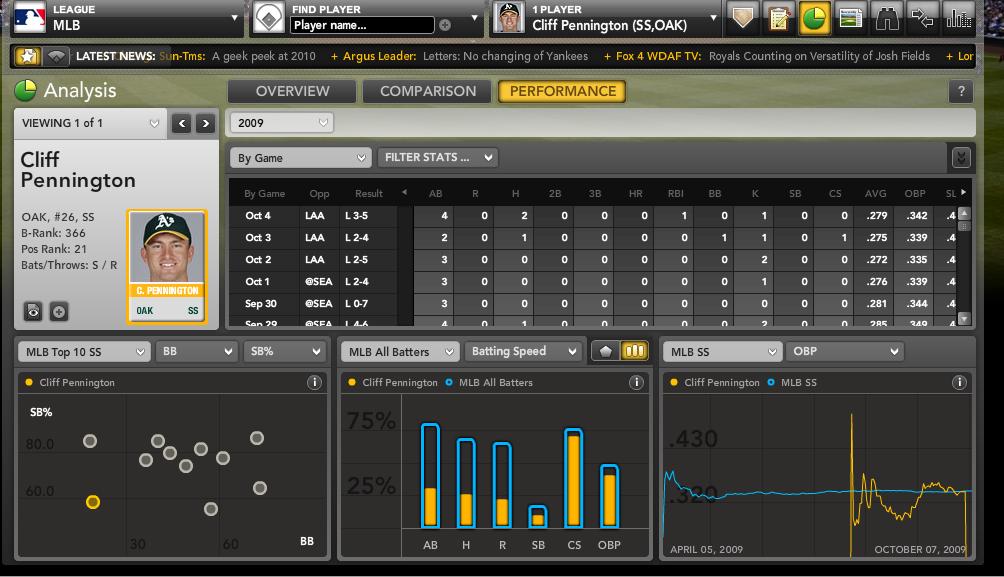
Pennington’s biggest weakness is a lack of power. His minor league ISO (Isolated Power, i.e. slugging percentage minus batting average) is a measly .095. For perspective, Willie Bloomquist‘s career Major League ISO is .069 and Nick Punto‘s
is .076. Pennington’s not quite swinging with a whiffle bat, but his minor league power
indicators
trail his shortstop counterparts in the big leagues –
American League shortstops had an average ISO of .117 in 2009. Combine
that
lack of pop with playing in a pitcher’s paradise in Oakland, and
Pennington projects as a player who’s a likely SB specialist for your
team, not an all-around threat.
Still, for some cheap
steals and walks, Pennington could be a value pick later in the draft,
especially in AL-only leagues.
For more information on Cliff Pennington and hundreds of other
players, and for dozens of tools to help you dominate your fantasy
league, check out Bloomberg Sports’ fantasy kits.
Cameron Maybin: Late Steals for Your Fantasy Team
by Eno Sarris
A well-worn strategy for fantasy baseball is to wait on steals. Why pick a Michael Bourn (Average Draft Position = 87.38) early when Juan Pierre (ADP 232.91) might give you comparable statistics much later?
In that vein, it pays to examine late-round steals options, and it doesn’t get much later than Cameron Maybin (288.25). To be fair, it’s not exactly an active market that late in a draft, as ADPs in the high 200s are not nearly as stable as ADPs earlier in the draft; Maybin goes as early as 200 according to Mock Draft Central. To help hedge your emotional investment in Maybin, we’ll identify a couple of other late options for steals, too. That way you can wait on the risky speed-only picks as long as possible and feel optimistic about landing one of them.
Back to Maybin. Remember back on December 5, 2007, when the announcement came through the wire that the Florida Marlins had traded Miguel Cabrera and Dontrelle Willis for a package headlined by Maybin and left-handed top-shelf prospect Andrew Miller? At the time, the consensus was that this was a Big Boy trade – top prospects for top players. It’s hard to separate the outcomes of the involved players from your appraisal of the trade when it occurred – as Rob Neyer so eloquently pointed out last week – so we won’t try too hard. We’ll just note that the shine has dimmed a bit on this trade in the interim, and it now seems to contain the worst parts of the business of swapping upside for currently performing talent. Sometimes the upside isn’t what you thought it was, and sometimes the current talent is not all it’s cracked up to be, either. (Sometimes the talent goes drinking before a big game, or develops Steve Blass disease.)
Maybin, in the meantime, has gone from the prospect that couldn’t miss to the prospect that couldn’t NOT miss: His career strikeout rate in the major leagues is 31.1%. To put that in perspective, Adam Dunn‘s career strikeout rate is 32.1%. The highest batting average of a player that struck out more than 30% last year was Ryan Howard‘s .279.
This has been a problem for Maybin his whole career, as he owns a 27.9% strikeout rate in the minor leagues as well. Looking through our rose-colored glasses, we can point to the fact that Maybin cut that rate to 19.5% last year in Triple-A. But even when dealing with that sample size we also have to admit that his 29% strikeout rate in the major leagues last year was just about the same as it ever was. There’s still room for growth, as Maybin is just 22 years old, with 257 career MLB at-bats under his belt. Still, without some luck on batted balls, it’s hard to envision Maybin hitting for a high average in 2010.
That said, Maybin’s Spider Graph from the Bloomberg Fantasy Tools shows that it’s not all about batting average. Of course, the spider graph also shows that Maybin comes up short in all categories currently.
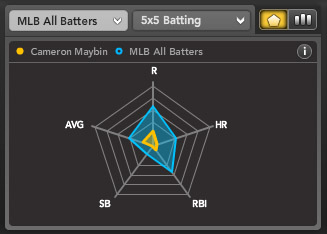 Ouch. Even with a graph predicated on a mere 200-odd plate appearances in 2009, this is a damning appraisal of his skills. Let’s reach for those rose-colored glasses again and see if we can find reasons to be optimistic.
For one, we know he has speed, as he stole 81 bases on a 79% success rate in the minor leagues. So far he’s 10-for-13 in major league attempts, so that bodes well.
But what about his power and patience at the plate? If he exhibits those skills, we can forgive the batting average risk and enjoy the home runs and steals. The patience we’ll deal with first because patience usually translates to the major leagues eventually. Maybin has walked in 12.2% of his minor league plate appearances, and 8% of his major league PAs, so far. Given that the league average last year was 8.9%, gaining those extra walks will be important for the young center fielder.
Now, the power. His minor league isolated power (slugging percentage minus batting average, ISO shows the non-singles a player produced) was .171. If Maybin can put up that number in the major leagues, he’d have power that was comparable to, say Jimmy Rollins (.173 ISO in 2009) or Brandon Phillips (.171 ISO in 2009). Go a little further up the list, though, and you get a good comp for Maybin – Nate McLouth. McLouth has a little more power (.194 career ISO), also strikes out a lot (over 20% in his first two seasons), walks around 10% of the time (9.3% career) and puts up the same kind of power/speed combo with a poor batting average (.260 career) that we might expect out of Maybin. Walk the power back a little, and push the speed forward a little, and you’ve got Maybin’s upside right now. (Mike Cameron (11.1% career BB%, 27.9% career K%, .198 career ISO) would make a good comp, but his speed is waning as he enters his 16th year in the bigs.
If you look at the different Maybin projections around the Web, you have the upper bounds defined by Bill James (as usual): .286 with 10 home runs and 14 stolen bases. To see the projections on the Bloomberg Sports Fantasy Tool, go to the Draft Kit, then pick the Draft List, then Search Mode. Then toggle the switch from picture view to grid view (midway up on left side). Then you can choose 2010 projections and sort by whichever stat or player you like or pick the groups like ‘Rising,’ ‘Falling,’ or ‘Sleepers.’
Add it all together and you get a player who could easily hit around .270 with up to 15 home runs and more than 20 steals this year. Nate-McLouth-lite is sounding like a good comparison right now – except you can get Maybin much, much later in your draft. If you want to wait really long for your steals, Maybin has some good upside and makes a solid late-round pick.
r other young speedsters you can nab late.)
For more information on Cameron Maybin and hundreds of other players check out Bloomberg Sports’ fantasy kit.
Ian Kinsler, the Chase Utley Alternative
By Tommy Rancel
Since joining the Phillies lineup full-time in 2005, Chase Utley has averaged .301/.388/.535 (AVG/OBP/SLG) with 29 home runs and 101 RBI per season. These numbers are typical for a star corner outfielder or a slugging first baseman – not a second baseman. For example, in 2009, Utley hit .282/.397/.508 with 31 home runs and 93 RBI. The average full-time major league second baseman hit .283/.348/.446 with 17 home runs and 74 RBI last year.
Utley is a consistently elite performer who shows no signs of slowing down. But Ian Kinsler may soon pose a threat to his throne atop the second base rankings.
Kinsler one of baseball’s unluckiest players in 2009. His batting average on balls in play (BABIP) was just .241, the lowest BABIP among qualified major leaguers, and 47 points lower than his career mark of .288. This drop in BABIP led to career lows in batting average (.253) and on-base percentage (.327).
Kinsler posted a career high 54% fly-ball rate (FB%) last season, with a career-low 15.4% line drive rate (LD%). If he rebounds toward career levels (47.1% FB, 20.0 % LD) a healthy batting average regression will likely follow.
Despite the low batting average, Kinsler still had a productive season for the Texas Rangers, smoking 31 home runs and swiping 31 bases. He became just the third second basemen (Brandon Phillips and Alfonso Soriano) in major league history to record a 30/30 season.
Looking at the spider charts of Kinsler and Utley, both players rate above average across the board. Utley’s batting average looks a lot better, but remember Kinslers’ BABIP fluctuation.
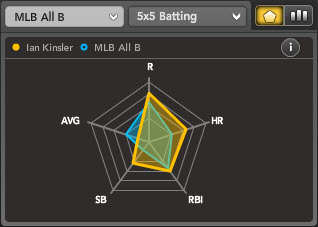
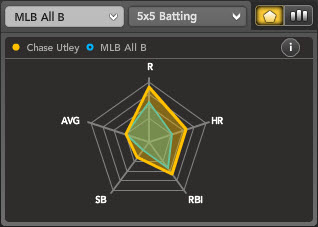
The final category is steals. Surprisingly, the 31-year-old, Utley stole a career high 23 bases last season after swiping 60 bags over the previous four. Kinsler has 91 career steals, including 80 over the past three years. He has increased his steals total in each of his four seasons: 11 in 2006, 23 in 2007, 26 in 2008, and 31 in 2009. Utley is on the wrong side of 30, while Kinsler is just 27; that age gap could widen the disparity in steals between the two players over the next few seasons.
One potential pitfall with Kinsler is health. In his four-year career he has spent 134 days on the DL with a variety of injuries. These include: a dislocated thumb, left foot stress fracture, sports hernia, and a strained hamstring last July. Utley missed 31 days with a broken bone in his hand in 2007, but has avoided a DL trip in the past two seasons.
Unlike previous years, Kinsler will not be leading off for the Rangers. This will give him fewer plate appearances, but should not be seen as a net negative. Instead, focus on all the increased RBI opportunities he will have hitting behind Michael Young and Josh Hamilton. In addition to the potential for more RBI, we know Kinsler’s power is real. His isolated power (slugging percentage minus batting average) has increased every season, going from .168 in 2006 to .235 in ’09.
B-Rank looks past Kinsler’s 2009 batting average and ranks him 12th overall; Utley ranks slightly higher at 10th overall. Meanwhile, Kinsler’s average draft position (ADP) of 17.2 means he could produce similar or better numbers than Utley (ADP 5.4) without expending a mid-first round pick.
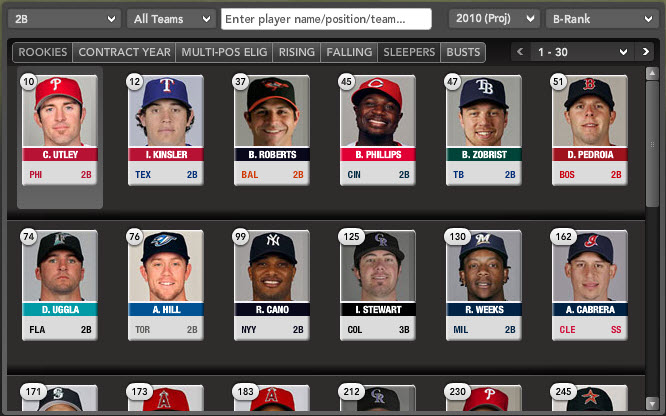
In a 12-team mixed league, a team picking late in the first round could conceivably draft a combination of Prince Fielder and Kinsl
er, a killer 1-2 punch on the right side of the infield to start the draft.
For more information on Ian Kinsler and hundreds of other players, and for dozens of tools to help you dominate your fantasy league, check out Bloomberg Sports’ fantasy kits.
The Underrated Derek Lee in 2010
By Tommy Rancel
At a position stacked with superstar names, Chicago Cubs first baseman Derrek Lee is often overlooked. The best player on the face of the planet, Albert Pujols, plays the same position in the same division. So do sweet-swinging first basemen Prince Fielder, Lance Berkman, and Joey Votto.
That Lee gets lost in the shuffle among other big hitters only makes him a more attractive pick. In 2009, he hit .306/.393/.579 (AVG/OBP/SLG) with 35 home runs, 111 RBI and 91 runs scored. His .972 OPS was fourth-best in the National League. The three names in front of him were all familiar foes: Pujols, Fielder and Votto.
Looking at Lee’s Spider Chart (bottom center), you can see the extent of his all-around contributions.
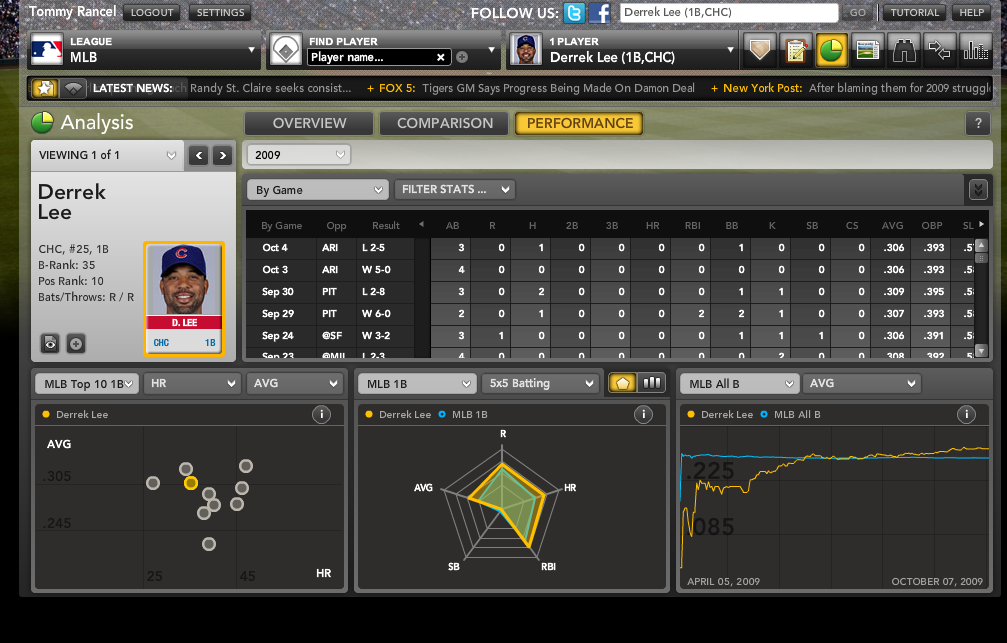
The biggest question facing Lee in 2010 is, can these numbers be sustained? It’s hard to envision a 34-year-old player duplicating such a great season.
When we look for flukes in a batter’s season, we often look at batting average on balls in p
lay (BABIP) and home run-to-fly ball ratios (HR/FB). In 2009, Lee had a BABIP of .327, well above league average, which typically hovers near .300. Lee’s career BABIP sits at .323, though, suggesting his ’09 figure isn’t unusual.
Lee’s career home run-to-flyball rate spiked to 17.9% in 2009, up from 11.7% In 2008. On the plus side, that ’08 figure represented a career low; Lee’s career HR/FB rate is 17%
With regression questions answered, we can look forward to the 2010 season. The most conservative projection on Lee in 2010 comes from the CHONE projection system. CHONE projects a slash line of .285/.365/.487. That would give him an OPS decline of .120 points compared to ’09 levels. Bloomberg Sports pegs Lee to hit .303/.386/.526. .
At these levels, Lee figures to slot in below some of the elite first basemen on baseball. But we’re still bullish on him, especially in 12-team mixed and deeper leagues. Here’s why.
Lee ranks 35th overall in B-Rank (Bloomberg’s proprietary ranking of all players). Despite the relatively high overall ranking, he is the 10th-rated first basemen. This is more a testament to the talent level at the position than Lee’s abilities. With such a deep pool of talent, it is essential to get a bargain at the position. Unless you’re able to score Pujols, Fielder, Ryan Howard or Mark Teixiera in the first round, you might want to lie in the weeds and snatch up Lee much later.
Average Draft Position shows Lee being taken at #90, making a 55-spot gap between where Bloomberg Sports ranks him and where people are drafting him. Looking at the Demand vs. Scarcity chart below, you’ll see that there are plenty of good first basemen available. But few have a bigger gap between their B-Rank and ADP than Lee.
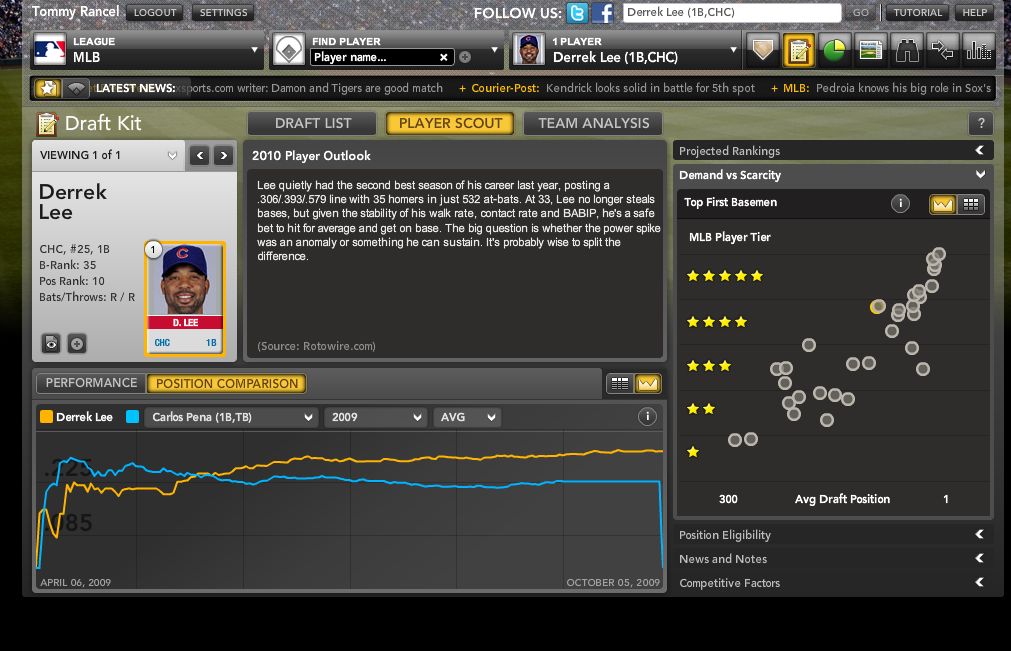
The dot nearly on top of Lee’s belongs to Carlos Pena. Pena’s value is nearly as high as Lee’s. If you can get either one you’ll be the benefactor of a big bargain. The reason to chose Lee over Pena is batting average. Looking at the trend line chart below, you can see just how big of a gap there is between the two in that category.
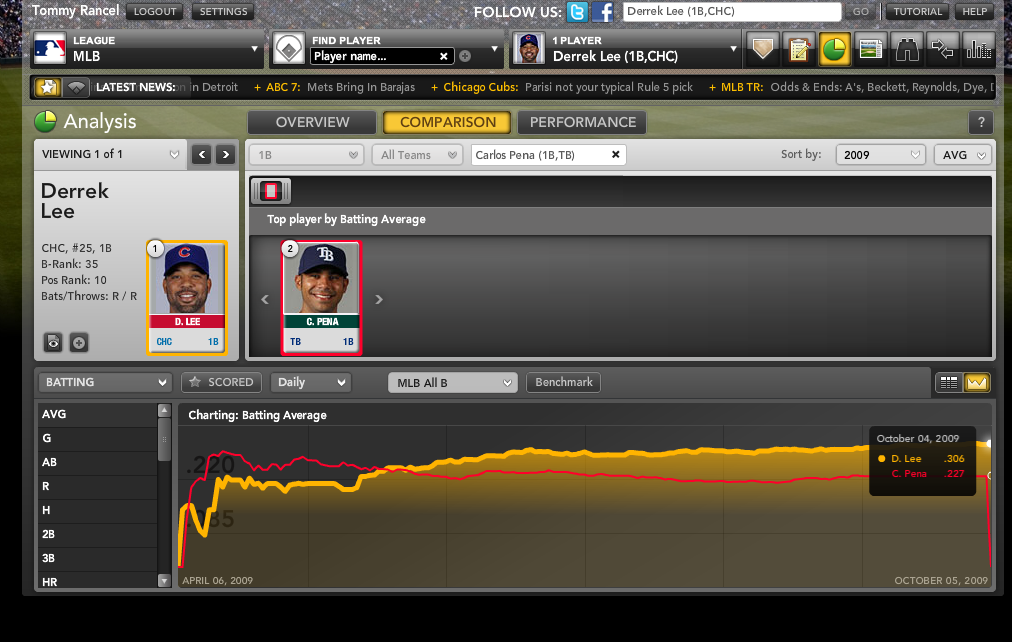
Outside of Lee and Pena, other four-star first basemen include: Justin Morneau, Votto, Berkman, Adam Dunn and Kendry Morales. None of the names above come close to representing the value of Lee. Here’s a look at each player’s B-Rank and ADP
Morneau
B-Rank: 42
ADP: 37.2
Votto
B-Rank: 34
ADP: 39.3
Berkman
B-Rank: 60
ADP: 69.0
Dunn
B-Rank: 38.0
ADP: 58.0
Morales
B-Rank 43
ADP: 59.5
Only Votto (34th) has a B-Rank higher than Lee (35th); however, all five of these 1B are being drafted three to five rounds earlier. It’s hard to fight the temptation of drafting Morneau or Votto in the fourth round, but your team is likely better off pursuing an elite starting pitcher or help at a shallower position, the coming back around to add Lee two or three rounds (or more) later.
Because he’s in a contract year, Lee is a safer play in a mixed league than an NL-only. If the Cubs fall out of the race by July 31, contenders in both leagues could be battling for his underrated services. Don’t find yourself in a similar fight come draft day. Lock him down.
For more information on Derek Lee and hundreds of other players check out Bloomberg Sports’ fantasy kits for yourself.
Draft Lots of Yankees and Phillies
By R.J. Anderson
The last time we saw competitive major league baseball, the New York Yankees and Philadelphia Phillies played in the World Series. Fittingly, those two teams are battling for something in the spring. This time it’s purely about bragging rights, and purely about the number of players in the top 100 B-Rank. The Yankees and Phillies both feature eight players apiece; the Red Sox hold seven; the Dodgers six; the Twins, Rays, Astros, and Cardinals with five; and five teams only have one player making the cut, including the Royals, Pirates, and Padres.
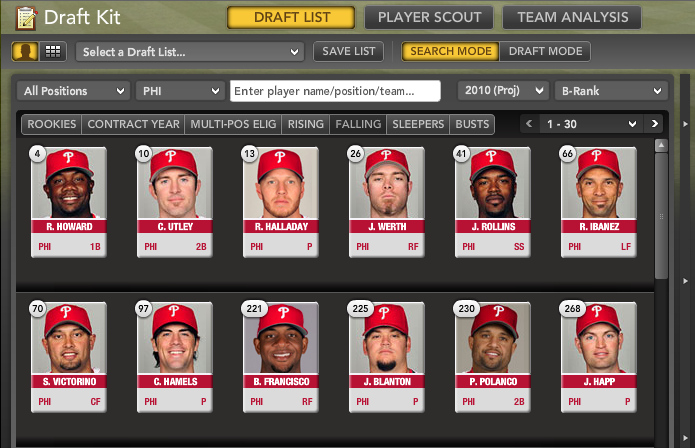
Number of players ranked within the top 100:
8 – NYY, PHI
7 – BOS
6 – LAD
5 – MIN, TB, HOU, STL
4 – SEA, FLA
3 – BAL, LAA, TEX, ARI, ATL, MIL, NYM, SF
2 – CLE, DET, TOR, CHC, CIN, COL, WAS
1- CWS, KC, OAK, PIT, SD
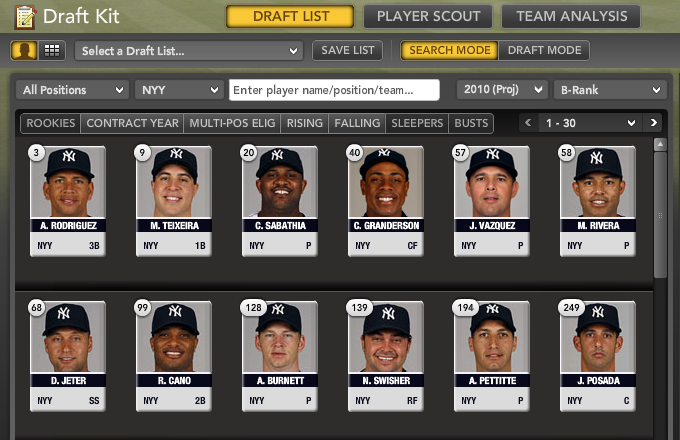
Number of hitters ranked within the top 100:
6 – PHI
5 – NYY, TB
4 – BOS, MIN, HOU
3 – LAD, STL, BAL, LAA, TEX
2 – SEA, FLA, ARI, ATL, MIL, NYM, CLE, TOR, CHC, CIN, COL, WAS
1 – SF, DET, CWS, PIT, SD
0 – KC, OAK
Some time later in your draft, a decision will have to be made between two players of similar caliber. The difference very well could be the quality of the lineup surrounding said players. That’s where the following data should help. If the decision comes down to Marco Scutaro (B-Rank of 213) or Everth Cabrera (190), then a quick scan of the differences between Boston’s quality of hitters and San Diego’s can pay dividends. Especially since so many leagues rely heavily on stats like RBI and R, two numbers that favor players in strong lineups over those surrounded by anemic offenses.
For more information on all of the Phillies, Yankees, and hundreds of other
players, and for dozens of tools to help you dominate your fantasy
league, check out Bloomberg Sports’ fantasy kits.
Hanley Ramirez No, Everth Cabrera Yes
By Jonah Keri
Hanley Ramirez is a consensus Top-2 pick.
Troy Tulowitzki’s in most people’s Top 20, and some people’s Top 10.
Jimmy Rollins’ stock has dropped a bit, but he remains a high-round
favorite among fantasy shortstop picks.
In deeper leagues, you can safely ignore all of them.
Building
your draft is all about finding value. One of the best sources of value
this year will be cheap steals – especially from the shortstop
position. In deep mixed leagues and especially NL-only leagues with 10
teams or more, several lightly-regarded shortstops figure to bring a
lot of hidden value in late rounds.
Leading that pack is Everth Cabrera. The 23-year-old San Diego Padre
swiped 25 bases in his rookie season last year, tied for 6th among MLB
shortstops.
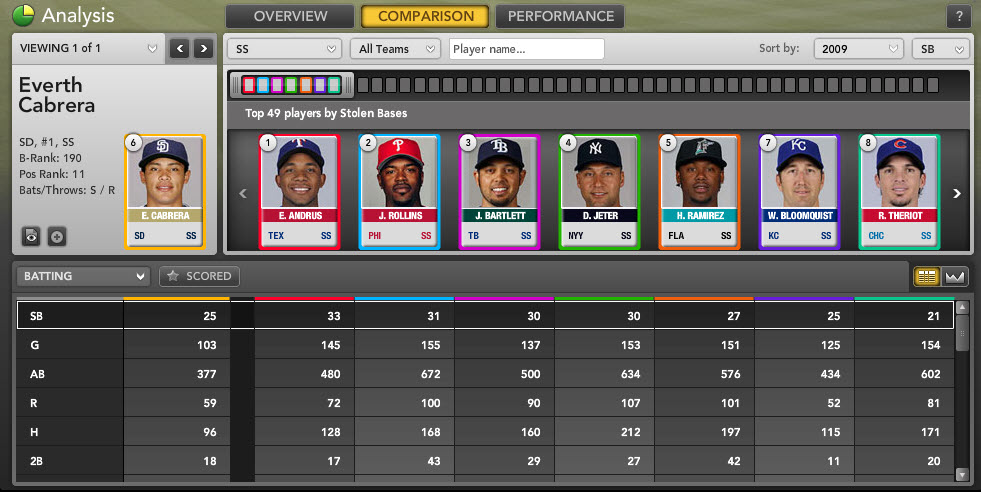
Cabrera’s impressive steals total came despite playing in just 103
games last year. Project those numbers out over a full season, and 35+
steals become a realistic goal; no MLB SS swiped more than 33 bags in
2009. Cabrera figures to get that additional playing time too. He
showed decent plate discipline, walking in 10.5% of his plate
appearances and notching a .342 on-base percentage. Cabrera also played
solid enough defense to earn his team’s trust as an everyday shortstop.
Cabrera will never be confused for a five-category beast like Ramirez.
He hit groundballs on 62.7% of the ball he hit in play last year, an
astronomical figure that severely limits his ability to rack up
extra-base hits. A look at his Spider Chart (bottom center) shows that Cabrera offered
value in the Runs Scored and Stolen Bases department. His other fantasy
categories aren’t pretty: His two home runs put him miles below the
league average even at a more power-deficient position like shortstop,
and you’re probably not knocking in a ton of runs if you’re constantly
chopping the ball into the ground either.

Cabrera’s value could hinge on his batting average. His .255 mark last
year was sub-par for someone with little to no power and a .325 batting
average on balls in play suggests that the culprit wasn’t necessarily
bad luck. On the other hand, Cabrera’s speed should work to his
advantage, helping him leg out infield hits. If he can hoist his line
drive percentage a bit higher than last year’s 14.8% and stick in the
everyday lineup, we could be looking at a .280 hitter with 80+ runs
scored and 35 steals.
Cabrera sports an Average Draft Position of 249. But his B-Rank (Bloomberg Sports’ proprietary ranking of all players) of 190 demonstrates his significantly higher upside.
Grabbing Albert Pujols or Chase Utley near the top of your draft, then waiting until the late rounds to grab Everth Cabrera (or Cubs shortstop Ryan Theriot,
a player with similar skills) as your starting shortstop and source of
cheap steals, could pay big dividends for your team this season.
For more information on Everth Cabrera and hundreds of other players,
and for dozens of tools to help you dominate your fantasy league, check
out Bloomberg Sports’ fantasy kits.
C.J. Wilson’s Potential Move To The Rangers’ Rotation
By Tommy Rancel
Spring Training marks a period of experimentation. With a month of meaningless games to fill, it’s the perfect time to try things that you would never think of once Opening Day arrives. Most experiments go nowhere and end in mid-March. Occasionally one will work, such as last season’s move of Skip Schumaker from the outfield to second base for the St. Louis Cardinals.
The Texas Rangers are doing some experimentation of their own by giving set-up man and former closer C.J. Wilson a chance to compete for a rotation spot. In recent seasons we’ve seen Adam Wainwright, Ryan Dempster, and Braden Looper make successful moves from reliever to starter – albeit to differing degrees.
It was not too long ago when Wilson was the Rangers’ closer. After solid numbers in 2007 (66 games, 3.02 ERA, 12 saves), Rangers Manager Ron Washington tapped the lefty as the team’s bullpen stopper in 2008. However, things didn’t go according to plan. In 2008, Wilson saved 24 games, but finished with a dismal 6.02 ERA in 50 games.
The biggest difference between the two seasons was a disparity in home runs. After allowing just four homers in 68.1 innings in 2007, Wilson gave up eight in just 46.1 innings in 2008.
The huge jump can be explained by a ridiculously high home run-to-fly ball rate (HR/FB). For his career, Wilson owns a HR/FB rate of 12.6%. But in 2008, his HR/FB skyrocketed to 16.8%, up from 2007 levels, when batters hit home runs on 8.2% of the flyballs hit off Wilson.
Wilson benefited from regression last year, when his HR/FB dropped to a career-low 6.3%, in the process lowered his home runs allowed per nine innings rate (HR/9) to 0.37 – also a career best. Filling the set-up role and backup closer role in support of the Rangers’ top closer choice Frank Francisco, Wilson finished the season with 14 saves and set career marks in several categories, including: wins (5), games pitched (74), innings pitched (73.2), strikeouts per nine innings (K/9) (10.26), and ERA (2.81).
Despite the career year out of the bullpen, Wilson is still auditioning for a rotation spot in the Texas Rangers rotation. Why? Because in most cases 150 innings of average starting pitching is more valuable to a team than a 60 good middle relief innings.
As strong as Wilson’s 2009 campaign was, his contributions added up to a decent but not overwhelming 2 wins above replacement level (WAR represents the number of wins a player adds to his team over your typical 25th man on a roster). According to fangraphs.com, Wilson was one of just one of 10 relievers to hit the 2 WAR threshold, showing the limited upside inherent in a role that severely limits innings pitched. On the other hand, 63 starting pitchers were worth 2 WAR or more.
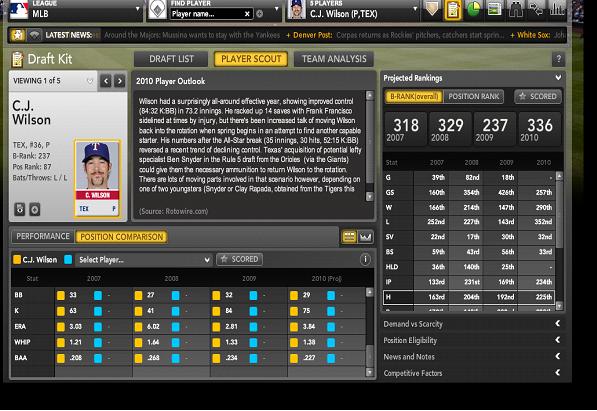
According to B-Rank (Bloomberg’s proprietary ranking of all players), Wilson’s stellar relief numbers earn him an overall ranking of 336. In most leagues he is not even drafted. On the other hand, Joe Saunders ranks 271th despite posting a nearly league average 4.60 ERA and an ugly 5.17 FIP (Fielding Independent Pitching, a stat that runs along a similar scale to ERA, while stripping out factors a pitcher can’t control such as defense and luck). He is also drafted in almost every league regardless for format. This is just another example of the value of league average starting pitching over above average relief
The move from bullpen to rotation is a tricky one. It’s generally accepted that a pitcher can see increases in ERA, strikeouts and velocity moving from the rotation to the bullpen. New Yankee Chan Ho Park is a good example of his phenomenon. As a starter, Park owns a career 4.39 ERA. His ERA plunged to 2.58 last season, on the strength of a strikeout rate that reached its highest point for a full season since 2001. Park also saw an increase in velocity: He posted an average fastball velocity of 92.2 MPH last season, up from his career average of 90.3 MPH. Even if Wilson makes a successful transition, he will likely see the reverse effect that Park – and other failed starts like Eric Gagne and Jose Mesa – experienced in moving to the bullpen from the rotation. In 2009, only two qualified major league starters posted K/9’s above 10.00: two-time National League Cy Young winner Tim Lincecum (10.42) and Justin Verlander (10.09).
In addition to the strikeouts, there are also the looming home run concerns. As mentioned, Wilson enjoyed career best marks of 6.3% HR/FB and 0.37 HR/9 in 2009. Beyond regression to the mean, neither are sustainable as a starting pitcher. In 2009, only five starters had HR/9 less than 0.50: Chris Carpenter (0.33), Clayton Kershaw (0.37), the aforementioned Lincecum (0.41), AL Cy Young Winner Zack Greinke (0.43) and Joel Pinero (0.46). Looking at HR/FB rates, five starters had rates below 6.0%, including four names from above: Carpenter (4.6%), Kershaw (4.1%), Lincecum (5.5%) and Greinke(4.5%), along with Carlos Zambrano (5.6%).
Outside of the statistical regressions, the biggest question is can Wilson handle the toll of pitching every fifth day over a 162-game season? After spending nearly five seasons in the bullpen, Wilson will be asked to throw at least 150 innings and upwards of 100 pitches per start. Last season, he threw 25 or
more pitches 14 times and never went over 38 pitches in one appearance. The good news is Wilson’s numbers reflect that he does better when pitching on more days rest. With zero days rest in between appearances, Wilson’s slash line against was .325/.385/.482 (opponents’ AVG/OBP/SLG) last year. When working on three days rest that went down to .190/.261/.238; on four days it was .190/.190/.238 on four days. (Please note small sample sizes in all cases.)
In addition to the physical aspect of starting, Wilson will need to work on pitch selection. A relief pitcher can get by with one dominant pitch and a secondary pitch. A starting pitcher generally needs at least three pitches to deal with the opposing lineup three or four times a night. Wilson has an above average fastball and a decent slider, but is lacking a true third option. In 2009, he toyed with a cut fastball and a curveball, but neither was used more than 5.6% of the time. He will need to up the usage of both pitches, or concentrate on just one as his third pitch, to balance out his pitch selection.
When taking everything into account – statistical regressions, the physical impact and pitch selection – Wilson is facing an uphill battle. But it’s a battle worth fighting. Despite being one of the games better relievers last season, Wilson was not a valuable fantasy player, because pitchers can only produce so much value (in fantasy or real life) as non-closing relief pitchers. However, if Wilson can parlay his solid historical strikeout rates into a league-average ERA as a starter, his value would jump considerably. I wouldn’t put Wilson on any draft boards as a starter right now; but you should add him to your watch list.
To keep an eye on C.J. Wilson, and hundreds of other players, check out Bloomberg Sports’ fantasy kits
Brad Penny: Draft Day Sleeper
By Erik Hahmann
A handful of moves made this off-season could prove very valuable to major league clubs, even if they lack the buzz of signing a Matt Holliday or John Lackey. The Cardinals’ signing of Brad Penny to a one-year contract is one such move.
Looking at Penny’s raw 2009 numbers may make you think I’m out of my mind. Penny’s fantasy stats in Boston were especially awful, as the big right-hander posted a 5.61 ERA in 24 starts. But more advanced metrics show that he pitched much better than that. Penny posted an unusually high batting average on balls in play (BABIP) of .336 with the Red Sox. That figure was 33 points above his career line, leading to more runs scoring as a result of luck, defense and other factors out of his control. His Fielding Independent Pitching (FIP), a measure of factors such as strikeout, walk and home run rate that a pitcher can better control, was a much more respectable 4.49 for the Red Sox.
Nevertheless, Penny was cut by Boston and subsequently signed by San Francisco. The move back to the NL, where Penny had great success over the first nine seasons of his career, proved to be beneficial career move. Away from the much tougher American League East, he posted a 2.59 ERA in 41.2 innings pitched with the Giants. This time, Penny benefited from good luck, posting a microscopic .211 BABIP in San Francisco, and a 4.19 FIP that showed the true performance gap between his stints with the Red Sox and Giants to be much smaller than his 3-runs-lower ERA suggested.
Still, those 41.2 IP are what earned Penny his chance with the Cardinals and pitching coach extraordinaire Dave Duncan. The list of pitchers Duncan has helped turn around while in St. Louis is impressive, with Chris Carpenter and Joel Pineiro the two most prominent recent examples. Duncan teaches his pitchers to throw a sinking fastball, with the goal of generating more outs early in counts and preventing home runs and other extra-base hits. In a recent LA Times article, Pineiro said: “Duncan has all his guys throwing sinkers. He just said, ‘I want you to trust it and throw it.’ ”
Coming into last season, Pineiro hadn’t posted an ERA below 4.33 or an FIP below 4.41 since 2003. A full season in the Duncan Pitching School would change that: Pineiro’s fastball usage, which had been above 60% just one time in his career, jumped to 71% last season, most of them of the sinking variety. That big increase in sinkers resulted in his groundball percentage rocketing to 60.5% – after never topping 47.5% in his pre-St. Louis days.
Other recent reclamation projects of Duncan’s include Todd Wellemeyer and Kyle Lohse. In 2008 Wellemeyer, a fringe swingman and reliever to that point, won 13 games for the Cardinals, posting a 3.71 ERA and a K/BB ratio of better than 2:1. That same season, the newly acquired Lohse, who’d never posted an ERA below 4.18 in his previous seven seasons, enjoyed the best year of his career under Duncan, going 15-6 with a 3.78 ERA.
Penny owns a better pedigree than Pineiro, Lohse or Wellemeyer; he’s also thrown fastballs at least 70% of the time in five different seasons, which should make for an easier transition to the Duncan system. Penny should benefit from a strong offense behind him this season, led by Matt Holliday and Albert Pujols guy. He also figures to benefit from facing some weak offenses: four of the Cardinals’ five division rivals ranked among the bottom 10 of baseball in runs scored.
Would-be Penny owners have may reason for concern on the defensive front. The Cardinals defense struggled last year, as the team ranked just 18th in MLB in Ultimate Zone Rating, a stat that measures the number of runs a fielder saves on ball hit into and around his assigned area of the field. Still, St. Louis’ team mark of -17.8 (every 10 runs saved equals one win gained in the standings, so -17.8 means the Cardinals’ defense added nearly two losses to the team’s ledger) was scarcely worse than the -16.3 total put up by the Red Sox, Penny’s employer for most of last season. The Cardinals are also optimistic that highly regarded third base prospects David Freese could prove to be a defensive asset as a first-year starter in 2010.
Penny does have a track record of injuries, with two straight ugly season on his ledger (he posted an abysmal 5.27 FIP with the Dodgers in 2008). Those factors add up to a B-Rank of 361 for this season, with a positional ranking of 137. That ranking sandwiches Penny between Homer Bailey and Brandon McCarthy (shown below using Bloomberg’s Draft Kit feature).
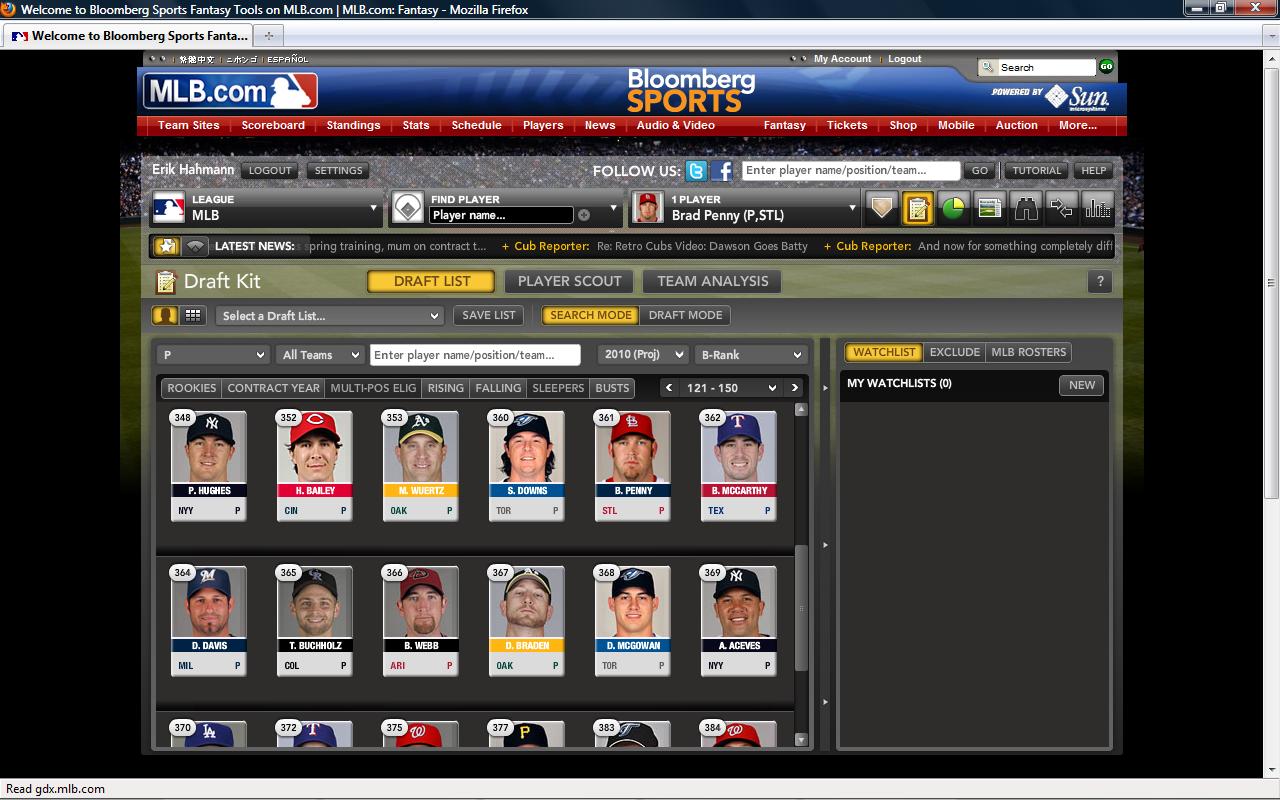
Brad Penny should be available near the end of most drafts. If he can click with Dave Duncan the way so many others have over the years, he will be an absolute steal come draft day.
For more information on Brad Penny and hundreds of other players, and for dozens of tools to help you dominate your fantasy league, check out Bloomberg Sports’ fantasy kits.
 Bloomberg Sports