Category: Dailies
Lou Piniella’s New Nasty Boy: Carlos Marmol
By Tommy Rancel //
Lou Piniella is no stranger to flame-throwing relievers at the back end of his bullpens. As manager of the 1990 World Champion Cincinnati Reds, Piniella employed a trio of relievers, Norm Charlton, Rob Dibble and Randy Myers (a.k.a. the Nasty Boys), to close out games. Twenty years later, Piniella’s current club, the Chicago Cubs, are not World Series contenders, but their closer sure is nasty.
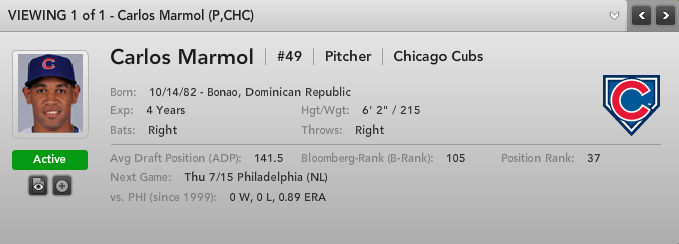
Carlos Marmol is a wild man. He has amazing stuff on the mound. While he owns a fastball that averages velocity in the mid-90s, the heater only serves as a compliment to his devastatingly successful slider. Despite the above-average offerings, he has a tendency to drive Lou (and Cubs) fans absolutely insane with his control issues. Meanwhile, he tiptoes around his shaky control just enough to be wildly successful.
If you looked at walk rate alone, you would think Marmol would be searching for employment rather than being the Cubs’ closer. In 43.1 innings of work this year, he’s handed out 33 free passes. That earns him a walks per nine inning (BB/9) rate of. 6.85! On the other hand, that’s a solid improvement over the 7.91 BB/9(!!) he posted last year – as Marmol walked 65 batters in 74 innings.
In spite of his immensely high walk rate, and a very high batting average on balls in play (.364), Marmol has maintained a sparkling 2.91 ERA, with an even better 2.26 FIP (Fielding Independent Pitching, which strips out luck, park factors and other elements beyond strikeout, walk and home run rates). Despite allowing 1.32 base runners per inning, he is stranding 79.2% of batters who reach base. All of these statistical oddities are made possible because Carlos Marmol will strike you out. In fact, he will strike you out and the guy behind you.
Marmol has struck out an unthinkable 83 batters in his 43.1 innings. Yes, he is striking out nearly two batters for every inning he pitches, 17.05 per nine innings, to be precise. If he maintains that insane pace throughout the course of the season, it would be a major league record for a reliever with a minimum of 50 innings pitched (Eric Gagne 14.98 K/9 in 2003).

The high amount of strikeouts and walks have severely limited the balls in play hit against Marmol. In fact, Marmol gets a swinging strike 15.3% of the time overall, and 19.6% on his slider. Because of this, the high number of walks, and high frequency of balls in play falling for hits, have not come back to haunt him.
Although Marmol has been successful, this path to success isn’t blueprint for others. On the plus side, there is there is an equal chance Marmol’s BABIP regresses toward career levels (.257). Regardless, Marmol’s unique processes should continue to provide above-average results – including an astronomical strikeout rates that’s going to equal more total Ks than many starting pitchers will rack up.
For more on Carlos Marmol and dominating closers, check out Bloomberg Sports’ Fantasy Kits.
Waiting Out Joba
By Bloomberg Sports //
On July 10, Joba Chamberlain‘s shaky season took a turn for the worse, when he surrendered an eighth-inning grand slam to Seattle’s Jose Lopez en route to a 4-1 Yankees loss. The poor performance reawakened calls for the Yankees and fantasy owners to consider exploring other options.
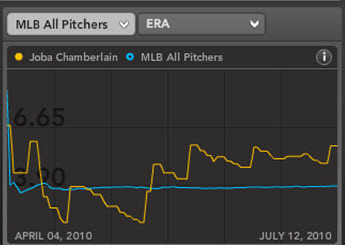
On the surface, it isn’t hard to see why both Yankees fans and fantasy owners have found Chamberlain frustrating in 2010. The big right-hander’s ERA stands at 5.77, his WHIP’s at 1.51, with opponents now hitting a robust .290 against him. He has not had more than three consecutive scoreless appearances since the middle of May. Of the 11 appearances in which he has allowed a run this year, he has allowed either 3 or 4 runs in five of them, a trend that makes it all but impossible for him to consistently lower his ERA.
In reality, Chamberlain’s luck has been the biggest difference this year from years past. Chamberlain’s FIP (Fielding Independent Pitching–a version of ERA that strips away all luck-related variables) stands at 2.66, more than three runs lower than his ERA. He is not walking his way into trouble, as his 3.23 walk rate is his lowest since 2007 and about league-average. His live drive rate is up a little bit, but a 21.7% line drive rate–compared to a career rate of 19.4%–doesn’t account for more than three runs of difference between ERA and FIP.
Chamberlain’s sky-high .391 BABIP (Career: .327) and microscopic 58.7% strand rate (Career: 73.1%) are the main reasons for his struggles. One minor change, a decrease in pop-ups (2.9%, Career: 9.6%), hasn’t helped. But the rest of his profile’s mostly unchanged.
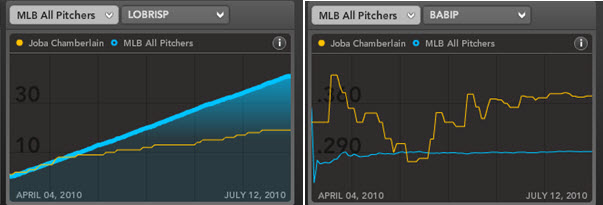
In 2007, Chamberlain burst on the scene with just 1 earned run allowed in 24 innings pitched, is hardly a distant memory for Yankee fans. When it was announced in March that he would return to the bullpen, there was anticipation of an immediate return to his lights-out form from three years ago. This has yet to happen, but the inevitable regression away from the abysmal luck Chamberlain has experienced so far this season could go a long way toward bringing back the Yankees’ shut-down 8th-inning man.
With the increased heat on Chamberlain’s fastball–which is once again consistently in the upper-90s–to consider, along with his past success in the eighth inning, an improvement should come sooner rather than later. If you own Joba in a deep fantasy league, especially one that counts holds, he is certainly worth your patience.
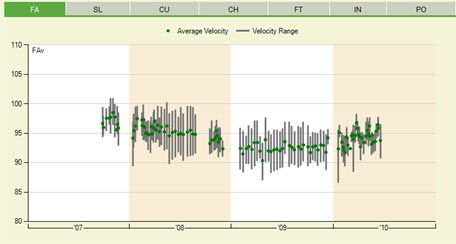
(chart and statistics courtesy of Fangraphs.com)
(Video) Bloomberg Sports’ Ballpark Figures: All-Star Special (AL Edition)
By Bloomberg Sports//
Ballpark Figures: All-Star Special (AL Edition) — Bloomberg Television’s Michele Steele talks some fantasy baseball with Bloomberg Sports Fantasy Analyst Rob Shaw live from the Angels Stadium of Anaheim, the site of the MLB All-Star game. Shaw tells us that the fans, managers, and players did not get it right and that there were some fantasy stars more deserving of starting in the All-Star game.
(Video) Ballpark Figures: All-Star Special (NL Edition)
By Bloomberg Sports //
Ballpark Figures: All-Star Special (NL Edition) — Bloomberg Television’s Michele Steele talks some fantasy baseball with Bloomberg Sports Fantasy Analyst Rob Shaw live from the Angels Stadium of Anaheim, the site of the MLB All-Star game. Shaw tells us that the fans, managers, and players did not get it right and that there were some fantasy stars more deserving of starting in the All-Star game.
First Half Fantasy All-Stars: Buy, Sell or Hold?
by Eno Sarris //
Fantasy managers should be taking a
good look at their teams and deciding where they have surpluses and
weaknesses. If you’ve got the Bloomberg Sports Fantasy Tools, it’s a great time to look at the rest-of-season projections for your team, and do some trade analyzing.
As
in the first half, you’re looking for players who are not only great
producers, but also those who deliver the best return on investment.
A fantasy All-Star brings in the question of how much was spent on the player. Yes, it’s nice that Evan Longoria is playing well, but he cost first-round prices. Meanwhile, how many people got those 20+ home runs from Jose Bautista
for virtually free? Those managers are probably rolling in power
numbers, and benefiting quite nicely from their fantasy All-Star.
Use these fantasy All-Stars as your template for what great ROI looks like.
C Miguel Olivo
Olivo
has a .319 batting average this year and a .249 career average. He’s
given his owners a great batting average and 12 homers at a tough
position to fill. He’s definitely a fantasy All-Star. But the gravy
train will most likely not continue. Olivo sports a .391 batting
average on balls in play for the year, which would be the
second-highest figure in the game if he qualified for the batting
title. It’s also almost 100 points above his career number and the
major league average. Yes, it’s nice that he’s walking at a career-high
pace, and that he’s cut his strikeouts down to one of the better rates
of his career. But Olivo’s batting average, and therefore his fantasy
value, will likely come way down. Then you’ve got Rockies backup Chris Iannetta, who has a BABIP (.214) that’s ready to go the other way. This is one All-Star that must be sold, almost at any price.
1B Paul Konerko
Twenty-one
home runs and a .301 batting average plays at any position, especially
when they come from the late rounds of a mixed-league draft. Konerko is
a first-half fantasy All-Star, and he’s actually one that might stick.
Don’t assume his higher-than-normal batting average will fall. HIs
BABIP is not at all out of whack with baseball norms (.306), even if
it’s a little higher than his career number (.283). Even if the batting
average comes down a little bit, his power will be useful. His .560
slugging percentage looks a little high (.494 career), but he’s also
hitting flyballs at a career-high rate (46.5% this year, 41.3% career).
To top it off, his home runs per fly ball rate this year (17.6%) is not
at all strange next to his career number (16.6%). Unless you can full
proper value for Konerko, he’s a hold.
2B Rickie Weeks
This could really be Martin Prado, but he was covered recently
– and excellently – by Tommy Rancel in this space. So instead, it’s the
Brewers’ surprising spark plug who gets the award. If one All-Star so
far was a hold, and the other a sell, this one is right in between.
Weeks’ BABIP looks a little high (.335) but just last year he put up
a similar batting average (.272) with a slightly lower BABIP (.313). Of
course, he got hurt last year, and health has always been Weeks’
weakness. If you think he can avoid the injury bug, though, this
breakout looks legitimate. Weeks has already reached a career high in
homers (17) and we’re just past the All-Star break. Even if you tried
to sell, your leaguemates would probably want to pay a reduced price
because of Weeks’ injury history. So you’re best off holding, and
hoping the breakout continues.
Sleeper Alert: Kris Medlen
By R.J. Anderson //
During any given season numerous players will emerge and submerge above and below the relevancy sea. So many, that it’s hard to keep up unless special circumstances surround the player: an unlikely MVP- or Cy Young-caliber season; pitching a no-hitter or hitting for the cycle; making some fantastic highlight-stealing catch, or hitting the longest home run in the history of baseball. The point is, sometimes guys just get lost in the shuffle and even those who can help your fantasy team out are ignored for the sake of sanity.
With that in mind, meet Kris Medlen. The Braves’ 24-year-old right-hander should be owned in all formats. Yet, Medlen is only owned in 14.1% of ESPN fantasy leagues. He’s owned in more than 50% of CBS fantasy leagues, but started only 29% of the time. This is downright insanity.
Despite having the body type of a reliever (he stands well below 6 feet) and relying primarily on two pitch types (his fastball and change-up combine for more than 90% usage), Medlen has made 11 starts since May 8 and performed admirably, to the tune of 68.2 innings pitched, 6.2 strikeouts per nine, a 1.18 WHIP, and a 3.41 ERA. Compare those stats to his relief numbers (18.2 IP, 8.2 SO/9, 1.02 WHIP, and 2.41 ERA) and Medlen hasn’t lost a step in the transformation. Here’s a more complete view from Baseball-Reference:

It’s not that Medlen is beating up on weak opponents either. He held the Mets to six baserunners and two runs through six-plus innings in mid-May. He went to the Dodgers’ home park and beat them with seven-plus innings of two-run ball. He limited the Twins to five baserunners in eight innings. The Tigers managed just one run against him in nearly seven innings. There’s a reason Medlen is 6-1 and a reason why the Braves haven’t lost a game he started since the final week of May.
He’s good, they’re good, and you’re good too if you can grab him off the free agency heap right now.
For more on Kris Medlen check out Bloomberg Sports’ Fantasy Tools.
var OutbrainPermaLink=’http://bloombergsports.mlblogs.com/wp-content/uploads/2010/07/medlen1-thumb-550×48-22310014.pngarchives/2010/07/the-trade-deadline-and-fantasy-baseball-part-2.html’;
var OB_Template = “mlbblogs”;
var OB_demoMode = false;
var OBITm = “1241712535489”;
var OB_langJS =’http://widgets.outbrain.com/lang_en.js’;
if ( typeof(OB_Script)!=’undefined’ )
OutbrainStart();
else {
var OB_Script = true;
var str = ”;
document.write(str);
}
Smoak in Seattle
By R.J. Anderson //
Given the happenings of the past few days, it’s safe to say most baseball fans are wholly aware of Justin Smoak’s name and new location. The new Mariners’ first baseman is going to have a difficult time making fans forget about just how special Cliff Lee is, but he should do a wonderful job making them forget just how terrible Casey Kotchman was.
Smoak is only 23 years old and a switch-hitter who the Rangers took 11th overall in the 2008 draft. He’s from Goose Creek, South Carolina which is also the birthplace of Orioles catcher Matt Wieters. Rated as the 13th-best prospect in baseball entering this season by Baseball America, Smoak spent only 15 games in the minors during the season, hitting .300/.470/.540 with two homers and six doubles. For his minor league career, which reaches nearly 600 plate appearances, he hit .293/.411/.461.

Not everything is sparkles and giggles however. In nearly 300 major league plate appearances he’s hit .208/.310/.356. That’s not enough time to label a player with his pedigree as a bust, but it’s enough time to make antsier fantasy owners a bit concerned. In down times is when doubts start to creep into people’s minds. Like, maybe Smoak only has warning track power. Or maybe he’s just going to be another Lyle Overbay. You don’t want to trade one of the best pitchers in baseball for a Lyle Overbay.
One projection system, CHONE, had him pegged at .240/.340/.363 this season. Kotchman, for instance, has hit .218/.299/.370 this year and it seems unrealistic to think Smoak would provide less pop than a first baseman who is renowned for his inability to hit his way out of a paper bag.
Still, the reality is Smoak might not contribute much this season. That’s fine, but what about those in keeper leagues who have the chance to add him cheap? That is definitely worth the risk. Even though Smoak will play most of his games in Safeco Field, he will spend most of his time batting from the left-handed batter’s box, meaning Safeco’s constrictor-like death grip on right-handed power won’t affect him as much as, say, Jose Lopez or Adrian Beltre. Of course the same could’ve been applied to Milton Bradley, and he’s got one of the worst slugging percentages of his career.
Bottom line: Stay away from Smoak in standard leagues, grab him in keeper leagues.
Billy Madison Bumgarner
by Eno Sarris //
Like Billy Madison in the movie of the same name, Madison Bumgarner had to go back to school to get his millions. After a lightning-quick ascension through the ranks and up the prospect ladder, Bumgarner had a rude awakening in the upper levels of the minor leagues as well as the major leagues last year. Now he’s gone back to school, spending much of the first half of this season in the minors. So far, so good back in the majors in 2010 as the Bloomberg Sports Fantasy Tools spider graphs show. What can we expect going forward?
 Last year, Bumgarner was the #9 prospect in baseball and had finished two-and-a-half-years at Single-A with a strikeout rate above one per inning and a booming mid-90s fastball. It almost didn’t seem like he needed any more fine-tuning in the minor leagues, but he went to Double-A anyway because that’s what young pitchers do.
That’s when things began to go south. Reports of diminished velocity started coming through, and the results showed that something was off. His strikeout rate fell precipitously, down to 5.8 per nine in AA. The shine was off. The whispers started. A penguin was spotted. Even Bob Barker started talking trash.
The Giants called him up for a cup of coffee anyway, and in four games, his strikeout rate looked great (9.00 K/9), and you’d have been forgiven for thinking that maybe this velocity thing was overblown. Bumgarner would graduate with honors if he could put up a strikeout rate like that, even with the caveat that he was relieving, and that relievers usually enjoy a slightly higher strikeout rate. Unfortunately, his K rate masked a still-diminished velocity (89.3 MPH on his fastball), and batters teed up on him often, with a 1.80 HR/9 number that would have to change for him to be successful at the major league level.
This year, in Bumgarner’s return to school, he performed adequately but did not recover his former glory on the gun or in his peripherals. His 6.4 K/9 at Triple-A this year wouldn’t qualify him for notice on any prospect list without giving him heavy extra credit for his young age (he’s still only 20 years old). The reason he was able to contribute a 3.16 ERA was the fact that he still doesn’t walk people (2.4 BB/9 in Triple-A and 1.9 career in minor leagues). And while some reports had him regaining velocity with a change in mechanics, his re-found ability to hit 90 on the gun from time to time was not a full recovery. The scouting reports had him as hitting the mid-90s before the mysterious dip. Another way his reduced ineffectiveness was obvious was in the number of hits Bumgarner gave up per nine innings: 9.6. That was a full two hits per nine worse than his previous numbers.
So now he’s back in the majors, diploma in hand. His fastball is averaging 90.3 MPH compared to last year’s 89.2 MPH, and he’s only striking out 6.75 batters per nine innings. His 47.6% groundball percentage is OK, but not good enough to mitigate his poor strikeout numbers. He’s not walking anyone (1.61 BB/9), but that’s about the best thing that can be send for him right now… other than his 2.57 ERA. The worst part about his current numbers is that he’s been lucky. He has a .266 BABIP and a 82.7% strand rate, numbers which trend towards .300 and 70% across baseball every year. A few more dinks and dunks should fall in, and a few more baserunners will hit home plate. In short, he has graduated, but not with honors. He looks like a pitcher who can put up an ERA in the low fours and lock down the back of a rotation by not walking batters and having just enough stuff.
Needless to say, this isn’t what the Giants expected out of their prized arm. At 20 years old, it’s possible that he fills in his frame or finds some arm slot that works better for him. He’s still young. But if someone values his upside like he was still the super-prospect of old, then managers should go ahead and sell. His ‘real’ velocity is just not back. Or, as Billy Madison might have said, “OK, a simple “wrong” would’ve done just fine.”
For more on Madison Bumgarner and other quacktastic young pitchers, check out Bloomberg Sports’ Fantasy Tools.
(Video) Ballpark Figures: Man vs. Machine – Pitchers
By Bloomberg Sports://
Man vs. Machine: Episode 5 — In a special from Bloomberg Sports’ Ballpark Figures, Mets legend Keith Hernandez sits down with Bloomberg Television’s Michele Steele and Bloomberg Sports Analyst Rob Shaw, to discuss the Fantasy Bulls and Bears for the second half of the season. In the fifth episode, the focus is on pitchers.
Today’s Position: Pitchers
Bulls
The Machine (Bloomberg Sports) says:
Dan Haren is one of the best pitchers in baseball. While his WHIP and ERA were up significantly in the first half, his underlying statistics tell a different story. His BABIP of .339 is well above average and should regress in the second half.

Don’t expect the 3.14 ERA of last season, when Haren posted an abnormally low .270 BABIP, but expect regression to the mean, which will help improve his WHIP and ERA from here on out.
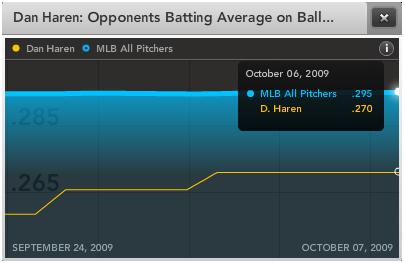
Haren gave up more than his share of home runs in the first half. His career high in home runs allowed is 31, and batters have already hit 19 against him this year. Combined with the expected regression in BABIP, Haren should post excellent numbers during the second half and the Bloomberg Sports computer thinks he could be a steal.
Luke Gregerson is a different kind of bull. He hasn’t gotten unlucky (his BABIP is in fact extremely low for the season at .204 and should come up) but he is undervalued in fantasy leagues nonetheless.
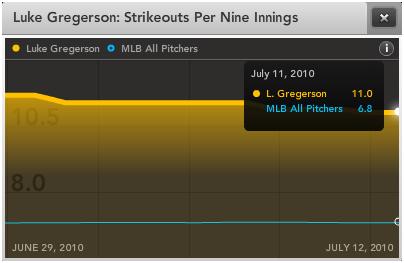
His phenomenal 11.0 K/9 and 0.73 WHIP can really buoy your fantasy pitching staff, a point previously discussed by Eriq Gardner on the Bloomberg Sports Blog (http://bloombergsports.mlblogs.com/wp-content/uploads/2010/07/pitchers74.jpgarchives/2010/03/true-value-of-great-relievers-unfinished.html).
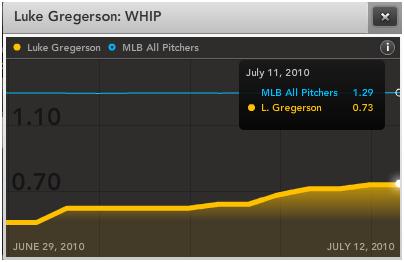
Gregerson had a rough end to the first half of the season, but his overall numbers were fantastic and he could contribute greatly from an often overlooked spot – middle reliever. Gregerson could also get some occasional save opportunities in the second half which would increase his value even more; in keeper leagues, he’s a good bet as the Padres’ future closer and Heath Bell‘s heir apparent.
The Man (Keith Hernandez) says:
“I like Jair Jurrjens, who has missed most of the first half of the season for the Braves. He is a pitcher who has a fine track record; has always been successful. The Braves were wise to keep him out almost the entire first half. I look for Jurrjens to really give the Braves a boost and have a terrific second half.”
“I love Francisco Cordero. The Reds are a ball club that can hit and he will have a lot of save opportunities. He’s a veteran, his ERA has been in the fours, but it won’t be at the end of the season. I’m putting my money with Francisco Cordero.”
Bears
The Machine (Bloomberg Sports) says:
Ubaldo Jimenez is one of the top pitchers in baseball. But the Bloomberg Sports computer doubts that he can continue to dominate at quite the same level. This makes him a sell-high candidate. His 8.0 K/9 leaves him just short of elite territory, while his .248 BABIP goes far in explaining his .197 batting average against and 2.20 ERA, which should regress in the second half.

Jimenez’s greatest value so far is in the wins category, where he leads the league with 15. Wins, however, are extremely difficult to predict, because they rely so much on run support and defensive support. The Bloomberg Sports computer only projects an 8-5 record for Jimenez in the second half of the season. That would still leave him with an astounding 23 wins for the year, but also far short of the 15 wins he compiled during the first half.

Matt Capps is another pitcher who has sterling statistics so far. After a rough season last year where he compiled a 5.80 ERA, he has that number down to 3.18. Combine that with a .358 BABIP in the first half (which should go down) and it might be somewhat puzzling that we have him as a bear for the second half.
Capps does not have an elite strikeout rate for a closer (7.4 K/9), which limits his value to some extent.

Saves depend a lot on the situation and are not directly under the player’s control. Bloomberg Sports sees Capps accruing only 12 more saves during the second half of the year, half of his first half tally.
Capps is another player who could find himself traded. If this happens, he could easily end up as a set-up on a contending team, in which case he could see even fewer saves. Sell high on Capps now before these questions catch up with him.
The Man (Kieth Hernandez) says:
“I’ll go with the Yankees Phil Hughes who got off to a fabulous start. He’s a curveball pitcher, but still very young. He’s still learning and this season is going to wear on him.”
“I’m [also] looking down at Florida with Leo Nunez, who has developed a new pitch, a change-up. He throws very hard, but has fallen in love with that change-up. This is one of the worst bullpens in baseball. I see the batters catching up with the change-up and giving Leo a lot of trouble.”
(Video) Ballpark Figures: Man vs. Machine – Outfielders
By Bloomberg Sports://
Man vs. Machine: Episode 4 — In a special from Bloomberg Sports’ Ballpark Figures, Mets legend Keith Hernandez sits down with Bloomberg Television’s Michele Steele and Bloomberg Sports Analyst Rob Shaw, to discuss the Fantasy Bulls and Bears for the second half of the season. In the fourth episode, the focus is on outfielders.
Today’s Position: Outfielders
Bulls
The Machine (Bloomberg Sports) says:
B.J. Upton is of the rare five-tool breed. Despite the raw talent, he is enduring a brutal season with a .230 average and .395 slugging percentage. Upton seems to be making a habit out of this low output, as last season he managed a .241 average with a .373 slugging percentage.
Even with his current struggles and meager production, Upton remains valuable in fantasy leagues thanks to his speed, with 25 swipes thus far. He also appears to be on the rebound lately, with a modest five-game hit streak that includes two extra-base hits.
The Man (Keith Hernandez) says:
I like Jason Bay of the New York Mets and not because I’m partial because I do broadcast for the Mets. I have seen this guy play the whole first half and he has not been able to do anything. His average is OK, but he has not been productive, he has not hit many home runs. This is a guy who hits 30 home runs. I know that Citi Field is a big park, but he is not going to have 12 home runs. I think he’s going to have a strong second half for the Mets.
Bears
The Machine (Bloomberg Sports) says:
Vernon Wells may have gotten off to a hot start, but he is bound to regress to so-so production in the second half of the season. In fact, the fall from grace has already started as Wells has had his average slip each month from .337 in April to .278 in May, to .240 in June, and currently a disastrous .094 in July.
At 31 years old, and riddled by injuries in recent years, Wells appears to be a case of diminishing returns. His last all-around solid season came in 2006 when he posted 32 home runs, 106 RBI, and a .303 average with 17 steals.
Despite the 19 home runs in the first half of the season, Wells’ recent decline leaves him with just four steals and a .265 average. Wells has also been known to struggle in the second half of the season. He entered the 2010 campaign with 112 career home runs prior to the All-Star break compared to just 80 after the mid-summer classic.
The Man (Keith Hernandez) says:
Corey Hart has had a phenomenal, off-the0charts first half. He’s been a power hitter before, but not like this. I can’t see him duplicating this over the second half, particularly for a team such as the Brewers that is going to fade in the second half.
 Bloomberg Sports
