Category: Dailies
Brian Fuentes Joins the Twins
By R.J. Anderson //
In one of the more sudden moves of the waiver deadline, the Los Angeles Angels of Anaheim sent Brian Fuentes to the Minnesota Twins for a player to be named later, or cash. This move can be taken as a somber admittance on Tony Reagins’ part that the Angels are out of the playoffs race as well as an admittance that maybe the Fuentes signing did not work out quite as planned – as if the Fernando Rodney signing last off-season didn’t hint at that conclusion.
Below is a chart showing the Angels’ and Twins’ respective bullpens with innings pitched, leverage index (a statistic which measures the amount of pressure based on the base/state and score matrices; the higher the leverage score the more pressure-packed situations entered), saves, and earned run average. Logically, Rodney will be the Angels’ permanent closer for now, but keep an eye on Kevin Jepsen and Jordan Walden. Both have the ability to rack up strikeouts and with youth (and contract status) on their side, the Angels could very well be nearing a return to the homegrown closer model they enjoyed with Troy Percival and Francisco Rodriguez.

As for the Twins, Fuentes is destined for a set-up role. One of the best relievers in the game between 2003-2008, Fuentes just never adjusted to the American League as his strikeout, walk, and home run rates went the wrong way. That last bit might not be a surprise given the extremity of Fuentes’ flyball tendencies. But when a pitcher is giving up more home runs after moving away from Coors Field, well, it’s not a good sign.
One item about Fuentes’ recent history that is a good sign for the Twins is his ability to get left-handers out. Southpaws are hitting .135 off Fuentes this year. In the past, he has shown the proficiency to shut same-handed batters down completely for long stretches. If the Twins stick to using him primarily but not exclusively versus lefties, then the odds are they will be happy with their acquisition. Matt Capps is still in line to record most of the saves for Ron Gardenhire’s club, although Fuentes will probably slip in one or two this month just based on matchups and rest days.
To sum this up: Hang onto Rodney for now with an eye towards Walden or Jepsen next season. If your league counts holds, grab Fuentes. Otherwise, the 2010 fantasy season implications for this move are limited.
For more on Brian Fuentes, Kevin Jepsen, Jordan Walden, and other late season additions, check out Bloomberg Sports’ Fantasy Kits.
Chris Perez Closing the Door in Cleveland
By Tommy Rancel //
Once upon a time, Chris Perez was regarded as the St. Louis Cardinals’ closer of the future. After a few seasons of inconsistency, a trade to Cleveland, and Kerry Wood‘s trade to the Yankees, Perez is finally closing games on a regular basis at the major league level.
Perez made his major league debut with the Cardinals in 2008 when he pitched 41 games out of the pen – compiling a 3.46 ERA with seven saves. Although he struggled with walks, he struck out more batters (42) than he had innings pitched (41.2) that year.
The right-hander would split the 2009 season between St. Louis and Cleveland after a mid-summer swap for Mark DeRosa. While his ERA jumped to 4.26, his strikeout rate improved from 9.04 strikeouts per nine innings (K/9) to 10.74 per nine. Walks were still a problem, but his BB/9 dropped slightly (4.33 in ’08, 4.27 in ’09). A flyball pitcher (his groundball rate was an extremely low 35.3% in 2009), Perez’s home run rate jumped to a shaky 1.26 per nine innings.
Perez was slated to start the 2010 season as the Tribe’s set-up man for Wood. When Wood went down with injury early in the season, Perez was temporarily given the closer’s role. Upon his return, Wood assumed control of the 9th inning. When Wood was traded to the Yankees at the July 31 deadline, Perez was once again given the title of closer.
Despite the uncertainty in roles, Perez has turned into a fairly reliable fantasy option at the back end of games. Overall, he has a 2.17 ERA over 49.2 innings. His K/9 has dropped to 8.34, no longer elite for a reliever, but still very playable. His BB/9 has dipped slightly to 3.99, a positive sign.
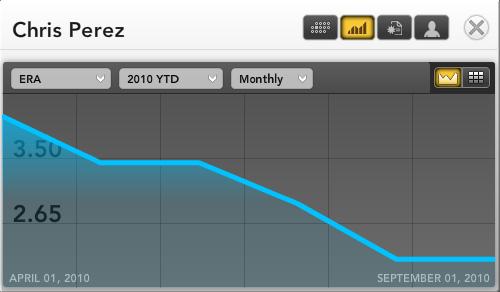
Speaking of progress, Perez has made his greatest strides over the past three months. Since June 1, Perez has struck out 29 batters while walking 12 in 31.2 innings. During the same time period, he has allowed just five earned runs (1.44 ERA). In the small sample size of August, he has not walked any batters while striking out nine and giving up just two runs.
Perez is certainly not the caliber of Mariano Rivera or Rafael Soriano. And his team is middle of the pack on their best day. That said, the low ERA, the stellar strikeout numbers, the unchallenged save opportunities, and the availability on most waiver wires make him an attractive option to deep AL only owners, and those looking for late-season closing options in mixed leagues.
Be warned, though: The biggest change in Perez’s results by far, though, has been a plunge
in his HR/9 rate. That’s down to a career-low 0.72 this season, and
seems to be mostly a product of tremendous luck: His HR/FB rate has
tumbled to 6.5% this season. A pitcher inducing a microscopic groundball rate of
30.3% (for comparison, Perez’s teammate Justin Masterson is generating a 62.3% GB rate) isn’t likely to avoid homers this successfully for long. Perez’s strand rate is a higher-than-average 83.6%, while his batting average on balls in play is just .254, well below the league average of about .300. His xFIP (a stat that runs along the same scale as ERA, but also adjusts for ballpark effects, aberrant home run rates, batted ball luck, and other factors) of 4.67 dwarfs his 2.17 ERA, and shows that luck has played a big role in his success.
Grab the saves, but don’t expect a Mariano-like ERA forever, especially if you’re in a keeper league.
For more on Chris Perez and other late season additions, check out Bloomberg Sports’ Fantasy Kits.
Players To Target For Specific Category Help

Like Jason Heyward? Why not Pedro Alvarez?
By Tommy Rancel //
While some fan bases prepare for a final month of playoff races, Pittsburgh Pirates fans are nearing the end of the franchise’s 18th consecutive losing season. This means the Pirates have been bottom dwellers for the entire life span of most high school seniors. However, we’re not here to focus on the past, but rather, the future. Namely, the future of Pedro Alvarez.
After years of misses at the top of the draft, the Pirates selected Alvarez in 2008. The former Vanderbilt teammate of Rays ace David Price is already a regular in the Pittsburgh lineup. Some questions remain about which side of the diamond he’ll play down the road, but for now, the 23-year-old the man at the hot corner for the Buccos.
Before signing his pro contract, Alvarez and his agent Scott Boras made plenty of headlines, In the end, though, he made his major league debut with relatively little hype. Despite lacking the media coverage of Jason Heyward (to say nothing of Stephen Strasburg) upon his debut, Alvarez has been one of this year’s most productive rookies, coming close to Heyward’s level of production.
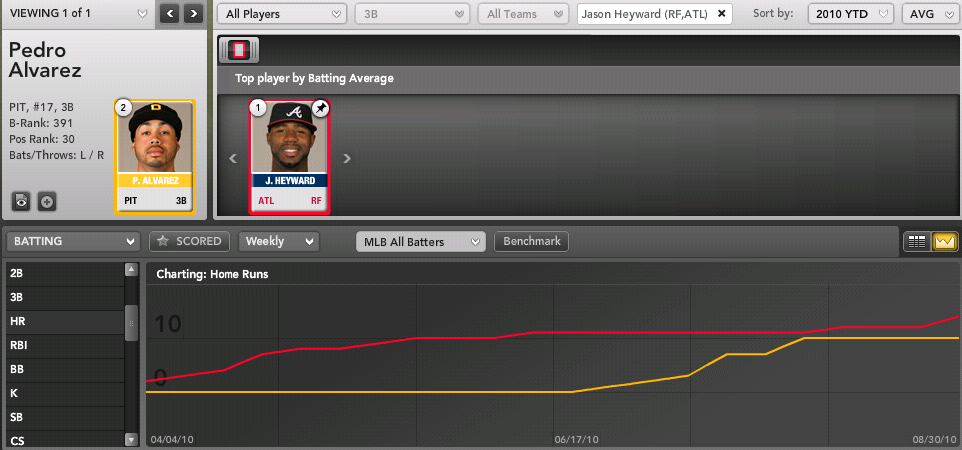
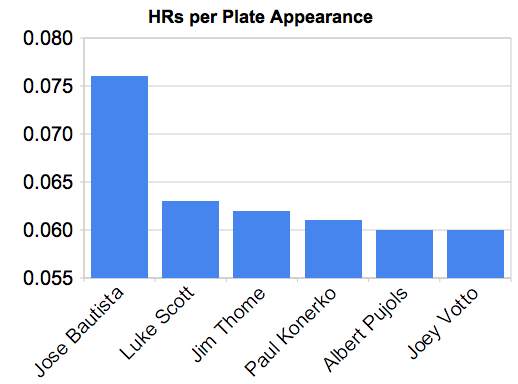
Heyward has hit 14 home runs in 105 games, while Alvarez has smashed 10 bombs in just 60 contests. The J-Hey Kid is currently hitting a home run once every 27 at-bats, while Alvarez is averaging one every 21 ABs.
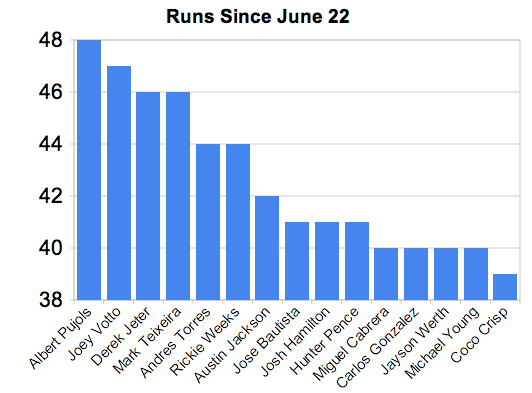
In addition to the home runs, Alvarez is doing an above-average job of driving in runs. The league average for driving in baserunners is 14%. Heyward is at 16%, Alvarez at 18%. An 18% baserunners scored rate rivals that of Evan Longoria, Albert Pujols, Josh Hamilton, and Miguel Cabrera. If we were to expand his home run and RBI rate over a full season, we would be talking nearly 30 home runs and 100 RBI.
Of course, we only have about one-fifth of the season remaining, so full-season projections mean little right now. On the other hand, Alvarez could add another 5-7 home runs, and drive in another 15-20 runs over the final six weeks of the season.
Going back to the Heyward comparison, Hotbox.com says the Braves rookie is owned in 77% of leagues – while Alvarez is owned is less than 5%. If you need some production down the stretch in a deep mixed or NL-only league, make sure you sneak Alvarez onto your roster before the playoffs start.
For more on Pedro Alvarez and other talented rookies flying under the radar, check out Bloomberg Sports’ fantasy kits.
(Video) Bloomberg Sports Ballpark Figures Stock Report
By Bloomberg Sports // Ballpark Figures: Stock Report— Bloomberg Television’s Michele Steele and Bloomberg Fantasy Sports Analyst Rob Shaw discuss the Bulls and the Bears in the world of Fantasy Baseball. Shaw tells us that even though Manny Ramirez is making headlines as he is likely to end up on waivers, he is a player to avoid thanks to his lack of power since the 50-game suspension last season. Next, Shaw is buying on the power potential of Wilson Betemit, but selling on his Royals teammate Yuniesky Betancourt, who struggles to get on base. Shaw finishes off with positive words for Indians prospect Michael Brantley, as well as former Indians outfielder Austin Kearns, who is riding a hot streak since joining the Bronx Bombers. For more fantasy insight visit us at twitter.com/bloombergsports as well as @MicheleSteele and @RobShawSports.
What is John Lackey Lacking?
by Eno Sarris //
With a career strikeout rate of about 7 per 9 innings, a career groundball rate of 43.6%, and only one season with an xFIP (a stat that runs along the same scale as ERA but strips out ballpark effects, bullpen support, batted-ball luck and other factors) under 3.88, John Lackey has lacked some of the traits that might point to a staff ace.
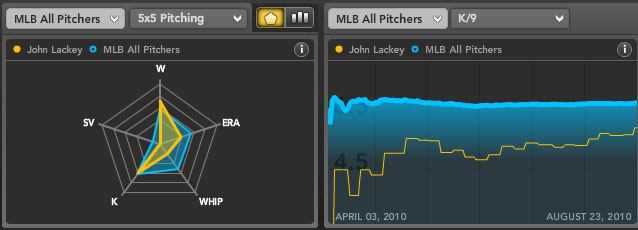 This year, the results have been worse. His xFIP has jumped to 4.51, the worst mark of his career. His strikeout rate (6.05 per nine) is the lowest it’s been since his rookie season eight years ago, and he’s walking more batters too (3.24 per 9 IP, vs. 2.70 career BB/9). The BABIP against (.328) is a little high, suggesting some bad luck, but that doesn’t explain the whole problem, as you can see from the Bloomberg Sports Fantasy Tools charts above.
Matthew Carruth wrote an interesting piece about Lackey on FanGraphs and pointed out an interesting quirk about his year. The money quote:
Lackey’s strikeout to walk rate versus righties was 3.0 in 2008, was
2.9 last year and is at 2.9 this season. Versus a lefty it has slipped
from 3.6 in 2008 and 3.1 in 2009 all the way to 1.3 in 2010. John Lackey
isn’t facing significantly more lefties this season than he did in the
past, but perhaps he should be given his collapse against them this
year.
Does this explain it all? After opening up the question on Twitter, I thought it was worth a little bit more exploration. One follower suggested the AL East and its competition level was mostly to blame. But that theory was handled by Carruth when he noted that Lackey faced batters with OPS figures of .755 and .766 the last two years – and .737 this year.
Another belief was that the parks in the AL East are much more conducive to offense than those in the AL West. According to StatCorner, the average park factor for home runs by left-handed batters in the AL West is 100 and for RHB it’s 92. In the AL East, those numbers are 104 and 108 respectively. Before we call it a day, though, it’s worth noting that Lackey has been pitching more often in Boston this year, so a comparison of Boston (83/95) to Anaheim (93/98) is more germane.
Another argument holds that Lackey’s giving up more doubles than usual due to the Green Monster. The park factor for doubles in Fenway is a sky-high 150 for left-handed batters (compared to 100 in Anaheim), so this seems plausible. Using this tool, you can even plot Lackey’s balls in play this year. Comparing his balls in play in Fenway to those in Anaheim does show this tendency. The light blue balls are singles and the dark blue dots are doubles. See the clusters out in left field? (Click on the picture for full size.)

Yes, it certainly looks like Lackey is giving up more doubles against left-handed batters, and that he is struggling against opposite-handed batters. We may have a chicken-and-egg situation with the balls in play versus lefties and his strikeout-to-walk ratio against lefties: Is he struggling to locate, or has he altered his approach against lefties after the Green Monster was rattled a few times?
We also have a battle of sample sizes at play here. Lackey’s career xFIP (expected FIP, with normalized
home run rates) against lefties is 4.13 in 852.2 innings. That’s a much
bigger sample size than his 4.82 xFIP in 92.1 innings this year. So have his skills legitimately eroded, or is this a fluke of small(er) sample size?
These questions are all difficult to answer definitively. Either way, even the most ardent Lackey-haters will have to admit that not every single one of his starts comes in Fenway, and that a pitcher who has had success against lefties in the past will probably find some way to adjust to his new surroundings. Still, fantasy managers in standard mixed leagues could do well to adjust their own Lackey strategy by avoiding lefty-heavy lineups in Fenway, just in case.
For more on John Lackey and other struggling starters, check out Bloomberg Sports’ Fantasy Tools.
(Video) Bloomberg Sports Ballpark Figures: Fantasy Headlines
By Bloomberg Sports // Ballpark Figures: Stock Report— Bloomberg Television’s Michele Steele and Bloomberg Fantasy Sports Analyst Rob Shaw discuss the news and notes in the fantasy baseball world. Shaw discusses the Rod Barajas deal to the Dodgers and what it means for Mets young catcher Josh Thole. Shaw then discusses the Marlins dealing of Cody Ross to the Giants and what it means for prospect Cameron Maybin. Other topics include the latest injury for Stephen Strasburg, the strong performance by Mike Minor, and finally, an incredible slugging performance by Jason Heyward.
What Stephen Strasburg Can Teach Fantasy Managers
by Eno Sarris //
The science surrounding young pitchers has never been set in stone. It’s come a long way since Rany Jazayerli first debuted Pitcher Abuse Points in 1998. The “discovery” that there was such a thing as too many pitches for a young pitcher then led to some new ways of thinking about young pitchers, pitch counts, and innings limits. Tom Verducci furthered the research with his own findings, called the Verducci Effect, that young starters that jumped more than 30 innings from year to year were more likely to end up injured.
Of course it’s not really that easy to just slap the 30-inning-increase limit on a young starter, especially when a team is in contention and under to pressure to win now. Plus, more rigorous research has not found such a hard cap to be completely useful for all pitchers. All innings are not created equal. More advanced studies look into pitches per inning and what types of pitches are more responsible for arm stress than others. The soft cap that many use in baseball is about 125% of the previous year’s innings total, but that number is more of a general benchmark than one that has the power of multiple research findings behind it.
The case of Stephen Strasburg offers a teaching moment. The upside of a pitcher like Strasburg made him a mid-round fantasy pick with the potential to return early-round value…provided he could put together enough major league innings. That was up for debate as his innings limits were reported to be around 140 to 150 IP – but no hard cap was reported in the media. Then this weekend, Strasburg grabbed his elbow and called the trainer to the mound, and his owners joined Nationals fans in a collective gasp.
 What Strasburg teaches us is not necessarily that young pitchers are more likely to hit the disabled list with elbow injuries. Rather, it’s
that young pitchers are less likely to amass critical innings in the latter half of the season. Whether from a cap or from injury, they are just more likely to have their rotation spot skipped late in the year, or to be shut down completely.
Consider all the pitchers that have had the shutdown rumor associated into their name so far this year. Jaime Garcia, Mat Latos, Jonathon Niese, Mike Leake, Mike Minor and Strasburg himself have all been the object of innings-limits speculation from their front offices and the media alike. All of these men are good young pitchers that are vital to their fantasy teams. Jeremy Hellickson dominated in his first four big league starts. For his efforts, he got sent back to A-ball. The best-case scenario for fantasy owners the rest of this season is that he get recalled for a few September innings of middle relief.
Garcia has 141.1 innings already, and his career high came in A-ball with 155 innings. He might be good for another 25 innings by that measure, but it’s complicated by his Tommy John surgery last year, and subsequent 33.2 innings pitched. His manager specifically said that the team was not going to limit its excellent young starter, but he also used 175 innings in his statement. With the Cards in the race (52% chance of making the playoffs according to Baseball Prospectus and their playoff odds), they’ll probably push the limit with Garcia.
Latos, on the other hand, is on a Padres team that is 95% likely to make the postseason, and they’ll need him in October. At 142.2 IP, he’s already well past last year’s 123 IP total and just a couple starts away from a soft cap situation. Since the Padres are far enough ahead, expect to see his starts skipped often down the stretch. Minor, on a Braves team with a 92% chance of making the playoffs, has already had his starts skipped. His 138.1 innings so far this year are well beyond the 110.2 innings he accumulated at Vanderbilt in 2009.
Leake and Niese are more likely to be shut down. Leake racked up 161 IP between Arizona State and the Arizona Fall League last year, but with his recent struggles the team demoted him to the bullpen at 138 innings anyway. The Mets have already openly contemplated shutting him down. They also have a 0.5% chance of making the playoffs, meaning there’s no point risking it with their young right-hander.
Innings caps are no reason to avoid young pitchers altogether, but they do represent another risk that isn’t inherent with veteran pitchers. Next year, when it comes time to decide between two pitchers of similar ilk, it’s worth giving the veteran a slight nudge forward if late-year innings will be crucial for your team. And if you reach the All-Star break with a hot hand like Strasburg or Leake in your fantasy rotation, start aggressively shopping him for a trade.
For more on Stephen Strasburg, Jaime Garcia, Mat Latos and other young pitchers, check out Bloomberg Sports’ Fantasy Tools.
Is Miguel Tejada Back?
By R.J. Anderson //
In late July, the Baltimore Orioles traded Miguel Tejada to the San Diego Padres. He’s hit .295/.360/.410 since, sparking endless stories on how rejuvenated and grateful the 2002 AL MVP is to be involved in a playoff push. The same media that comes down on Hanley Ramirez and Matt Kemp for single-play gaffes has allowed Tejada to skate by on, presumably, giving lackluster effort for nearly 100 games.
More amazing is how people are so quick to buy that Tejada is back to being an above-average player. Tejada is hitting for marginally more power than he was in Baltimore (.115 ISO to .092) and while he’s walking more often (9.3% versus 3.5%), he’s also striking out more (from 9.7% to 14.1%). Tejada has not sustained a walk rate over 9% since 2000 and that includes playing on good Oakland teams and bad Astros teams alike. The odds of him doing it with the Padres over any length of time are low.
Besides the walk rate, an increased batting average on balls in play is helping to buoy his line. In Baltimore, 28.2% of Tejada’s balls in play turned into hits; that number has spiked 33.3% have with the Padres (league average is usually around 30%). Tejada is actually hitting fewer grounders and more balls in the air with San Diego, which usually isn’t a great combination for improved BABIP, but he has improved his infield hit rate. Tejada had 10 with the Orioles, he’s got three with San Diego already. Perhaps he really is a man full of joy:

Or not.
If that seems like a lot of negativity around Tejada’s future prospects, well, it is. Little optimism exists for a 36-year-old with a line of .292/.325/.417 over the past three seasons, moving to an extreme pitcher’s park no less. Nonetheless, being a shortstop again adds some value to his recent hot streak and moving from the American League East to the National League West could boost his player’s offensive value.
If you need a shortstop at this point in the season then you probably won’t have an active team for much longer, so add Tejada for nostalgia’s sake if you want because he’s available in more than 30% of ESPN leagues. If you’re a standard mixed league of 12 teams or less, though, pick up someone like Oakland’s Cliff Pennington instead.
For more on Miguel Tejada and other former MVPs in baseball, check out Bloomberg Sports’ Fantasy Tools.
D-Lee in The A-T-L
By R.J. Anderson //
With only six weeks remaining, the National League East race is heating up. The Atlanta Braves and Philadelphia Phillies are the only teams with realistic shots at hooking the title, but both have endured a rash of injuries in recent weeks. But while Ryan Howard and Chase Utley are now back for the Phillies, the Braves have lost Chipper Jones for the season and Troy Glaus is on the disabled list.
Counting on health with Jones and Glaus on the corners is like playing Russian roulette with a full clip. The Braves have responded by adding long-time Chicago Cubs first baseman Derrek Lee. A pending free agent, the Cubs received more value than they should have for Lee, but that aspect isn’t nearly as important for the short-term as what the Braves received.
Glaus owners in particular should be looking at adding Lee, as he’s still available in 6.5% of ESPN leagues. Lee’s seasonal line is a disappointing .247/.333/.410 with 16 homers and 65 runs batted in. One of the more telling differences between Lee’s magnificent 2009 season, in which he hit .306 with 35 homers and 91 RBI, and his 2010 campaign, is his strikeout rate. In about 100 fewer at-bats, Lee has struck out just five fewer times than he did all of last year. The soon-to-be 35-year-old is striking out at his highest rate since leaving the Marlins in 2003.
Lee is still walking and his non-home run power (22 doubles) is in line with 2006-2008 totals. The raisin in the sun is Lee’s batting average on balls in play. 29.1% of Lee’s balls in play are turning into hits, marking a career-low dating back to 1999 and more than 30 points below his previous low over the past five years. Batted ball data suggest a bit of a change in how Lee is hitting the ball, with a slight uptick in grounders over last year and a steady drop in flyballs. Lee is getting slightly fewer infield hits, but that comes with fewer infield flies too, a worthy trade-off in the big picture.

Graphic courtesy of Baseball-Reference
Being dropped into a pennant race could revitalize Lee’s spirit (and he has heated up lately) but do not expect him to hit like he did last year. Lee’s 2008 line of .291/.361/.462 line is probably a good best-case scenario for the last six weeks of 2010.
—
As for the other significant recent waiver acquisition, Pedro Feliz with the Cardinals, don’t bother unless you play in a fantasy league where the goal is to field the worst players. In that case, he is a keeper.
For more on Derrek Lee, Pedro Feliz, and other late-season adds, check out Bloomberg Sports’ Fantasy Kits.
 Bloomberg Sports