Tagged: MLB
Orioles Add Derrek Lee
By R.J. Anderson //
The Baltimore Orioles’ infield has received a makeover this offseason. Trades for Mark Reynolds and J.J. Hardy filled the holes on the left side, while the latest move – signing Derrek Lee – completes an infield around the venerable Brian Roberts. Lee comes at a steep price (the contract carries a max value of $10 million) despite hitting only .260/.347/.428 last season. Can a 35-year-old Lee recover from a down season in the game’s toughest division?
Perhaps burdened by an underachieving team, Lee struggled with the Chicago Cubs to the tune of a .251/.335/.416 line. The Cubs traded Lee to the playoff-surging Atlanta Braves following an injury to Troy Glaus in August and immediately saw his line shoot up: Lee hit .287/.384/.465 in 39 games worth of action with Atlanta. While the success with the Braves is encouraging relative to his Cubs’ struggles, it is not a sure sign that Lee is back. A more encouraging note: from 2007-2009, Lee hit .304/.384/.515 and averaged 26 home runs a season.
Beyond the surface, the big differences from Lee’s 2010 and prior seasons came down to strikeouts and batting average on balls in play. Lee fanned 17.4% of the time during his glory days, as opposed to 21.4% in 2010. He also saw his BABIP drop from .340 to .309. The decrease in batted ball success is at least partially responsible for Lee’s ISO dipping below .170 for the first time in his career (excluding his 236 plate appearance stint in 1999).
A sharp decline in BABIP can usually be waved off as either bad luck or random fluctuation. There seem to be larger concerns at work with Lee, though, as scouts have questioned his bat speed (according to ESPN’s Keith Law). Lee’s new division features left-handers with stellar fastballs – CC Sabathia, Jon Lester, and David Price for starters – meaning that Lee owning a platoon advantage may not be enough to find success.
As such, Lee becomes someone to watch on draft day. He’s worth a shot at the end of a standard mixed league draft, or a little earlier in shallower mixed leagues and AL-only formats.
Milwaukee Brewers Upgrade Bullpen, Sign Takashi Saito
By Tommy Rancel
The 2010 nightmare of Trevor Hoffman was not enough to scare off the Milwaukee Brewers from signing another 40-year-old reliever this off-season – this time Takashi Saito. In terms of performance, Saito is a much safer signing, since the righty has a more recent track record of success than Hoffman did, having been one of the best relief pitchers since coming to the United States in 2006.
After spending three seasons with the Los Angeles Dodgers (much of it as a closer) Saito has spent the past two seasons as a set-up man in Boston and then Atlanta. Regardless of his role, he has been dominant over those five seasons. In fact, he is just one of six relievers in baseball to throw at least 250 innings with an ERA below 2.25 since 2006. You may recognize the other names on that list: Joakim Soria, Mariano Rivera, Joe Nathan, and the two men he has set up for recently: Jonathan Papelbon and Billy Wagner.Of those names, only Saito and Wagner have done so with a strikeout rate of 11.0 or greater per nine innings.
Saito features a fastball, slider, and a curveball. He induces more swings and misses than league average with all three pitches, fueling his fantastic strikeout rate. He has also excelled at limiting walks and home runs allowed.
The one negative on Takashi Saito is health. Although he has pitched at least 45 games and topped 47 innings in each of his five seasons, he has dealt with a variety of ailments, including several arm issues. As he advances in age, those concerns will not go away; however, he did throw a respectable 99.2 innings over the past two years.
Saito won’t have the closer job to start, which severely limits his fantasy value in standard mixed leagues, even with his strong ratios. That said, if something should happen to incumbent closer John Axford, be it injury or ineffectiveness, Saito is the most likely replacement for saves.
Because of his fantastic peripheral stats, low ERA, and status as the Brewers’ plan B, Saito is still worth either a reserve-round pick in standard 12-team mixed leagues, and a slightly higher draft slot in deeper mixed and NL-only leagues. If your league counts holds, Saito’s value rises considerably.
Chicago White Sox (Finally) Acquire Adam Dunn
By Tommy Rancel //
Following what seems like years of courting by the Chicago White Sox, as well as years of resisting becoming a designated hitter in the American League, Adam Dunn signed a four-year deal, $56 million to slug on Chicago’s South Side. Whether it was a change of heart or the $56 million being waved in front of his 31-year-old eyes, Dunn now says he’s not only willing to DH, but play whatever position the White Sox ask of him.
Dunn could be asked to use his butcher’s knife glove at first base along with his time at DH. Luckily for fantasy owners, his defense is not a factor. He’ll keep his first base eligibility for 2011 at least; his offensive game is so strong that he’s well worth a spot in mixed league lineups even if he eventually loses that eligibility.
In seasons past, Dunn has been one of the more underrated hitters in the game. This is largely because his batting average has been mediocre (or worse), despite the many home runs launched from his bat. Dunn also walks a lot and strikeouts a ton. The walks are underrated in many circles and the strikeouts are seen as a huge negative to some. Still, the total package is a valuable one, in fantasy and even more so in real life.
The Big Donkey has hit at least 38 home runs in each of the last seven seasons. He is the only major leaguer who can say that. Over those seven seasons, he’s averaged 40 bombs a season with 101 runs driven in. Even though he is as slow as his nickname would suggest, his fantastic on-base skills (.381 career OBP), frequent homers and underrated durability (he’s missed 10 games or less in each of the past seven seasons) have helped him average 94 runs scored a year since 2004.
Also working in Dunn’s favor this season will be a switch to one of the more hitter-friendly parks in the AL. His new home, U.S. Cellular Field, rated as the top home run ballpark in 2010. Nationals Park ranked 15th last season.
On the other hand, there are some concerns about Dunn going into next season. He will be playing in the AL for the first time and will also be DHing for the first time on a regular basis. Add in the fact that old-player skills (walks, strikeouts, home runs) do not tend to age gracefully, and there are some concerns about a Pat Burrell-like slide.
Still, we must give Dunn the benefit of the doubt. His durability and colossal power – in conjunction with a move to “the Cell” – put him among the game’s top projected sluggers in 2011. His position in the field and lineup are to be determined; however his status as a top fantasy option remains intact as a member of the Chicago White Sox.
Carlos Pena, First Base Bargain?
By Tommy Rancel //
Despite being the Tampa Bay Rays all-time home run leader, Carlos Pena was the second-most important Rays player to sign with a new team at the winter meetings. Carl Crawford got the big bucks from the Boston Red Sox, and Pena is looking to make a big comeback with the Chicago Cubs in 2011.
A crown jewel in the Andrew Friedman collection, Pena went from first-round bust to MVP candidate in the span of one season. In his first year (2007) with the (Devil) Rays, the first baseman smashed 46 home runs and drove in 121 runs – both single-season franchise records. Unsurprisingly, he was unable to top those numbers in any of the next three seasons, but still managed an impressive OPS of .884 in his time with the Rays.
Pena became the franchise all-time home run leader this past season. His 144 home runs in a Rays uniform also rank as the sixth highest total in baseball since 2007.
For all the good done – on and off the field – during his time with the Rays, Pena ended his career with the Rays on a down note. Just three years removed from his breakout campaign, Los hit just .195/.325/.409 in 2010.
Aside from the massive number of strikeouts which are typical for a three outcome hitter (home runs, walks, and strikeouts), groundball outs were also a problem for Pena this past season. His 44.9% groundball rate was his highest total in any full-season.
The last thing you want from primary home run hitter is nearly half the balls he puts in play staying on the ground. His slash line (AVG/OBP/SLG) on grounders was an abysmal .137/.137/.151. The .137 BA represents the second-lowest average on groundballs (min. 100 PA) in the majors, owing to Pena’s lack of speed, and teams shifting on him to prevent right-side grounders from scooting through the infield.
Though he may be on the downside of his career, Pena’s power is still a threat. Aside from the terrible slash line, the strikeouts, and high number of grounders, Pena still managed to hit 28 home runs last year. Also consider, he is moving from a below-average hitter’s park for left-handed batters to one of the friendlier parks for lefties. According to statcorner.com, Tropicana Field had a home run park factor of 89 for LHB (neutral is 100). Wrigley Field, on the other hand, had a park factor of 119. NL Central pitching is likely to be easier to handle than that seen in the AL East too.
After whiffing (literally) on his chance of a big payday this off-season, Pena gets another chance with this one-year, $10 million deal with the Cubs. With contract motivation, a ton of natural power, a home run friendly environment, and even reuniting with hitting guru Rudy Jaramillo, Pena could be poised for another 30-plus home run campaign.
For fantasy owners who don’t want to pay premium prices for a first baseman, Pena could be a good sleeper. At a stacked position, and coming of a down year, he could get lost in the shuffle in some leagues. While Adrian Gonzalez, Albert Pujols, and Joey Votto go early, you can focus on a weaker position (say, shortstop Troy Tulowitzki) in the first few rounds and target Pena as a mid-to-late-round selection in mixed leagues.
Miguel Tejada Heads Back To NorCal
By Tommy Rancel //
San Francisco Giants’ general manager Brian Sabean has a type: aging middle infielders. From Omar Vizquel and Ray Durham to Juan Uribe and Edgar Renteria, Sabean always seems to find a past-his-prime infielder that puts a little twinkle in his eye. His latest move follows that blueprint: the signing 36-year-old Miguel Tejada to a one-year deal worth $6.5 million.
Tejada is familiar with the Bay Area, having spent the first seven years of his career with the Oakland Athletics. Unfortunately, the production he put up as a member of the A’s is just a memory.
In recent seasons, he has transformed from a slugging run-producer to a contact-driven, league-average hitter with a little pop left in the bat. From 1998 to 2006, Tejada averaged 26 home runs and 105 RBI a year. Since then, he’s averaged just 15 home runs and 76 RBI per year.
On the other hand, 15 home runs, 75 RBI, and 80 runs scored would be a pretty solid season, given the weak current group of MLB shortstops. The only two players to top those marks in 2010 were Hanley Ramirez and Troy Tulowitzki – the two best offensive shortstops in the game.
Also working in Tejada’s favor is durability. He’s averaged 151 games played over the past four years, while averaging more 40 extra-base hits a season. The question for the Giants is, can he handle 140 games at shortstop? But as a fantasy owner, he’s also earned his SS eligibility for 2011.
After the top tier of Ramirez, Tulowitzki, and the second level of Stephen Drew, Starlin Castro, and Jose Reyes, the remaining NL options have as many – if not more – offensive question marks than Tejada in 2011.
If you are unable to land one of the top guys early on draft day, sit back and wait. Odds are the latest Sabean Special will be available later as a potential starter. The risk of Tejada completely deteriorating is real, but the minimal cost in terms of a draft pick with the likelihood of league average production should be worth it in NL-only leagues; his counting stat potential even makes him a decent choice at the end of a mixed-league draft.
Jon Garland Returns to Los Angeles Dodgers
By Tommy Rancel //
After something of a career year in San Diego, Jon Garland has agreed to a one-year, $5 million dollar deal (plus performance bonuses and a vesting option) with the team he pitched for in the second half of the 2009 season, the Los Angeles Dodgers. In six starts in Dodger blue, he went 3-2 with a 2.72 ERA. While pitching for the Padres in 2010, he went 14-12 with a career-best 3.47 ERA in 33 starts.
In addition to the stellar ERA, Garland posted his best strikeout rate to date – although 6.12 strikeouts per nine innings (K/9) aren’t much to brag about. He also turned in his best groundball rate with 52% of the balls put in play against him burning worms.
That said, defensive independent metrics, which strip luck and defense from a pitcher’s performance, suggest Garland’s true talent level in 2010 was much closer to his 4.32 career ERA than the sub 3.50 he posted. This can be attributed to a lower-than-normal batting average on balls in play (BABIP) and pitching in Petco Park for more than half of his innings total.
In 2010, Garland’s BABIP (.267) was 35 points lower than the league average (.302). Most often the best indicator of what a pitcher’s BABIP should be is his career average. Those numbers show Garland’s mark is usually below the league’s average; however, his career .288 BABIP is still 21 points above his 2010 showing.
When looking at home/road splits, we see that Garland is the latest pitcher to rebound thanks to the “Petco Factor.” Easily one of the most pitcher-friendly parks in baseball, several pitchers have gone to San Diego for a numbers boost. Here are Garland’s home/road splits for 2010:
Home: 18 starts, 7-5, 3.00 ERA, .259 BABIP, 0.80 HR/9
Road: 15 starts, 7-7, 4.01 ERA, .277 BABIP, 1.08 HR/9
As you can see, his ERA differential was more than one full run. Closer to career levels, he allowed more balls to drop in play and more to carry over the fence on the road. The good news for Garland is Dodger Stadium is also pitcher-friendly park. In terms of ESPN’s park factors, the stadium has finished in the bottom half of the league for home runs allowed over the past three seasons.
Also working in Garland’s favor are consistency and durability. Over the past nine seasons, he has won at least 10 games and pitched more than 190 innings in each. The only other pitcher in baseball who can say he’s done the same is Garland’s former White Sox teammate Mark Buehrle.
Looking at everything in play, Garland is probably the most predictable fantasy pitcher in the National League. Expect a double-digit win total, nearly 200 innings, and an ERA around the league average. He should regress from his 2010 numbers, but landing in Dodger Stadium should soften the blow. He will start the season as Los Angeles’ fifth starter; consider him a fourth or fifth starter in NL-only leagues, and the last man on your staff in standard 12-team mixed leagues.
For more on Jon Garland, check out Bloomberg Sports’ Front Office. For more coverage of the Dodgers’ rotation check out this article on Ted Lilly and this one on Hiroki Kuroda.
Detroit Tigers Sign Victor Martinez To 4-yr, $50 Million Deal
By Tommy Rancel //
The Detroit Tigers continue to be the most aggressive team during the early stages of the off-season hot stove. Earlier today, they signed C/1B/DH Victor Martinez to a four-year deal worth a reported $50 million dollars. In addition to the money, the Tigers also surrendered their first-round pick to the Boston Red Sox because of Martinez’s Type-A status.
Martinez will be 32 by opening day 2011; however, he is one of the best hitting catchers in baseball. A career .300/.369/.469 hitter, he hit .302/.351/.493 in his first full season with the Red Sox. His patience at the plate dropped slightly, but that coincided with an increase in power numbers.
While it is unlikely he is still an everyday catcher at the end of this contract, one would assume the Tigers’ plan is to have the bulk of his playing time from behind the plate in 2011. They have the AL MVP runner-up in Miguel Cabrera at first base and paying Martinez to DH doesn’t make sense – at least at this point in his career. Sure, he’ll spell Cabrera at times and take a few hacks at DH, but he should be prepared to catch 100+ times in 2011.
This is good news for fantasy owners as Martinez will remain a top player at the position. Along with Joe Mauer and NL Rookie of the Year Buster Posey, Martinez provides a blend of average and power that is a rarity for the position.
There is some concern about him leaving the cozy dimensions of Fenway Park for the spacious Comerica Park; however, it shouldn’t be a huge factor. It is true Fenway is a haven for doubles hitters. In fact, 23 of Martinez’s 32 doubles in 2010 came at home, but the vast outfield in Detroit should lead to its fair share of extra bases as well. According to ESPN’s park factors, Detroit’s park was actually more home run friendly than Boston’s; another good sign for Martinez, who split his 20 home runs equally on the home and road.
The concerns of moving positions shouldn’t be a factor this season. And the change in ballparks isn’t as extreme as one might think. Because of his ability to hit for an average around .300 with upwards of 50 extra-base hits a season as a catcher, Martinez should once again be a primary target of fantasy owners in 2011.
For more on Victor Martinez and the catcher position, check out Bloomberg Sports’ Front Office.
Underrated Hiroki Kuroda Re-Signs With Los Angeles Dodgers
By Tommy Rancel //
Following in the footsteps of fellow Dodgers’ starter Ted Lilly, Hiroki Kuroda chose the comfort of Southern California instead of the uncertainty of the open market. After entertaining the idea of returning to his native Japan, the 35-year-old will remain in the States for at least one more season.
The deal itself looks like a win-win for both sides. Kuroda gets $12 million dollars for one year of work. And the end of the season, he can re-assess his options. For the Dodgers, they get another year of his services at fair market value.
Although Kuroda has a sub .500 record (28-30) in the Major Leagues, he has maintained an above-average ERA. In nearly 500 innings pitched, his career ERA is a sparking 3.60. In fact, he is one of just 13 National League pitchers with a ERA of 3.60 or below (min. 490 innings) over the past three years. Other names include Johan Santana, Tim Lincecum, and Dodger teammate Chad Billingsley amongst others. Looking at fielding independent metrics, they support the fact that Kuroda is a 3.5-3.75 ERA starter.
Despite being in his mid-30s, Baseball Info Solutions clocked his average fastball at just over 92 miles per hour. In addition to his regular heater, Kuroda throws a split-fingered fastball, a slider, and has briefly experimented with a curveball. The fastball/slider combo has combined to give him groundball rate of over 50% for his career.
In his three seasons with the Dodgers, his strikeout rates have proven to be largely average (6.56 K/9 career), but he improved slightly this past season (7.29 K/9). He also shows good control (2.06 BB/9 career) and has done a fantastic job of keeping the ball in the yard (0.72 HR/9).
Of course, with age comes concern about durability. Kuroda has not topped 200 innings in a major league season; however he did come close with 196.1 in 2010. He also spent a combined 76 days on the disabled list in 2009 and battled shoulder tendinitis in 2008.
Like his re-signing, Hiroki Kuroda’s efforts have largely gone unnoticed. That said, if you’re looking for the potential for double-digit wins with an above-average ERA at the SP3 spot don’t forget the name.
For more on Hiroki Kuroda and the Los Angeles Dodgers, check out Bloomberg Sports’ Front Office.
Report: John Bucks To Sign Three-Year Deal With Marlins
By Tommy Rancel //
Jose Bautista and his 54 home runs grabbed the headlines as leader of a powerful Toronto Blue Jays lineup that smashed 257 home runs. Counting Bautista, seven Jays hit at least 20 home runs. This doesn’t include Alex Gonzalez‘s 17 home runs in 85 games with Toronto and the six he added with the Braves. On the other hand, this does include catcher John Buck who hit a career-high 20 home runs.
After his power-filled season north of the border, it is being reported that Buck is close to signing a three-year deal with the Florida Marlins worth between $16-18 million. Before we get into the fantasy aspect, let’s look at the deal.
Like most teams, the Marlins were looking to upgrade their catcher situation. Ronny Paulino served as the teams’ primary catcher before being suspended 50 games after testing positive for a performance-enhancing substance. Whatever he took didn’t work as he hit just .259/.311/.384 in 91 games. From there names like John Baker, Brad Davis, and Brett Hayes received playing time, but none did anything to warrant more.
In Buck, the Marlins are getting a player whose profile is easy to project. Despite his .281 batting average this past season (inflated by a batting average on balls in play of .335 compared to a .289 career average), Buck is more of a .250 hitter. He does not show much patience at the plate (6.5% career walk rate) and is a hacker. In addition to striking out more than 26% of the time, he swings at nearly 30% of pitches outside of the strike zone. In the last two seasons, he whiffed at more than 16% of the pitches thrown to him.
The one positive in Buck’s game is his power. That said, he is not Mike Piazza in his prime. As mentioned, he hit a career-best 20 home runs this past season. His previous high came in 2007 when he belted 18 bombs as a member of the Royals.
Like a lot of Blue Jays, he enjoyed a home-run friendly Rogers Centre. The former Sky Dome had a home run park factor of 116 for right-handed batters (average is 100). The park he now calls home had a park factor of 95 for right-handed batters. The good news is he hit 10 home runs on the road.
With a similar player in Ramon Hernandez signing a one-year, $3 million deal on Monday, this looks like a gross overpay by the Marlins. In terms of fantasy impact, Buck was not a top 10 catcher going into 2011, but he was a decent backup option in the right situation. When you consider him leaving the confines of Toronto as well as the potential for regression in batting average, he is now closer to the bottom 10 than the top.
He should still hit for decent power numbers in Miami – sacrificing some home runs for doubles – and could give you some value in a deep league, but do not take the bait and overpay like the Marlins.
For more on John Buck and the Florida Marlins, check out Bloomberg Sports’ Front Office.
Logan Morrison Takes His Talents to South Beach
By Tommy Rancel //
Although he has the size (6’3″/235) and he plays the positions (first base and corner outfield), Logan Morrison‘s game does not match his size. Still, that hasn’t stopped Morrison from being rated as a top-20 prospect in all of baseball by Baseball America for the past two years.
Morrison, 23, spent most of his minor league career as a first baseman. However, with Gaby Sanchez‘s solid play at first and Chris Coghlan‘s injury leaving a void in left field, Morrison has found a new home with the Marlins – at least temporarily. While his defensive responsibilities have shifted, Morrison is still doing what he does best – hit and get on base.
The Marlins rookie is hitting .310/.427/.492 in 225 plate appearances since getting called up from the minor leagues. With that said, his .310 batting average is largely fueled by an unsustainable .378 BABIP (batting average on balls in play), and he is not likely to carry a .919 OPS over 600 a full season. However, don’t mistake this hot start as just a fluke.
In more than 1900 minor league at-bats, Morrison hit .292/.383/.465. That’s a far cry from his current slash line, but still above-average. As mentioned, Morrison has the look of a hulk-smashing home run hitter, but that’s not a major part of his game – at least not yet. On the other hand, he has shown some solid doubles power, including 38 in 130 games at A-ball in 2008.
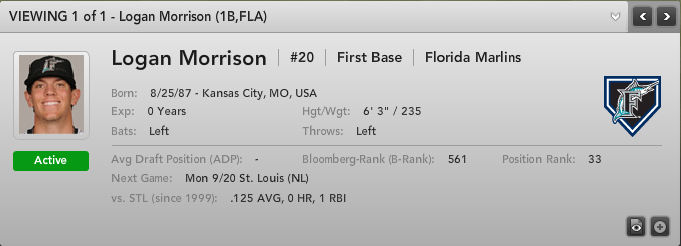
Currently, Morrison has a .182 ISO (Isolated Power – slugging percentage minus batting average) despite having just two major league home runs. Lacking the power to put the ball over the wall, he is simply spraying it all over the field. He has already racked up 18 doubles and five triples this year.
In addition to the gap power, Morrison is showing a very good batting eye, with a 16% walk rate. He is striking out 19.8% of the time, but his 20.7% O-Swing (swings at pitches outside of the strike zone) and 6.5% swinging strike percentage show further signs of a solid batting eye.
Because of his extra-base hits and the favorable walk rate, Morrison has already scored 36 runs despite playing in just 48 games.
While his red-hot slash line is not likely to be reproduced in the near future, Morrison looks ready for an everyday spot in the Marlins lineup next season. Whether it comes as a first baseman or an outfielder is unknown. But don’t let that stop you from picking him up right now in NL-only and mixed keeper leagues.
For more on Logan Morrison and potential NL keepers, check out Bloomberg Sports’ Fantasy Kits
 Bloomberg Sports