Gordon Beckham Position Switch Adds Value to Second Base

By Tommy Rancel

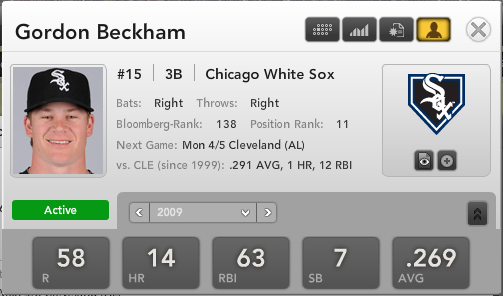
It didn’t take long for Gordon Beckham to prove to the White Sox that he was ready for the major leagues in 2009. The eighth-overall pick in the 2008 draft (second Beckham overall, behind Tim) made his major league debut just 364 days after being drafted.

The University of Georgia product didn’t disappoint, as he hit .269/.347/.460 (AVG/OBP/SLG) with 14 home runs and 63 RBI in 103 games. He was named American League Rookie of the Year by The Sporting News and the Major League Baseball Players Association.


beck.png

Beckham, a shortstop in college, played third base exclusively at the major league level. If we stretched his 14 home runs and 63 RBI over a 162-game schedule, we get a projected total of 22 home runs and 99 RBI. Those numbers are not bad for a third baseman, but fall well below the top producers at the position like Evan Longoria and Alex Rodriguez.

With the acquisition of Mark Teahen this off-season, Beckham will try a new position in the majors; second base. If we take those same 22 home runs and 99 RBI, and apply them to second base, only Aaron Hill of the Blue Jays topped those numbers at the AL keystone position last season.

Looking back at some batted-ball data from 2009, we can get a feel for Beckham in 2010. Among numbers we like to look at as “fluke” stats, namely batting average on balls in play (BABIP) and home run-to-fly ball ratio (HR/FB), Beckham scores well. His .290 BABIP was slightly below average, and could jump over .300 with more line drives (16.6% line drives last year). This would bring his batting average closer to the .280 mark.

Beckham will play a full season at U.S. Cellular Field in 2010. The home of the White Sox had the fourth-highest home run rate in 2009. Because of this, it’s possible that Beckham’s HR/FB rate could move up, placing him among the league’s top power-hitting second basemen.

Another good sign from Beckham was his patience at the plate. He struck out 17.2% of the time last season, but he also walked nearly 9.5% of the time. For reference, Evan Longoria walked 9.1% of the time as a rookie, but struck out 27.2%. With a sharper batting eye, Beckham could increase his walk total, bump up his OBP, and create more run-scoring opportunities. 

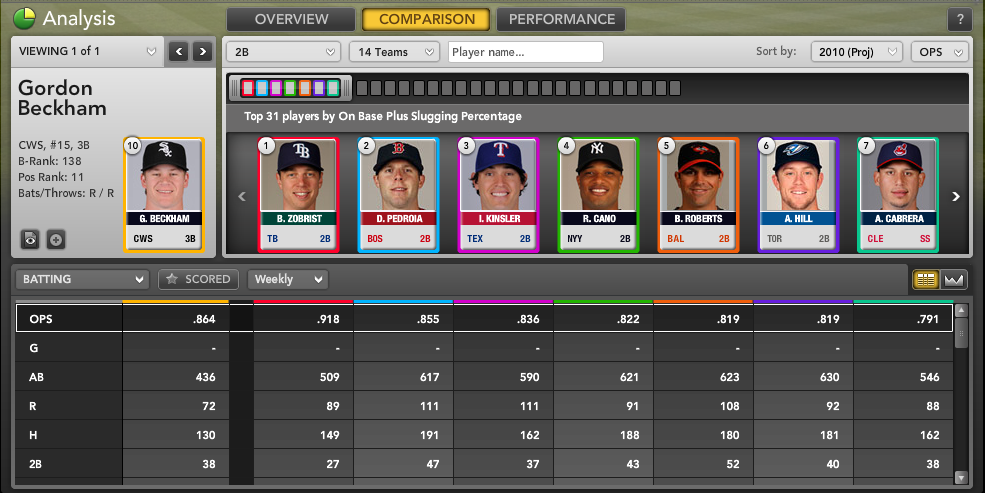
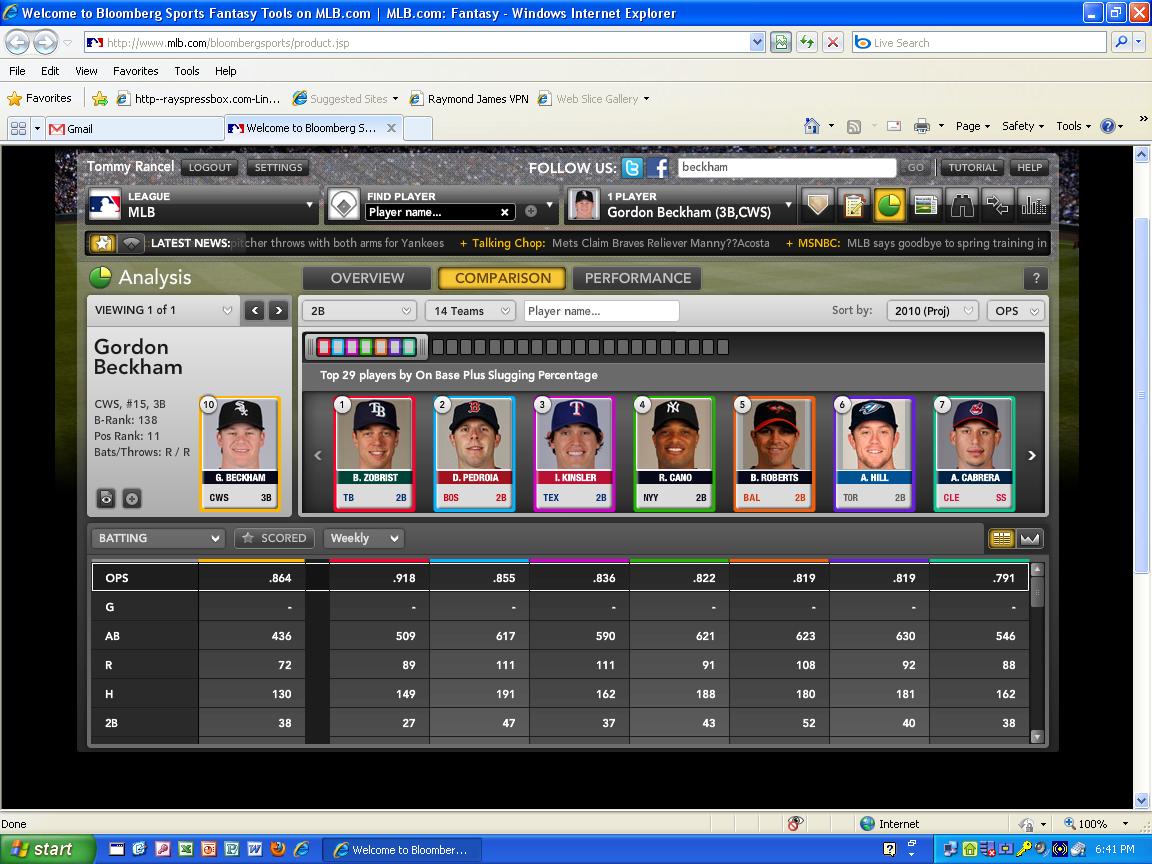
Beckham’s average draft position (ADP) was 88.2 before Opening Day, which would rank sixth among AL second basemen behind Ian Kinsler, Brian Roberts, Dustin Pedroia, Ben Zobrist and Robinson Cano. He’ll need to meet your league’s in-season eligibility standards first – but that’s impressive company. Looking at Bloomberg Sports’ projections, Beckham’s .864 OPS in 2010 is projected as second-highest figure for AL second basemen.

becks2b.PNG
Because he played third base last season, Beckham will carry multiple position eligibility that Kinsler, Roberts, Pedroia, Cano, and Hill don’t have. Though your draft has ended and the season has begun, see if you can pry Beckham loose from a leaguemate with a well-timed trade offer. The move could prove a big help to your 2010 fantasy team.

For more on Gordon Beckham and other players switching positions in 2010, check out Bloomberg Sports’ fantasy kits.

Bloomberg Sports 2010 National League West Preview

By Eno Sarris


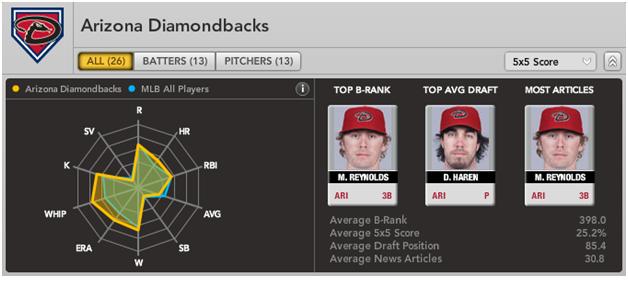
AZDiamondbacks_Reynolds.jpg

Arizona Diamondbacks
It’s no surprise that a team with big strikeout men Mark Reynolds and Chris Young in the lineup has above-average power and a below-average batting average. A little more development from their best hitter, Justin Upton, and some steps forward from their post-hype sleepers Stephen Drew and Miguel Montero, and this team could actually develop the best offense in their division. They certainly have a nice young core.

The staff is well above average, with sneaky ace Dan Haren leading the way. If Brandon Webb can recover his health, they’ll form a potent one-two duo once again. Newcomers Edwin Jackson and Ian Kennedy can make for decent NL middle-of-the-rotation guys, too, even if their pasts have been checkered. They’ll enjoy striking out pitchers this year, after spending the past few years in the American League. Chad Qualls and Juan Gutierrez are different pitchers – Qualls has a little more control, Gutierrez a little more gas – but they are a good combo at the end of the pen. Qualls in particular is a very good closer who’s being priced like a bargain-basement guy right now. Don’t be afraid to draft him a round or two above his ADP.


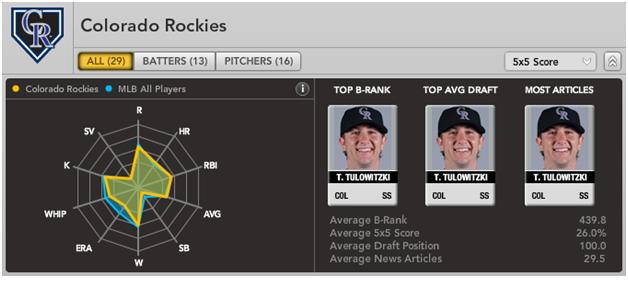
CORockies_Tulowitzki.jpg

Colorado Rockies
It’s not surprising that the Bloomberg Sports team spider graph identifies Troy Tulowitzki as the best player on the Rockies. His power from a premium defensive position makes this offense hum. Young Ian Stewart has the potential to be a poor man’s Mark Reynolds, and the team has buckets of upside hanging out in the outfield – Seth Smith, Dexter Fowler, and Carlos Gonzalez comprise one of the best collections of young outfielders in the game. Veterans Brad Hawpe and Todd Helton are still there to provide a bridge to all the young talent.

The rotation is led by underrated ace Ubaldo Jimenez. Jorge De La Rosa is searching for a breakout season: He strikes batter out, but also gives up too many walks. It’s a good thing that the Rockies still have young lefty Franklin Morales around, since Huston Street signed a contract extension and promptly hit the DL with shoulder trouble.


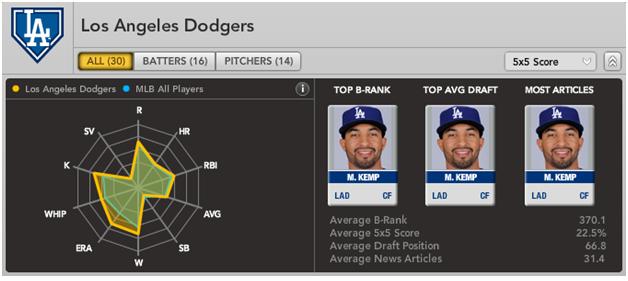
LADodgers_Kemp.jpg

Los Angeles Dodgers
The oufield boasts fantasy first-rounder Matt Kemp, solid young player Andre Ethier, and venerable slugger Manny Ramirez. If this above-average offense is going to get any better, though, it’ll because James Loney finally takes a step forward. Young Blake DeWitt gets another chance to prove his mettle, this time at second base, with a little more seasoning under his belt. Even Casey Blake is quietly effective.

For all of the belly-aching about the lack of a true ace in Los Angeles, Clayton Kershaw certainly has the strikeout rate and wipeout stuff of a number-one starter, and Chad Billingsley is a solid number-two. Their pen is also pretty exciting with stud Jon Broxton anchoring the team on his massive quads alone. The back of the rotation won’t produce as much value as last year, though, with Randy Wolf shipped off to Milwaukee after a strong 2009 season.


SDPadres_Gonzalez.jpg

San Diego Padres
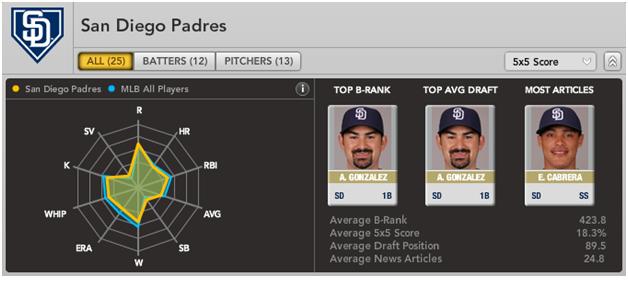
The book says that the Padres have a bad offense and a good staff, but is the book right? Maybe it’s just run-supressing Petco Park that gives fans that impression. The Bloomberg Sports team Spider Graph suggest that the team stacks up rather differently. Instead, it’s the staff falling behind the average team in ERA, WHIP and strikeouts, despite those pitcher-friendly park effects. Perhaps young fireballer Mat Latos can help them turn that rotation around. He had an impressive showing in his rookie season last year.

On the offensive side of the ball, Adrian Gonzalez and Chase Headley provide good power without the aid of the greatest batting averages. Young players Kyle Blanks and Everth Cabrera also provide run creation with low batting averages coupled with on-base ability and a blend of power (Blanks) and speed (Cabrera). There’s reason for hope here, even if it comes with a .242 team batting average.


SFGiants_Lincecum.jpg

San Francisco Giants
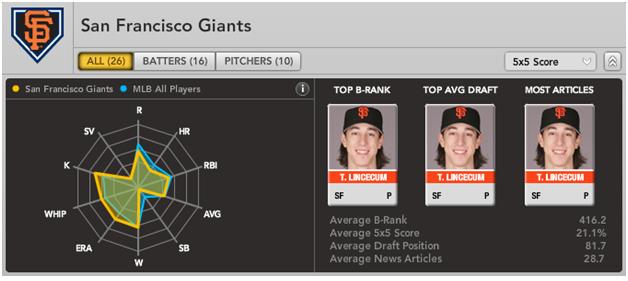
The average age of the Giants pitching staff is 26.8 years old. The starting lineup? 28.4. Take Pablo “Kung Fu Panda” Sandoval out of that lineup, and the other geezers pull the offense to an average age of over 30. Fittingly, the team has an exciting young staff that keeps their boring old offense in just enough games to matter for most of the year. Will the offense do any better this year?

The Panda needs a robin, but will that be one of the new veterans, Aubrey Huff, Freddy Sanchez or Mark DeRosa? Each has had a nice season in the last two years, and each is basically coming off an average or below-average season. GM Brian Sabean was probably looking at those career seasons when he signed each of them. Without some repeats of those career seasons, though, this will be a roster full of guys with .280 batting averages and 20-home run power. Opposing pitchers are already circling their scheduled starts against the Giants as we speak.

Meanwhile, the pitching staff will remain elite. All Tim Lincecum has going for him are two straight Cy Young awards. Matt Cain is one of the best number-two starters in the game. Barry Zito is a reliable, above-average innings eater who’s a valuable commodity, monster contract aside. Jonathan Sanchez is a dynamic young lefty with the ability to post annual 200-strikeout seasons. Brian Wilson has quietly emerged as one of the best closers in the game. Even the top set-up men, Sergio Romo and Jeremy Affeldt, are worth a look in deep leagues.

For more on Tim Lincecum and other American League West players, check out Bloomberg Sports’ fantasy kits.

Bloomberg Sports 2010 American League West Preview

By R.J. Anderson

This is the first of a series looking at all six major league divisions, with the help of Bloomberg Sports’ Spider Charts. We start today with the AL West.

The American League West figures to be the tightest division in baseball, without a clear favorite or doormat in sight. It would be inaccurate to say every team has an equal shot, but there’s certainly an opportunity for each of them to ascend to the throne and punch a ticket for October baseball. Here’s a quick look at the fantasy standouts on each club.

laa.png

Los Angeles Angels of Anaheim

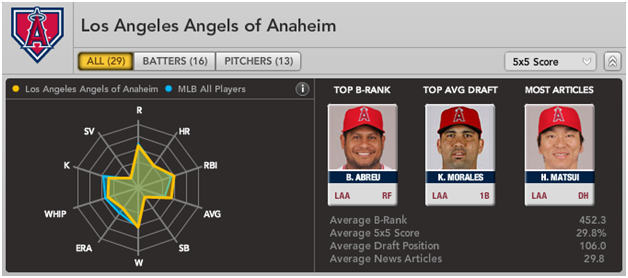
Even with the losses of Chone Figgins and John Lackey, the Angels have several interesting fantasy options. Kendry Morales, Torii Hunter, Bobby Abreu, and new addition Hideki Matsui represent the team’s sluggers. Meanwhile, Mike Napoli is one of the best-hitting catchers in baseball; if he can shake the injury bug and wrest the full-time job from Jeff Mathis, he’ll be a great pick this season. Abreu and Hunter form two-thirds of a aging outfield, alongside Juan Rivera; though Abreu and Hunter both bring diverse skills to the table, don’t overbid on either player. Howie Kendrick, Brandon Wood, Maicer Izturis, and Erick Aybar
have fantasy potential too, with Wood being the much hyped and much
delayed former top shortstop prospect who finally gets his shot. Kendrick in particular could be a breakout player if he can finally stay healthy for a full season.

The pitching staff could be hurt by the loss of Lackey, but ample talent remains. Brian Fuentes saved 48 games last year despite so-so peripherals; newly acquired Fernando Rodney and sleeper flamethrower Kevin Jepsen would nab saves if Fuentes falters in 2010. The rotation features Jered Weaver, a perennially good, but underrated anchor. Scott Kazmir and Ervin Santana represent intriguing starting options, but both are also huge injury risks, with Kazmir opening this season on the disabled list.  Joe Saunders’ peripherals suggest he’s closer to last year’s version than the 2008 addition. The Angels appear solid across the board, without any defined flaw.


seattle.png
Seattle Mariners

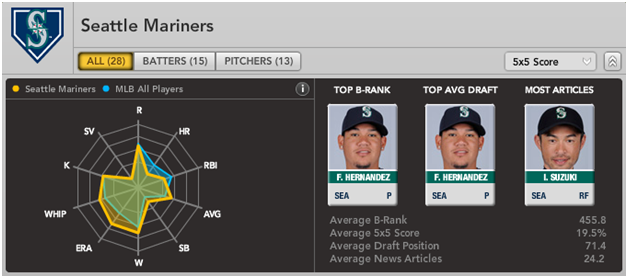
The Mariners were everyone’s off-season sweethearts with the acquisitions of Cliff Lee and Chone Figgins, but Lee’s injury changes the outlook of this team, as does Erik Bedard’s continued battle with the machete-yielding injury bug. Regardless, Felix Hernandez is still the King, and one of the top five starting pitchers in baseball. Ryan-Rowland Smith is the type of finesse lefty who could get a boost from Safeco Field’s spacious dimensions and great outfield defense (see Jarrod Washburn, 2009), and he’ll certainly be available as  a late-round flyer in any mixed league of 12 teams or less.

Ichiro is Ichiro. He’ll approach 200 hits, steal bases, and potentially get undervalued in leagues that overemphasize youth. Milton Bradley has been discussed here before, and while Seattle essentially features black holes at designated hitter and shortstop, the addition of Figgins gives Seattle another speed/contact option to bat at the top of the lineup in front of Franklin Gutierrez, who could lead the team in runs batted in. The sleeper here is either Brandon League or Mark Lowe, either of whom could get the call if David Aardsma‘s out-of-nowhere 2009 performance turns out to be a one-time deal. Meanwhile, it’s probably best to avoid Jose Lopez in the early rounds. His home run total is nice, but the switch to third base and fact that he is the absolute worst type of hitter for Safeco means you should let someone else overbid for his homers and RBI.


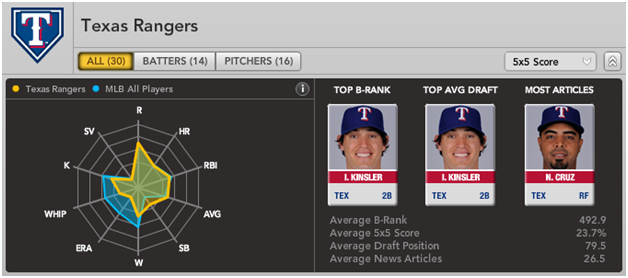
texas.png
Texas Rangers

Given their deep stable of young talent, Texas has the greatest potential for a big leap this season, and in the next few years. The addition of Rich Harden makes them even more intriguing. Much like Ben Sheets and Erik Bedard, if Harden is healthy, he’s fire. The Rangers hope the program set forth by pitching coach Mike Maddux, as well as the innovative strength and conditioning regimen implemented by Jose Vazquez will do for Harden what they did for other Rangers pitchers last year. Scott Feldman, the biggest beneficiary of the Rangers’ pitch-to-contact approach last season with 17 wins and a 4.08 approach, is a long shot to duplicate last year’s numbers. Meanwhile, Derek Holland has considerable upside, as does Neftali Feliz; Holland will start the season in the minors, Feliz in the bullpen.

On the hitting side, Nelson Cruz will seek to duplicate the 30 HR-20 SB performance he put up in ’09, his first full major league season. Michael Young will be overvalued after some gaudy numbers last year, and is a good bet to see significant regression. Vladimir Guerrero should only be bought if he comes at a bargain price; as last season showed, the Vlad of old is gone. A deep sleeper could be David Murphy, a solid if unspectacular left-handed hitter entering the prime of his career in a deep lineup, with Arlington’s hitter-friendly backdrop acting as a tailwind.


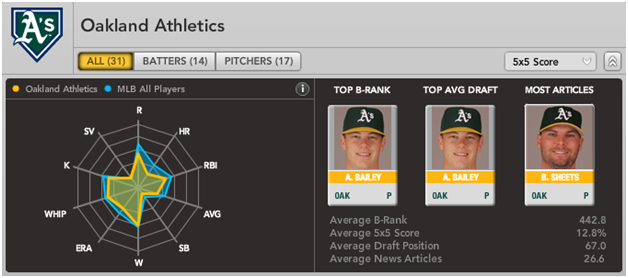
oakland.png
Oakland Athletics

Oakland’s offense offers little other than a sprinkling of speed, with Rajai Davis and Cliff Pennington leading the way. Pennington in particular could be a strong sleeper if he can extend his promising 2009 performance over a full season. An even bigger sleeper could be Jake Fox, who becomes the A’s designated power threat without an obvious position after the team cut Jack Cust.

At least there are a few hurlers worthy of consideration. Ben Sheets, for one, even with his health being a perpetual question mark. Brett Anderson is another, coming off an terrific rookie season that was even better than his superficial numbers suggest. Closer Andrew Bailey has health issues, as does set-up man Michael Wuertz, which could push sleeper saves candidate Tyson Ross into the equation. Ross was one of the Athletics’ top pitching prospects and will be used out of the bullpen to begin the year. He gets groundballs and has above-average stuff, which should translate to a good number of strikeouts.

If you’re in a keeper league, the A’s also feature some intriguing offensive options in the minors. Chris Carter and Michael Taylor could be up at some point this season and definitely should be on your list of sleeper pickups. Oakland probably has the lowest chance of actually winning the division, but in the wild West, anything can happen.

For more on Ichiro Suzuki and other American League West players, check out Bloomberg Sports’ fantasy kits.

Should You Sit Your Starting Pitchers in Week 1?

By Eriq Gardner

A reader wrote in to ask whether or not the numbers support sitting a starter in the first week of the season.

I understand the reasoning behind the strategy: In the first week of the season, starters might be dangerous, as they haven’t built up the stamina to go long into games, may not have fully gotten control of their arsenal of pitches, and might be expected to be less likely to put up wins and more likely to damage a fantasy teams pitching ratios.

But let’s look at the numbers.

Unfortunately, we couldn’t find any “first week” splits anywhere, but we were able to gather together data for pitchers who made starts between April 5 and April 12 going back five years. We can call this set of data, “Starters in Early April,” which may be better anyway since what we’re talking about is a pitcher’s seasonal maturity at this early part of the year. We compared these data to how starters performed overall in the past five years.

Picture 13.png

The results of the study were somewhat surprising.

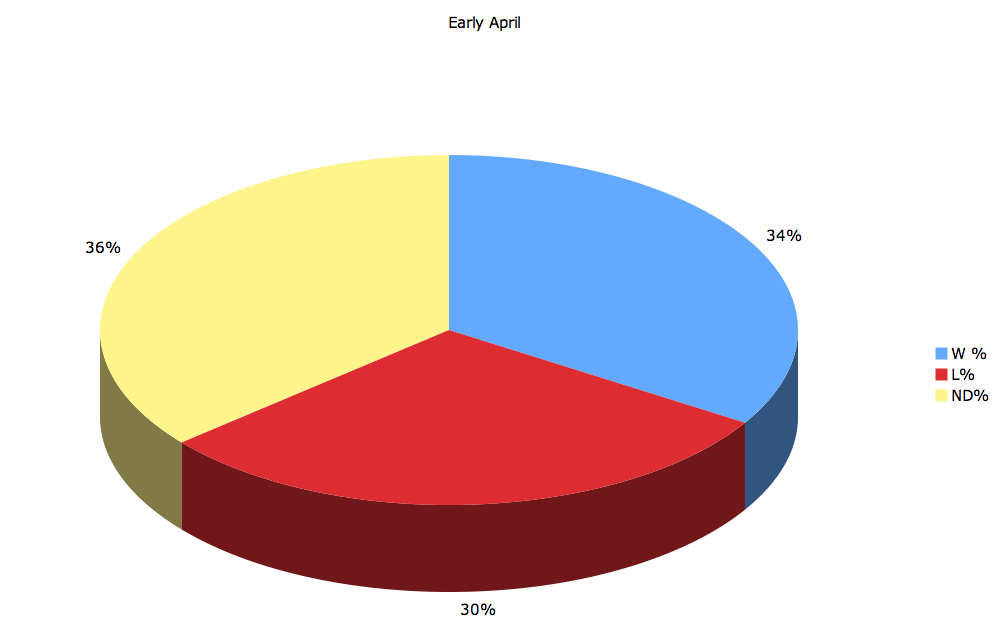
Let’s start with endurance and the potential for wins. We’re shocked to learn there’s hardly any difference at all. Starters in early April average 5.8 innings per game started. Starters average the same 5.8 innings per game started throughout the season. In early April, starters win the games they start 34% of the time. Throughout the season, that only ticks up to 35%. In early April, starters are a little less likely to be on the hook for a loss and a little more likely to be given a no-decision, but unless your league counts those stats, that’s not very important.

Picture 15.png

Let’s go to ERA and WHIP.

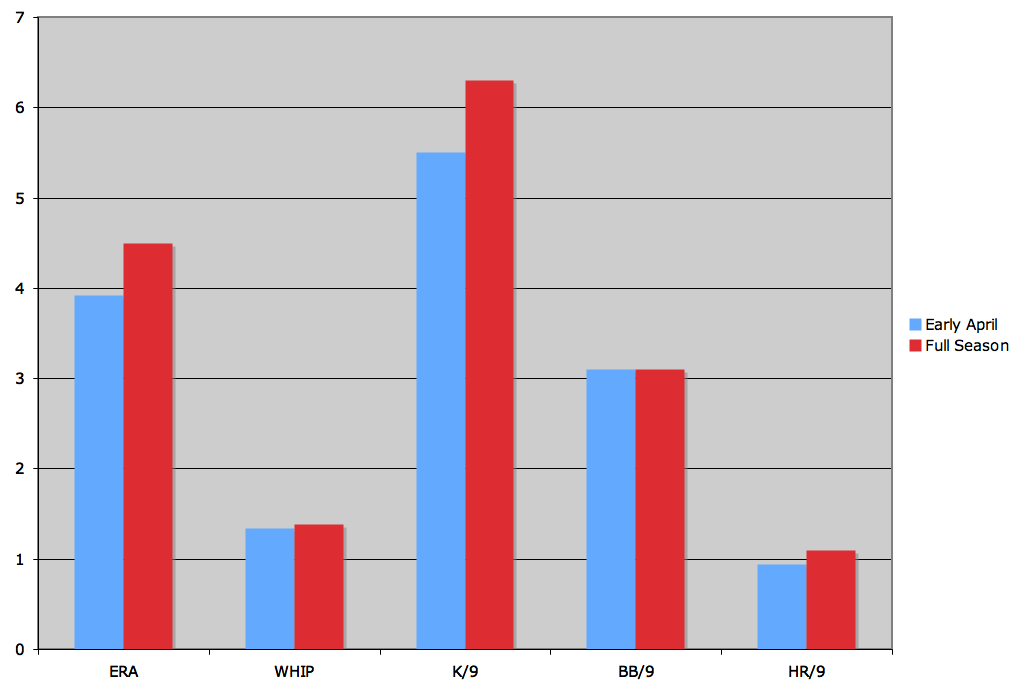
Here we find big differences, but in the complete opposite direction we expected. Starters in early April average a 3.92 ERA and a 1.34 WHIP. Over a full season, starters average a much worse 4.50 ERA and a 1.39 WHIP. Is it because teams mostly have their best starters healthy at the onset of the season? Perhaps that’s one factor, but I think we can explain the difference better by jumping into the peripheral numbers.

First, we find no command issues. Both time frames yield an average of 3.1 walks per 9 IP.

Interestingly, despite the better surface ratios, pitchers at the beginning of the season strike out fewer batters. In early April, pitchers strike out 5.5 batters per 9 IP. Throughout the season, the number jumps to 6.3. If starters are whiffing fewer batters in early April, how are they managing to gain a better ERA?

We can put the mystery to bed by taking a look at the HR numbers. In early April, the HR/9 rate of a starter is only 0.94. Throughout the season, it’s 1.1. Clearly, the biggest advantage that a starter has at the start of the season is the colder weather. If you’ve ever swung a bat in frigid temperatures, you know it stings upon contact. Moreover, because warm air is less dense than cool air — ask your local meteorologist — balls travel further in those warm summer months.

So while it might seem a good idea to bench your starters early in the season, the numbers say you should do no such thing. 

For more on starting pitchers, check out Bloomberg Sports’ fantasy kits

The Bloomberg Sports Fantasy Squad

By Jonah Keri

It’s one
thing to dig into the numbers and make a bunch of predictions for the
upcoming fantasy season. It’s quite another to put your fantasy draft
where your mouth is. That’s just what I did last week in the Brian Kenny Show Fantasy Baseball League.

Run by ESPN anchor and radio host Brian Kenny, the league
includes some heavy hitters at the Worldwide Leader, along with a special guest from the pigskin world. Mike Greenberg (of the Mike and Mike Show), Linda
Cohn, Jay Harris, Ryen Russillo, Amy Lawrence, Buster Olney, Rob Neyer
and NFL wide receiver T.J. Houshmanzadeh (I was as surprised as you, but the man’s got a good team) joined me in the league, along
with Kenny, his producer Mike Urrunaga, and three listeners.

The format is a little different than your typical fantasy league.
Instead of the standard 5×5 format, or the original 4×4, this is 6×6.
The offensive categories are: HR, RBI, R, SB, along with OBP and SLG
(no Batting Average). The pitching categories are: W, K, ERA, WHIP,
along with Quality Starts and Saves+Holds (instead of Saves only).

The strategy here was simple: Load up on offense early and grab
quality starting pitching periodically. Then take advantage of the
league’s unique categories in two ways: 1) Punt saves, so that while
others are fixated on lousy closers, I can swoop and take elite set-up
men who’ll produce almost as many holds, with much better ratios. 2)
Target hitters late in the draft who are better in real life than in
fantasy, since they typically put up low batting averages but also
strong on-base percentages and slugging averages.

Picking 10th in the draft, I grabbed Rays third baseman Evan Longoria
with my 1st-round pick. I wanted big power numbers right away, since
cheap steals figured to be abundant. Third base is also a thin position
this year, Alex Rodriguez was gone, and I trusted Longoria’s improving game and stacked Rays lineup over David Wright, the 10 home runs he hit last year, and his abysmal Mets teammates.

I was hoping to address position scarcity again and grab Rockies shortstop Troy Tulowitzki with my 2nd-round pick, but he went four slots ahead of my #19 selection. Come on down Roy Halladay! The Phillies’ new ace is the most dependable starting pitcher in the game, ranked #2 behind only Tim Lincecum
this season and #14 in B-Rank (Bloomberg Sports’ proprietary ranking of
all MLB players). The initial goal might have been to target offense
early, but you don’t say no to Halladay at this point of the draft.
That Quality Starts were an additional category in this league only
made Halladay (and other top SP) more valuable.

The next four rounds were an offensive blitz. Padres first baseman Adrian Gonzalez
is already an elite hitter in standard leagues; add OBP and SLG to the
mix, though, and he’s arguably a top-10 hitter. So heck yes, I’ll take
him at #38. With Longoria and Gonzalez now anchoring the infield and
the power categories, it was time to look for speed, which is copious
this year in the outfield. Kenny was hosting his radio show as the
draft was going on, and had no qualms about calling out players he
wanted. In Round 4, he was jonesing for Rays outfielder B.J. Upton.
At #47, I was already planning to take Upton if he fell to me; huge
source of steals, and now that he’s reportedly over the shoulder injury
that plagued him in 2009, I expect big bouncebacks in OBP, SLG and
counting stats. Taking Upton three spots ahead of Kenny, and eliciting
a horrified on-air reaction, only made the pick sweeter.

For my fifth-round pick, I turned to the first of several Bloomberg
Sports Blog-profiled players I would nab in this draft: newly-minted
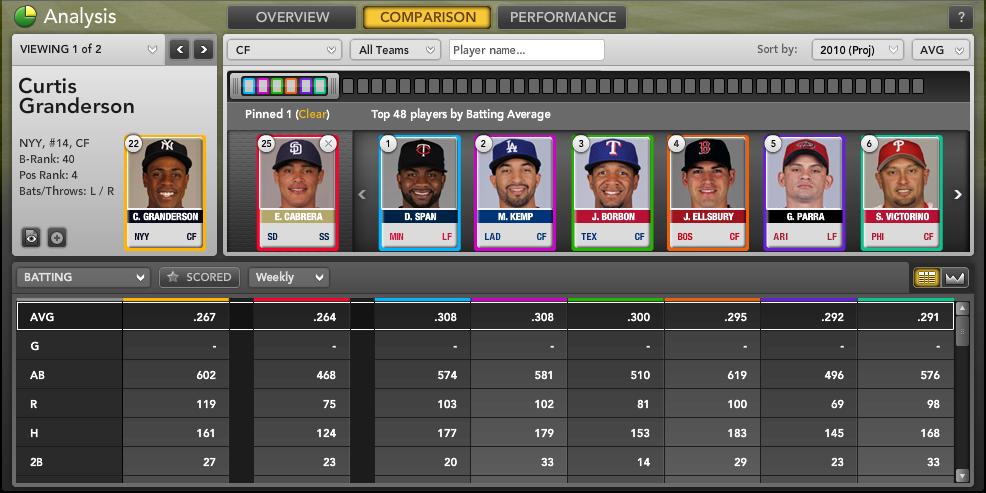
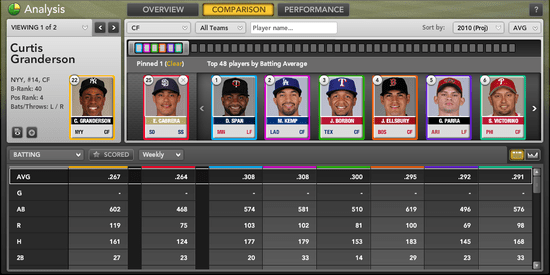
Yankees outfielder Curtis Granderson. Here again I wanted a power-speed guy and agreed with the take of colleague Tommy Rancel, who profiled Granderson as a
30-home run player coming to Yankee Stadium, a place that greatly
favors slashing left-handed hitters. Much later in the draft (16th
round), I would grab Padres shortstop Everth Cabrera, adding more speed to the roster, and a second Bloomberg Sports Blog-touted option for 2010.
4-5-2010 11-25-20 am.png

With the five-outfielder format of this league, I wanted another power-speed OF early, so Rangers outfielder Nelson Cruz (33 HR, 20 SB, .524 SLG in his first full season last year) made it three such picks in a row, at #75.

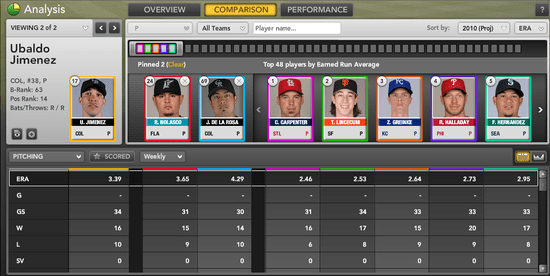
Then, the pitching onslaught began. In recent weeks, we’ve discussed the huge upside of Marlins starter Ricky Nolasco and Rockies starter Ubaldo Jimenez (as well as his slightly less talented but still solid teammate Jorge de la Rosa).
I landed all three of those pitchers, in the 7th, 8th, and 15th rounds
respectively. All three project to put up big strikeout numbers, with
Nolasco and Jimenez also targets to produce stellar ratios and even
darkhorse Cy Young seasons.
4-5-2010 11-21-42 am.png

In the later rounds, I drafted a
boatload of players who figure to benefit from the league’s OBP/SLG
yes, AVG no format, including Yankees outfielder/first baseman Nick Swisher, Nationals outfielder Josh Willingham and Angels catcher Mike Napoli. Brewers second baseman Rickie Weeks
is a definite injury risk, but his power/speed/OBP potential made him
too good to pass up in Round 11 (and I hedged by grabbing Twins second
baseman Orlando Hudson in post-draft free agency as a backup).

Rounding out the draft, I landed no fewer than four top set-up men
who figure to combine for 100+ holds plus occasional saves, all four
with strong strikeout and ratio numbers. Good to have you, Matt Thornton, Daniel Bard, George Sherrill and Mark Lowe. You’ll be a lot easier to carry all season than shaky Opening Day closers like Matt Capps and (shudder) Matt Lindstrom.

I’ve pasted the roster for the Bloomberg Sports Squad below. We like our chances. (Round selected in parentheses)

You can follow the league, all season long, here.

HITTERS
C Mike Napoli (13th)
1B Adrian Gonzalez (3rd)
2B Rickie Weeks (11th)
3B Evan Longoria (1st)

SS Everth Cabrera (16th)
MI Marco Scutaro (18th)
CI Nick Swisher (14th)
OF B. J. Upton (4th)
OF Curtis Granderson (5th)
OF Nelson Cruz (6th)
OF Denard Span (10th)
OF Josh Willingham (20th)
UT Paul Konerko (17th)

PITCHERS
SP Roy Halladay (2nd)
SP Ricky Nolasco (7th)
SP Ubaldo Jimenez (8th)
SP Brett Anderson (9th)
SP Max Scherzer (12th)
SP Jorge de la Rosa (15th)
SP Ervin Santana (22nd)
RP Matt Thornton (19th)

RP Daniel Bard (21st)

BENCH
RP George Sherrill
RP Mark Lowe
2B Orlando Hudson
1B Russell Branyan (DL)
For more on how to build and manage your fantasy team throughout the season, check out Bloomberg Sports’ fantasy kits.

Alex Gordon: Post-hype Sleeper or Bust?

by Eno Sarris

Think back to 2006. That quaint comedy Beerfest was taking the country by storm while we were all saying prayers for Barbaro’s quick recovery. Faint memories of a movie called Little Miss Sunshine waft through the house like the scent of apple cobbler. Ah, those were the days.

Those were also the last days that featured Alex Gordon as The Future of the Royals Franchise. He was tearing up the minor leagues at the time, a number-two pick overall making good on his promise with a stellar .325/.427/.588 (AVG/OBP/SLG) line in Double-A. Fans of the powde -blue were practically salivating at the thought of the new George Brett rescuing the franchise. Gordon was the epitome of the hyped prospect and was being penciled in for the 2007 Rookie of the Year hardware before the season began.

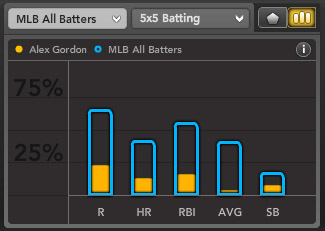
Unfortunately this story was not going to be without some speed bumps. Gordon produced an underwhelming .247/.314/.411 major league stat line in 2007. Though he played a decent third base and was actually an above-average player when appraised as a whole, the hype balloon was popped. If his second season’s line, .260/.351/.432, was also not very inspiring, and last season his year was cut short by an injury, why is there hope for Gordon to have a good year thisGordonGrab.jpg season? He’s currently hurt – could his stock fall  any lower? Take a look at the graphical representation of his 2009 compared to other major league batters in the Bloomberg Sports Fantasy Kit. Yuck.

Taking
a player on the hopes of a rags-to-riches journey is always enticing for a fantasy player
looking for value. Consider that Gordon actually showed some signs of
life between his first two years, and you’ll find that his 189-plate appearance season in 2009 is not enough to write those gains
off. If you instead focus on his first two years, here’s a short list
of underlying statistics that Gordon improved in his sneaky-good
sophomore season: walk rate, strikeout rate, isolated power, line drive
percentage, fly ball percentage, home runs per fly ball, reach rate,
and contact percentage.

That’s a lot of improvement. In other
words, Gordon walked more, struck out less, reached at fewer balls outside the strike zone, and hit the
ball higher, further and harder. Isn’t that the kind of improvement you want from your best prospect? There’s reason for a bit of concern after last season, and Gordon’s health needs to be watched. Still, there’s reason for hope too.

Looking at his minor league
numbers and you might still expect super-stardom from Gordon, but there is
a slight asterisk that must come into play. As an accomplished college
star, Gordon hit Double-A at 22 years old (the average age of his league that year was 24).
Age matters when considering a player’s statistics in the minor leagues
– if a teenager is holding his own against top talent (like Elvis Andrus, who was 19 in the same league in 2008, or Jason Heyward
hitting the majors at 19), he gets extra credit. If a guy in his
mid-20s comes in and destroys younger pitching, his stats lose a
tiny bit of luster. Have some fun and check Kevin Maasminor league statistics and the picture becomes clearer.

In
any case, the positives here still outweigh the negatives, as nebulous
as Gordon’s future may seem. Gordon has a good bit of power, a little
bit of speed, plays an important position, and has an improving
approach at the plate. The ending of this movie has not yet been
written, and it may just yet be the story of a Post-Hype Sleeper that
made good.

For more information on Alex Gordon and other cheap third-sackers this year, check out Bloomberg Sports’ Fantasy Kit for yourself.   

Ricky Nolasco’s ’09, Bad Luck or Bad Form?

By Tyler McKee

Going into last season, Ricky Nolasco‘s solid rookie campaign pointed to a budding star poised to make a large fantasy impact. He finished the year with a solid 13-9 record for a decent Florida Marlins club, but also put up a disappointing 5.06 ERA — a full run and a half higher than his previous season.

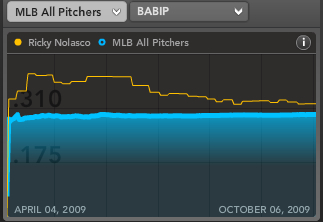
Some might see Nolasco’s extremely large jump in BABIP from .284 in 2008 to .336 in 2009 and his impressive FIP (Fielding Independent Pitching – a measure that runs on a similar scale to ERA but strips out factors such as defense, run and bullpen support) of 3.35 for the year as signs of a particularly unlucky season and thus expect regression to the mean this year. But there’s more to it than that. The key is to look at the splits.

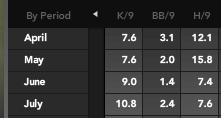
The disparity between his April/May and June/July splits is quite astonishing. Nolasco posted a huge 6.49 FIP in May coupled with an absurd BABIP of .418 and a left-on-base percentage of 37.6%. This means that 62.4% of batters that reached base against Nolasco ended up scoring! Compare this with one month later, when all of those stats fell faster than stock in Toyota. In June and July, Nolasco saw his BABIP fall to around .300 and his LOB% rise to a solid 75%. His FIP fell below 3.00. So what happened? We know that he was not injured, so the answer must have involved his mechanics. 

Whatever it was did not seem to affect Nolasco’s ability to hit the strike zone. Bloomberg Sports’ performance grid shows that his walks per nine innings (BB/9) stayed right around his career average. Instead, it appears the culprit was an inability to keep the ball down in the zone, as evidenced by his flyball percentage (FB%), which jumped to 50%, from his usual average of about 41%. Needless to say, this is a big problem for a major league pitcher, especially one that depends on a dominant slider as one of his go to pitches.


If a slider is thrown properly it should have significant lateral movement as well as diving action, causing hitters to swing over top of the ball and drive it into the ground, or miss it completely. However, delivery issues could significantly hinder a pitcher’s ability to achieve this breaking action. When thrown poorly a slider will stay flat and be easily distinguished by the hitter, (as explained in detail here) which is what appears to have happened to Nolasco. 

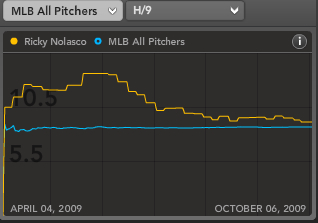
The increased FB% and a drop of two strikeouts per nine innings, to 7 from 9, indicates that batters were able to square up his pitches far more often then normal. Instead of hitters rolling over his breaking stuff and driving it into the ground, they were able to make more solid contact — and Nolasco struggled as a result. The Bloomberg Sports hits per nine innings chart (H/9) shows just how bad it got for him. At one point he was giving up five more hits than the league average. The H/9 chart also shows a strong correlation with the BABIP chart. This is a clear indication that what many thought was a run of bad luck, was also the result of bad pitching. 


On May 22, Nolasco was sent down to Triple-A to work out his issues, and whatever adjustments were made worked out well. After he returned on June 7, Nolasco saw a return to his old results. His flyball rates fell in both June and July, bottoming out at 24.1%, his groundball rate skyrocketed to 54.2%, and his K/9 returned to its normal rate of better than 9.0. During this time Nolasco achieved a miniscule 2.34 FIP.

In 2010 it won’t be better luck, or better fielding that enables Ricky Nolasco to return to the mean, and the hearts of fantasy managers. Look to see if he can become more consistent in his delivery. If he can do this, he will make a very solid number two starting pitcher for any fantasy team. 

For more on Ricky Nolasco and other starting pitchers, check out Bloomberg Sports’ fantasy kits.

Some Things to Consider When Measuring Player Value

By Eriq Gardner
Let’s pretend we have two teams each drafting one batter at C, 1B, 2B, SS, 3B, OF1, OF2, OF3.
The roster of Team A is the following: Alex Rodriguez, Mark Reynolds, Jason Bay, Jayson Werth, Nelson Cruz, Ben Zobrist, Elvis Andrus, and Mike Napoli.
The roster of Team B is the following: Adrian Gonzalez, Nick Markakis, Ryan Zimmerman, Adam Jones, Robinson Cano, Alex Rios, Orlando Cabrera, and Bengie Molina.
Team A should be the far superior team if you go by any Average Draft Position measure. These are all heavy hitters who contribute some nice speed; however, when we take a look at projections, we’re not quite that certain that Team A would finish ahead of Team B.
Here are the projected team statistics for Team A:
Picture 18.png
And here are the projected team statistics for Team B:
Picture 19.png
As you’ll see above, Team A has the clear upper-hand in HRs and SBs. However, Team B holds a small edge in RBIs and Rs and a big edge in AVG. How did we pull this trick?
The answer tells us something important about player value and is something to keep in mind when using player raters and managing a roster into the season.
Team A is a squad comprised of the top-rated players at every position who each project for less than 550 at-bats.
Team B is a squad comprised of players who are rated relatively lower compared to the other squad, but who each project for somewhere between 575 to 650 at-bats.
In other words, the extra ABs translate to added counting numbers, particularly important in context stats such as R and RBI. In addition, more ABs mean a bigger contribution to the overall team average. Last year’s best best performers against draft position included Aaron HillChone Figgins, and Victor Martinez. Is it a coincidence that each of these players led their position in ABs?
We’re all trained to weight heavily the categories that are seemingly dependent on core skills like power and speed; player raters in particular give a little bit of extra credit to steals because of the overall scarcity. But HRs and SBs aren’t the only categories worth considering when taking a look at a player. And core skills are not the only factors worth examining. Teams doing well in undervalued categories and teams healthy enough to gain a playing time advantage can find their way to fantasy success, perhaps to the astonishment of their league-mates.
For more on competitive factors in fantasy baseball, check out Bloomberg Sports’ fantasy kits.

James Shields: Rays’ Quiet and Consistent Ace

By R.J. Anderson

Here’s a fun trivia question: Who has the fourth-most innings pitched over the past three seasons, behind only Roy Halladay, CC Sabathia, and Dan Haren? Nope, not Cliff Lee or Felix Hernandez. Nor Justin Verlander.

It’s James Shields. The Tampa Bay Rays ace has made at least 31 starts in each of his three full major league seasons while completing at least 215 innings, and winning at least 11 games. Shields’ durability would be one thing, but when combined with solid performances — notably by advanced metrics, like Fielding Independent Pitching or even Adjusted Fielding Independent Pitching (both of which attempt to strip the luck aspect out of evaluating pitchers) — Shields becomes one of the better and more underappreciated talents in the league.

shields2.png
Oddly enough, Shields is actually being drafted well ahead of his 133 B-Rank; his ADP is currently 110. His 2010 Bloomberg Sports projection calls for 217 innings, a 3.89 ERA, 13 wins, and a 1.23 WHIP. That line places him smack in the middle of strong three-star pitchers such as A.J. Burnett, Brett Anderson, and Rays teammate Matt Garza.

shields1.png
Shields has the luxury of pitching in front of one of the best defensive teams in baseball, which should help his rate stats. One thing Shields does, perhaps better than anyone else in the division, is mix his pitches. When he came into the league, he was extremely reliant upon a plus change-up. Talk to a handful of scouts during that period and his change-up was right up there with Johan Santana’s for the honor of best in baseball. Since then, though, Shields has continued to add pitches and tweak his arsenal. He throws a cutter now and has a plus curve to go with it. He locates all of those pitches well.

The only real flaws in Shields’ game is the lack of run support (presumably something that should even out over time), and home runs allowed. Shields’ run support was just 4.42 runs per game last season, despite the Rays’ offense setting numerous
franchise records for offensive production; t
hat was the fourth-lowest total among AL starters. Meanwhile, Shields has allowed at least one home run per
nine innings in each of his big league seasons. Last year’s 1.19 HR/9 IP was a
career high in seasons where he threw more than 150 innings, so expect
a little regression there.

Still, the positives far outweigh the negatives. The Rays’ franchise single-season record for wins by a pitcher is 14. With a little help, Shields could break that record this season, and could do so as a strong number-two or number-three option on your pitching staff.

For more on James Shields and other starting pitchers, check out Bloomberg Sports’ fantasy kits.

Continue reading

Stephen Drew: Post-Hype Sleeper or Bust?

by Eno Sarris

We continue our way around the infield after examining the post-hype prognoses for Chris Davis and Rickie Weeks. It’s about time that I admit my dark secret – I actually own a fantasy team that features all of these players around the horn on the infield. As I joked on this podcast with the folks at BaseballPress, this is not a strategy to try at home, and it’s only the particulars of this league that forced me into a corner. On the other hand, finding an undervalued player that has shown elite skills in the past for a bargain price is useful in any league.

So does Stephen Drew count? He has certainly shown plenty of strong attributes at the plate – but not in the same season. If he puts these disparate parts of his game together, though, he could become an impact player at shortstop. It’s been shown by researcher Tom Tango that a player’s peak age range is 27 through 29. Lo and behold, Drew is 27. Could this be his year?

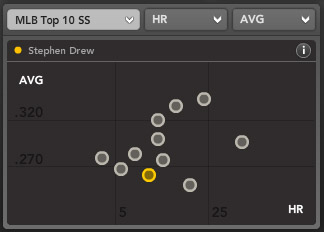
DrewGrab1.jpgThere’s a bit of a split between Bloomberg Sports’ projections for Drew and the wisdom of the crowd on this one. The Bloomberg Sports Fantasy Kit projects Drew for an underwhelming .268 batting average, albeit with 18 home runs. Shown graphically to the left, these numbers don’t combine to instill confidence. In what is perhaps a nod to the fact that manager A.J. Hinch is thinking of batting Drew second this year, he is projected for a decent 80 runs. Are those runs scored combined with the poor batting average and mediocre home run total enough to make fantasy owners right for drafting him more than 100 spots earlier than his B-Rank (B-Rank 229, ADP 127.6)?
DrewGrab2.jpg
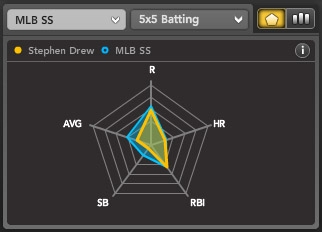
There’s obviously some value in his complete package of skills. His skills looks better on a Bloomberg Sports spider graph, where you can see how he stacks up in the offensively-challenged position of shortstop. Even that graph might be selling Drew short, though.

Take his batting average. Not only has he hit .291 before (in 2008), but he’s shown the different components of being able to do it again. Check out his reach rates (the percentage of swings at pitches outside of the zone) since he hit the majors: 30.6%, 21.8%, 28.2%, 22.3%. It may not be a surprise that his walk rate has oscillated similarly: 6.2%, 9.7%, 6.2%, 8.2%. On the plus side, one element of his game has steadily improved: His contact rate has risen from a poor 74.3% to a solid 84.2%.

What does it all mean for his batting average? it means that Drew is struggling with his aggressiveness but is making more and more contact as he figures it out. The recipe for a good year might just include a nice middle ground for his reach rate (say around 25%), an average walk rate (last year the ML average was 8.9%) and an above-average contact rate (the ML average was 80.5% last year). He’s done each piece before – it follows that he could hit each benchmark again, ideally in the same season.

Because he’s not a speedster (19 career stolen bases), the power is the other attractive part of Drew’s profile. His isolated power (slugging percentage minus batting average) has also jumped around more than Ozzie Guillen after a liter of Red Bull: .201, .133, .211, .167 (ML average is usually around .155). This is probably related to another component stat that Drew is struggling to harness: his line drive percentage (23.8%, 16.5%, 22.6%, 18.9%). It seems that his power rises and falls with his line drives. The lesson here is that he’s had nice line drive rates twice before – he can do it again.

Why would this year be the year that he once again puts together a good line drive rate with a strong approach at the plate and gives us something that looks like 2008 (or better)? Well, spring training stats are obviously a small sample size, but sometimes those mere 40 or 50 at-bats can give us hope. It is also worth mentioning that John Dewan has shown that about 75% of players that improve their slugging percentage by more than .200 in spring training go on to perform better than their career average during the upcoming season. Drew’s close. His slugging percentage this spring? .609. His career number? .445.

For more information on Stephen Drew and his fellow shortstops this year, check out Bloomberg Sports’ Fantasy Kit for yourself.