Derek Jeter’s Bleak Future

By R.J. Anderson //

Derek Jeter is a free agent by name only. The Yankees’ only conundrum in re-signing their captain will be similar to the ones the Bombers faced with Andy Pettitte last offseason: how long and for how much?

Those questions are not easy to answer in this case, because Jeter’s marketing power and brand are unrivaled. The Yankees’ own brand would not suffer from losing Jeter – they were popular before him too, you know – but they have no reason to pass on him (despite diminishing skills) because a sunk cost is no big deal to New York.

Jeter’s 2010 season represents a massive disappointment. Fresh off a season in which hit .334/.406/.465 with 18 home runs, Jeter failed to come near those numbers. His batting average slipped under .300 (to .270) for the first time since 2004. His on-base percentage fell below .350 (.340) for the first time in his career – the same can be said of his slugging percentage ending at less than .400. Jeter still managed 10 home runs and 18 stolen bases, but his mediocre stats and slap-hitting ways might represent the future more than Yankees fans would like to believe.

In June, Jeter will turn 37. No shortstop (defined by having played at least 50% of their games at the position along with 300 plate appearances) aged at least 37 has ever hit more than nine home runs in a season. Since 1970, only 20 shortstops met that qualification after turning 37, with the highest batting average being .295, the highest on-base percentage being .367, and the highest slugging percentage being .419. Over the last three seasons, Jeter’s line: .301/.369/.414. Meanwhile, only two of those players finished with an OPS above the league’s average.

In other words, Jeter’s not likely to get much better than he’s played lately as he ages. The crowd perception is that Jeter will get a deal worth three years at roughly $15 million per year. Even though three years does not seem like a long time, one has to wonder if Jeter’s increasing immobility at shortstop along with the presence of prospect Eduardo Nunez will result in the Yankees moving Jeter to the outfield or full-time DH before the contract expires. Moving him becomes a definite if the Yankees foolishly give in to Jeter’s supposed desire for six years. Consider the idea admirable – in the sense that Jeter loves to play and really wants to test the limits of his icon boundaries – but also insane.

As for your fantasy docket, one would expect him to be undervalued entering next season, and there’s something possibility for a bit of positive regression after such a huge year-over-year drop. Still, in most leagues Jeter’s name value will inflate his bidding price beyond a reasonable range.

Tread softly and do not be afraid to let him go. Unlike the Yankees, you have a choice.

For more on Derek Jeter and other free agents, check out Bloomberg Sports’ Fantasy Tools.
Revisiting the Fantasy Value of Madison Bumgarner

by Eno Sarris // 

Back in July, we took a look at Madison Bumgarner and found some reasons to be suspicious of his early success. As a short recap, here are those reasons in helpful bullet form.

  • His velocity was down from the mid-nineties to barely cracking 90 MPH.
  • His strikeout rate was below-average (6.75 K/9, average was 7.13 K/9 this year).
  • He was getting lucky, with a .266 batting average on balls in play (BABIP) and an 82.7% strand rate (numbers that trend to .300 and 70% across baseball).

All of these shortcomings were notable at the time, given his history and velocity. But now we are looking at Madison Bumgarner, World Series Beast. Perhaps it’s time to revisit our initial findings on Bumgarner and see if he should get a revised rating.

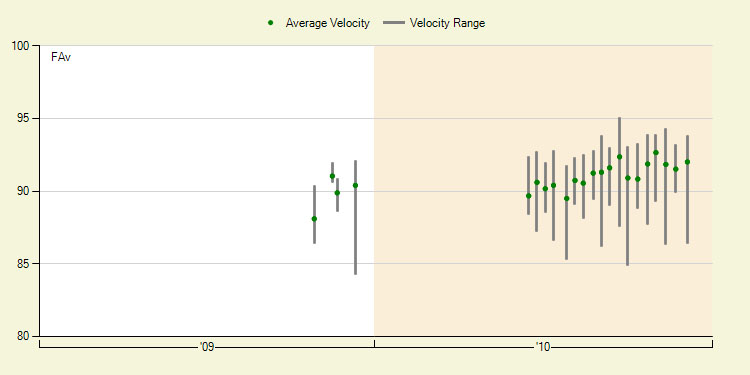
First, his velocity. Bumgarner throws across his body, and he’s not a very thick guy, so there were reasons to be worried about a drop in velocity. Sometimes it’s a harbinger of injury. But then Bumgarner went out and improved that velocity all year – it’s now steady at 91 MPH, touching the mid-90s some games. If you look at his fastball velocity chart below, you see there might still be some issues (the bars represent full velocity range for each game), but it also shows that he found some oomph.

BumgarnerVelo1 copy.jpgBumgarner rode that improved velocity to an improved strikeout rate, ending the year at 6.97 K/9. Perhaps we focused too heavily on his strikeout rate, however. His walk rate is so low (2.11 BB/9 in 2010, 2.16 career) that his K/BB is well above average.  Had he qualified for the ERA title, his 3.31 K/BB would have ranked 15th in baseball – tied with a pretty decent pitcher named Felix Hernandez.

Largely because of this ability to limit walks, Bumgarner’s work stood up even when his luck regressed to the mean. He ended the year with a .322 BABIP, so many more hits fell, and yet he finished the year with an even 3.00 ERA. His strand rate remained high (81.7%), but his FIP (a number on the ERA scale that strips out batted-ball luck and other factors largely beyond a pitcher’s control) was still strong at 3.66.

Upside remains. Bumgarner once struck out double-digit batters per nine innings in the minor leagues, and obviously his postseason performance has shown that he has the ability to punch batters out. Because he can limit walks, it looks like the worst-case scenario has shifted in his favor. Without reaching his upside fully and pushing the strikeout rate further, he may not be the ace that was hoped for him, but we can now be more positive about his future.

For more on Madison Bumgarner and other young pitchers, check out Bloomberg Sports’ Fantasy Tools.

MLB Season in Review: Houston Astros Hitting

By Eno Sarris //

Biggest Surprise & Regression Alert: Chris Johnson

Chris Johnson was a revelation in an otherwise poor season for the Astros; Houston scored the third-fewest runs in baseball in 2010. His .308/.337/.481 rookie batting line is in the books, but can he make a repeat performance in 2011? It’s not likely. His minor league isolated power (ISO) was only about average (.152, major league average is .150), so the power he showed last year (.173 ISO) was a little high – not impossible to replicate, but don’t bet on it either. The bigger issues: Johnson’s plate discipline (4.2% career BB%, 26.7% career K%) and elevated 2010 batting average on balls in play (.387 BABIP last year, a number that trends towards .300 across baseball), point to a big potential drop in batting average next year.

Biggest Bust: Lance Berkman

Tommy Manzanella was terrible, but he was mostly known for his defense anyway. Carlos Lee also had a poor season, but turned it on late to get to 24 home runs and some respectability – at least from a fantasy perspective. Michael Bourn didn’t have a great batting average, but still stole 52 bases. That leaves Lance Berkman. He was injured much of the season, and didn’t crack 500 plate appearances for the first time since his sophomore season in 2000. His knee condition may be degenerative, and he’s seen a three-year decline in slugging and on-base percentages now. He’s best left for the deepest of leagues until he shows life again.

2011 Keeper Alert: Brett Wallace

Hunter Pence is the only no-doubt keeper on this offense, but Brett Wallace is the only interesting player who has yet to establish himself in the major leagues. Coming off his minor league record, in which he put up a .304/.375/.487 batting line, more was expected of him than his rookie-year stats (.222/.296/.319). Then again, many of his better power years in the minor leagues came in high-run environments, so his power might be suspect. In his 159-plate appearance major league debut, he didn’t show the ability to take a walk (5%), struck out too much (34.7%) and didn’t show any power. He’s a deep-league sleeper and an NL-only dynasty keeper at most, but he’s also a name worth remembering, if only for potential help in the batting average category if and when he gets going.

For more on Brett Wallace, Chris Johnson and other young Houston Astros, check out Bloomberg Sports’ Fantasy Tools.

MLB Season in Review: Washington Nationals Hitting

By Eno Sarris //

Biggest Surprise & Regression Alert: Mike Morse

Morse was once a light-hitting shortstop in the Mariners organization – his minor league slugging percentage (.425) and 513 minor league games at shortstop might surprise many that saw him play first base for the Nationals late in 2010 (and slug .519). If you look closer at the numbers, though, the power was developing as he aged (four of his five best slugging seasons came since 2009), and he hit a career high number of flyballs in 2010 (37.9%, 33.8% career), so the progression seems natural. That said, he still strikes out a bit much (24.1% in 2010), his .330 batting average on balls in play (BABIP) may not be sustainable (so the .289 batting average may fall), and the outfield is a little crowded in Washington. He’s probably best thought of as a late-round sleeper in very deep drafts next year.

Biggest Bust: Nyjer Morgan

His career-worst BABIP (.305) may not look so bad, but Morgan has no power (.077 career ISO, .145 is average) and lives by putting the ball on the ground and using his wheels to get on base. After three straight seasons of .350+ BABIPs before 2010’s “stinker,” it’s not outlandish to expect a return to better days for the mercurial Morgan. But in fantasy he’s mostly a one-category guy until that batting average returns. Leave him out there until the end of your drafts in 2011, but don’t count him out completely just because of a few run-ins with authority late in the 2010 season.

2011 Keeper Alert: Ian Desmond

We know Ryan Zimmerman and Adam Dunn are fine keepers in the right leagues, and we know Ian Desmond is a flawed player. He doesn’t walk (5% career), he strikes out a bit much (20.3% career), and he’s poor on defense. Last year, his power also tapered off – his .124 ISO was lower than his career major (.145) and minor league (.129) ISO numbers. But ugly wins in deeper leagues, and his production in the ‘counting stats’ – 10 home runs and 17 stolen bases in particular – plays just fine at a tough position, and he’ll get more chances with plenty of job security. Don’t expect him to grow too much (especially considering his .259/.326/.388 minor league slash line), but if last year’s numbers were good enough to play in your league, he should be able to repeat them.

For more on Mike Morse, Ian Desmond and other young Washington Nationals, check out Bloomberg Sports’ Fantasy Tools.

MLB Season in Review: Washington Nationals Pitching

By Eno Sarris //

Biggest Surprise: Stephen Strasburg

Maybe it doesn’t seem like Strasburg’s performance was a surprise – he did get his fair share of hype on the way up. That said, plenty of top prospects have flamed out, especially on the mound, so the fact that he came up and maintained his double-digit strikeout rate (12.18 K/9) was very impressive. Even better, his control held (2.25 BB/9), and he got balls on the ground (47.8%). When he was on the mound, everyone was watching, and for good reason. Now we have to wait until late 2011, most likely, as he recovers from Tommy John surgery.

Biggest Bust: Yunesky Maya

Maya did not live up to his somewhat lofty expectations. After dominating in his home country of Cuba and pitching well at the World Baseball Classic, Maya did not show the ability to harness his secondary stuff in the major leagues (3.81 BB/9). With the mediocre fastball that we profiled here late in the season, he’s also not showing the strikeout ability (4.15 K/9) he needs in order to succeed. As of now, he’s not really fantasy-relevant.

2011 Keeper Alert: Jordan Zimmermann

On the surface, Zimmermann’s statistics don’t seem to argue that he’s a keeper. His 4.94 ERA and 1.32 WHIP were not great in his 31-inning return from Tommy John surgery last year. However, his control was still strong (2.9 BB/9, 2.87 BB/9 career), and he did strike out an above-average number of batters (7.84 K/9). The rest of the reason for optimism comes from projecting his minor league numbers, where he struck out 9.4 batters per nine innings for his career. He’s got the punch, the control, and he keeps the ball on the ground – he’s a great deep-league sleeper keeper.
 

2011 Regression Alert: Livan Hernandez

Hernandez seems to have a good stretch every year, but in 2010, that stretch lasted all season. No matter. Despite some improving numbers, it’s fair to say that the portly 35-year-old right-hander won’t put up another 3.66 ERA – if only because the last time he bettered that number, it was in an Expos uniform in 2004. He’s not a terrible real-life innings-eater, but as a guy who doesn’t strike people out (4.85 K/9 last year) and allows a lot of flyballs (39.3% groundballs last year), he’s not a good fantasy starter for 2011.

For more on Stephen Strasburg, Jordan Zimmermann and other young Washington Nationals, check out Bloomberg Sports’ Fantasy Tools.

MLB Season in Review: Milwaukee Brewers Hitters

By R.J. Anderson //

Biggest Surprise: Jim Edmonds

When the 40-year-old joined the Brewers’ camp in spring, few people
expected him to make the team. Even fewer expected him to play well,
yer that’s he did. Sure, .276/.342/.504 pales in comparison to his
career numbers (which are Hall of Fame-worthy, even if few people are
talking about him in that light). At age 40, after a year away from the
game, that’s an impressive feat. That he enjoyed the postseason ride
with the Cincinnati Reds is a nice touch as well.

Biggest Bust(s): Alcides Escobar and Carlos Gomez

Gomez’s best baseball-related skill remains his speed. That’s why it
has to be disappointing for the Brewers that he cannot get on base at
all, leaving his ability to cause havoc on the basepaths untapped.
Meanwhile, Escobar struggled in his first full season in the bigs.
These two are still young enough to turn it around in time to
contribute to a winning Brewers team, but for 2010 you have to label
both disappointments.

2011 Keeper Alert: Lorenzo Cain

And the reason Gomez might never get another starting chance in
Milwaukee is Cain. The 24-year-old only got a little over 150 plate
appearances, but he hit .306/.348/.415 while showing solid defensive
chops. He’s probably the Brew Crew’s Opening Day center fielder in
2011.

2011 Regression Alert: Corey Hart

1) Hart’s BABIP was well above his career average (.324 instead of
.310) and 2) his home runs per flyball ratio was too (16.7% instead of
12.4%). Maybe Hart is just maturing as he heads into his statistical
prime seasons, but more likely, he’s not quite as good as he showed in
2010. A drop to 20-25 home runs is a more reasonable projection than a
repeat of 30.

For more on Brewers hitters, check out Bloomberg Sports’ Fantasy Tools.

MLB Season in Review: Milwaukee Brewers Pitchers

By R.J. Anderson //

Biggest Surprise and 2011 Keeper Alert: John Axford

Axford will begin the 2011 season as the Brewers’ closer. That’s the only thing in the 27-year-old’s career that seems like a given, as he’s had one heck of a ride to this point. A former Yankee farmhand with a handlebar mustache, Axford had seven Major League appearances before appearing in 50 games last season and saving 24 games with a 2.48 ERA. A devastating strikeout rate (11.79 K/9 innings) points to a closer with staying power, even if his walk rate (4.19 BB/9 IP) is a bit worrisome and his flukishly low home run rate’s likely to edge higher next year.

Biggest Bust: Trevor Hoffman

Hoffman managed to break the 600 career saves mark in 2010, which represents a high point in his season. Otherwise, 50 appearances and 31 earned runs suggests the man who made “Hells Bells” a ballpark anthem is near the end of his career.

2011 Regression Alert: Randy Wolf

Give Wolf some credit, as he was able to squeak out one more inning in 2010 than he did in 2009, despite making 34 starts both years. Unfortunately, for Wolf and the Brewers, his ERA shot up nearly a full run, and his peripherals suggest he just didn’t pitch as well as that 4.17 figure might suggest. The National League Central is not a good division and Wolf’s history suggests he should bounce back in 2011. The problem being, of course, folks will overvalue his 2010 performance based on the ERA, innings, and wins. Let someone else overbid.

For more on Brewers pitchers, check out Bloomberg Sports’ Fantasy Tools.

MLB Season in Review: Florida Marlins Pitching

By Eno Sarris //

Biggest Surprise: Anibal Sanchez

He’s been pitching in the major leagues since 2006, but 2010 was the first time Anibal Sanchez put together more than 30 starts. He still doesn’t have great upside beyond his fine 2010 season (3.55 ERA, 1.34 WHIP) because of his good-but-not-great K rate (7.25 K/9 in 2010, 6.87 career). His groundball percentage improved (45.1%), but if he has a little less luck on home runs next year, his ERA might be closer to four. The rest of his line was pretty luck-neutral, though.

Biggest Bust: Ricky Nolasco

Leo Nunez lost his closer role and Chris Volstad had a poor year that included a demotion, but much more was expected of Ricky Nolasco, so he’s the bigger bust. Nolasco put up some poor stats (4.51 ERA, 1.28 WHIP) and frustrated owners who saw that he’d been unlucky in 2009 (5.06 ERA, 3.35 FIP) and expected a big rebound. Well, he did it again, as his 3.86 FIP in 2010 was much better than his ERA. Nolasco still struck out a lot of batters (8.39 K/9), and walked very few (1.88 BB/9), but all those flyballs keep turning into home runs (1.37 HR/9), and he needs to iron that wrinkle out before returning to the top echelon of fantasy starters.

2011 Keeper Alert: Clay Hensley

It’s not a great idea to keep a closer, with all the volatility in the position, but this team didn’t show any great young arms in the bullpen. Into the breach stepped 31-year-old Clay Hensley, who found that magical combination of strikeouts (9.24 K/9), control (3.48 BB/9), and groundballs (53.4%) that makes him interesting despite his iffy pedigree.
 

2011 Regression Alert: Alex Sanabia

Alex Sanabia had an xFIP (a number on the ERA scale that strips out batted ball luck and normalizes home run rates) of 4.57 in 2010, and an ERA of 3.73. He’s got great control, but he’s a flyballer without a strikeout pitch, so he’ll have a little more trouble next year. Leo Nunez had terrible luck on the batted ball (.337 BABIP) and could easily return to his role with some positive regression in 2011.

For more on Anibal Sanchez, Clay Hensley, Alex Sanabia and other young Florida Marlins, check out Bloomberg Sports’ Fantasy Tools.

MLB Season in Review: Florida Marlins Hitting

By Eno Sarris //

Biggest Surprise: Gaby Sanchez

Gaby Sanchez opened eyes in his freshman season mostly by not striking out (17.7%, average is 20.7%). His high-contact approach did lead to a decent batting average (.273) and some RBI (85), and it’s not like he’s completely without power – his .175 ISO was above-average for all players (.150), just not first basemen. Deep keeper leaguers will find a place for him, but otherwise he’s best in standard mixed leagues as a utility player, taken late in 2011 drafts.

Biggest Bust: Chris Coghlan

Even during his Rookie of the Year campaign in 2009, Chris Coghlan didn’t show a ton of power or speed. He did ride an unsustainable BABIP (.365) to a great batting average (.321), and with a nice end to the season he caught a lot of eyes. He still showed a high BABIP in 2010 (.336), but with his higher strikeout rate (23.5%) and lower power (.115 Isolated Slugging), his line was devoid of interest. And that’s not even mentioning the injuries that limited him to 400 plate appearances. As a third baseman next year, Coghlan could still be interesting in deeper leagues.

2011 Keeper Alert: Mike Stanton

Mike Stanton is not yet 21 years old and yet his isolated power (.248) would have been 12th-best in the major leagues if he had qualified for the batting title. That’s impressive, even if his strikeout rate (34.3%) means he may have a hard time putting up high batting averages in the future. After hitting 22 bombs in his short first season, he could easily hit more than 30 home runs next year, thus making him a promising keeper even with the batting average risk. Logan Morrison is also interesting (especially on Twitter), but he profiles a little more like Gaby Sanchez right now, albeit with more power upside long-term.

2011 Regression Alert: Dan Uggla

We all know who Dan Uggla is. Lots of power, not a great batting average – a boon at a tough position, especially for teams starved for power. Then again, Uggla had a career-high .287 batting average this year, on the back of an unsustainable-looking BABIP (.330). That part of the package probably won’t return in 2011, so don’t overbid.

For more on Logan Morrison, Gaby Sanchez, Mike Stanton and other young Florida Marlins, check out Bloomberg Sports’ Fantasy Tools.

MLB Season in Review: Los Angeles Angels Hitters

By Tommy Rancel //

Biggest Surprise: Hideki Matsui
 
When Godzilla left the Bronx, no one knew how he would adjust to losing Yankee Stadium as his home park. Matsui answered those questions by hitting a solid .274/.361/.459. His batting average and on-base percentage were nearly identical to the numbers he posted in 2009 (.274/.367). As expected, his slugging dropped from .509 to .459, but he still hit 21 home runs while driving in 84, giving fantasy owners who trusted their utility slot to Matsui a lift.
 
Biggest Bust:
Brandon Wood
 
Once a top prospect in the Angels’ system, Wood, 25, got his first real chance to start in 2010. He responded by putting up one of the worst offensive seasons in baseball. Over 81 games, he “hit” .146/.174/.208 with four home runs and 14 RBI. Making matters even worse, Wood showed no plate discipline or pitch recognition. He walked less than 3% of the time while striking out more than 30%. Of the swings he took, nearly 15% ended up in a whiff. There is still time for him to improve, but don’t hold your breath waiting.

2011 Keeper Alert: Mike Napoli

Mike Scioscia’s fetish for catching defense over offensive production pushed Napoli out of the Angels’ lineup more often than not at the beginning of the season. However, after injuries to Jeff Mathis and then Kendry Morales, Napoli found his way into a career-best 140 games. In those games, he hit .238/.316/.468 with a career-high 26 home runs; those 26 homers led all catcher-eligible players. With Morales coming back to man first next season, Napoli is likely to hit another 20-plus bombs with catcher eligibility next season. He should also see a boost in batting average with some simple BABIP regression.

2011 Regression Alert: Erick Aybar

Aybar was a pleasant surprise in 2009 when he hit .312 with 37 extra-base hits for Los Angeles. In 2010, he hit just .253 with 27 XBH, despite 30 more at-bats. In June, Aybar dealt with a knee injury and his season was cut short in mid-September due to a sports hernia. In addition to the injuries, Aybar’s BABIP was nearly 20 points less than his career number. This is due in part to a decline in line drives hit. He has hit 17% liners in his career, but managed just 15.3% this year. A healthy, luckier Aybar would make for a nice late-round pick in deeper leagues, with multi-position eligibility next season. 

For more on Mike Napoli and the Los Angeles Angels lineup, check out Bloomberg Sports’ Fantasy Kits