Orioles Add Derrek Lee

By R.J. Anderson //

The Baltimore Orioles’ infield has received a makeover this offseason. Trades for Mark Reynolds and J.J. Hardy filled the holes on the left side, while the latest move – signing Derrek Lee – completes an infield around the venerable Brian Roberts. Lee comes at a steep price (the contract carries a max value of $10 million) despite hitting only .260/.347/.428 last season. Can a 35-year-old Lee recover from a down season in the game’s toughest division?

Perhaps burdened by an underachieving team, Lee struggled with the Chicago Cubs to the tune of a .251/.335/.416 line. The Cubs traded Lee to the playoff-surging Atlanta Braves following an injury to Troy Glaus in August and immediately saw his line shoot up: Lee hit .287/.384/.465 in 39 games worth of action with Atlanta. While the success with the Braves is encouraging relative to his Cubs’ struggles, it is not a sure sign that Lee is back. A more encouraging note: from 2007-2009, Lee hit .304/.384/.515 and averaged 26 home runs a season.

Beyond the surface, the big differences from Lee’s 2010 and prior seasons came down to strikeouts and batting average on balls in play. Lee fanned 17.4% of the time during his glory days, as opposed to 21.4% in 2010. He also saw his BABIP drop from .340 to .309. The decrease in batted ball success is at least partially responsible for Lee’s ISO dipping below .170 for the first time in his career (excluding his 236 plate appearance stint in 1999).

A sharp decline in BABIP can usually be waved off as either bad luck or random fluctuation. There seem to be larger concerns at work with Lee, though, as scouts have questioned his bat speed (according to ESPN’s Keith Law). Lee’s new division features left-handers with stellar fastballs – CC Sabathia, Jon Lester, and David Price for starters – meaning that Lee owning a platoon advantage may not be enough to find success.

As such, Lee becomes someone to watch on draft day. He’s worth a shot at the end of a standard mixed league draft, or a little earlier in shallower mixed leagues and AL-only formats.

Milwaukee Brewers Upgrade Bullpen, Sign Takashi Saito

By Tommy Rancel

The 2010 nightmare of Trevor Hoffman was not enough to scare off the Milwaukee Brewers from signing another 40-year-old reliever this off-season – this time Takashi Saito. In terms of performance, Saito is a much safer signing, since the righty has a more recent track record of success than Hoffman did, having been one of the best relief pitchers since coming to the United States in 2006.

After spending three seasons with the Los Angeles Dodgers (much of it as a closer) Saito has spent the past two seasons as a set-up man in Boston and then Atlanta. Regardless of his role, he has been dominant over those five seasons. In fact, he is just one of six relievers in baseball to throw at least 250 innings with an ERA below 2.25 since 2006.  You may recognize the other names on that list: Joakim Soria, Mariano Rivera, Joe Nathan, and the two men he has set up for recently: Jonathan Papelbon and Billy Wagner.Of those names, only Saito and Wagner have done so with a strikeout rate of 11.0 or greater per nine innings.

Saito features a fastball, slider, and a curveball. He induces more swings and misses than league average with all three pitches, fueling his fantastic strikeout rate. He has also excelled at limiting walks and home runs allowed.

The one negative on Takashi Saito is health. Although he has pitched at least 45 games and topped 47 innings in each of his five seasons, he has dealt with a variety of ailments, including several arm issues. As he advances in age, those concerns will not go away; however, he did throw a respectable 99.2 innings over the past two years.

Saito won’t have the closer job to start, which severely limits his fantasy value in standard mixed leagues, even with his strong ratios. That said, if something should happen to incumbent closer John Axford, be it injury or ineffectiveness, Saito is the most likely replacement for saves.

Because of his fantastic peripheral stats, low ERA, and status as the Brewers’ plan B, Saito is still worth either a reserve-round pick in standard 12-team mixed leagues, and a slightly higher draft slot in deeper mixed and NL-only leagues. If your league counts holds, Saito’s value rises considerably.


Matt Garza’s Potential Impact with the Cubs

By Jonah Keri //

Continuing their dramatic off-season makeover, the Tampa Bay Rays were
on the verge of trading Matt Garza to the Chicago Cubs as the linchpin
of an eight-player trade (none of the other players in the trade
project as worth rostering in 2011).

Opinions are split on
exactly what the Cubs are getting in the deal. One one hand, Garza’s
enjoyed great success in his three seasons with the Rays. He was the
key to another Rays blockbuster deal, coming over from Minnesota along
with Jason Bartlett as part of a six-player trade before the 2008
season. That year, Garza went 11-9 with a 3.70 ERA. In the postseason
he fared even better, going 2-0 with a 1.38 ERA in a thrilling LCS
against the Red Sox, capped by Garza’s dominant Game 7 performance that
lifted Tampa Bay to the first World Series in franchise history.

After an apparent pullback in 2009 (8-10, 3.95 ERA), Garza enjoyed
the best season of his career from a fantasy perspective in 2010, going
15-10 with a 3.91 ERA and 150 strikeouts over 204.2 effective innings.
Though he struggled at times with consistency, he also flashed the
brilliance that defined his 2008 LCS performance, tossing a no-hitter
against the Tigers in July – also a first in franchise history.

Some analysts hold a less rosy opinion of the big right-hander.
Garza’s xFIP (a stat that runs along a similar scale to ERA, but strips
out the impact of team defense, park factors, and other variables
beyond a pitcher’s control) has been fairly pedestrian over the past
three seasons, at 4.48, 4.21 and 4.51 (the 4.21 figure coming during
the season in which his more superficial fantasy stats looked worst).
His home run rates have climbed in each season with the Rays (0.93 HR/9
IP in 2008, 1.11 HR/9 IP in 2009, 1.23 HR/9 IP in 2010), just as his
groundball rates have been falling (41.7% GB% in 2008, 39.7% in 2009,
35.8% in 2010).

Dave Cameron of FanGraphs compared Garza to Aaron Harang, another
pitcher who’s eaten innings in the past (Garza’s topped 200 frames in
each of the past two seasons), owns a strong K/BB rate (2.17, 2.39 and
2.38 in the past three years for Garza) and also endangers his team
with high home run rates. With Adrian Gonzalez joining the AL East this
season, Garza would have faced an even scarier assortment of power
threats on a regular basis had he stayed with the Rays for 2011, making
those home run and groundball rates an even bigger concern.

On the other hand, Garza’s been called overrated so many times by
analysts wielding advanced stats that he may now be underrated.
Baseball Prospectus tracks 
every pitcher in the big leagues by opponents’ OPS, seeking to assess
quality of competition. Of the top 60 opponents’ OPS by pitcher in MLB
last year, just one pitcher (Madison Bumgarner) hailed from the
National League. Three of the top four hailed from the AL East.

So even if you grant that Garza has looked like another incarnation of Harang over the past three seasons with the Rays, it’s reasonable
to project significant potential improvement if and when he’s dealt to
the weaker NL Central.

But not so fast! Even if we project improvement based on a divisional
move, let’s reconsider Garza’s increasingly extreme flyball trends.
With the Rays, Garza benefited from Gold Glover Carl Crawford playing
left field, the rangy B.J. Upton in center, and underrated defender
Matt Joyce (and before him, fellow underrated defender Gabe Gross)
chasing down flyballs and line drives hit into the gaps. The Cubs
ranked just 26th in MLB at converting balls in play into outs last year; the Rays ranked 3rd. Using Ultimate Zone Rating, the Cubs ranked 18th last year, the Rays
5th.
While advanced metrics reflect relatively kindly on projected Cubs
outfielders Alfonso Soriano and Marlon Byrd, those players rank well
below Garza’s past LF-CF tandem of Crawford and Upton. Right fielder
Tyler Colvin, meanwhile, projects as average or worse in right field.

Taking all of these factors into account, we project…fairly similar
results for Garza in 2011. He’ll post decent but not spectacular
numbers for a starting pitcher in a standard mixed league. Don’t get
too caught up with Garza’s flashes of brilliance. He’ll wield
occasional no-hit stuff. But he’s more of a #3 or even #4 fantasy
starter in standard leagues than anything approaching a #1.

The real-life take? The Cubs are still the 4th-best team in the NL Central. And the Rays are still a Wild Card contender, with Jeremy Hellickson poised to take Garza’s spot in the rotation and money now freed to sign a big bat at DH such as Jim Thome or Manny Ramirez. As I often note in The Extra 2%, my upcoming book about the Rays’ Wall Street-inspired approach, Andrew Friedman does not give a damn about public relations. To the Rays’ benefit.

UPDATE: Thanks to Twitter’s @AbPow for reminding us that Garza’s HR tendencies could be further magnified by Wrigley Field, which showed a 119 park factor for LH home runs in 2010 (100 is average, and Tropicana Field was below average).

Adrian Beltre’s Glove and C.J. Wilson’s ERA

By R.J. Anderson //

Eno Sarris already wrote about Adrian Beltre’s impact on the Texas Rangers’ offense. Due to the nature of fantasy scoring, Beltre’s individual defensive value will not result in points. Instead, the only way fantasy owners can reap the excellence of Beltre’s defense is to pick up the Rangers pitchers who seem most likely to benefit.

The recipe for a pitcher who stands to gain from Beltre’s presence includes a pitcher who gives up plenty of balls to the left side. A large ratio of those balls should be of the groundball variety. While Beltre is sure to make a snag or two on a liner and track down a fly pop-up here and there, he’s going to make his living off scooping and firing grounders at a prolific rate.

Using Baseball-Reference’s groundball-to-flyball ratio (which includes line drives as flyballs), it turns out that only three of the Rangers 2010 pitchers finished above the league average mark of 0.79. Oddly enough, each is a southpaw. Ageless set-up man Darren Oliver (0.90), swingman Matt Harrison (0.88), and starter C.J. Wilson (0.98) vary in fantasy value. There is no reason to ever own Harrison, Oliver is a nice get in leagues that value holds, and Wilson might be considered one of the better pitchers in the American League if he can continue the success he found in his first season of starting.

Therefore, Wilson is going to get the attention here.

In 2010, batters held a batting average of .090 against Wilson on balls hit inside the infield (well above the American League average of .078). Batters also managed a .206 batting average on groundballs hit against Wilson (AL average was .231) and .556 on bunts (AL average was .449). Since exact batted ball locations are unavailable, assumptions have to be made based on the infielders’ overall defensive value.

FanGraphs’ UZR suggests that the only below-average defender on the Rangers infield last year was (then) third baseman Michael Young, with Ian Kinsler, Mitch Moreland, and Elvis Andrus rating as either average or above-average at their positions. That’s not to say UZR is perfect or that Young is responsible for Wilson’s mishaps on grounders per se.

But it does indicate that in a vacuum, the Rangers defense should be improve, with Beltre the vacuum cleaner set to replace Young at third base. And that should help Wilson retain some of his strong 2010 value, which included a sparkling 3.35 ERA.

Adrian Beltre, Texas Ranger

by Eno Sarris // 

Look at the career statistics for Adrian Beltre, and you might be surprised to see how much money he’s made. After going to Texas and signing his newest five-year, $80 million contract (with a $16 million vesting option), Beltre will have earned close to $200 million (at least) by the time his career ends. And yet right now, his career batting average is a mere .275 and he’s averaged about 23 home runs per full year.

The truth is, he’s probably been worth the money (if not high fantasy picks most seasons) for two reasons: his glove and the offense-suppressing ballparks that have made his numbers look worse than they’d be most elsewhere. R.J. Anderson will take a look at the value of Beltre’s excellent glove later this week. For now, let’s take a look at Beltre and his relationship to his home parks over his career.

AdrianBeltre-300x243.jpgBeltre didn’t like hitting in Safeco field. He’s a right-handed pull hitter and the park factor for home runs by a right-hander in that park is just 84 (100 is average). That kept him to a .253/.307/.409 line in 363 games in Seattle – 1406 at-bats that helped suppress his overall value in fantasy leagues. That modest work came after 489 games and a .253/.316/.423 line in spacious Dodger Stadium (which had a 92 park factor for right-handed home runs last year).

What happens to his overall numbers when you take out those 3076 at-bats? Away from Safeco and Dodger Stadium, Beltre has hit .293 with 26 home runs per 600 at-bats. And, as he showed with his .325 batting average and 28 home runs in Fenway, Beltre can be even better if given an extra boost by his home park.

Fenway had a 95 park factor for right-handed home runs – and a 130 park factor for right-handed doubles. That helped Beltre put together his second-best batting average and clear his previous high in doubles by eight in a great year for the Red Sox. His new stadium in Arlington has a 105 park factor for right-handed home runs (105 for doubles), and Beltre will surely enjoy calling such a park home.

The .331 batting average on balls in play in 2010, in the face of his career .294 BABIP, probably means that his batting average will fall in 2011. His new park won’t allow him to pepper the Green Monster with doubles any more. But while the batting average falls, the power might surge. A home park that is 10% friendlier for home runs will help his case.

Bill James projects a .283 batting average and 24 home runs for Beltre in 2011. Up the home run total since his new home stadium is now determined, and that looks about right. Take Beltre in the early rounds of your draft (especially given the position scarcity at third base) and profit off owners that put too much credence in his overall career numbers.

Can Aaron Harang Replicate Jon Garland’s Formula?

By R.J. Anderson //

A comparison:

Pitcher A – 1,829.1 IP, 4.42 ERA, 4.7 SO/9, 2.9 BB/9, 1.1 HR/9

Pitcher B – 1,451.2 IP, 4.33 ERA, 7.5 SO/9, 2.5 BB/9, 1.2 HR/9

Pitcher A is Jon Garland before joining the San Diego Padres; Pitcher B is Aaron Harang through the 2010 season. Harang has agreed to a one-year deal with the Friars worth $3 million, making the comparison apt and timely. Garland boosted his reputation by turning in an impressive 2010 season. A combination of 14 wins, 200 innings on the nose, and a 3.47 ERA has that sort of effect on opinions. Can Harang manage the same?

Harang was one of the National League’s finest starting pitcher from 2005 to 2007. His average season included 14 wins, 226 innings, a 3.77 ERA, and a 3.75 strikeout-to-walk ratio. He ate innings, he won games, he avoided walks, he struck batters out, and he did so while pitching in a hitter’s park. Since then, Harang has struggled to recapture any semblance of those seasons. His average season in the past three seasons: 6 wins, 153 innings, a 4.71 ERA, and a (still very good) 2.88 strikeout-to-walk ratio.

Some would call the 32-year-old hittable nowadays. His batting average on balls in play over the past two seasons tops .330. Prior to 2009, Harang’s BABIP had topped .320 over an entire season only once, and that came when he was much younger. One of Harang’s career-long ailments is home runs. Yet, believe it or not, his flyball per home run percentage is roughly league average (11%). The issue with Harang’s homers is not the percentage of flyballs they represent, but rather the percentage of batted balls that are flyballs. That’s nothing that a prolonged stay in the super-friendly confines of Petco Park (and the Padres’ likely to be very good defense) can’t potentially help fix.

With that in mind, don’t be surprised if Harang becomes a worthwhile sleeper pick in NL-only leagues.

For more on Aaron Harang and other starting pitchers, check out Bloomberg Sports’ Front Office.

Who Will Close in Atlanta?

by Eno Sarris //

Though the retirement papers haven’t been filed, it seems that Billy Wagner has holstered his left arm for good and left an opening at the back end of the Atlanta bullpen. Since the closer position is such a volatile job – about one-third of the closers who begin the year earning saves end up losing their job to injury or poor play – cheap saves are tantamount to fantasy success. Guessing correctly about Atlanta’s pen will pay dividends.

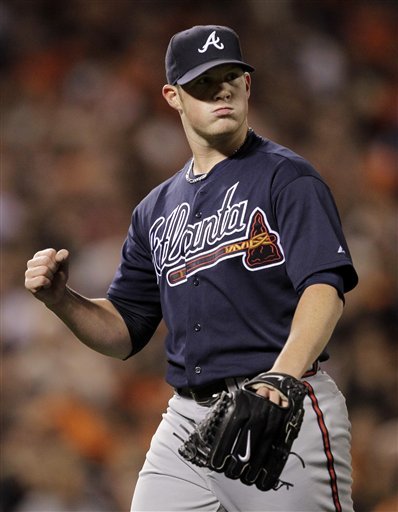
craig kimbrel.jpgIn the pole position is Craig Kimbrel, a fireballer with a 97 MPH fastball who has been groomed as the Closer of the Future with capital letters. He’s already fielding questions about being the closer this season. Eyeball ERA and strikeout rate alone, and he looks like a shoo-in. His numbers in those categories in both the minors (1.85 ERA, 14.4 K/9) and majors (0.44 ERA, 17.42 K/9) are impeccable, even eye-popping.

Those two numbers don’t quite tell the whole story, though. There’s one more number that must come to the fore: Kimbrel has walked a ton of batters in his career – 5.7 per nine innings in the minors and 16 in his first 20 and 2/3 innings in the majors (6.97 BB/9). He’s got some Ricky Vaughn in him, too.

Look at his pitching mix on Texas Leaguers, and you’ll see that this story continues on the pitch-by-pitch level. The swinging strike rates for his fastball (13.3%), changeup (24.3%) and slider (18.2%) are all well above the respective averages for those pitches (6.9% for fastballs, 15.1% for changeups, and 14.9% for sliders). It’s the changeup that gets strikes the least often (56.8%), and from FanGraphs’ splits page, we can see that he uses his fastball least often in 0-2 and 1-2 counts. Perhaps that poor strike rate on the pitch labeled as a changeup on Texas Leaguers leads to longer counts and more walks.

Looking around the league to see if there’s a role model for Kimbrel, we see that only eight qualified pitchers had a walk rate over 5 BB/9 IP. Among those, only Carlos Marmol and Kimbrel’s teammate Peter Moylan had ERAs under 3.00. Marmol is the obvious comp for Kimbrel, though, since he was the only one who paired a double-digit strikeout rate with a very poor walk rate. If Marmol’s success is to be believed, it seems to say that a walk rate like that can work, if the strikeout rate is stratospheric. Still, there’s some risk with Kimbrel if there’s really only one comp out there for him.

Competition from the rest of the pen should come mostly from fellow youngster Johnny Venters. The recently acquired Scott Linebrink is more decent than good (he’s never struck out a batter per inning or shown a good groundball rate, despite many solid years), and the rest of the pen is more about filling roles than finishing games.

Venters fared well in his rookie year. He struck out 10.08 batters per nine innings and garnered 68.4% of his contact on the ground, both excellent numbers that deserve attention, especially since he cooks with gas (94.6 MPH). While his control isn’t great (4.23 BB/9), it’s not as poor as Kimbrel’s. There is still a caveat for the lefty – he’s much better against lefties than righties. He struck out 14.79 per nine innings against lefties (and walked 3.21 per nine), and only had a 7.69 K/9 (4.75 BB/9) against righties. Those split issues also followed him through the minors, so they might be real.

Since Kimbrel has been groomed for the role and doesn’t own worrisome splits, he’s the front-runner. Venters is probably the backup plan. Treat them as such in your mixed-league drafts this season.  

Hawpe Leaps to San Diego

By R.J. Anderson //

Replacing Adrian Gonzalez’s production is nearly impossible, because the population of ballplayers who can hit like him is limited. Replacing Adrian Gonzalez’s body at first base is not as difficult, since just about any player can play first. With newly-acquired first base prospect Anthony Rizzo not yet ready for the big leagues, the Padres took a step to sure up their first base vacancy over the holiday weekend by signing Brad Hawpe.

What Hawpe does is this: He walks (12.9% career, 12.1% last year), usually hits for power (four straight seasons of 20-plus home runs until last season), and strikes out a lot (career 26.8%, 28.5% last season). What Hawpe does not do is field. That’s less of an issue with a move from the corner outfield to first base (and a non-issue in fantasy), but something to keep in mind nonetheless, as Hawpe attempts to adjust to the new position full-time, for the first time in his career.

The biggest difference between last year and the ones before was Hawpe’s home run per flyball percentage. In 2010, it plunged to 10.5%; from 2007 to 2009, it ranged from 17.6% and 17.9%. His career average is 16%.

The biggest obstacle for a Hawpe comeback is his home park. Petco Park is extremely pitcher-friendly, and it’s notoriously difficult on left-handed sluggers like Hawpe (which amplified Gonzalez’s accomplishments even more).

At least Hawpe is guaranteed the lion’s share of playing time at first base, but don’t necessarily bank on 600-to-650 plate appearances. The National League West is loaded with southpaws, and the Padres might add a right-handed option at first base too to form a platoon, or at least a semi-platoon. Late-inning pinch-hit appearances by right-handed bats are also possible.  

Hawpe is unlikely to reach his career slash line of .279/.373/.490, but he has a chance to top last season’s meager .245/.338/.419. From a fantasy perspective, though, he’s still a batting average risk, and expecting a bunch of home runs in that park is asking a lot. Draft Hawpe in NL-only and deep mixed league, but stay away in standard, 12-team mixed formats.

Is Brandon Webb Rosterable?

By R.J. Anderson //

Brandon Webb averaged 33 starts a season from 2003 until the 2009 season. He’s made one start since (on Opening Day of the 2009 season), as a shoulder injury sidelined him for the duration of the 2010 season. After 199 appearances with the Arizona Diamondbacks, number 200 and beyond will come as a member of the Texas Rangers. Webb signed a one-year deal with Texas, heavy on incentives, over the holiday weekend.

Webb threw for scouts late last season, and the reported velocity readings were disappointing. Webb has never been someone to toss fireballs at batters – his fastball has sat around 87-89 for his career – but low-to-mid 80s is a whole other beast. Webb has been one of the most extreme groundball pitchers in the game throughout his career, which could lead you to wonder if he could, in fact, get by with a fastball of 85 mph or lower. If he does, he’ll be in rarefied air. Below is a list of right-handed pitchers with velocities under 86 miles per hour on their fastballs last season, along with the usage rate and their ERA:

R.A. Dickey (83.9 MPH, 16.1% usage): 2.84 ERA

Livan Hernandez (84.3 MPH, 61.4% usage): 3.66 ERA

The accompanying peripherals suggest both Dickey and Hernandez weren’t as good as their ERA suggests. Next, comparing Webb to Dickey is a bit ridiculous. Dickey lives and dies with his knuckler – which makes him odd. Even odder is that he lacks a UCL in his throwing arm – i.e. the ligament operated on in Tommy John surgery. Comparing Webb to Hernandez is imperfect as well. Hernandez is notorious for his pacing and relative lack of stuff, getting by for years on guile and durability.

That Webb fits into his own category isn’t surprising. What that means, though, is that he should be approached carefully. Depending on spring reports, he could become borderline rosterable in deep AL-only leagues,. But for now Webb is not a suitable fantasy option, until proven otherwise.

Bill Hall Joins Fantasy Baseball’s Worst Infield

by Eno Sarris // 

You won’t find many fantasy baseball articles about the implications of Bill Hall joining the Houston Astros this off-season. That’s for good reason: Hall’s faults are well-defined, his upside muted, and his strengths not the kind that lead to fantasy dominance. What might be most notable about the acquisition is how well he will fit in that Astros infield.

bill-hall-brewers.jpgHall is who he is. Almost 3500 plate appearances into his career, we know he’ll take walks at about an average rate (7.8% career, 8.9% last year, average hovers around 8.5%), strike out way too often (28.7% career, 30.2% last year, average hovers around 20%), and put a charge into the ball (.193 ISO career, .209 last year, average hovers around .150). He’s versatile – in that he can play most positions without embarrassing himself, though he’s great with the glove. He’ll most likely start at second base for the Astros, but his history suggests he’ll rack up some games elsewhere by the end of the season.

Of course with that package, Hall’s usual place in fantasy baseball becomes clear. The lack of contact keeps his batting average too low to be a sought-after solution in mixed-league drafts (.250 career, .247 last year) but his ability to hit home runs and fill in at tough positions (Hall played 20+ games at LF and 2B, 5+ games at SS, CF, 3B, and RF) often becomes interesting at some point in the year. He’s mostly a waiver-wire, plug-in type. Maybe a late-round pick.

Remarkably, you might use that tag to describe each member of the Astros’ infield as presently constructed. On that infield, only Clint Barmes struck out less than 30% of the time last year, nobody walked
more than 9% of the time, and Hall’s 18 homers led the group. Dan Symborski’s well-respected ZiPs projections just came out for the Astros, and the projections for Brett Wallace (.261 BA, 17 HR, 59 RBI), Barmes (.245 BA, 11 HR, 8 SB), Hall (.234, 16 HR) and Chris Johnson (.269, 17 HR, 73 RBI) paint an ugly picture: The Astros are a good bet to field the worst fantasy infield in the game next year.

Caveats apply. The average qualifying second baseman put up a .276/.345/.414 line in 2010, and that resulting .138 ISO means that Hall will show well above-average power among his peers at that position. He could keep the starting second base job all year and hit 25 home runs with that short porch in left field, though he’s only once before hit more than 20 home runs. Even if he does top that power mark, the question remains how much losing those 30+ points of batting average will hurt your team.

If your league has corner infield spots, or you took a flier on a young or inconsistent third baseman ahead of Johnson, he could be a late-draft handcuff possibility – but in that case, there’s a chance that someone sees his batting average from last year and likes him better than they should. Wallace and Barmes – well, a wait-and-see approach is best for those two.