Is Peavy Worth a Look?
By R.J. Anderson //
Jake Peavy is one of the most difficult, yet intriguing pitchers in the field this season. A few years ago, Peavy was one of the finest pitchers in the league while benefitting from the spacious environment of San Diego’s cavernous ballpark. Injuries have since crept into Peavy’s life, leaving his status as an annual question mark. Peavy’s below league-average ERA certainly did not help his draft value and neither will the reports suggesting he is set to miss the beginning of the season. Not everything is so dire, though, as when Peavy pitched in 2010, he was actually solid.
Peavy’s first five starts were nothing short of disasterous as he allowed nearly as many earned runs (25) as innings pitched (28.2) with a strikeout-to-walk ratio barely topping 1. Over his next 12 starts, Peavy allowed 30 earned runs in 78 innings while posting a strikeout-to-walk ratio over 5. The exact reasoning for the turnaround is unknown. Perhaps Peavy adjusted to his new surroundings or finally began to feel healthy after missing most of the previous season. The important thing is whether Peavy can continue the success once he returns this season.
Most projection systems say yes, but are without knowledge of Peavy’s injury history. The exact effect of the ailments are impossible to know. Perhaps he bounces back just fine, or maybe he loses some zip on his fastball and some command. There’s no safe expectation to be had. In which case, the best approach is cautionary. Peavy could prove to be a waiver wire steal upon his return, but for now, treat his status delicately.
Baltimore Closer Battle
by Eno Sarris //
The closer carousel in Baltimore continues. Since 2008, George Sherrill, Alfredo Simon, Jim Johnson, David Hernandez, Mark Hendrickson, Mike Gonzalez, Lance Cormier, Jim Miller, Cla Meredith and Rocky Cherry have all notched a save for the Orioles, and that’s not mentioning the two main candidates for the closer’s role this year.
This past offseason, the Orioles signed Kevin Gregg to a two-year, $10 deal. Gregg has functioned as his teams’ closer for four straight years, providing solid-but-not-spectacular numbers for the Marlins, Cubs and Blue Jays along the way. Now that he’s the second-highest paid player in the pen, and owns the most career saves of the crew, is the the favorite for the role?
Probably, but that doesn’t mean he’s not without his flaws. Last year, Gregg struck out 8.85 batters per nine, walked 4.58 batters per nine, and had a 42.3% groundball rate. All of those numbers are too close to average for relievers to get very excited about. Relievers averaged 7.58 strikeouts per nine, 4.56 walks per nine, and a 42.7% groundball rate last year. That means that Gregg was a mere strikeout per nine away from being an average pitcher, which doesn’t scream “Closer” with a capital ‘c.’
Last year’s closer, Koji Uehara, is still with the team, as he was resigned to a one-year, $3 million deal that can jump to $5 with incentives. He might be paid a little less, but he’s a better pitcher. After moving to the pen last year, Uehara had an insane 11.25 strikeouts per nine against 1.02 walks per nine. He’s an extreme flyball pitcher – his 23.6% groundball rate has to count against him – but that kind of strikeout punch and control is ideal for a closer. Some may point to his relative inexperience in the role as a negative, but Uehara pitched over 1300 innings in Japan, saved 32 games in 2007, and has a generally excellent resume once you include his Japanese history.
Take a look at the Bloomberg Sports projection for Kevin Gregg on the left, and the argument comes into focus. Gregg may be in line for the saves right now, but his projected ERA (4.11) and WHIP (1.37) should make fantasy managers nervous. Remember, saves are just one category, and Uehara should easily trump Gregg in the other categories – and could easily steal the job completely. Consider handcuffing these two together late in drafts this year.
For the best fantasy baseball analysis and insight please visit BloombergSports.com
Pablo Sandoval In 2011: Sink Or Swim?
By Tommy Rancel //
Despite having just over two seasons under his rather large belt, Pablo Sandoval has seen the ups and downs of the major leagues. The Kung-Fu Panda made his debut for San Francisco in 2008, hitting .345/.357/.490 in an abbreviated 41-game rookie season. In his first full season at the big league level, he hit .330/.387/.559 with 25 home runs, 44 doubles, and somehow legged out five triples. For his efforts, he was rewarded with a top-10 finish in the 2009 National League MVP vote – placing seventh. Sandoval entered the 2010 season as a 23-year-old with a career batting average of .333 in over 700 at-bats. Then the season started…
Not only was Sandoval unable to replicate his 2009 success, but he did not even come close. In 152 games, he posted a slash line of .268/.323/.409. His home run total was pretty much cut in half (13), and he drove in just 63 runners compared to the 90 from the previous year. By season’s end, he was replaced by Juan Uribe in the lineup and totaled just 19 plate appearances in the playoffs as the Giants’ marched to a World Series title Such a steep drop-off for a player with Sandoval’s experience immediately brings up the word fluke. However, when looking past his fantasy stats, there are not many signs of fluke.
In terms of plate discipline, he was still a free swinger last season, but did not rack up a ton of strikeouts. He walk rate declined a bit, however, nothing substantial. Overall, he displayed the same patience as he did in 2009. In terms of batted ball data, he hit about the same number of line drives as well as ground and flyballs.
The areas where he experienced steep regression were batting average on balls in play and home run-to-flyball ratio. He was unlikely to be a career .330 hitter anyway so some correction was expected. In terms of the HR/FB issue, he might have regressed a bit too much leaving the potential for positive regression in the future.
With similar peripherals yet differerent results over the past two seasons, what can we expect in 2011? Another near-MVP caliber season or another mostly disappointing and average campaign?
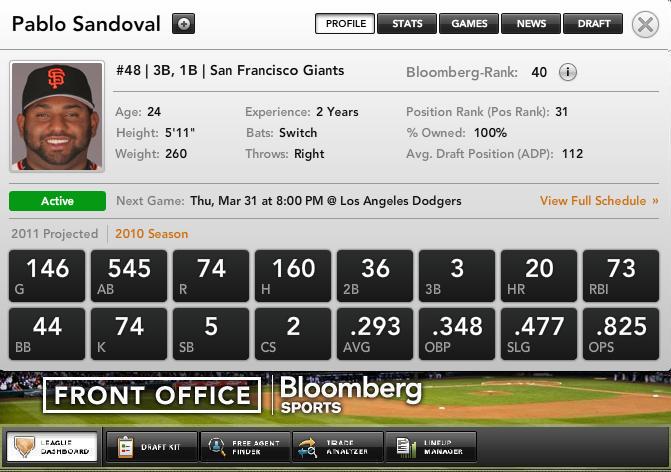
According to Bloomberg Sports’ projections, Sandoval should fall right in between. Our projections peg the Panda with a .293 average and an OPS of .825. In terms of power, the system projects him to once again top the 20 home run plateau with a steady dose of doubles mixed in.
After the season, Sandoval was told to lose weight by Giants’ management or face a demotion to the minors. We don’t know if he is the best shape of his life, but reports say he is in much better condition than he was a few months ago. In addition to working with trainers, he has also picked the mind of Giants’ great Barry Bonds about improving his swing and plate approach.
With the fresh stench of his 2010 lingering on some draft boards, Sandoval may linger around a bit longer than his true value. That said, he becomes a prime target in the mid-rounds as a bounce back sleeper with multi-position flexibility.
What To Watch In Spring Training
By Eriq Gardner //
The Year of Adam Jones?
By R.J. Anderson //
#avg_ls_inline_popup { position:absolute; z-index:9999; padding: 0px 0px; margin-left: 0px; margin-top: 0px; width: 240px; overflow: hidden; word-wrap: break-word; color: black; font-size: 10px; text-align: left; line-height: 13px;}
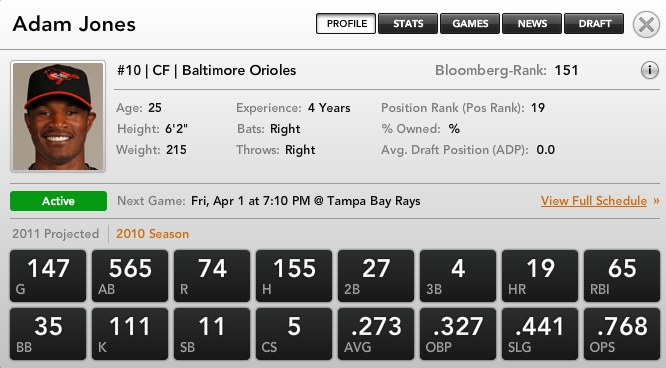
Over the weekend, the Orioles added Vladimir Guerrero. This development gives the Orioles a lineup heavy on name value, as the team could field a starting nine with Derrek Lee, J.J. Hardy, Nick Markakis, Brian Roberts, Matt Wieters, Mark Reynolds, Guerrero, Luke Scott, and Adam Jones. The latter is perhaps the most intriguing player not named Wieters.
Despite only being 25, it feels like Jones has a half-dozen seasons under his belt at the big league level — and he will after the 2011 season. Since becoming a regular with the Orioles, Jones is averaging a line of .278/.324/.343, above league-average rates, but one thing to take away from Jones is the predictive power of the hot hand. In more precise terms: There is no little to no predictive value.
Consider Jones’ month-by-month OPS breakdown during the 2010 season:
April: .634
May: .678
June: .952
July: .692
August: .850
September/October: .821
Depending on the narrative one wants to establish, Jones either needs to be more prepare to start the season or he finally got comfortable around midseason. Either way, it will lead to skewed views on just how valuable Jones should be viewed entering the 2011 season. The key is to look at the final product rather than how Jones got there unless there’s a reason (injury, mostly) to think one month is more indicative of his talents than another.
With respects to others, this means look beyond the last 10 days or three weeks of performance. In Jones’ case, do not expect a drastic step forward in performance. The typical hitter will gradually improve through his late 20s before beginning a decline, keep a conservative projection in mind for Jones rather than using his last month or two as the base line in order to avoid disappointment when it turns out he simply had a well-time hot streak.
Projection systems (like the one that generated the above projection) are heartless and emotionless. They are, undoubtedly, better at projecting players than human beings. When in doubt, trust the cold grip of a projection system above your gut and you’ll be less likely to suffer disappointment from under performing players.
For the best fantasy baseball analysis and insight please visit BloombergSports.com
#avg_ls_inline_popup { position:absolute; z-index:9999; padding: 0px 0px; margin-left: 0px; margin-top: 0px; width: 240px; overflow: hidden; word-wrap: break-word; color: black; font-size: 10px; text-align: left; line-height: 13px;}
MLB Fantasy Baseball Sleepers 2006 to 2011
The Biggest Fantasy Surprises
BloombergSports.com
2010
Jose Bautista, 3B/OF, Blue Jays
2009: 54 R, 13 HR, 40 RBI, .235 AVG
2010: 109 R, 54 HR, 124 RBI, .260 AVG
Can’t saw we saw this coming. Although Bautista had a big final month to the 2009 season, no one could have predicted him to the top power bat in the Majors last season.
2009
Ben Zobrist, INF, Rays
2008: 32 R, 12 HR, 30 RBI, 3 SB, .253 AVG
2009: 91 R, 27 HR, 91 RBI, 17 SB, .297 AVG
A solid all-around talent, Zobrist may have peaked in 2009, as his numbers declined quite a bit in 2010.
2008
Ryan Ludwick, OF, Cardinals
2007: 42 R, 14 HR, 52 RBI, .267 AVG
2008: 104 R, 37 HR, 113 RBI, .299 AVG
It’s nice to hit next to Albert Pujols, but the good times did not last. Ludwick is now bound to long singles and pop outs at Petco Park.
2007
Fausto Carmona, SP, Indians
2006: 1-10, 58 K, 5.42 ERA, 1.59 WHIP
2007: 19-8, 137 K, 3.06 ERA, 1.21 WHIP
Quite a turnaround for the failed closer, Carmona ranks as the ace for Cleveland and one of the better pitchers in the game.
2006
Garrett Atkins
2005: 62 R, 13 HR, 89 RBI, .287 AVG
2006: 117 R, 29 HR, 120 RBI, .329 AVG
Atkins enjoyed Rocky-High Colorado, but when placed in Baltimore he wasn’t even a starter.
Who will it be this season?
Pedro Alvarez: A big-time slugger who can lead the Pirates back to respectability.
Adam Jones: Has the talent, but so far not the results.
JP Arencibia: The Blue Jays quickly traded Mike Napoli because they don’t want anyone to get in his way.
Kila Ka’aihue: A star in the Minors, can the power translate at the Big League level.
For the best fantasy baseball analysis and insight please visit BloombergSports.com
Healthy Carlos Santana, Fantasy Super Sleeper
by Eno Sarris //
Most health updates at this point in the season are nigh useless. Yes, many major leaguers enter spring training in the best shape of their life. Why should we care?
In the case of Indians catcher Carlos Santana, there’s a little more significance to this latest piece of news:
Almost six months to the date after knee surgery to fix a strained LCL and hyper-extended knee suffered in this horrific collision, it looks like Carlos Santana is looking good again. He can catch and run the bases – he’ll get a full spring training.
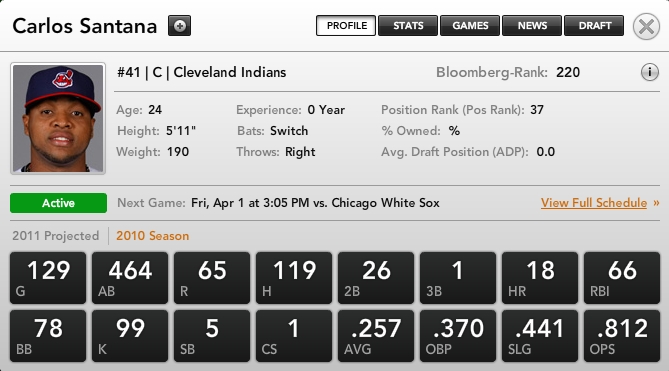
Projection systems can’t always take injuries into consideration. Sure, they can read that he ‘only’ managed 438 plate appearances next year, and take that into consideration when predicting his playing time this year, but they can’t examine the knee and declare it structurally sound. Bloomberg’s Front Office tool did its best, using the sage B-Rank to project Santana for a .257 batting average, with 18 home runs, 66 RBI and one stolen base in 538 plate appearances. Those numbers look nice, and will play at a tough fantasy posiiton, even if we can’t see the MRIs and examine the ligament ourselves.
What we can do is remark how spectacular Santana has already been by taking a look at his abbreviated 2010 season. Last year, he showed an OBP over .400 by walking in as many at-bats as he struck out (19.3% walk and strikeout rates in 2010). He also had a .207 ISO (isolated slugging percentage, or SLG – AVG), which translates to above-average for the general population (.150 is about average), but even better when compared to other catchers. In fact, only eight catchers have shown an ISO above .200 since 2005, and none of them showed the same elite plate discipline.
Carlos Santana has already shown he belongs. Once he shows he’s healthy, his price will begin rising. And appropriately so – he’s likely to end the season as a top option at his position. Recent mocks have Santana going anywhere from the seventh to the fifteenth round, but with this news expect that second number to get smaller.
For the best fantasy baseball analysis and insight please visit BloombergSports.com
MLB Headlines: Braves Closers, Millwood to Indians, and Vladimir to Baltimore
Normal
0
false
false
false
EN-US
X-NONE
X-NONE
/* Style Definitions */
table.MsoNormalTable
{mso-style-name:”Table Normal”;
mso-tstyle-rowband-size:0;
mso-tstyle-colband-size:0;
mso-style-noshow:yes;
mso-style-priority:99;
mso-style-qformat:yes;
mso-style-parent:””;
mso-padding-alt:0in 5.4pt 0in 5.4pt;
mso-para-margin-top:0in;
mso-para-margin-right:0in;
mso-para-margin-bottom:10.0pt;
mso-para-margin-left:0in;
line-height:115%;
mso-pagination:widow-orphan;
font-size:11.0pt;
font-family:”Calibri”,”sans-serif”;
mso-ascii-font-family:Calibri;
mso-ascii-theme-font:minor-latin;
mso-fareast-font-family:”Times New Roman”;
mso-fareast-theme-font:minor-fareast;
mso-hansi-font-family:Calibri;
mso-hansi-theme-font:minor-latin;}
Braves Likely to Split
Closing Duties: Kimbrel and Venters
Already some panic from fantasy managers before the season
has even commenced because Braves manager Fredi Gonzalez uttered the dreaded
words: “a closer’s platoon.”
The Braves seem to be loaded with talent on the hill and two
young hurlers coming off incredible 2010 performances are in position to pitch
the ninth inning.
First is Craig Kimbrel, who in 21 appearances surrendered
just one earned run, and a ******** 40 strikeouts. He does walk a lot of batters, but if his
first look is any indicator of what’s to come, he could be even better than
Billy Wagner. Right-handers hit just
.079 off him last season.
Then there is Jonny Venters, who struck out 93 batters in 83
innings. A southpaw, lefties hit just
.198 against him. So maybe not as
dominant as Kimbrel, but he is more proven with a full season under his
belt.
Both players are worth drafting due to their great
peripheral numbers. Kimbrel gets the
slight edge, but is also more risky.
Millwood to the
Indians?
Despite rumors that have the 36-year old signing with the
Yankees, Millwood is likely returning to Cleveland, where he posted a stellar
2.86 ERA in 2005. Of course, since then
there have been struggles.
Millwood has lost 10-plus games in six straight seasons and
last year hit a new low with a 4-16 record and 5.10 ERA.
Millwood is very hittable and gives up a lot of home runs,
so a move out of the American League East is probably a good move for the
veteran hurler.
Vladimir Guerrero
signs with the Orioles
One of the great hitters of his generation and a likely Hall
of Famer, the 36-year old Vladimir Guerrero is fresh off a monster year with 29
home runs, 115 RBI, and a .300 average for the Rangers. The good news is that he was not just a
product of the ballpark, as 13 home runs and 52 RBI came on the road.
Now that he will join the Orioles lineup, you should expect
a solid season with 20-plus home runs and a .280-plus average, but the
combination of another year under his belt and a less power-friendly confines
should keep expectations lower than a year ago.
Guerrero enters the season just 73 hits shy of 2500 for his
career and 24 home runs shy of 450.
For the best fantasy baseball analysis and insight please visit BloombergSports.com
Dan Hudson Remains A Sleeper In Arizona
By Tommy Rancel //
The Arizona Diamondbacks have completely revamped their rotation in the last calendar year. With Dan Haren, Brandon Webb, and Edwin Jackson now pitching for new teams, the D-Backs have added Joe Saunders, Ian Kennedy, Dan Hudson, and recently Armando Galarraga. The club even brought back reliever Aaron Heilman to compete for a rotation spot. In all fairness, the list reads as a casting call for your average fourth or fifth starter; however Dan Hudson had a real chance to stand out in the snakes’ rotation.
When Arizona acquired Hudson for Jackson last year, we quickly boarded the Hudson-hype train, urging owners to pick him up as a boost for playoff rotations. He did not disappoint – going 7-1 with a minuscule 1.69 ERA in 11 starts for the Diamondbacks. Overall, he went 8-2 with 2.45 ERA in 95 innings last year between Chicago and Arizona. After the trade to the National League, Hudson was literally spot-on. He struck out 70 batters in 79 innings while allowing just 16 walks. He induced a swing and a miss more than 12% of the time and allowed less than one baserunner per inning.
For all the good Hudson produced, there are some signs that he may regress from the absolute beast mode he displayed at the end of 2010. Though his strikeout rate may continue to be slightly above the league average, his walk rate is likely to regress from elite status to simply very good.
As a flyball pitcher, we were concerned about home runs being an issue at Chase Field; however, Hudson did a good job of limiting the big fly in his brief introduction to the stadium. Meanwhile, his home run-to-flyball ratio was below the league average which means he’ll likely allow more home runs in a larger sample size. In addition to the home runs, Hudson’s batting average on balls in play (.216) was well below the league average of around .300 and is also likely to see some regression.
Despite his strong showing at the end of the season, nobody expects Hudson to be a sub-2.00 ERA pitcher over the course of 30-plus starts. Going forward his ERA will probably be close to 3.50 than it will be 2.00. On the other hand, over the course of full-season that is still very valuable.
Though he may allow more hits and home runs, Hudson’s peripheral stats are strong enough to hold up as a valuable SP3 or possibly an SP2 in some deeper leagues. In even better news, Hudson goes into the 2011 season without much hype or fanfare meaning you could possibly get that value for the cost of an SP4 or SP5 in most standard mixed leagues.