Category: Uncategorized
Is Chone Figgins a Buy-Low?
By Eno Sarris //
The Mariners are surprisingly close to first in their division despite having amassed the second-least runs in the American League. Some of the blame for the scoring woes rests on their second-highest-priced position player, Chone Figgins. With the injury problems at third base across the league, baseball fans both real and fantasy want to know if Figgins can provide value this year.
This early in the season it’s hard to say much about certain aspects of a player’s game. Power, for example, doesn’t become reliable until the season is basically over. Power swings happen to players all the time. But, thanks to a famous article by “Pizza Cutter,” we can know which aspects of a game are reliable at this point. Mr. Cutter ran the numbers and found plate appearance thresholds at which stats could predict future performance from that player at a 70% reliability or better. Here are the stat thresholds that Figgins has passed:
50 PA – swing percentage
100 PA – contact rate, response bias (both just missed at 50… the real number is probably around 70)
150 PA – K rate, line drive rate, pitches/PA
200 PA – BB rate, grounder rate, GB/FB ratio
So basically we can best look at Figgins’ approach at the plate and batted ball mix right now. Looking solely at these numbers, there is reason for some cautious optimism.
At the plate, Figgins is swinging more than ever (43.5% this year, career 40.2%, average is 45.5%) and making more contact than he ever has (90.9% this year, career 86.7%, average is 80.9%). That’s right, in those two categories he’s sporting career highs. Since he’s not swinging more than the average player, it seems like this approach is a good thing. We see that his strikeout rate is also a career best (11.2% this year, 17.1% career), and since it’s backed up by his per-swing numbers and he’s had 192 plate appearances so far, we can believe he’s made strides there. Lower strikeout rates mean more balls in play and more opportunities for hits.
The unfortunate thing is that his walk rate is also at a career-low (5.2% this year, 10% career). Perhaps we can say that he will have more opportunities for hits, but since he’s walking less, his base-stealing opportunities should remain static. For every walk he loses, he gains at least a chance at a hit.

Of course, not every chance at a hit is equal. Line drives are the best batted ball in terms of batting average, then grounders, then fly balls. Since Figgins has very little power (.089 ISO, .150 is average), it would be best for him to hit the ball on the ground. Well, he’s showing his career-best ground ball percentage, and he’s only 8 PAs short of reliability there. It’s paired with the worst line drive rate of his career, though, so once again we have a mixed bag.
Then there’s the matter of Figgins’ batting average on balls in play (BABIP), which is very low at .226. Using Figgins’ mix of batted ball types – which are mostly reliable at this point – we can find an expected BABIP for Figgins – .312. (Check here for a more detailed explanation of the xBABIP calculator.) Given his lack of power, batted ball mix, and xBABIP, we could expect Figgins to hit as well as .260 going forward. He’s still attempting steals, and though his success rate has fallen this year, he’s going to get the green light from his team.
It’s reasonable to expect a middling batting average and a solid amount of steals from Figgins going forward, just like the Bloomberg Sports fantasy projections predicted before the season. At 33, he may be declining, but he’ll still help teams, fantasy and real, with his play this year.
For the best fantasy baseball analysis and insight please visit BloombergSports.com
(Vid) Behind the Numbers – Jason Fry and his favorite Mets memories
The Grand Slam Single & Other Baseball Stories
Hosts: Wayne Parillo and Brendan McGrail
Behind the Numbers is a series of conversations and discussions with baseball, blog, sabermetric, and fantasy experts.
Watch the entire episode, or use the links below to jump to the exact point you want:
Guest: Jason Fry
Celebrating the fan experience with Faithandfearinflushing.com co-founder and NY Times best selling author as he gives us with his craziest Mets story while watching a Mets game at a bar in New Orleans, his most emotional Mets memories, why he goes to games live, and R.A. Dickey and the Darth Vader outfit.
Follow him a @jasoncfry
- Introducing Jason C Fry & The Guest Host 0:21 – 0:58
- The lengths Jason went to watching a Mets game in New Orleans and the unintended involvement of adult entertainment and beer 1:17 – 6:35
- Brendan’s most electrifying he ever watched 6:36 – 7:56
- Being at The Grand Slam Single game and Shea physically rocking 8:19 – 10:20
- The most emotional stadium reactions Jason’s witnessed: Ventura, the 10 run comeback, and post 9/11 sports & why he thought he was having a heart attack and didn’t care 10:21 – 11:24
- What keeps Jason coming back to watch the games live 11:40 – 13:18
- Brendan on never outgrowing baseball and why you appreciate it on different levels over time 13:20 – 14:24
- RA Dickey’s Darth Vader outfit and the naming of his bats 15:00 – 15:58
- Closing & Credits 15:59 – the End
For the best fantasy baseball analysis and insight please visit BloombergSports.com
Follow us on twitter at:
Ramon Hernandez Leading The Way For Catchers
Normally, the catcher position is one of the weaker spots in your fantasy lineup. Outside of the top tier of talent, there is not much to be had behind the plate from a roto perspective. Catchers are not exactly lighting up in 2011; however, the position is out producing several other spots. In fact, catchers have combined for a higher OPS than several positions including the historically more powerful third base. Catchers have also combined to hit 141 home runs this year. That is more than second basemen, shortstops, third basemen, and center fielders.
For a few years, the position has been dominated by names like Joe Mauer, Brian McCann, and Victor Martinez. This season, more catchers are getting in on the action. Coming in to Monday night’s games, nine catchers with 90 or more plate appearances have an OPS of .800 or above. There are three more over .790. Even more surprising, none of the players on the list are named Mauer, McCann, or Posey.
In place of the common names we’ve see at the top of the catching leaderboard are names like Russell Martin, Alex Avila, Yadier Molina, and Jonathan Lucroy. Each of them owns an OPS greater than .860. But there is one name that has topped them all. With a slash line of .333/.380/.581, Cincinnati Reds’ catcher Ramon Hernandez is leading the way of offensive catchers.
Hernandez has been a productive fantasy player in the past. Since 2001, he has hit 15 or more home runs in five seasons – including two seasons with more than 20 bombs. In 97 games for the Reds last season, he hit .297/.364/.428. Of course when a player like Hernandez gets off to a hot start, the term fluke is tossed around.
The case of Hernandez is a rather interesting one. On one hand, his home run-to-flyball rate of nearly 25% is highly unlike to continue long-term. His .333 batting average on balls in play (BABIP) may seem high for a 35-year-old catcher with no speed. On the other hand, he posted a .332 BABIP in 352 plate appearances as at age 34 last season. Looking at his batted ball data (line drives, groundballs, flyballs) not much has changed except a few less grounders and a few more flyballs.
Despite the hot start, Hernandez is available in a large number of leagues. You may have one of the other productive catchers on your roster, but at his rate, he is becoming worthy of starting in a utility role. If you are able to grab Hernandez and team him a Jonathan Lucroy – a beneficiary of a lot of early season luck – you could double up on the catcher production and then perhaps trade one (in this scenario I would say Lucroy) while his value is high.
–Tommy Rancel
For access to the top baseball analytics and fantasy tool Bloomberg Sports Front Office visit BloombergSports.com
How The Preseason Sleepers Are Faring So Far
Time to check in an see how some favorite preseason sleepers are faring this season.
Bloomberg Sports was more optimistic on Hunter Pence, Dan Haren, Billy Butler, Jay Bruce, and Pablo Sandoval than most other fantasy baseball prognosticators.
On the positive side, Dan Haren and Jay Bruce have both paid off handsomely. Haren has been the fourth most valuable starter in the majors this year, according to the Front Office tool. He’s only garnered four wins in ten starts so far, but can show a 1.84 ERA and 66 strikeouts, which is second most in the American League at the moment. His better success this season can be attributed to better command — he’s brought down his walk rate — as well as a better ability to keep the ball in the ballpark. Last season, he was allowing 1.19 HRs per 9 IP; this season, in a friendlier pitcher’s park, that’s down to 0.37. He’s getting a tad lucky, but he’s likely going to earn his owners’ draft investment easily.
The same goes for Jay Bruce, who has 10 HRs, 4 SBs, and a respectable-for-a-slugger .265 batting average. Since last August, one can count the number of players with more HRs than Bruce on a single hand. Bruce has also made strides in his batting eye, cutting down on the strikeouts. A better Reds lineup also means he should surpass career high totals in runs and RBIs too.
Unfortunately, both Hunter Pence and Billy Butler seem to have taken a step backwards thus far. Pence is doing adequately on the surface with 5 HRs and a .293 AVG, but he’s whiffing a lot more at the plate these days. His strikeout rate is up from 17% last year to over 23% this one. Pence’s average may be due for some regression and he’s not stealing much either these days.
As for Butler, his batting eye is better than ever. He’s drawing a ton of walks and isn’t striking out significantly. Unfortunately, he only has 3 HRs this season as his HR-to-fly-balls has dipped down to the level we typically see from middle infielders with no power. He’ll be lucky to get to 20 HRs at this rate.
Pablo Sandoval was in the midst of a resurgent comeback season with 5 HRs and a .313 AVG in 91 plate appearances before he injured his hand and was lost for May. He’s due back next month but carries some risk. He’s likely to maintain a good average as his discipline at the plate is near elite; however, the hand injury could sap his power.
Finally, a look at some preseason sleeper favorites by others. Before the season began, we collected names being touted as breakouts and put them into a word cloud. The bigger the name, the more they were hyped…
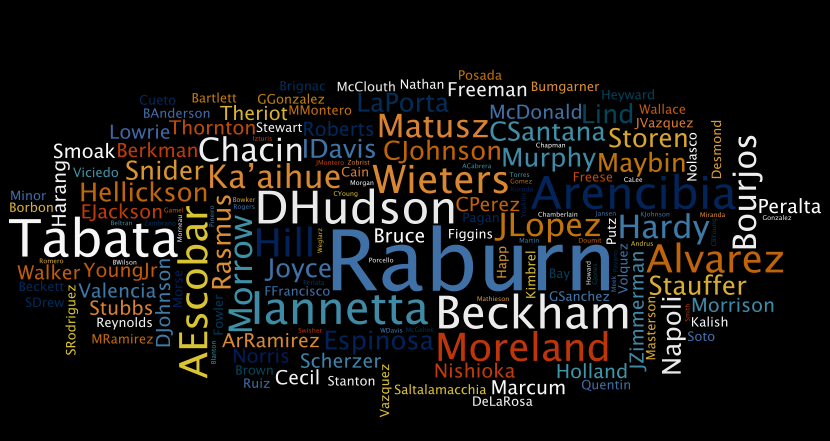
So far, the wisdom of crowds seems to be a bit off in 2011. Ryan Raburn is hitting close to the Mendoza Line with a putrid 49 strikeouts to just 7 walks. He’s only got four home runs thus far. Dan Hudson‘s peripheral numbers hint at better things to come, but he’s currently sitting on an ERA above 4 and a WHIP above 1.3. Jose Tabata started out strong, then had to deal with a minor injury, and is now struggling to get it going again. J.P Arencibia and Chris Iannetta have both delivered moderate power at the catcher position, but both struggle to put the ball into play and suffer terrible batting averages and low RBI totals as a result. On the more positive side, Jhoulys Chacin and Mitch Moreland have delivered nice value from the late draft rounds.
-Eriq Gardner
For more, check out Bloomberg Sports’ Front Office 2011
Hot Pickups On the Fantasy MLB Waiver Wire
Hot Pickups
Jake Peavy, SP, White Sox
In 22 career starts with the White Sox, Jake Peavy is now 11-6 with 123 K’s in 142 innings with a 3.93 ERA. Of course, before all the ankle injuries, Peavy was a legitimate ace, perhaps the elite pitcher in the game, peaking in 2007 with the Padres- 19-6, 240 K’s, and a 2.54 ERA. On Wednesday, Peavy went the distance for the White Sox allowing just 3 hits, no walks, and fanning 8. At just 30 years old, with a great track record, Peavy should be picked up in all fantasy leagues.
Ryan Ludwick, OF, Padres
Among the hottest hitters in baseball is Ryan Ludwick. He is riding a 7 game hit streak with four home runs, 13 RBI, and yet at the end of the day, his average sits at .227. Now I do think he is better than that, but Ludwick is just a career .264 hitter and playing in the cavernous Petco Park will not help his cause. I only see this as a hot streak, not the makings of a repeat of his 2008 campaign when he blasted 37 home runs with 113 RBI.
Matt Guerrier / Kenley Jansen
The Dodgers closer situation got a bit murkier when Vincente Padilla now is dealing with forearm stiffness and Matt Guerrier picked up the last save. I am still high on Kenley Jansen and think he’s the future closer, so he may be worth a pickup, but if you are looking for short-term, Guerrier has pitched well and could be well worth a flyer.
The National League West Has Center Field Talent
By R.J. Anderson //
The National League West is usually one of baseball’s tightest divisions. This season, it’s producing some interesting seasons from the center field position. Here is a rundown with the order based on the team name:
Diamondbacks – Chris Young
Young has started in center every game except one for Arizona this season and the usual caveats are still in play. Young will provide power (he already has eight home runs in a little under 200 plate appearances) at the expense of batting average (.225) and strikeouts (21.2 percent of his plate appearances). A higher percentage of Young’s hits and plate appearances are ending with extra bases, but his walk-to-strikeout rate is also at its worst since 2007.
Dodgers – Matt Kemp
Kemp has done Young one better by starting every game for the Dodgers. Because Kemp debuted at age 21, it’s easy to forget that he is only 26-years-old. Right now, he is in the midst of a ridiculous season, hitting .321/.404/.528 with 12 stolen bases (he stole 19 last season) and eight home runs. Kemp’s walks are up, his strikeouts are down, and the increase in singles is boosting his average. He is a surefire keeper.
Giants – Andres Torres
After a shocking 2010 season, Torres has missed most of the 2011 campaign due to injury. When he has played, he continues to hit well–.308/.379/.500. The danger in acquiring Torres is buying high via trade. Torres is unlikely to produce at that rate for too long, even if he managed to do so for 170 plate appearances in 2009. If Torres is available on the free agency market, grab him, otherwise stick to laurels when it comes to his value.
Padres – Cameron Maybin
One of the better stories in baseball this season, Maybin is hitting .273/.345/.440 after being acquired in an offseason deal. The Padres bought low and it’s paying off, as some nights he looks to be their best player. In nearly half the plate appearances as last season, Maybin already has roughly as many doubles, triples, home runs, stolen bases, and walks. If he is available, grab him. This could be the tip of the iceberg.
Rockies – Dexter Fowler
If your league values on-base percentage, then Fowler is unlikely to be available. His OBP is over .370 thanks to a walk rate near 15 percent. Unfortunately, Fowler’s strikeouts are up too, hence why his batting average is down despite good success on balls in play (a .374 BABIP versus .340 career).
This is one of those divisions and positions where every starting player is worth owning. If one of these five players is available in your league, scoop him up.
For access to the top baseball analytics and fantasy tool Bloomberg Sports Front Office visitBloombergSports.com
Bloomberg Sports’ Fantasy Baseball with MSG’s Tina Cervasio
Bloomberg Sports Anchor Rob Shaw goes one-on-one with MSG Network Sports Journalist Tina Cervacio. The topics range from Tina’s fantasy team, the Boston Red Sox, Brian Wilson, and some top fantasy baseball waiver wire pickups. For more fantasy baseball insight visit BloombergSports.com for access to the Front Office product. For Knicks and Red Bulls news and insight follow Tina on Twitter at @MSGTina.
(Vid) Behind the Numbers – Will Leitch on everything
Hosts: Robert Shaw and Wayne Parillo
Behind the Numbers is a series of conversations and discussions with baseball, blog, sabermetric, and fantasy experts.
Watch the entire episode, or use the links below to jump to the exact point you want:
Guest: Will Leitch
The extremely funny and entertaing co-founder Deadspin, contributing editor at New York Magazine, and author of four books stops by. Follow him a @williamfleitch
- Introducing Will Leitch 0:11 – 0:58
About Deadspin
- The creation and evolution of Deadspin & The Influence of Ron Mexico 1:00 – 5:51
- Did traditional media miss an opportunity? 6:21 – 7:04
- A story of Joel Sherman’s “blog” 7:11 – 7:50
- Why Deadspin was revolutionary for sports 8:04 – 8:28
Would Deadspin work now?
- Could Deadspin start up now due to changes in measurement of success 8:36 – 8:58
- Nick Denton emails about March Madness in June 8:58 – 9:28
- Having time to develop an audience & Kyle Orton 9:29 – 10:21
- The line between editorial and ad people and how it changes editorial 10:40 – 11:42
Is the opportunity for independent sites gone?
- Generate revenue in a new world 11:43 – 12:30
- The Only Way to get noticed: be good 12:31 – 13:00
- Why you can’t predict technology(social media) 13:01 – 14:00
- The change to Gawker 14:01 – 14:45
Branding
- Will Leitch: the Brand 14:46 – 15:24
- Rick Reilly’s comments to students 15:25 – 16:06
- Creating yourself as a brand 16:07 – 16:27
- The old path to success is gone 16:27 – 16:59
- New York Magazine’s hires: all with brand name recognition 17:00 – 17:40
- What editors want? Proof of skills 17:41 – 18:29
Closing & Credits 18:30 – the End
For the best fantasy baseball analysis and insight please visit BloombergSports.com
Follow us on twitter at:
The 35 & Up Club: Berkman, Helton, Ortiz, Lowe, Colon
May be you can’t teach an old dog new tricks. On the other hand, there are a few old dogs in the Major Leagues that are up to their old tricks. Here are five players 35 years of age or older who are producing at a high level. But how long can they keep it up? And what you should do if they are on your roster?
Lance Berkman
Berkman, 35, appeared on our surprise leaderboard list a few weeks ago. Although he has come back to earth recently, he came into Monday night’s games with a season slash line of .347/.434/.694. In just 36 games, he has 11 home runs and 34 RBI – second most in the league. In 122 games last season, he had just 14 home runs and drove in 58. Looking at his current .333 batting average on balls in play (BABIP) compared to his career .317 mark, Berkman’s hot streak appears to be more legit than fluke. The home runs may cool down a bit, but even if they do, he can rack up doubles. After looking done toward the end of last season, Berkman is a keeper in 2011.
Todd Helton
A fixture in the Rockies’ lineup since 1998, Helton is showing more power than we have seen in recent seasons. The 35-year-old belted his sixth home run on Sunday after hitting just eight in 2010. In fact, you’ll have to back to 2005 to find the last 20 home run season from Helton. His home run-to-flyball rate is a bit above average; however, 20 home runs look like a possibility once again for him. Meanwhile, Helton’s .325 average should not come as a surprise to anyone. He has not been a source for runs (17) or run production (19 RBI), but if you need average and gap power, he excels at both.
David Ortiz
In early 2009, it looked as if Ortiz, 35, was finished as a middle of the order threat in the Red Sox lineup. Fast forward to 2011 and Ortiz has a chance for his seventh 30-plus home run season since moving to Boston in 2003. Big Papi is also hitting for a high average (.295) with a sustainable BABIP (.298) despite the overshifting by opposing defenses. A large portion of that is due to a massive cut down in strikeout rates. As the top of the Red Sox order improves, his RBI chances will increase, only adding to his value.
Derek Lowe
One of the more durable pitchers of the last decade, Lowe has averaged 205 innings and 15 wins over the past nine seasons. This season, Lowe is striking out nearly a batter per inning after increasing the usage of his cut-fastball and slider. His 3.73 ERA appears sustainable and his groundball rate is once again amongst the league leaders. In a division where he is easily overlooked, Lowe, 37, remains one of the most consistent performers in fantasy leagues & real life as well.
Bartolo Colon
One of the more intriguing storylines in 2011, Colon has been a pleasant surprise in the New York Yankees rotation. Colon sat out the 2010 season, but has racked up 41 strikeouts in 43.1 innings with New York while maintaining a 3.74 ERA in the American League East. The results have been favorable for Colon thus far; however, one must question how long he can sustain this level of success. There isn’t much fluke in his numbers, but, his health remains a big question mark and his strikeout seems unstable considering he is getting a lot of called strikes. If you can afford to sell high, Colon is a good candidate.
–Tommy Rancel
For access to the top baseball analytics and fantasy tool Bloomberg Sports Front Office visit BloombergSports.com
Bloomberg Sports Waiver Wire Report: Helton, Lucroy, Porcello, Salas, and Posada
Todd Helton, 1B, Rockies
The 36-year old first baseman is having a blast from the past with six home runs, 19 RBI, and a .325 average. He has 3 homers in the last four games and now is just two shy of last year’s total of eight home runs.
Jonathan Lucroy, C, Brewers
This 24-year old backstop is red-hot with a six game hit streak that includes 10 hits, 2 homers, and 9 RBI. He is now hitting .329 on the season. Lasts eason he hit just .256 with four homers, but this is a guy who once hit 20 homers in a season in the Minor Leagues.
Rick Porcello, SP, Tigers
At 22 years old, Porcello already has 27 wins under his belt, and he is currently riding three straight wins. Over his last 5 starts, Porcello has surrendered just 7 earned runs, and while he does not get many strikeouts, he has offered a solid 3.67 ERA.
Fernando Salas/ Mitchell Boggs
The Cardinal’s closer’s gig is back on the market after Eduardo Sanchez blew a few saves. There are two names to know right now. Fernando Salas is a 25-year old hurler who boasts a 1.15 ERA this season with three saves. He gets about a strikeout per inning, and the opposition is hitting .170 off him. Then there is Mitchell Boggs a 27-year old flame-thrower with a 19-4 strikeout to walk ratio this season. He also has three saves, but his ERA is up to 3.66 and he struggled when initially handed the job a few weeks back.
Jorge Posada, C, Yankees
As if a .165 batting average wasn’t enough to keep him humble, Jorge Posada then asked out of the lineup when he was slotted to hit ninth on a nationally televised Saturday game against the Red Sox. He regrets the decision, and he won’t be punished thanks to his tremendous career in pinstripes. However, it does bring greater attention to the Yankees DH slot. If he does not get his average north of .200 by the end of the week, he is bound to lose his job. He already sits against southpaws, as he hasn’t had a hit in 24 at bats against them this season. Posada actually hit .257 against southpaws last year with a .493 slugging percentage, which is higher than what he offered against right-handers, so the fact that he is now getting benched against southpaws looks more like an excuse to take him out of the lineup.
 Bloomberg Sports