Category: Dailies
Adrian Beltre’s Glove and C.J. Wilson’s ERA
By R.J. Anderson //
Eno Sarris already wrote about Adrian Beltre’s impact on the Texas Rangers’ offense. Due to the nature of fantasy scoring, Beltre’s individual defensive value will not result in points. Instead, the only way fantasy owners can reap the excellence of Beltre’s defense is to pick up the Rangers pitchers who seem most likely to benefit.
The recipe for a pitcher who stands to gain from Beltre’s presence includes a pitcher who gives up plenty of balls to the left side. A large ratio of those balls should be of the groundball variety. While Beltre is sure to make a snag or two on a liner and track down a fly pop-up here and there, he’s going to make his living off scooping and firing grounders at a prolific rate.
Using Baseball-Reference’s groundball-to-flyball ratio (which includes line drives as flyballs), it turns out that only three of the Rangers 2010 pitchers finished above the league average mark of 0.79. Oddly enough, each is a southpaw. Ageless set-up man Darren Oliver (0.90), swingman Matt Harrison (0.88), and starter C.J. Wilson (0.98) vary in fantasy value. There is no reason to ever own Harrison, Oliver is a nice get in leagues that value holds, and Wilson might be considered one of the better pitchers in the American League if he can continue the success he found in his first season of starting.
Therefore, Wilson is going to get the attention here.
In 2010, batters held a batting average of .090 against Wilson on balls hit inside the infield (well above the American League average of .078). Batters also managed a .206 batting average on groundballs hit against Wilson (AL average was .231) and .556 on bunts (AL average was .449). Since exact batted ball locations are unavailable, assumptions have to be made based on the infielders’ overall defensive value.
FanGraphs’ UZR suggests that the only below-average defender on the Rangers infield last year was (then) third baseman Michael Young, with Ian Kinsler, Mitch Moreland, and Elvis Andrus rating as either average or above-average at their positions. That’s not to say UZR is perfect or that Young is responsible for Wilson’s mishaps on grounders per se.
But it does indicate that in a vacuum, the Rangers defense should be improve, with Beltre the vacuum cleaner set to replace Young at third base. And that should help Wilson retain some of his strong 2010 value, which included a sparkling 3.35 ERA.
Adrian Beltre, Texas Ranger
by Eno Sarris //
Look at the career statistics for Adrian Beltre, and you might be surprised to see how much money he’s made. After going to Texas and signing his newest five-year, $80 million contract (with a $16 million vesting option), Beltre will have earned close to $200 million (at least) by the time his career ends. And yet right now, his career batting average is a mere .275 and he’s averaged about 23 home runs per full year.
The truth is, he’s probably been worth the money (if not high fantasy picks most seasons) for two reasons: his glove and the offense-suppressing ballparks that have made his numbers look worse than they’d be most elsewhere. R.J. Anderson will take a look at the value of Beltre’s excellent glove later this week. For now, let’s take a look at Beltre and his relationship to his home parks over his career.
 Beltre didn’t like hitting in Safeco field. He’s a right-handed pull hitter and the park factor for home runs by a right-hander in that park is just 84 (100 is average). That kept him to a .253/.307/.409 line in 363 games in Seattle – 1406 at-bats that helped suppress his overall value in fantasy leagues. That modest work came after 489 games and a .253/.316/.423 line in spacious Dodger Stadium (which had a 92 park factor for right-handed home runs last year).
What happens to his overall numbers when you take out those 3076 at-bats? Away from Safeco and Dodger Stadium, Beltre has hit .293 with 26 home runs per 600 at-bats. And, as he showed with his .325 batting average and 28 home runs in Fenway, Beltre can be even better if given an extra boost by his home park.
Fenway had a 95 park factor for right-handed home runs – and a 130 park factor for right-handed doubles. That helped Beltre put together his second-best batting average and clear his previous high in doubles by eight in a great year for the Red Sox. His new stadium in Arlington has a 105 park factor for right-handed home runs (105 for doubles), and Beltre will surely enjoy calling such a park home.
The .331 batting average on balls in play in 2010, in the face of his career .294 BABIP, probably means that his batting average will fall in 2011. His new park won’t allow him to pepper the Green Monster with doubles any more. But while the batting average falls, the power might surge. A home park that is 10% friendlier for home runs will help his case.
Bill James projects a .283 batting average and 24 home runs for Beltre in 2011. Up the home run total since his new home stadium is now determined, and that looks about right. Take Beltre in the early rounds of your draft (especially given the position scarcity at third base) and profit off owners that put too much credence in his overall career numbers.
Can Aaron Harang Replicate Jon Garland’s Formula?
By R.J. Anderson //
A comparison:
Pitcher A – 1,829.1 IP, 4.42 ERA, 4.7 SO/9, 2.9 BB/9, 1.1 HR/9
Pitcher B – 1,451.2 IP, 4.33 ERA, 7.5 SO/9, 2.5 BB/9, 1.2 HR/9
Pitcher A is Jon Garland before joining the San Diego Padres; Pitcher B is Aaron Harang through the 2010 season. Harang has agreed to a one-year deal with the Friars worth $3 million, making the comparison apt and timely. Garland boosted his reputation by turning in an impressive 2010 season. A combination of 14 wins, 200 innings on the nose, and a 3.47 ERA has that sort of effect on opinions. Can Harang manage the same?
Harang was one of the National League’s finest starting pitcher from 2005 to 2007. His average season included 14 wins, 226 innings, a 3.77 ERA, and a 3.75 strikeout-to-walk ratio. He ate innings, he won games, he avoided walks, he struck batters out, and he did so while pitching in a hitter’s park. Since then, Harang has struggled to recapture any semblance of those seasons. His average season in the past three seasons: 6 wins, 153 innings, a 4.71 ERA, and a (still very good) 2.88 strikeout-to-walk ratio.
Some would call the 32-year-old hittable nowadays. His batting average on balls in play over the past two seasons tops .330. Prior to 2009, Harang’s BABIP had topped .320 over an entire season only once, and that came when he was much younger. One of Harang’s career-long ailments is home runs. Yet, believe it or not, his flyball per home run percentage is roughly league average (11%). The issue with Harang’s homers is not the percentage of flyballs they represent, but rather the percentage of batted balls that are flyballs. That’s nothing that a prolonged stay in the super-friendly confines of Petco Park (and the Padres’ likely to be very good defense) can’t potentially help fix.
With that in mind, don’t be surprised if Harang becomes a worthwhile sleeper pick in NL-only leagues.
Who Will Close in Atlanta?
by Eno Sarris //
Though the retirement papers haven’t been filed, it seems that Billy Wagner has holstered his left arm for good and left an opening at the back end of the Atlanta bullpen. Since the closer position is such a volatile job – about one-third of the closers who begin the year earning saves end up losing their job to injury or poor play – cheap saves are tantamount to fantasy success. Guessing correctly about Atlanta’s pen will pay dividends.
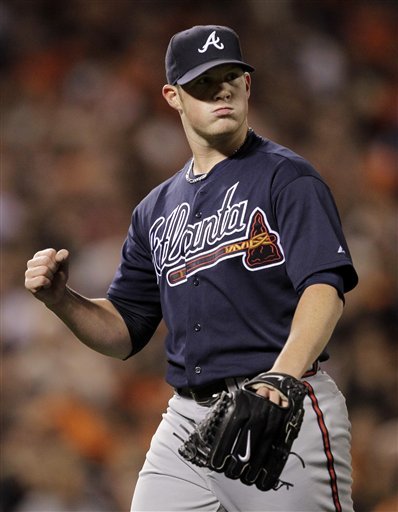 In the pole position is Craig Kimbrel, a fireballer with a 97 MPH fastball who has been groomed as the Closer of the Future with capital letters. He’s already fielding questions about being the closer this season. Eyeball ERA and strikeout rate alone, and he looks like a shoo-in. His numbers in those categories in both the minors (1.85 ERA, 14.4 K/9) and majors (0.44 ERA, 17.42 K/9) are impeccable, even eye-popping.
Those two numbers don’t quite tell the whole story, though. There’s one more number that must come to the fore: Kimbrel has walked a ton of batters in his career – 5.7 per nine innings in the minors and 16 in his first 20 and 2/3 innings in the majors (6.97 BB/9). He’s got some Ricky Vaughn in him, too.
Look at his pitching mix on Texas Leaguers, and you’ll see that this story continues on the pitch-by-pitch level. The swinging strike rates for his fastball (13.3%), changeup (24.3%) and slider (18.2%) are all well above the respective averages for those pitches (6.9% for fastballs, 15.1% for changeups, and 14.9% for sliders). It’s the changeup that gets strikes the least often (56.8%), and from FanGraphs’ splits page, we can see that he uses his fastball least often in 0-2 and 1-2 counts. Perhaps that poor strike rate on the pitch labeled as a changeup on Texas Leaguers leads to longer counts and more walks.
Looking around the league to see if there’s a role model for Kimbrel, we see that only eight qualified pitchers had a walk rate over 5 BB/9 IP. Among those, only Carlos Marmol and Kimbrel’s teammate Peter Moylan had ERAs under 3.00. Marmol is the obvious comp for Kimbrel, though, since he was the only one who paired a double-digit strikeout rate with a very poor walk rate. If Marmol’s success is to be believed, it seems to say that a walk rate like that can work, if the strikeout rate is stratospheric. Still, there’s some risk with Kimbrel if there’s really only one comp out there for him.
Competition from the rest of the pen should come mostly from fellow youngster Johnny Venters. The recently acquired Scott Linebrink is more decent than good (he’s never struck out a batter per inning or shown a good groundball rate, despite many solid years), and the rest of the pen is more about filling roles than finishing games.
Venters fared well in his rookie year. He struck out 10.08 batters per nine innings and garnered 68.4% of his contact on the ground, both excellent numbers that deserve attention, especially since he cooks with gas (94.6 MPH). While his control isn’t great (4.23 BB/9), it’s not as poor as Kimbrel’s. There is still a caveat for the lefty – he’s much better against lefties than righties. He struck out 14.79 per nine innings against lefties (and walked 3.21 per nine), and only had a 7.69 K/9 (4.75 BB/9) against righties. Those split issues also followed him through the minors, so they might be real.
Since Kimbrel has been groomed for the role and doesn’t own worrisome splits, he’s the front-runner. Venters is probably the backup plan. Treat them as such in your mixed-league drafts this season.
Hawpe Leaps to San Diego
By R.J. Anderson //
Replacing Adrian Gonzalez’s production is nearly impossible, because the population of ballplayers who can hit like him is limited. Replacing Adrian Gonzalez’s body at first base is not as difficult, since just about any player can play first. With newly-acquired first base prospect Anthony Rizzo not yet ready for the big leagues, the Padres took a step to sure up their first base vacancy over the holiday weekend by signing Brad Hawpe.
What Hawpe does is this: He walks (12.9% career, 12.1% last year), usually hits for power (four straight seasons of 20-plus home runs until last season), and strikes out a lot (career 26.8%, 28.5% last season). What Hawpe does not do is field. That’s less of an issue with a move from the corner outfield to first base (and a non-issue in fantasy), but something to keep in mind nonetheless, as Hawpe attempts to adjust to the new position full-time, for the first time in his career.
The biggest difference between last year and the ones before was Hawpe’s home run per flyball percentage. In 2010, it plunged to 10.5%; from 2007 to 2009, it ranged from 17.6% and 17.9%. His career average is 16%.
The biggest obstacle for a Hawpe comeback is his home park. Petco Park is extremely pitcher-friendly, and it’s notoriously difficult on left-handed sluggers like Hawpe (which amplified Gonzalez’s accomplishments even more).
At least Hawpe is guaranteed the lion’s share of playing time at first base, but don’t necessarily bank on 600-to-650 plate appearances. The National League West is loaded with southpaws, and the Padres might add a right-handed option at first base too to form a platoon, or at least a semi-platoon. Late-inning pinch-hit appearances by right-handed bats are also possible.
Hawpe is unlikely to reach his career slash line of .279/.373/.490, but he has a chance to top last season’s meager .245/.338/.419. From a fantasy perspective, though, he’s still a batting average risk, and expecting a bunch of home runs in that park is asking a lot. Draft Hawpe in NL-only and deep mixed league, but stay away in standard, 12-team mixed formats.
Is Brandon Webb Rosterable?
By R.J. Anderson //
Brandon Webb averaged 33 starts a season from 2003 until the 2009 season. He’s made one start since (on Opening Day of the 2009 season), as a shoulder injury sidelined him for the duration of the 2010 season. After 199 appearances with the Arizona Diamondbacks, number 200 and beyond will come as a member of the Texas Rangers. Webb signed a one-year deal with Texas, heavy on incentives, over the holiday weekend.
Webb threw for scouts late last season, and the reported velocity readings were disappointing. Webb has never been someone to toss fireballs at batters – his fastball has sat around 87-89 for his career – but low-to-mid 80s is a whole other beast. Webb has been one of the most extreme groundball pitchers in the game throughout his career, which could lead you to wonder if he could, in fact, get by with a fastball of 85 mph or lower. If he does, he’ll be in rarefied air. Below is a list of right-handed pitchers with velocities under 86 miles per hour on their fastballs last season, along with the usage rate and their ERA:
R.A. Dickey (83.9 MPH, 16.1% usage): 2.84 ERA
Livan Hernandez (84.3 MPH, 61.4% usage): 3.66 ERA
The accompanying peripherals suggest both Dickey and Hernandez weren’t as good as their ERA suggests. Next, comparing Webb to Dickey is a bit ridiculous. Dickey lives and dies with his knuckler – which makes him odd. Even odder is that he lacks a UCL in his throwing arm – i.e. the ligament operated on in Tommy John surgery. Comparing Webb to Hernandez is imperfect as well. Hernandez is notorious for his pacing and relative lack of stuff, getting by for years on guile and durability.
That Webb fits into his own category isn’t surprising. What that means, though, is that he should be approached carefully. Depending on spring reports, he could become borderline rosterable in deep AL-only leagues,. But for now Webb is not a suitable fantasy option, until proven otherwise.
Bill Hall Joins Fantasy Baseball’s Worst Infield
by Eno Sarris //
You won’t find many fantasy baseball articles about the implications of Bill Hall joining the Houston Astros this off-season. That’s for good reason: Hall’s faults are well-defined, his upside muted, and his strengths not the kind that lead to fantasy dominance. What might be most notable about the acquisition is how well he will fit in that Astros infield.
 Hall is who he is. Almost 3500 plate appearances into his career, we know he’ll take walks at about an average rate (7.8% career, 8.9% last year, average hovers around 8.5%), strike out way too often (28.7% career, 30.2% last year, average hovers around 20%), and put a charge into the ball (.193 ISO career, .209 last year, average hovers around .150). He’s versatile – in that he can play most positions without embarrassing himself, though he’s great with the glove. He’ll most likely start at second base for the Astros, but his history suggests he’ll rack up some games elsewhere by the end of the season.
Of course with that package, Hall’s usual place in fantasy baseball becomes clear. The lack of contact keeps his batting average too low to be a sought-after solution in mixed-league drafts (.250 career, .247 last year) but his ability to hit home runs and fill in at tough positions (Hall played 20+ games at LF and 2B, 5+ games at SS, CF, 3B, and RF) often becomes interesting at some point in the year. He’s mostly a waiver-wire, plug-in type. Maybe a late-round pick.
Remarkably, you might use that tag to describe each member of the Astros’ infield as presently constructed. On that infield, only Clint Barmes struck out less than 30% of the time last year, nobody walked
more than 9% of the time, and Hall’s 18 homers led the group. Dan Symborski’s well-respected ZiPs projections just came out for the Astros, and the projections for Brett Wallace (.261 BA, 17 HR, 59 RBI), Barmes (.245 BA, 11 HR, 8 SB), Hall (.234, 16 HR) and Chris Johnson (.269, 17 HR, 73 RBI) paint an ugly picture: The Astros are a good bet to field the worst fantasy infield in the game next year.
Caveats apply. The average qualifying second baseman put up a .276/.345/.414 line in 2010, and that resulting .138 ISO means that Hall will show well above-average power among his peers at that position. He could keep the starting second base job all year and hit 25 home runs with that short porch in left field, though he’s only once before hit more than 20 home runs. Even if he does top that power mark, the question remains how much losing those 30+ points of batting average will hurt your team.
If your league has corner infield spots, or you took a flier on a young or inconsistent third baseman ahead of Johnson, he could be a late-draft handcuff possibility – but in that case, there’s a chance that someone sees his batting average from last year and likes him better than they should. Wallace and Barmes – well, a wait-and-see approach is best for those two.
Fantasy Third Basemen: Strike Early or Late
by Eno Sarris //
When planning your draft for the 2011 season, there are a few different ways to consider positional scarcity. While introducing us to Tsuyoshi Nishioka recently, Eriq Gardner showed us the relative run production for each position on the infield, which demonstrated how terrible shortstop can be. That graph is certainly one way to consider the relative strengths of each position.
But for the most part, only the 12 to 18 best (including CI/MI/UT) at each infield position are relevant in regular mixed leagues. Another way to consider your approach would be to take a look at the projections and rankings at the position and highlight some tiers. A tier-based approach allows you to know when to leap, and when to wait.
Let’s take a look at third base. If you strike early for a first-tier third baseman, you’re looking at Evan Longoria, David Wright and Ryan Zimmerman. Those are fine selections, and there’s no reason not to take any of these three early in your draft.
But only three members of your league will leave the early rounds with an elite third baseman, and the names that follow are fraught with uncertainty. Alex Rodriguez (age-related decline), Adrian Beltre (home park, lineup and some consistency issues), Jose Bautista (batting average, limited track record), Michael Young (muted power), Aramis Ramirez (health) and Mark Reynolds (batting average) all have question marks as large as their relative upsides. You could reasonably lump these players into one tier, which means that as you fill your other positions, your leaguemates will be spending picks on this tier.
Now we’re nine third basemen into the rankings, and only two other managers have a hole at the position – with possibly a few more willing to speculate on a CI or UT third base option. You could define scarcity at the position as the quality of this final tier. How does third base rank in this situation? Well, left on the board are Pablo Sandoval, Casey McGehee, Chase Headley, Pedro Alvarez and Ian Stewart. Take a look at the projections I’ve cobbled together for these players, and you’ll see that while there’s plenty of risk here, there’s also a decent amount of upside.
 The best part about this group is that they are a diverse bunch. Need some steals? Headley has swiped double-digit bases in each of the past two seasons, and considering his total last year (17), he may have upside to better his projection in that category. He’ll likely either steal the second- or third-most bases at the position. Need batting average above all else? Might as well take the leap that the Kung Fu Panda will return to his hit-filled ways. The good news is that Sandoval has lost 10 pounds already this off-season, and that some positive regression should be expected after such a huge year-to-year drop from 2009 to 2010. Want a safe player after filling your team with risk? McGehee has been solid the past two years and seems like he could easily hit these projections even with a step back. Need power upside no matter what? Take your pick between the young and exciting Alvarez, and Stewart, or take both to spread out your risk.
Looking at the position as a whole is important – that’s the easiest way to see the overall offensive strengths around the diamond. But looking at the particular personnel and the particular strengths and weaknesses of the players near the bottom of your rankings is also a good way to plan your draft.
Royals Trade Zack Greinke To Brewers
By Tommy Rancel //
Following weeks of speculation, requests, and an agent change, Zack Greinke finally got his wish. The Kansas City Royals traded their ace to the Milwaukee Brewers for a package of players including: outfielder Lorenzo Cain, shortstop Alcides Escobar, and pitchers Jake Odorizzi and Jeremy Jeffress. The Brewers will also receive shortstop Yuniesky Betancourt and $2 million in cash.
Going by both traditional and advanced metrics, Greinke took a step back from his Cy Young season of 2009. He went just 10-14 with a 4.17 ERA after going 16-8 with a 2.16 ERA the year before. Meanwhile, FIP (fielding independent pitching) and xFIP (expected fielding independent pitching) – two metrics that strip away luck and defense from a pitcher’s performance – suggest that Greinke was closer to a run worse in 2010 and not the full two runs that his ERA showed.
While Greinke pulled back from 2009, he regressed toward his career level, which is still that of a really good pitcher. His strikeout-to-walk ratio (K/BB) of 3.29 was nearly identical to his career 3.33 K/BB. His home run rate was also within striking distance of his career number.
Discounting bad luck from the equation, his batting average on balls in play (BABIP) of .314 was basically identical to his .315 career average. That said, his strand rate or LOB% (percentage of base runners left on base) was just 65.3%. That’s about 7% lower than the league average and his career rate. Strand rate often depends on factors such as relief pitchers’ support; the sharp drop in Greinke’s rate suggest bad luck more than a big drop in skill.
A large part of Greinke’s 2009 success was fueled by strikeouts. His K/9 (strikeouts per nine innings) topped 9.0 for the first time in ’09. That number dipped to 7.40 in 2010, but again was in line with his career 7.56 K/9. Not surprisingly, his percentage of swinging strikes also dropped, from 9.9% to 7.5%.
Another change for Greinke was groundballs. A historically neutral pitcher, his groundball rate was an even 46%. According to Baseball Info Solutions, he threw more change-ups and fewer breaking balls than usual, which could explain the shift in batted ball data.
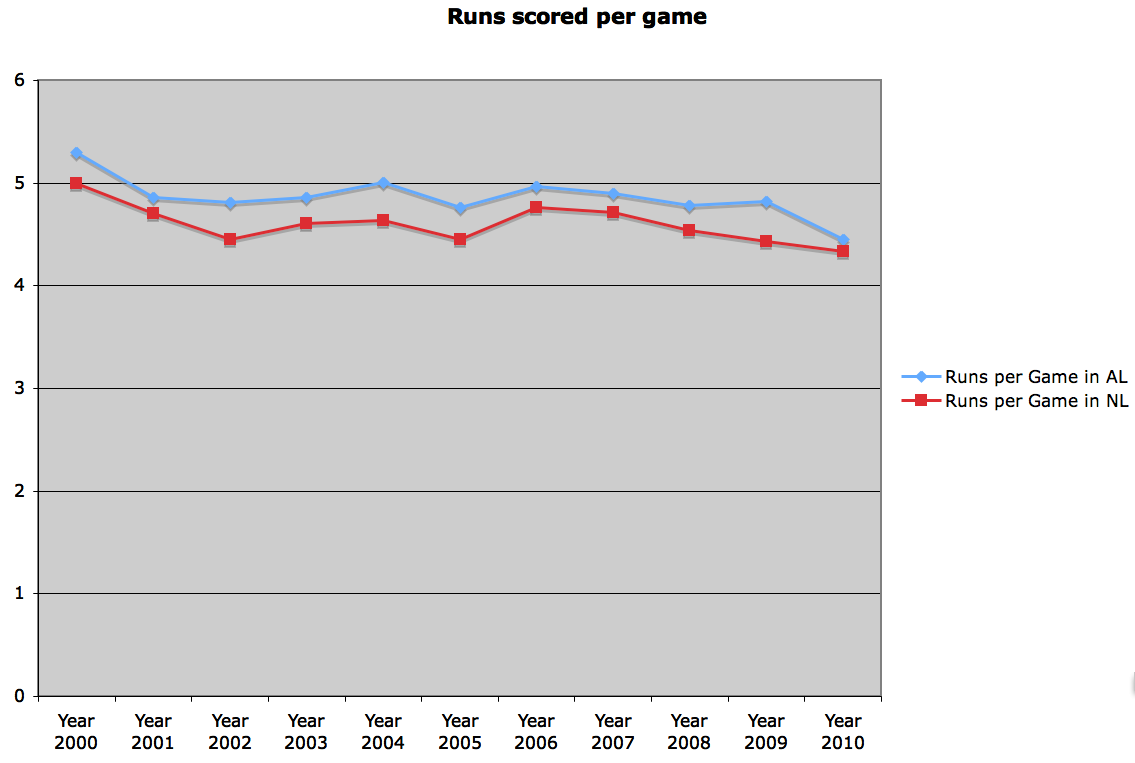
Unlike last season, Greinke will not be saddled with the expectations of repeating 2009’s performance next season. Instead, look for double-digit wins, 200+ innings, and an ERA of 3.75 or lower (possibly much lower). Like the recently acquired Shaun Marcum, moving from the American League to the National League should also help. Some will shy away from his 2010 numbers, but you shouldn’t make that mistake. Treat Greinke as a true SP1 option, even in mixed leagues.
For Kansas City, Alcides Escobar will become the team’s everyday shortstop, while Lorenzo Cain should roam center field on most days. Escobar’s slash line of .235/.288/.326 ranked among the worst by any full-time hitter. A lower than expected BABIP (.264, vs. league average of about .300) does suggest some bad mojo involved. The Brewers did not let Escobar run much (14 attempts, 10 steals), but he showed a lot of speed with 10 triples. If the Royals let him roam free, he could post 25-30 extra-base hits, with matching steals. His weak batting eye could harm his batting average and also runs scored, though.
On the flip side, Cain’s positive slash line of .306/.348/.415 was largely influenced by his .370 BABIP. That number will likely regress in 2011. Like Escobar, though, Cain should be another decent speed option, especially in AL-only formats.
The Zack Greinke Trade: Impact on NL vs. AL Hitters
 Bloomberg Sports