Category: Dailies
Will Scott Podsednik Steal 50 Bases This Year?
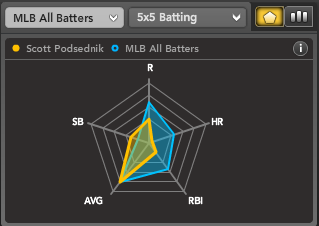

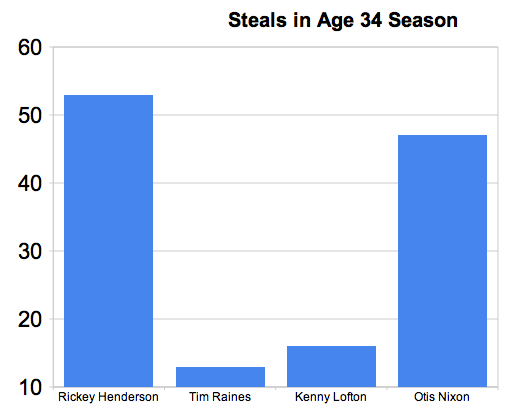
We’re betting on the latter. If you own him and can sell high, do it.
Fantasy Baseball Intelligence, Episode 6
By Jonah Keri //
In Episode 6 of Fantasy Baseball Intelligence, Bloomberg Sports’ Wayne Parillo and I discuss advanced stats, and how they may help you win your fantasy baseball league.
Here’s the direct link to the podcast. To subscribe to an RSS feed of Bloomberg Sports’ podcast, head here, or check out Fantasy Baseball Intelligence at iTunes.
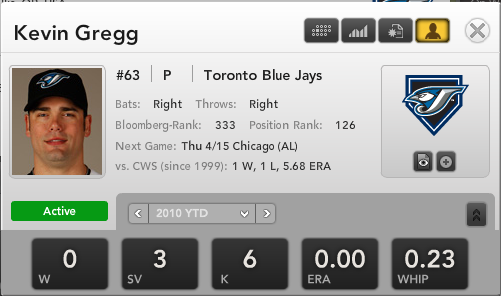
Kevin Gregg In As Blue Jays Closer; Jason Frasor Out
By Tommy Rancel //
The season’s barely started, yet by last count we’ve had seven teams make a switch from their projected closer. Some are injury related, and some are simple managerial decisions. The decision by the Toronto Blue Jays to remove Jason Frasor from the closer’s role in favor of Kevin Gregg falls under the latter.
Normally, making a switch this early would scream knee-jerk reaction. On the other hand, Gregg and Frasor were locked in a tight battle this spring, and the Jays didn’t give Gregg nearly $3 million this winter without considering the possibility that he might close some games.
Frasor has struggled in his five games so far. Meanwhile, there is concern about his velocity, which is down more than two miles per hour from 2009. That could just be a product of building up arm strength early in the year, but also good reason to lower his usage in high-leverage situations for now.
Gregg came to Toronto after one disappointing season with the Chicago Cubs. Despite the ugly 4.72 ERA in Chicago, his peripheral stats were pretty good. His 9.31 strikeouts per nine innings (K/9) were just off his career best and among the highest such rates in the game. His walk per nine innings (BB/9) of 3.92 was his lowest total since 2006.
Gregg struggled with the long ball while in Chicago. After allowing 10 home runs in two seasons with the Marlins, he yielded 13 homers in 2009 with the Cubs. Some of that was bad luck, though: Gregg posted an aberrant 15.3% home run-to-fly ball rate (HR/FB), much higher than his career rate of 8.5%. He is likely due for some regression.
If we normalize his HR/FB from 2009 using expected fielding independent pitching (xFIP), a metric that looks at things pitchers can control like strikeouts and walks with a normalized home run rate, we see Gregg’s xFIP of 4.18 last year was a lot better than the near 5.00 ERA.
In addition to regression, Gregg has made some changes in pitch selection that could go a long way in lowering his home runs allowed. Since 2003, nearly 85% of Gregg’s pitches have been a fastball (65%) or slider (18%). But in early 2010, he’s thrown the pair of pitches less than 60% of the time.
In their place, he’s throwing more split-fingered fastballs (8.4% career, 23.1% in 2010), and has reintroduced a cutter to his arsenal. Gregg has dabbled with a cutter before – throwing it 2% of the time in his career – but is throwing the pitch nearly 20% of the time so far this season. Please note that all these percentages are extremely small sample sizes, but don’t ignore the fact that Gregg has made some adjustments.
It also seems the pitch selection changes have changed the type of pitcher Gregg is. He’s getting nearly 70% groundballs this year after getting less than 40% for his career. Of course a 70% groundball rate is unlikely over the course of a full season (unless you’re Chad Bradford). Nonetheless, if Gregg and his newfound weapons can keep that ground ball rate above 45% (or even better, 50%), that would be a nifty shift for the 31-year-old.
If he’s available in your league, immediately grab Gregg regardless of size and format. Frasor and Scott Downs are still in the mix, but all things considered, Gregg is looking like a strong play, especially in a season that has seen a 23% turnover rate at the closer position in just 10 days. Also remember that Toronto has seen a different saves leader in each of the last five seasons including Frasor in 2009. This trend looks likely to continue in 2010.
For more on Kevin Gregg and the Toronto Blue Jays check out Bloomberg Sports’ fantasy kits.
Who Replaces Mike Gonzalez?
By R.J. Anderson //
The Orioles’ signing of Mike Gonzalez during the off-season was an odd move. The team had no hopes of competing this year, maybe not even in 2011, yet felt for the talent Gonzalez held, he was too good to pass up for the cost (in draft picks and money).
The start of Gonzalez’s 2010 season was not what the team had in mind when the contract was being crafted. Gonzalez made three appearances over the opening week, completing two innings, saving one game, and taking the loss in the other two. On Wednesday, he was placed on the 15-day disabled list with a strained shoulder. There’s little to no point in looking into the statistics of three outings as anything meaningful. One potential trouble sign did emerge, though: Gonzalez’s fastball velocity was down nearly two full miles per hour.
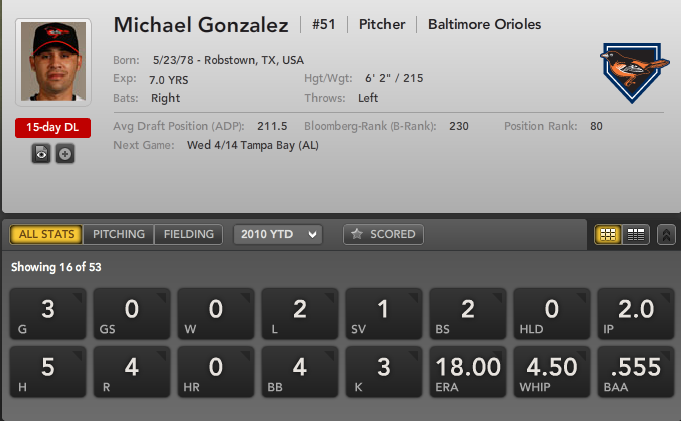
Replacing him in the closer role for now will be Jim Johnson.
Johnson is a big right-hander who actually saved 10 games for the
Orioles last season and has pitched in 50 games or more in the past two
seasons.
Johnson certainly could morph into a season-long option. Gonzalez’s struggles had certainly raised the possibility of his closer tag being removed. At the same time, it’s hard to see that occurring now with his injury. At best, Johnson will serve as the temporary closer until Gonzalez returns and proves his health.
The good news is that the rest of the Orioles’ pen looks like a mess. Well, that’s sort of good news, at least. It means Johnson has little to no competition for those save situations, but it also means a few save opportunities could be blown by lesser quality pitchers.
He doesn’t strike out as many batters as you would expect from someone with mid-90s velocity (just 5.0 per nine innings in 2008, an improved 6.3 per 9 IP in 2009), but he is an extreme groundball reliever, which helps to hold his home run totals down. The problem is that the Orioles’ infield defense is rather lackluster, making him a WHIP liability on bad days. That makes young reliever Kam Mickolio a deep sleeper in extremely deep leagues, including AL-only ones.
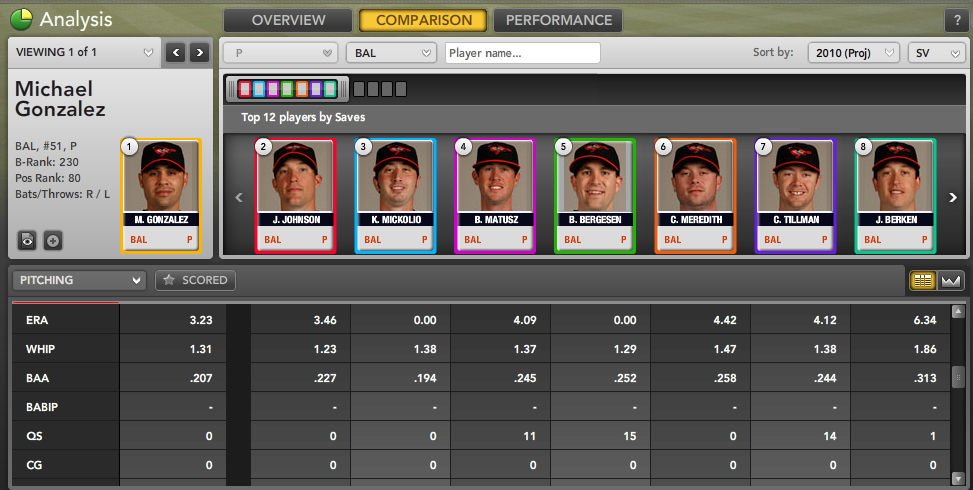
Despite Johnson’s flaws, he’s well worth a pickup in deeper leagues. If nothing else, you can always hoard saves, then trade them for other assets later. In the meantime, keep an eye on Gonzalez’s recovery, and how Mickolio fares in the early going.
Don’t Chase Early Stats
Slow-Starting Targets: Adam LaRoche, Alexei Ramirez, Hunter Pence
By Tommy Rancel
The regular season has started, and now it’s time to work your magic as a fantasy general manager. One of the angles to exploit in the early part of the season is slow starts. There is always someone in your league that is on edge beginning Opening Day, ready to ditch a player at the first signs of struggles. With that in mind, here is a look at some notorious slow starters you might be able to steal in a buy-low trade.
Adam LaRoche
LaRoche entered 2010 with a new team, yet got off to the same old slow start. He started his Arizona Diamondbacks career 0-for-13. He’s racked up a few hits since then, but is still hitting an ugly .231/.310/.308 (AVG/OBP/SLG), with no homers, no steals and just 3 RBI in 7 games. Long-time LaRoche owners (if there are any) are not surprised by this start, since the 30-year-old first baseman is your quintessential second-half hitter.
For his career, his slash line in the first half is .250/.324/.444. In the second half of the season, LaRoche blossoms into a .300/.363/.546 hitter. The .768 OPS in the first half represents a .141 point difference from his second-half total of .909.
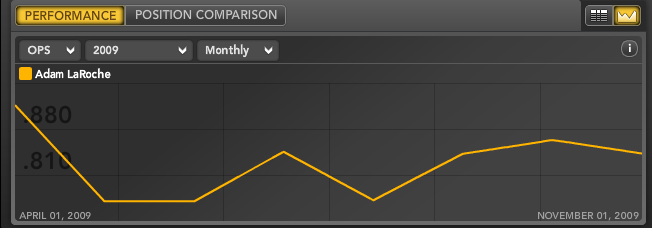
The bulk of LaRoche’s early-season struggles come in March and April. Over his career, he has combined for a slash line of .192/.283/.360 in the opening months of the season. However, from May going forward, there is a steady increase in OPS:
.781 (May)
.798 (June)
.908 (July)
He peaks in August with a .933 OPS, and then goes slightly back down to .908 in September.
When targeting LaRoche, in trades be sure to exploit his early struggles. If you’re lucky enough to land LaRoche, just be patient as he is likely to once again heat up with the weather. Also remember he should enjoy playing his home games in doubles-friendly Chase Field.
Alexei Ramirez
Since joining the major leagues in 2008, the Cuban Missile has struggled with his early-season stroke. 2010 has been no different for the White Sox shortstop: He’s hitting .138 with no walks and one extra-base hit through his first eight games. While he is not a second half player per se, Ramirez is definitely a slow starter.
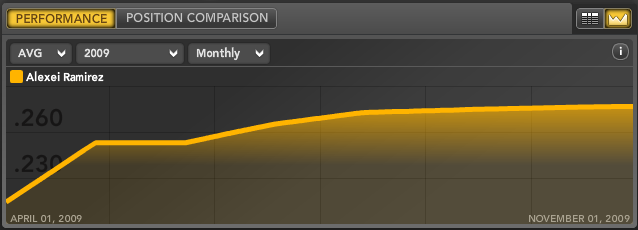
In the opening months of the season (March and April), Ramirez has hit just .175/.221/.237 in his career. The monthly OPS of .458 is 409 points less than his best month, June, in which his OPS jumps up to .867.
Overall, Ramirez is rated as the eighth-best shortstop according to B-Rank. On the other hand, he is ranked only behind Derek Jeter, Jason Bartlett and Elvis Andrus in the American League. If you do not have one of those three shortstops in an AL-only league, you should be contacting the Alexei Ramirez owner in your league immediately.
If the price is too high right now, you might be able to wait a little bit longer if Ramirez holds to form, as his career May OPS of .719 isn’t impressive either. However, don’t wait much longer than that. In the summer months of June, July and August, his OPS jumps to an average of .834 per month, with the usual double-digit home run and stolen base pace.
Hunter Pence
The 27-year-old Astros outfielder is also off to a rough start in 2010 (3-for-25 with no walks). He was even benched for Sunday’s game against the Phillies. The slow start isn’t that big of a surprise, though, given his early-career track record.
A career .286 hitter, Pence’s batting average in the first month of the season is just .254. In addition to the batting average struggles, Pence’s power is slow to develop. His .391 slugging percentage in March and April represents the only monthly slugging mark below .462.
While he struggles in the first month of the season, history tells us that Pence will blow up in the month of May. His slash line in the second month of the season is .358/.415/.561. His 49 RBI in the month of May are also the highest of any monthly total.
Even with the slow start, Pence is likely to cost you a fair amount, given his combined 50 homers and 25 steals in the past two seasons. However, his B-Rank of 87 shows he’s among the game’s top 100 talents, and his owner might not have him valued that high if his early struggles continue. If you can get Pence at a slight discount, do it.
For more on notorious slow starters like Hunter Pence, Adam LaRoche and Alexei Ramirez, check out Bloomberg Sports Fantasy Kits
Neftali Feliz: The Closer
By R.J. Anderson
When it comes to early-season role shuffling, Neftali Feliz to the closer’s spot in Texas is as big a maneuver as you’ll ever find. Ignore whether or not it’s the right real-world call for the Rangers, and just focus on the facts:
– Feliz is 21 years old.
– He throws fire.
– He’s one of baseball’s top prospects.
Those three reasons alone are enough to give him fantasy value. Add in the extra pleasure of getting saves credit for his appearances, and the decision has made some fantasy owners downright giddy. It’s hard to project just how good he will be and the worrisome part is that no timetable on his closing efforts is being publicly made. That means that owners of Feliz have two choices:
1. Ride the tidal wave and hope the Rangers don’t move him to the rotation, or away from the ninth inning.
2. Let him rack up even more hype, then ship him off, and hope the Rangers realize he’s wasting away in a closer’s spot, since he’ll likely provide more real-life value (if not necessarily more fantasy value) as a starting pitcher.
It’s a difficult call. How many saves could Feliz rack up, anyway? Last year, Frank Francisco recorded 25 saves, which led the Rangers, but C.J. Wilson also tallied 14, and four others had at least one, including Feliz. All told, there were 45 saves recorded. The Rangers won fewer games in 2008 and as a result only racked up 36 saves, although team quality did not stop the 2007 Rangers from topping 40 saves once more.
Skeptics might speculate that Feliz is too young, too new, and too untried to wage war in the 9th. They have no idea what they’re talking about. In 34 career big league innings, Feliz has per nine ratios of 11.8 strikeouts and 2.6 walks. During his time at Triple-A, mostly as a starter, he posted about a strikeout per inning, and his career minor league numbers are 325 strikeouts in 276 innings. He’s got the stuff to miss bats and produce outs, even in high-leverage situations.

If Feliz is the full-time closer from here on out, he’s getting something like 35-40 chances for a save. That’s valuable, but it’s not like another closer’s job won’t change hands and lead to a similar opportunity before the month of May is even upon us. So, depending on the needs of your team, and the offer quality presented, you could either ride the wave or ship Feliz out for a king’s ransom.
Either way, Feliz could win you a title. If your league has weekly transactions and Feliz isn’t owned yet, use that number-one waiver claim, or empty your FAAB account.
Diamondbacks’ Miguel Montero Hits DL; Chris Snyder To Start
By Tommy Rancel
Going into the 2010 season, Miguel Montero was considered a top-10 fantasy catcher. At Bloomberg Sports, we liked Montero’s chances just as much as anyone else. After belting 16 home runs and driving in 59 runs in just 425 at-bats last season, the expectations of a bigger season seemed attainable.
Unfortunately, Montero’s season is now in limbo, as we learned this weekend that he has a torn meniscus in his right knee. He will undergo further tests to determine if there is any more damage. Currently, there is no timetable for his return, but MLB.com is reporting that he will need surgery. At the very least, he’s on the 15-day disabled list.
With Montero on the shelf, the Diamondbacks will turn to former starter Chris Snyder to handle the workload behind the plate.

Snyder went into 2009 as Arizona’s primary backstop; however he suffered a back injury and was never able to regain his spot thanks to Montero’s breakout. The Diamondbacks tried shipping him to Toronto this off-season – a deal they are now lucky they didn’t make. It’s unlikely that Snyder will be able to permanently pry the position back from Montero’s grip. But for now, Snyder is definitely in play as a fantasy option, especially in a deeper mixed league.
From 2006 to 2008, Snyder racked up nearly 1,000 plate appearances for the D-Backs. Over the three-year span he averaged .251/.346/.438 (AVG/OBP/SLG) with 12 home runs a season. An OPS of .785 with double-digit home runs represent solid numbers for a catcher. Of the 29 catchers with at least 300 PAs last season, only six had an OPS greater than .785.
Due to the injury, and subsequent decrease in playing time, Snyder had a down season in 2009. He appeared in just 61 games, hitting .200/.333/.358. Those numbers are ugly in raw form; however, consider these stats as well.
Despite the Mendoza level-like batting average of .200, Snyder still reached base one-third of the time. Thanks to a career walk rate of 12%, he doesn’t need to hit .300 to get on base at a decent rate. Another thing to consider is his batting average on balls in play (BABIP). His 2010 BABIP of .237 represents a 37-point drop from his career .274 mark. With some regression, his batting average could see a significant rebound.
If you own Montero, especially in a mixed league of 12 teams or more, or an NL-only league, Snyder is a must-get. He should be available on the waiver wire in most leagues, but act quickly if you haven’t already snagged him. For non-Montero owners, Snyder is still worth a flier, especially since Montero needs surgery and the position is so physically demanding. At a thin position, Snyder provides a decent bat with a proven track record. If nothing else, grab him before the Montero owner in your league does, setting up a potential trade.
For more on Chris Snyder and other potential waiver wire catchers check out Bloomberg Sports’ fantasy kits
Tim Hudson: Comeback Kid
By Erik Hahmann
Seeing Hudson go in for Tommy John surgery was troubling to his fantasy owners, and to the Braves. But the elbow replacement surgery carries strong recovery rates. In seven starts after returning from Tommy John last season, Hudson showed signs of a healthy recovery, posting an impressive 3.47 xFIP (a stat which strips out the effects of bad luck, defense, bullpen support, aberrant HR/FB rates, and other factors).
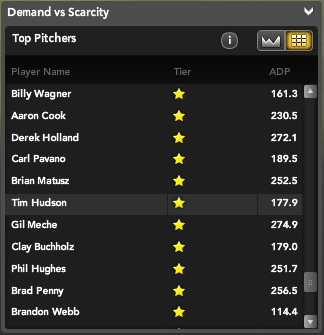
Hudson was ranked in the one-star group, with names like Carl Pavano, Gil Meche and rookie Brian Matusz, all of whom Hudson could easily outperform this season. Continuing his late-season dominance from last year, Hudson was dominant this spring, putting up a 1.35 ERA while striking out 17 batters and walking just 3 in 20 IP. While you must take spring training stats with a grain of salt, they can be instructive for young players, and especially for players trying to prove themselves after an injury. According to Braves catcher Brian McCann: “He look[ed] great. He’s putting his pitches right where he wants them. He’s definitely ready for the season.”
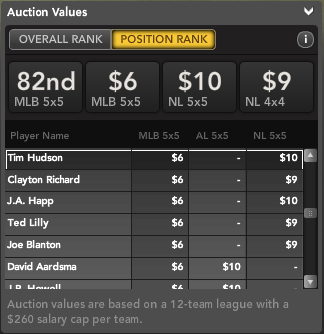
The 11-win total should be easily reachable now that the Braves have added more firepower in the forms of Jason Heyward and Troy Glaus to an already talented lineup. The defense behind Hudson as improved as well, with Heyward in right field, Melky Cabrera (career 4.0 UZR in LF) seeing time in left, and Garret Anderson (-16.5 UZR last season) no longer on the roster.
Hudson’s 2010 debut was an impressive one: 7 innings, 2 runs, 3 hits and no walks. A couple of caveats apply. First, he was facing the Giants, who have only one elite hitter in their entire lineup in Pablo Sandoval. Second, Hudson only struck out two batters in his inaugural 2010 start. Still, his best indicator of success, aside from his pinpoint, no-walk control, was his impressive groundball rate: Fourteen of the 21 outs Hudson rang up Friday against San Francisco came via groundballs. That’s a great sign for a pitcher who’s thrived on worm-burners his whole career.
Hudson’s probably owned in even the shallowest leagues, and his value spiked after his opening start, such that targeting him in trade now doesn’t make much sense. But if you already own him, resist the temptation to sell high. Unless someone bowls you over with an offer, hang onto Hudson and give him a chance to put up a big season.
Chris Iannetta: Fantasy Post-Hype Sleeper or Bust?
by Eno Sarris
We close out our post-hype infield with Colorado Rockies catcher Chris Iannetta. Just to recap, that was Chris Davis at first base, Rickie Weeks at second base, Stephen Drew at shortstop, and Alex Gordon at third base.
As I mentioned before, this is not a strategy to try at home. I was
hoping to find one or two good, young and cost-controlled infielders in
a league with contracts and 15 keepers, so I had to try something. (Gotta love Weeks’ huge first week.)
Iannetta presents a mixed bag of positive and negative indicators. Yes, he has a slightly worrisome fellow backstop in Miguel Olivo. But Olivo has established himself as a prolific outmaker throughout his career.
As evidence that the team still believes in their young catcher, the Rockies gave Iannetta a three-year contract in January.
Iannetta came tearing through
the Rockies’ minor league system and has held the Catcher of the Future
title there for a while now. An accomplished college catcher that was around average age at each level of the minor leagues, his .303/.409/.511 career
line there was still impressive. After struggling to hit for power or
batting average in his first two attempts at the majors, he
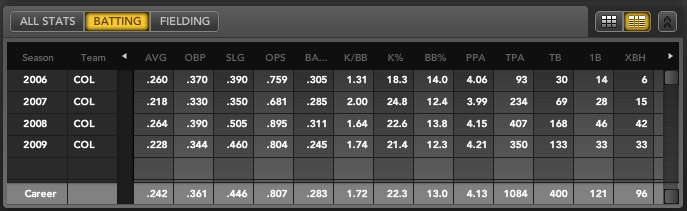
had a breakout 2008, hitting .264/.390/.505 with 18 home runs in
407 plate appearances. So, in fact, Iannetta has already been a
post-hype sleeper before and come through with a great year. Now, after
a less impressive .228/.344/.460 and just 350 PAs last season, he’s once again
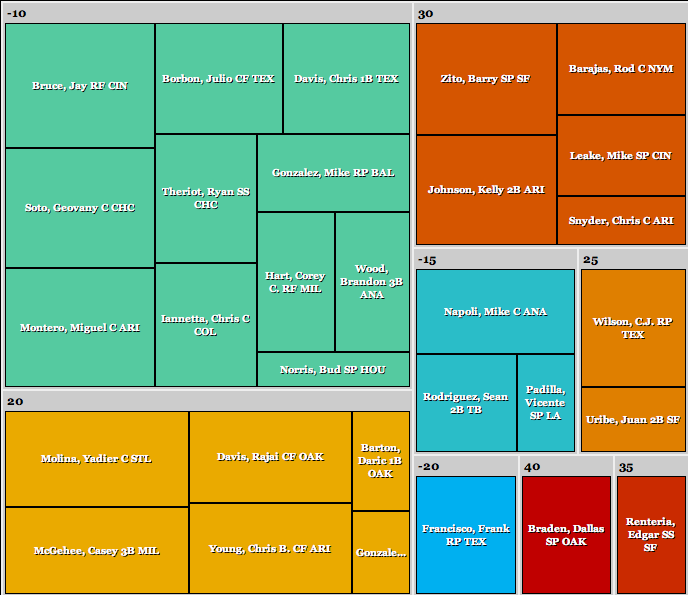
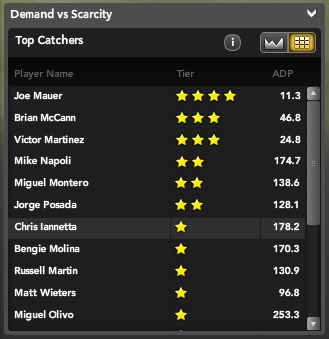
undervalued. Take a look at the Bloomberg Sports Fantasy Tool, which shows how cheap he is compared to other possible top-10 catchers this year – increasing the likelihood that he could be available on the waiver wire in your shallow league.
So
what changed in 2009? Why did Iannetta’s batting average suddenly plunge the year after establishing himself? Once again, the Bloomberg Sports Fantasy Tool,
with some recently added stats, gives us great insight into his 2009
struggles. As you can see from this screen shot, Iannetta suffered from
terrible luck on the balls in play last year. He walked with about the same
frequency as he did the year before, struck out a little less, had a similar
isolated slugging percentage (.241 in 2008, .232 in 2009) and looked
like the same hitter in general. However, he had a .245 batting average
on balls in play (BABIP) in 2009, and his career number in that
category is .283.
Even though BABIP holds steady around .300 across all of baseball, each player has their own true level. Ichiro Suzuki‘s
BABIP (.357) is a great example of this. Using a players’ batted ball
profile and speed, however, we can estimate a player’s BABIP.
Iannetta’s xBABIP last year? .303. It seems that Iannetta had some
rotten luck last year.
Given that Iannetta held his power
steady in both 2008 and 2009, and showed the same control of the strike
zone both years, it seems to follow that he can put in another campaign
that looks like 2008, once the BABIP normalizes. With an
acceptable batting average (for a catcher, a position where the average
line was .253/.320/.394 last year), fantasy owners will benefit from
getting his above-average power cheaply.
And yet, there’s that pesky timeshare. If you’re an optimist, though, you can look at the current situation this way: Iannetta’s lack of playing time means he might not be owned in many shallow leagues. So if you’re a Miguel Montero owner and you’re looking for a replacement at catcher, don’t chase first-week stats by proven mediocrities like Rod Barajas. Take a shot on someone with real upside. Someone like Chris Iannetta.
For more information on Chris Iannetta and other underrated catchers this year, check out Bloomberg Sports’ fantasy kit for yourself.
 Bloomberg Sports