Category: Dailies
(Video) Ballpark Figures: Dose of Reality, Washington Nationals
By Bloomberg Sports //
Ballpark Figures: Does of Reality — Bloomberg Television’s Michele Steele and Bloomberg Fantasy Sports Analyst Rob Shaw head to Washington DC to discuss the present and future of the Washington Nationals. They talk with slugger Josh Willingham, Tyler Clippard, as well as phenom Stephen Strasburg about their current goals and where they hope to improve. For more insight, follow us at Twitter.com/BloombergSports.
Los Angeles Angels Acquire Dan Haren
By Tommy Rancel //
With Cliff Lee off the market, the Arizona Diamondbacks held one of the few aces (Dan Haren) left on the market. Instead of getting a king’s ransom in return, they settled for a ten (Joe Saunders), a five (Rafael Rodriguez), and a pair of wild cards (Patrick Corbin and a player to be named later). The Dan Haren trade is a blow to NL-only owners; however, to members of AL-only leagues…welcome to Christmas in July.
On the surface, Haren doesn’t look like a “significant” upgrade over Saunders. Both pitchers have sub-.500 win-loss records and near-matching ERAs around 4.60. That’s where the similarities end.
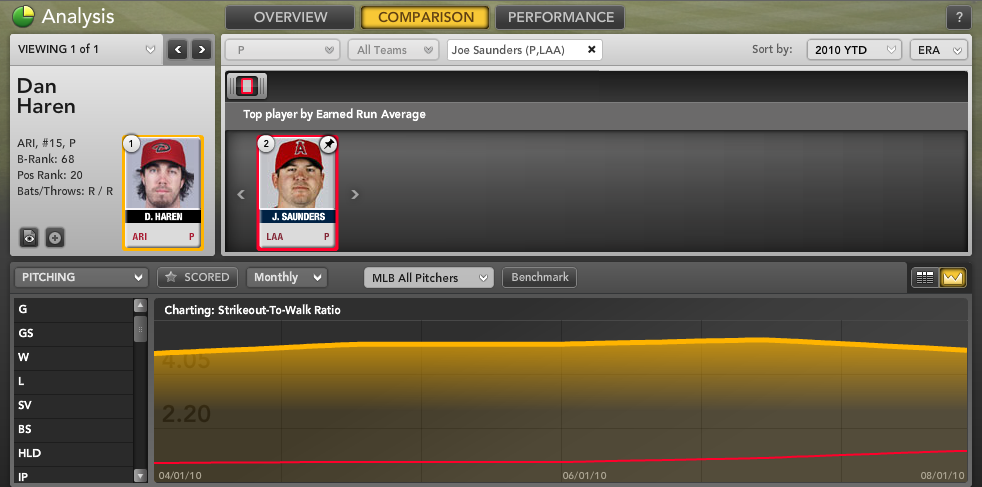
Unlike Saunders, Haren is actually better than his ERA suggests; much better. Despite the high ERA, Haren is striking out a batter per inning. His smooth 9.00 K/9 rate is a career high. Also unlike Saunders, Haren does not walk many batters. He’s handed out just 29 walks in 141 innings (1.85 BB/9), and owns a career walk rate below 2.0. According to those metrics, Haren has been a top-five pitcher in the NL. Where he has struggled in 2010 is home runs allowed, batting average on balls in play (BABIP), and strand rate.

It’s true that Haren deserves partial blame for his rather high home run rate. He has allowed nearly as many home runs (23) as walks (29). His home run per nine rate (HR/9) of 1.47 is a career worst and nearly half a homer higher than his career 1.07 rate. Outside of bad luck, Haren’s (former) home ball park is not helping matters either.
According to ESPN’s park factors, the 29-year-old is moving from a home ball park that ranks among the most generous in home runs per game to one that ranks near the bottom (22nd). Digging even deeper into park factors, Statcorner.com tells us Chase Field is extremely friendly to left-handed batters in terms of the long ball.
Looking at Haren’s splits for 2010, he is allowing more home runs to lefties (1.81 HR/9) than righties (1.22 HR/9). His home run rate at home (1.57 HR/9) is also higher his road rate (1.35). In fact, 17.1% of flyballs hit against Haren in Chase Field clear the wall. That number drops to 11.2% on the road. For his career, his HR/FB rate is 11.1%. It is not a guaranteed fix for the gopherball problems that have plagued Haren, but a move to Angels Stadium certainly won’t hurt.
In addition to the home run rate, Haren has been ridiculously unlucky on balls in play. His current BABIP of .350 is nearly 50 points higher than his career .304 level. This is odd given the rates in types of balls put in play against him (line drives, flyballs, groundballs) have not drastically changed.
His line drive rate (LD%) of 20.3% is nearly identical to his 20.0% career number. Since line drives are the type of batted ball most likely to fall for hits, it is strange that Haren’s BABIP has climbed so high. If Haren’s current BABIP regresses toward career levels, expect a significant drop in ERA.
Meanwhile, Haren’s strand rate has fallen to 70.9% from 2009’s 77% and his career 73.2%. Pitchers will often see more of the runners they put on base score as a result of a shaky bullpen. Arizona’s pen owns a stratospheric 6.50 ERA, the worst mark in the majors and a full run and a half higher than the next worst team. Better bullpen support could help Haren’s strand rate, and also his wins total, with fewer saves likely to be blown once he leaves the game (although the Angels rank a poor 25th in MLB themselves with a 4.50 bullpen ERA).
Normally, when a pitcher moves from the NL to AL, we worry about league adjustment. Haren made 102 starts for the Oakland Athletics. In those three years he went 43-34 with a 3.64 ERA. He also struck out 531 batters while walking just 153 in more than 600 innings of work.
If you’re in a mixed league, hold the line for all the reasons above. In NL-only leagues, I’m sorry. On the other hand, in a competitive AL-only format, you might as well break your free agent budget.
Alberto Callaspo’s Fantasy Value after the Trade
most notable aspect of Callaspo’s profile is that he nearly impossible
to strike out. This season, only three batters sport a strikeout
percentage that’s better than Callaspo’s 8.3%.
and Callaspo himself, have owned the ability to put the ball into play at a brisk rate. One player who didn’t fit the organizational philosophy was Brandon Wood,
who stands on the opposite spectrum and is one of the easiest to strike
out in the majors with a 30% rate. It’s no surprise then to see that Callaspo will be replacing Wood at
the hot corner.
elite contact rate earns Callaspo some batting average karma. In both
2008 and 2009, he hit above .300. This season, he’s hitting .275,
but has been the victim of an unlucky .278 BABIP. Callaspo’s walk rate
is down this season, but with some regression on the upside, he could certainly be a .300
hitter going forward.
become relevant in all leagues, however, he’ll need to boost his stats
in the other counting categories. There may be some hope.
stands to gain additional run and RBI opportunities in his new
environment. In Kansas City, he was batting in the sixth lineup
spot for a team that ranked 20th in the majors in runs
scored. For Los Angeles, he’ll be hitting for a team that’s 9th in run scored. Judging by manager Mike Scioscia’s comments after the trade, Callaspo could have a prominent role in the lineup too.
has never been much of a speed demon, with only eight steals in five major
league seasons. But in moving to the Angels, he’ll also get the
opportunity to play for a manager who has traditionally been one of the
most aggressive on the basepaths.
power, Callaspo isn’t a big bopper. But he did hit 11 HRs last year and
is on pace for 13 this year. Angels Stadium of Anaheim has ranked as a
more friendly HR environment than Kauffman Stadium in Kansas City for
three consecutive seasons, according to ESPN’s Park Factors.
Wood, the Angels sport another third baseman who is an elite force in
making contact in Maicer Izturis. But assuming Callaspo stays
in the lineup on a regular basis, the trade portends better things to
come.
Delmon Young: Finally Living up to the Hype
By Tommy Rancel //
If you evaluated the Delmon Young for Matt Garza/Jason Bartlett swap after the 2008 season, the Rays would have won in a landslide. Bartlett was (controversially)
named the team’s most valuable player for the regular season, while
Garza won the franchise’s biggest game ever – Game 7 of the American
League Championship Series. He was also named ALCS MVP.
On the other hand, Young was wrapping up his second full season in
the big leagues. His numbers (.290 AVG/.336 OBP/.408 SLG) were decent,
but a far cry from the lofty projections of a top overall pick.
Flash-forward to present day, and the trade looks a bit more even.
Garza is still a good-but-not-yet-great starter for the Rays. Bartlett
is still an everyday shortstop, but is on the wrong side of 30, and
struggling both offensively and defensively in 2010. Meanwhile, Young
is finally showing some of the potential Minnesota hoped to tap into
when the deal was made.
After posting two mostly average seasons for the Twins
(.288/.325/.413), Young is breaking out in 2010. His slash line stats –
.316/.349/.511 – represent career highs across the board. His 5% walk
rate is above his career norm (4.2%). Meanwhile, his
strikeout rate of 12.5% is a vast improvement over his 18.8% career
number.

That said, Young’s plate discipline has room to improve.
Currently, he is swinging at pitches out of the zone more than 40% of the
time. The biggest difference is he is making contact on 72.3% of those
pitches — vs. 56.6% in years past.
In addition to the improving walk-to-strikeout rate, Young is
hitting the ball with more authority, as evidenced by his .511 slugging
and .195 ISO (Isolated Power, which is slugging percentage minus batting
average). He is also turning into to quite the run producer; he’s knocked in
22% of his base runners, tied for tops in the AL.
Young’s batting average
on balls in play (BABIP) of .327 this season looks high, but it’s actually lower than his BABIP numbers the past two seasons, .338 both times. As
of June 1 this year, his slash line was .273/.323/.469; his BABIP was
just .274. Since then, he is hitting .350/.372/.548 with a BABIP of
.368.

According to ESPN.com, Delmon is still available in more than 5% of leagues.
If you happen to be in one of those leagues, put in a claim immediately.
If you are not fortunate enough to be in such a league, check in with Young’s owner. This breakout looks like it could be the real deal.
For more on Delmon Young and 2010 breakouts, check out Bloomberg Sports’ fantasy kits.
Colby Lewis’ Run of Excellence
By R.J. Anderson //
Many looked on with apathy when the Texas Rangers signed Colby Lewis to a two-year deal with a club option this past off-season. This very same Lewis had pitched for the Rangers from 2002-2004 with a not-so-good 5.48 ERA in nearly 300 innings. Lewis didn’t find success in short stints as a Tiger or Athletic either and he bolted to the Hiroshima Carp for the 2008 and 2009 seasons.
Then it happened. The same pitcher that Baseball America ranked as the 32nd-best prospect in baseball entering the 2003 season emerged. In those two seasons in Japan, Lewis started 54 games, pitched more than 350 innings, held a strikeout-to-walk ratio of better than 8-to-1(!) and an ERA of 2.82. He struck out more batters than he allowed baserunners. Entering this season, it was hard to peg just how good Lewis could be. After all, Daisuke Matsuzaka had similar success in Japan, and he’s been a pretty average pitcher (ignoring the price tag) during his stint in Boston. Meanwhile, other decent Japanese league hurlers, like Kei Igawa and Kenshin Kawamaki, won’t be in the running for any Cy Young awards in the foreseeable future.
Yet Lewis has persevered and sustained that level of success stateside. In 19 starts for the Rangers, he’s recorded nearly a strikeout per inning. He’s walked only 41 batters too. Why is that impressive? Because in 2003 (the only other season he recorded more than five starts in the majors) Lewis walked 70 batters in about the same number of innings, while striking out 29 fewer batters. He looks nothing like the old Colby Lewis, which makes you wonder: Can he continue to have a 3.52 ERA? Will he continue to pitch this well?
Odds are, his ERA will escalate a bit. Lewis’ home run per flyball ratio is well below league average, despite pitching in a ballpark that makes home runs commonplace. Despite the Rangers’ defense, it’s hard to foresee any Ranger pitcher lasting too long without a bump in the ERA road. That’s not to say Lewis is valueless or should be sold high, just that expecting this exact level of domination heading forward isn’t a good idea.

There is no magic innings mark within a season that determines when it’s OK to assume the ERA will last. Still, unless your fellow league owners value Lewis as an elite or near-elite starting pitcher, he’s a solid hold for the rest of the season.
For more information on Colby Lewis and hundreds of other
players, and for dozens of tools to help you dominate your fantasy
league, check out Bloomberg Sports’ fantasy kits.
(Video) Ballpark Figures: Head-to-Head
By Bloomberg Sports //
Ballpark Figures: Head-to-Head — Bloomberg Television’s Michele Steele and Bloomberg Fantasy Sports Analyst Rob Shaw preview the upcoming weekend in fantasy baseball. The main topic is Alex Rodriguez nearing 600 career home runs. Ben Kabak joins Ballpark Figures from Riveraveblues.com to discuss his take on A-Rod’s chasing of history and how Yankees fans will respond.
First Half Fantasy All-Star Lineup, Part II
by Eno Sarris //
Earlier this week, we talked about some fantasy All-Stars and how they were determined by their return on investment as much as their actual production. The cheaper a fantasy player, the more valuable his breakout.
Now it’s time to finish off the lineup with a look at other players who have exceeded expectations this year, and whether or not they will continue to do so.
SS Juan Uribe
We could have easily installed Rafael Furcal here, and deservedly so. But Eriq Gardner did a great job breaking down Furcal, just the other day. Plus, the injury risk inherent with Furcal going into the season is still there.
Instead, we’ll take a player that is in the midst of a slide that has taken much of the wind out his sails already. His .242/.313/.475 June is even more worrisome because of its proximity to his .257/.300/.431 career line. Even in a poor month by Uribe’s 2010 standards, we see that he’s shown some improvement at the plate this year, though. He’s walking at a career-high rate, striking out at a four-year low rate, and even carried over much of his power from last year. The back story with Uribe is one of a below-average BABIP, both this year (.274) and career (.285). Though he doesn’t have bushels of line drives in his arsenal (19.4% career), it’s probably the lack of speed (51% career success rate on stolen bases, low speed scores) that is hurting Uribe’s BABIP.
In any case, he won’t be worth much in trade talks with his career stats, so keeping him – hopefully on the bench during this tough stretch – is your only option. If the new-ish approach at the plate holds, he should return to grace at some point this summer.
3B Scott Rolen
As with Furcal above, Rolen’s biggest knock coming into the season was his injury history. He hadn’t topped 128 games in a season since 2006, and had averaged 111 games per season since 2005. He’s missed some games this year, but he’s on a pace that would net him closer to 140 games this year, making his owners seem to be geniuses.
Other than his good health so far this year, though, Rolen has enjoyed a power surge that has his slugging percentage over .500 for the first time since 2006. It’s no linear relationship, but the fact that the last time he was this healthy for this long was the last time he showed this much power is worth noting. In 2006, he hit .296 with 22 home runs, and he should top that home run total this year, with 17 bombs already jacked on the year. It helps to call Great American Ballpark home – the park has been one of baseball’s top parks for homers so far this year – but it’s the health that makes Rolen a hold, especially since it’s the health issues of the past that will keep Rolen owners from getting full value in a trade. Keep a caddy around for him, too, since he already has a hurting hamstring right now and has missed the last few games.
 OF Josh Hamilton
Here’s a real-life All-Star who also happens to be a fantasy All-Star. Once again, injury concerns with Hamilton depressed his pre-season rankings past the half-century mark, and he’s shown health that has allowed his real talent to shine through. Those concerns were real – he’s only averaged 112 games per season so far in his young career, but since he’s still relatively young – 29 – perhaps those concerns were over-blown.
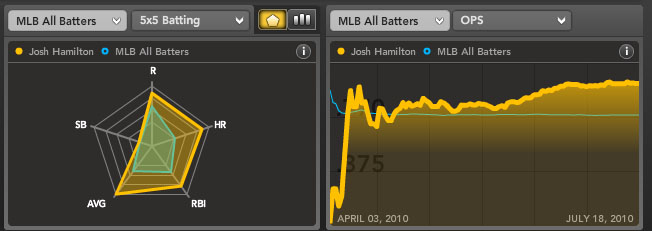
Judging from his Bloomberg Sports Fantasy Tools spider graphs, Hamilton is a true five-category performer and even a Triple Crown candidate. It goes without saying that a batting average like he has (.357), built on a BABIP like the one he owns (.397), won’t last. On the other hand, a .306 career batting average suggests he can still produce in that statistic going forward. His slugging percentage (.638) is at a career-high, but his line drive rate (22.4%) and home runs per fly ball (20.9%) are both high, and in line with his career numbers (21.8% and 18% respectively). Hit a lot of line drives, and convert a fifth of your fly balls into home runs, and you’ll have great power. Even with a step back, Hamilton is the fantasy All-Star of the year, most likely. If you’re going to sell, only sell for top-dollar talent in return.
For more on other fantasy All-Stars, check out Bloomberg Sports’ Fantasy Tools.
(Audio) BTN with Amanda Rykoff of OCDChick.com
By Bloomberg Sports //*
Listen now! – (loads in new browser – 23 megs)
Behind the Numbers
Hosts: Wayne Parillo and Rob Shaw
Guest: Amanda Rykoff of OCDCHICK.COM and follow her on twitter
Total Running Time: 23:08
The High Level Look at What’s Inside
- Becoming a Yankee fan and bing part of the community (0:00 – 4:32)
- Twitter, Social Media, Community, and the nickname “Queen of Twitter” (4:40 – 8:44)
- Being a woman at the Sloan conference and being involved with sports (8:44 – 11:42)
- Fantasy baseball, The Longorious Basterds, and how Twitter helped build her team (11:46 – 16:10)
- Being at the first game at Yankee Stadium after the recent deaths and reflections on George (16:17 – 22:20)
A Baker’s Dozen of a Lower Level Look
- (1:18 – 2:21) How a SoCal woman fell for the Yankees
- (2:45 – 3:00) Telling her father about her new baseball team love
- (3:21 – 3:51) Baseball roadtrip with a friend from twitter
- (3:57 – 4:32) Rooting for the underdog…unless it’s the Yankees
- (4:40 – 5:30) Queen of Twitter and how she got involved
- (7:27 – 8:12) Twitter as an online sports bar and a Twitter ah-hah moment
- (9:10 – 9:44) Holding your own when your information is good
- (9:45 – 10:50) Being at the Sloan Conference and how it resembled a sports event
- (12:40 – 14:40) The Longorious Basterds
- (16:42 – 17:22) Honoring the deaths at Yankee stadium
- (17:29 – 18:05) Whether to mourn or cheer, and questions about the almost silent PA booth
- (18:37 – 19:03) The weird Sunday return to business as usual
- (21:22 – 22:17) Will any other owner’s death be this big?
Direct link to the conversation
More ways to get Behind the Numbers, talk to us, or just have a good time
(Video) Bloomberg Sports’ Ballpark Figures: Stock Report
By Bloomberg Sports//
Bloomberg Sports’ Ballpark Figures: Stock Report — Bloomberg Television’s Michele Steele and Bloomberg Sports Fantasy Analyst Rob Shaw discuss the Bulls and Bears in Fantasy Baseball. Shaw is buying on the talents of newly acquired Blue Jays shortstop Yunel Escobar, White Sox prospect Gordon Beckham, and Rays slick-fielding Jason Bartlett, while selling on Padres outfielder/third baseman Chase Headley, A’s Kevin Kouzmanoff, and Cubs rookie Starlin Castro.
Pennington Available for a Penny
By R.J. Anderson //
In early March, I detailed why Cliff Pennington
could be a valuable piece in deeper leagues because of his ability to
steal bases. So far, he’s been well worth the late-round draft pick.
To date, Pennington’s stolen base total sits at 15. That places him sixth amongst shortstops, behind the usual names like Elvis Andrus, Erick Aybar, Hanley Ramirez, and Jose Reyes. Pennington
will probably finish within the 25-30 steals range; not bad for someone
without the hype or draft status of a Hanley or Reyes. What I expected
from Pennington was a hot streak that placed him among the game’s best
hitters for a prolonged period. Yet, over the last 30 days, he’s been
absolute on fire, batting .408/.463/.563 and placing him amongst the
top 10 batters in the entire league.
Fantasy league veterans
know all about the positional scarcity that comes with playing
shortstop. Any morsel of value from a non-elite shortstop or catcher
should be savored. Pennington ranked second in shortstop batting
average during the month of June (.338, only Rafael Furcal was
above .320) and he is hitting .375 in July. With that kind of
performance for the last month, you would think his stock would be up.
That is not reality, though, as he’s owned in only 26% of ESPN leagues
and 46% of CBS leagues.

Data courtesy of FanGraphs
The
obvious caveats apply to Pennington’s streak. Do not expect this level
of performance to continue. Besides the fact that nobody hits .400
anymore, Pennington plays in a cavernous ballpark. Despite all that
room, the park’s dimensions restrict hits of all variety from either
hand due to the large area of foul territory. A safe projection for his
performance from here on out is essentially his slash line to date:
.267/.338/.389. That looks similar to his 2009, when he produced
.279/.342/.418, in far fewer at-bats.
If you need shortstop help for the short-term in a standard league, grab Pennington and hope to ride out the wave.
For more information on Cliff Pennington and hundreds of other
players, and for dozens of tools to help you dominate your fantasy
league, check out Bloomberg Sports’ fantasy kits.
 Bloomberg Sports