Category: Dailies
(Video) Ballpark Figures: Hot Commodities
By Bloomberg Sports //
Ballpark Figures: Hot Commodities — Bloomberg Television’s Michele Steele and Bloomberg Sports Fantasy Analyst Rob Shaw discuss the available sleepers in fantasy baseball. Shaw’s Bets are Tampa Bay Rays middle infielder Reid Brignac, a former second round pick who can offer some pop, as well as Barry Enright, one of the few bright spots for Diamondbacks fans in this lost season. Michele’s Steal is Cubs outfielder Tyler Colvin, who boasts some real power and is now playing on a regular basis.
Phillies Promote Domonic Brown to Major Leagues
By Tommy Rancel //
Following in the footsteps of Jason Heyward and Mike Stanton, Domonic Brown is the latest stud outfield prospect to get a call-up for an National League East team this season.
When Jayson Werth‘s name was recently tossed around in trade rumors, Brown was the one commonly expected to be his replacement in the Philadelphia lineup. With Shane Victorino hitting the disabled list, Brown no longer has to wait for a spot to open via trade.
A 20th-round pick in the 2006 draft, Brown shot up the prospect rankings. The 22-year-old started the 2009 season in the lower levels of the Phillies’ organization, but found himself in Double-A by season’s end. In a combined 454 plate appearances, he hit .299/.377/.504 with 44 extra-base hits and 23 stolen bases.
Brown became a hot commodity. He was ranked the #15 prospect by Baseball America this off-season, and was rumored to be a trading chip for Roy Halladay. Credit Phillies General Manager Ruben Amaro Jr. for not only landing Halladay, but managing to keep Brown in the process.
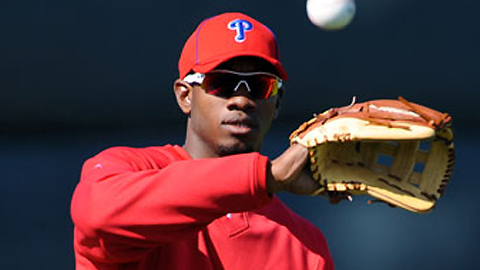
Photo Credit: (Miles Kennedy/Phillies)
Brown started the 2010 season at the Double-A level where he continued to mash. In just over 270 PAs, he hit a ridiculous .318/.391/.602. His 15 home runs were one more than he hit in all of 2009. Clearly finished with that level, he was promoted to Triple-A. All he did there was hit .346/.390/.561 with five more bombs in 118 PAs.
Making his major league debut Wednesday night, Brown wasted no time with two hits and two RBI. Although Victorino could be back in as little as two weeks, Brown could force his way in the everyday lineup even if the Phillies hold on to Werth. For a team in need of some offensive firepower with Chase Utley out, Brown could easily replace a struggling Raul Ibanez in the Philadelphia lineup.
If he wasn’t snatched up in your league during the initial rush after his call-up, Brown is definitely worth a spot in mixed leagues, as well as NL-only formats. Act fast.
For more on Domonic Brown and the rest of the NL-East phenoms, check out Bloomberg Sports’ Fantasy Kits
Ryan Ludwick Should Be Owned in More Fantasy Leagues
by Eno Sarris //
Every once in a while, injury suppresses a player’s stats at a key point in the season and creates a waiver-wire sleeper. At least, that has to be the reason behind the fact that Ryan Ludwick is only owned in 68% of fantasy leagues right now.
Just look at the Bloomberg Sports Fantasy Tools spider graphs. They sum up how Ludwick looks, sitting out there on the waiver wire with ‘only’ 11 home runs and a passable batting average. Mediocre.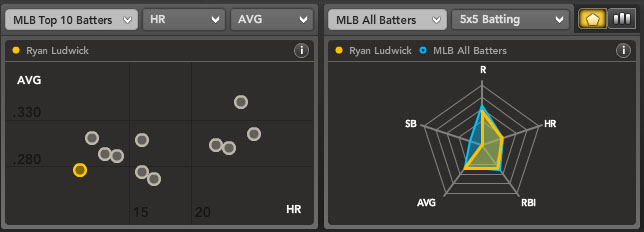
But when Ludwick is in the lineup, he has been very good, a one-man argument for using rate stats over counting stats. His .279/.342/.482 batting line shows a player who can work the count and hit for power. If you pro-rated his current fantasy statistics out to a full year, you’d get 22 home runs and 84 RBI, useful even in mixed leagues, and the rate stats once again pass the sniff test.
Of course, Ludwick does have a perceived inability to hit left-handers, and judging from his career .772 OPS against left-handers, it’s tempting to sit him against all lefties, as his team often does. But he has only accrued 703 plate appearances against left-handers in his career, and righty/lefty splits have been shown to become significant at 2000 plate appearances. So even that flaw is not set in stone.
We do all remember Ludwick’s 2008 season, when he smashed 37 home runs. Perhaps it’s the fact that he’s not looking like that 2008 version these days that has fantasy owners moving on to younger batters with more perceived upside. It is true that Ludwick is 32, but that also means that his 2172 plate appearances to date are significant. In those PAs, Ludwick has shown an isolated slugging percentage (ISO, or slugging percentage minus batting average) of .219. He’s at .203 this season, right between David Wright and Josh Willingham on the NL leaderboard.
If you’re in one of the 32% of leagues where Ludwick isn’t owned, pick him up immediately.
For more on other fantasy All-Stars, check out Bloomberg Sports’ Fantasy Tools.
Is Jose Bautista’s 2010 Legit?
By R.J. Anderson //
Jose Bautista has been the biggest
surprise of any hitter in baseball this season. The 29-year-old’s
career has been anything but conventional. In 2004 he split time
between four of the worst teams in baseball (Devil Rays, Royals,
Orioles, and Pirates) and stuck with Pittsburgh until the 2008 season,
when he eventually wound up on the Blue Jays.
Entering this season, Bautista sported a career line
of .238/.329/.400 in 2,038 plate appearances. He’s hitting
.254/.364/.580 this season. A 4-for-4 explosion last night against
Baltimore hoisted his league-leading home run total to 30, with 75 RBI
for good measure. So where did this improvement come from, and is it
sustainable?
In cases where a player suddenly blows up, the easy
thing to do is peruse his underlying metrics and see which ones are
inflated. That’s a problem, though, because Bautista doesn’t appear to
be the usual blow-up candidate with fluky peripherals. His walk rate is
almost identical to last season, as is his strikeout rate, and his
BABIP is a career worst .233 – (vs. career BABIP of .273). The only
area which has seen change is his flyball rate, and by extension, his
power.
Bautista is hitting more flyballs than ever, 53.4%
(fourth-highest in MLB) vs. a career rate of 44.4%. Hitting that many
flyballs is an excellent way for a power hitter to smack more home
runs. But it’s bad for a player’s batting, average as most infield
flies are outs, and more than 70% of outfield flies are caught too.
Bautista’s 18.9% HR/FB rate is 6.8% higher than his career norm and
explains some of the newfound power, but not all of it.
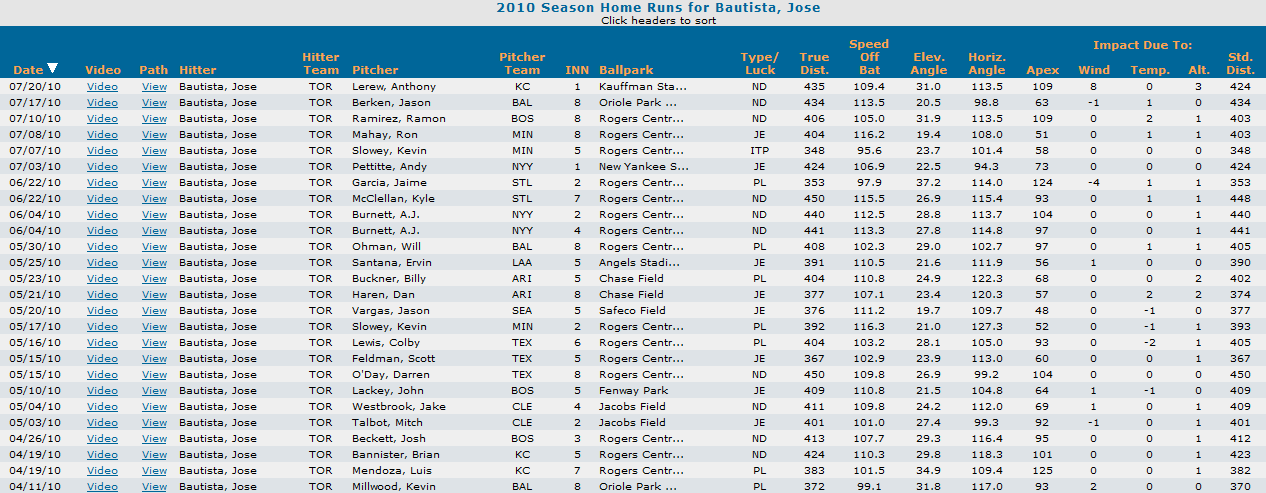
HitTrackerOnline.com keeps count of home runs by batter and park. Below
are Bautista’s homers this season, pay close attention to the parks
column, which means Bautista isn’t just taking advantage of short
fences.
One subtle factor that explains a large part of his
power streak is his sudden ability to hit right-handed pitching. For
his career, Bautista has hit .259/.358/.478 versus southpaws and
.230/.324/.401 versus righties. This season, Bautista is still hitting
lefties, but he has upped his game versus same-handed pitchers, batting
.243/.358/.558 through Monday. As is the case with his overall line,
nothing outside of the power sticks out in his line. He’s not getting
incredibly lucky with balls in play or walking a whole lot more than
usual.
That generally suggests a bona fide improvement. Even
still, it’s always important to consider the larger sample size.
Consider dealing Bautista if your leaguemates see him as a true
40-homer man.
For more information on Jose Bautista and hundreds of other
players, and for dozens of tools to help you dominate your fantasy
league, check out Bloomberg Sports’ fantasy kits.
What Can Coin Flips Teach Us about Managing a Fantasy Team?

For more insight to help you dominate your fantasy league, check out Bloomberg Sports’ fantasy kits.
(Audio) BTN with Rany Jazayerli
By Bloomberg Sports //*
Listen now! – (loads in new browser – 32 megs)
Behind the Numbers
Hosts: Rob Shaw and Wayne Parillo
Guest: Rany Jazarerli
About the Guest:
He may be the world’s most famous dermatologist, though you probably know him better as the co-founder of Baseball Prospectus, from his website Ranyontheroyals.com or his weekly radio show. Either way enjoy the podcast and make sure to follow him on twitter
Total Running Time: 31:08
The High Level Look at What’s Inside
- The KC Saber-mafia & Why Everyone Came out of KC (:48 – 3:40)
- The State of a Royals Fan’s Mind (4:11 – 15:11)
- The Path from Royals Fan to Baseball Prospectus (15:11 – 21:19)
- Pitcher Abuse & Are Teams Too Cautious (21:20 – 28:09)
- The Four or Five Man Rotation (28:10 – 29:57)
Eleven Lower Level Highlights
- (0:48 – 1:38) The KC Saber-mafia
- (3:00 – 3:50) Boston Globe influence and now Bill Simmons
- (4:44 – 6:35) Low expectations of Royals Fans & why they glom onto hope
- (7:01 – 10:42) Why peole are saying good things about the farm system
- (10:54 – 14:10) Alex Gordon & Billy Butler
- (15:23 – 16:40) Being ownerless & life with David Glass
- (17:21 – 19:20) Right place, right time, and Baseball Prospectus
- (20:00 – 21:19) Why to work for or be a Baseball Prospectus Intern
- (21:20 – 23:10) Are teams now too cautious with pitchers?
- (24:00 – 27:53) Nolan Ryan and why NOT to limit innings
- (28:10 – 29:57) How a brave team needs to step forward and change to a four man rotation
Direct link to the conversation
More ways to get Behind the Numbers, talk to us, or just have a good time
(Video) Bloomberg Sports’ Ballpark Figures: Headlines
By Bloomberg Sports //
Ballpark Figures: Headlines — Bloomberg Television’s Michele Steele and Bloomberg Sports Fantasy Analyst Rob Shaw discuss the latest headlines coming out of Major League Baseball. Shaw offers insight on the Dan Haren trade, what the injury to Magglio Ordonez means for the Tigers, as well as the return of Victor Martinez and Brett Anderson from the disabled list.
Grab James Shields
By R.J. Anderson //
When it comes to wins, James Shields has always had tough luck. Despite an ERA of 4.01 over his first 118 starts (his career total entering this season), Shields had only won 43 games, and had 36. Part of that was because of blown wins by his bullpen. Baseball-Reference keeps track of the times a pitcher leaves a game in line for the win only to see his bullpen blow it. That happened eight times to Shields entering 2010.
This off-season, the Rays upgraded the bullpen, spending $7 million on new closer Rafael Soriano (2.71 FIP) and finding a hidden gem in new set-up man Joaquin Benoit (2.00 FIP). Shields figured to benefit from those moves. Yet he’s actually in the midst of the worst season of his career if you go solely by ERA (4.90), and still struggling in the win-loss department (8-9). Still, here are the two reasons why you should go out and acquire Shields or at least refuse to sell low.
1) The ERA is skewed.
By nearly every other pitching metric Shields is actually having one of, if not the best season of his career. FIP, which simply weighs walks, strikeouts, and home runs allowed; xFIP – which adjusts for home run rates; and SIERA, which includes groundball rates, all suggest Shields is one of the league’s better pitchers this season. So why is his ERA so off? Well, in part, because of one really horrendous start. On June 11, Shields completed only 3.1 innings against the Florida Marlins, allowing 10 earned runs. Take that one start out of the equation and Shields’ ERA drops from 4.90 to 4.31. Which leads us to reason number two.
2) The home run rate isn’t sustainable.
There’s a point in a pitcher’s career when you can accept that maybe he does give up more home runs than the average starter. That point never occurs over the span of one season. Take the batted ball data from Shields’ pre-2010 career and compare it to this season. His home run per flyball rate is more than 3% higher. There is no reason to believe the same pitcher who has upped his strikeout rate is suddenly more hittable. Further, his home run per outfield flyball rate (as opposed to infield flies) is even higher.

When in doubt, go with the larger sample size. And in this case, that sample size suggests Shields is going to be a worthwhile pickup in the second half.
For more information on James Shields and hundreds of other players, and for dozens of tools to help you dominate your fantasy league, check out Bloomberg Sports’ fantasy kits.
Ordonez Goes Down, Raburn Comes Up?
by Eno Sarris //
When a player goes down, the first instinct is often to go to the wire and pluck the best year-to-date performer you can off waivers. Sometimes, though, the best move is to look at the real-life team and target the real-life replacement.
When Magglio Ordonez went down this weekend with a fractured right ankle, many fantasy teams (and the real-life Tigers) lost a resurgent run producer. Though he no longer has the gaudy power of yore, Ordonez has used his high (BABIP-neutral) batting average (.303) to plate his teammates (59), while still socking a respectable 12 home runs. Take a look at how Bloomberg Sports Fantasy Tools values Ordonez’s overall skill set.
 Replacing him in the Tiger outfield is a player who couldn’t be any more different, but still has the upside to provide some run production in Magglio’s stead. Ryan Raburn strikes out too much (25.8%) to put up the same superlative batting average, but his .208 AVG should rise if his .262 batting average on balls in play regulates toward his career mark of .314. Raburn still has some potential to make this comparison from the Bloomberg Sports Fantasy Tools look a little better over the next couple of weeks.
 In fact, Raburn’s upside is probably defined by his 2009 final slash line (.291/.359/.533), though his BABIP (.323) might have been a little high for a slugger-type with little speed (5/9 in stolen base attempts last year). Look at his minor league numbers, and you see that while he was usually at the average age or older in each league, he did consistently show solid power (.223 career minor league ISO, or slugging percentage minus batting average).
This year? He’s been reaching at 28% of pitches outside of the zone (26% career, 28.9% average across baseball), and walking a little less (5.6% walk rate this year, 7.3% career, 10.4% in the minors). He hasn’t been showing the same power as is his norm, but he’s only 162 plate appearances into this year, and his 831 career PAs with above-average power (.179 ISO, the average is around .150-.155 in any given year) are just more important to valuing him as a player.
Those looking for an Ordonez replacement in deeper leagues should consider Raburn. This might just be his chance to rediscover the abilities he showed just last year, which includes more power upside than the veteran he is replacing. In mixed leagues, though, there are probably surer things out there.
FanGraphs NYC MegaBaseball Event Aug 7 – Why You Should Go
By Jonah Keri //
On August 7, FanGraphs, one of our favorite baseball analysis sites, will be teaming up with the great New York Yankees blog River Avenue Blues for a huge event in New York City. Bloomberg Sports is excited to announce that we’ll be well represented as well.
The event starts with a panel on New York baseball, led by Ben Kabak, Joe Pawlikowski and Mike Axisa from River Avenue Blues, three guys smart enough and entertaining enough to make that morning commute from Brooklyn, after a late Friday night, well worth your while.
Yours truly will lead a panel featuring some of the brightest minds in baseball beat writing, newspaper coverage, and around the Web. The panel includes: Will Leitch from New York Magazine, David Biderman from the Wall Street Journal, Matthew Cerrone from the popular MetsBlog, Red Sox writer Alex Speier from WEEI.com, and fellow Red Sox writer Michael Silverman of the Boston Herald. The topics will be far-ranging, and the different backgrounds of the panelists should lend themselves to some lively debate.
Dave Cameron of FanGraphs will then lead a discussion of baseball analytics and where the future of baseball will take us. On the panel: Mitchel Lichtman, co-author of The Book: Playing the Percentages in Baseball and a contributor to several leading baseball sites, Sky Kalkman, former big shot at Beyond The Boxscore and current big shot on Twitter and other places, FanGraphs founder David Appelman, and ESPN TV and radio broadcaster Boog Sciambi, a knowledgeable student of baseball analysis who seamlessly blends that knowledge into his broadcasts.
Also, Bloomberg Sports contributors Ben Lindbergh and Craig Glaser will give a short presentation on Bloomberg’s suite of Consumer and Pro tools which may or may not include a laser light show.
Tickets to this baseballgasm are $15 (plus service charge) and can be purchased here. There are rumors of post-event shenanigans with other attendees and some panelists and moderators as well.
Hope to see you there!
 Bloomberg Sports