Category: Dailies
Brandon Allen: A September Sleeper?
By Eriq Gardner //
Jay Bruce: Power Upside on Your Waiver Wire
by Eno Sarris //
If you took a look at Jay Bruce on August 26, you might not have come away very impressed. He had a .265/.333/.430 line that morning, with 13 home runs. Even looking for power alone, you might have been forgiven for moving along to another player on the wire. How could someone with 13 home runs this deep into the season be a power pickup?
What a difference a few days make. Starting August 27, Bruce has gone eight for his last 15 with five home runs. Now his current line (.274/.343/.464), with 18 home runs, looks a lot better. In case you are in one of the 36% of Yahoo fantasy leagues where Bruce is a free agent, it’s worth unpacking his upside a little further.
In the minor leagues, Bruce had a .243 ISO (isolated slugging percentage, or slugging minus batting average); that number would rank in the top 20 if he had put that together in the major leagues this year.
One of the reasons we use ISO instead of straight slugging percentage is shown when you delve into Bruce’s history in the major leagues. His .462 slugging percentage doesn’t look that great given his position – even the average right fielder this year has put together a .448 slugging percentage. But Bruce is a moderate flyball hitter (43.2% this year), and flyballs tend to produce low batting averages on balls in play. Sure enough, Bruce has a mediocre career BABIP (.287), and that’s one of the reasons his batting average is a little low (.253 career). So instead we use ISO, to tease out his power and avoid dealing with all the singles. Bruce has a career .209 ISO in the majors, which would rank him between David Wright and Andre Ethier on the leaderboard right now. That is decidedly above average.
This year, Bruce’s HR/FB percentage is 12.3%, down from 16.8% in 2009. There is little reason for a young, developing player’s HR/FB to go down. Just take a look at Ethier – who has kept his HR/FB around 14 and 15% the last three years after debuting around 9% – for an example of your typical power progression.
Bruce has a .190 ISO so far in 2010, but of course a week ago that was .165. And last year, it was .246. We know from past research that ISO is one of the last statistics to become reliable, and it usually does so around 550 plate appearances. Bloomberg Sports Fantasy Tool projects Bruce for a .212 ISO going forward as the year-to-end projections below show.
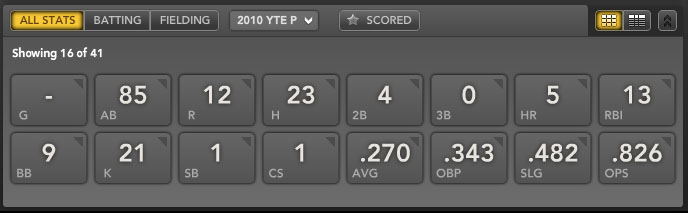 There are few men on the waiver wire that can provide pop like Bruce can in the final weeks of the season. If he’s out there in your league, pick up him up right away. If you are thinking of trading for him in a keeper league, do it soon, before he hits another strong week (or another year of development) and his owner decides not to trade him away.
For more on Jay Bruce and other power options on your waiver wire, check out Bloomberg Sports’ Fantasy Tools.
Rays Call Up Desmond Jennings
By Tommy Rancel //
Although he was just called up to the big leagues for the first time
on Wednesday, Rays fans have had Desmond Jennings on
the brain for a while. Even before his breakout minor league season of
2009 – in which he hit .318/.401/.487 with 52 steals and 92 runs scored –
Jennings was regarded as the stallion-heir apparent to Carl
Crawford in the Tampa Bay lineup.
After his fantastic ’09 campaign – including being named MVP of the
Southern League (Double-A) – Jennings went from the 80th-ranked prospect
according to Baseball America to the 6th-best prospect overall. He was
invited to his first big league camp this spring, but a wrist injury
wiped out most of that audition, as well as the first part of his minor
league season.
Once healthy, the 23-year-old played in 109 games for the Triple-A
Durham Bulls. His numbers were not as impressive as they were last
season, but he still hit .278/.362/.393. At this point in his career,
Jennings has not shown much power (29 home runs in 420 career minor
league games), but he still projects as a top-of-the-order hitter,
blessed with blazing speed and advanced plate discipline.
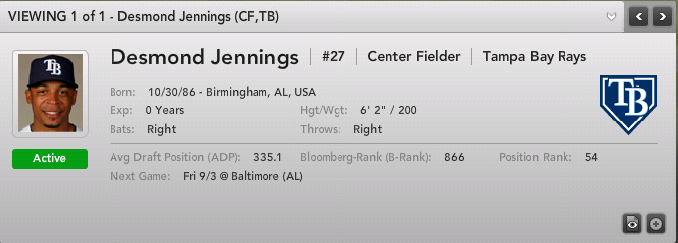
Despite the lack of power in Durham, Jennings still scored 82 runs in
100 games. His OBP (.362) wasn’t fantastic, but it was still above
average. He walked nearly 11% of the time and struck out in less than
17% of his plate appearances. Once on base, he swiped 37 bags in 41
attempts (90% success rate).
As a September call-up on one of the most talented teams in baseball,
Jennings probably won’t rack up many at-bats over the next 30 days,
unless the Rays unexpectedly clinch a playoff berth very early. His
value to the Rays, and potential fantasy owners, will be tied to speed
and baserunning ability. Similar to Fernando Perez in 2008,
Jennings is likely to be the Rays’ primary pinch-runner and a part-time
defensive replacement.
In his MLB debut on Wednesday night, Jennings went 0-3 with two
groundouts and a swinging strikeout. We did not get a chance to see him
glide around the bases, but we did get a chance to see his speed out of
the box and his trained batting eye.
Jennings had four plate appearances, but officially only had three
(4th inning appearance negated by a B.J. Upton caught
stealing). Overall he saw 19 pitches (14 officially) and worked three
full counts. In his final at-bat, Jennings came up with the bases
loaded. He grounded out on what amounted to a swinging bunt. On the
other hand, had the force play not been on at home – and a slow runner
in Dioner Navarro at third – Jennings would’ve been
easily safe as he burned through the chalk on the way to first base.
If you have the need for some steals and runs, then Jennings is worth
a spot in (really) deep mixed and AL-only leagues. They will come
sporadically, but he should provide a handful of both. If Jennings is
available in your keeper league, though, jump on him immediately.
For more on Desmond Jennings and other September call-ups, check
out Bloomberg Sports’ Fantasy
Kits
Hawpe in St. Pete
By R.J. Anderson //
In a purely subjective sense, Brad Hawpe is the tailor-made contrast between fantasy and real world baseball values. Hawpe’s talent cavities have always included rambunctious defensive play – even on the quietest of balls – and an inability to hit as well on the road as he did at home. This leaves a general manager – particularly one in the National League – in the awkward position. Choosing to either hang onto Hawpe with the hope that he’ll steal Rickey Henderson’s legs or explaining to the ownership and media why he couldn’t recoup the standard fare for hitters with Hawpe’s numbers through a trade.
Dan O’Dowd held onto Hawpe for seasons but recently decided to release him. On Friday, Hawpe found a new home. The Tampa Bay Rays signed the southpaw to a minor league deal with the idea that he will eventually come up within the week and take over as the left-handed designated hitter. Is Hawpe worth the fee to acquire him in American League only leagues? Maybe.
Most starting pitchers are right-handed, meaning Hawpe may receive 60-65% of the Rays’ designated hitter plate appearances in September. Throughout Hawpe’s career, his line versus righties is a robust .290/.387/.507 with 94 home runs in 2,452 plate appearances. The concern is not over whether Hawpe has hit, though, but rather will he continue to hit now that he is out of Coors Field and into the American League East. Since both franchises are relatively new, the amount of players with significant playing time with both is limited.
Nevertheless, here is a table detailing how those players performed after trading their Coors for a glass of Tropicana’s finest:

The only player to improve both his batting average and AB/HR is Greg Norton. One has to suspect starting, even if only as a designated hitter, had to be an easier role for Norton to stay fresh and focused than coming off the bench in a pinch hitter role. Suffice to say that history is not on Hawpe’s side and those odds are only worsened when expanding the scope beyond the Rays and onto the entire American League East. Garret Atkins is the most recent case of failure and the last success story might be Mark Bellhorn way back in 2004 – and make note that Bellhorn’s abbreviated Colorado performance was Coors-worthy for an entirely different reason.
The Rays will stick with him despite going 0-4 with four strikeouts in his debut. A streak of such ineptitude just means that someone is likely to break it. The odds are just too great. Just please, please do not make a “Hawpe and pray” joke if you decide to add him.
For more on Brad Hawpe and other late season additions, check out Bloomberg Sports’ Fantasy Kits.
What to Expect from Phil Hughes and Ivan Nova in September
By Tommy Rancel //
Coming off his worst start of the season, Phil Hughes looks to rebound tonight against the Oakland Athletics. Sure, the five runs allowed in 3.2 innings last time out hurt fantasy owners, but it may have bought you more time with the Yankees’ young righty. While some suggest New York should be counting pitches thrown (102 pitches in his short 3.2 inning outing) and not innings, the common belief is Hughes is on an innings limit rather than a pitch limit. There is no public number, but that limit is believed to be around 170-180 innings.
In 2010, Hughes has thrown just under 145 innings. That is up from the 105 (combined major and minor leagues) he threw last season. That potentially leaves fantasy owners with 25-35 innings of Hughes to work with. We don’t know if they will all be starts, or if he makes a couple more starts and then shifts to the bullpen. There is a good chance, though, that those will be above-average innings.
Despite last week’s bump in the road, Hughes is still 15-6 with a 4.12 ERA. According to fielding independent pitching (FIP), which measures home runs allowed, walks, and strikeouts, he has actually been a tick better (4.02 FIP) than his ERA. His 7.61 strikeouts per nine innings rate (K/9) is slightly above average. Moreover, he does a good job of limiting walks (2.68 per nine). His home run rate is so-so at 1.18/9 IP, with some of that number attributable to his home ballpark being a launching pad for left-handed hitters.
If Hughes remains a starter, you might be able squeeze two or three wins out of him in the four or five starts he has left. On the other hand, if he splits his time between the rotation and the bullpen, hi ratios might actually improve.
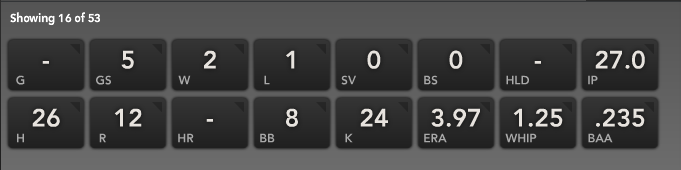
*Phil Hughes Year-To-End Projections by Bloomberg Sports
Hughes did dual duty in the major leagues during the 2009 season. He made 44 appearances in relief, but also made seven starts. In his time as a reliever, he had a 1.44 ERA and struck out 65 batters in 51.1 innings. That translates into a K/9 of 11.43 – a number generally reserved for the elite.
Regardless of what the Yankees do, make sure Hughes remains in your plans as we shift our focus toward the playoffs. That said, make sure you have a contingency plan as well. For that, look no further than Hughes’ teammate Ivan Nova.
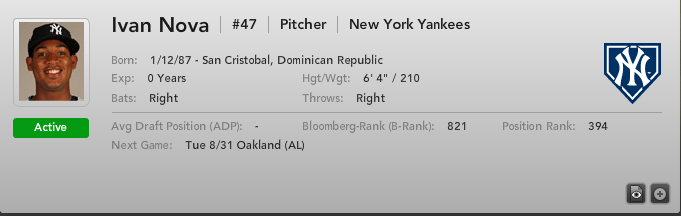
The 23-year-old right-hander has made four appearances for the Yankees – including two starts. He sports a shiny 1.93 ERA and his 2.89 FIP isn’t too shabby either. With Andy Pettitte injured, A.J. Burnett struggling, and Javier Vazquez in the pen, there is a chance that Nova remains in the Yankees rotation through September.
Looking at his peripheral stats, Nova’s K/9 (7.07), BB/9 (1.29), and HR/9 (0.56) suggest the kid is not just throwing hard (94.1 mph average), but also pitching well. Of course, these are small-sample size number. Still, with five or six starts left this season, pitching for a team that offers plenty of run support, Nova’s a decent pickup, especially if your league is deeper than the standard mixed format.
For more on Phil Hughes and other young starters facing innings limits, check out Bloomberg Sports’ Fantasy Kits.
(Video) Bloomberg Sports’ Ballpark Figures: Stock Report
By Bloomberg Sports// Ballpark Figures: Stock Report— Bloomberg Television’s Michele Steele and Bloomberg Sports Fantasy Analyst Rob Shaw are talking Bulls and Bears in Fantasy Baseball. Shaw tells us to invest in Royals infielder Wilson Betemit, Yankees outfielder Marcus Thames, Nationals outfielder Michael Morse, and Mets pitcher RA Dickey. Shaw is bearish on infielders Alberto Callaspo of the Angels and Miguel Tejada of the Padres. For more fantasy insight visit us at BloombergSports.com.
Manny Being Manny In New Places
by Eno Sarris //
Judging by his inglorious exit from from a Los Angeles Dodgers team that sits five and a half games out of the wild card (before four other teams), one might be forgiven for comparing Manny Ramirez to chopped liver. The prevailing attitude vis-a-vis the mercurial slugger is that he’s injured too often and that at 38 years old, his offensive skills are just not what they used to be.
The prevailing view is wrong on this one. Ramirez has sported an OPS over .900 the past two years in Los Angeles, showing relatively little deterioration in his skills as a batter. There’s also reason to believe that he may be able to stay healthier in his new digs.
First, he’s still a great hitter. Ramirez’s walk rate, strikeout rate, and BABIP have held steady his whole career at above-average levels, making him an excellent bet for a strong OBP and batting average. Even in this ‘down’ period of his career, he should still put up a batting average near .300 and an OBP near .400 – benchmarks he’s hit more often than not in his illustrious career. These two facts alone make him an above-average real-life batter and a decent fantasy baseball option in many leagues.
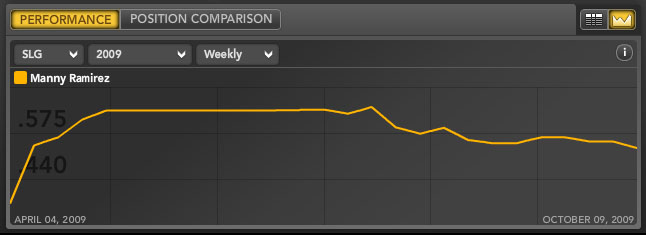 Power is the real question mark, admittedly. After putting up isolated slugging numbers (slugging percentage minus batting average, ISO is a statistic that focuses on extra-base hits) near .300 for most of his career, Ramirez dipped to .241 last year and has a .199 ISO this year. His positive test for performance-enhancing drugs in 2009 has been blamed for this power outage, but Ramirez still had an ISO of .204 after he returned, which would put him on par with players like Brian McCann (.197 ISO), Aramis Ramirez (.201 ISO) and Rickie Weeks (.203 ISO) this year.
If a .200 ISO does not seem exciting enough, there are reasons to think he can do better in Chicago. According to StatCorner.com, the park factor for home runs for right-handed hitters in Los Angeles was 92. Compare that to U.S. Cellular, home of the White Sox, which has a 134 park factor for home runs for right-handed hitters. That is a serious swing in fortunes. In 213 earlier-career at-bats at the Cell, he’s had a .338/.448/.601 line that suggests he feels comfortable there.
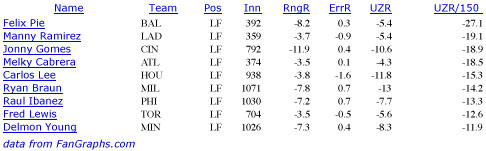 The last piece of optimism arises when we consider defense. Not normally important when considering fantasy baseball, Ramirez has been so poor defensively that it had begun to cost him playing time. Since defensive statistics have been kept at FanGraphs.com, he has ranked in the very bottom of the outfield defensive rankings. Only one player with as many as 350 innings in left field this year has performed worse than Ramirez, for example. With the benefit of the DH – his new full-time position – he won’t have to stumble around the outfield anymore and should get his full share of at-bats. Maybe he’ll even stay healthier without the added stress on his legs and back.
Ramirez probably should have signed with an AL team before the 2009 season, but the Dodgers thought he had enough in the tank to help, even in the outfield. Now that it’s Manny time again in the AL and Ramirez is a DH, he should have enough left to help your fantasy team down the stretch.
For more on Manny Ramirez and other DHs, check out Bloomberg Sports’ Fantasy Tools.
(Video) Bloomberg Sports’ Ballpark Figures: Fantasy Headlines
By Bloomberg Sports // Ballpark Figures: Stock Report— Bloomberg Television’s Michele Steele and Bloomberg Sports Fantasy Analyst Rob Shaw discuss the fantasy baseball headlines. Shaw tells us Manny Ramirez should enjoy a bump in production when it comes to joining the Chicago White Sox. Aroldis Chapman should rack up plenty of K’s and a sweet ERA for the Reds. Brandon Morrow’s fantasy value takes a hit as the Blue Jays look to limit his innings. Jose Reyes is injured again and should not be depended upon for at least another week. Finally, Yankees rookie Ivan Nova has pushed controversy to the side with another fine outing for the Bombers. For more fantasy insight follow us Twitter.com/BloombergSports.
More Players To Target For Specific Category Help
(Audio) Behind the Numbers w Dave Studeman
By Bloomberg Sports //*
Listen now! – (loads in new browser – 19 megs)
Behind the Numbers
Hosts: Rob Shaw and Wayne Parillo
Guest: Dave Studeman
About the Guest:
He has been called a National Treasure by Rob Neyer, and is also the owner/manager of thehardballtimes.com.
Enjoy the podcast and make sure to follow him on twitter
Total Running Time: 18:29
High Level
- Being a National Treasure and all about the Hardball Times(0:28 – 2:20)
- The Pirates and the drive to make money (3:21 – 5:45)
- The Hardball Times projections (6:30 – 7:41)
- King Felix for Cy Young & Manny for Chicago (7:44 – 12:43)
- What is the Hardball Times Annual (17:04 – 17:49)
A Highlight a Minute
- (0:28 – 0:59) Dave Studeman – the National Treasure
- (1:00 – 1:35) What The Hardball Times is all about
- (1:40 – 2:20) Sabermetrics for both fantasy & reality
- (2:21 – 3:16) Telling a story visually & joining the Hardball Times
- (3:21 – 4:36) The Pirates making a profit (and the drive to make money)
- (4:37 – 5:45) Pirates previous failures in developing stars
- (5:46 – 6:24) Dave’s business background & his lifestyle choice
- (6:30 – 7:41) THT Projections covering 7,000+ players over the next six years
- (7:44 – 9:09) Stats v WInning Impact on the organization for the Cy Young Winner
- (9:15 – 10:22) Why Dave’s proud of the Wins Probably game graphic
- (10:24 – 11:50) King Felix for Cy Young?
- (11:51 – 12:43) Is Manny Ramirez enough for the White Sox?
- (12:44 – 14:12) Did Numb3rs “borrow” from the THT?
- (14:14 – 15:36) Major League teams buying the annual and the true success of the writers
- (15:37 – 16:13) How to measure stats in the history books due to steroids
- (16:14 – 16:49) Why HOF Guidelines would be good
- (17:04 – 17:49) THT Annual: Stats, Graphs, and Articles
- RSS feed
- on iTunes
- Follow us on twitter: Bloomberg Sports, Rob Shaw, or Wayne Parillo
- Play Batter’s Box
- What we have for fans
Direct link to the conversation
More ways to get Behind the Numbers, talk to us, or just have a good time
 Bloomberg Sports