Category: Dailies
Detroit Tigers Sign Victor Martinez To 4-yr, $50 Million Deal
By Tommy Rancel //
The Detroit Tigers continue to be the most aggressive team during the early stages of the off-season hot stove. Earlier today, they signed C/1B/DH Victor Martinez to a four-year deal worth a reported $50 million dollars. In addition to the money, the Tigers also surrendered their first-round pick to the Boston Red Sox because of Martinez’s Type-A status.
Martinez will be 32 by opening day 2011; however, he is one of the best hitting catchers in baseball. A career .300/.369/.469 hitter, he hit .302/.351/.493 in his first full season with the Red Sox. His patience at the plate dropped slightly, but that coincided with an increase in power numbers.
While it is unlikely he is still an everyday catcher at the end of this contract, one would assume the Tigers’ plan is to have the bulk of his playing time from behind the plate in 2011. They have the AL MVP runner-up in Miguel Cabrera at first base and paying Martinez to DH doesn’t make sense – at least at this point in his career. Sure, he’ll spell Cabrera at times and take a few hacks at DH, but he should be prepared to catch 100+ times in 2011.
This is good news for fantasy owners as Martinez will remain a top player at the position. Along with Joe Mauer and NL Rookie of the Year Buster Posey, Martinez provides a blend of average and power that is a rarity for the position.
There is some concern about him leaving the cozy dimensions of Fenway Park for the spacious Comerica Park; however, it shouldn’t be a huge factor. It is true Fenway is a haven for doubles hitters. In fact, 23 of Martinez’s 32 doubles in 2010 came at home, but the vast outfield in Detroit should lead to its fair share of extra bases as well. According to ESPN’s park factors, Detroit’s park was actually more home run friendly than Boston’s; another good sign for Martinez, who split his 20 home runs equally on the home and road.
The concerns of moving positions shouldn’t be a factor this season. And the change in ballparks isn’t as extreme as one might think. Because of his ability to hit for an average around .300 with upwards of 50 extra-base hits a season as a catcher, Martinez should once again be a primary target of fantasy owners in 2011.
For more on Victor Martinez and the catcher position, check out Bloomberg Sports’ Front Office.
Aubrey Huff Remains in San Fran
By R.J. Anderson //
The San Francisco Giants secured the services one of their unlikely 2010 heroes today, re-signing Aubrey Huff for two years and $22 million (with a club option for a third year). I took a look at what Huff’s real world value to the Giants meant at FanGraphs, so in the interest of new material, let’s focus on solely his fantasy value.
Over the last three seasons, Huff has teetered between good and bad offensive player to the extremes of which are nothing shy of a rarity. With the Orioles in 2008, he hit .304 with 32 home runs and 108 runs batted in. That kind of production made his 2009 season even more of an unexpected disaster, as he managed a .241/.310/.384 line with just 15 home runs while splitting time with the Orioles and Tigers. Nobody knew what to expect from Huff entering 2010, and as a result, the Giants were able to secure him at a relatively low cost. He made them quite the return on investment, hitting .290/.385/.506 with 26 home runs in a pitcher’s paradise.
Taking an average of those three seasons nets you a .280 batting average with 24 home runs and 93 runs batted in. Take into consideration Huff’s age (he turns 34 turns before Christmas) along with the ballpark, and Huff is unlikely to replicate those numbers. That means a safer expectation for next season is a slight decline in each category; i.e. a .270 average instead of .280, 20 home runs instead of 24, and 80-to-85 runs batted in instead of 90-plus. That means he still holds fantasy value, especially if eligible at multiple positions.
The one consequence this re-signing holds for the Giants is that top prospect Brandon Belt is blocked for the foreseeable future. Eno Sarris will have more on what that means for Belt’s value later this week.
What We Can Learn From Vladimir Guerrero This Off-Season
By Eriq Gardner //
Underrated Hiroki Kuroda Re-Signs With Los Angeles Dodgers
By Tommy Rancel //
Following in the footsteps of fellow Dodgers’ starter Ted Lilly, Hiroki Kuroda chose the comfort of Southern California instead of the uncertainty of the open market. After entertaining the idea of returning to his native Japan, the 35-year-old will remain in the States for at least one more season.
The deal itself looks like a win-win for both sides. Kuroda gets $12 million dollars for one year of work. And the end of the season, he can re-assess his options. For the Dodgers, they get another year of his services at fair market value.
Although Kuroda has a sub .500 record (28-30) in the Major Leagues, he has maintained an above-average ERA. In nearly 500 innings pitched, his career ERA is a sparking 3.60. In fact, he is one of just 13 National League pitchers with a ERA of 3.60 or below (min. 490 innings) over the past three years. Other names include Johan Santana, Tim Lincecum, and Dodger teammate Chad Billingsley amongst others. Looking at fielding independent metrics, they support the fact that Kuroda is a 3.5-3.75 ERA starter.
Despite being in his mid-30s, Baseball Info Solutions clocked his average fastball at just over 92 miles per hour. In addition to his regular heater, Kuroda throws a split-fingered fastball, a slider, and has briefly experimented with a curveball. The fastball/slider combo has combined to give him groundball rate of over 50% for his career.
In his three seasons with the Dodgers, his strikeout rates have proven to be largely average (6.56 K/9 career), but he improved slightly this past season (7.29 K/9). He also shows good control (2.06 BB/9 career) and has done a fantastic job of keeping the ball in the yard (0.72 HR/9).
Of course, with age comes concern about durability. Kuroda has not topped 200 innings in a major league season; however he did come close with 196.1 in 2010. He also spent a combined 76 days on the disabled list in 2009 and battled shoulder tendinitis in 2008.
Like his re-signing, Hiroki Kuroda’s efforts have largely gone unnoticed. That said, if you’re looking for the potential for double-digit wins with an above-average ERA at the SP3 spot don’t forget the name.
For more on Hiroki Kuroda and the Los Angeles Dodgers, check out Bloomberg Sports’ Front Office.
Javier Vazquez a Fantasy Bounceback? Deja Vu All Over Again
by Eno Sarris //
Maybe there’s something in the water in New York. Javier Vazquez certainly doesn’t like something about the city, because both of his attempts at wearing the pinstripes went poorly.
Consider this: Only twice in the decade did Vazquez strike out fewer than 6.99 batters per nine, and only twice did he walk more than 2.7 batters per nine. Both of those times were with the Yankees, in his worst two seasons (2004 and 2010). Over his career, those numbers are 8.07 and 2.42 per nine respectively, so his failure to meet those benchmarks is significant.
Much has rightly been made about the drop in fastball velocity that Vazquez suffered last year. His fastball and slider both lost about two miles per hour, and the difference between his fastball and changeup dipped under 10 MPH for the first time. The strange thing? The last time his fastball averaged under 91 MPH, it was in a Yankee uniform. Perhaps the stadium gun is a little slow, or the pundits have it right and he Just Can’t Pitch in New York. [Edit: Mike Fast from Baseball Prospectus points out that the gun in New York runs about 0.7 miles per hour slow, so some of the drop is thereby explained. Vazquez may be declining, but it isn’t as drastic as it seems.]
Now it sounds like the Florida Marlins are looking into Vazquez, and it’s not surprising that the feeling is mutual. Not only will the righty be getting out of New York, but he’s always been a flyballer and has had a problem with home runs (1.2 HR/9 career, 1.83 in 2010, 39% groundballs career), so the move to Florida should help. Last year, the stadium had a 95 park factor for home runs for right-handers (99 for lefties), and ESPN’s park factor has averaged a .931 over the last three years. The park in Florida should help Vazquez suppress home runs by 5-7%, it seems.
In 2004, Vazquez left New York after losing oomph on his fastball and suffering from wonky control. He went to the National League and refound his game in Arizona. Because of a more drastic loss of oomph in 2010, Vazquez may need to go to a nicer park in the weaker league to find success this time. The good news is that Florida is just that park. Vazquez looks like a fantasy sleeper all over again.
For more on Javier Vazquez and other possible fantasy rebounds, check out Bloomberg Sports’ Front Office.
Introducing Hisashi Iwakuma
By R.J. Anderson //
We’ve already covered the Athletics’ trade of Vin Mazzaro. The preface to that deal involves the A’s winning the negotiating rights to Hisashi Iwakuma. Yes, Iwakuma is from Japan, which means the level of knowledge about his pitching abilities and potential sits lower than most domestic products.
Keith Law ranked Iwakuma as the sixteenth best free agent available this offseason. Noting Iwakuma’s upside as “mid- to back-of-the-rotation guy” and stating that his delivery is “more conventional” while his mindset is “pitch-to-contact.” Law also offered a scouting report on Iwakuma’s stuff. The basics being that Iwakuma sits in the low-90s while relying on his secondary pitches throughout at-bats.
All of that information combined with the knowledge of Iwakuma’s park and division make it easy to set the baseline projections around a league average performance. Going a step further, though, how have previous Japanese starters fared in making the move?
Only 12 pitchers born in Japan have made more than 10 starts in the major leagues. Only nine have made more than 15 starts. Iwakuma will (presumably) become the tenth sometime around the All-Star Break. The nine names to concern yourself with here are Hideo Nomo, Tomo Ohka, Masato Yoshii, Kazuhisa Ishii, Daisuke Matsuzaka, Hiroki Kuroda, Hideki Irabu, Mac Suzuki, and Kenshin Kawakami. Eliminating the pitchers who came up through the minor leagues (Ohka, Suzuki) leaves us with these first full season results:
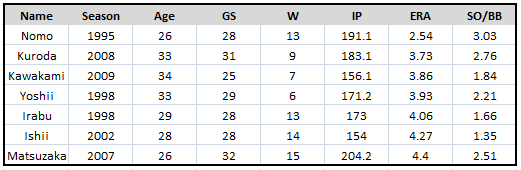
Overall impressive, although one has to keep in mind the inherent survivor bias. There are Japanese pitchers like Kei Igawa whom received a ton of cash and quickly bombed out of the rotation. There is no guarantee Iwakamu will avoid that faith in 2011 and particularly not in 2012. Kawakami had the third best debut season and Atlanta Braves removed him from their 40-man rotation over the weekend. Meanwhile the stories of Nomo, Irabu, Ishii, and Matsuzaka are common in the public consciousness.
Iwakuma looks rosterable (at least to begin the season) with an ERA projection around 4.00.
For more on Hisashi Iwakuma and mid-rotation candidates check out Bloomberg Sports’ Front Office.
Jake Westbrook Likes St. Louis
by Eno Sarris //
Reports of a $17.5 million, two-year contract between Jake Westbrook
mean that the right-hander must like pitching in St. Louis, or at least
enjoy taking their money. If he can continue to put up his late-2010
numbers, the Cardinals and fantasy owners will like him right back.
In twelve post-trade starts, Westbrook bettered his strikeout rate (from
5.15 K/9 to 6.60 K/9), walk rate (from 3.10 BB/9 to 2.88 BB/9),
groundball rate (from 53.3% to 62%), and home run rate (from 1.06
HR/9 to .60 HR/9). His ERA (3.48) and WHIP (1.25) matched his
peripherals, and if it weren’t for the small sample size, the magic
eightball would read “signs point to yes” when asked about Westbrook’s 2011. 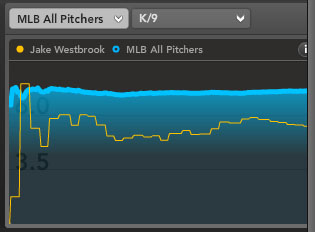
But the small sample size is a fact, and it makes for some doubt. Was
the improved performance more Dave Duncan magic? Or was it simply a move
to the weaker, and DH-less, league? Or did Westbrook finally recover
from the Tommy John surgery that forced him to miss much of 2008 and all
of 2009? Finally, was it just a short, fun, 12-start run?
Let’s use the largest sample size possible and compare Westbrook’s NL
work to his career numbers. The first thing that leaps out is that his
post-trade control (career 2.80 BB/9) and groundball work (career 59%) look legit.
He can repeat those aspects of his game, and they will help to limit the
damage when batters make contact. Fewer ducks on the pond and fewer
home runs make for fewer five-run innings.
We are left to wonder about the strikeout rate. Westbrook’s contract and groundball rates look like erstwhile Cardinal Joel Piniero‘s
numbers in those categories, so it’s no surprise that the two pitchers share similar career strikeout rates as well (Westbrook: 5.03 K/9; Piniero: 5.57 K/9). Piniero’s 2009 probably provides us a definition of new Cardinal’s upside. Moving
from the AL to the NL might make for a little boost for Westbrook, but his
best season-long strikeout rate as a starter was 5.51 in 2007, and he’s
now three years older. It would be folly to predict many more strikeouts
than five-and-a-half per nine in 2011.
Still, as he puts more distance between his current self and his
surgery, the likelihood that Westbrook finds his old control increases (from 2004-2006, his walks per nine ranged from 2.34 to 2.55). Paired with a slight uptick in strikeouts, and his always-excellent
groundball rates, Westbrook is a fairly safe bet for fantasy relevance
in most leagues – even if he probably won’t repeat his excellent
late-season numbers from last year.
For more on Jake Westbrook and other late-draft pitching options, check out Bloomberg Sports’ Front Office.
Report: John Bucks To Sign Three-Year Deal With Marlins
By Tommy Rancel //
Jose Bautista and his 54 home runs grabbed the headlines as leader of a powerful Toronto Blue Jays lineup that smashed 257 home runs. Counting Bautista, seven Jays hit at least 20 home runs. This doesn’t include Alex Gonzalez‘s 17 home runs in 85 games with Toronto and the six he added with the Braves. On the other hand, this does include catcher John Buck who hit a career-high 20 home runs.
After his power-filled season north of the border, it is being reported that Buck is close to signing a three-year deal with the Florida Marlins worth between $16-18 million. Before we get into the fantasy aspect, let’s look at the deal.
Like most teams, the Marlins were looking to upgrade their catcher situation. Ronny Paulino served as the teams’ primary catcher before being suspended 50 games after testing positive for a performance-enhancing substance. Whatever he took didn’t work as he hit just .259/.311/.384 in 91 games. From there names like John Baker, Brad Davis, and Brett Hayes received playing time, but none did anything to warrant more.
In Buck, the Marlins are getting a player whose profile is easy to project. Despite his .281 batting average this past season (inflated by a batting average on balls in play of .335 compared to a .289 career average), Buck is more of a .250 hitter. He does not show much patience at the plate (6.5% career walk rate) and is a hacker. In addition to striking out more than 26% of the time, he swings at nearly 30% of pitches outside of the strike zone. In the last two seasons, he whiffed at more than 16% of the pitches thrown to him.
The one positive in Buck’s game is his power. That said, he is not Mike Piazza in his prime. As mentioned, he hit a career-best 20 home runs this past season. His previous high came in 2007 when he belted 18 bombs as a member of the Royals.
Like a lot of Blue Jays, he enjoyed a home-run friendly Rogers Centre. The former Sky Dome had a home run park factor of 116 for right-handed batters (average is 100). The park he now calls home had a park factor of 95 for right-handed batters. The good news is he hit 10 home runs on the road.
With a similar player in Ramon Hernandez signing a one-year, $3 million deal on Monday, this looks like a gross overpay by the Marlins. In terms of fantasy impact, Buck was not a top 10 catcher going into 2011, but he was a decent backup option in the right situation. When you consider him leaving the confines of Toronto as well as the potential for regression in batting average, he is now closer to the bottom 10 than the top.
He should still hit for decent power numbers in Miami – sacrificing some home runs for doubles – and could give you some value in a deep league, but do not take the bait and overpay like the Marlins.
For more on John Buck and the Florida Marlins, check out Bloomberg Sports’ Front Office.
MLB Season in Review: Baltimore Orioles Hitters
By Eriq Gardner //
Cameron Maybin Traded to the Padres
By R.J. Anderson //
A day after the Florida Marlins traded Andrew Miller to the Boston Red Sox, the Fish shipped out the other big name from their ill-fated Miguel Cabrera trade, by sending Cameron Maybin to the San Diego Padres. (That leaves only Burke Badenhop remaining in the organization from that package and that’s probably a good thing, given how the others have played during their time in Florida.) The Marlins received two right-handed relievers in return for Maybin – Ryan Webb and Edward Mujica. Both could be in line for some save opportunities if Florida decides to trade closer Leo Nunez.
Webb stands 6’6″ and features a mid-90s fastball. The prototypical closer image with a fierce slider that translates into wicked groundball rates (over 60% for his career), Webb is more than projection, as the arithmetic matches the physiology. Webb’s ERA sits at 3.19 through more than 80 career innings, while his peripherals remain steady with a strikeout-to-walk ratio of better than 2-to-1. Part of Webb’s shine can be attributed to a microscopic home run rate in 2010 (0.15 per nine innings; or one in 59 innings). That will not continue in 2011, but a sub-4.00 ERA would not be out of line.
Meanwhile, Mujica’s inability to keep the ball in the park remains the only aspect separating him from prominence. Since the 2009 season started — coinciding with Mujica becoming a Friar — he has accumulated 163 innings, a 3.80 ERA, 148 strikeouts, 21 unintentional walks…and 28 home runs. His stuff misses bats and he controls it well. Whether the home runs are a short-term blemish or a permanent flaw is to be determined. Having the gopherball bug through more than 200 career innings (with most of that time coming in pitcher-friendly San Diego) suggests it’s probably not going away. Still, his numbers are not too different from those of the incumbent closer, Nunez:

For the Padres to part with two quality relievers with years of cost control left, they required a player with the potential of Maybin. The one attribute about Maybin that will continue to be repeated until the season gets underway is his age. He is only 23 years old despite having more than 600 career plate appearances in the bigs (and a .246/.313/.380 line). That in itself is pretty rare for center fielders. Take the top 10 center fielders during the 2010 season (as determined by FanGraphs’ WAR) and track them at age 23. Here’s what you’ll find:
Josh Hamilton – Not playing baseball due to substance abuse issues.
Andres Torres – In Double-A hitting .294/.391/.393 line.
Carlos Gonzalez – In his second season in the bigs, hitting .284/.353/.525 for Colorado.
Brett Gardner – Hitting .281/.369/.378 between the upper minors.
Angel Pagan – Hitting .271/.333/.395 in his first full season in Triple-A.
Chris Young – Hitting .237/.295/.467 in his first full season in the majors.
Michal Bourn – Getting his first cup of coffee after hitting .277/.356/.385 in the upper minors.
Marlon Byrd – In Double-A hitting .316/.386/.555.
Vernon Wells – First full season in the majors, hitting .275/.305/.457.
Austin Jackson – This season, first full in the majors, hitting .293/.345/.400
With that kind of history, Maybin has some cause for optimism. There is reason to believe he still possesses the tools that made prospect analysts go wild over his potential just three years ago, it’s just a matter of tapping into those tools. Regardless of his immense physical skills, though, Maybin must cut down on his whiffing. The driving force behind his awful line is not a lack of walks (nearly 8%) or success on balls in play (.334 batting average on batted balls) but rather, strikeouts. It’s hard for any player to fare well while striking out in nearly one-third of his career at-bats; particularly when that player hits the ball on the ground a lot, rather than hitting for a lot of power.
There’s an outside chance that the two relievers are more productive in fantasy than Maybin in 2011. There’s even an outside chance that Maybin is relegated to a bench role. It’s hard to see him not breaking camp with the Padres, though, as he is out of options (meaning he cannot be sent to the minors without passing through waivers) and the acquisition cost suggests there was a demand for Maybin on the trade market. At the very least, Maybin is the more intriguing long-term keeper if you’re in a perpetual league.
 Bloomberg Sports