Category: Dailies
Brewers, Blue Jays Swap Shaun Marcum for Brett Lawrie
By Tommy Rancel //
Tucked behind the announcement of Jayson Werth‘s monster contract with the Washington Nationals, the Milwaukee Brewers acquired starting pitcher Shaun Marcum from the Toronto Blue Jays in exchange for top prospect infielder Brett Lawrie.
Marcum returned in 2010 after missing the entire 2009 major league season due to Tommy John surgery. Once a death sentence for pitchers, Marcum is the latest in a long line of post-Tommy John success stories. He made 31 starts for the Jays, tossing 195.1 innings – both career highs. He never had much of a fastball to begin with, but his velocity returned to the high 80s.
Had Marcum been able to make 30 starts and toss 200 innings with mediocre results, it would’ve still been considered a successful comeback. Meanwhile, he not only returned healthy, but very effective. After posting a 3.39 ERA in 25 starts back in 2008, he went 13-8 with a 3.64 ERA in 2010. The 13 victories also qualify as a career high.
Without the natural ability to blow hitters away with a blazing fastball, Marcum has relied on one of the best change-ups in the game to get hitters out. While throwing the pitch more than 25% of the time in 2010, he was able to get a swing and a miss a jaw-dropping 28.1% of the time.
Because of the pitch’s effectiveness, Marcum has been able to have great success against left-handed batters, defying the usual platoon disadvantage. Last season, LHB hit just .190/.233/.299 against him. So pronounced was Marcum’s reverse split that Tampa Bay Rays manager Joe Maddon employed a reverse-platoon lineup against him that featured mostly right-handed batters.
In addition to the unhittable change-up, Marcum exhibited above-average control. His strikeout rate near 7.5 strikeouts per nine (K/9) was slightly above the league average (7.13) while his walk rate of 1.98 was well below (3.28).In fact Marcum posted the 6th-best strikeout-to-walk ratio in the league, topping even the likes of Cy Young winner Felix Hernandez – while pitching in a tougher ballpark, in a tougher division.
Marcum, 29 as of opening day, should be on your list of #2 starters headed in 2010 – he’s that good. The recovery from surgery looked complete last year. Also, consider that the shift to the National League – more specifically the NL Central – should benefit Marcum going forward.
On the Toronto side, it is unknown who replaces Marcum in the rotation; in Brett Lawrie, they did receive Milwaukee’s top prospect. Last season as a 20-year-old in Double-A, Lawrie hit .285/.346/.449. He hasn’t shown much home run power, yet still smacked 59 extra-base hits last year.
Thus far, Lawrie has played second base exclusively in the minor leagues. That said, there are some who say he is destined for the corner outfield in the future. There is also some speculation that Toronto may have acquired the native Canadian in order to flip him in a package for another piece. In any event, there is little chance that he has a significant fantasy impact in 2011 – outside of a potential September call-up.
Werth to Washington
By R.J. Anderson //
Separating current value from future value is a must in the world of transaction analysis; less so in the fantasy world, where so many leagues go with limited (or no) stability from year-to-year. Understanding that is paramount to understanding the negative reaction to Jayson Werth’s signing in the real world. The common critical points arising are that seven years is too long for someone Werth’s age (31), that $126 million is too much, and that the Nationals will not benefit from this deal when they are nearing competitor status. And yet, none of that matters in the fantasy world.
Werth is one of baseball’s best right fielders offensively or defensively. Over the last three seasons he’s hit .279/.376/.513 while averaging 29 home runs per season, 84 runs batted in, and 8 steals. His ability to steal bases and play defense is important to note. Whereas a player like Adam Dunn – whom Werth ostensibly replaces in the Nationals’ lineup – derives much of his value from hitting home runs and drawing walks – like Werth — receives criticism for his skill set that ages poorly, Werth is more athletic and should age better. That does not mean Werth will live up to that line this season, though, it just means don’t expect a sudden collapse.
What everyone should expect is for Werth’s new ballpark to limit his home runs. Not egregiously, but a few here and there. Citizen’s Bank Park is one of the kindest to right-handed batters in the game. Nationals Park isn’t mean to them, but it’s not nearly as charitable. The other aspect of the Nationals’ organization that may affect Werth is the talent around him. Werth batted behind Chase Utley and Ryan Howard last season, sometimes far enough behind that he didn’t benefit fully from their ability to reach base. With Washington, he figures to bat ahead of or directly behind Josh Willingham and Ryan Zimmerman, who both got on base roughly 39% of the time last season.
With young talent like Danny Espinoza, Ian Desmond, and of course Bryce Harper potentially filling out the Washington lineup sooner than later, there’s a chance Werth can continue to knock in 85-plus a season to along with 25 or so home runs and a .275 or so batting average. He shouldn’t rise up your charts because of this signing, but he shouldn’t fall either.
For more on Jayson Werth, check out Bloomberg Sports’ Front Office.
var OutbrainPermaLink=’http://bloombergsports.mlblogs.com/archives/2010/11/brandon-belt-is-buckled-in-and-ready-to-go.html’;
var OB_Template = “mlbblogs”;
var OB_demoMode = false;
var OBITm = “1241712535489”;
var OB_langJS =’http://widgets.outbrain.com/lang_en.js’;
if ( typeof(OB_Script)!=’undefined’ )
OutbrainStart();
else {
var OB_Script = true;
var str = ”;
document.write(str);
}
How the Adrian Gonzalez Trade Shakes Up the Rankings
By Eriq Gardner //
Pretend we’re in the middle of the first round and an owner has the choice between Votto and Tulowitzki. A week ago, the consensus would be for Votto. Now? Does a drafter choose Votto when his competition can take the roughly equal Gonzo a few picks later? Does choosing Votto make sense when other 1B like Teixeira and Ryan Howard may now be available in the 2nd round, as a result of being pushed down in the rankings? Tulo’s edge over other shortstops should be given more credit given the increased strength and depth at first base.
Juan Uribe Joins the Dodgers
By R.J. Anderson //
The Dodgers have been one of the most active teams this off-season. All of their moves to date had focused on bolstering their rotation: re-signing Ted Lilly and Hiroki Kuroda, then signing free agent Jon Garland. Their latest is an attempt to solidify their middle infield (specifically second base) while weakening a division rival. They believe they’ve done so by signing Juan Uribe to a three-year deal worth $21 million.
The shift away from shortstop and to second base actually limits Uribe’s real world value. Uribe’s defensive skill set is the opposite of David Eckstein’s. His arm gives him the ability to make long, tough throws, meaning he should be playing on the left side of the infield.
Uribe’s offensive value should be unaffected by the park change and he remains a safe bet to hit 15 to 20 home runs during any season where he amasses 500-plus plate appearances. Not everything in Uribe’s offensive game is that dependable or worthwhile, though, as his slash line over the last three seasons is a combined .261/.312/.443. That batting average and on-base percentage are weak, even for a middle infielder.
Making matters worse is Uribe’s unpredictable aging curve. He turns 32 in July and carries a history of problematic conditioning. Now, those issues were a few seasons ago, and perhaps it is unfair to place the sins of a younger (and possibly less dedicated) Uribe upon this version. Being this is the first comfortable contract Uribe has bagged in a while, though, the possibility remains that he could become a little too relaxed about his work ethic.
Nevertheless, Uribe remains a decent mixed league option for 2011 at shortstop and second base (he also qualifies at third base), thanks to his steady power output. Just don’t expect much if your league values on-base percentage in any form.
For more on Juan Uribe, check out Bloomberg Sports’ Front Office.
var OutbrainPermaLink=’http://bloombergsports.mlblogs.com/archives/2010/11/brandon-belt-is-buckled-in-and-ready-to-go.html’;
var OB_Template = “mlbblogs”;
var OB_demoMode = false;
var OBITm = “1241712535489”;
var OB_langJS =’http://widgets.outbrain.com/lang_en.js’;
if ( typeof(OB_Script)!=’undefined’ )
OutbrainStart();
else {
var OB_Script = true;
var str = ”;
document.write(str);
}
Derek Jeter Will Be Valuable For Fantasy Owners in 2011
By Eriq Gardner //
Not Bullish On Jeter In a New Uniform
by Eno Sarris //
Things are getting heated in the negotiations between Derek Jeter and the Yankees. Over the holiday week, Brian Cashman dropped this bomb in typically understated fashion:
“We understand his contributions to the franchise and our offer has taken them into account,” Cashman said. “We’ve
encouraged him to test the market and see if there’s something he
would prefer other than this. If he can, fine. That’s the way it
works.”
That is the way it works, but of course the baseball blogosphere took the tidbit and ran with it. Some of the fake baseball cards created by Beckett.com were chilling, and the prospect of Jeter in another uniform should be doubly chilling to fantasy players planning on snapping up Jeter as a bounce-back shortstop in 2011.
R.J. Anderson did a fine job taking a look at the historical precedent that 37-year old shortstops have provided in his article on Jeter earlier in the month. The most damning paragraph:
In June, Jeter will turn 37. No shortstop (defined by
having played at least 50% of their games at the position along with 300
plate appearances) aged at least 37 has ever hit more than nine home
runs in a season. Since 1970, only 20 shortstops met that qualification
after turning 37, with the highest batting average being .295, the
highest on-base percentage being .367, and the highest slugging
percentage being .419. Over the last three seasons, Jeter’s line:
.301/.369/.414. Meanwhile, only two of those players finished with an
OPS above the league’s average.
Looking at Jeter’s combination of BABIP and batting average last year (.307 BABIP, .270 batting average), you might wonder where some optimistic batting average projections are coming from. Bill James has him projected at .295, for example. On the other hand, Jeter is still athletic, has a much better career BABIP (.356), and could easily find himself batting closer to .300 next year.
And yet, if Jeter ends up in a different uniform, he probably won’t be a great bounceback pick. Three important statistics that have always been in Jeter’s favor could then work against him: plate appearances, runs and RBI.
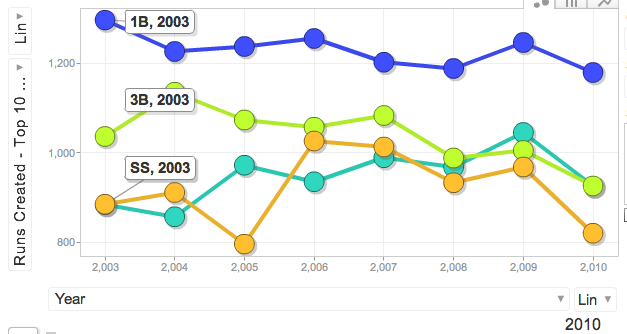
If Jeter were to don a new uniform in 2011, the most vulnerable statistic would be runs scored. Since Jeter joined the Yankees’ lineup for good fifteen years ago, he’s averaged 112 runs per season. That’s meant that even in his worst seasons, he’s been a boon in the category. The Yankees lineup has driven him in prolifically, and last year that offense scored the most runs in baseball (859). The offenses on the two teams that have been linked to Jeter, the Giants and Orioles, weren’t even close. In fact, the Giants (697 runs) scored only 81% of the runs that the Yankees scored.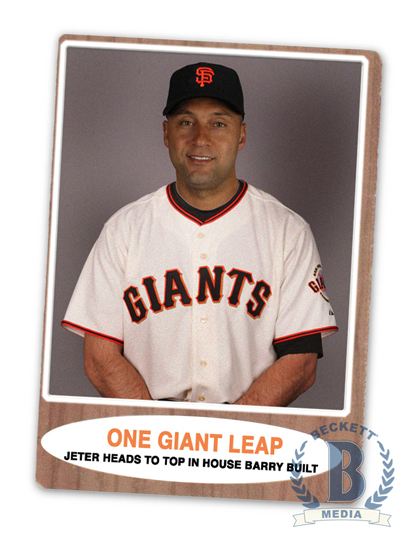
Let’s say we walk the runs and RBI projections for Jeter back 15% – after all Jeter would improve those two lineups ostensibly – and the package looks a little worse. Now we’re talking about a player that will gather around 85 runs and 50 RBI.
And there’s one last caveat. The projections we’ve been using here – Bill James’ on FanGraphs – use 703 plate appearances. A 37-year-old shortstop has never amassed 700 plate appearances. Omar Vizquel‘s 659 plate appearances in 2006 is tied with Luke Appling‘s effort in 1946 as the most ever by a 37-year-old at the position. Only nine other men have ever crossed the 600 plate appearance threshold. If we remove another 50 plate appearances to place Jeter in the middle of the best old shortstops ever, now we’re hoping that Jeter can get to double-digits in homers and steals, and worrying that he might not garner even 80 runs and 45 RBI.
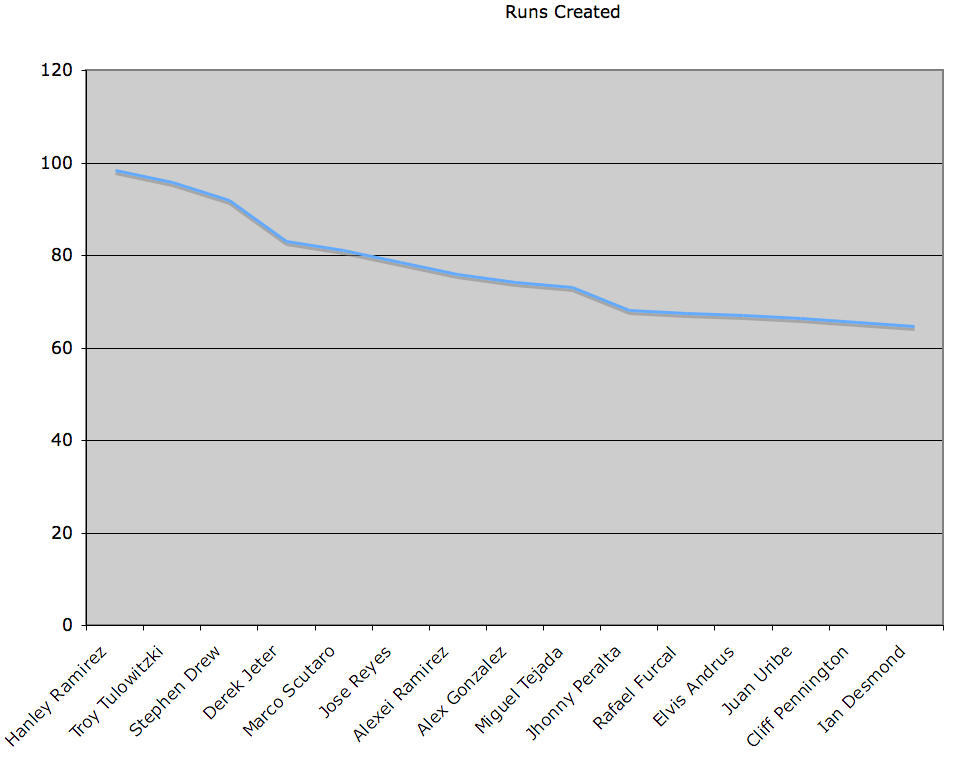
Later in 2011 drafts, you may be looking at Jeter among some shortstops that are at least five years younger than him. Would you pick Jeter over Alexei Ramirez (.280, 18 HR, 80 R, 78 RBI, 12 SB), Stephen Drew (projected for .270, 16 HR, 82 R, 67 RBI and 8 SB), or Elvis Andrus (.274, 2 HR, 82 R, 43 RBI, 34 SB)?
The answer to that question will depend, of course, on the actual draft positions required to grab each of the shortstops in question. But, looking at the runs and RBI totals of this projected crew, it doesn’t look like Jeter would be the same old Jeter in a new uniform. Fantasy managers looking to grab Jeter as a value should join the throng hoping that Jeter will re-up with the Yankees.
For more on Derek Jeter and other shortstops, check out Bloomberg Sports’ Front Office.
Who is Tsuyoshi Nishioka?
The New Duke of Arizona
By R.J. Anderson //
In 2006, the Pittsburgh Pirates had five pitchers of age 24 or younger combine to account for three-quarters of their season starts. Only one of those pitchers remains a Bucco. Oliver Perez was the first to go, then Tom Gorzelanny and Ian Snell hit the bricks. Now, Zach Duke is a member of the Arizona Diamondbacks, leaving Paul Maholm as the sole survivor.
The Pirates chose to designated Duke for assignment last week rather than hold off and (eventually) non-tender him. The move simply paved the way for Duke to leave the team. The only added benefit was the potential to recoup something in exchange for the rights to Duke. Someone did bite, and as a result the Pirates will receive a player to be named later, which reports peg as a marginal prospect.
The 2009 season represents the apex of Duke’s fantasy value. He tossed more than 200 innings of 4.06 ERA ball and won double-digit games. In typical Pirates fashion, the breakout’s sequel was a setback. Duke still made 29 starts, but only lasted 159 innings – a little over five innings per start, on average. That’s not a good ratio for someone who had averaged more than six innings per start throughout his career, including a career-best 6.7 innings a start in 2009.
The drop in innings was not because of durability or stamina issues, but rather ineffective pitching. His 5.72 ERA was an eyesore. Digging deeper, Duke had nine starts last season where he allowed more than four runs and he allowed more than six runs in six of those starts. He also had seven starts where he allowed multiple home runs and two where he allowed three homers.
Nevertheless, Duke is exactly the kind of pitcher Arizona General Manager Kevin Towers targeted during his time in San Diego. A lefty, Duke throws a mid-to-high-80s fastball with sink on it (resulting in a career groundball rate just a tick below 49%). His changeup sits in the low-80s and he relies heavily on two kinds of breaking balls; a low-70s curve and a high-70s/low-80s slider. The pitches combined for a decent whiff rate the last two seasons, but nothing special.
Pittsburgh plays its games within the friendly dimensions of PNC Park – a stadium with a reputation for limiting right-handed power; which in turn enhanced Duke’s ability to pitch. Arizona’s Chase Field is geared towards hitters, particularly lefties. Attempting to find similar cases of pitchers who went from Pittsburgh to Arizona (or vice versa) and quantify the trend is impossible. The Diamondbacks are too young to have many common links throughout the league, but even they had standards above the Pirates’ rejects.
Expect Duke’s hit rate (because pitchers who give up hits on 34.7% of their balls in play simply don’t last in the major leagues) and his home run rate (because, again, pitchers who give up homers on nearly 14% of their flyballs never make it this far) to decline. From there, his upside is likely that of a league-average pitcher, with the chance to look slightly better thanks to pitching his road games in some extremely friendly environments. He could be serviceable for the DBacks. But he’s unrosterable in all but the deepest fantasy leagues.
For more on Zach Duke and other change of scenary pitchers, check out Bloomberg Sports’ Front Office.
var OutbrainPermaLink=’http://bloombergsports.mlblogs.com/archives/2010/11/brandon-belt-is-buckled-in-and-ready-to-go.html’;
var OB_Template = “mlbblogs”;
var OB_demoMode = false;
var OBITm = “1241712535489”;
var OB_langJS =’http://widgets.outbrain.com/lang_en.js’;
if ( typeof(OB_Script)!=’undefined’ )
OutbrainStart();
else {
var OB_Script = true;
var str = ”;
document.write(str);
}
Jon Garland Returns to Los Angeles Dodgers
By Tommy Rancel //
After something of a career year in San Diego, Jon Garland has agreed to a one-year, $5 million dollar deal (plus performance bonuses and a vesting option) with the team he pitched for in the second half of the 2009 season, the Los Angeles Dodgers. In six starts in Dodger blue, he went 3-2 with a 2.72 ERA. While pitching for the Padres in 2010, he went 14-12 with a career-best 3.47 ERA in 33 starts.
In addition to the stellar ERA, Garland posted his best strikeout rate to date – although 6.12 strikeouts per nine innings (K/9) aren’t much to brag about. He also turned in his best groundball rate with 52% of the balls put in play against him burning worms.
That said, defensive independent metrics, which strip luck and defense from a pitcher’s performance, suggest Garland’s true talent level in 2010 was much closer to his 4.32 career ERA than the sub 3.50 he posted. This can be attributed to a lower-than-normal batting average on balls in play (BABIP) and pitching in Petco Park for more than half of his innings total.
In 2010, Garland’s BABIP (.267) was 35 points lower than the league average (.302). Most often the best indicator of what a pitcher’s BABIP should be is his career average. Those numbers show Garland’s mark is usually below the league’s average; however, his career .288 BABIP is still 21 points above his 2010 showing.
When looking at home/road splits, we see that Garland is the latest pitcher to rebound thanks to the “Petco Factor.” Easily one of the most pitcher-friendly parks in baseball, several pitchers have gone to San Diego for a numbers boost. Here are Garland’s home/road splits for 2010:
Home: 18 starts, 7-5, 3.00 ERA, .259 BABIP, 0.80 HR/9
Road: 15 starts, 7-7, 4.01 ERA, .277 BABIP, 1.08 HR/9
As you can see, his ERA differential was more than one full run. Closer to career levels, he allowed more balls to drop in play and more to carry over the fence on the road. The good news for Garland is Dodger Stadium is also pitcher-friendly park. In terms of ESPN’s park factors, the stadium has finished in the bottom half of the league for home runs allowed over the past three seasons.
Also working in Garland’s favor are consistency and durability. Over the past nine seasons, he has won at least 10 games and pitched more than 190 innings in each. The only other pitcher in baseball who can say he’s done the same is Garland’s former White Sox teammate Mark Buehrle.
Looking at everything in play, Garland is probably the most predictable fantasy pitcher in the National League. Expect a double-digit win total, nearly 200 innings, and an ERA around the league average. He should regress from his 2010 numbers, but landing in Dodger Stadium should soften the blow. He will start the season as Los Angeles’ fifth starter; consider him a fourth or fifth starter in NL-only leagues, and the last man on your staff in standard 12-team mixed leagues.
For more on Jon Garland, check out Bloomberg Sports’ Front Office. For more coverage of the Dodgers’ rotation check out this article on Ted Lilly and this one on Hiroki Kuroda.
Brandon Belt: Buckled In and Ready to Go
by Eno Sarris //
San Francisco Giants’ first-base prospect Brandon Belt is only 22 years old, has only played one season in the minor leagues, is blocked at his major league position by the recently re-signed Aubrey Huff (as R.J. Anderson noted yesterday)… and yet, he may make a fantasy impact in 2011 despite all of these obstacles. He’s jumped many a hurdle already.
In 2006, Belt was drafted in the 11th round by the Red Sox – as a high school pitcher. In 2007, he was drafted in the same round by the Braves – once again, as a pitcher. Then Belt went to the University Texas and struck out eight batters per nine as a reliever, only accruing 17 innings in 2008. After his 2009 season, he was drafted in the fifth round by the Giants.
If you are unfamiliar with his story, this progression might seem strange. The explaining factor is that Belt decided to focus on hitting with the Longhorns, and in that second season at the university, he put up a .323/.416/.523 line (with 40 walks against 37 strikeouts) that caught San Francisco’s eye. They drafted him, corrected his stance by asking him to widen his base and raise his hands, and set him loose on the minor leagues.
In short, he dominated despite lacking much experience as a hitter. In 595 plate appearances across High-, Double- and Triple-A, Belt hit .352/.455/.620 and walked 93 times against 99 strikeouts. That’s a 15.6% walk rate and a 20.1% strikeout rate, both excellent for a power hitter. Even in Triple-A, where he only accrued 61 plate appearances and ‘struggled’ with a .229 batting average, the rest of his triple-slash line looked just fine (.393/.563), and he walked 13 times against 15 strikeouts. He has an excellent idea of what to do at the plate.
The team sent him to the AFL to get more at-bats, and perhaps see if he was ready to play in the major leagues in 2011. Mission accomplished – Belt’s .372/.427/.616 line looked excellent even in the context of the offense-first AFL. This is true of all of Belt’s numbers. Even if you adjust for his slightly offense-friendly leagues, he has been excellent. Considering that his Double-A league, the Eastern League, was considered slightly pitcher-friendly in a recent study, there seems to be little left for Belt to prove in the minor leagues.
The best part about Belt’s work so far is the fact that he’s made these adjustments in his first professional year. That bodes well for future adjustments – both in terms of dealing with major-league pitching, as well as possible short-term positional adjustments. He’s also a very athletic guy with a smooth and easy way about him, as this video taken by Paul Sporer shows.
Of course there are hurdles left for Belt to jump – he has to prove that he’s either capable of playing in the outfield or capable of being so impressive at the plate that Huff should move there in his stead – but Belt has overcome higher obstacles already. He’s a good bet for fantasy relevance at some point in 2011.
For more on Brandon Belt and other young studs, check out Bloomberg Sports’ Front Office.
 Bloomberg Sports