Category: Baseball
Second to None: The Best Second Baseman, the Surprise, the Bust, and the Sleeper
Second to None!
The Best: Rickie Weeks, Brewers
After breaking out last season with 29 home runs, 112 runs, and 11 steals many baseball fans expected Rickie Weeks to take a small step back this season. I’m not really sure why expectations were so low.
The second overall pick of the 2003 draft is finally healthy and at 28 years old he should be in his prime. Plus, he is surrounded by sluggers such as Ryan Braun, Prince Fielder, and Corey Hart, all who guarantee that Weeks will rack up plenty of runs. Weeks has managed to cut down on his strikeouts this season, while improving his batting average to .286. Considering the drastic difference in expectations, Weeks gets the edge as the best second baseman over Yankees star Robinson Cano.
The Surprise: Danny Espinosa, Nationals
Coming into the season, Danny Espinosa had been called the poor man’s version of Dan Uggla. While the expectations have been met with Espinosa blasting 15 home runs despite just a .238 average, it turns out that Espinosa has actually outperformed Uggla.
At 24 years old, Espinosa is a building block for the Nationals. The 2008 third round pick out of Long Beach State has also impressed with a keen ability to draw walks. Plus, something that he offers that Uggla never has is his speed on the base paths. Pretty soon, baseball fans will have to compare Espinosa to Rangers star second baseman Ian Kinsler.
The Bust: Dan Uggla, Braves
After belting 33 home runs with 105 RBI and a .287 last season, Dan Uggla was sought by several teams and ended up joining his long-time rival Atlanta Braves. As it turns out, Uggla is not done punishing the Braves. This time the damage is not a result of his power, but instead an unsuspecting power outage.
Sure, Uggla does have 12 home runs, which still ranks amongst the top second basemen. The problem is that his .178 average is more than 100 points off last year’s batting clip, as his home runs make up 22% of his total hits. There have been no signs of a let-up either, as Uggla hit just .179 in June.
The 2nd Half Sleeper: Howie Kendrick, Angels
Riding a nine-game hit streak, it looks like Howie Kendrick is on the verge of a bounce back season. After hitting just .279 last season, his average is up to .305 plus he has shown signs of power and speed. The good news is that Angels fans can expect even better for the second half of the season.
Kendrick missed some time in the first half due to a injury that forced him out of the lineup for two weeks and when he did return, Kendrick was hitless in his first ten at bats. Now that he is healthy, Kendrick should surpass his first half production culminating in what could be his best season so far.
MLB Shortstops: The Best, The Bust, The Surprise, and the Second Half Sleeper
Nothing Short of Sensational!
The Best: Jose Reyes, Mets
It’s not a bad time to be Jose Reyes’ agent. The Mets shortstop was supposed to be a middle-tier free agent well behind Prince Fielder and Albert Pujols this off-season, but instead the speedster may be the most in demand. Reyes is on pace for some pretty historic statistics: 130 runs, 30 triples, 60 steals, and a .352 average.
Mets owner Fred Wilpon said early in the season that Jose Reyes was nuts for expecting Carl Crawford type money. It turns out Reyes would be crazy to accept Crawford-type money. He is younger, plays a more difficult positions, and this year proved that he has a higher ceiling than the Red Sox outfielder.
The Surprise: Asdrubal Cabrera, Indians
Entering this season Asdrubal Cabrera had never before hit as many as seven home runs in a season. At the half-way point in the season, he is currently sitting on 13 dingers with 47 RBI, 12 steals, and a .296 average.
Just 25-years old, Cabrera is thriving for the surprise Cleveland Indians. While the career-season is impressive, it is not necessarily shocking. After all, Cabrera did belt 42 doubles in 2009 despite missing 31 games due to injuries.
The Bust: Hanley Ramirez, Marlins
Coming into the season a hot debate was who to draft with the first oversall pick Hanley Ramirez or Albert Pujols. As it turns out neither big talent has been worthy of the top pick. While Pujols struggled then endured a fractured wrist, Hanley Ramirez has been downright awful.
Ramirez took a minor step backwards last season, as his average slipped from .342 to .300. However, no one could have predicted that his average would decline to .221 mid-way through the season. Ramirez has at least shown some signs of life over the last 10 games raising his average 21 points. However, it will take a major bounce back over the next few months for Ramirez’s production to return to its normal standards.
The 2nd Half Sleeper: Stephen Drew, Diamondbacks
Stephen Drew has always been a strong second half batter. In fact, his .282 average following the All-Star break is 20 points better than his career first-half statistics. At the moment, Drew is having an up-and-down season. Drew’s 43 runs and 43 RBI are solid, considering he spent the first week of the season injured. However, his five home runs and four steals are a bit pedestrian considering this a player that blasted 15 home runs with 10 steals last season. Expect Drew to heat up as the season progresses, perhaps reaching 100 runs and 100 RBI by season’s end.
What a Catch! Talking McCann, Avila, Mauer, and Ramos
What a Catch!
The Best: Brian McCann, Braves
One of the most consistent catchers over the last five seasons has been Braves backstop Brian McCann. Though McCann has never had 25 home runs or 100 RBI in a season, the Georgia native has been an iron man, avoiding serious injury while blasting 20-plus home runs in each of the last five seasons. Best yet, at just 27 years old, McCann is still young and in his prime.
The Surprise: Alex Avila, Tigers
When Victor Martinez was originally brought into Detroit, it was assumed that he was responsible for most of the Tigers catching duties. It turns out that Martinez is truly the team’s designated hitter, while Alex Avila is the team’s top catcher. Just 24 years old, Avila has evolved into a slugger with 10 home runs and 45 RBI this season.
The Bust: Joe Mauer, Twins
Injuries have certainly played a large role in the Twins disappointing season. The problem is that even though Mauer has returned to the field, he is still seeking the potent bat that won him an MVP award just a few years back. Mauer’s last home run came on September 15, 2010. He has now gone 72 at bats without a dinger this season and he boasts just seven RBI.
Mauer is hurt by several factors including a lack of protection in the batting order and he calls home to a pitcher-friendly ballpark. Though he should improve this season, he likely will struggle to live up to his expectations entering the season.
The 2nd Half Sleeper: Wilson Ramos, Nationals
While most catchers break down late into the season, Wilson Ramos should be able to avoid a great deal of the wear and tear. That’s because at 23 years old, Ramos work behind the plate has yet to take its toll, plus the Nationals originally split playing time between Ramos and Ivan Rodriguez. In other words, as the team looks to provide Ramos with the majority of the playing time going forward, he should be fresher because of the limited action to start the season. A power bat with impressive plate discipline, Ramos is a rising talent.
Who’s on First?: A Look at First Basemen from the Best to the Bust
Who’s on First?
The Best: Adrian Gonzalez, Red Sox
The likely AL MVP has made a smooth transition from the pitcher-friendly Petco Park to the hitter-friendly Fenway Park. Thanks in large part to the fine start by Jacoby Ellsbury, Gonzalez has been driving runs in at a career-high pace. While his power is evident in the 25 doubles and 16 home runs, it’s his consistency that makes his .356 average sustainable.
The Surprise: Mark Trumbo, Angels
The loss of Kendry Morales for another season would have been even more devastating had rookie Mark Trumbo not filled in admirably. The 25-year old first baseman has belted 13 home runs with a solid seven steals. Though he can improve on his plate discipline and raise his .258 average, Trumbo’s 28 extra bases have gone a long way for the Angels.
The Bust: Adam Dunn, White Sox
Playing in the homer-friendly US Cellular Ballpark with an improved lineup around him seemed like a slam dunk for Adam Dunn. Instead, the White Sox slugger who has had no less than 38 home runs over the last seven seasons has been downright awful. His .173 average is nearly 100 points lower than last season’s batting clip, and his power has been zapped to a .316 slugging percentage.
The 31-year old veteran has a few possible reasons for his lack of production. He is new to the American League and he has never before been a designated hitter on a regular basis. It may be time for the White Sox to call in Harold Baines to help mentor the fallen slugger.
The 2nd Half Sleeper: Mitch Moreland, Rangers
Texas may be a launching pad for sluggers, but during the dog days of summer, the heat takes its toll. That’s why fantasy managers should not be too concerned about the fact hat Mitch Moreland remains a platoon player despite the .287 average and 11 home runs. Come August, Moreland is bound to be fresh. On that note, Moreland has yet to get into a big hot streak that is bound to lift his season totals past 20 home runs. Expect a big second half from the rising first baseman who blasted nine home runs in 47 games after the All-Star break last season.
Why Mark Ellis — Yes, Mark Ellis — Could Be A Second Half Sleeper
By Eriq Gardner //
When Mark Ellis was traded from the Oakland Athletics to the Colorado Rockies this past week, most people shrugged.
Ellis is 34 years old and only was only batting .217 at the time of the trade. His ownership in mixed fantasy leagues is less than 5% and didn’t move an inch after being dealt. Nothing to see here, right?
Well, not so fast.
Call us crazy, but there’s definitely something intriguing about Ellis going forward this year.
For one thing, Ellis is going from a terrible home hitter’s environment at the Oakland Coliseum to one of the friendliest home hitter’s environments at Coors’ Field. You say, “So what? We’re still talking about Mark Ellis!”
But check out just how badly playing in Oakland has hurt Ellis’ production these past few seasons. Here’s a look at the five players who have had the biggest OPS home-road split differences from the beginning of the 2007 season until today:
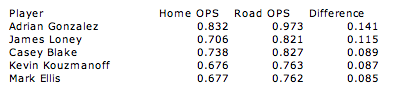
Adrian Gonzalez tops this list and is one of the greatest reasons we were quite high on him in the preseason. (How’s that working out?) Park effects get a good amount of press, but is it possible we still underrate the influence?
A few more things why Ellis could be a second half sleeper.
First, Ellis’ road OPS over the past few years is 0.762, which isn’t spectacular, but check out his road stats compared to a player at a much deeper position who is owned in virtually every league. Mark Ellis on the road vs. Billy Butler on the road (since 2007):
- Mark Ellis: 1054 AB, 25 HRs, 135 RBIs, 136 Runs, 27 SBs, .282 AVG
- Billy Butler: 1092 AB, 22 HRs, 135 RBIs, 120 Runs, 1 SB, .282 AVG
Nearly identical, except that Ellis has more speed and plays a position where good production is tougher to come by.
Second, he’s not just headed away from Oakland to play in a neutral environment. He’s going to Colorado, which based on historical evidence, could inflate Ellis’ statistics even beyond the decent production he’s put up on the road in past seasons.
Plus, he’s not merely going to a hitter’s environment, but also playing with better teammates, including Troy Tulowitzki, Carlos Gonzalez, and Seth Smith. That’s also an improvement on what he had in Oakland.
Finally, and it’s only been a couple of games so far, but Ellis is looking at a pretty nice lineup opportunity in Colorado. On Friday and Saturday, Ellis hit in the #2 slot. It’s too early to establish where Ellis will hit in the Rockies lineup going forward, but this is certainly a good sign. The fact that Ellis puts the ball into play rather than striking out (85% contact rate this season) and has a decent, if-not-spectacular amount of speed means he could indeed stick there. He plays pretty good defense and the team just optioned Eric Young Jr. and Chris Nelson to the minors, so he’s got pretty firm job security as well.
Don’t be surprised to see Mark Ellis’ ownership numbers climbing in future weeks.
For the best fantasy baseball analysis and insight please visit BloombergSports.com
Outfielders On the Waiver Wire
Again manning the charge alone, fantasy expert, Rob Shaw takes a look at some of the best Outfielders in baseball that still might be hanging around your league’s fantasy wire.
Nick Swisher, Yankees
The Yankees bats seem to be waking up, and while he won’t make the All-Star game, Swisher can very much still fix this season. His average is just .245 right now, but consider that he is actually batting .316 this month with a stellar six home runs and 18 RBI. To put that in perspective, in last year’s All-Star season, the most home runs Swisher belted in a month was seven and the most RBI was 19. So he could actually outperform last year’s figures in the few days remaining in June.
Vernon Wells, Angels
Blue Jays fans are very much familiar with the streaky nature of Vernon Wells, but this is the first time that the Angels fan base sees it in person. After a dismal start to the season, Wells is heating up with three home runs and 7 RBI over the last seven games. Wells still has some power, he has nine blasts so far after swatting 31 dingers last season.
Nick Markakis, Orioles
Despite the .296 career average and solid arm in the outfield, Nick Markakis is often considered a disappointment because the power never developed. However, at 27 years old, this Long Island native still has some time on his side. This month Markakis is batting .337 with 13 RBI, which marks a season high. He also has six steals on the season, so keep the Orioles outfielder on your watch list.
BJ Upton, Rays
Dropped in a lot of fantasy leagues thanks to the .219 average as of June 22, BJ Upton is making a case to be a great pickup. He has at least one RBI in each of the last four games and has gone deep in the last three games. On the season, Upton has 20 steals with 11 home runs while racking up 40-plus in runs and RBI. While he will hurt you in average, Upton has the rare ability to help in every other statistic. You have to pick him up if he’s available in your fantasy league’s waiver wire.
For more fantasy advice from the Shaw-man himself, check out our YouTube channel: http://www.youtube.com/user/BloombergSports
Fantasy Baseball Pitchers Pick Ups & Jim Riggleman
Again accompanied by their live studio audience Rob Shaw and Michelle Steele break-down some Pitcher Pick-Up’s for your Fantasy Baseball team, as well as discuss Jim Riggleman and the Nationals.
John Danks, SP, White Sox
Remember when John Danks was 0-8 with a 5.25 ERA. Well that was at the end of May, and as it turns he hit rock bottom. Ever since, Danks has won all three starts while allowing a combined three runs to score. His ERA, down a full run to 4.29 and his record a not as bad 3-8. Folks, this is a young southpaw with 40 wins over the last three seasons with a solid strikeout total. This is a player you want on your team. Pick him up if he’s available.
Jason Vargas, SP, Mariners
The last time Jason Vargas took the mound, he tossed a 3-hitter. He improved to 5-4 with a 3.75 ERA and an even better 1.18 WHIP. While his lack of K’s keep him away from stardom, his solid control and favorable home park makes him a solid fantasy spot starter. His career record at Safeco is 13-10 with a 3.18 ERA.
Tim Wakefield, SP, Red Sox
At 44-years old, Tim Wakefield is the oldest player in the game, but he is an oldie but goodie. The hurler, who is three wins shy of 200 for his career has won four of his last five decisions, and his ERA isn’t all that bad either at 4.26 ERA. What makes him unique, even among fellow knuckleballers is his control. Wakefield’s 1.14 WHIP is incredible when you consider he has the slowest fastball in the Majors at just 73 MPH.
Tyler Clippard, RP, Nationals
He is not a closer, but yet just like my favorite middle reliever Al Alburquerque, he is worth adding to your fantasy lineup. Tyler Clippard boasts a 1.85 ERA and sensational 0.89 WHIP. Then there are the strikeouts. With 56 K’s in 43.2 innings, he is doing even better than last season when he finished with 112 strikeouts. Picking up Clippard is a sneaky way to improve in strikeouts, WHIP, and ERA for your fantasy team.
For more Fantasy Baseball news and advice check out our YouTube channel: http://www.youtube.com/user/BloombergSports
Fantasy Baseball Waiver Wire Report: Who is Chris Heisey?
Rob Shaw and Michelle Steele report on the waiver wire, including Yankee killer Chris Heisey, joined for the first time ever by a live studio audience!
Brandon Beachy, SP, Braves
Beachy has just two wins on the season, but with a 3.22 ERA and 1.07 WHIP, fantasy managers are picking up a reliable hurler. Best of all, Beachy, who was undrafted of Indiana Wesleyan, is a strikeout artist. In fact, fresh from more than a month on the disabled list, Beachy fanned 11 batters in just 6 innings on Thursday night. He has 57 K’s on the season in just 50.1 innings of work.
Carlos Pena, 1B, Cubs
He is an all or nothing type slugger, but the good news is that lately he has been more all than nothing. He has gone three straight games with a homer, and make that 5 dingers over the last seven games. Sure, only once did he get an additional hit in those games, but the RBI are piling up as well as the runs scored. This is a guy who can swat 40 in a season, so feel free to pick up the hot bat.
Travis Hafner, 1B, Indians
One of the biggest surprises this season has been the play of the Indians, and if you’re wondering where they’re getting their offense from, well the answer is an oldie, but goodie. Travis Hafner has turned back the clock to hit .338 this season. This is a former .300-plus hitter, so the fact that he is raking is not unprecedented. He is 34-years old, so invest accordingly.
Chris Heisey, OF, Reds
Yankees fans are wondering who the heck is Chris Heisey. Turns out this newfound Yankee killer, Red Sox fans will love this, went to a college called Messiah! Not sure if he is the chosen one, but in a small sampling, Heisey now has 16 home runs in just 329 at bats. This year his slugging is .492, to put that in perspective, his teammate Joey Votto is not that far above him at .519. In 2009, at the high levels of Minor League ball, Heisey blasted 22 home runs with 21 steals and a .314 average. Looks like fantasy managers should put this outfielder on their radar, although playing time could be an issue unless Jonny Gomes finds the bench with his .222 average.
Jonathan Broxton, RP, Dodgers
If you cut Dodgers closer Jonathan Broxton following his most recent blowup in early May before landing on the DL, it may be a good idea to pick him right up. We have no idea if his struggles are in the past, but we do know that his manager intends on returning him to the closer’s role once he is healthy. Broxton is on the road to recovery, most recently pitching at Triple-A in a rehab appearance.
For more Fantasy Baseball news and advice check out our YouTube channel: http://www.youtube.com/user/BloombergSports
Steve Phillips On A-Rod, Jose Reyes, Madoff, and More
Steve Phillips
A-Rod Almost Signed with the Mets?
Sitting down with Steve Phillips gave us the opportunity to re-look at a major “What If?” for the New York Mets.
Imagine the 2011 Mets infield of Wright, A-Rod, and Reyes. After expressing interest to play for the Mets in 2000, A Rod’s then-agent Scott Boras and Mets GM Steve Phillips discussed the possibility. Before the numbers were even reached, Boras demanded these perks, amongst others, for A-Rod:
- A tent in Spring Training for A-Rod Apparel and Merchandise.
- A personal suite in the stadium.
- A private office for his marketing representative to work during the day.
- Permission to use the team logo.
Phillips felt uncomfortable giving A-Rod such special attention. He memorably, and regrettably, gave A-Rod the “24-plus-1” label that succinctly defined the divide that A-Rod’s contract could bring to the Mets and between other superstars such as Mike Piazza.
What is still debated, however, is as soon as Phillips heard about A-Rod’s demands, he pulled out faster than a snowman melts in July. The real “What if?” revolves around putting the contract on the table, and telling A-Rod to take it or leave it. What if Phillips had at least offered a 180 million dollar deal, with none of the perks? Would A-Rod have taken a pay and perk cut to play for a winning team that he loved ever since he was a child? We’ll never know for sure.
A-Rod signed with Texas for the memorable contract of 10 years at 252 million. Why not $250 million? Because then it wouldn’t be exactly double the previous high contract in sports, a titled previously owned by Kevin Garnett at $126 million.
Jose Reyes
Under Steve Phillips, Jose Reyes was drafted and began what appears to be the start of a prolific career with the Mets. As Steve Phillips says, he is the “most exciting player in baseball.” The question is, will the Mets try and resign Reyes now before he hits free-agency, will they trade him to try and get something out of him, or do they take the two draft picks?
Steve Phillips says that the two draft picks wouldn’t cut it for Reyes if he was still the Mets GM, as he believes he could get a lot more than that through a mid-season trade. In fact, he says that the sooner the Mets trade him, the better, because it will eliminate any shards of hope Mets fans have for a playoff run sooner rather than later.
When asked if he would personally re-sign Jose Reyes as the GM, Phillips says he absolutely would sign him, but he would protect the contract by addressing Reyes’s history of frequent injuries by having incentives for Reyes to stay on the field, measured by statistics such as plate appearances and games played.
Just yesterday, we discovered that Jose Reyes is not willing to negotiate a contract with the Mets during the season, making it seem all the more likely that Jose Reyes will not be a Met next season, and the Mets will end up with the two draft picks.
This is especially a real blow to the Mets because if they were able to negotiate with Reyes mid-season, they could get a better idea if they actually have a chance of signing him and of trading him, but now that’s all in the dark. The Mets will have to wait until the seasons over, which works against them because they simply can’t compete with teams like the Yankees on the free agent market while in the financial condition that they’ve been in since the Madoff scandal.
Players will sometimes choose to play with a team they love at a pay cut of a couple of millions of dollars, but likely not the size pay-cut he would take by signing with the Mets.
On the Wilpon Madoff Relationship
Phillips a long-time Mets General Manager (1997-2003), touched briefly on the much-talked about Mets ownership. In the news recently, Mets owner Fred Wilpon has come under fire due to his connection to Bernie Madoff.
Phillips recalls that the Madoff name was not unfamiliar in the organization, stating that he “heard Bernie Madoff’s name every week.” The former GM went on to explain that Madoff served as an “investment vehicle” in the organization, to defer payment on player contracts and serve other financial functions for the Mets.
When asked about Fred Wilpon’s involvement, Phillips stated that he would honestly be surprised that Wilpon “smelled something fishy.” Wilpon is fighting to keep the team head on, bringing in minority share holders such as hedge fund manager David Einhorn. Of this Phillips noted that Fred would like to keep the organization in the family, citing his son, COO, Jeff Wilpon.
Overall, Phillips said that he thinks Wilpon will keep ownership of the team, citing Fred as a “do the next right thing type of guy.” Steve Phillips can be heard on SIRIUS XM Radio on the Mad Dog and Fantasy Sports Network.
Bloomberg Sports’ Robert Shaw sits down to talk with Steve Phillips about life, baseball and the state of the New York Metropolitans.
Phillips a long-time Mets General Manager (1997-2003), touched briefly on the much-talked about Mets ownership. In the news recently, Mets owner Fred Wilpon has come under fire due to his connection to Bernie Madoff.
Phillips recalls that the Madoff name was not unfamiliar in the organization, stating that he “heard Bernie Madoff’s name every week.” The former GM went on to explain that Madoff served as an “investment vehicle” in the organization, to defer payment on player contracts and serve other financial functions for the Mets.
When asked about Fred Wilpon’s involvement, Phillips stated that he would honestly be surprised that Wilpon “smelled something fishy.” Wilpon is fighting to keep the team head on, bringing in minority share holders such as hedge fund manager David Einhorn. Of this Phillips noted that Fred would like to keep the organization in the family, citing his son, COO, Jeff Wilpon.
Overall, Phillips said that he thinks Wilpon will keep ownership of the team, citing Fred as a “do the next right thing type of guy.”
Steve Phillips can be heard on SIRIUS XM Radio on the Mad Dog and Fantasy Sports Network.
What To Do About Ian Desmond
By Eno Sarris //
The more we learn, the less we know. For example, we know about batting average on balls in play (BABIP). We know that the league BABIP is usually around .300, and that a player’s unique mix of batted balls can be used to judge a player’s specific expected BABIP (xBABIP). But what happens when a player with some major league track record in the bank is showing a poor batting average but a BABIP that is just about luck-neutral?
Consider Ian Desmond. The shortstop is flawed, but he had power and speed while coming up in the minor leagues, and power and speed at shortstop is almost always playable in fantasy baseball. The problem with Ian Desmond right now is that he has a .234 batting average to go with his three home runs and 20 stolen bases. And his BABIP is .295. And his xBABIP is .286. He’s not unlucky on batted balls right now, but he has a batting average that’s thirty points under his career number in the category. Why?
Obviously, BABIP is not the only component of batting average. The elements that go into a batting average are diverse. Contact is part of it – you have to make contact to get the ball in play. Power is also part of it – power can turn a liner to the shortstop into a liner into short center field. Plate discipline is also a component. You want to avoid swinging at pitches outside of the zone, and you want to make contact on pitches inside the zone. In all three of these categories, there’s some hope for Desmond owners.
At first glance, contact is a problem for Desmond. He’s striking out in a quarter of his at-bats right now and his whiff rate (8.8%) is above average (8.4% this year). But already there’s something not quite right. He’s only slightly more likely to swing and miss than the average player, but his strikeout rate is 5% above average. Given that fact, and the fact that Desmond has improved his whiff rate over last year (10%), it seems likely that Desmond will strike out a little less often going forward.
Power is also not going Desmond’s way right now. He has a below-average ISO (slugging percentage minus batting average) right now and has shown better power numbers in the past. In fact his current ISO (.098) would be his lowest number since rookie ball. His minor league ISO was .129 and his Double-A ISOs were both above .155. His major league ISO is .131. And power is the last statistic to stabilize over the course of a season. Give him a good week and he may find his power stroke once again. All it takes is a few doubles.
Lastly, though Desmond does not have great plate discipline, he has made improvements. He is reaching at balls outside the zone less than he has in his career (29.3% this year, 31.4% career, 29.5% is average this year). He’s also making more contact than he has in his career (80.3% this year, 79.2% career, 81% is average this year). Maybe he’s a little too passive right now – he’s only swinging at 63.2% of pitches within the zone, and league-wide that number is 64.7% and his personal career number is 65.5%. But he’s not reaching, and just a few more swings at solid pitches within the zone could really help.
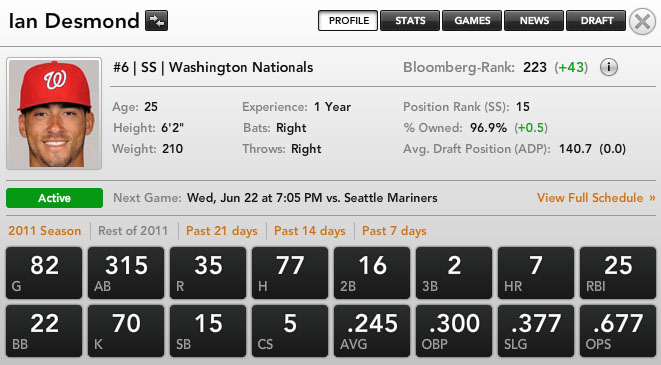 Give Desmond a little more power – possibly from swinging at a few more pitches within the zone – and subtract a few strikeouts, and his batting average will improve. Given the fact that he’ll probably still strike out more than the average player and still won’t show much better than average power, his batting average won’t be awesome. But with power and speed, at shortstop, a .250+ batting average would work in most leagues. If it won’t work for your team, you’re probably best off looking for a new man in the middle.
For the best fantasy baseball analysis and insight please visit BloombergSports.com
 Bloomberg Sports