Tagged: Starting Pitchers
Who in the World is David Pauley?
By R.J. Anderson //
Quick, who replaced Cliff Lee in the Seattle Mariners’ rotation? Nope, not Erik Bedard or Michael Pineda. Try David Pauley. Who? The 27-year-old righty sports a 3.31 ERA through his first 10 appearances this season. With the Mariners already holding two fantasy league sleepers in their rotation this season – Jason Vargas and Doug Fister – could Pauley be the next pitcher to benefit from Seattle’s pitcher-friendly home park and excellent defense? Maybe.
Pauley has bounced around since being drafted in the eighth round of the 2001 draft by the San Diego Padres. Three years later, San Diego traded him to the Boston Red Sox in the Dave Roberts deal, who then sent him to the Baltimore Orioles five years later. After reaching minor league free agency this past winter, Pauley inked with the Mariners, where he probably did not expect to join a rotation stacked with names like Felix Hernandez, Bedard, and Lee. Yet, here he is.
Pauley had only 28 major league innings entering this season, with mixed results. His ERA was awful, and still is, but his underlying peripherals suggested he wasn’t that bad. For instance, his FIP this season is 3.91, whereas his career mark is 4.18. Even with a fastball that sits below 90 (check the chart below, he really does not throw hard), Pauley manages to get a league-average amount of whiffs, thanks to heavy usage of his change-up.

In 85 minor league innings this season, Pauley posted a 3.68 ERA. The last time he flashed an ERA over 4.50 in the minors came in 2006, during his first stint in Triple-A. Since then he’s posted ERAs of 4.33, 3.55, 4.37, and the aforementioned 3.68. Most projection systems have Pauley with a much higher ERA than league average, but that seems harsh considering his ability to get groundballs while pitching in front of a grade-A defense and in a park that restricts power.
That doesn’t mean Pauley is a must-get in your league. He’s hardly that, but he is owned in less than 1% of ESPN leagues. So if you’re in an AL-only or deep mixed league, Pauley is worth a shot.
For more on David Pauley and other potential pitcher pickups, check out Bloomberg Sports’ Fantasy Kits
The Value of Jorge de la Rosa
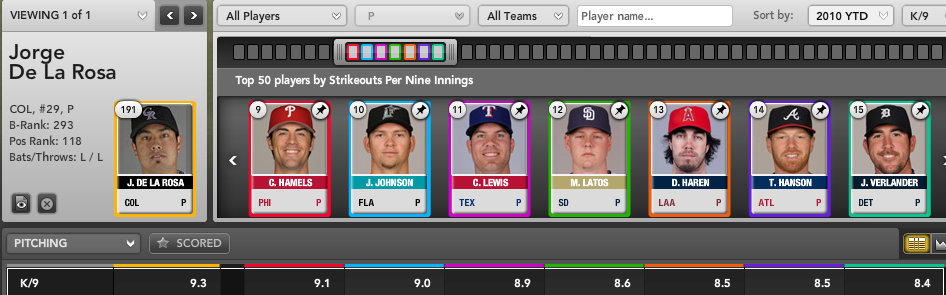
- Team A: 7.30 K/9
- Team B: 7.28 K/9
- Team C: 7.26 K/9
- Team D: 7.24 K/9
- Team E: 7.22 K/9
- Our Team: 7.20 K/9
Jorge de la Rosa’s strikeout rate is 9.24 per nine innings this year. It was 9.39 last year. Bloomberg Sports projects a conservative 8.8 over 55 innings the rest of the year.
Justin Masterson and Brett Cecil Are Mirror Images
By R.J. Anderson //
There are only so many ways to make it to the major leagues. You
have to be good at something; whether it’s hitting for average or
power, pitching with great stuff or excellent command; or excelling at
defense. Two of the youngest and most promising American League
starters this season share quite a bit in common, both being talented
but still flawed pitchers. Those two SP: Brett Cecil and Justin Masterson.
When the Jays drafted the 6’1″ Cecil, he was finishing up his career
at the University of Maryland as a closer. In fact, he made fewer than
10 starts during his collegiate career, but showed promise as a
potential late-inning reliever who could be placed on the accelerated
path to a big league bullpen. The Jays selected him in the supplemental
phase of round one in 2007’s draft, and immediately converted him to
starting. He spent less than two seasons in the minors before being
promoted as a 22-year-old last year. Cecil went 7-4 with a 5.30 ERA in
17 starts.
On the other hand, Masterson came out of San Diego University and
the Boston Red Sox quickly groomed him as a swingman. He started 36
games in the minors while entering 17 others as a reliever. Promoted to
Boston, a team with strong starting pitching depth, he started only 15
games while entering 42 others out of the pen. He only became a
full-time starter after the Red Sox traded him to Cleveland last July.
Beyond those similarities, the biggest trait the two pitchers share
is an inability to retire opposite-handed batters. Masterson has held
righties to a .699 OPS this season; but lefties have a .462 slugging
percentage and .392 on-base percentage (.854 OPS) against him. When his
days as a set-up man are factored in, the difference holds true; a .626
OPS against righties, .848 OPS against lefties. Cecil, meanwhile, can
get lefties out – their career line against him is .232/.269/.388 – but
struggles with righties: .280/.353/.451. For a further illustration of
Cecil’s struggles, consider this:

If you could combine the two pitchers, taking each of their
strengths and placing them into one pitcher, you would have someone
capable of retiring both hands without ease.Dr. Frankenstein isn’t
walking through the doors of a baseball facility anytime soon, though,
unless it’s to retrieve Shelley Duncan,
meaning the hopes of improvement hinge not on the advancements of
modern science and surgical precision, but on the ability of either
pitcher, or both, to make strides at adaption.
From
a scouting perspective, the better bet is Masterson. Cecil is short for
a starting pitcher, with a fastball that lives in the low-90s.
Masterson is no vintage Pedro, but his fastball moves faster and his
ability to rank among the league leaders in groundball rate during any
given season appears legitimate. Beyond that, Masterson is more likely
to face a bunch of right-handed hitters than Cecil. This season alone,
Masterson is facing righties roughly 46% of the time; Cecil is facing
lefties 22% of the time. As is the same with positional players, if you
have two at a position with extreme platoon splits and you can only
keep one, keep the one who will be useful more of the time.
One caveat: Masterson’s pitching motion, typically from a
three-quarters angle, might always invite a significant split. He’s a
fine player to own in AL-only leagues, but not an ideal choice for a
shallow mixed league.
For more information on Masterson, Cecil, and hundreds of other
players, and for dozens of tools to help you dominate your fantasy
league, check out Bloomberg Sports’ fantasy kits
Rays’ Jeremy Hellickson Gets the Call, Again
By Tommy Rancel //
Jeremy Hellickson may have been an effective major league starter had he cracked the Tampa Bay Rays’ roster on Opening Day of this season. But where an April gig would have been a luxury, Hellickson’s promotion recently became a necessity.
The Rays had a plan for Hellickson. He made a spot start last week and was sent back down to Durham where his workload could be monitored and controlled. Once the rosters expanded in September, they would recall Hellickson and use him out of the bullpen.
Tampa Bay was able to execute the first part of the plan. Hellickson made his major league debut – a successful one – and was immediately returned to Triple-A. However, even the best-laid plans are subject to change. With Wade Davis AND Jeff Niemann experiencing shoulder pain, the Rays had no choice but to bring back Hellickson and use him as a starter, beginning with tonight’s outing against the Detroit Tigers.
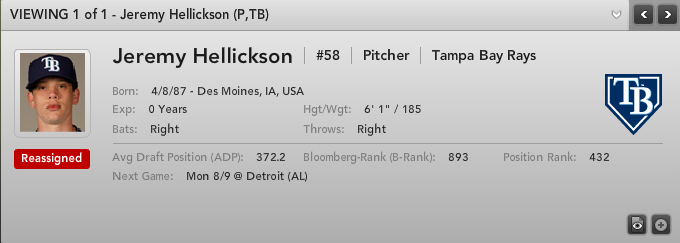
Although he is listed at 6-1 – already on the short side for a right-handed starting pitcher – that might be a generous measurement. Still, the numbers don’t lie. In 578.2 career innings in the minors, he posted 630 strikeouts and just 135 walks. His pinpoint command of the strike zone has drawn comparisons to Greg Maddux. Stuff-wise, Hellickson sets hitters up with his low-to-mid-90s fastball, and puts them away with an excellent change-up and plus breaking ball.
This time around, Hellickson will be on the shortest of leashes. After pitching 114 innings last season, he has surpassed 124 innings this year (117 minor league, 7 major league). Hellickson pitched a career-high 152 innings in 2008. Don’t expect him to go much beyond that this year, if at all.
If that is the case, then we might be looking at five-to-seven big league starts, or possibly just a couple of starts and several relief appearances, if Davis and Niemann get well soon. Still, given Hellickson’s talent and body of work, he’s worth an immediate pickup in all leagues.
For more information on Jeremy Hellickson and
hundreds of other players, and for dozens of tools to help you dominate
your fantasy league, check out Bloomberg Sports’ fantasy kits.
It’s Time To Trust Brett Myers Again

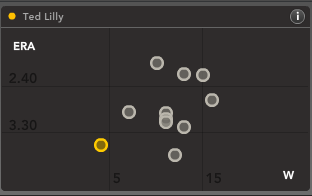
Ted Lilly in Los Angeles
Grab James Shields
By R.J. Anderson //
When it comes to wins, James Shields has always had tough luck. Despite an ERA of 4.01 over his first 118 starts (his career total entering this season), Shields had only won 43 games, and had 36. Part of that was because of blown wins by his bullpen. Baseball-Reference keeps track of the times a pitcher leaves a game in line for the win only to see his bullpen blow it. That happened eight times to Shields entering 2010.
This off-season, the Rays upgraded the bullpen, spending $7 million on new closer Rafael Soriano (2.71 FIP) and finding a hidden gem in new set-up man Joaquin Benoit (2.00 FIP). Shields figured to benefit from those moves. Yet he’s actually in the midst of the worst season of his career if you go solely by ERA (4.90), and still struggling in the win-loss department (8-9). Still, here are the two reasons why you should go out and acquire Shields or at least refuse to sell low.
1) The ERA is skewed.
By nearly every other pitching metric Shields is actually having one of, if not the best season of his career. FIP, which simply weighs walks, strikeouts, and home runs allowed; xFIP – which adjusts for home run rates; and SIERA, which includes groundball rates, all suggest Shields is one of the league’s better pitchers this season. So why is his ERA so off? Well, in part, because of one really horrendous start. On June 11, Shields completed only 3.1 innings against the Florida Marlins, allowing 10 earned runs. Take that one start out of the equation and Shields’ ERA drops from 4.90 to 4.31. Which leads us to reason number two.
2) The home run rate isn’t sustainable.
There’s a point in a pitcher’s career when you can accept that maybe he does give up more home runs than the average starter. That point never occurs over the span of one season. Take the batted ball data from Shields’ pre-2010 career and compare it to this season. His home run per flyball rate is more than 3% higher. There is no reason to believe the same pitcher who has upped his strikeout rate is suddenly more hittable. Further, his home run per outfield flyball rate (as opposed to infield flies) is even higher.

When in doubt, go with the larger sample size. And in this case, that sample size suggests Shields is going to be a worthwhile pickup in the second half.
For more information on James Shields and hundreds of other players, and for dozens of tools to help you dominate your fantasy league, check out Bloomberg Sports’ fantasy kits.
Colby Lewis’ Run of Excellence
By R.J. Anderson //
Many looked on with apathy when the Texas Rangers signed Colby Lewis to a two-year deal with a club option this past off-season. This very same Lewis had pitched for the Rangers from 2002-2004 with a not-so-good 5.48 ERA in nearly 300 innings. Lewis didn’t find success in short stints as a Tiger or Athletic either and he bolted to the Hiroshima Carp for the 2008 and 2009 seasons.
Then it happened. The same pitcher that Baseball America ranked as the 32nd-best prospect in baseball entering the 2003 season emerged. In those two seasons in Japan, Lewis started 54 games, pitched more than 350 innings, held a strikeout-to-walk ratio of better than 8-to-1(!) and an ERA of 2.82. He struck out more batters than he allowed baserunners. Entering this season, it was hard to peg just how good Lewis could be. After all, Daisuke Matsuzaka had similar success in Japan, and he’s been a pretty average pitcher (ignoring the price tag) during his stint in Boston. Meanwhile, other decent Japanese league hurlers, like Kei Igawa and Kenshin Kawamaki, won’t be in the running for any Cy Young awards in the foreseeable future.
Yet Lewis has persevered and sustained that level of success stateside. In 19 starts for the Rangers, he’s recorded nearly a strikeout per inning. He’s walked only 41 batters too. Why is that impressive? Because in 2003 (the only other season he recorded more than five starts in the majors) Lewis walked 70 batters in about the same number of innings, while striking out 29 fewer batters. He looks nothing like the old Colby Lewis, which makes you wonder: Can he continue to have a 3.52 ERA? Will he continue to pitch this well?
Odds are, his ERA will escalate a bit. Lewis’ home run per flyball ratio is well below league average, despite pitching in a ballpark that makes home runs commonplace. Despite the Rangers’ defense, it’s hard to foresee any Ranger pitcher lasting too long without a bump in the ERA road. That’s not to say Lewis is valueless or should be sold high, just that expecting this exact level of domination heading forward isn’t a good idea.

There is no magic innings mark within a season that determines when it’s OK to assume the ERA will last. Still, unless your fellow league owners value Lewis as an elite or near-elite starting pitcher, he’s a solid hold for the rest of the season.
For more information on Colby Lewis and hundreds of other
players, and for dozens of tools to help you dominate your fantasy
league, check out Bloomberg Sports’ fantasy kits.
Is Francisco Liriano the Best Pitcher in the American League?
By Tommy Rancel //
Similar to the recently profiled Josh Johnson, Francisco Liriano captivated the major leagues as a rookie in 2006. As the understudy to staff ace Johan Santana on the Minnesota Twins’ staff, Liriano went 12-3 with a 2.15 ERA in 28 appearances.
In an unfortunate similarity to Johnson, Liriano blew out his arm, and would miss all of 2007. He tossed just 76 innings in 2008 and struggled in his full-time return in 2009. That said, he continues to parallel Johnson. This time, in a good way.
Through 14 turns in the rotation, Liriano is just 6-5. His 3.11 ERA ranks among the league leaders, but still doesn’t fully convey how well he has pitched in 2010. For that, we look to fielding independent metrics like FIP and xFIP. By now you know FIP and xFIP measure events a pitcher can control: strikeouts, walks and home runs. xFIP drills still further down by normalizing the pitcher’s home run rate to league average.
According to FIP, Liriano has been the major league’s best pitcher not named Cliff Lee. His 2.16 FIP in 2010 is even better than the 2.55 he posted as a rookie in ’06. Looking at his 2.99 xFIP compared to Lee’s 3.11, one could argue that Liriano has been the American League’s best pitcher.

So how does arguably the best pitcher in the league have just six wins? Run support and bad luck are to blame.
Of qualified starters in the AL, Liriano owns the 10th-lowest run support, according to ESPN.com. For comparison, the Yankees have scored nearly twice as many runs when Phil Hughes toes the rubber as the Twins have Liriano pitches.
In addition to the lack of run support, Liriano has been one of the league’s unluckiest pitchers in terms of batting average on balls in play. The .348 BABIP carried by Liriano in 2010 is the third-highest in the AL; league average BABIP is .302. And while his personal BABIP has always been a bit above the norm (.316 career), his current total is by far the highest of his career.
The large BABIP number is a bit odd given the fact that the Twins employ an above-average defense, especially in the infield. I note the infield defense because 49.8% of the balls hit against Liriano this year have been groundballs, another excellent skill. Even in the absences of J.J. Hardy and Orlando Hudson, Minnesota’s backup infielders posted positive UZR (ultimate zone rating) marks*.
*Defensive statistics such as UZR usually take years of data to show true talent levels.
As noted, when looking at factors Liriano can control, he has done a wonderful job. His strikeouts per nine innings rate (K/9) of 9.71 ranks among the game’s elite. His walks per nine innings rate (BB/9) of just 2.43 suggests that his control is back to where it was pre-injury. The one category that may regress in a negative manner is home runs allowed (just two home runs allowed in 92.2 innings). But xFIP suggests that even with regression he is still among the game’s best.
Because his win total and ERA aren’t as fantasy friendly as some other starters, Liriano might be available in trade at a slight discount compared to his true worth – that of an elite starter. He’s been about as good as Ubaldo Jimenez, for instance, but with much less hype. If you own Jimenez and can land a deal that nets you Liriano and, say, a solid bat or half-decent closer, jump on it.
For more on Francisco Liriano and other underrated aces, check out Bloomberg Sports’ fantasy kits
How to Catch Up in ERA in Fantasy Baseball
By Eriq Gardner //
Let’s assume for a second that your team needs to improve in pitching for you to win a championship. You basically have three options:
- Hope your pitching staff gets luckier from here on out
- Hope your pitching staff improves via prospect call-ups or additions off the waiver wire
- Make a trade
Most owners will choose of the first two options. But maybe, you’re clear-headed and know that your current pitching staff just doesn’t have the stuff to improve. You don’t want to risk your season in the hands of a prospect. Maybe streaming is not very enticing either. You want stability, so you start thinking of a trade.
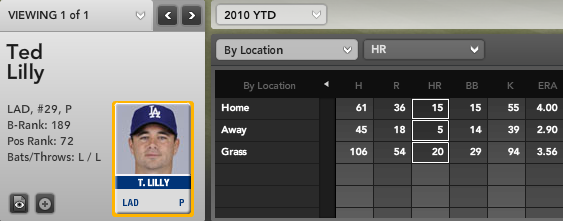
But what kind of trade do you need? Most owners may have a vague idea they’d like to improve pitching, and will shop around for great pitchers on other teams who can be helpful in attaining the goal of improving pitching. But then again, why pay for Ubaldo Jimenez and Josh Johnson if you only need Ted Lilly and Hiroki Kuroda? Sure, you may accomplish your goal of upgrading pitching, but by sacrificing too much to plug the leak on one end, you may cause the dam to burst on the other.
Let’s assume team is targeting 1400 innings and has 850 left to pitch in the season. (Depending on your innings limit and your current pace, this might not be completely accurate, but should be close enough for this kind of exercise.)
Here’s a table showing how many earned runs you need to shave off from your current pitching staff the rest of the way:

So how do we save those runs? OK, here’s some ideas…
To save 8 runs:
Frankly, if you only need to diminish your team ERA by 0.05, you’re better off hoping the gods of fantasy baseball luck cooperate. Eight runs over 850 innings is simply within the margin of error of any projection.
That said, for the sake of fun, let’s take a look at some swaps that would yield 8 runs saved. To do this, we’re going to use ZIPS rest-of-season projections.
Eight runs is not a lot. It can easily (and best) be done by upgrading a closer. For example, going from Matt Capps to Brian Wilson or from Kevin Gregg to Heath Bell. Your trading partner may shrug off this exchange because he’s not giving up a ton of saves, but there’s an ERA benefit in making such a swap. If you’re doing well in saves you might also consider trading your back-end closer for an upgrade in hitting, and replacing one of your closers with a top middle reliever or set-up man. For example, going from Arizona’s shaky new closer Aaron Heilman to Luke Gregerson would do the job.
To save 16 runs:
If you want to diminish your ERA by 0.1 the rest of the way via trade, you can get creative with your bullpen by trading for two closers, or punting shaky closers and saves and going with middle relievers. More likely, you’ll be looking at the starting pitching market.
What kind of starters need to be exchanged to yield savings of 16 runs? You’ll probably need to upgrade two or three slots, meaning exchanging a #3 or #4 for a #1, like Ricky Nolasco for Cliff Lee or James Shields for Tim Lincecum. Buying those two pitchers would probably be expensive, though. So a better strategy might be looking to drop your #5 and acquire a #2 or #3: Getting rid of someone like Wade LeBlanc/Mike Pelfrey/Barry Zito/Fausto Carmona and trading for someone like Roy Oswalt/Hiroki Kuroda/Clayton Kershaw/Ted Lilly should be good enough.
To save 24 runs:
We’re now at the point where teams need to be looking at drastic upgrades.
To give you an idea, going from Paul Maholm to Cliff Lee saves just 19 expected runs. Going from Kyle Kendrick to Tommy Hanson saves 22 expected runs.
In other words, to diminish your ERA by .15, you probably need to trade for an ace and hope the acquired pitcher can get a little bit lucky the rest of the season.
To save 32 runs:
To diminish your ERA by 0.2 via trade, you’re probably looking at multiple player swaps. If you’re looking at the standings and see a gap this large, you may want to consider combining some of the strategies outlined above.
For instance, when you ask for an ace pitcher in a trade, you may also try to press your trading partner to include a closer swap too. So for example, a trade might look something like this: Alex Rios and Matt Capps for Cliff Lee and Joakim Soria.
At a certain point, catching up in ERA is going to either be too difficult or too expensive. At that point, it might be a better strategy to look the other way by deciding to sacrifice some ground in ERA for greater potential gains in other categories. We’ll have more on that in a future post.
To get more trading ideas, check out Bloomberg Sports’ Fantasy Tools
 Bloomberg Sports