Tagged: fantasy baseball
Stephen Strasburg On the Mend (MLB Injury Updates)
Follow us: @BloombergSports @RobShawSports @MicheleSteele
The Injury Report:
Stephen Strasburg, SP, Nationals
Guess who’s back! The man who routinely hit 100 MPH on the radar gun as a starter last season is on his way back and is already up to 95 MPH following Tommy John surgery. Strasburg is apparently in mid-spring training mode, as far as his recovery. That puts him about a month and a half away from the Major Leagues assuming all goes well. That, of course, is a wide assumption considering how serious this injury was. Nonetheless, if you have the roster space and could use an arm for the playoff run, Strasburg could play a role this season.
Chien-Ming Wang, SP, Nationals
Once the ace of the New York Yankees, this Taiwan native enjoyed back-to-back 19-win seasons in 2006 and 2007. Injuries have since limited Wang to just 27 appearances. His last outing actually came more than two years ago on July 4, 2009. The 31-year old right-hander hopes that there is still something left in the tank. He is currently in the midst of a rehab start and Davey Johnson hinted that he is just a start away from joining the Major League club. Even in his prime, Wang’s value was limited because he pitches to contact, however, in the National League his ERA can dip to a respectable level so keep an eye on his progress.
Brett Lawrie, 3B, Blue Jays
The top prospect in the Blue Jays system was supposed to make his Major League debut more than a month ago, but then an injury forced him to the bench. The Blue Jays have made it clear that they will take the cautious route with Lawrie, who is dominating at Las Vegas despite learning a new position (third base). Look for Lawrie to spend at least the next two weeks in the Minor Leagues. Some good news is that current third baseman Edwin Encarnacion has heated up over the last month, even though he is clearly a short-term solution.
Jason Heyward, OF, Braves / Chipper Jones, 3B, Braves
The Braves are very much in contention in spite of the awful play of Jason Heyward this season. For a second straight season the much-heralded prospect has dealt with some injuries, and it’s an ankle injury that has forced Heyward to miss out on the friendly confines of Coors Field. It’s been a power outage for Heyward this season, as his slugging is currently under .400. Before the panic sets in remember, this talent is just 21-years old. He is listed as day-to-day because of an ankle injury, but he is expected to play tonight.
Chipper Jones has been plagued by injuries for what seems like a decade now. The 38-year old remains one of the better power options in the Braves lineup, even though the career .304 hitter has been a .260 hitter the last three seasons. Recovering from minor knee surgery, Jones is still a few weeks away from returning to the Braves lineup, but he has taken some live batting practice and believes he may be a bit ahead of schedule.
David Wright, 3B Mets / Ike Davis, 3B, Mets
The big question for Mets fans is whether we will ever see Jose Reyes, Carlos Beltran, and David Wright in the lineup together again. While Wright is enjoying a rehab stint, Carlos Beltran can be traded any day now. Wright is recovering from a stress fracture in his lower back. The 28-year old has been raking at Class-A, and has set this weekend as a possible return date.
Such progress has not come to Ike Davis, the Mets young first baseman who appeared on his way to breakout season before injuring his ankle. While the New York tabloids have gone back and forth on rumors surrounding whether he will be shut down this season, Davis himself has said that if he does not make serious progress in the next three weeks, the season will be lost. The Mets have been thrilled with the play of replacements Daniel Murphy and Lucas Duda. In fact, when Wright does return it may make the most sense to alternate Murphy and Duda at first, while also playing Murphy a bit at second base.
Why You Should Buy, Not Sell, Jeremy Hellickson
by Eno Sarris //
We can get a little smart for our britches sometimes. We’ll take a pitcher, look at his peripherals and declare him over-rated. Then that pitcher goes and improves his peripherals and retains his ERA and WHIP and we look silly. This explains much of Trevor Cahill‘s last two years. Are we seeing it again this year in Tampa?
Take a look at Jeremy Hellickson‘s underlying statistics and he seems like a perfect sell-high. Despite a sweet ERA (3.17 ERA), he’s not striking out a ton of batters (6.1 K/9), is walking batters at about an average rate (3.25 BB/9, average is 3.14 BB/9), and is getting ground balls at a below-average rate (33.9% GB, 44% is average). To recap: that’s below average, average and below average. He’s managing the ERA mostly on the back of a lucky batting average on balls in play (.224 BABIP) and a lucky strand rate (79% left on base, 70% is league average).
Put it all together and you get a 4.27 FIP, or fielding independent pitching, a number on the ERA scale that strips out batted ball luck. An average FIP this year is 3.84. He’s been below average, which is a strange thing to say about a guy with a low-threes ERA and nine wins.
But here’s something even stranger to say: He could be just as good going forward, and maybe even fundamentally better. Well, that’s not really that strange, but given his rate stats, you might frown for a moment.
The reasoning behind the statement is simple. Like Trevor Cahill before him, Hellickson is a young pitcher. He has fewer than 150 innings pitched at the major league level. We can’t really assume that the strikeout and walk rates that we currently see are his true talent rates. In 2010, Cahill showed a 5.4 K/9 and the book was that he couldn’t sustain his results with that level of strikeouts. But Cahill had also had a 9.9 K/9 in the minor leagues. He just needed to figure it out on the major league level, and lo and behold, he now has a 6.65 K/9 and has bettered his FIP a quarter of a run.
Hellickson? He had a 9.8 K/9 in the minor leagues. He was a control artist, with a 2.1 BB/9 on the farm and no season where he walked more than three per nine. He never got a ton of ground balls, but he did get much closer to 40%. These numbers were accrued against inferior talent, but they are also relevant. We can’t just assume that Hellickson will continue to strike out six per nine and say he’s over-rated. Small sample sizes are the bane of the saber-friendly analyst, but in his last three starts, Hellickson has 18 strikeouts against three walks in 20 1/3 innings. That’s the sort of work he did in the minor leagues.
Particularly when we evaluate young pitchers, we cannot forget their minor league work. Baseball is a game of adjustments, and a young pitcher is an adjustment away from improving his underlying rates and ‘deserving’ his good fortune. Even in baseball’s toughest division, Hell Boy has great stuff, dominant control, and the ability to continue putting up an ERA in the low threes.
For the best fantasy baseball analysis and insight please visit BloombergSports.com
The Next Batch of Rookies: Kipnis, Turner, Goldschmidt, Jennings, and Gibson
Follow us: @BloombergSports @RobShawSports @MicheleSteele
Rookies On the Way:
Jason Kipnis, 2B, Indians
A second round pick out of Arizona State, this 24-year old is bound for a late call-up by the contending Indians. A .300 hitter in the Minor Leagues, Kipnis has deployed a nice combination of power and speed at Triple-A this season. Considering second base is currently being help by Orlando Cabrera, who is batting just .244, it seems like promoting Kipnis would actually be an upgrade at the Major League level.
Jacob Turner, SP, Tigers
Just 20-years old, Turner was the ninth overall pick of the 2009 draft and his ability to throw strikes may be enough to earn a call-up to the Big League level. The Tigers are not afraid to bring a young hurler to the Majors, after all, they did with the 20-year old Rick Porcello just three years ago. Turner is able to miss bats more effectively than Porcello, so in other words he has greater potential.
Paul Goldschmidt, 1B, Diamondbacks
The Diamondbacks seem afraid to let their young players contribute. Heck it took long enough for Brandon Allen to earn the call up to the Majors this season despite blasting 25 home runs last season at Triple-A. The problem here is that Allen, who hit 18 home runs with a .306 average at Triple-A before recently earning a promotion. Then there’s Paul Goldschmidt, a former 8th round pick with 80 home runs through three Minor League seasons. It might make sense to trade one of these two boppers, but with a .424 OBP and a .616 slugging, it looks like Goldschmidt is the one they want to keep.
Desmond Jennings, OF, Rays
The Rays have come to realize that they called upon Desmond Jennings to contribute a bit too early last season. They also are doing a great job of alleviating the pressure of replacing Carl Crawford from Jennings this season by keeping him in the Minors for an extended period. However, do not be confused, Jennings is very much a long-term solution for the Rays. After a mediocre start to the season, Jennings has come on as of late with 12 home runs, 17 steals, and now a .280 average. He still fans a bit too often, but Jennings has all five tools and will make his return to the Big Leagues in the coming weeks.
Kyle Gibson, SP, Twins
The 22nd pick of the 2009 draft, Gibson is a 6’6 right-hander with front of the rotation potential. He hasn’t had the best season so far at Triple-A, as his record is just 3-8 with a 4.68 ERA. However, the number to pay attention to is the 22 walks in 90.1 innings. While his stuff is solid, as suggested by his average of a strikeout per inning, what’s more impressive is his ability to control his entire arsenal of pitches. Improved game-calling by Major League catchers should help Gibson out, but based on his stuff and control, he could be a surprise contributor in the pennant race.
Fantasy Baseball Average Joes
Follow us on Twitter: @BloombergSports @RobShawSports @MicheleSteele
Daniel Murphy, Utility, Mets
I am not sure what the Mets will do once Ike Davis returns to the lineup be it this year or next. Daniel Murphy is simply a hired bat who can offer some serious offense. The problem is on the defensive side, as Murphy is at his best at third base, which happens to be the home for Mr. David Wright.
Murphy has his average up to .315 this season, with line drive power: 6 HR, 21 doubles and 2 triples. Murphy has hit .385 this month after hitting .330 in June.
Murphy is just 26 years old and bats left-handed, so this is a nice problem to have for the Mets.
Alex Gordon, OF, Royals
The second overall pick of the 2005 draft, Gordon has long been considered a bust due to the slow start to his career, but this season he has finally met expectations.
The 27-year old boasts 11 home runs with 24 doubles and 8 swipes. His average is up to .296 after batting just .215 last season. His plate discipline has been so impressive that the team opted to have him leadoff before pushing him down in the order to take advantage of his power.
Gordon is now considered a potential trade target for teams in need of offense.
Jeff Francoeur, OF, Royals
You would think Jeff Francoeur is 40 years old since he’s played for three teams over the last year. Though he has not been able to sustain the hot start to the season (after batting .316 in April, Francoeur hit just .233 and .235 the next two months), he has found a way to contribute to a fantasy roster. He’s doing this on the basepaths, as he has already swiped 15 bases, nearly double his previous high.
The .266 average still leaves something to be desired, but his 13 home runs and 58 RBI may be enough to force yet another trade.
Michael Morse, OF, Nationals
At 29 years old, Morse is a late bloomer, but he is also one of the better hitters in baseball right now with an even .300 average and 15 home runs. Morse has already matched his previous career-high in home runs, set last season. His OBP is a healthy .348 and while walks are hard to come by, Morse makes up for it with a .523 slugging percentage.
Jon Jay, OF, Cardinals
This 26-year old left-handed hitter was drafted in the second round of the 2006 draft out of Miami. However, Jay never quite earned top prospect status, and this year he has surprised people as a solid platoon option.
Jay is hurt by a lack of patience at the plate and limited power, but you can’t argue with the .310 average, which comes a season after hitting .300. In total, Jay boasts a .304 career average with 11 home runs in 516 at bats.
Jay has made a case to get regular at bats, considering he hits both lefties and righties for at least a .300 average throughout his career. However, with Lance Berkman leading the league in homers, Jay’s playing time will continue to be limited for the remainder of the season.
The Abundance of Strikeouts and Fantasy Baseball
by Eno Sarris //
Strikeouts are up across baseball. Well, if you look at strikeouts per nine, that’s not necessarily true. The average K/9 this year is 6.98, last year it was 7.13 and the year before it was 6.99. But all three of those numbers are higher than the previous three years. And if you look at strikeouts as a percentage, as Christina Kahrl did on ESPN Insider today, they are up. Probably because walks are down. This year’s 2.21 K/BB ratio is the highest of the last seven years.
Anyway, it looks like pitching has taken a step forward. FIP, or fielding-independent pitching, is down to 3.84 around the league after at least 15 years of being over four. What does this mean for fantasy purposes? Easy: trade pitching for hitting because you can find pitching on the wire.
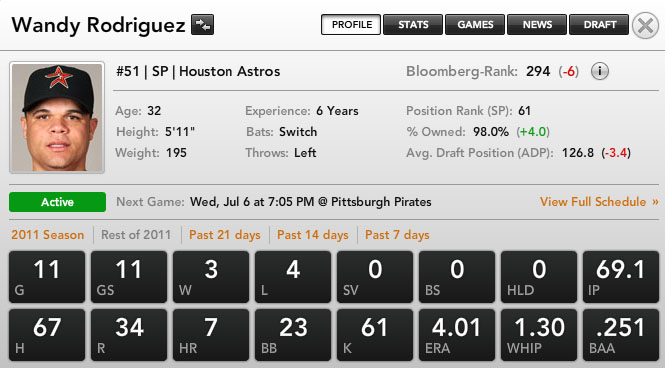 Let’s look at Wandy Rodriguez. He has a 3.88 FIP right now, and is striking out 7.33 batters per nine. He gets 45.6% of his contact on the ground, barely above the 44% average. His 2.6 BB/9 is good, but as the average walk rate has improved to 3.16 this year, it looks less exciting against the backdrop of the league. His 3.25 ERA right now is just about as exciting vis-a-vis the league (13% better than average) as his 3.60 ERA was last year (9% above average). He’s looking like the new average fantasy starter in mixed leagues.
Going into the season, my personal projections had Rodriguez going for a 3.49 ERA, 1.21 WHIP, 12 wins and 189 strikeouts. With his injury, the strikeout total might not come true, but going into the season, the package was worth $11.20 when compared to the replacement-level pitcher, Jorge De La Rosa and his projected 4.13 ERA and 1.33 WHIP with 168 strikeouts in 176 innings. That doesn’t look like the replacement-level pitcher this year. This year’s FIP is 6% better than last year’s. If we move the replacement level about 6% higher, that takes a $1 off of Wandy’s value.
All of this is to set up a conversation about the relative value of Wandy Rodriguez in a trade. Say you’re trying to get out in front of a possible trade to the Yankees and you want to capitalize on a player that might not know that pitching is more abundant this year. If you can sell him at $11 and get someone like Jayson Werth or Corey Hart in order to bolster your speed and power, it might make a lot of sense. Even at $10, more Andre Ethier and Nick Markakis territory, you might have to consider it.
After all, there’s more pitching on your wire this year, and we’ll be here to help you find it.
For the best fantasy baseball analysis and insight please visit BloombergSports.com
Second to None: The Best Second Baseman, the Surprise, the Bust, and the Sleeper
Second to None!
The Best: Rickie Weeks, Brewers
After breaking out last season with 29 home runs, 112 runs, and 11 steals many baseball fans expected Rickie Weeks to take a small step back this season. I’m not really sure why expectations were so low.
The second overall pick of the 2003 draft is finally healthy and at 28 years old he should be in his prime. Plus, he is surrounded by sluggers such as Ryan Braun, Prince Fielder, and Corey Hart, all who guarantee that Weeks will rack up plenty of runs. Weeks has managed to cut down on his strikeouts this season, while improving his batting average to .286. Considering the drastic difference in expectations, Weeks gets the edge as the best second baseman over Yankees star Robinson Cano.
The Surprise: Danny Espinosa, Nationals
Coming into the season, Danny Espinosa had been called the poor man’s version of Dan Uggla. While the expectations have been met with Espinosa blasting 15 home runs despite just a .238 average, it turns out that Espinosa has actually outperformed Uggla.
At 24 years old, Espinosa is a building block for the Nationals. The 2008 third round pick out of Long Beach State has also impressed with a keen ability to draw walks. Plus, something that he offers that Uggla never has is his speed on the base paths. Pretty soon, baseball fans will have to compare Espinosa to Rangers star second baseman Ian Kinsler.
The Bust: Dan Uggla, Braves
After belting 33 home runs with 105 RBI and a .287 last season, Dan Uggla was sought by several teams and ended up joining his long-time rival Atlanta Braves. As it turns out, Uggla is not done punishing the Braves. This time the damage is not a result of his power, but instead an unsuspecting power outage.
Sure, Uggla does have 12 home runs, which still ranks amongst the top second basemen. The problem is that his .178 average is more than 100 points off last year’s batting clip, as his home runs make up 22% of his total hits. There have been no signs of a let-up either, as Uggla hit just .179 in June.
The 2nd Half Sleeper: Howie Kendrick, Angels
Riding a nine-game hit streak, it looks like Howie Kendrick is on the verge of a bounce back season. After hitting just .279 last season, his average is up to .305 plus he has shown signs of power and speed. The good news is that Angels fans can expect even better for the second half of the season.
Kendrick missed some time in the first half due to a injury that forced him out of the lineup for two weeks and when he did return, Kendrick was hitless in his first ten at bats. Now that he is healthy, Kendrick should surpass his first half production culminating in what could be his best season so far.
What a Catch! Talking McCann, Avila, Mauer, and Ramos
What a Catch!
The Best: Brian McCann, Braves
One of the most consistent catchers over the last five seasons has been Braves backstop Brian McCann. Though McCann has never had 25 home runs or 100 RBI in a season, the Georgia native has been an iron man, avoiding serious injury while blasting 20-plus home runs in each of the last five seasons. Best yet, at just 27 years old, McCann is still young and in his prime.
The Surprise: Alex Avila, Tigers
When Victor Martinez was originally brought into Detroit, it was assumed that he was responsible for most of the Tigers catching duties. It turns out that Martinez is truly the team’s designated hitter, while Alex Avila is the team’s top catcher. Just 24 years old, Avila has evolved into a slugger with 10 home runs and 45 RBI this season.
The Bust: Joe Mauer, Twins
Injuries have certainly played a large role in the Twins disappointing season. The problem is that even though Mauer has returned to the field, he is still seeking the potent bat that won him an MVP award just a few years back. Mauer’s last home run came on September 15, 2010. He has now gone 72 at bats without a dinger this season and he boasts just seven RBI.
Mauer is hurt by several factors including a lack of protection in the batting order and he calls home to a pitcher-friendly ballpark. Though he should improve this season, he likely will struggle to live up to his expectations entering the season.
The 2nd Half Sleeper: Wilson Ramos, Nationals
While most catchers break down late into the season, Wilson Ramos should be able to avoid a great deal of the wear and tear. That’s because at 23 years old, Ramos work behind the plate has yet to take its toll, plus the Nationals originally split playing time between Ramos and Ivan Rodriguez. In other words, as the team looks to provide Ramos with the majority of the playing time going forward, he should be fresher because of the limited action to start the season. A power bat with impressive plate discipline, Ramos is a rising talent.
Who’s on First?: A Look at First Basemen from the Best to the Bust
Who’s on First?
The Best: Adrian Gonzalez, Red Sox
The likely AL MVP has made a smooth transition from the pitcher-friendly Petco Park to the hitter-friendly Fenway Park. Thanks in large part to the fine start by Jacoby Ellsbury, Gonzalez has been driving runs in at a career-high pace. While his power is evident in the 25 doubles and 16 home runs, it’s his consistency that makes his .356 average sustainable.
The Surprise: Mark Trumbo, Angels
The loss of Kendry Morales for another season would have been even more devastating had rookie Mark Trumbo not filled in admirably. The 25-year old first baseman has belted 13 home runs with a solid seven steals. Though he can improve on his plate discipline and raise his .258 average, Trumbo’s 28 extra bases have gone a long way for the Angels.
The Bust: Adam Dunn, White Sox
Playing in the homer-friendly US Cellular Ballpark with an improved lineup around him seemed like a slam dunk for Adam Dunn. Instead, the White Sox slugger who has had no less than 38 home runs over the last seven seasons has been downright awful. His .173 average is nearly 100 points lower than last season’s batting clip, and his power has been zapped to a .316 slugging percentage.
The 31-year old veteran has a few possible reasons for his lack of production. He is new to the American League and he has never before been a designated hitter on a regular basis. It may be time for the White Sox to call in Harold Baines to help mentor the fallen slugger.
The 2nd Half Sleeper: Mitch Moreland, Rangers
Texas may be a launching pad for sluggers, but during the dog days of summer, the heat takes its toll. That’s why fantasy managers should not be too concerned about the fact hat Mitch Moreland remains a platoon player despite the .287 average and 11 home runs. Come August, Moreland is bound to be fresh. On that note, Moreland has yet to get into a big hot streak that is bound to lift his season totals past 20 home runs. Expect a big second half from the rising first baseman who blasted nine home runs in 47 games after the All-Star break last season.
Why Jason Heyward is Overrated (In Fantasy Baseball)
by Eno Sarris //
He has plenty of upside over the rest of his career. He’s very exciting and he’s young (22). He has excellent plate discipline. He looks like an athletic masher. He can play a fine corner outfield. But Jason Heyward is over-rated when it comes to his production over the rest of this season. And the key is where he’s hitting the ball.
First, let’s go over the components of batting average.
One component is contact, since the batting average on a strikeout is zero. Heyward is striking out almost exactly as much (24.3%) as he did last year (24.6%), and both numbers are worse than the national average (20% most years). He also whiffs on more swings (10%) than the average hitter (8.5%), so his per-pitch numbers support the fact that he makes contact at a below-average rate. Only four qualified batters that have struck out over 24% of the time this year have a batting average over .280, and among those four, the lowest BABIP is .344. If one or two of them still end up with a good batting average by the end of the year, that small group probably won’t include Heyward.
Another part of batting average is speed. Heyward is an athletic fellow, and has 15 stolen bases so far in his young career. He’s also only been successful on 65% of his attempts, which is below the break-even point — you need to get the extra base twice out of every three times to make the gamble ‘worth it.’ Bill James has a four-component speed score that uses triples, runs, stolen bases and stolen base success rates to judge a player’s speed in the context of the league. A 5.0 speed score is average. Heyward has a 4.8 so far in his career. He’s got average speed, but not enough that you can expect him to beat out a slow dribbler to short.
The last component of batting average is also important for the rest of non-batting average value: power. He’ll steal some bases, he might even up that batting average a little once his current BABIP (.263) moves, but that power is the key to his value the rest of this year. We know that fly balls offer more power — around 10% of them leave the park, and they have a much higher slugging percentage than ground balls (.547 to .252 around the league this year). Well, Heyward just hits too many ground balls. He’s now hit 55% of his balls on the ground over his first season and a half. He’s also hit close to two ground balls to every fly ball so far.
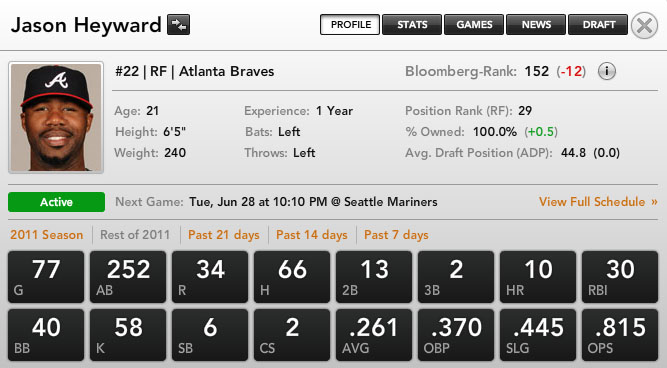 That would be good enough to be the tenth-highest ground-ball rate in the major leagues among qualified batters this year. Only eleven players hit two ground balls for every fly ball. The most powerful player above him on either of these lists is Yunel Escobar with his .416 slugging percentage and .140 ISO. It’s not great company if you’re expecting power. Last year, Heyward used a 17.8% line drive rate and 16.8% HR/FB rate to muscle 18 balls over the wall. This year, those numbers are 13.6% and 15.9% respectively, and he might need a little luck to manage the same home run pace.
Unfortunately for most of his fantasy owners, the Atlanta outfielder wasn’t valued as a .275-hitting, 18-home-run having, average-speed showing outfielder this year. As he ages and puts more weight on his frame and more loft in his swing, it’s obvious that this young man with a keen eye and a line drive stroke will achieve greater heights. But this year? In a re-draft league? It might be time to shop him.
For the best fantasy baseball analysis and insight please visit BloombergSports.com
Steve Phillips On A-Rod, Jose Reyes, Madoff, and More
Steve Phillips
A-Rod Almost Signed with the Mets?
Sitting down with Steve Phillips gave us the opportunity to re-look at a major “What If?” for the New York Mets.
Imagine the 2011 Mets infield of Wright, A-Rod, and Reyes. After expressing interest to play for the Mets in 2000, A Rod’s then-agent Scott Boras and Mets GM Steve Phillips discussed the possibility. Before the numbers were even reached, Boras demanded these perks, amongst others, for A-Rod:
- A tent in Spring Training for A-Rod Apparel and Merchandise.
- A personal suite in the stadium.
- A private office for his marketing representative to work during the day.
- Permission to use the team logo.
Phillips felt uncomfortable giving A-Rod such special attention. He memorably, and regrettably, gave A-Rod the “24-plus-1” label that succinctly defined the divide that A-Rod’s contract could bring to the Mets and between other superstars such as Mike Piazza.
What is still debated, however, is as soon as Phillips heard about A-Rod’s demands, he pulled out faster than a snowman melts in July. The real “What if?” revolves around putting the contract on the table, and telling A-Rod to take it or leave it. What if Phillips had at least offered a 180 million dollar deal, with none of the perks? Would A-Rod have taken a pay and perk cut to play for a winning team that he loved ever since he was a child? We’ll never know for sure.
A-Rod signed with Texas for the memorable contract of 10 years at 252 million. Why not $250 million? Because then it wouldn’t be exactly double the previous high contract in sports, a titled previously owned by Kevin Garnett at $126 million.
Jose Reyes
Under Steve Phillips, Jose Reyes was drafted and began what appears to be the start of a prolific career with the Mets. As Steve Phillips says, he is the “most exciting player in baseball.” The question is, will the Mets try and resign Reyes now before he hits free-agency, will they trade him to try and get something out of him, or do they take the two draft picks?
Steve Phillips says that the two draft picks wouldn’t cut it for Reyes if he was still the Mets GM, as he believes he could get a lot more than that through a mid-season trade. In fact, he says that the sooner the Mets trade him, the better, because it will eliminate any shards of hope Mets fans have for a playoff run sooner rather than later.
When asked if he would personally re-sign Jose Reyes as the GM, Phillips says he absolutely would sign him, but he would protect the contract by addressing Reyes’s history of frequent injuries by having incentives for Reyes to stay on the field, measured by statistics such as plate appearances and games played.
Just yesterday, we discovered that Jose Reyes is not willing to negotiate a contract with the Mets during the season, making it seem all the more likely that Jose Reyes will not be a Met next season, and the Mets will end up with the two draft picks.
This is especially a real blow to the Mets because if they were able to negotiate with Reyes mid-season, they could get a better idea if they actually have a chance of signing him and of trading him, but now that’s all in the dark. The Mets will have to wait until the seasons over, which works against them because they simply can’t compete with teams like the Yankees on the free agent market while in the financial condition that they’ve been in since the Madoff scandal.
Players will sometimes choose to play with a team they love at a pay cut of a couple of millions of dollars, but likely not the size pay-cut he would take by signing with the Mets.
On the Wilpon Madoff Relationship
Phillips a long-time Mets General Manager (1997-2003), touched briefly on the much-talked about Mets ownership. In the news recently, Mets owner Fred Wilpon has come under fire due to his connection to Bernie Madoff.
Phillips recalls that the Madoff name was not unfamiliar in the organization, stating that he “heard Bernie Madoff’s name every week.” The former GM went on to explain that Madoff served as an “investment vehicle” in the organization, to defer payment on player contracts and serve other financial functions for the Mets.
When asked about Fred Wilpon’s involvement, Phillips stated that he would honestly be surprised that Wilpon “smelled something fishy.” Wilpon is fighting to keep the team head on, bringing in minority share holders such as hedge fund manager David Einhorn. Of this Phillips noted that Fred would like to keep the organization in the family, citing his son, COO, Jeff Wilpon.
Overall, Phillips said that he thinks Wilpon will keep ownership of the team, citing Fred as a “do the next right thing type of guy.” Steve Phillips can be heard on SIRIUS XM Radio on the Mad Dog and Fantasy Sports Network.
Bloomberg Sports’ Robert Shaw sits down to talk with Steve Phillips about life, baseball and the state of the New York Metropolitans.
Phillips a long-time Mets General Manager (1997-2003), touched briefly on the much-talked about Mets ownership. In the news recently, Mets owner Fred Wilpon has come under fire due to his connection to Bernie Madoff.
Phillips recalls that the Madoff name was not unfamiliar in the organization, stating that he “heard Bernie Madoff’s name every week.” The former GM went on to explain that Madoff served as an “investment vehicle” in the organization, to defer payment on player contracts and serve other financial functions for the Mets.
When asked about Fred Wilpon’s involvement, Phillips stated that he would honestly be surprised that Wilpon “smelled something fishy.” Wilpon is fighting to keep the team head on, bringing in minority share holders such as hedge fund manager David Einhorn. Of this Phillips noted that Fred would like to keep the organization in the family, citing his son, COO, Jeff Wilpon.
Overall, Phillips said that he thinks Wilpon will keep ownership of the team, citing Fred as a “do the next right thing type of guy.”
Steve Phillips can be heard on SIRIUS XM Radio on the Mad Dog and Fantasy Sports Network.
 Bloomberg Sports