Bobby Abreu Remains A Sleeper In 2010

By Tommy Rancel

Despite playing most of his career in major media markets (Philadelphia, New York, and Los Angeles), Bobby Abreu remains one of baseball’s most underrated players.

Since 2001, Abreu has averaged .295/.400/.485 (AVG/OBP/SLG), 21 home
runs, 102 RBIs, 106 runs scored and 30 steals. In eight of those nine
seasons – including 2009 – he topped 100 RBI.

Last season Abreu took his bat west to Los Angeles. The change
in time zone didn’t change his production much. In his first season for the
Angels he hit .285/.390/.435 with 15 home runs and 103 RBI. He also scored 96 times and swiped 30 bases.

Abreu’s all-inclusive skill set has avoided most signs of
age-related
decline. Though he’s not the fastest runner in the game, he still
racks up plenty of steals. His
career 22.8% line drive rate (LD%) keeps his batting average
consistently above .280. His trained batting eye – shown by a 14.9%
career
walk rate – allows his on-base percentage to hover around .400. The
only element that’s held him back from true superstar status is his
good-but-not-great power.

spider.png

Still, Abreu does carry some concerns heading into 2010.

First, he turned 36 this week. For most players, this would be a
giant red
flag. But Abreu profiles differently than most aging players, with a
high-contact swing and good speed to go with walks and gap power. On the other hand, that power appears to be waning: Abreu’s 15 homers and .142
isolated slugging (slugging percentage minus batting average) were both
his lowest figures for any full season.

Over the past three seasons, Abreu’s batting average on balls in
play (BABIP) is .338. This would be high for a normal player with a
league average near .300 BABIP. For Abreu, a .338 BABIP is nearly 10
points lower than his .347 career mark. The high BABIP is a product of
his career 22.8% line drive percentage. Even if he regresses further toward .300, his
batting average will likely remain playable.

Many will point to the departures of Chone Figgins and Vladimir Guerrero as additional causes for concerned. Guerrero was already on the downswing of this career, and he’ll be replaced by Hideki Matsui at
designated hitter; Matsui’s 2009 OPS of
.876 was 82 points higher than Guerrero’s .794. But Figgins’ 100-walk,
.400 OBP ability will be nearly impossible to replace. The Angels will
hope to do it by committee, relying more on
younger players like Howie Kendrick, Erick Aybar, and Brandon Wood. Those three players, along with Mike Napoli, Juan Rivera, Torii Hunter and 2009 breakout Kendry Morales, should continue to offer the kind of support that leads to solid counting stats.

lineup.png

B-Rank loves Bobby Abreu with a ranking of 30; however, his
average draft position is a low 100.2. Even if you move Abreu’s value
down a bit to account for age and Figgins’ departure, you’re still
looking at big value potential around the seventh round in 12-team
mixed leagues or the eighth round in 10-team mixed leagues.

Looking at players with similar production to Abreu last year, Nick Markakis
is a pretty close comparison. In 2009, Markakis hit .293/.347/.453 with
18 home runs, 101 RBI and 94 runs scored. Markakis wins the slugging
battle .453 to .435, but Abreu was on base at a much higher clip (.390
to .347). The big difference came in steals: Mid-30s Abreu stole 30 bases, compared to mid-20s Markakis’ total of just
six.

Markakis places 59th in B-Rank with an ADP of 54.2. While it’s
usually a good idea to discount older players and bump up players
entering their physical prime, Abreu still projects to produce similar,
or possibly better numbers than Markakis in 2010 – yet he’s being
drafted 46 spots behind his Orioles counterpart.

As long as there are no major health concerns with an older player,
that’s often a great place to find value in your draft. Abreu’s career
low in games played since his first season as a regular is 151; he’s
been a model of durability for the past 12 years. If he falls in your
draft, pick him up.

For more on Bobby Abreu, and hundreds of other players, check out Bloomberg Sports’ fantasy kits.
Kendry Morales: Fantasy Value or Sophomore Bust?

By Eno Sarris

At the start of last season, the Angels had a vacuum at first base after Mark Teixeira chose pinstriped dollars and headed East.

Enter Cuban import Kendry Morales. Morales had totaled 1,130 at-bats at the Double-A level or above, showing the
Angels he was at least ready to provide league-average offense at
first base, with a nice glove. The Angels previously let light-hitting Casey Kotchman man first base – Morales couldn’t be much worse, could he?

Many fantasy players were caught off-guard when Morales zoomed right by
average. Here was a player that once hit five home runs in a full year
(2007 in Triple-A Salt Lake, a park that usually inflates home runs by 10%
or more in a given year). He wasn’t supposed to come up and mash
.306/.355/.569 (AVG/OBP/SLG) in his first full MLB season. That slugging percentage
was even better MoralesGrab.jpgthan the minor league number (.528) he put up in much more favorable hitter’s parks, even better than the best number he put up at any one stop along the way.
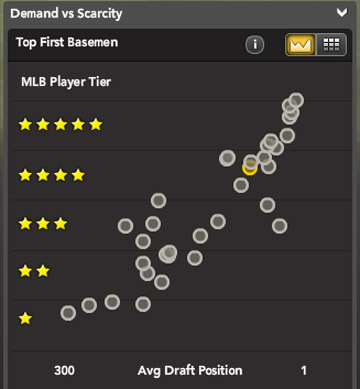
This season, the first-base position is deep for fantasy baseball purposes. Managers can afford to wait before grabbing a first baseman, especially if someone like Morales (B-Rank 43) is
slipping below his average draft position (61.3 ADP). Let’s say he won’t drop further than the fifth or sixth round, though. Do you pull the trigger? Will he hit for the same power and batting average this year?

Let’s take the easier question first. Morales hit .306 last year, but sported a .329 batting average on balls in play (BABIP). If that BABIP regresses towards the league-wide average (around .300), he should sport a lower batting average, correct? Not so fast. While BABIP figures across baseball hover close to .300, each player has some control over that number, especially if he possesses unique speed and hitting ability. Consider that Ichiro Suzuki has a lifetime BABIP of .357, for instance. Luckily for us, baseball analysts Peter Bendix and Chris Dutton developed a simple calculator for Expected BABIP (xBABIP); if you plug in Morales’ component statistics, you get .320. So while there might be a little regression in his stats, but it looks like this career .332 hitter in the minors stands a good chance of posting a batting average around .300 next year.

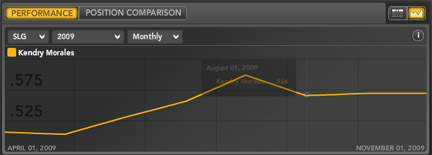
Now the harder question. What will his power output look like? it’s an open question for sure, since Morales had a slugging percentage closer to .400 in his first couple of attempts at the major leagues, then zoomed right by that figure, and .500, last year. Look at his monthly sluggingMoralesGrab2.jpg percentage and you’ll see that it took him half of last year to get there. Will he see a summer surge that big again?

One good sign for Morales’ power potential is his minor league Isolated Slugging number (ISO, which is Slugging Percentage minus Batting Average). Even granting the homer-friendly parks he played in,  Morales hovers around a .200 throughout his minor league career, a good sign. Major leaguers who posted an ISO around that number last year included Torii Hunter, Curtis Granderson, Matt Holliday and Robinson Cano. These are useful comps: Many of these players might hit 30 home runs, but would you bet your house on it? Bloomberg Sports is bullish on Morales and projects 32 homers. Still, there’s always the potential for regression to the mean after such a huge breakout season.

Morales could be a good acquisition if you can get him late enough in the draft. But considering that his power might skew closer to Robinson Cano than Prince Fielder, an early-round pick might be a bit of a reach.

For more information on Kendry Morales and other draft options, and more, check out Bloomberg Sports’ fantasy kit.

The (Always) Underrated Torii Hunter

By Eriq Gardner
In 2009, only four players in baseball put up at least 90 RBIs, 16 SBs, and a .299 AVG — Hanley Ramirez, Albert Pujols, Ryan Braun, and Torii Hunter.

In
fantasy baseball, we’re always looking for the player who can provide
all-around value. To most people, this means a guy with both power and
speed. Every year, we’ll see about a dozen guys crack 20/20. Last year,
there were 14 of them. 

Picture 37.png
For
my money, though, the rarest commodity in baseball is a player who can
both steal bases and drive in runs. After all, speedy players usually
hit at the top of the lineup and have only limited RBI opportunities.
Last year, there were only four batters who drove in 100 and swiped 20
bags. 
Torii Hunter came very close last
season — and would have made it happen if not for a strained oblique
that limited him to 451 at bats. If it wasn’t for missed playing time,
Hunter would have posted above-average totals in all five of the main
statistical categories. As it was, Hunter only fell short in the
category of runs.

Most people might not
appreciate the kind of pace that Hunter was on last season. Sporting a
slugging percentage (.508) that was greater than players such as Jayson
Werth
, Carlos Lee, and Matt Kemp, Hunter may well have flirted
with 30 HR with an extra 100-150 AB. Here’s a look at how he performed
against several outfielders going well ahead of him in drafts right now
who finished last season with relatively similar OPS numbers:

Picture 36.png

Picture 34.pngWhen
projecting Hunter’s 2010 season, there’s another consideration
to make. Besides having the rare ability to provide speed and the
opportunity to knock in runs, Hunter is one of only about 20 players in
baseball with 25-HR power and the ability to make contact with the ball
in at least 80 percent of his at-bats. Combined with the ability to run
quickly to first base after the ball is hit into play, this typically
translates to a pretty solid average. Last year, Hunter finished at
.299. Bloomberg Sports projects .289 for the upcoming season.

He’s
ranked 46th on the B-Rank scale, yet is being drafted well below his
projections. That’s nothing new. Hunter has a pretty long history of
being underrated in drafts year after year, and at age 34, few see him
as having the kind of statistical upside offered by many youngsters.
But is that assessment accurate? A player who provides power, speed,
RBI production, and average? Those kinds of players are a very rare
breed. Just ask Pujols, Hanley, and Braun.
For more information on Torii Hunter and other speed-RBI options, check out Bloomberg Sports’ fantasy kit.

The Pavano Principle

By R.J. Anderson

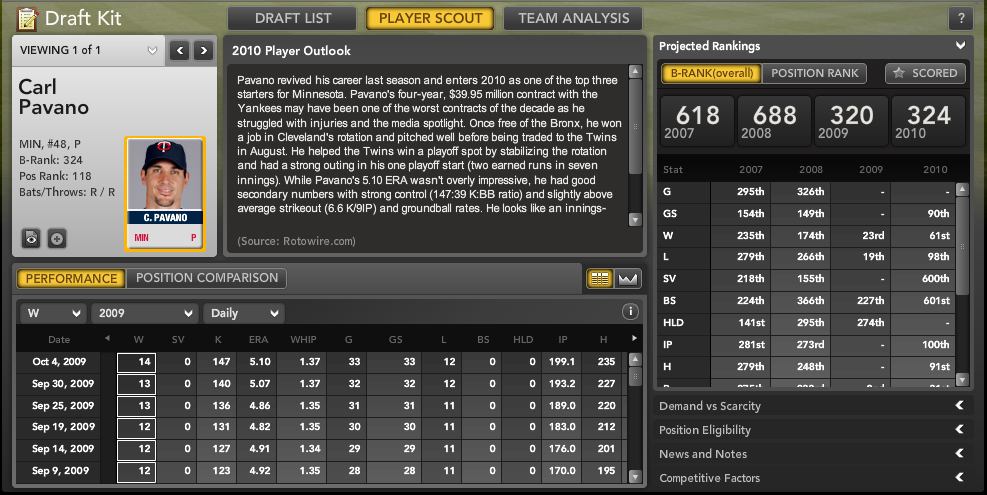
Carl Pavano has long been a whipping boy, an entry into a word association game when the term “fragile” came up, and a baseball punchline. Pavano thrived in relative anonymity last season, posting a good enough year with the terrible Cleveland Indians to earn him a trade to the contending Minnesota Twins. Rather than testing the frost-bitten market, Pavano accepted the Twins’ offer of arbitration. And boy, who can blame him? The Twins added some fun toys for his usage in the form of a new middle infield with high defensive reputations and offensive ability.

Nothing about Pavano screams fantasy asset. He’s a pitchability type, someone who relies on getting groundballs and avoiding mistakes. His injury-heavy past makes him more of a risk than most and he’s always given up quite a few homers. Pour all of that information into a bowl and whisk softly for a few minutes until the aroma of sleeper hits you. Right? Well, evidently not, since Pavano is being drafted at an average spot of 188th. His B-Rank is a low 324th and his positional rank (meaning of all pitchers, not just starters) is 118th.
 
pavano1.png
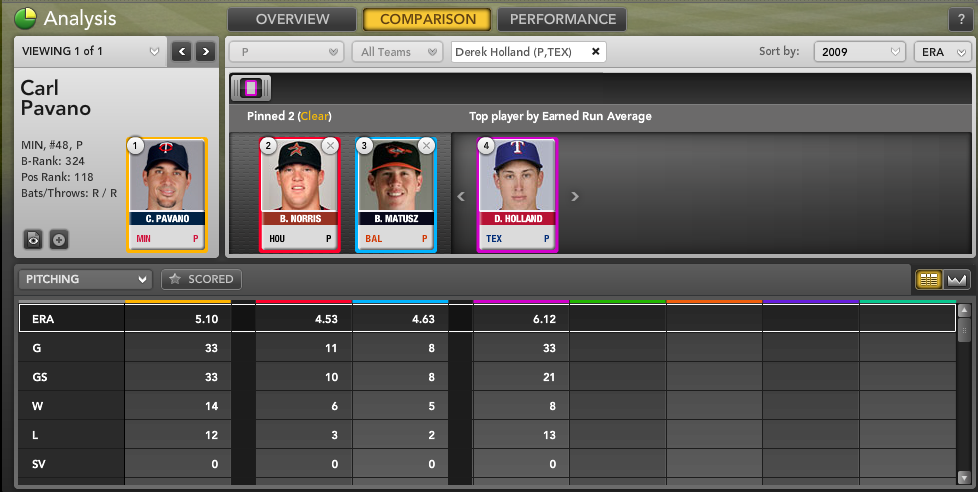
Pavano is pitching for the AL Central favorites, so wins should be available. The defense behind him is strong, so his ERA could be playable. He doesn’t strike many out, but then again he doesn’t walk many either, so his K/BB and WHIP are passable. But, is he really worth a top-200 pick? The immediate options that surround Pavano in the B-Rank standings are young talents like Bud Norris, Brian Matusz, and Derek Holland – three pitchers with considerably more upside who aren’t being drafted until the 250-270 range, if it all (in Norris’ case, he’s not being drafted).
 
pavano2.png
It’s not that Pavano is worthless or unworthy of being considered a fantasy option. It’s just that he’s being favored in front of options with a lot more potential to help your team. In shallower leagues, there’s no reason at all to take Pavano ahead of these younger pitchers: You can always find another generic SP with a 4.50 ERA and 12 wins on the waiver wire in a 10- or 12-team mixed league. But Holland and Matusz have the potential to be top-tier pitchers if or when their breakout comes.

At the end of your draft, take the upside pick, not predictable mediocrity.

For more information on possible over- and underrated starting pitchers and more, check out Bloomberg Sports’ fantasy kits.

Orlando Hudson and the Hidden Doubles


By Erik Hahmann
 
When one thinks of getting production from second base rarely do the words “Minnesota” and “Twins” come to mind – at least not since the days of Chuck Knoblauch. Over the past few seasons, banjo hitters like Nick Punto, Alexi Casilla, Matt Tolbert, and Luis Castillo have manned the position for the Twins. Last season it was Punto and Casilla teaming up to do the damage, splitting time at the position and posting OPS numbers of .676 and .526 respectively. It was time for a change.
 
Enter Orlando Hudson.
 
Minnesota inked the veteran second baseman to a one-year, $5 million deal this off-season, a small price to pay for such a significant upgrade in talent. Hudson isn’t in the same class as Chase Utley or Ian Kinsler, fantasy-wise. That duo rank as five-star talents in Bloomberg Sports’ Demand vs Scarcity chart, while Hudson earns just one star. Even so, his ability to steadily contribute in a number of categories gives him solid value as a late-round pick.
 
 
Demand.png 
 
 
Over the past four seasons Hudson has averaged a slash line of .292/.363/.440 (AVG/OBP/SLG) with 10 home runs, 64 RBI and 66 runs scored, more than respectable for someone ranked 24th at his position. Some of that success can be attributed to playing with the Diamondbacks in hitter-friendly Chase Field for three seasons. But Hudson spent 2009 with the Dodgers, where he posted a home OPS of .807 in Dodger Stadium, a tougher park for hitters.
 
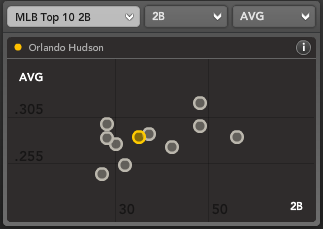
Hudson averaged 31 doubles during that same four-year period. Last season, he rapped .283 with 35 doubles, numbers few second basemen achieve. If you sort the Top 10 second basemen by those two stats you can see that Hudson’s combination of average and doubles ranks among MLB’s leaders.
 

bubble.png 
 
We don’t yet know how Target Field will play, and if the Twins’ new stadium will be friendly to doubles hitters like Hudson. But in an increasingly potent Minnesota lineup, Hudson’s ability to get into scoring position could net some solid runs scored totals. Hudson’s current ADP (Average Draft Position) is 185th, which slots him somewhere in the 15th round in standard 12-team mixed leagues, making him a middle infield target late in your draft.
 
For more information on the top second basemen in baseball, check out Bloomberg Sports’ fantasy kits

Is Drew Sutton the next Ben Zobrist?


By Tommy Rancel

In 2009, Ben Zobrist exploded onto the national scene with an All-Star season. The Tampa Bay Rays super-utility man hit .297/.405/.543 (AVG/OBP/SLG) with 27 home runs and 91 RBI. The seeds for Zobrist’s success were planted by a former collegiate baseball player named Jaime Cevallos.

Cevallos, now an independent swing instructor known as “the swing mechanic“, met Zobrist in 2008, and convinced him to train with him. Zobrist came up through the minor leagues as a hitter who could get on base but sorely lacked power. Little wonder: Coaches and instructors drilled him to spray the ball all over the ballpark, rather than rearing back and swinging for the fences. Cevallos used video analysis to give Zobrist a variety of recommendations, on weight shift, positioning his hands, and other techniques. Perhaps his simplest piece of advice was this: swing harder. Cevallos cracked the Zobrist Code, turning a decent utility man to an elite hitter known as “Zorilla.”

Zobrist was not alone in his workouts with Cevallos. Houston Astros farmhand Drew Sutton also came along for the ride.

3-5-2010 3-01-41 pm.png

Sutton and Zobrist have been linked to each other from day one of their professional baseball lives. The pair of middle infielders were selected by the Astros in the same 2004 amateur draft (Zobrist round six, Sutton round 15). They would move through the minor leagues in near unison until Zobrist was traded to the Tampa Bay (Devil) Rays in the summer of 2007. Sutton would stick around with the Astros for a little longer before being sent to the Cincinnati Reds for infielder Jeff Keppinger in early 2009.

Like Zobrist, Sutton was a decent minor player, but nothing special. He was a nice hitter, but did not display the power potential of a big-time prospect. While playing for the Astros Double-A affiliate in 2007, he hit .269/.351/.388, with nine home runs and 28 doubles – typical numbers for a good-but-not-great middle infielder.

Then came Cevallos’ instruction. Playing for the same Double-A affiliate in 2008, Sutton ramped his production up to .317/.408/.523. In just 48 more plate appearances (558 in ’07, 606 in ’08) he racked up 21 more extra-base hits. He more than doubled his home run total from nine to 20 and also hit 39 doubles. Not only did his slugging percentage increase by .135 points, his raw power, displayed in ISO (Isolated power, slugging minus batting average), also jumped from .119 to .206.

In 2009, Sutton played 44 games for Cincinnati’s Triple-A team. In his brief 190 plate appearances, he rapped 19 extra base hits (five home runs, 14 doubles) and slugged .471. When we take his .261 batting average out of the equation, we can see that his ISO actually increased from .206 to .210.

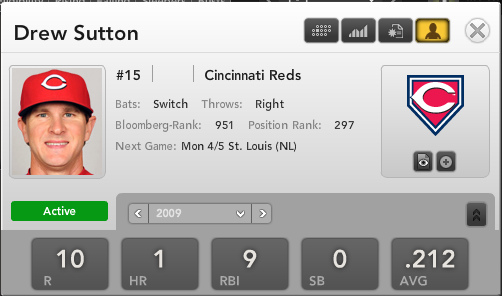
After an early July major league debut, Sutton appeared in 42 games for the Reds. He hit just .212/.297/.348 in his first big league action, but we can’t much stock in a small sample of 76 plate appearances.

When interviewing Cevallos about Zobrist, I asked him how many home runs Zobrist could hit if given enough playing time. Cevallos said he would hit 30 home runs. Zobrist came up just short with 27. I recently contacted Cevallos about Sutton, and asked him a similar question: If given 600 at-bats, how many home runs would Sutton hit? Cevallos said, 25. He also noted that while both players had similar power, Zobrist’s swing would lead to a higher batting average, but Sutton’s stroke could produce a lot of doubles.

The Sutton/Zobrist comparison is showing itself once again in 2010. Like Zobrist in 2009, Sutton enters 2010 spring training without a regular job and or an obvious position, after playing five positions (2B, SS, 3B, LF, RF) in ’09. That also sounds a lot like Zobrist, who has started at seven different positions for the Rays (every position except P and C).

On the infield, the Reds have unquestioned starters in Joey Votto, Brandon Phillips, and Scott Rolen. Orlando Cabrera was signed to be the team’s shortstop, but could see a challenge from Paul Janish. Heralded prospects Jay Bruce and Drew Stubbs make up two-thirds of the outfield with Jonny Gomes and a partner to be named later in left field.

All positions seem relatively settled; however, Sutton’s versatility could come into play.

The obvious holes in the Reds lineup are shortstop and left field. Gomes mashes left-handed pitching (.274/.369/.517), but is sub-par against righties (.224/.311/.448), particularly for a player who struggles on defense. At short , the 35-year-old Cabrera has averaged .275/.322/.398 in his career; he’s a minor offensive threat at this stage of his career. Janish has been an awful hitter in his brief major league career (.205/.290/.292) after being average in the minors (.261/.351/.382), but is a good defender.

Outside of those two positions, there is always the unforeseen injury. The surprising knee injury to Rays starting second baseman Akinori Iwamura in ’09 opened the door for Zobrist in 2009. With Scott Rolen and his injury history (124 days missed over last three seasons) manning third base for the Reds, there may be an opportunity for Sutton to steal some at-bats that way.

Of course, Zobrist may have caught lightning in a bottle in 2009, and Sutton may not respond to Cevallos’ instruction — or other factors that led to Zobrist’s success — the same way as his former teammate did. Sutton isn’t worth a draft pick in standard 10- or 12-team mixed leagues. But in a deep NL-only or larger mixed (18+ teams) league, he’s a good gamble toward the end of the draft. His B-Rank of 951 is so far off the radar that most people won’t even notice him, meaning you can snag him with your last pick.

Then again, check out Zobrist’s year-by-year B-Ranks. 

3-5-2010 3-03-25 pm.png

Ya never know.

To keep tabs on Drew Sutton, and hundreds of other players, check out Bloomberg Sports’ fantasy kits.

More Late Steals for your Fantasy Team: Drew Stubbs

by Eno Sarris 

When we recently wrote about Cameron Maybin and Cliff Pennington, we pointed out that these young players had the potential to give your fantasy team late steals. Steals are a rarer phenomenon than home runs in regular baseball, but you’ll notice that this scarcity is mitigated by the fact that you only need about 100-120 steals to be competitive in the category in a traditional mixed roto league (as opposed to 200-240 home runs). It’s good not to go overboard on steals too early in your draft – especially with late speed available.

Drew Stubbs will be available late in your draft (B-Rank 178, ADP 258.6), and has speed (121 stolen bases in 423 minor league games and 10 in 42 major league games). Those are your known knowns. Let’s explore the unknowns about this young player.

Will he start? It’s difficult to predict the ways of Dusty Baker, who ran one of the worst major league regulars (Willy Taveras) out there so often last year that General Manager Walt Jocketty had to trade Taveras away just to keep him off the field (and his new team, the Oakland A’s, promptly released him). Stubbs does have competition in the form of Chris Dickerson, a speedy slap hitter who’s had some success against right-handed pitching. But Dickerson is both a known commodity with his 28th birthday imminent, and a liability against lefty pitching: a .707 OPS against them in the majors, .647 in the minors. The 25-year-old Stubbs owns no such platoon weakness. Meanwhile, Total Zone, which rates defense in the minor leagues, rates Stubbs as a very good defender in center and Dickerson as much less impressive. It looks like Stubbs will get every opportunity to start.

Will he hit for power? It’s a small sample size, but you might remember that Stubbs debuted late last year and spanked eight home runs in only 180 at-bats. That was good for an isolated power number (ISO, or SLG minus AVG) of .172, something that might translate to about 20+ home runs over a full season. That would well outpace his minor league ISO of .132, so the power is actually an open question. Though last year’s 180 at-bats don’t represent much of a sample size, he really enjoyed hitting at home, where he posted a .997 OPS and a .600+ SLG. Remember that Great American Ball Park sports a 1.176 park factor for home runs – GAB tended to give up 17.6% more home runs than a neutral park. Perhaps the park will coax a few more homers out of Stubbs in 2010.

Will he hit for average? This might be the toughest question to answer about prospects in general, but Stubbs has a major factor going against him that will probably keep him from posting a nice batting average in 2010. While perusing his minor league records (where he hit .269 in more than 1500 plate appearances), you’ll notice a very high strikeout rate (27.3%). His best full-season strikeout rate in the minor leagues was not much better (25.3%). Stubbs also made below-average contact with the Reds last year (76% – 80.5% is league average). There’s really no reason to think that Stubbs will improve beyond his 27.2% strikeout rate from his stint in the majors last season, and a player who strikes out more than a quarter of the time is going to struggle to post a nice batting average. In this respect, Stubbs is very similar to Maybin, actually. Consult Bloomberg Sports’ Fantasy Tool about Stubbs, and you’ll notice that his 2010 Spring Training statistics are compiled on the ‘Analysis’ page for each player. It’s early going, but you might notice something.

Stubbs2Grab.jpgYup. Stubbs has already struck out three times in his first six at-bats this spring. That’s about the tiniest sample size you could use, but it does underline his previous problems with the strikeout. Expect a poor batting average, some power, and lots of speed from Stubbs. He makes for a fine backup option if you decide to wait on speedy outfielders.

For more information on Drew Stubbs, late-round steals options, and more, check out Bloomberg Sports’ fantasy kit.

Joe Nathan Suffers UCL Tear; Who Becomes Twins Closer?

By Tommy Rancel

Joe Nathan‘s worst fears were confirmed this morning when it was announced that the Twins closer is out indefinitely with a torn ulnar collateral ligament (UCL). Nathan will wait a week or two before deciding on surgery, but rest and rehab is not a normal course of action for this injury. To repair the tear, he would need season-ending Tommy John surgery.

This is terrible news to Twins fans and fantasy owners alike. Nathan is not just your normal 30-save closer. He is one of the few, true relief aces in Major League Baseball.

Nathan moved full-time to the closer position in 2004. Over the past six seasons, he has averaged 41 saves with an ERA of 1.87. He has also struck out 518 batters in 418.2 innings. Just to show the magnitude of the loss, over the same period, Mariano Rivera has averaged 40 saves with an ERA of 1.90. He has 424 strikeouts in 440.1 innings.

So the question is, who replaces Nathan in the 9th inning?

Jon Rauch jumps out as a replacement. Acquired mid-season from Arizona, Rauch has the most closing experience of any current Twins reliever. He has 26 career saves and spent most of 2008 as the closer for the Washington Nationals (18 saves). However, beyond the saves and experience, Rauch does not provide much from the closer position.

Despite his size (6’11”, 291 pounds), Rauch does not possess a blazing fastball (90.9 MPH career) nor is he an elite strikeout pitcher. His career strikeouts per nine innings (K/9) is a solid but unspectacular 7.4; in 2009, that number dipped down to 6.3. Rauch’s career walk total of 2.9 batters per nine innings is better than average, netting a strong, if not nearly Nathan-esque strikeout-to-walk rate of 2.5-to-1.

rauch.png

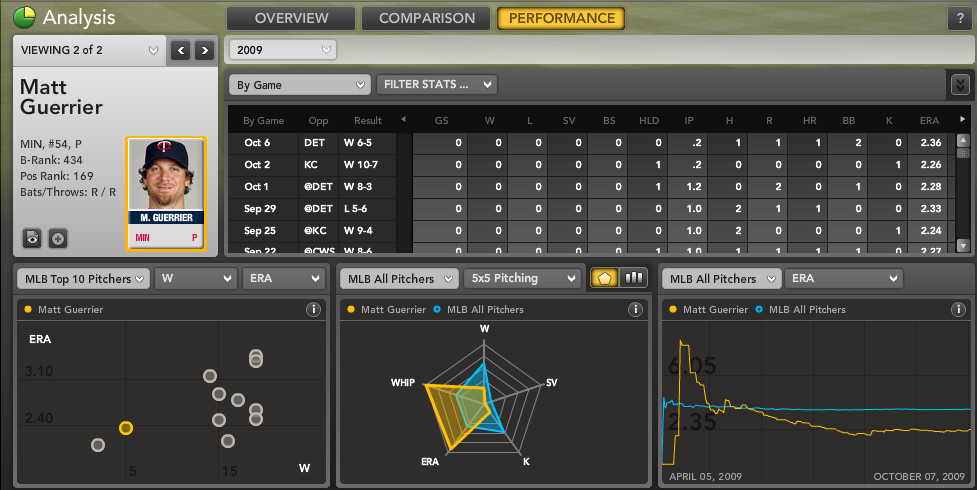
Matt Guerrier is another candidate. Guerrier has never handled the closing duties before, but has been a decent reliever in the Twins bullpen since 2006. In 389 innings as a relief pitcher, his ERA is a low 3.31. Last season, Guerrier pitched in 79 games for the Twins, going 5-1 with a 2.36 ERA. His 0.97 WHIP (walks + hits per innings) was 10th-best in the big leagues among pitchers in full-time relief roles or more.

Guerrier’s 2009 ERA and WHIP were both enhanced by a microscopic, likely unsustainable batting average on balls in play of .222 – well below his career BABIP of .278. Expect some regression here. His WHIP also benefited from a BB/9 of 1.9 last season, that’s much lower than his career 2.8 and could see some regression in 2010.

Guerrier does not possess the dominating strikeout rates you would like to see from the closer position. His career K/9 is just 6.0; in 2009, it was an unimpressive 5.5.

guerrier.png

The dark horse candidate in this potential race is Pat Neshek. If this decision was based off talent alone, Neshek would be the clear cut winner. But the 29-year-old with the funky delivery is coming off Tommy John surgery; Neshek missed the 2009 season after appearing in just 15 games in 2008. Pitchers often need several months or more of major league action
before finding their command and returning to pre-TJ levels

That said, Neshek was a dominant middle reliever/set-up man before his injury. With a healthy arm in 2006 and 2007, Neshek racked up 127 strikeouts in 107 innings while maintaining a 2.68 ERA. His career K/9 of 10.59 is definitely a plus for any pitcher, and he has walked fewer batters per nine (2.8) than either Rauch or Guerrier.

neshek.png

We don’t usually take much stock in intangibles, but own Jonah Keri is a Neshek fan. Need proof? Check here and here. Neshek is a talented blogger as well.

Rauch’s combination of skills, health and experience make him our preferred choice right now. Keep a close eye on Spring Training events, though, as Twins Manager Ron Gardenhire may have other ideas. If you draft Rauch, try to back him up with Guerrier and/or Neshek. Track all three to your Bloomberg Sports watch list.

For more information on Jon Rauch, Matt Guerrier, Pat Neshek and hundreds of other players check out Bloomberg Sports’ fantasy kits.

Stephen Strasburg, Jason Heyward, and Desmond Jennings: The Shiny Toys of 2010

By R.J. Anderson

Let’s take a look at three much-hyped prospects and their potential to make fantasy impacts in 2010 and beyond. Worth noting: Since all three players aren’t sure bets to go north with their major league clubs (two are near shoo-ins for demotions), they do not own B-Ranks. The entire equation changes if the league is of the keeper variety though, so keep that in mind.

SP Stephen Strasburg, Washington Nationals

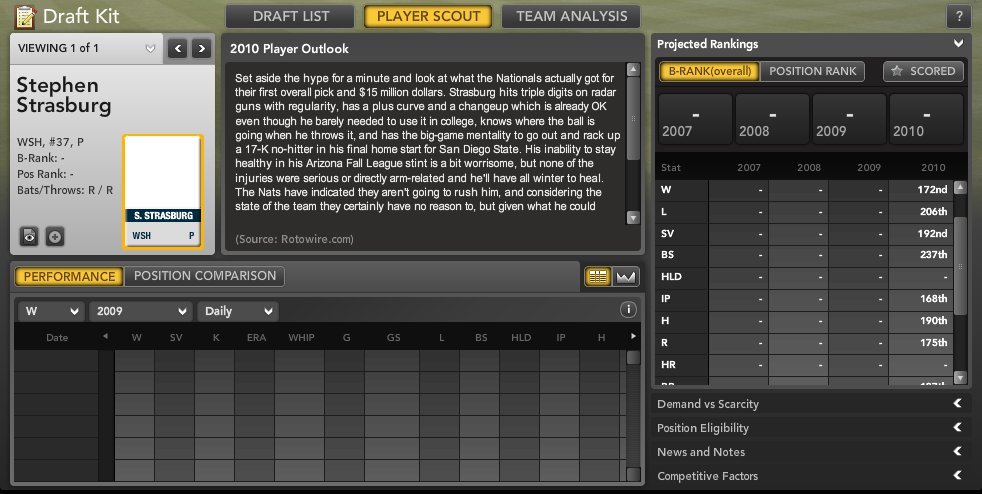
Strasburg is being drafted 287th overall in non-keeper leagues, despite the Nationals’ stated intention to send him to the minors for mysterious reasons that allegedly have enough to do with money or service time and Strasburg’s lack of professional experience beyond the Arizona Fall League and spring training bullpen sessions. Bloomberg Sports still projects Strasburg projected to finish in the top 200 of wins, games started, innings pitched, walks, and strikeouts. An ERA projection over 6.00 is hard to take seriously, but again, the guy hasn’t thrown a pitch in minor league baseball, so anointing him as a fantasy stud this year is a reach. The lack of available data on him aside, Strasburg’s electric stuff and the Nationals’ desperate need to generate some excitement make his chances of seeing the majors at some point this year something like 95%.

3-3-2010 5-39-01 pm.png

OF Jason Heyward, Atlanta Braves

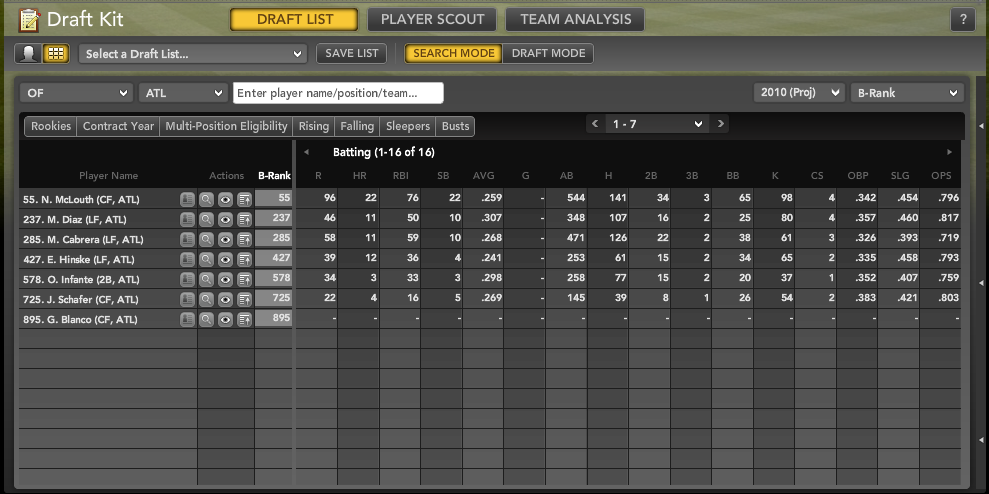
Strasburg’s division mate, Heyward could be an Atlanta Brave on Opening Day. The conservative projection for the Braves’ outfield has Melky Cabrera, Nate McLouth, and Matt Diaz starting, with Eric Hinske backing them up. None of those players are nearly as skilled as Heyward, and right field looks conveniently open for when the 20-year-old slugger ascends to the majors. Of the three vaunted prospects, Heyward seems the least likely to disappoint in 2010.
 
3-3-2010 5-41-24 pm.png

OF Desmond Jennings, Tampa Bay Rays

Unlike Strasburg and Heyward, Jennings is not only far less likely to see much – if any – major league time this year, he also has no place on the big league club. The Rays have the immensely talented Carl Crawford and B.J. Upton playing left and center field respectively, and two extremely serviceable players in Matt Joyce and Gabe Kapler to platoon in right. Jennings finds himself in the same spot Joyce did last season, blocked because of a numbers game. A dazzling defender with great plate discipline and speed, Jennings has a history of injuries that could hold him back as well. If you’re looking for rookie outfield help this season, look to Heyward, or possibly the Florida Marlins’ Mike Stanton instead.

Drafting prospects always carries risk, and these three cases are no different. As with any fantasy baseball decision, consider the value proposition. If your leaguemates fall victim to hype, don’t get into a bidding war for Strasburg, Heyward or Jennings. If all it will cost you is a late-round pick and a bench spot, Heyward and Strasburg are both worth a shot; Jennings too, if your league is deep enough.

For more information on these prospects and hundreds of other players check out Bloomberg Sports’ fantasy kits.

The Case For Joe Mauer in the 1st Round

By Eriq Gardner


Last season, Joe Mauer took home the AL MVP after slugging 28 HR, 96 RBI, and a .365 AVG. It’s nearly indisputable that Mauer had one of the finest seasons ever by a catcher. Yet hardly any fantasy baseball idea is more controversial than the prospect of taking a catcher in the first round.

Some people who blanch at Mauer as a high pick might be nervous about the inherent risks of investing in a catcher, the one position on the diamond (other than pitcher) where no player can every day, and where injuries and wear are big concerns. Others point to Mauer’s HR-to-flyball leap (from 6.5% in 2008 to 20.4% in 2009), seeing it as a clear sign that “Mauer power” is illusory.

However, the best case for Mauer as a solid first-round pick has nothing to do with faith he’ll keep up the HRs. Nor does it have anything to do with batting average, his most famous advantage over other players. It comes down to another category in which he’s so spectacular, he holds the potential of helping a team go a long way toward winning it.

That category is runs — probably the least-considered one in fantasy baseball. It’s also the category that’s been shown repeatedly as most correlative with a fantasy team’s hitting success.

Competitors tend to dismiss the runs category, perhaps because they see it as outside  of their control. A player crosses the plate, after all, not just based on his ability, but also due to other players’ ability to drive him in.

However, it follows that getting on base is a skill, and that those who do it well score more runs. Over the last three years, only three batters with more than 600 at-bats (Albert Pujols, Chipper Jones, and Todd Helton) have gotten on-base more than Joe Mauer.

The result is that Mauer crosses the plate a lot. Over the last three seasons, he’s averaged 85 runs scored. He scored 94 in 2009. In 2010, he’s projected to score 92 times.

How valuable is that? Let’s put it in perspective.

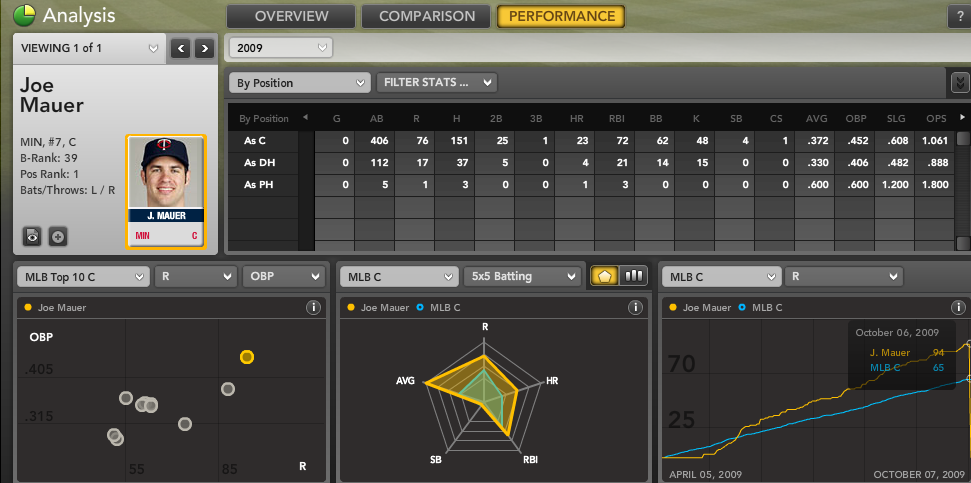
Among catchers, he’s a beast. Last year, he scored 30 more runs than the average Top-10 catcher. He did this despite missing the first month of the season. Here’s a graphical look at Mauer’s performance last year. Note, too, those 112 AB as a DH:

Picture 26.png

Going into 2010, Bloomberg projects Mauer to have a 25-run advantage on the top-10 leading run scorers at catcher. Is that a lot? Let’s look at how other players in the first round stack up in the runs category compared to the top-10 projected run scorers at their respective positions.Picture 30.png

As you’ll see above, Mauer (+25) holds a bigger advantage compared to his peers than Pujols (+12), Chase Utley (+12), Alex Rodriguez (+12), and Ryan Braun (+1).

Perhaps it’s time we began to look at things differently. Maybe Joe Mauer is to runs as players like Carl Crawford and Jacoby Ellsbury are to steals. This may sound controversial, but after going through several drafts already this year, and then projecting the seasons out, I’ve typically found that the team in my league that drafts Mauer is usually the one projected to win the runs category — and give himself a huge leg up on a league title.

For more information on Joe Mauer and hundreds of other players, check out Bloomberg Sports’ fantasy tools.