Is Jaime Garcia the Cardinals New (Under)Ground Pitcher?

By Tommy Rancel //

We continue to put the emphasis on understanding small sample sizes
in the early stages for the season. This is especially true for a
veteran player who has a career worth of data suggesting otherwise. On
the other hand, for a younger player the small sample could be a
prequel of things to come, most notably in situations in which the
young player is exhibiting skills carried over from the minor leagues.
 
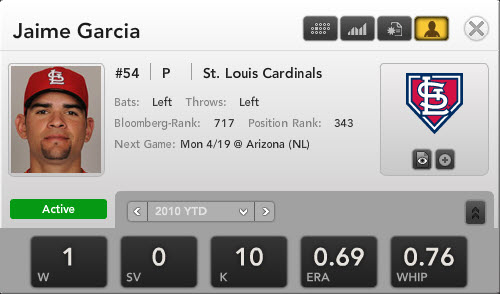
One young pitcher hoping to continue his small sample size success is Jaime Garcia of the St. Louis Cardinals.
jaimegarcia_playercard.jpg

The 22nd-round draft pick of the Cardinals in the 2005 draft, Garcia
cracked the team’s rotation this spring. After missing most of 2008 and
2009 with Tommy John surgery, the 23-year-old lefty is 1-0 with an 0.69
ERA after two turns through the rotation. Garcia’s performance will
surely normalize. Still, there is a lot about Garcia’s game and the
situation he is in with the Cardinals.
 
The most notable skill
Garcia possesses in the ability to get groundballs. In nearly 400
cumulative innings in the minor leagues, Garcia’s ground ball rate was
a fantastic 58.7%. In fact, 60% of the balls hit by right-hander
hitters off Garcia in the minors stayed on the ground. Groundballs are
great – especially for a starting pitcher – because at worst they
surrender a single, and never go for a home run.
 
In his brief
major league career, Garcia has carried over this ability. On the young
season, he has a 69.7% groundball rate. Working with Dave Duncan, one
of the game’s best pitching coaches and noted groundball enthusiast,
should only help Garcia maintain an above-average ground ball rate. To
date, the Duncan-led staff has the highest GB% (50.9) of any team in
the majors. We recently profiled Duncan’s effect on Brad Penny.

Thanks to his groundball ways, Garcia has been able to keep the ball
in the park. In 394.1 innings in the minor leagues, he allowed just 29
balls to leave the park. That translates into a wonderful home run per
nine (HR/9) rate of 0.63. He has not allowed a home run in 13 innings
so far this year, and his groundball tendency should limit the amount
of home runs given up over the course of the year.
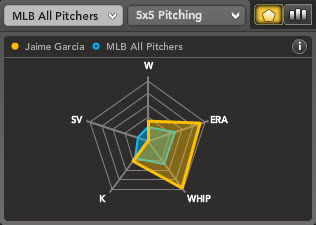
Thumbnail image for jaimegarcia_spiderchart.jpg
 
In
addition to the stellar groundball and home run rates, Garcia has
exhibited good control throughout his professional career. In the minor
leagues his strikeouts per nine (K/9) was a healthy 8.3, while
maintaining a manageable 3.0 walks per nine (BB/9). Those numbers have
regressed slightly at the highest level, but nothing considered drastic.
 
Not
to sound like a broken record, but understanding small sample sizes
can’t be stressed enough. However, in certain cases, and even more so
for younger players, they shouldn’t be ignored completely. For example,
Garcia is a much better choice than Livan Hernandez.
Despite the small sample on both, Hernandez has proven below average
for the past few years and likely will regress towards the same level
in 2010.

Currently, Garcia is an unknown commodity. But if he adds another
win in his next start he will start to gain notoriety. That said, feel
free to add Garcia right now in deeper mixed league or NL-only formats.

For more on Jaime Garcia and young players off to hot starts check out Bloomberg Sports’ fantasy kits.
Travis Snider: A Work in Progress

by Eno Sarris //

We’ve talked a little in this space about approaching early stats with some skepticism. Eriq Gardner had a great piece reminding us about the Emilio Bonifacios of the world – not all fast-starters turn out great. Tommy Rancel also pointed out some slow starters who would make great waiver wire or trade targets. So, we know not to take too much stock in the first 50 plate appearances of a season.

But there must be something we can figure out from smaller sample sizes. Thankfully, Steve Slowinski from DRaysBay provides an answer. Here are the following levels at which these stats become significant:

Offense Statistics:

  • 50 PA: Swing%
  • 100 PA: Contact Rate
  • 150 PA: Strikeout Rate, Line Drive Rate, Pitches/PA
  • 200 PA: Walk Rate, Ground Ball Rate, GB/FB
  • 250 PA: Fly Ball Rate
  • 300 PA: Home Run Rate, HR/FB
  • 500 PA: OBP, SLG, OPS, 1B Rate, Popup Rate
  • 550 PA: ISO

It follows that statistics based on pitches would become significant earlier: a batter sees anywhere from three to four pitches per plate appearance, so you’re really looking at a sample of 200+ pitches early in the year. Swing percentages and, to a lesser extent, contact rates, don’t leave us with too many tools in the early going. Let’s take a look at Travis Snider with these statistics in mind.

Snider is striking out in almost a third of his at-bats (32.4%), and sports a terrible .118/.286/.265 batting line (through Sunday) that is being held down by his strikeouts as well as his microscopic .136 BABIP. If a few more balls fell into play, his numbers would look a lot better. But these stats are misleading two weeks into the season. Let’s focus on the other tools in our bag right now.

The swing rates favor improvement for Snider. One of Snider’s major weaknesses is his tendency to strike out. And the only statistic that is currently significant, swing percentage, suggests that he may be making progress in that part of his game. Snider’s swing percentage this year is 42.3%, which is down from 48.2% last year. The even better news is that he’s swinging less at pitches outside the zone (21.7% this year, 27.1% last year). So Snider is making progress at discerning bad pitches, which might bode well for his strikeouts.

He’s swinging less, and making about the same contact (69.7% this year, 71.3% last year), but he has another 50 or so plate appearances before that trend starts to become significant. If he can boost the contact rate while keeping the newfound swing rate, his sense of the strike zone will benefit greatly – and so should his batting average.

Another piece of news that we can take away is that his reduced power this year (.147 ISO this year, .178 ISO last year, .229 ISO in minors) is not significant. It won’t be for another 400 plate appearances.  In fact, Snider’s career ISO (.172) was amassed in just 398 plate appearances. That could improve.

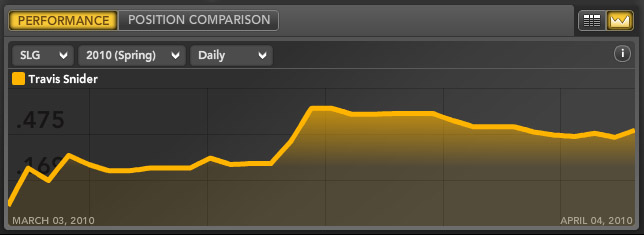
SniderGrab.jpgThough it, too, comes in a few plate appearances, perhaps Snider’s spring training slugging percentage can provide a pattern for his future growth. Taken from the Bloomberg Fantasy Tools, the grab on the right shows Snider’s slugging percentage in spring training.


Of course the best indicator of Snider’s upside is his terrific minor league performance. He hit a lofty .304/.382/.533 in four minor league seasons, with much of that performance coming in pitcher-friendly leagues and ballparks. He’s also just 22, so there’s plenty of room for improvement.

Snider’s plate discipline is getting better. We’ll have to rely on hope and those minor league statistics when it comes to his power. There’s still a chance he meets his Bloomberg Sports projections (.267, 18 home runs) for the year, or even betters them. Most of the season remains.

For more on struggling young players like Travis Snider, check out Bloomberg Sports Fantasy Tools.


A (Brad) Penny for Your Fantasy Team

by Eno Sarris //

Two starts into his 2010 season, Brad Penny sports a 0.79 ERA and a 0.64 WHIP. Sample size caveats obviously apply. But can Penny dip into the Dave Duncan fountain of rejuvenation and enjoy a big year? Let’s take a look at his career both recent and long-term, as well as the effects of the Cardinals’ pitching coach.

To tamp down expectations, one only needs to realize that Penny is likely to strike out batters at a below-average rate. He’s only struck out more than the major league average three times in his 10-year-plus career, and not once since 2006. Since then, his strikeout rate has been on a three-year decline.

In Boston in 2008, the combination of his declining strikeout rate, increasing walk rate, an unlucky .336 BABIP and 64% strand rate (usually around 70% across baseball) led to his career nadir. That low point sent him packing from the American League and seemed to signal the end of his fantasy value. Not so. Back in the National League last year (and a nice pitcher’s park, as the Giants’ home park had a .970 park factor for home runs), Penny again found relevance that he’s continued to provide this year. How did he do it?

Taking a look at the Bloomberg Sports Fantasy Tool, we get our first clue in the graph for Penny’s WHIP in 2009. He slowly whittled that number down to a more respectable 1.40 level by the end of the year, mostly by returning to his historical levels of control. His full-year walk
PennyWHIPGrab.jpgrate was 2.65, compared to his already better-than-average 2.88 number. He also got lucky in San Francisco, where his .211 BABIP and 81.8% strand rate evened out his Boston struggles.

It wasn’t just luck that provided some of his boost in San Francisco, however. With the Giants, Penny had a 53.8% groundball rate, which followed his career trend of inducing groundballs. Derek Lowe has already showed us that someone can survive – and even thrive – with a sub-standard strikeout rates if it comes paired with great control and lots of dead worms. Through his first two starts this year, Penny has upped the ante by walking a miniscule 1.29 batters per nine and inducing 60% of his contact on the ground.

Of course, you don’t put up a sub-one ERA and WHIP without some luck, and Penny’s been lucky this year. He won’t continue to put up a .222 BABIP or 81.8% strand rate for sure. But Penny does have something on his side: Duncan. The Cardinals pitching coach has been helping Penny with a mystery pitch, which different classification systems call a split-finger or a cutter. As with Kyle Lohse, Chris Carpenter and Joel Pineiro before him, Duncan seems to have helped Penny work on a sinker and induce more groundballs. 

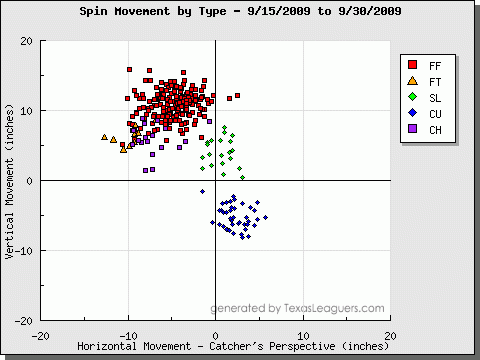
The Duncan Effect has been pointed out before, and even demonstrated statistically by Steve Sommers on Fangraphs.com, but it’s worth looking at Penny’s two starts this year in comparison to his last two starts in of 2009. First up, a graph of his last two starts
PennyMovement09.gifin 2009, courtesy of Texas Leaguers. Notice that green bunch of diamonds in the middle, lacking much movement, and also the number of purple squares. Penny was throwing his slider (green diamonds) about 7% of the time, and his changeup (purple squares) 15.2% of the time in late 2009. Mostly, Penny was all fastballs (red squares, 67.3%).

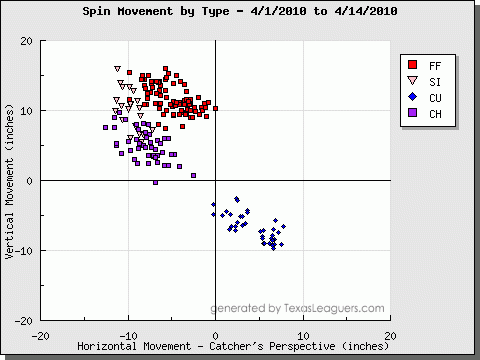
Fast forward to the beginning of this year, after a spring of tutelage from the new pitching coach. He’s given up the slider, and now throws the changeup 24.6% of the time. Instead of relying too heavily on his fastball (43.3% this year), he’s also throwing a new pitch that Texas Leaguers calls a sinker (11.8%). All in all, the mix looks very different; removing a rather straight group of pitches which he couldn’t command well (55% strike percentage on sliders) is a good
PennyMovement10.gifmove.

It’s all a little confusing because pitch f/x databases are all getting better at calibrating their classification systems. One system might call a pitch a cutter, another might label that same pitch a two-seam fastball, another might call it a sinker. In the end, though, the fact that Penny is moving away from his four-seam fastball and adding new pitches is important. Even though the fastball velocity has returned to his early career levels, that pitch only garnered a 5.6% whiff rate last year. Compare that to the 10-13% whiff rates he’s getting from his changeup, curveball and sinker this year, and you see that the decision to throw fewer fastballs was a good one (though again sample size caveats apply).

The newfound pitching mix, the added groundballs, and playing in a friendlier stadium and more pitcher-friendly league than he did at this time last year – these facts all make Brad Penny a decent pickup in all formats. While he won’t be an elite pitcher all year, a season like Joel Piniero had last year is not out of the question for Penny.

For more on Brad Penny and other groundball-inducing pitchers, check out Bloomberg Sports’ Fantasy Tools.


Will Scott Podsednik Steal 50 Bases This Year?

By Eriq Gardner //
Dan Goldstein, a psychologist at Columbia University, once did a famous study where he asked college students in Germany and America to identify the larger city — San Diego or San Antonio.
A majority of American college students guessed San Antonio. A majority of German college students guessed San Diego. The Germans were correct.
The takeaway from this study was not that Germans are better at demography than the Americans. Rather, most Germans had never heard of San Antonio. They didn’t know it was a booming town, rated as one of the best places to live in the United States, home to a highly successful basketball franchise. They guessed San Diego because of the name recognition factor.
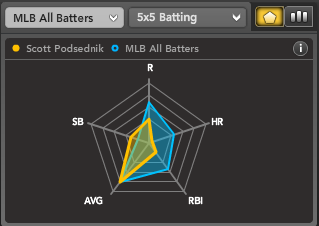
I’ve thought about this study when contemplating all the people in fantasy leagues this year who drafted Scott Podsednik and have enjoyed his seven steals in his first 12 games of the season, not to mention his .457 average to date. 

Podsednikproj.png

Podsednik wasn’t supposed to be anywhere near this good. Those in the know may have targeted Julio Borbon or Nyjer Morgan as their cheap speed guy. Or maybe the smart money was on Rajai Davis, Elvis Andrus, Michael Bourn, or Alcides Escobar. Even if you were picking a reclamation project in his 30s, Juan Pierre was most people’s target, not Podsednik.
Podsednik has been better than all of the above players two weeks into the season, and I can’t help but think he ended up being owned in many leagues by the person who is least obsessive about the opinions of others. After all, Podsednik was not a sexy choice at all in drafts this year. Instead, those who drafted him may have associated him with 212 steals between 2003 and 2006. He was a burner back then. But that was supposed to be ancient history.
Now, Podsednik is 34 years old, a time when players are supposed to be on their last legs — especially players whose genetic gift was quick feet.
He’s on pace for more than 90 steals, which is amazing considering that Bloomberg Sports had him pegged at just 20. So the question is whether Podsednik can get to 50. That would make him, pardon the pun, a draft steal.
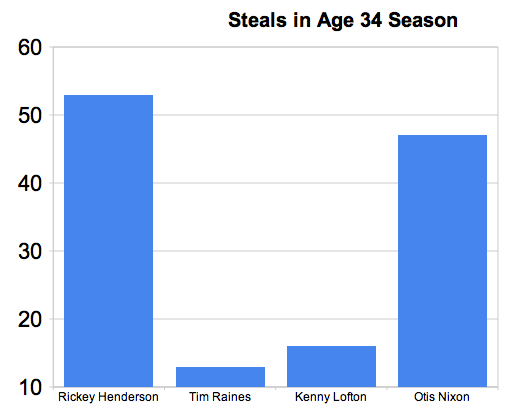
Baseball Reference lists several players in history who have similar statistical profiles to Podsednik’s career. From that list, I took the players who played in 1980 or after so as to try to understand what we can expect from a 34-year-old who has burnished his reputation as a base theft artist. Here are the results:
age34steals.png
As you’ll see, none of these players came close to 50. The closest, Al Bumbry, topped out at 22 steals in 1981, playing for the Baltimore Orioles.
Maybe Podsednik hasn’t been given a fair shake in his career. He’s played in an era where managers increasingly value getting on base, and he’s been somewhat subpar there. As a result, he’s been a bit of a journeyman these past few years, fighting for playing time. What if we group him among the great speed threats of our era?
age34steals2.png
A mixed bag. The great Ricky Henderson stole 53 in 1993 playing for the Toronto Blue Jays, and Otis Nixon swiped 47. But we also see that Tim Raines and Kenny Lofton had mostly lost their wheels by age 34.
Looking back at 2009 for Podsednik, he quietly put up 30 stolen bases. Breaking it down by month, he stole nine bags in June and eight in August, but just three in May and four in July. That’s probably what we can expect from him this season too: inconsistency. He’ll have great months and some poor months.
Maybe it’s possible that owners who drafted him are similar to the Germans who tabbed San Diego in that study, and will prove the experts wrong. Or maybe we can discount the Podsednik Phenomenon as another illustrative example of why it’s foolish to chase early stats.

We’re betting on the latter. If you own him and can sell high, do it.

For more on Scott Podsednik and other speed candidates, check out Bloomberg Sports’ fantasy kits.
Fantasy Baseball Intelligence, Episode 6

By Jonah Keri //

In Episode 6 of Fantasy Baseball Intelligence, Bloomberg Sports’ Wayne Parillo and I discuss advanced stats, and how they may help you win your fantasy baseball league.

Here’s the direct link to the podcast. To subscribe to an RSS feed of Bloomberg Sports’ podcast, head here, or check out Fantasy Baseball Intelligence at iTunes.

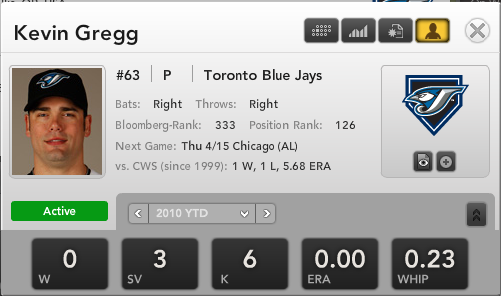
Kevin Gregg In As Blue Jays Closer; Jason Frasor Out

By Tommy Rancel //

The season’s barely started, yet by last count we’ve had seven teams make a switch from their projected closer. Some are injury related, and some are simple managerial decisions. The decision by the Toronto Blue Jays to remove Jason Frasor from the closer’s role in favor of Kevin Gregg falls under the latter.

Normally, making a switch this early would scream knee-jerk reaction. On the other hand, Gregg and Frasor were locked in a tight battle this spring, and the Jays didn’t give Gregg nearly $3 million this winter without considering the possibility that he might close some games.

Frasor has struggled in his five games so far. Meanwhile, there is concern about his velocity, which is down more than two miles per hour from 2009. That could just be a product of building up arm strength early in the year, but also good reason to lower his usage in high-leverage situations for now.

Gregg came to Toronto after one disappointing season with the Chicago Cubs. Despite the ugly 4.72 ERA in Chicago, his peripheral stats were pretty good. His 9.31 strikeouts per nine innings (K/9) were just off his career best and among the highest such rates in the game. His walk per nine innings (BB/9) of 3.92 was his lowest total since 2006.

Gregg struggled with the long ball while in Chicago. After allowing 10 home runs in two seasons with the Marlins, he yielded 13 homers in 2009 with the Cubs. Some of that was bad luck, though: Gregg posted an aberrant 15.3% home run-to-fly ball rate (HR/FB), much higher than his career rate of 8.5%. He is likely due for some regression.

gregg.png

If we normalize his HR/FB from 2009 using expected fielding independent pitching (xFIP), a metric that looks at things pitchers can control like strikeouts and walks with a normalized home run rate, we see Gregg’s xFIP of 4.18 last year was a lot better than the near 5.00 ERA.

In addition to regression, Gregg has made some changes in pitch selection that could go a long way in lowering his home runs allowed. Since 2003, nearly 85% of Gregg’s pitches have been a fastball (65%) or slider (18%). But in early 2010, he’s thrown the pair of pitches less than 60% of the time.

In their place, he’s throwing more split-fingered fastballs (8.4% career, 23.1% in 2010), and has reintroduced a cutter to his arsenal. Gregg has dabbled with a cutter before – throwing it 2% of the time in his career – but is throwing the pitch nearly 20% of the time so far this season. Please note that all these percentages are extremely small sample sizes, but don’t ignore the fact that Gregg has made some adjustments.

It also seems the pitch selection changes have changed the type of pitcher Gregg is. He’s getting nearly 70% groundballs this year after getting less than 40% for his career. Of course a 70% groundball rate is unlikely over the course of a full season (unless you’re Chad Bradford). Nonetheless, if Gregg and his newfound weapons can keep that ground ball rate above 45% (or even better, 50%), that would be a nifty shift for the 31-year-old.

If he’s available in your league, immediately grab Gregg regardless of size and format. Frasor and Scott Downs are still in the mix, but all things considered, Gregg is looking like a strong play, especially in a season that has seen a 23% turnover rate at the closer position in just 10 days. Also remember that Toronto has seen a different saves leader in each of the last five seasons including Frasor in 2009. This trend looks likely to continue in 2010.

For more on Kevin Gregg and the Toronto Blue Jays check out Bloomberg Sports’ fantasy kits.
 

Who Replaces Mike Gonzalez?

By R.J. Anderson //

The Orioles’ signing of Mike Gonzalez during the off-season was an odd move. The team had no hopes of competing this year, maybe not even in 2011, yet felt for the talent Gonzalez held, he was too good to pass up for the cost (in draft picks and money).

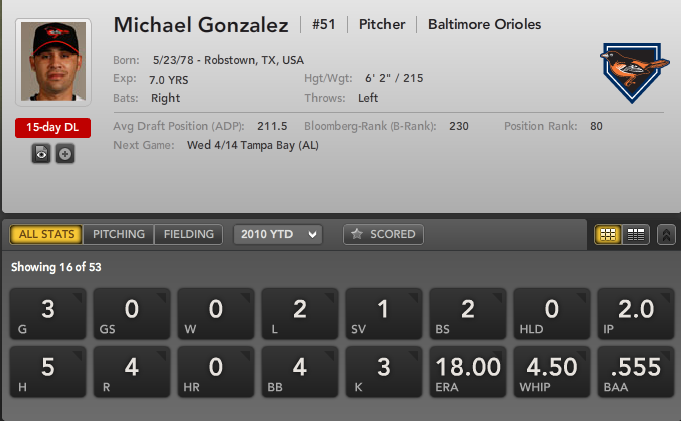
The start of Gonzalez’s 2010 season was not what the team had in mind when the contract was being crafted. Gonzalez made three appearances over the opening week, completing two innings, saving one game, and taking the loss in the other two. On Wednesday, he was placed on the 15-day disabled list with a strained shoulder. There’s little to no point in looking into the statistics of three outings as anything meaningful. One potential trouble sign did emerge, though: Gonzalez’s fastball velocity was down nearly two full miles per hour.

gonzo1.png
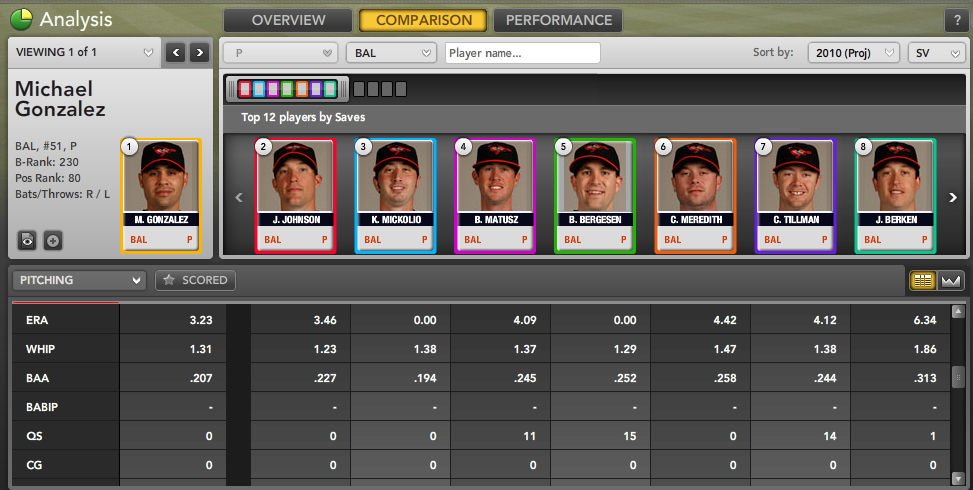
Replacing him in the closer role for now will be Jim Johnson.
Johnson is a big right-hander who actually saved 10 games for the
Orioles last season and has pitched in 50 games or more in the past two
seasons.

Johnson certainly could morph into a season-long option. Gonzalez’s struggles had certainly raised the possibility of his closer tag being removed. At the same time, it’s hard to see that occurring now with his injury. At best, Johnson will serve as the temporary closer until Gonzalez returns and proves his health.

The good news is that the rest of the Orioles’ pen looks like a mess. Well, that’s sort of good news, at least. It means Johnson has little to no competition for those save situations, but it also means a few save opportunities could be blown by lesser quality pitchers.

He doesn’t strike out as many batters as you would expect from someone with mid-90s velocity (just 5.0 per nine innings in 2008, an improved 6.3 per 9 IP in 2009), but he is an extreme groundball reliever, which helps to hold his home run totals down. The problem is that the Orioles’ infield defense is rather lackluster, making him a WHIP liability on bad days. That makes young reliever Kam Mickolio a deep sleeper in extremely deep leagues, including AL-only ones. 

gonzo2.png 

Despite Johnson’s flaws, he’s well worth a pickup in deeper leagues. If nothing else, you can always hoard saves, then trade them for other assets later. In the meantime, keep an eye on Gonzalez’s recovery, and how Mickolio fares in the early going.

For more on Jim Johnson, Mike Gonzalez, and other closing pitchers, check out Bloomberg Sports’ fantasy kits.
Don’t Chase Early Stats

By Eriq Gardner //
Even before Aaron Hill was placed on the injury list by the Toronto Blue Jays this week, the talented second baseman was a good bet to haunt fantasy owners this season. Flash back to April, 2009, and many fantasy competitors were hesitant to pick him up off the waiver wire. Hill ended that month with a .365 average and 5 home runs. Many smart folks seemed sure it was a fluke. Guess what? It wasn’t. Hill ended the season with 36 HR.
The lesson of Aaron Hill might linger in the subconscious of many fantasy players this spring. And if not Hill, then perhaps Marco Scutaro. Or Mark Reynolds. Or Ben Zobrist. Or Jason Bartlett.
Every year, a handful of players hardly get drafted, yet go on to have breakout years. Many fantasy players know if they don’t quickly scoop these players off the waiver wire, they’ll end up on a competitor’s team. Kicking yourself for lost opportunity hurts.
What many people forget is Brandon Inge, Orlando Hudson, Jorge Cantu, Kevin Millwood, and certainly last and least, Emilio Bonifacio. All these players rocketed out of the gate in 2009 only to end the season with drab numbers, or worse. Nothing dulls quicker from the mind than pain.
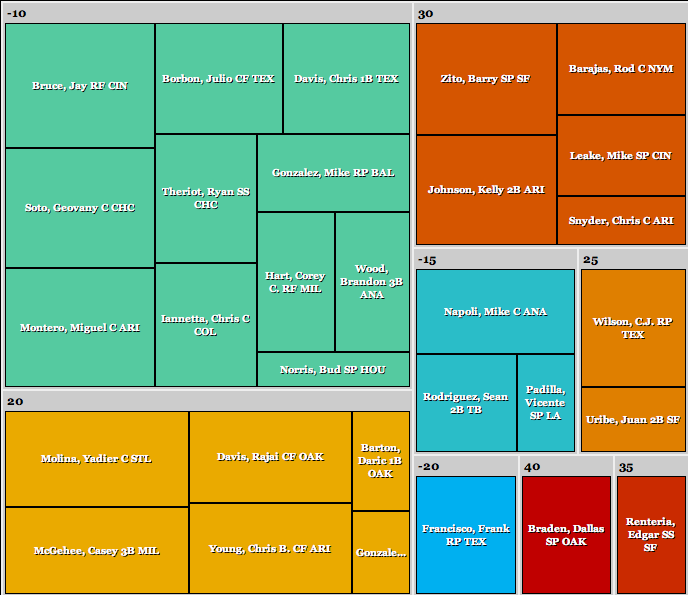
So which player is the next Aaron Hill and which is the next Emilio Bonifacio? General wisdom forthcoming, but first look at this heat map which shows the players who are red hot or ice blue cold. Players are boxed according to the size of their ownership in CBS Sports leagues and grouped and colored according to the change in ownership over the last week.
trendsown.png
You’ll see above that fantasy owners are scooping up Dallas Braden and Edgar Renteria by the barrel and dropping Frank Francisco and Mike Napoli quicker than a five-ton weight. Is there any sense to these roster trends?
The season is only a small fraction of the way completed and already we’re all making decisions based on very tiny sample sets. Has Rod Barajas really done anything yet to deserve the love he’s been getting? Quite simply, no.
In evaluating potential roster decisions, it’s best to be mindful not to chase recent history. Any player in baseball can have a lucky week. Sure, it’s possible that the good start is indicative of a trend to come, but we must examine context. One or two weeks doesn’t negate years of mediocrity and shouldn’t change our perceptions significantly.
That’s especially the case when it comes to older players like Barajas or Renteria who shouldn’t be counted upon to have discovered the fountain of youth and grown their skill level well into their 30s. Every once in awhile, a Marco Scutaro will come along; more often, they’ll just tease at a great season near the twilight of their career, before showing true colors.
Exceptions can be made for newfound opportunity, or players who may have been slowed in previous seasons due to exigent circumstances. Hill and Zobrist are both good examples here. In 2007, Hill showed tremendous promise in his third season in the majors before being sidetracked due to a concussion. His breakout last year wasn’t a huge shocker. He was on a good path towards stardom before people forgot about him. Similarly, Zobrist always had promising numbers until he was given the opportunity to strut his abilities with full-time playing time (though the size of his breakout surprised even his biggest fans).
Looking at the chart above, we may have similar hope for C.J. Wilson, who has flashed skills in prior years and has now been giving a new opportunity in the Rangers’ starting rotation. The same is true for Kelly Johnson, who has long been projected for a breakout and now gets opportunity in the hitter-friendly confines of Chase Field in Arizona.
But please don’t count on a breakout from Juan Uribe. And don’t give up too quickly on Mike Napoli, despite the buzz that he’s losing playing time. In a few weeks, the law of averages will catch up for both those with talent and those who have proven time and time again that they aren’t worthy of our consideration. Hopefully, in the interim, owners aren’t hit with the double whammy of curses — seduced by the hot start, and reluctant to cut bait at what still appears to be a respectable stat line.
For more on C.J. Wilson, Kelly Johnson, and other breakout candidates, check out Bloomberg Sports’ fantasy kits.

Slow-Starting Targets: Adam LaRoche, Alexei Ramirez, Hunter Pence

By Tommy Rancel

The regular season has started, and now it’s time to work your magic as a fantasy general manager. One of the angles to exploit in the early part of the season is slow starts. There is always someone in your league that is on edge beginning Opening Day, ready to ditch a player at the first signs of struggles. With that in mind, here is a look at some notorious slow starters you might be able to steal in a buy-low trade.

Adam LaRoche

LaRoche entered 2010 with a new team, yet got off to the same old slow start. He started his Arizona Diamondbacks career 0-for-13. He’s racked up a few hits since then, but is still hitting an ugly .231/.310/.308 (AVG/OBP/SLG), with no homers, no steals and just 3 RBI in 7 games. Long-time LaRoche owners (if there are any) are not surprised by this start, since the 30-year-old first baseman is your quintessential second-half hitter.

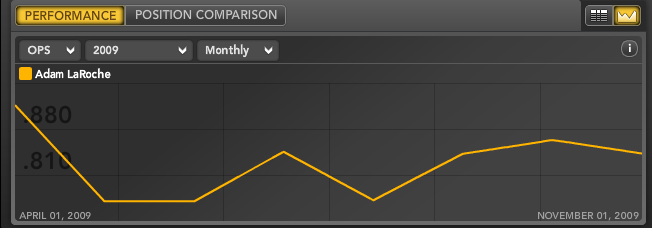
For his career, his slash line in the first half is .250/.324/.444. In the second half of the season, LaRoche blossoms into a .300/.363/.546 hitter. The .768 OPS in the first half represents a .141 point difference from his second-half total of .909.

laroche.png

The bulk of LaRoche’s early-season struggles come in March and April. Over his career, he has combined for a slash line of .192/.283/.360 in the opening months of the season. However, from May going forward, there is a steady increase in OPS:

.781 (May)

.798 (June)

.908 (July)

He peaks in August with a .933 OPS, and then goes slightly back down to .908 in September.

When targeting LaRoche, in trades be sure to exploit his early struggles. If you’re lucky enough to land LaRoche, just be patient as he is likely to once again heat up with the weather. Also remember he should enjoy playing his home games in doubles-friendly Chase Field.

Alexei Ramirez

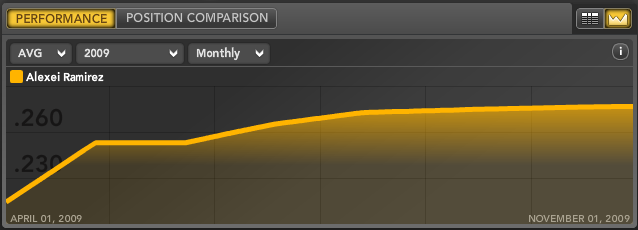
Since joining the major leagues in 2008, the Cuban Missile has struggled with his early-season stroke. 2010 has been no different for the White Sox shortstop: He’s hitting .138 with no walks and one extra-base hit through his first eight games. While he is not a second half player per se, Ramirez is definitely a slow starter.

alexei.png

In the opening months of the season (March and April), Ramirez has hit just .175/.221/.237 in his career. The monthly OPS of .458 is 409 points less than his best month, June, in which his OPS jumps up to .867.

Overall, Ramirez is rated as the eighth-best shortstop according to B-Rank. On the other hand, he is ranked only behind Derek Jeter, Jason Bartlett and Elvis Andrus in the American League. If you do not have one of those three shortstops in an AL-only league, you should be contacting the Alexei Ramirez owner in your league immediately.

If the price is too high right now, you might be able to wait a little bit longer if Ramirez holds to form, as his career May OPS of .719 isn’t impressive either. However, don’t wait much longer than that. In the summer months of June, July and August, his OPS jumps to an average of .834 per month, with the usual double-digit home run and stolen base pace.

Hunter Pence

The 27-year-old Astros outfielder is also off to a rough start in 2010 (3-for-25 with no walks). He was even benched for Sunday’s game against the Phillies. The slow start isn’t that big of a surprise, though, given his early-career track record.

A career .286 hitter, Pence’s batting average in the first month of the season is just .254. In addition to the batting average struggles, Pence’s power is slow to develop. His .391 slugging percentage in March and April represents the only monthly slugging mark below .462.

While he struggles in the first month of the season, history tells us that Pence will blow up in the month of May. His slash line in the second month of the season is .358/.415/.561. His 49 RBI in the month of May are also the highest of any monthly total.

Even with the slow start, Pence is likely to cost you a fair amount, given his combined 50 homers and 25 steals in the past two seasons. However, his B-Rank of 87 shows he’s among the game’s top 100 talents, and his owner might not have him valued that high if his early struggles continue. If you can get Pence at a slight discount, do it.

For more on notorious slow starters like Hunter Pence, Adam LaRoche and Alexei Ramirez, check out Bloomberg Sports Fantasy Kits

Neftali Feliz: The Closer


By R.J. Anderson

When it comes to early-season role shuffling, Neftali Feliz to the closer’s spot in Texas is as big a maneuver as you’ll ever find. Ignore whether or not it’s the right real-world call for the Rangers, and just focus on the facts:

– Feliz is 21 years old.

– He throws fire.

– He’s one of baseball’s top prospects.

Those three reasons alone are enough to give him fantasy value. Add in the extra pleasure of getting saves credit for his appearances, and the decision has made some fantasy owners downright giddy. It’s hard to project just how good he will be and the worrisome part is that no timetable on his closing efforts is being publicly made. That means that owners of Feliz have two choices:

1. Ride the tidal wave and hope the Rangers don’t move him to the rotation, or away from the ninth inning.

2. Let him rack up even more hype, then ship him off, and hope the Rangers realize he’s wasting away in a closer’s spot, since he’ll likely provide more real-life value (if not necessarily more fantasy value) as a starting pitcher.

It’s a difficult call. How many saves could Feliz rack up, anyway? Last year, Frank Francisco recorded 25 saves, which led the Rangers, but C.J. Wilson also tallied 14, and four others had at least one, including Feliz. All told, there were 45 saves recorded. The Rangers won fewer games in 2008 and as a result only racked up 36 saves, although team quality did not stop the 2007 Rangers from topping 40 saves once more.

Skeptics might speculate that Feliz is too young, too new, and too untried to wage war in the 9th. They have no idea what they’re talking about. In 34 career big league innings, Feliz has per nine ratios of 11.8 strikeouts and 2.6 walks. During his time at Triple-A, mostly as a starter, he posted about a strikeout per inning, and his career minor league numbers are 325 strikeouts in 276 innings. He’s got the stuff to miss bats and produce outs, even in high-leverage situations.

feliz1.png

If Feliz is the full-time closer from here on out, he’s getting something like 35-40 chances for a save. That’s valuable, but it’s not like another closer’s job won’t change hands and lead to a similar opportunity before the month of May is even upon us. So, depending on the needs of your team, and the offer quality presented, you could either ride the wave or ship Feliz out for a king’s ransom.

Either way, Feliz could win you a title. If your league has weekly transactions and Feliz isn’t owned yet, use that number-one waiver claim, or empty your FAAB account.

For more on Neftali Feliz and other pitchers, check out Bloomberg Sports’ fantasy kits.