(Video) Ballpark Figures: Hot Commodities

by Jonah Keri //

Welcome to Bloomberg Sports’ Ballpark Figures, hosted by Bloomberg TV’s Michele
Steele and Bloomberg Sports’ fantasy baseball analyst Rob Shaw. Each day they
discuss the trends and headlines that impact fantasy baseball the same way
Bloomberg News monitors the stories that move the financial markets. Who are
the bears and bulls? Who are the hottest commodities? You get the idea.

Ballpark Figures: Hot Commodities — Bloomberg TV’s Michele Steele talks fantasy baseball with Bloomberg Sports’
fantasy analyst Rob Shaw. Why are Royals middle infielder Alberto Callaspo and
Diamondbacks second baseman Kelly Johnson “Shaw Bets!” and how has
Diamondbacks closer Chad Qualls rebounded from a rough start to become
“Michele’s Steal!”?

Is B.J. Upton Back to Being Powerful?


By R.J. Anderson //

Formerly a top draft pick and uberprospect, B.J. Upton broke out in 2007 with 24 home runs and 22 stolen bases. Those stats were accumulated despite Upton missing roughly 30 games with a strained quadriceps muscle and changing positions for the third time. Since then, Upton has played most of the previous two seasons and in every game this year, yet he’s racked up a total of 24 homers.To say Upton’s 2007 looks like a tease is being kind. With four home runs in the first 19 games, is it time to start wondering whether Upton’s power is back?

Early in the 2008 season, Upton suffered a torn labrum while attempting to rob a home run. He fought off surgery until after the season, which helps to explain his zapped homer production as well as his increased number of groundballs hit. The reality is the more groundballs Upton hits, the fewer extra-base hits he’ll rack up. Even with elite speed, Upton’s not turning grounders through infield holes into doubles. In 2009, Upton hit fewer grounders but showed signs of rust and did not hit the ball well when he connected.

Over the winter, Upton spent ludicrous amounts of time with the Tampa Bay Rays’ new hitting coach Derek Shelton. So far, that work is paying off. Upton’s .239 ISO (a metric which is derived from subtracting batting average from slugging percentage so as to not count singles twice) would mark a career high by a good margin. He’s hitting a career-low number of groundballs, with a career-high flyball rate. His homers per fly ball ratio is around the mark he set in 2007.

bj1.pngOnly 28.8% of Upton’s batted balls are turning into hits, a stark contrast from a career 33.8% rate driven partly by his excellent speed. If his BABIP rises toward career norms, that would also boost his batting average. Meanwhile, Upton’s 13.4% walk rate is extremely attractive in leagues that count on-base percentage, especially if his BABIP rebounds.

The open question remains what will happen to Upton’s power, underscored by his current lofty .507 slugging percentage. The common perception is that Upton has began going the opposite way more and dumping balls into right field that he would’ve fouled off or whiffed at in the past. That perception is simply untrue. Using data provided by FanGraphs, we can chart how many balls Upton puts into play, and how many of those are hit to right field (since Upton is a right-handed batter). Here are those numbers:

Year BIP Oppo%

2007 325 28

2008 407 31.2

2009 414 24.4

2010 56 23.2


Upton is actually hitting fewer balls the other way than ever before. Still, Upton’s batting average while going the other way is well over .400, which suggests he’s hitting the ball decently when he does go the other way. That’s an important part of the equation.  

Who knows whether this will continue. Upton certainly has the upside and potential to be a 30/30 threat, but if you value risk minimization over reward maximization, then you should consider selling high on Upton. Remember that you already spent a high draft pick to get him, though. If you can’t find a trade partner who values Upton like the super prospect with 30/30 potential, you can sit tight rather than sell for 80 cents on the dollar.

For more about B.J. Upton and other power/speed threats, check out Bloomberg Sports’ Fantasy Tools.  

Why Player Injuries Don’t Have To Hurt

By Eriq Gardner
There’s nothing more aggravating in fantasy baseball than dealing with injuries. We can’t control when they occur. And we may feel victimized when fate treats the health of our competitors’ rosters more kindly than our own.
But on second thought, injuries provide one of the best tests of real competition. These days, everyone has access to the opinions of experts or can use cutting edge tools like the ones provided by Bloomberg Sports to make roster decisions. But there’s hardly any consensus approach about what to do with a star player who gets put on the injury shelf.
Do you suck it up and do nothing? Do you sell your injured superstar for 80 cents on the dollar? Or might you look at the other side and look to acquire a discounted injured player who can potentially help out down the road?
In looking at a portfolio of assets such as a fantasy baseball roster, and figuring out how to mitigate risk and capitalize on upside, there’s great divergence in strategy. Isn’t that what makes fantasy baseball so great?
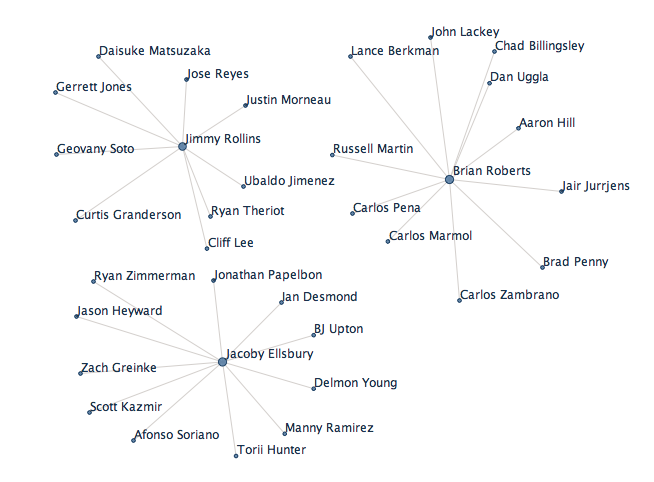
BaseballHQ’s Ron Shandler recently pointed out that last year, among the top 276 players, more than 50% ended up missing time — the majority from injuries. This year, more than 10% of players have already experienced injury, including top fantasy superstars such as Jacoby Ellsbury, Brian Roberts, Aaron Hill, Brian Fuentes, Cliff Lee, Huston Street, Jimmy Rollins, Lance Berkman and Manny Ramirez.
The owners of these players have big decisions on their hands: Hold or sell? Other owners may also be tempted into action: Acquire or stay clear?
The decision will often make or break a fantasy season. And as you’ll see by the diagram below, which charts recent trades made in real fantasy leagues, injured superstars like Ellsbury, Roberts, and Rollins are being dealt for widely divergent returns. This is understandable considering that rest-of-the-season projections on these players are hard to figure out with much precision at all:
injuredplayertrades.png
Scott Kazmir and Zack Greinke have little value commonality these days except for the fact that each brought back Jacoby Ellsbury in trade. Presumably, in one fantasy league, an Ellsbury owner panicked and got whatever he could for his Red Sox outfielder who was just diagnosed with hairline fractures in four of his ribs. In another fantasy league, an Ellsbury owner got a lot more — Zack Greinke, who went behind Ellsbury in many drafts (though not too far behind).
I don’t believe there’s any absolute rule when it comes to what teams should do with injured players except one: Don’t sit still. Many people shrug off any necessity to take action, but that’s a big mistake when the possibility exists of mitigating lost value from injuries or capitalizing on another owner’s frustration. Some of the owners making trades in the above graph have it right.
Here are some more common sense tips:
  • Do research and understand the injury: What’s the timeframe for return? What’s the risk of injury setbacks or injury re-occurrences? How long until a player can really rehabilitate and perform up to the usual standard?
  • Watch out for misleading news: It’s almost a cliché these days that a player is making “significant progress” in his road to recovery. Reporters have a duty to check up with team management about a player’s status. Rarely do they get an honest response. The spin is usually positive. For buyers, this means tread carefully. For sellers, the moment that news story hits about a player being ahead of schedule on his road to return, this might represent the best opportunity to explore the trade market.
  • Correctly factor an injured player’s expected contribution to your team: If your player is going to miss 20% of the season, you might think that means the standard for return in trade is 80%. But keep in mind that even without a trade, you’ll be plugging someone off of reserves or the waiver wire who will produce some. So maybe you’d want a player in return who will give you at least 90% of your injured player’s original value. For buyers, if your potential trading partner doesn’t realize this math, it’s a good investment.
  • Measure your team’s need for downgrading risk or upgrading upside: If your team is in the middle of the pack and can’t afford a big hit like a player injury, getting some value in return for an injured player makes sense. If your team is struggling or ahead of the pack with depth to spare, taking on an injured superstar’s upside is also a sound idea. Also keep in mind that a player who is injured can usually be put on the DL, which frees up a roster spot for another player too.
  • Be aggressive but cautious: Always assume the worst when it comes to a player’s injury. Professional ballclubs have a lot of money at stake with their players, so organizations are usually conservative in getting a player back into the lineup. If a player is said to be out two-to-four weeks, assume four-to-five.

Finally, I recently expressed some skepticism about whether so-called sell-high candidates like Scott Podsednik are really candidates for trade. Convincing people to move off of long-held perceptions about a player’s ability is usually easier said than done.

Nevertheless, sell-high candidates usually match up very nicely with buy-low candidates. One guy isn’t producing at all. That’s traumatic. The other guy is returning monster value. That’s exciting. This represents some kind of trading match: Scott Podsednik for Jacoby Ellsbury….would you do that deal?

For more on advanced fantasy baseball strategies, check out Bloomberg Sports’ fantasy kits.

This Bud (Norris) is for You (and Your Fantasy Team)

by Eno Sarris //

Sometimes deep league managers have a hard time reading fantasy advice columns. “But he’s already owned” is the refrain of many a frustrated dude (or dudette). Jeff Zimmerman at FanGraphs did a little piece about ownership cutoff rates in fantasy leagues and what the definition of a ‘waiver wire guy’ is depending on the size of your league. The upshot is that players who are owned in 11% of Yahoo fantasy leagues or fewer are on the waiver wire if your league rosters 350 players. That number drops to 6% if your league rosters 400. So, in other words, if you are in a 14-team league with 25-man rosters, your waiver wire should be full of guys that have about an 11% ownership level.

With that in mind, let’s look at two very different pitchers who are owned in 9% of Yahoo leagues. They are both interesting pitchers, but it will be up to your personal preference whether you take Bud Norris or Chris Volstad in the end. Apples and oranges here, but we’ll cover Norris today and Volstad in a subsequent post.

Norris’ overall 78.2% contact rate this year puts him between Adam Wainwright and Ubaldo Jimenez in that category — elite company. He was top-five in contact rate outside the zone last year, so it’s no fluke. He has a 9.5% swinging strike percentage in 2010 – which is above average (around 8.5% across baseball). So Norris brings legitimate stuff to the table.

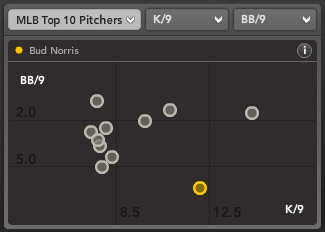
NorrisGrab.jpgSome of his other peripheral stats are nearly off the charts.  His 12.08 strikeouts per nine  innings would be very impressive if he wasn’t allowing a correspondingly terrible 6.39 walks per nine innings. It’s a rare combo. Take a look at this chart from the Bloomberg Sports Fantasy Tools — those other three dots with huge strikeout rates are Tim Lincecum, Dan Haren and Jonathon Broxton. To approach that group’s overall performance, Norris will have to maintain his elite strikeout rate while also improving his command significantly. Is there a chance he develops his abilities further this year?

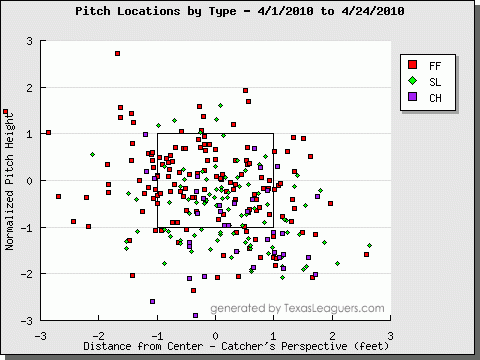
Let’s take a look at the locations of his pitches this year (click image for full size version). You may notice something about theNorrisLocation.gif red squares. Yeah, he’s all over the place with his fastball. Looks like rearing back for that gas really hurts his command of the pitch – only about 55% of those fastballs find the zone. Norris’ other pitches find the zone more than 60% of the time.

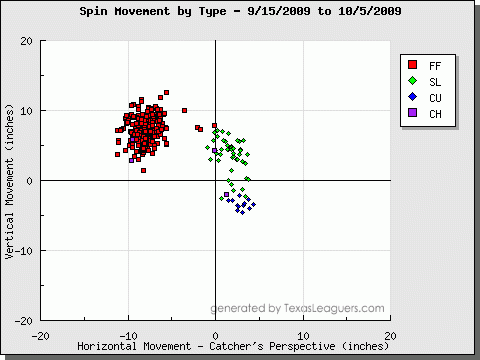
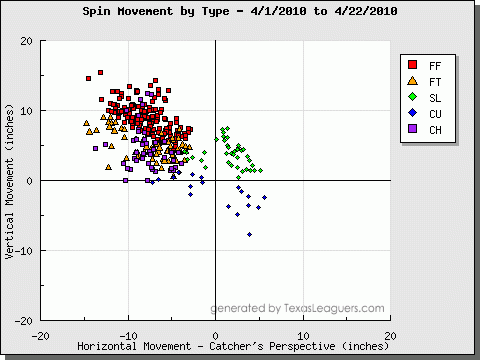
A look at the spin and movement graph of Norris’ pitches shows that he only really has two pitches this year. He’s a fastball/slider guy, and that’s why whispers of future reliever duty have followed him up the ranks. Satchel Price at Beyond the Box Score recently had a post that outlined the reasons to move a pitcher to the bullpen (Insider link), and inconsistent command of a smaller repertoire was one such condition.

NorrisMovement09.gifBut if we look at last year’s spin and movement chart to get a larger sample size, the change-up actually looks like a legitimate pitch (see how distinct the purple squares are on the left). Since he can command it better than his fastball and it has shown a distinctly different movement and spin in the past, the change-up might be Norris’ path to fewer walks in the future. This year, the change is getting the best whiff rate of his three pitches (19.4%); it has the potential to be a strong third pitch for Norris.

If you are interested in strikeouts no matter what the damage to your WHIP, Norris is already a play for your mixed league team. If you’re looking for further development from Norris, watch his fastball command and change-up usage. If they trend up in future games, we may yet see solid, more consistent starting pitching from Norris. He can certainly miss bats.

For more on Bud Norris and other flame-throwing starters, check out Bloomberg Sports’ Fantasy Tools.    

Jake Peavy’s Struggles


By R.J. Anderson //

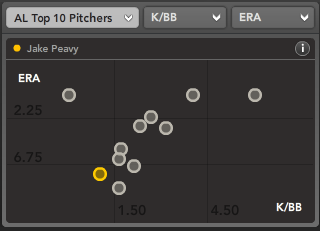
Four starts into his 2010 season, Jake Peavy continues to experience some issues. He’s lasted beyond the fifth inning just once in four starts, and his usually solid K/BB ratio is down to a morbid 1:1. For perspective, Peavy’s previous career low in that statistic was 1.90 and that came in his first full season in the majors. Peavy is only striking out six batters per nine (also walking six) and he’s allowed three homers already; he allowed eight in 101.2 innings last season.

peavy1.png

One of the problems has been Peavy’s inability to miss bats. FanGraphs has batters whiffing at Peavy’s pitches 10% to 12% of the time throughout his career. His swinging strike rate this season is a disconcerting 6.4%. Why is that important? Because swinging strikes correlate extremely well with strikeouts. Which makes sense on a basic level — i.e. the better the stuff, the more swings and misses, and the higher likelihood of at-bats ending in strikeouts. Despite a static velocity reading on his fastball and a presumably healthy elbow, Peavy’s results — in a small sample of four starts, anyway — suggest his stuff has been subpar and extremely hittable.

peavy3.pngIt should be noted that Peavy’s increased gopherball tendencies are expected. As with any pitcher who moves from the National League to the American League, Peavy’s numbers are going to look rougher. Combine the improved level of competition as well as facing the designated hitter instead of a pitcher and you’ve got a recipe for a rising ERA. Peavy’s numbers are going to experience a double whammy though, since he’s moving from perhaps the most pitcher-friendly park in baseball in Petco Park to a the homer haven that is U.S. Cellular Field. About 10% of Peavy’s flyballs are going for home runs; the reality is that number is closer to the projected total than his previous seasons in Petco suggest.

Another thing to keep in mind about Peavy’s performance is his Batting Average on Balls in Play (BABIP). About 32% of the balls being put into play against him are turning into hits, which is high, but not absurdly so. Chicago’s so-so defense features iffy defenders like Carlos Quentin, so don’t expect Peavy’s BABIP to see much positive regression, barring a big streak of luck. That leaves Peavy as a pitcher who, right now, is throwing less than his best stuff and having it hammered around and out of the park. Not quite the pitcher who led the majors in strikeouts during the 2007 season.  

It might be too early to drop Peavy in standard mixed leagues, and he holds little trade value at this point. That means the best option could be placing him on the bench and waiting.

For more on Jake Peavy and other struggling starting pitchers, check out Bloomberg Sports’ Fantasy Tools.  

Big Mike Pelfrey and His Soft Stuff

by Eno Sarris //

There’s a riddle taking the mound for the New York Mets every fifth game, and he could easily take the Shaq-like nickname of the Big Conundrum.

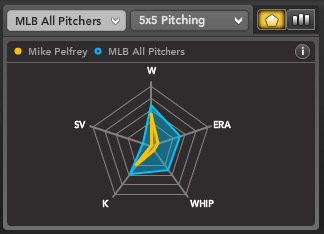
Though he has a mid-90s fastball, Mike Pelfrey has struggled through the beginning of his career – partially because he has used the fastball too often. Take a look at this Bloomberg Sports spider chart for PelfreyPelfreyGrab.jpg last year – not pretty. The secondary stats were just as ugly, as Pelfrey also sported a below-average strikeout rate (5.22) and walk rate (3.22). He was rescued from irrelevance by a decent groundball rate (49.9% career).

So far this season, though, Pelfrey is riding high. The theories for the newfound success have been multitude. Jerry Manuel said it was because Pelfrey kept his secondary pitches down. Bob Klapisch said it was because he maintained his fastball velocity. In this case, Mike Pelfrey actually knows best about Mike Pelfrey. After his last game, he said the following:

“I feel like I am different, being able to throw the secondary stuff
for strikes… I think it got the point where, in the seventh inning, I
didn’t throw any fastballs, I threw all off-speed pitches, and that’s
something I would never have done.”

As my creative writing teacher said, always show something rather than tell it. So let’s show Pelfrey’s new approach in some pictures, shall we? Since different systems classify cutters PelfreyMovement09.gifas different pitches, we’ll count them both as fastballs for the purposes of this analysis. Let’s take a look at his starts from late last year. All those red triangles? Fastballs – he threw them 77.1% of the time last year. He also added a sprinkling of sliders (14.4%), changeups (5.1%) and curveballs (2.5%). But the diet was mostly fastballs.

Fast forward to this year. You might notice immediately that Pelfrey has not been getting more sink on his secondary pitches this year (see the dispersed green and blue dots?), so Manuel’s idea is out. And Pelfrey’s averaged 91.5 MPH on his fastball this year compared to 92.7 MPH last year, so Klapisch doesn’t have it right. No, the biggest difference is merely in the color mix. Even adding those yellow triangles (cutters) to the red triangles (to get our combined ‘fastballs’),PelfreyMovement10.gif you get 67.7% fastballs – lower than last year. Look at all the non-red in there – he’s upped the changeup to 14.1% and the curveball to 6.0% while using the slider just about as much (12.2% this year). 

An added look at the groupings of each of the non-red pitches seems to suggest that Pelfrey is still working the kinks out when it comes to his feel for the secondary pitches. The plots are a little scattered when it comes to non-fastballs. But obviously the new mix is working for him, and the most important thing is that he’s actually throwing these non-fastballs. He has a 6.86 K/9 this year, which is finally close to average (7.06 so far this year), and is much better than his career rate. He’s still getting lucky – his .231 BABIP will rise (.294 across baseball this year), and his 90.5% strand rate will fall (71.5% across baseball). But his xFIP (expected fielding-independent pitching, a number that strips out luck. park effects, and aberrant home run-to-flyball rates) is 3.88, which would be a career-best.

In the end, the best news is that Pelfrey is throwing his secondary pitches. Period. Once the luck evens out a little, his ERA will probably regress closer to his xFIP. Fantasy owners are right to pick up Pelfrey off the waiver wire now.

For more about the new Mike Pelfrey, check out Bloomberg Sports’ Fantasy Tools.  

A Tale of Two Groundballers: Doug Fister and Mike Leake

By R.J. Anderson //

Every year a handful of young pitchers will ascend the ranks, have a hot start, and cause a scramble to the fantasy waiver wire. Two of these early-season stories couldn’t be more contrasting in background and how they get the job done.

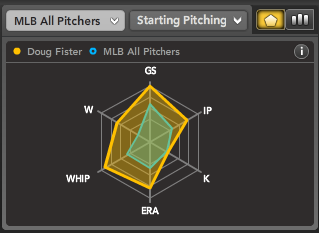
Doug Fister is a large human being. He stands six-foot-eight and most of that height is made up by lengthy stubs he uses as legs. Fister spent most of 2009 in Triple-A and showed impeccable command while getting outs via groundballs. Seattle placed him in their rotation late in the season and he continued those ways while giving up a few too many longballs. He still held a 4.13 ERA though.

fister1.png
Mike Leake
has never thrown a pitch in the minor leagues. The Cincinnati Reds drafted the six-foot-nothing righty out of Arizona State University last June. The only pitches he threw for them thereafter came in the Arizona Fall League and during spring training. That didn’t prevent Leake from winning a job with the big league team this season, and so far the results have looked pretty good. Thanks to a Cliff Lee injury, Fister began the season in the Mariners’ rotation. Not only has he made three starts while lasting an average of six innings per, he’s allowed only three runs and 12 hits. He’s still not striking anyone out, but he doesn’t have to right now because he’s not handing out free passes or home runs. Even when his ERA regresses upwards – and it will – he could still fit the mold of a Nick Blackburn or – Seattle fans hide your eyes – what the Mariners thought they would be getting when they signed Carlos Silva a few fateful winters ago. With the Mariners’ terrific outfield defense, it could work.

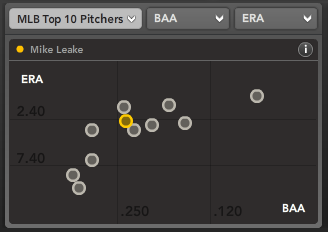
leake1.pngIn two starts and 13.2 innings, Leake racked up groundballs and avoided home runs, which made him a lot like Fister. Leake had a tougher time in his third start. He still managed to last seven innings, but gave up five earned runs on two home runs. Five strikeouts, a walk, and 16 of 23 balls in play going for groundballs provide some hope that this is an outlier rather than the real package heading forward.  

Unlike Fister, though, Leake only has a 77% contact rate against, whereas his taller counterpart has a 92% contact rate against. That suggests that while they may take similar steps to getting the same result – groundball outs – Leake has the secondary stuff to also record strikeouts. Particularly his change-up and slider; according to pitch data from pitchfx, Leake’s change-up is being swung at and missed 18% of the time and his slider is being missed 19% of the time. Those are fantastic rates for any pitcher, especially for a rookie without a minor league track record.

fisterleake1.png 

In a vacuum, that potential along with his pedigree make Leake a more attractive fantasy option moving forward. At this point, either are worth adds in deep American- or National League-only environments. Leake might be worth adding in deeper mixed leagues too.

For more on promising young players like Mike Leake, check out Bloomberg Sports Fantasy Tools.

Sorting Out Boston’s Outfield

By Tommy Rancel //

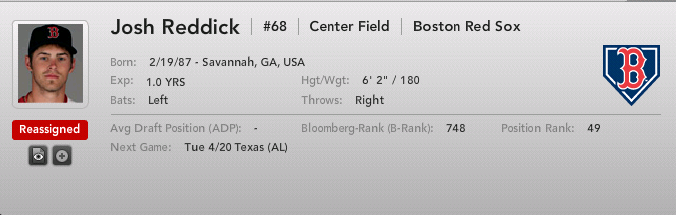
The Boston Red Sox’ attempt at improved run prevention has been put on hold temporarily – at least in the outfield. On Tuesday, the team placed outfielders Mike Cameron and Jacoby Ellsbury on the disabled list. Cameron suffered an abdominal tear, while Ellsbury has been slow to recover from bruised ribs. The Ellsbury move is retroactive to April 12, meaning he will be eligible to come back next Tuesday.

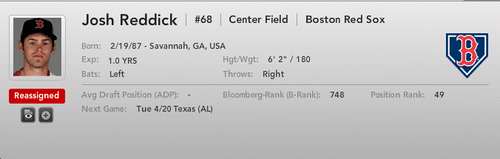
In the interim, Josh Reddick and Darnell McDonald were called up from Triple-A Pawtucket. McDonald is a 31-year-old journeyman who got off to a hot start in the minors, and has continued that in his first two games with Boston. However, he holds little fantasy value unless you’re in an extremely deep AL-only league. 

Meanwhile, Reddick might be worth a look in slightly shallower leagues. He spent 27 games with the big club in 2009 after hitting .277/.352/.520 at Double-A.
red.PNG

The 23-year-old outfielder is rated above average defensively by Total Zone, a metric similar to Ultimate Zone Rating. He has shown good pop – posting an ISO (Isolated Power, which is slugging percentage minus batting average) of .242 at the Double-A level in 2009. With Bill Hall‘s recent struggles at the plate and in the field, Reddick is likely to see the bulk of playing time in center.

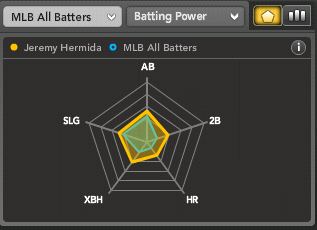
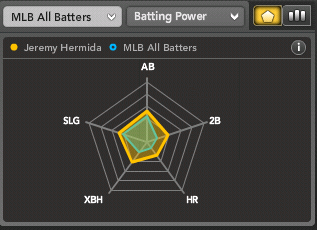
The other player to pick up in this outfield shuffle is Jeremy Hermida.

A quiet off-season acquisition of Theo Epstein, Hermida’s potential became too expensive for the thrifty Florida Marlins. This made him a prime target for Epstein, who paid pennies on the dollar for his talent. For now, Hermida will in the Sox lineup on most days until Cameron and Ellsbury are both healed.

Even after that, Hermida could steal some at-bats from the struggling David Ortiz. Hermida, 26, had his best season in 2007 while playing for the Marlins. In that ’07 season, he hit .296/.369/.502 with 18 home runs and 63 RBI in 123 games.

Since then Hermida has been on a downward spiral. His ISO has dropped in each of the past few seasons – down from .205 in 2007 to .133 in 2009. Small sample size rules apply, but Hermida’s left-handed swing has enjoyed life so far in the American League.

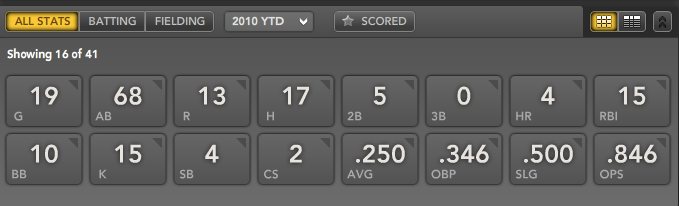
On the young season, he has six extra-base hits including three home runs. Defensively, Hermida has made Jason Bay look like Carl Crawford, but has had less than 80 innings to learn the nuances of playing the outfield in Fenway Park.
 

her.PNG

Hermida should be available in most leagues and is worth a look in deeper mixed, as well as AL-only, formats. Once more, he is the stronger play over Reddick (or McDonald), who could be back in Pawtucket in a week’s time. If Hermida swings a hot stick as a fill-in, the locals will be calling for him to get more at-bats over Big Papi in no time.

For more on the hottest fantasy baseball topics and trends, check out Bloomberg Sports’ fantasy kits.
(Audio) BTN with Jason Fry of Faithandfearinflushing.com

By Bloomberg Sports //

Listen now! – (loads in new browser)

Behind the Numbers
Hosts: Wayne Parillo and Rob Shaw
Guest: Jason Fry of Faith and Fear in Flushing

Total Running Time: 10:08

High Level Look

  • His love of the Mets
  • How to play fantasy baseball and still remain a fan
  • Why his son may already be a better player than him

More ways to get Behind the Numbers, talk to us, or just have a good time

For more on the hottest fantasy baseball topics and trends, check out Bloomberg Sports’ fantasy kits.
Will Fantasy Owners Like Ike?

By R.J. Anderson //

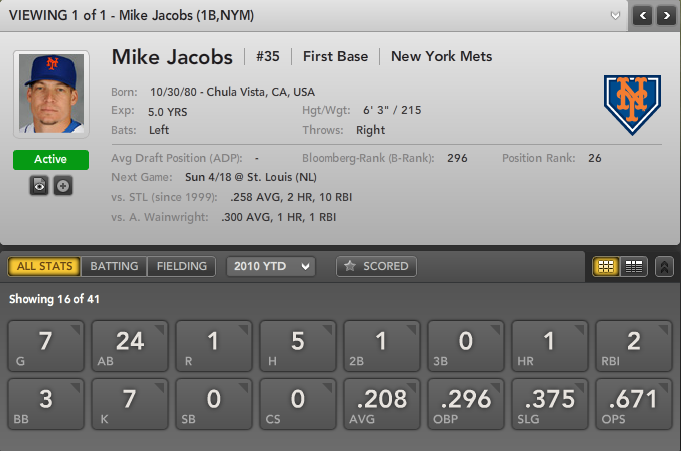
Ike Davis made his Major League debut on Monday night and he’s already a fan favorite. The new Mets first baseman has the luxurious job of replacing Mike Jacobs, who represented the lowest common denominator amongst big league first basemen before the Mets sent him packing. The Mets could put Charlie Brown there and the fans would respond by cheering the comic strip covering first base until the wind inevitably swept him deep into the Gotham night.

drb10p13.pngDavis has the lineage to be a successful baseball player. The 23-year-old – born Isaac – is the son of former big league pitcher Ron Davis. After a stellar career at Arizona State, the Mets nabbed Davis with the 18th selection in the 2008 draft – a few slots after teammate Brett Wallace was selected by the St. Louis Cardinals. Davis has since flown through the Mets’ minor league system, with an abrupt stop in Triple-A for all of 10 games. His 2009 Double-A statistics through 233 plate appearances were pretty solid: .309/.386/.565, but Davis’ overall minor league statistics were .288/.371/.467.

The obvious question is now whether Davis holds fantasy value in non-keeper leagues. Well, he’s the best fantasy option the Mets have at first base, which should give those in National League-only leagues reason to add him. For the rest, it’s worth waiting and seeing.

Along with the New York prospect hype, Davis hit two home runs in that short Triple-A stint. Do not buy into a sudden power surge though, since he previously hit 20 homers, with seven of those coming below Double-A. Remember, he was a college pick and a college first baseman at that. The expectation levels are higher than normal. Baseball America ranked Davis as the Mets’ fourth-best prospect. Noting that his swing has the tendency to become pull-happy and that his swing was rather long, leaving him likely to strike out quite a bit.

Those skills translate to fantasy leagues as:

– OK average

– Decent power

– No threat to steal bases

– Some chances for runs (both batted in and scored)

– Lots of strikeouts

That’s not to say Davis won’t eventually become a decent major leaguer. He might even be decent out of the gate. But the hype can mostly be explained by post-Jacobs depression alleviation. If the Mets fan in your local league is buying into it, then by all means, allow him to claim Davis first. He’s just not a great fantasy option right now for standard 10- and 12-team mixed leagues.

For more on upcoming young players like Ike Davis, check out Bloomberg Sports Fantasy Tools.