Colby Lewis: New Pitcher

by Eno Sarris //

We’ve talked in this space about different ways that a pitcher can improve his game. He can refine a pitch and increase his whiff rate on a specific pitch like Johnny Cueto, or alter his pitching mix like Mike Pelfrey. Usually that change happens right in front of our eyes in American baseball. In the case of Colby Lewis, we actually have a pitcher that seems to have done both by undergoing a sea change abroad.

Lewis left MLB for Japan after the 2007 season, following an ERA north of six with the Rangers and Athletics. He struggled to strike out batters at an above-average rate, couldn’t keep walks down (career 4.8 BB/9 before this year), and didn’t have a proclivity for worm-burning, as his career groundball percentage is below average (39.9%). There wasn’t much that suggested he was going to succeed in the major leagues other than his good minor league statistics (3.39 ERA, 1.185 WHIP, 8.7 K/9, 2.5 BB/9).

Then he went to Japan. In those two years, Lewis had a strikeout rate over one per inning, and walked a minuscule 1.16 batters per nine. His ERA was sparkling and under three both years, he led the Japanese leagues in WHIP one year, and he took the strikeout crown both years. You could say that he made good use of his time there.

Now that he’s back, he’s striking people out, not walking people as often as he did before, and has even become the subject of fawning love letters in the media. Okay, it’s not quite a love letter, but you get the picture. Despite his poor start on Sunday, Lewis is still striking out more than a batter per inning, and walking fewer than four batters per nine innings. The Bloomberg Sports Fantasy Tools spider chart shows us that his current walk and strikeout rates make him aLewisGrab.jpg more than capable fantasy as an SP2 in a deep league, or SP3 in a shallower league. The dot closest to him is Justin Verlander
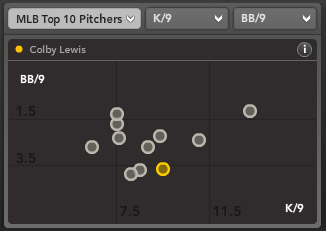
First off, he’s been a little lucky, but not incredibly so. His BABIP will rise (.261 currently, around .300 MLB-wide), and he’ll strand fewer runners (78.1% this year, 70% across baseball). As more dinks and dunks fall into play, more runners will cross the plate instead of ending the inning on the basepaths. Lewis is also a flyball pitcher that is only giving up 0.88 HR/9 because of a slightly-generous 8.3% HR/FB rate. That number usually approaches 9-11% across baseball, so a couple more long flies could turn into homers soon, especially in the favorable hitting environment at Arlington.

All that said, Lewis’ xFIP (a number that focuses on strikeouts and walks and strips out batted-ball luck, and produces a number on the ERA scale) is still 3.99; that seems to be a good estimate of his true talent level. He’s obviously striking people out and has made real progress finding the strike zone.

Most of his progression came from altering his pitching mix to feature his slider. In 2003, Lewis used his fastball 74.6% of the time and his slider 2.4% of the time. FanGraphs tracks a stat called linear weights, which uses game states before and after a pitch to measure the effectiveness of each type of pitch. In 2003, Lewis’ fastball was ‘worth’ -25.8 runs. That number is legendarily bad, as Carl Pavano owned last year’s worst fastball with -23.6 runs and Zach Duke‘s -19.4 runs fastball was second-worst. Surprisingly for such a bad season, Lewis’ slider was still worth +1.2 runs that year.

After five years of featuring that below-average fastball and hiding his slider, which was the only pitch that was consistently positive by linear weights, it took two years in Japan for the light to go on permanently. Now that Lewis is back, he’s using the slider 30.3% of the time, and it’s his best pitch by linear weights (+7.8 runs). Altering his pitching mix has made all of his pitches more effective, as his fastball is finally a positive (+2.1 runs).

Lewis’ slider is his most effective pitch at getting whiffs this year (15%, 8.5% is average), and in particular it’s great low and away as Dave Allen showed on FanGraphs.com. Using Patrick Newman’s pitch f/x tracker for the Japanese leagues, we can see that he refined the pitch while in Japan. Take a look at the image below, which shows how often he threw the slider in a typical start (5/22/09 in this case, and the sliders are yellow).

LewisPFX.jpgThe biggest remaining question is which way Lewis’ walk rate will go. Obviously, he was having trouble in that category before he left for Japan, as his career rate suggests (4.86 BB/9). And then he dominated in that category in Japan, where the strike zone is called a little bit larger and walks are not as prominent in the baseball culture. For example, Patrick Newman had this to say about the Japanese strike zone:

“My (unofficial) translation of the official rule is “the strike zone’s
upper limit is the point mid-way between the batter’s shoulders and the
top of his pants, the lower limit is the bottom of the batter’s knees,
and covers the area over homeplate”. So that’s not too far off the MLB
strike zone. In practice, I have noticed that the umpires can get a
little generous at times.”

Of course we can expect his walks to come in closer to the major league average (3.59 BB/9) than his elite Japanese rates, but if he does only walk batters at an average rate, his strikeout ability will play well enough to make that work as a package. On the other hand, if the walk rate starts creeping significantly over 4 (and after his bad start Sunday, it’s at 3.68 BB/9), Lewis may have some trouble.

In the meantime, Lewis is a hold in shallow leagues – you wouldn’t get much for such an unestablished non-prospect pitcher anyway – and a testament to the ability of pitchers to change. With that new focus on the slider, he’s practically a new pitcher.

For more on Colby Lewis and other surging pitchers, check out Bloomberg Sports’ Fantasy Tools.
Plan C: The Phillies Turn To Jose Contreras to Close Games

By Tommy Rancel //

Several major league teams have switched closers this season due to incumbents’ ineffectiveness. The Philadelphia Philies, on the other hand, have made multiple changes at the closer spot because they can’t find one player to remain healthy at the position. With Brad Lidge on the disabled list, again, the Phillies went looking for a new 9th-inning man.

Lidge started the season on the disabled list with an injured elbow. He was activated on April 30th and appeared in four games, recording one save. He felt some soreness earlier this week, and now finds himself back on the DL with inflammation of that same pitching elbow.

When Lidge started the season on the shelf, the Phils turned the ball over to his set-up man Ryan Madson. To the naked eye, it appeared Madson struggled in the role with a 7.00 ERA. But much of that gaudy ERA stemmed from bad luck, as Madson allowed two home runs in just nine innings of work. Looking at his expected fielding independent pitching (xFIP), a metric that looks at walks and strikeouts along with a neutralized home run rate, Madson’s xFIP was a sparkling 2.79.

In his time as closer, Madson notched four saves. However, he had two blown saves in six chances. The latter of the two came against the San Francisco Giants. Madson was so frustrated after the game that he kicked a metal chair, injuring his toe. Madson needed surgery on the toe and currently sits on the 60-day DL.

With Lidge on the DL again, and Madson already there, the Phillies have turned to former starting pitcher Jose Contreras to close games – at least for now. Contreras has spent the bulk of his career in major league rotations. Of his 206 career appearances, 175 of them have come in the form of starts. The 15 appearances out of the Phillies pen this year represent nearly half of his 31 career relief outings.

Contreras spent most of 2009 as a starter, splitting time between the Chicago White Sox and the Colorado Rockies. He made 21 starts for Chicago before being traded to Colorado later on in the season. He made two starts for the Rockies before moving to the team’s bullpen. In recent seasons, Contreras was barely average as a starting pitcher. He battled injuries and ineffectiveness for the better part of the last few years.

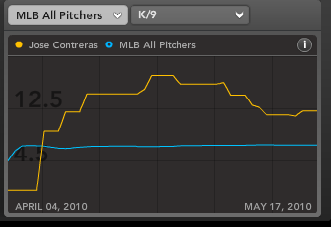
However, at his listed age of 38, Contreras has re-invented himself as a very good relief pitcher. Since moving to the bullpen, Contreras has seen his strikeouts per nine innings (K/9) jump. Career wise, his K/9 of 6.70 is unspectacular, However, out of the bullpen, he has struck out more than a batter per inning.

contk9.PNG

This season, Contreras has 18 Ks in 13.1 innings; a K/9 of 12.15. While the strikeouts have increased, the walks have declined. Contreras has shown decent control in his career with a walks per nine (BB/9) of 3.25. With just two walks in 2010, his BB/9 sits at 1.35 in the early stage of this season.

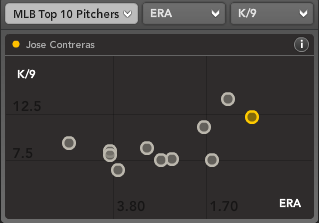
In fact, Contreras is the only relief pitcher to have an ERA below 1.00 and a K/9 above 12.0 so far this season. (min 10 IP)

kera.PNG

One potential reason for the increase in strikes is an increase in velocity. As a starting pitcher, a player must condition himself to conserve enough velocity and energy to throw upwards of 100 pitches on his day. As a relief pitcher, he can fire away as his workload goes down to around 15-20 pitches per night. In his career, Contreras has averaged 91.7 mph on the fastball. In 2010, he is throwing almost three miles per hour more at 94.6. He is also getting more swings and misses than ever, with a swing strike percentage of 14.8% compared to 9.3% in his career.

On Saturday, his 206th career appearance, Contreras did something he had never done in the major leagues; he saved a game. With Madson and Lidge unavailable, it appears that Charlie Manuel will give Ol’ Jose a chance to pad that career save total of one.

Given Contreras’ improved skills and the Phillies winning wins, the Cuban righty is worth grabbing in all formats. If you have a free agent bidding budget, invest the extra buck to get him.

For more on Jose Contreras and fill-in closers, check out Bloomberg Sports’ fantasy kits. 

Scott Hairston’s Early-Season Surge

By R.J. Anderson //

Scott Hairston is not the only Hairston on the San Diego Padres. His brother, Jerry Hairston Jr., has been the Friars’ starting shortstop with Everth Cabrera on the disabled list. Scott starts most games for the Padres too, and why wouldn’t he? The Padres traded Hairston during the 2009 season, but reacquired him in the Kevin Kouzmanoff deal and quickly decided he would start in the outfield.

So far, Hairston is batting .247/.357/.494 with six homers and three steals. Besides the fact that Hairston’s previous career high in home runs is 17 – and that he’s on pace to top that by a healthy margin – Hairston is also walking more than 13% of the time. It wasn’t too long ago that Hairston was a top prospect with the Arizona Diamondbacks. Playing second and clobbering home runs, but doing so with poor defense, the Diamondbacks eventually traded him to the Padres; they would also allow Dan Uggla to leave via the Rule 5 draft, a player with a similar skill set.


shairston1.pngHairston’s career batting average is a few points higher, but here’s where things get a little weird. His career batting average on balls in play is about 20 points above his current level, meaning Hairston is a little unlucky based on what we know about his ability to turn batted balls into hits. On the other hand, he’s striking out 33% of the time. That’s well above his typical K rate around 23% and generally enough to kill any hopes of a respectable batting average.

Of course, with Hairston, the golden egg of value is never going to be his batting average, but rather his power. This surge of power is impressive, without doubt, yet carries some sustainability questions. His home run per fly ball ratio is above 20% (career is just under 12%) and he plays in the National League West, where most parks, save for Coors Field, tend to favor pitchers. Hairston plays his home games at PETCO Park, one of the toughest stadiums in the game for power hitters, though a more favorable environment for right-handed hitters like Hairston than for lefties.

Hairston’s status changed over the weekend, though. He suffered a hamstring injury and may be on his way to the disabled list. So there are a few ways to assess his value. In shallow mixed leagues, you can disable him or just cut him outright. In deeper leagues, his DL stint might provide a buy-low opportunity. If you can find someone willing to offer 85 to 90 cents on the dollar based on Hairston’s power potential, though, pull the trigger.

For more about Scott Hairston , check out Bloomberg Sports’ Fantasy Tools.
 

Carlos Ruiz: Breakout Player, or Regression on the Way?

By Tommy Rancel //

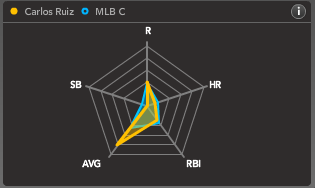
Joe MauerBrian McCannCarlos Ruiz? Going into the 2010 season, not many people had Carlos Ruiz pegged as a .345 hitter with a .948 OPS. Yet here we sit in mid-May and Ruiz is exactly that. Welcome to the beauty of early-season sample sizes. However, the hot start raises the question…is there anything to suggest that Ruiz’s hot start is anything more than just that?

ruiz.png

In terms of being a .345 hitter, no. Ruiz is a career .253 hitter. Expecting him to maintain an average nearly 100 points higher is just silly. The inflated early-season average is a result of a ridiculously high batting average on balls in play (BABIP). We talk about BABIP around here a lot, with good reason.

Throughout his career with the Phillies, Ruiz has a .271 BABIP. The average player is around .300, On the other hand, it is not uncommon to see catchers, who tend to be slow, with lower than normal BABIPs. Ruiz’s BABIP thus far in 2010 is a robust, and unsustainable, .403. It is true that a hitter has slightly more control over his BABIP than a pitcher, but not this much control.

Part of the reason for the high BABIP is an increase in line drives, a factor that a hitter can, in fact, control to some extent. Of the most common ways to put a ball in play – line drives, groundballs and flyballs – liners are the ones that go for hits more often than any other. Ruiz has a relatively normal career line drive rate (LD%) of 18.4%; that’s increased to 24.6% so far in 2010. An LD% more than 20% is sustainable, but only four players in the major leagues had a rate of greater than 24% last season.

One would suspect Ruiz’s LD% to settle toward career norms; this would likely create a batting average chain reaction. His BABIP would likely fall, and in turn, so would his batting average. ZiPs updated in season projections have Ruiz with a projected .285 batting average at season’s end. That would mean a batting average of .267 the rest of the way. Even then, a .285 average is more than 30 points higher than his career number, but a lot more believable than the .345 average he boasts right now.

Outside of batting average, the biggest change for Ruiz has come in terms of strikeouts and walks. Since joining the Phillies in 2006, Ruiz has posted favorable rates in terms of walks and strikeouts. His career walk rate (BB%) of 11.6% is decent, and his 12.8% strikeout rate (K%) is more than acceptable. In recent seasons, Ruiz has posted nearly identical K and BB percentages. 2010 has been no different.

ruizkbb.png

What is different is an increase in both numbers. The 31-year-old has increased his BB% to 19.8%, but his strikeouts have also increased to nearly the same level (19.0%). Ruiz is swinging at pitches out of the zone 20.4% of the time, but that is not far off his career number of 17.4%. Pitchers are throwing slightly more fastballs to him, however, nothing that could be considered drastic. More likely, Ruiz has just improved his batting eye in terms of walks, and become more willing to work deep counts, even if it means more strikeouts.

Power-wise, Ruiz has shown decent, not great, pop in his five-year career. His ISO or Isolated Power (slugging percentage minus batting average) of .131 in 2010 is very close to his career number of .133. His home run-to-flyball rate of 9.5 is slightly higher than his career number, although easily sustainable.

If you were able to snag Ruiz as your catcher in the later rounds of your draft, enjoy the early-season success. While the batting average is expected to regress, the increase in walks could give him a very favorable on-base percentage, especially from the catcher position; that could boost his runs scored totals in standard 5×5 leagues. In terms of power, expecting Ruiz to duplicate his nine home runs and 26 doubles from last season is reasonable.

If you’re OK with that production from your catcher, then Ruiz is your man. However, if you have a decent back-up option, you might want to strongly consider selling high on Ruiz and his batting average before the potential BABIP regression sets in. Assuming you can get inflated value for him, of course.

*Carlos Ruiz was diagnosed with a right knee sprain on Wednesday. The injury should not require a DL stint. 

For more on Carlos Ruiz and other players with surprising starts, check out Bloomberg Sports’ Fantasy Kits.

(Audio) BTN with guest Ben Kabak of RiverAveBlues

By Bloomberg Sports //

Listen now! – (loads in new browser)

Behind the Numbers
Hosts: Wayne Parillo and Rob Shaw
Guest: Ben Kabak of RiverAveBlues

Total Running Time: 15:40

High Level Look

  • Being “zen” during games
  • the state of the farm system
  • How RAB became so successful

More ways to get Behind the Numbers, talk to us, or just have a good time

For more on the hottest fantasy baseball topics and trends, check out Bloomberg Sports’ fantasy kits.

(Video) Ballpark Figures: Head-to-Head

By Jonah Keri //

Ballpark Figures: Head-to-Head — Bloomberg Television’s Michele Steele talks some fantasy baseball with Bloomberg Sports Analyst Rob Shaw about the upcoming weekend. Shaw has his eyes on a pitching duel in Tampa Bay between the Rays and Seattle Mariners. For offensive fireworks, check out the Cardinals and Reds. Finally, in reality, Shaw has his eyes on a postseason rematch between the Twins and Yankees. Play ball!

No Regular Johnny Cueto

by Eno Sarris //

On the heels of a complete game, one-hit shutout against the Pittsburgh Pirates, it’s tempting to get excited about Johnny Cueto.
But fantasy owners – and the baseball world in general – have been
excited about Cueto before. And, hey, it’s the Pirates.

After
his 10-strikeout, zero-walk debut in his rookie season, all sorts of
people prognosticated greatness for the effectively wild hurler. In
fact, Rob Neyer wrote about ‘signature significance’
the idea that one performance can be so great that it means something
for the career of the performer. While the article Neyer was quoting
mentioned Jason Bere and Luke Hudson, he did make the
excellent point that perhaps there was more significance when the
pitcher was as young as Cueto was (22). Cueto’s rookie ERA did not live up to the hype created by his first start, but he did put up a
8.17 K/9 that seemed to portend good times ahead.

Fast forward to this spring, and the optimism wasn’t nearly that strong. His Bloomberg Sports Fantasy Tools
B-Rank going into the season was only 183. That was largely due to his tepid sophomore season in 2009 which produced a much less
exciting strikeout rate of 6.93 per nine innings, as well as another ERA on the wrong
side of four. His home park hasn’t helped – Great American Ballpark
has averaged a 1.25 park factor for home runs
since 2007, meaning that the park augments home runs by 25%.
Nevertheless, Cueto gave up 1.26 home runs per nine innings last year, with a 1.36 rate for his career. He seems to have a bit of a homer problem, but if he was striking out a batter per inning we’d probably forgive him his trespasses.

So what gives? We’ve talked about post-hype sleepers before. Can Cueto recover all that promise that we once thought he had?

Let’s
take a look at the pitching mix, one area we have identified as a part
of the game that young pitchers can mess with in order to improve the
effectiveness of their overall arsenal. In 2009, Cueto was almost a
two-pitch pitcher. He threw his fastball 60.9% of the time and his
slider 28.9% of the time. Strangely, it was his change-up, which he only
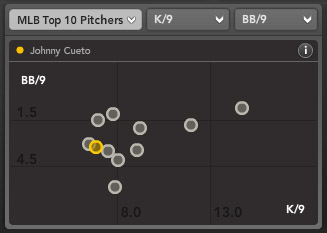
threw 9.3% of the time, that got the best whiff rate (14.1%).CuetoGrab1.jpg

In
2010, he’s thrown his two-seam or four-seam fastball 58.7% of the time,
his slider 31.9% of the time, and his change-up 9.3% of the time. The
mix is largely similar, but the extra use of the slider is worth
noting.  While the slider got just slightly above-average strikeout
rates in 2009 (9.7%), the pitch is inching its way back towards elite
territory this year (12.2%). Guess the slider’s rate of whiffs in 2008: 15.8%. His fastball whiff rate is also into double digits after languishing at 5.8% last year. Cueto’s increased whiff rates have led to his strikeout rate inching forward to 7.07 K/9 this year. As you can see
from the screenshot above, this new K-rate puts him in the middle of the
top-10 pitchers’ pack in terms of strikeout and walk rates.

We return now to his
start against the Pirates. Of the 102 pitches in that game, Cueto threw 73 fastballs, 24
sliders and five change-ups. He got four whiffs on the slider for 17% and 14 whiffs on 73 fastballs for 19.2%. It
seems that his nice whiff rate was a big part of his good night. 
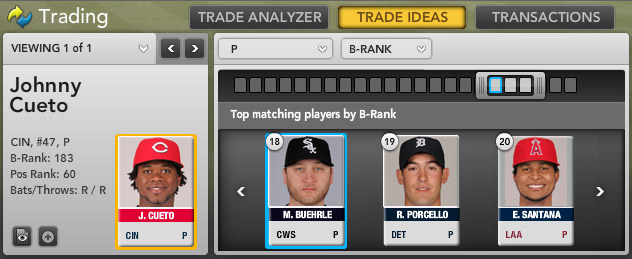
CuetoGrab2.jpg
The Bloomberg Sports Fantasy Tools
just added a Trade Analyzer.
On the left you’ll see a trio of players that the trade machine
suggests might match up with Cueto as trade options. If you have the
chance to trade Mark Buehrle or Rick Porcello for Cueto, now would seem like the time to pull the trigger. The
slider is getting whiffs again, which seems to be a big part of his
original promise. If he can regain the slidepiece stuff that made us
all drool in 2008, he’ll be a boon to fantasy managers in 2010.

For more about trades that might net you Johnny Cueto, check out Bloomberg Sports’ Fantasy Tools.

(Video) Ballpark Figures: Hot Commodities

By Jonah Keri //

Ballpark Figures: Hot Commodities — Bloomberg Television’s Michele Steele talks fantasy baseball with Bloomberg Sports analyst Rob Shaw. The result is a list of Shaw’s Bets and Michele’s Steals! Shaw likes Padres former top prospect Tim Stauffer as a hidden gem (though he is currently on the DL), while Brewers Casey McGehee also gets the thumbs up. Michele is rolling with Aaron Rowand, who has been a major help for the Giants offense.

The Five Types of Trades You’ll See In Fantasy Leagues

By Eriq Gardner

Everyone has a different philosophy on trading.
There’s usually no right or wrong, but competitors will usually lean towards a certain trading style.
Some owners will get itchy and make trades based upon their position in the standings or their perception of what other competitors are doing. Other owners always want to “win” a deal and will focus foremost on getting the upper hand on value, regardless of need. Some tend to focus heavily on player upside, while others do their best to avoid risk. There’s no limit to the types of psychological dispositions that compel a deal, and it’s always best to try to figure out where your potential trading partner is coming from when opening up a negotiation.
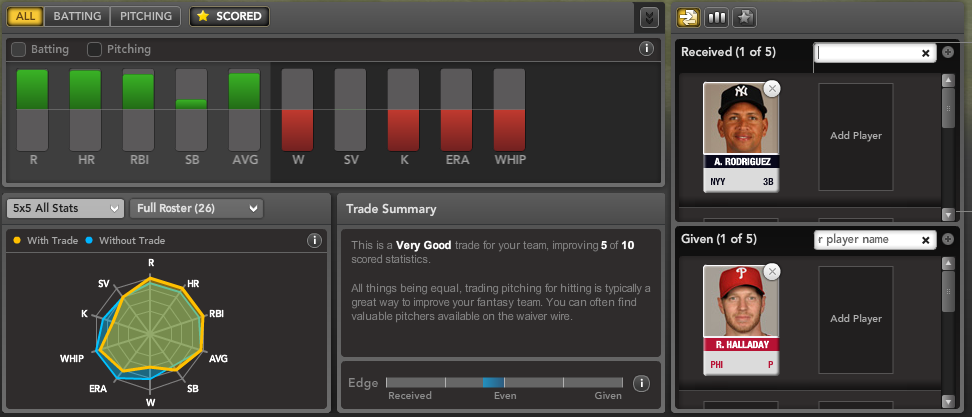
With that said, trades can be classified into five types. With the help of Bloomberg Sports’ brand new Trade Analyzer, here they are:
The Challenge Trade:

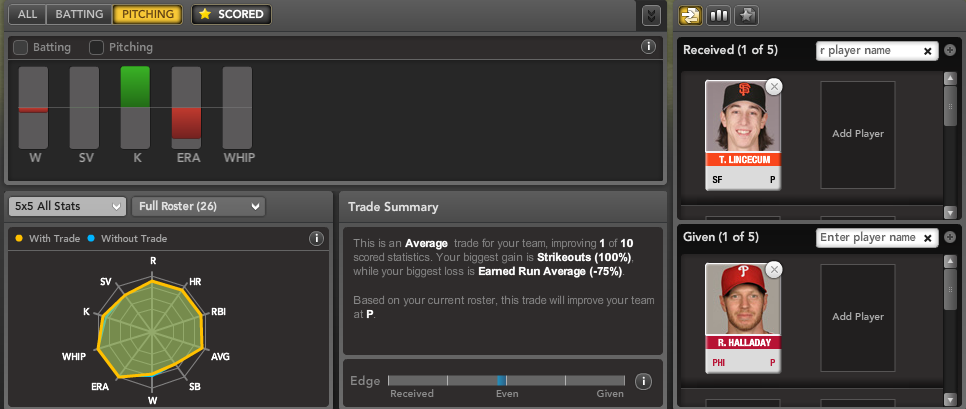
challengetrade.png
The Challenge Trade isn’t about need, per se. Instead, it’s about differing perceptions of value: I like your Tim Lincecum. You like my Roy Halladay. We swap because we both think we’re making out better by completing the swap.
This is easy enough, but very rarely do things match up so elegantly. There’s a good reason, after all, why my player ended up on my own team whereas your player ended up on your team. 
Only exigent circumstances would shift valuations significantly.
For example, let’s say you owned Josh Beckett and were disturbed by his 7.64 ERA. You might wish to get rid of him. I, on the other hand, am a pretty patient owner, who won’t let five weeks of stats significantly shake my notion of the struggling Red Sox ace. I might have a pitcher who is currently performing much better — say, Jonathan Sanchez — but may wish to take the odds that a pitcher with a longer track record of success like Beckett will outperform a recent upstart like Sanchez. We make the deal.
Challenge trades are good for opinionated folk. They serve the purpose of settling a bet on who can most accurately forecast player value, But they are nearly impossible to pursue unless you compete in a trade-happy league.
The Utilitarian Trade

tradeutilitarian.png

The Utilitarian Trade is all about need. In these types of trades, competitors can see eye-to-eye on player value, and still make an exchange based on differing team shortcomings. I trade you my Roy Halladay because you need pitching. You trade me your Alex Rodriguez because I need hitting.
Swaps like this should occur more often, but don’t. There’s a few reasons why this is the case. 
First, competitors can be hesitant about admitting a team deficiency or reluctant to make bold moves to redress a situation. Many of us are optimists by competitive nature.
Second, teams don’t always do a great job analyzing the ways they can move forward in the standings. When most people think of a Utilitarian Trade, they think about the big blockbuster above or maybe an obvious one such as speed-for-power. The fact that there’s theoretically an endless supply of trades where trading partners can both pursue smaller gains in the standings usually gets missed.
Third and perhaps most importantly, trade negotiations break down over disagreements about player value. Teams attempting to negotiate a Utilitarian Trade will do so because they see a mutual benefit to the exchange. The deal may be about need, but negotiations can still fall apart based on distractions like, “Who is coming out better?”
These trades are best for teams who can do hard analysis and let ego stand aside.
The Hedge Trade

hedgetrade.png
The Hedge Trade is about anticipating the future and managing both risk and upside. No player’s value is truly stable and teams have different tolerance levels for holding onto assets that may boom or bust.
Injured players, prospects, and ballplayers who are on the verge of a promotion or demotion are always good candidates for trade. 
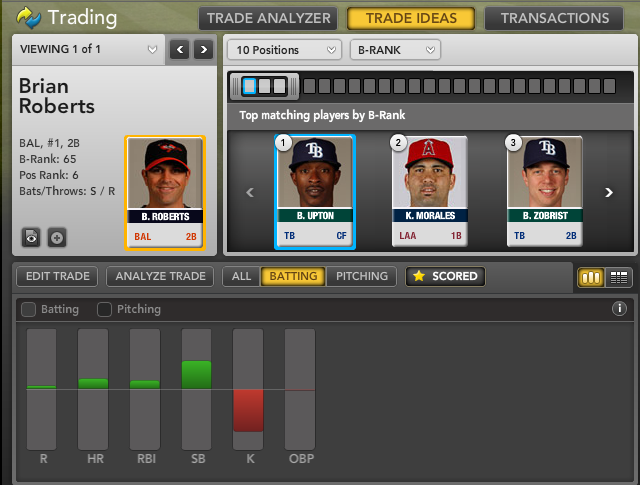
Let’s say I owned injured Baltimore 2B Brian Roberts. He recently told the media that he might be back in three weeks or he might be back in three months. That’s quite a difference. If I’m a conservative fellow, I might accept 75 cents on the dollar. If you’re a gamblin’ man, you might jump at the chance at getting a superstar at a discount. I give you Brian Roberts and you give me Ben Zobrist. Voila.
Similarly, nobody is quite certain when a prospect like Desmond Jennings will be called up and make an impact at the majors. An owner who is excited at Jennings’ potential might make a strong offer. 
Or let’s say the owner of Brian Fuentes is a bit worried that the Angels pitcher might be on the verge of losing his closer gig. He might wish to take as much as he can get right now, before the bad news breaks. Maybe he matches well with the team owner who is last in the standings in the saves category, desperate to take a shot at bolstering his bullpen.
These trades are good for teams who are either forward-looking or very short-sighted. There are benefits to be on either side, depending on a team’s position in the standings.
The Depth Trade

depthtrade.png
In some ways, the Depth Trade looks a lot like the Utilitarian Trade in that one of the two teams is making the deal out of a big need. But in this iteration, the other trading partner has a surplus of talent and can package two or more players together to consolidate the value. In other words, he’s in a position of luxury.
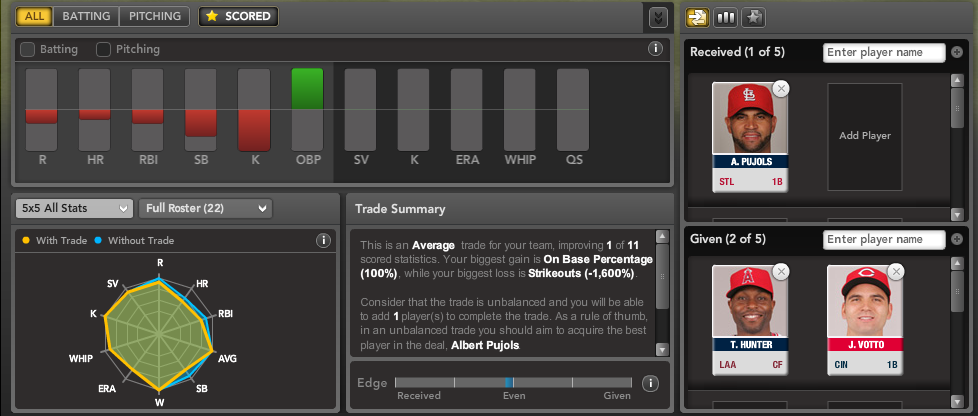
For instance, I give you Torii Hunter and Joey Votto for Albert Pujols. Stated another way, I give you Hunter so that I may upgrade from Votto to Pujols. If Hunter represents a big upgrade for your outfield, the gains you make can outweigh the negatives of downgrading from Pujols to Votto. The deal figures to be a net benefit to both of us.
Obviously, most teams would like to be in the luxury position, which explains why deals
like these aren’t the easiest to pull off. As the Bloomberg Sports tool notes, “As a rule of thumb, in an unbalanced trade you should aim to acquire the best player in the deal.” 
That’s a good objective, of course, but the reality is that some teams do stand to benefit from being on the other side and making their team more well rounded. The question is: Can these teams swallow their pride by giving up the best player involved in the transaction?
It’s also important to note that an unbalanced trade like Torii Hunter and Joey Votto for Albert Pujols isn’t really a 2-for-1 trade. After all, the team receiving Hunter and Votto will need to drop another player to clear roster room. The team receiving Pujols will free up a roster spot to pick up another player off of the waiver wire. These factors should also be considered.
The Rebuilding Trade
rebuildingtrade.png
Finally, we have the Rebuilding Trade, reviled by some and loved by others.
These trades mostly occur in keeper leagues. On one side of the deal is a team who has fallen out of competition and will give up their best stars for future talent. On the other side of the trade is a team who is in the midst of battling for a championship and will give up their best prospects for strong players who can help propel them the final mile.
These types of deals will typically be guided by a league’s incentive and rules structure. Some leagues have a system in place that rewards aggressive long-term roster building. Other leagues are more primed to consider the integrity of current competition foremost and insist upon guidelines to prevent so-called dump deals.
Timing is the biggest consideration in these types of trades. Teams must decide when it’s appropriate to give up on a season and how to attain the best return in a trade. In a future post, we’ll explore negotiating strategies in further depth.
For a closer look at the new Trade Analyzer and trade suggestion tools, check out Bloomberg Sports’ fantasy kits

Is Darnell McDonald the New Garrett Jones?

By R.J. Anderson //

The Baltimore Orioles selected Darnell McDonald with the 26th pick of the 1997 amateur draft. With just over 200 career big league at-bats, after sharing a class with All-Stars like Lance Berkman, Troy Glaus, Jayson Werth, and teammate J.D. Drew it’s easy to call McDonald’s career a bust. But for right now, McDonald has done his part to inspire the downtrodden Red Sox nation.

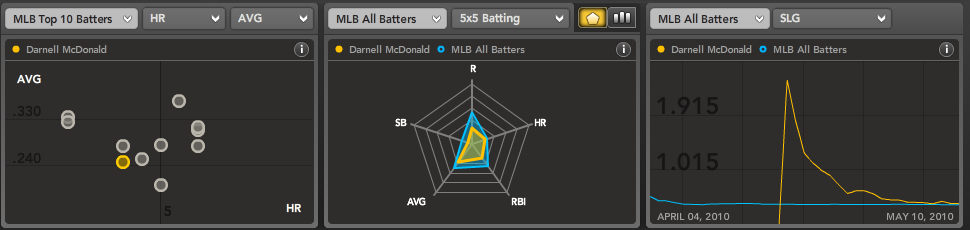
Now 31 years old, McDonald is hitting .246/.328/.456 with below-average defense in center but also some huge late-game heroics. The projected starter in center field, Mike Cameron, began a rehab assignment on Monday, and left fielder Jacoby Ellsbury will return at some point in the near future too. McDonald’s power figures to keep him around longer than Jonathan Van Every, but just because McDonald could stick on the Sox’s roster for an additional few weeks, does that mean he should stick on your roster?

In a word: No.

darnell1.png
It’s easy to get caught up in McDonald’s triumphant debut with Boston and buy into his power as legitimate. The sample size is still incredibly small, even smaller than McDonald’s stint in Cincinnati last year, in which he hit .267/.306/.400. Even in the minors, McDonald never showed the ability to consistently hit for a slugging percentage over .450. His career Triple-A slash line – which is representative of more than 3,700 plate appearances over a good stretch of his statistical prime – is only .278/.337/.423.

This all seems rather obvious. After all, McDonald is probably out of a roster spot by June and career journeymen are pretty fungible in the fantasy world. However, after the success of Garrett Jones and Casey McGehee or even players like Jack Cust, it’s important to analyze and evaluate each player under their own circumstances, since career minor leaguers can occasionally grow into viable big league fantasy commodities.

McDonald’s story is a nice one of potential redemption and persistence. But he’s just not somebody who will continue to help your mixed league fantasy team no matter how much longer he’ll stick in the majors. In a deep American League-only league, he’s worth holding for a little while longer. Otherwise, you can safely let him pass.

For more on Darnell McDonald and the Boston Red Sox, check out Bloomberg Sports’ fantasy kits