Alex Rios & Matt Kemp: Tale of the Tape

By Eriq Gardner
At the end of the 2008 season, Alex Rios and Matt Kemp looked to be statistical clones, at least with respect to surface stats in 5×5 leagues that year:
  • Alex Rios: 15 HR, 91 R, 79 RBI, 32 SB, and a .291 BA
  • Matt Kemp: 18 HR, 93 R, 76 RBI, 35 SB, and a .290 BA
The similarity, though, was put on hiatus last season.
Kemp increased his power to 26 HR, maintained his speed, and slightly boosted his batting average to .297. He became a consensus first-round pick for the potential to make big contributions in all five categories.
Rios, on the other hand, was miserable last season. He finished the year with 17 HR and also fell sharply in the other categories. His SB total dropped to 24. His average sank to .247. He only produced 63 R and 71 RBIs — the result of a woeful average and hitting further down in the lineup. The Blue Jays gave up on Rios, shipping him to the White Sox for virtually nothing. He lasted until the 11th round in many fantasy drafts this spring, and hardly anyone targeted him as a “sleeper.”
Wow, how things have changed.


Right now, Rios is arguably the most valuable batter in fantasy leagues. He’s on a pace for an amazing 35 HRs and 50 SBs and he’s doing it with a .318 batting average.
We can’t say that Rios is getting lucky either. His peripheral stats show some tremendous improvement from a year ago. Most noticeably, his strikeout rate is down to a meager 11.8%, which is about Albert Pujols‘ career rate. Rios’ walk rate is up too — from 5.8% to 7.9% — and his ISO (Isolated Power, which is slugging percentage minus batting average) is up from .148 to .272.
Talk about elite…
rios.png
Meanwhile, Kemp has been a slight disappointment. His power (11 HRs) is fine, but his average (.279) and speed (8 steals and 8 times caught stealing) are both unworthy of first-round pick status, especially as an outfielder. Kemp’s strikeout rate is up to 27% and there doesn’t seem to be anything below the surface that points to bad luck. He’s doing about what he should be doing.
I made the case last September that we were expecting a bit too much from Kemp, writing that “with batting average regression and less speed, Kemp could easily fall back into Hunter Pence/Alex Rios/Corey Hart territory.” That seems to have been on target, at least so far.
No doubt, Kemp is a worthy player, and there aren’t too many 25/25 candidates in baseball. But what we saw this spring in fantasy drafts across the land was a bit of an overreaction to recent trends. Clearly, today, there’s less separation between Matt Kemp and Alex Rios than once imagined. Both show power and speed. Perhaps Rios now gets slightly more credit for being able to make contact at a higher rate.
Kemp is a great young player and there’s no reason for any of his owners to sell him low right now.  As for Rios, I think he deserves once again to be mentioned in the same breath. If an owner in your league thinks Rios is anything less than a Kemp quality talent, I’d say buy. The analogy between the two players is off hiatus.
Here are Bloomberg Sports’ projections for the rest of the season:

rioskempproj.png

For more on Matt Kemp, Alex Rios, and other power-speed candidates, check out Bloomberg Sports’ Fantasy tools.
Hisanori Takahashi and The Shuuto: Fantasy Buy?

by Eno Sarris //

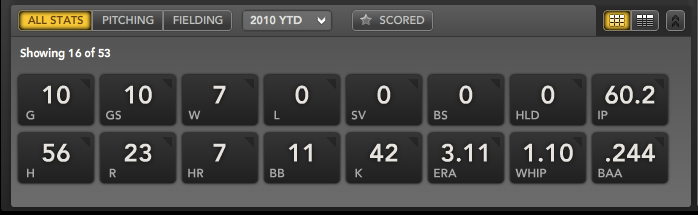
Fantasy baseball can be a fickle beast. Take the case of Hisanori Takahashi on the Mets.

First, he was a 35-year-old veteran of the Japanese leagues that had never pitched more than 150 innings in a season, never struck out as many as one batter per inning (a feat Colby Lewis and numerous other dominant Japanese league pitchers have managed), and didn’t come with a ton of buzz. It seemed that the Mets were happy to use him as a LOOGY, as they stuck him in the bullpen despite Rod Barajasclaim that he was a “Number 3 starter” after catching him in spring training.

Fast forward to the first month of the season, and Takahashi was doing fine, but wasn’t interesting to most fantasy players as a middle reliever. Then John Maine went down with an injury and Oliver Perez went down with a case of Oliver-Perez-ness, and suddenly Takahashi was thrust into a starting role. It was what Takahashi was used to, and he blossomed at first.

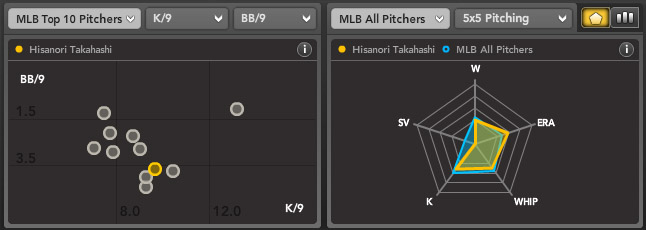
Two starts in, Takahashi hadn’t given up a run in 11 innings, and had even bested the mighty New York Yankees and Philadelphia Phillies. Fantasy owners went to the wire and picked him up. Many people had him in against the San Diego Padres – and then he wasTakahashiGrab1.jpg shelled for six runs in four innings. He followed that up with five runs allowed in five innings against the Marlins on Sunday. Now Takahashi is owned in only 12% of fantasy leagues and is probably on most waiver wires in mixed leagues. Will the real Takahashi stand up? The pitcher represented by the Bloomberg Sports Fantasy Tools spider graphs on the right is just barely fantasy relevant in shallow mixed leagues.

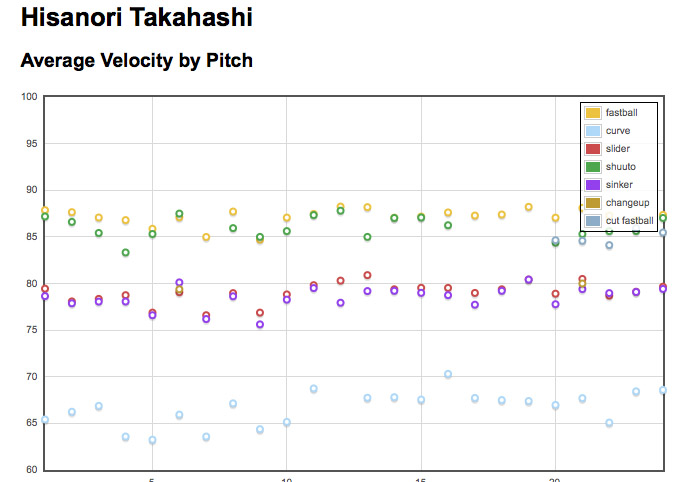
Going back to Patrick Newman and his NPB Tracker to figure out more about Takahashi’s history, we delve into more mysteries. Take a look at the velocity tracker grab on the left. He’s got five legitimate pitches, most of which are usual in American baseball: fastball, curve, change, sinker TakahashiNPBGrab.jpgand slider. The last, though? The shuuto.

The shuuto is a legendary pitch in Japan and is hard to translate. Mike Fast, pitch f/x analyst extraordinaire, took a look at the pitch and recent literature on the subject and couldn’t definitely label the pitch. By all accounts, though, it’s a two-seam “cut” fastball – a tiny bit slower than a regular four-seam fastball, but with movement that bores to the left. It could just be another name for the cut fastball, in the end. 

Does that jive with what we can see in pitch f/x for Takahashi? Fangraphs doesn’t have a pitch that seems to fit the description of a pitch with a similar velocity but different movement, but Texas Leaguers says that Takahashi throws a two-seamer 7.5% of the time. The two-seamer that Texas Leaguers describes crosses the plate at 81.5 MPH compared to his four-seam 88.6 MPH velocity, though, so it’s already a little different than most two-seamers. We know from Harry Pavlidis’ work with benchmarks for pitch types that the average four-seamer goes 92 MPH and the average two-seamer goes 91 MPH.  

If we move forward with the idea that the shuuto is what most would call a two-seamer, we realize that the pitch is probably not the key to Takahashi’s success. After all, the primary benefit from the two-seamer is the ground balls it entices. With a 52% groundball rate, the pitch is the most grounder-heavy pitch type according to Pavlidis’ work. Takahashi’s shuuto yields a poor 33.3% groundball rate. And he throws the pitch, at most, 7.5% of the time.

From NPBTracker.com, here is Takahashi’s pitching mix in Japan:

Fastball: 46%
Sinker: 26.4%
Slider: 16.5%
Curve: 6.3%
Shuuto: 2.9%

Here’s Texas Leaguers description of his pitching mix this year:

Fastball: 44.9%
Changeup: 19.6%
Sinker: 8.9%
Curve: 9.5%
Two-Seamer: 7.5%
TakahashiPFXGrab.jpgSlider: 8.0%

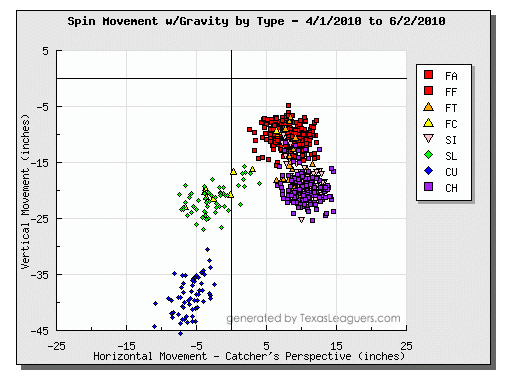
Obviously, the classification systems are different. Newman stated that he thought Takahashi threw the shuuto very rarely in Japan, as his numbers show. Looking at his pitch f/x spin angle with gravity chart, we can see the four-seam fastball, the changeup, the slider and the curve pretty distinctly. The ‘shuuto’ or two-seamer might be those straggler dots in between the fastball and the changeup. Tightening pitch classifications will be a big step forward for pitch f/x, and will help us answer questions like these more definitively in the future.

What we can tell now is that Takahashi throws a lot of pitches, and that his three main pitches – the fastball, changeup and sinker – all pound the strike zone at above-average rates (all above 65.7%, and average is ~60%). The changeup and sinker also get above-average whiffs (11.0% for the changeup, 25.7% for the sinker, 9% is about average.

Conventional wisdom might lump him in with some countrymen, point out the hitch in his delivery, his large arsenal including the shuuto, the bad groundball rate, and the below-average whiff rate on his fastball (7.3%), and call Takahashi a novelty that will suffer once teams start scouting him better and seeing him more often.

But as a lefty in a division with some nice parks for a flyball pitcher (0.499 park factor for home runs in Citi Field this year, for one), Takahashi has some things going for him. Shuuto or not, he can find the strike zone with multiple pitches and gets whiffs on his secondary stuff. At the very least, he is a good matchups play and a strong bench pitcher in any format deeper than a 10-team mixed league. 

For more on Hisanori Takahashi and other waiver-wire pitchers, check out Bloomberg Sports’ fantasy kits.

What Will We Witness from Washington’s Wunderkind?

By R.J. Anderson //

With all due respect to Brad Lincoln and Michael Stanton, the big debut of the week comes tonight in the form of Stephen Strasburg. His availability in most leagues is non-existent thanks to the hype and attention paid to his college and minor league performances alike over the last 12 plus months, yet it’s suffice to say most people who own 21-year-old have no idea what to expect from him except some variation of “good”. Let’s take a closer look through a pair of historical lenses at just what could be in store for Washington’s new ace.

21-year-old starting pitchers

Since 1947 – the beginning of the expansion era – 97 21-year-old pitchers have thrown at least 100 innings while starting 80% of their appearances. Of them, Vida Blue is the only one to finish with an ERA below 2.00. 18 more finished with an ERA below 3.00; 47 finished with an ERA between 3.01 and 4.00; and five more finished with an ERA over 5.00. The average ERA is 3.62, which is pretty good, all things considered, but when we modernize the sample and make 1990 the furthest year back, that average ERA raises to a touch below 4.00 (with the best case scenario being Clayton Kershaw’s 2.79 ERA and the worst being Zack Grienke’s 5.8 ERA).

Top college arms

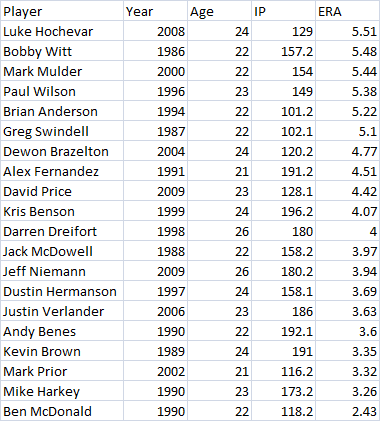
Strasburg was qualified enough as a collegiate pitcher to go first overall, so it makes sense to compare him to his peers who were also good enough to go within the top five picks. Going back to 1985 and selecting only pitchers who were chosen in the top five out of the NCAA, we can create the following list to examine (Note: the statistics and age are from their first 100+ inning season):

stras.png

Stripping away the guys who simply never made it or were relievers for most of their early career gives us a group of 20 arms. 15 of which either posted ERA above 5 or below 4; or in other words: these guys are usually either above or below average. The average ERA is above 4 with the high water mark being just shy of 5.6 and the low being in the 2.3’s. If we slice the pool smaller, and focus on the really hyped top arms similar to Strasburg – like Prior, McDonald, Benes, Price, and Benson – then the average ERA hovers around 3.5.

Using all of that information, we still have an incomplete picture from which to draw conclusions. One could argue that Strasburg is just another class of pitcher. One with more velocity, better control, a more polished feel for the game, and an enhanced sense of observation; you know, a lot of things that aren’t entirely quantifiable but sound good and intensifies the myth of Strasburg. Betting that Strasburg will be average or better is one thing; however do not fall into the trap of expecting a legendary performance from him. History simply isn’t on his side.

For more attempts to profit off the prophets like Stephen Strasburg, check out Bloomberg Sports’ fantasy kits.

Tale of the Tape: John Ely & Randy Wells

By Eriq Gardner

Sometimes prospects come up to the majors without much hype and astonish us all.
This year’s candidate has to be John Ely of the Los Angeles Dodgers, who through eight starts in the majors, sits upon a 3.00 ERA and a 1.06 WHIP. 
Ely was involved in the deal that sent Juan Pierre to Chicago, and had pretty good numbers in the minors, but was dismissed because of a lack of “stuff.” His fastball only reaches the upper 80s. But he’s been able to effectively change speeds and locate his pitches to great effect.
Can he keep it up?
Another pitcher comes to mind. Last year, Randy Wells was a largely unheralded prospect who came up to the majors and dominated in his first six starts. Nobody believed in Wells, even after he struck out 31 batters to only 8 walks in those six games. (Ely’s ratio after six games was an eerily similar, and excellent, 32:6.) 
This year, on the surface, Wells isn’t doing so great with a 4.86 ERA and a 1.41 WHIP. However, the numbers are largely the result of two bad games recently. Otherwise, he’s been quietly solid and may even be a nice buy-low candidate. Wells has struck out 50 batters and walked only 14. His xFIP (a stat that runs along a similar scale to ERA, while stripping out park effects, defense, luck and other factors beyond a pitcher’s control) is very good at just 3.60. Like Ely, Wells doesn’t have dominating stuff, but he keeps the ball on the ground and sports excellent control.
We might expect batters to catch up to Ely at some point, and there may have been some indication of this in Sunday’s game versus the Atlanta Braves, but he can continue to be effective as a contributor at the back-end of a fantasy rotation. 
His upside is similar to Randy Wells — and there’s value in these types of back-end fantasy rotation arms. Finding guys like Ely and Wells on the cheap who can post respectable numbers saves the big investments for commodities harder to attain through draft, trade, and waiver wire pickup.
Is comparing Ely to Wells a fair one? You be the judge.
compelywells.png

For more on pitching sleepers, check out Bloomberg Sports’ Fantasy Tools.

Buying into George Kottaras’ Small Sample Size

By Tommy Rancel //

Over the past few months we’ve warned about small sample sizes. This is especially true for veteran players with large career sample sizes, or big-named stars going through early-season slumps. However, there are certain times when you have to put sample size aside and jump in while the gettin’ is good. George Kottaras is a prime example of someone worth riding the sample size wave.

With Gregg Zaun out due to a torn labrum, the former San Diego Padres/Boston Red Sox farmhand is enjoying life as the Milwaukee Brewers primary backstop. It seems a little outlandish to get excited about a 27-year-old with 200 career plate appearances, but there is something very interesting about this career .234 hitter.

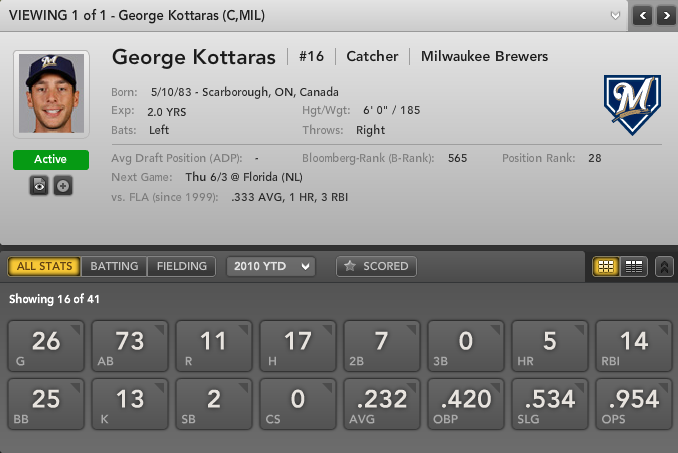
Though Kottaras has been ugly (.217), he’s been an on-base machine in the early stages of 2010, posting a .393 OBP to date. The secret to his success is simple; Kottaras likes to take 90-foot walks along the first-base line. In fact, nearly one-fourth of his plate appearances have ended in a base-on-balls.

kottaras2.PNG

Kottaras showed a good eye in the minor leagues (12% walk rate in Triple-A), but not this good. Beyond the nearly 25% walk rate, he is laying off pitches out of the zone (13.6% O-swing, or swings outside of the strike zone), and not missing when he does swing (3.8% swinging-strike percentage). Another key aspect is getting ahead in the count. While the league-average hitter sees a first-pitch strike 59% of the time, Kottaras falls behind just 51%.

kottaras1.PNG

Outside of the terrific patience, Kottaras is showing some nice pop at the plate. Twelve of his 18 hits have gone for extra bases, including five home runs. Of course, no one expects Kottaras to put up a .265 ISO (Isolated Power, which is slugging percentage minus batting average) for the duration of the season. That said, Kottaras belted 22 home runs as a minor leaguer in 2008. ZiPs projects him to hit a home run once every 28 plate appearances and a double once every 17. If he amasses 400 PAs this year, that would give him around 15 home runs and 21 doubles.

As for the low batting average, Kottaras has a lower than normal batting average on balls in play (BABIP) – even for a catcher. The league-average BABIP is .297; Kottaras’ is a microscopic .197. With more line drives (9.0%), Kottaras is likely to see positive regression in his average.

Because of that low average, and Kottaras’ relative obscurity, he is barely owned in fantasy leagues. While we don’t expect him to continue walking at Barry Bonds-like levels, Kottaras is a buy-low candidate, especially in NL-only leagues.

If he levels out to an average hitter with gap power by season’s end, that would still make him one of the better offensive catchers in the senior circuit. On the other hand, there is a fair chance that Kottaras is a sample size anomaly. Regardless, this hot hand is definitely worth the risk in deeper leagues, given the low cost and the shallow talent pool at the position. 

For more on George Kottaras and other buy-low candidates, check out Bloomberg Sports’ Fantasy tools.
(Audio) BTN with Tommy Bennett of Baseball Prospectus

By Bloomberg Sports //

Listen now! – (loads in new browser)

Behind the Numbers
Hosts: Wayne Parillo and Rob Shaw
Guest: Tommy Bennett of Baseballprospectus.com

Total Running Time: 14:38

High Level Look

  • What exactly Baseball Prospectus is trying to accomplish these days
  • A bit about the Phillies
  • Baseball cards. Yes, baseball cards.

More ways to get Behind the Numbers, talk to us, or just have a good time

For more on the hottest fantasy baseball topics and trends, check out Bloomberg Sports’ fantasy kits.

Is Armando Galarraga the Perfect Addition for Your Fantasy Team?

By R.J. Anderson //


With apologies to Ken Griffey Jr., Armando Galarraga is the hot story in the baseball world thanks to Wednesday’s near-perfect game. Whether the call on Jason Donald’s infield single was blown or not is irrelevant for fantasy purposes. The real question is whether Galarraga deserves a spot on your team. Short answer: probably not.

Galarraga broke onto the scene for the Tigers in 2008, making 30 starts. He would win 13 games and post a 3.73 ERA. Most pundits applauded the Tigers and bemoaned the Rangers – Galarraga’s previous employer – for grabbing yet another worthwhile arm. A season later Galarraga fell apart: He still managed to make 29 starts, but won only six games and held a 5.64 ERA. This led some to wonder what exactly went wrong; those who saw Galarraga’s 4.88 FIP in 2008 knew better – he was never all that good in the first place.

That’s not to say Galarraga wasn’t worse than expected last year – his FIP jumped more than a half run up to 5.47 in 2009 – but Galarraga’s skill set fails to inspire confidence in his ability to be an above-average pitcher. He’s a right-handed starter with a fastball that sits at just 90 miles per hour and he’s only a slight groundball pitcher. Generally pitchers with that profile need good command and control to make it in the majors, and Galarraga had never shown that ability in the majors. His career walk rate per nine innings is still over 3.5, giving him a mediocre 1.71 strikeout-to-walk ratio.

galarraga1.png

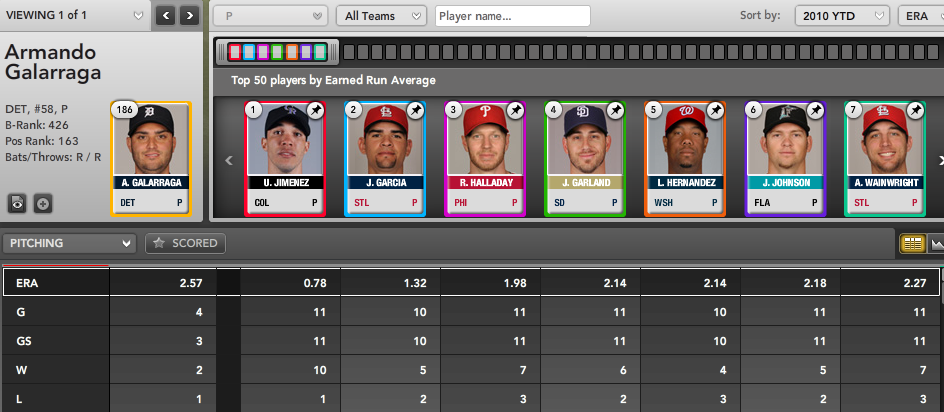
Getting back to the question at hand, Galarraga has made three starts this season, and has a 2.57 ERA and 3.86 FIP to show for it. He’s turning the corner, right? Don’t be so sure. One near-perfect game goes a long way, especially when it comes in the pitcher’s fourth appearance of the season.

Galarraga just wasn’t all that good in his previous starts this season. Against Boston he went just over five innings and allowed only one run. He made up for that good outing by allowing five earned runs against the Dodgers a week later. All told, he struck out eight batters, walked four, and allowed two homers in 10.1 innings. That’s a 5.34 FIP and 5.24 ERA, more along the lines of what we’d expect from him.

Galarraga’s classiness is worth applauding, given his reaction to umpire Jim Joyce’s blown call. He had a very special night on Wednesday, but unless something has changed for good, he’s just not rosterable in most mixed leagues.

For more on Armando Galarraga and other pitchers who do something amazing, check out Bloomberg Sports’ Fantasy Tools.

Who Is This Carlos Silva Guy?

By R.J. Anderson //

It’s June and Carlos Silva has a 3.12 ERA and a 7-0 record through 10 starts. To enhance his portfolio, Silva is coming off a start versus the St. Louis Cardinals in which he struck out 11 batters. Suffice to say, this is not the Carlos Silva we’ve come to know over the years – the Silva with a career win-loss record a tick above .500, an ERA over 4.60, and a career strikeout per nine ratio of 3.90. The 2010 version is striking out more than six batters per nine innings, with better numbers across the board.

silva1.png

The main difference between the old Silva and this one has been his pitch usage. In the past, Silva would throw his heavy sinker that sits in the low-90s and pound the zone with it about three-fourths of the time. This worked against batters of the same hand, but left-handed hitters would take advantage of his weak secondary offerings.

This season, though, Silva is throwing his fastball less than ever and pumping his slider and change-up more often. His change-up is actually his best pitch according to FanGraphs’ run values, which assign a run value to each event to which a pitch leads, whether it be a strike, a groundball, a home run, or something else.

This revolution in Silva’s arsenal is leading to increased success against opposite-handed batters and endearing him to fantasy owners thanks to the resulting newfound strikeout ability. This year to date, Silva’s inducing whiffs on 8.5% of his pitches. Consider that for a moment, while observing Silva’s swinging strike rates since breaking into the major leagues full-time:

2004: 4.8%

2005: 4.5%

2006: 4.8%

2007: 5.5%

2008: 4.9%

2009: 3.7%

2010: 8.5%

The sustainability of Silva’s success is debatable. The rarity of 3.12 ERA seasons makes it unlikely that Silva will remain quite this good heading forward. Plus Silva is a groundball pitcher and groundballs turn into hits far more often than flyballs; they just turn into extra-base hits less often. As it stands, 27.5% of Silva’s balls in play are turning into hits as opposed to a career rate over 31%. Even if one discounts a full regression to that number, the reality is that Silva’s probably going to give up hits at a higher clip heading forward than he has to date.

It’s unlikely that you or the owners in your league have shaken the perception of who Silva is, meaning selling high on him for a big return is a long shot. If someone bites, go for it, otherwise sit on Silva with adjusted expectations.

For more on Carlos Silva and other pitchers who went from good or mediocre to amazing, check out Bloomberg Sports’ Fantasy Tools.

(Video) Ballpark Figures: Headlines

By Bloomberg Sports //

Ballpark Figures: Headlines — Bloomberg Television’s Michele Steele and Bloomberg Sports Fantasy Analyst Rob Shaw are talking some baseball. Today Steele and Shaw are discussing the fantasy headlines. In Anaheim, Kendry Morales blasted a game-winning grand slam, then while celebrating that grand slam Morales decided to jump on home plate, and he landed awkwardly fracturing his leg. The injury will likely keep him out for several months, they are saying September for a return date. This kills the Angels lineup and hurts fantasy managers with one of the best young first baseman on their squad.