How to Catch Up in ERA in Fantasy Baseball

By Eriq Gardner //

Let’s assume for a second that your team needs to improve in pitching for you to win a championship. You basically have three options:

  1. Hope your pitching staff gets luckier from here on out
  2. Hope your pitching staff improves via prospect call-ups or additions off the waiver wire
  3. Make a trade

Most owners will choose of the first two options. But maybe, you’re clear-headed and know that your current pitching staff just doesn’t have the stuff to improve. You don’t want to risk your season in the hands of a prospect. Maybe streaming is not very enticing either.  You want stability, so you start thinking of a trade.

But what kind of trade do you need? Most owners may have a vague idea they’d like to improve pitching, and will shop around for great pitchers on other teams who can be helpful in attaining the goal of improving pitching. But then again, why pay for Ubaldo Jimenez and Josh Johnson if you only need Ted Lilly and Hiroki Kuroda? Sure, you may accomplish your goal of upgrading pitching, but by sacrificing too much to plug the leak on one end, you may cause the dam to burst on the other.

Let’s assume team is targeting 1400 innings and has 850 left to pitch in the season. (Depending on your innings limit and your current pace, this might not be completely accurate, but should be close enough for this kind of exercise.)

Here’s a table showing how many earned runs you need to shave off from your current pitching staff the rest of the way:

So how do we save those runs? OK, here’s some ideas…

To save 8 runs:

Frankly, if you only need to diminish your team ERA by 0.05, you’re better off hoping the gods of fantasy baseball luck cooperate. Eight runs over 850 innings is simply within the margin of error of any projection.

That said, for the sake of fun, let’s take a look at some swaps that would yield 8 runs saved. To do this, we’re going to use ZIPS rest-of-season projections.

Eight runs is not a lot. It can easily (and best) be done by upgrading a closer. For example, going from Matt Capps to Brian Wilson or from Kevin Gregg to Heath Bell. Your trading partner may shrug off this exchange because he’s not giving up a ton of saves, but there’s an ERA benefit in making such a swap. If you’re doing well in saves you might also consider trading your back-end closer for an upgrade in hitting, and replacing one of your closers with a top middle reliever or set-up man. For example, going from Arizona’s shaky new closer Aaron Heilman to Luke Gregerson would do the job.

To save 16 runs:

If you want to diminish your ERA by 0.1 the rest of the way via trade, you can get creative with your bullpen by trading for two closers, or punting shaky closers and saves and going with middle relievers. More likely, you’ll be looking at the starting pitching market.

What kind of starters need to be exchanged to yield savings of 16 runs? You’ll probably need to upgrade two or three slots, meaning exchanging a #3 or #4 for a #1, like Ricky Nolasco for Cliff Lee or James Shields for Tim Lincecum. Buying those two pitchers would probably be expensive, though. So a better strategy might be looking to drop your #5 and acquire a #2 or #3: Getting rid of someone like Wade LeBlanc/Mike Pelfrey/Barry Zito/Fausto Carmona and trading for someone like Roy Oswalt/Hiroki Kuroda/Clayton Kershaw/Ted Lilly should be good enough.

To save 24 runs:

We’re now at the point where teams need to be looking at drastic upgrades.

To give you an idea, going from Paul Maholm to Cliff Lee saves just 19 expected runs. Going from Kyle Kendrick to Tommy Hanson saves 22 expected runs.

In other words, to diminish your ERA by .15, you probably need to trade for an ace and hope the acquired pitcher can get a little bit lucky the rest of the season.

To save 32 runs:

To diminish your ERA by 0.2 via trade, you’re probably looking at multiple player swaps. If you’re looking at the standings and see a gap this large,  you may want to consider combining some of the strategies outlined above.

For instance, when you ask for an ace pitcher in a trade, you may also try to press your trading partner to include a closer swap too. So for example, a trade might look something like this: Alex Rios and Matt Capps for Cliff Lee and Joakim Soria.

At a certain point, catching up in ERA is going to either be too difficult or too expensive. At that point, it might be a better strategy to look the other way by deciding to sacrifice some ground in ERA for greater potential gains in other categories. We’ll have more on that in a future post. 

To get more trading ideas, check out Bloomberg Sports’ Fantasy Tools
Aubrey Huff: Underrated Fantasy Slugger?

by Eno Sarris //

There’s a slugger in San Francisco hitting long homers into the bay in San Francisco these days. Aubrey Huff is a lot less surly than the last version, though, and looks to be underrated by the average fantasy manager.

How else would you explain that a player with 12 home runs and a sparkling .307 batting average is about half of Yahoo leagues? There aren’t many 30-home run candidates available on the wire.

Perhaps owners can be forgiven for leaving Huff there – he had an underwhelming .241/.310/.384 line combined for the Tigers and Orioles last year. Moving to a park that suppresses home runs by 18.8% this year, he was an afterthought in drafts going into this season. Then again, Huff is a lefty, and according to Baseball Prospectus’ park factors by handedness, lefties slug .371 on average at AT&T Park, compared to .351 for righties (thanks to Bill Baer of CrashburnAlley.com for the nudge in the right direction). StatCorner.com muddies the water by pointing out that home runs have a mediocre 93 park factor for righties, but an even worse 88 park factor for lefties – meaning whatever extra-base hit lift lefties get comes from the huge gap in right-center, fueling a bump in doubles and triples. Either way, we should not have discounted Huff completely because of his move to his new park.

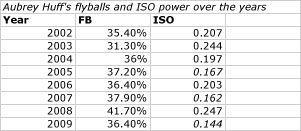
Amazingly, there was an outside chance we could have seen Huff’s power output coming. Huff has alternated from low-powered to high-powered performances his whole career. Look at the table on the HuffFlyGrab.jpgleft. It’s no clean-cut, easily explainable issue, but it’s clear that despite a general trend toward more flyballs, Huff has not had the corresponding trend toward a higher isolated slugging mark (slugging percentage minus batting average) that should have come along with that trend. After all, the batting line on the average flyball this year is .222/.217/.568, which produces an average ISO of .246, compared to groundballs’ .018 ISO. Another way of saying this is that Huff’s ISO has oscillated so much that it’s hard to discern a similar positive trend in that statistic.

Though weHuffGrab.jpg know that ISO doesn’t stabilize until almost a full season of data, we also know from Huff that his ISO has not stabilized over his whole career. Judging from the Bloomberg Sports Fantasy Tools spider graphs on the right, this looks like one of his more powerful years. 

In the years that Huff has had a .200+ ISO, Huff has averaged 27.5 home runs. A shot at that sort of power production this year is worth picking up in a league of any size. That he’s hitting in the middle of the order, and thus gaining plenty of RBI chances, only makes him more valuable. If Huff is available in your league, grab him immediately.

For more on Aubrey Huff and other surprising power options, check out Bloomberg Sports’ Fantasy Tools.

Is Wade Davis Worth Waiting Out?

By R.J. Anderson //


In a past life, Wade Davis attempted to woo Lady Luck. Instead, he clearly offended her, leaving himself hexed for this one. At least, that’s how Davis must feel given his schedule of opponents this season. He started with consecutive games against the Yankees and Red Sox, and has since faced them both twice, along with Texas, the White Sox twice, and the Blue Jays.


Davis endured through a May 19 start against the Yankees, wielding an impressive 3.35 ERA at that point. His ERA now sits at 4.94. His cumulative statistics in those five starts in between:


25.1 IP

36 H

17 SO

6 BB

6 HR

22 ER


That works out to an ERA of 7.89. Simply put: that’s bad. His seasonal numbers suggest that he’s not quite as good as that 3.35 ERA reflected, but he’s far superior to the 7.89 figure. With top prospect Jeremy Hellickson tearing up Triple-A, the question might not be whether Davis is rosterable in fantasy leagues, but rather if the Rays will even keep him on the 25-man major league roster, let alone in the starting rotation.


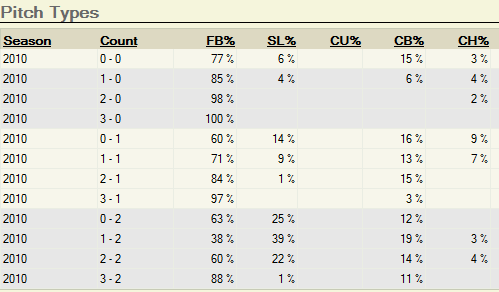
Lately it seems Davis is on the right path. He’s struggled with his command at times, yet his June strikeout-to-walk ratio is an impressive 15:1. That includes two starts where Davis didn’t walk anyone. The home run bug he’s encountered could be tied partially to bad luck, but also to his predictability in pitching. Here is his fastball usage by count:


davis2.png


Adding to the confusion is that Davis possesses what most scouting reports describe as plus breaking pitches. Yet, if one were simply to look at his usage patterns, it would seem he’s either uncomfortable throwing those pitches or simply doesn’t want to. Either way, it’s a problem. Part of pitching is having the upper hand when it comes to game theory. If the batter knows what’s coming, he better not know where it’s going, and if the batter doesn’t know what’s coming or where it’s going, then he’s probably not going to hit you well.


Expect a league average or slightly worse performance from Davis heading forward. In standard 12-team mixed leagues, that makes him a fringe starter at best.


For more on Wade Davis, check out Bloomberg Sports’ Fantasy Tools

The Buccos’ Trio of Treasure

by R.J. Anderson //

Baseball summers in Pittsburgh have largely consisted of apathy and agony since the departure of one Barry Bonds. This summer is a bit different from the past few, though.

General manager Neal Huntington is now adding players to the roster rather than subtracting and reshuffling. These players are worth noting because they’re all products of Huntington’s era, whether via trade or the draft. Clearly he feels they’re worth rostering right now, but should you? Let’s take a look.

SP Brad Lincoln

Drafted out of the University of Houston in the same draft that saw fellow collegiate arms Andrew Miller, Tim Lincecum, and Brandon Morrow also go top 10, Lincoln suffered a similar initial fate as most recent Pirates’ pitching prospects: He suffered an arm injury that delayed his progression through the system.

The 25-year-old has made two starts thus far, and it’s only 12 innings, but boy, what an ugly 12 innings they’ve been. He’s not missing bats or avoiding walks – his K and BB rates are identical at 3.75/9 IP, and his whiff rate is a low 3.8%. The good news is that Lincoln should be better than this moving forward. Throughout the minors he did a nice job avoiding walks, but had issues when it came to keeping the ball within the playing area (he averaged more than one home run per nine innings pitched). It’s hard to expect anything more than a league-average performance from Lincoln this year, but in NL-only leagues he’s worth a look.

OF Jose Tabata

Acquired in the Xavier Nady/Damaso Marte trade of summer 2008, Tabata is best known for his wife’s legal issues, and persistent questions about his age. He’s supposedly only 21 years old, which makes him among the game’s youngest major leaguers. Through 31 plate appearances Tabata holds a line of .259/.355/.444. That’s well above what one should expect from him when age and his Triple-A career .296/.358/.419 line are considered. Unless the idea is to try and catch lightning in a bottle, he’s probably not worth an add, outside of very deep keeper leagues.


pedro1.png

3B Pedro Alvarez

And finally, the cream of the crop. Alvarez made his major league debut on Wednesday night. He bats lefty and plays third base – for now, at least – which gives him instant value. Prior to his promotion, Alvarez was hitting .277/.363/.533 in Triple-A, with 13 home runs in 278 plate appearances. Of the three players, it’s most difficult to be realistic in assessing Alvarez. Given his status as an elite prospect and draft pick, he very well could burst onto the scene in a fashion similar to Evan Longoria or Ryan Braun. Or he could take some lumps in his first major league taste, and be a more attractive option come 2011. Either way, he’s worth a grab, assuming he’s somehow still available in your league. If you have a FAAB budget, break the bank.

For more on the hottest rookies, check out Bloomberg Sports’ fantasy kits

The Carlos Santana Experience Invades Cleveland

By Tommy Rancel //

In the summer of 2008, the Dodgers acquired Casey Blake from the Cleveland Indians. Blake, 36, was a soon-to-be free agent after the season. In exchange for a few months of Blake’s services, the Dodgers parted ways with catching prospect Carlos Santana and minor league relief pitcher Jonathan Meloan.

The Dodgers re-signed Blake after the ’08 season, and the four-corner man (1B/3B/RF/LF) has been a good player for Los Angeles. On the other hand, he is far from an impact player. While it may have not seemed like it at the time of the trade, one of the players sent to the Indians may indeed become an impact player.

Jon Meloan has bounced around the league, from Cleveland to Tampa Bay to Oakland. Meanwhile, Carlos Santana has become a top-10 prospect in baseball. With the Indians already out of the race 2010, the focus has shifted to the future.

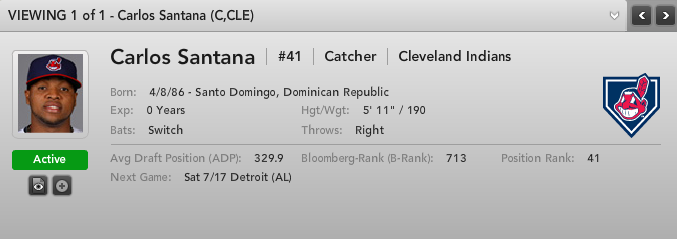
santana.PNG

Santana figures to be a key part of that future. A former third baseman/outfielder, Santana was converted to catcher in 2007. His defense is still questionable, but Santana’s ability at the plate has him ready for the big leagues right now.

In 2008, while splitting time between the two organizations, Santana hit .326/.431/.568 (AVG/OBP/SLG) with 21 home runs and 117 RBI. That said, 560 of his 568 plate appearances came at the Single-A level. The Indians promoted him to Double-A in 2009, and he responded by hitting .290/.413/.530 with 23 home runs and 30 doubles. Ready for the top level of the minors in 2010, Santana appeared in 57 games for Triple-A Columbus – compiling a slash line of .316/.447/.597 with 13 longballs in just 246 PAs.

Along with a good batting average, and very good power (.241 Isolated power, aka slugging minus batting average, in 2009), perhaps Santana’s greatest skill is his batting eye. As a member of the Indians farm system, he walked 145 times and struck out just 132 times over the past two plus seasons. Throughout his minor league career, he has 333 walks and 322 strikeouts. It is that fantastic plate discipline that should help ease the transition from a good minor league hitter to a good major league one.

So far, so good. In his first four games as a major leaguer, Santana had three walks and just one strikeout. He also belted his first major league home run on Saturday. Although his batting average may take an initial hit at the top level, his plate discipline should keep him on base at an above-average clip.

Despite playing in the same division as Joe Mauer, don’t expect Mauer-like production, at least not right away. Meanwhile, looking at the man Santana indirectly replaced, Victor Martinez, we may have a more apt comparison. If Santana is on your waiver wire, put in a claim immediately in all mixed-league and AL-only formats.

Not much has gone the Indians’ way in 2010, but Santana’s supernatural on-base ability should be fun to watch this summer.

For more on Carlos Santana and other top prospects, check out Bloomberg Sports’ Fantasy Kits.

(Audio) BTN with guest Chris Liss of Rotowire

By Bloomberg Sports //

Listen to it now! – (loads in a new browser)

Hosts: Rob Shaw and Wayne Parillo
Guest: Chris Liss of Rotowire.com
Topics

  • Why he does doesn’t like projections
  • Winning Tout Wars
  • A message to scared fantasy owners

How you can get Behind the Numbers:

For more on the hottest fantasy baseball topics and trends, check out Bloomberg Sports’ fantasy kits.

Lilly and Velocity: Fantasy Buy, Sell or Hold?

by Eno Sarris //

There are a lot of different ways to look at Ted Lilly and his season so far.

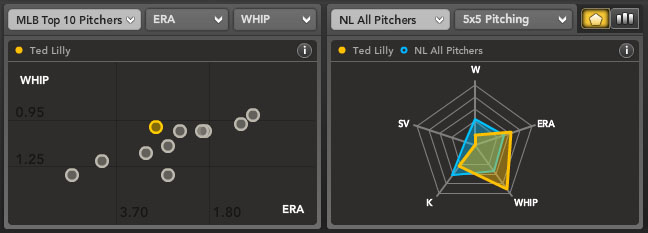
1) He’s doing fine. He has a 2.90 ERA, a 1.00 WHIP, and is only 2-5 because of a poor offense behind him. The Cubs have scored the third-fewest runs in baseball, so Lilly is good for everything but wins. Just check out his Bloomberg Sports Fantasy Tools spider graphs! He’s elite in every category but strikeouts. This is not a crazy way to look at Lilly – he’s never been about strikeouts anyway, and he’s still got his trademark control. Buy!
LillyGrab.jpg
2) He’s heading for disaster. He’s sporting a career low in strikeouts per nine innings this year (5.66). A drop in strikeouts for a veteran is worrisome enough, but Lilly hasn’t ever averaged below 6.84 K/9 for a full year, and the lowest average he has put up in the National League was 7.57 in his first year with the Cubs. This is not a dip, it’s falling off the table bad. And Lilly’s walk rate, though still solid (2.37 BB/9), has gone up from last year (1.83 BB/9).

Lilly is also suffering from his worst fastball velocity in years – one system has him at 85.6 MPH, and one at 86.4 MPH. Both are far below his normal ~88 MPH level. Add to all this the fact that Lilly is a flyball pitcher (34.4% career groundball rate) and suddenly you can envision that home run rate (1.05) starting to inflate closer to his career number (1.35) once Wrigley Field starts warming up. Lower velocity, fewer strikeouts, more walks, and more home runs on the way? Sell!

As usual, the truth lies somewhere in between the two extremes. A pitcher with an 88 MPH fastball obviously doesn’t rely on blowing people away for his success. His current walk rate is in line with his National League walk rate (2.36 BB/9) and he’s getting his pitches in the zone at exactly his career rate (54.7%). It’s a little worrisome that his contact rate is up (83.7% this year, 79.7% career), but we have not yet tackled his velocity fully.

It may be tempting to point to his arthroscopic surgery and the reduced velocity and wipe your hands of Lilly. The surgery did go into the labrum, and labrum surgeries have ruined many careers. But the surgery only repaired a little fraying, and was done soon after last season ended. He’s now put seven months between himself and the surgery, and lo and behold, look at his velocity charts for the most recent games (courtesyLillyVeloGrab.jpg www.fangraphs.com). See how he’s been his old self again in the last two starts? Maybe Lilly just needed a little time to get back to his prior form. You might notice that his K/9 in those last two starts was a decent 6.19 (11 strikeouts in 16 innings). While velocity alone does not a good pitcher make, given average movement (and Lilly’s movement is not elite), a faster fastball is always better. Here’s some great work on the subject by Jeremy Greenhouse at Baseball Analysts.

As a flyball pitcher, Lilly will always have the risk of the home run looming (or flying) over his head. A 1.3+ HR/9 rate is not a comfortable place to be for most pitchers. Had he put up his 1.35 career HR/9 rate last year, for example, he would have been sixth-worst among ERA title qualifiers in the category. But Lilly always makes up for this flaw by not walking anyone (and thus keeping his WHIP low); the home runs he allows are often solo shots. Because he helps in WHIP, doesn’t (usually) hurt in strikeouts, and will hopefully start to win some games, he’s still a valuable pitcher despite the lack of a marquee name.

And since he still gives up those home runs, hasn’t pushed the average velocity needle back over the hump, and hasn’t yet struck out enough batters to register in that category, he can be hard to trade. Especially in leagues where other managers know how to find the velocity of a pitcher, that makes Lilly a “hold” in most formats.

For more on Ted Lilly and other options for the middle of your fantasy rotation, check out Bloomberg Sports’ Fantasy Tools.