Chris Vernon Carter: Fantasy Baseball All-Or-Nothing

by Eno Sarris //

Search for Chris Carter on most baseball sites, and you’ll have two options. One plays backup outfield for the Mets and is known as the “Animal” for his sideline calisthenics and intense demeanor. The other, with “Vernon” as a secret first name, is an ever-smiling cuddly bear, with well-above-average power. He’s the one who was just called up on Monday, and he’s the one who is interesting for fantasy baseball owners, despite some notable flaws.

CarterGrab.jpgBefore this year, it might have been hard to figure out why Carter wasn’t in the major leagues yet. Going into 2010, he was 22 (which is neither too old nor too young to take seriously as a major-league-ready prospect), had a .290 career batting average in the minor leagues, had played in Double-A for consecutive seasons, and had amassed 92 home runs from 2007 to 2009. That is an impressive resume for any minor leaguer, and since the Athletics have been so power-starved in the major leagues, his callup seemed inevitable.

But the team knew better. The A’s promoted him to Triple-A instead of the majors late in 2009, and his .259/.293/.519 line showed he had something to learn (even though that line came in just 58 plate appearances). It’s the sort of news that should make a fantasy manager delve back into the numbers to figure out why the masher wasn’t mashing in the bigs.

With a critical eye, the reason jumps out at you. A 27% strikeout rate in the minor leagues is a big warning sign. Think back to our discussion of possible post-hype sleeper Chris Davis in the off-season, and you might remember that Davis was posting similar strikeout rates in the minor leagues before struggling in the majors. In fact, Davis’ 26.7% career minor league strikeout rate is eerily similar.

So is that it? Case closed? Carter = Davis, struggles to come? Well, in his first game in the bigs, it certainly seemed that way. Carter couldn’t lay off the outside slider and wound up striking out twice in two at-bats. And Davis even had a better batting average (.313) in the minor leagues. You could be forgiven for being concerned.

Not so fast. Davis, as we said, needs to walk more to get the Three True Outcomes thing down. Those three outcomes – walks, strikeouts and home runs – work well in tandem, but not so well if you are missing the walks or home runs. Davis’ walk rate in the minor leagues (8.3%) was passable, but when it inevitably dropped upon joining the big league squad (6.5%), he was a below-average batter. Carter’s 12.2% number in that category on the other hand can survive a drop and still be playable (8.6% is average this year).

Using MinorLeagueSplits.com to adjust Carter’s batting line for park
effects and luck, even his diminished Triple-A batting line looks great this
year: .298/.398/.600. Looking at his ISO, or isolated slugging
percentage, we can see that he has great power. His career minor league
ISO (.255) would place him seven spots above slugger Ryan Howard (.236
ISO) on the leaderboard this year. He may have some issues making
contact, but when he does, the ball could go a long way.

Vernon Christopher Carter smiles like Ryan Howard, and fantasy managers in long-term leagues should pick him up immediately and hope he can eventually play like the Phillies first baseman too. A warning, though: Carter’s contact issues, and the fact that he’s struggled to get going at new levels, mean that he might not be a great option in shallow mixed leagues.

For more on Vernon Christopher Carter and other big callups, check out Bloomberg Sports’ Fantasy Tools.
(Video) Bloomberg Sports’ Dose of Reality: Veteran Pitchers

By Bloomberg Sports //

Dose of Reality: Veteran Pitchers — Bloomberg Television’s Michele Steele and Bloomberg Sports Fantasy Analyst Rob Shaw pick up from yesterday’s discussion of a pitching era. Today they focus on the veteran hurlers who are changing the way they pitch in order to sustain their winning ways. Shaw chats with Angels ace Jered Weaver who is striking batters out at a career-best rate, Yankees veteran Andy Pettitte who has been as impressive this season as any other in his career, as well as CC Sabathia, who is finding ways to pitch deep into games and make it through all 33 starts. For more fantasy insight visit BloombergSports.com.

(Audio) Behind the Numbers w/ Rob Iracane

By Bloomberg Sports //*

Listen now! – (loads in new browser – 21 megs)

Behind the Numbers
Hosts: Wayne Parillo and Rob Shaw
Guest: Rob Iracane
About the Guest:
Walkoffwalk.com co-founder, Heist leader, and Deadspin.com combudsman.
Enjoy the podcast and make sure to follow him on twitter

Total Running Time: 20:31

The High Level Look

  • The Heist – What it is & why it exists (0:38 – 1:49)
  • A-Rod, Steroids, and Home Grown Talent (1:55 – 6:19)
  • The Human Condition & Commenters (6:30 – 7:50)
  • Smart defending, last season trades & why not to root for Kerry Wood (8:00-13:23)
  • Twitter, Blogs v Newspapers & discussing news (13:33 – 27:54)

A Highlight a Minute

  • (0:38 – 1:30) The Heist – what it is and why it exsists
  • (1:31 – 1:49) PNC Park and the Sellout
  • (1:55 – 2:40) A-Rod’s 600th home run
  • (2:44 – 3:48) Covering esoteric news
  • (3:51 – 5:04) Steroids users being lumped with A-Rod
  • (5:08 – 5:28) A-Rod’s celebration v Jeter’s 3000 hits celebration
  • (5:30 – 6:19) Yankees homegrown talent
  • (6:30 – 7:04) The Human Condition according to Walkoffwalk.com
  • (7:05 – 7:21) Boycotting D-Backs as a serious post
  • (7:22 – 7:50) The commenters and what else the site covers
  • (8:00 – 9:09) The year of smart defending
  • (9:10 – 10:00) Are hitters weaker?
  • (10:03 – 10:50) Too little, too late for Dodgers but not for Rockies, Padres & Giants
  • (10:51 – 11:29) Berkman as DH & why it’s impossible to root for Kerry Wood
  • (11:30 – 12:27) Is the Wild Card ruining a great division race?
  • (12:34 – 13:23) Is Manny Ramirez done?
  • (13:33 – 14:52) From UVA to Deadspin.com combudsman to Walkoffwalk.com
  • (14:57 – 16:11) The influence of Twitter & Commenters on fandom
  • (16:23 – 17:57) Deadspin’s Brett Favre post & Journalistic standards: Blog v Newspaper
  • (18:14 – 20:00) Breaking News v Discussing News & an inner Secret

Direct link to the conversation

More ways to get Behind the Numbers, talk to us, or just have a good time

Rays’ Jeremy Hellickson Gets the Call, Again

By Tommy Rancel //

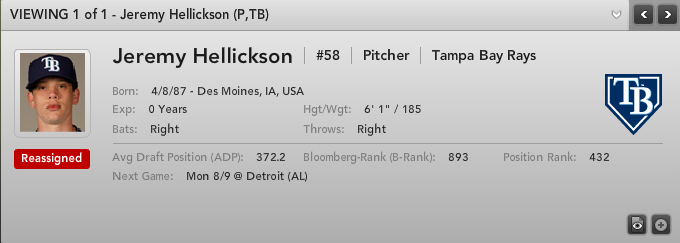
Jeremy Hellickson may have been an effective major league starter had he cracked the Tampa Bay Rays’ roster on Opening Day of this season. But where an April gig would have been a luxury, Hellickson’s promotion recently became a necessity.

The Rays had a plan for Hellickson. He made a spot start last week and was sent back down to Durham where his workload could be monitored and controlled. Once the rosters expanded in September, they would recall Hellickson and use him out of the bullpen.

Tampa Bay was able to execute the first part of the plan. Hellickson made his major league debut – a successful one – and was immediately returned to Triple-A. However, even the best-laid plans are subject to change. With Wade Davis AND Jeff Niemann experiencing shoulder pain, the Rays had no choice but to bring back Hellickson and use him as a starter, beginning with tonight’s outing against the Detroit Tigers.

helly.PNG

Although he is listed at 6-1 – already on the short side for a right-handed starting pitcher – that might be a generous measurement. Still, the numbers don’t lie. In 578.2 career innings in the minors, he posted 630 strikeouts and just 135 walks. His pinpoint command of the strike zone has drawn comparisons to Greg Maddux. Stuff-wise, Hellickson sets hitters up with his low-to-mid-90s fastball, and puts them away with an excellent change-up and plus breaking ball.

This time around, Hellickson will be on the shortest of leashes. After pitching 114 innings last season, he has surpassed 124 innings this year (117 minor league, 7 major league). Hellickson pitched a career-high 152 innings in 2008. Don’t expect him to go much beyond that this year, if at all.

If that is the case, then we might be looking at five-to-seven big league starts, or possibly just a couple of starts and several relief appearances, if Davis and Niemann get well soon. Still, given Hellickson’s talent and body of work, he’s worth an immediate pickup in all leagues. 

For more information on Jeremy Hellickson and
hundreds of other players, and for dozens of tools to help you dominate
your fantasy league, check out Bloomberg Sports’ fantasy kits.

(Video) Ballpark Figures: Dose of Reality – Dawn of a Pitchers Era

By Bloomberg Sports //

Ballpark Figures: Dose of Reality – Dawn of a Pitchers Era — Bloomberg Television’s Michele Steele and Bloomberg Sports Fantasy Analyst Rob Shaw discuss what appears to be the dawning of a pitcher’s era. Shaw explains why he believes we’re seeing so many dominant performances and then speaks to several All-Stars to get their take on the recent trends. Among the players Shaw speaks with are Cardinals ace Adam Wainwright, Marlins ace Josh Johnson, Yankees legend Derek Jeter, Yankees rising star Phil Hughes, and Yankees veteran ace CC Sabathia. For more fantasy insight visit BloombergSports.com.

Yorvit’s Average Batting Average Spree

By R.J. Anderson //

It’s only reasonable that whenever a player goes from one of the best hitting environments in baseball to one of the worst, the expectations for his offensive performance should move down. Evidently, Yorvit Torrealba disagrees with the premise. The 31-year-old backstop spent the last four seasons playing in the Colorado Rockies’ hitter-friendly haven Coors Field, before signing on to play in the San Diego Padres’ pitcher paradise, Petco Park. Yet Torrealba is in the midst of a career year.

Torrealba’s career line with the Rockies, an aweless .258 AVG/.316 OBP/.394 SLG, falls into line with the five-year total he produced with the San Francisco Giants (.251/.318/.393). This year, he’s at .317/.381/.400. Before hounding on how unlikely this development is on so many levels (age, position, park, etc.) take a look at how players who spent time in San Diego and Colorado fared offensively (minimum: 150 AB with each team).

torrealba1.png

This is an imperfect set of comparisons because age isn’t taken into consideration whatsoever. It does a decent job, though, in illustrating that no matter the year, moving from Colorado to San Diego is less conductive to batting average increases. Of those 11 players, only four saw their batting average go up transitioning to San Diego, and the highest gain stands at a seven-point increase. Torrealba’s average is up more than 60 points.

Beyond the ballpark, look at Torrealba’s age and position again. Only Ivan Rodriguez, Javy Lopez, and Mike Piazza have topped Torrealba’s average since 2000 while being between 30 and 32 years of age. It’s incredibly rare for an older catcher to have his career best season. They generally age poorly at the plate, hence why most of the good offensive catchers, like Piazza and Johnny Bench, move away from backstopping as they age.

A few root causes to note: career-high .373 batting average on balls in play (mostly luck – his career line is .304), and a drop in K rate to 16.6% (career mark is 19.2%). Still, most of Torrealba’s unexpected production is probably just the usual noise associated with a small sample of just 226 plate appearances. In an NL-only league, especially one that rosters two catchers per team, Torrealba’s fine to hold. Otherwise, no need to give him a second look.

For more information on Yorvit Torrealba and hundreds of other players, and for dozens of tools to help you dominate your fantasy league, check out Bloomberg Sports’ fantasy kits. 

It’s Time To Trust Brett Myers Again

By Eriq Gardner //
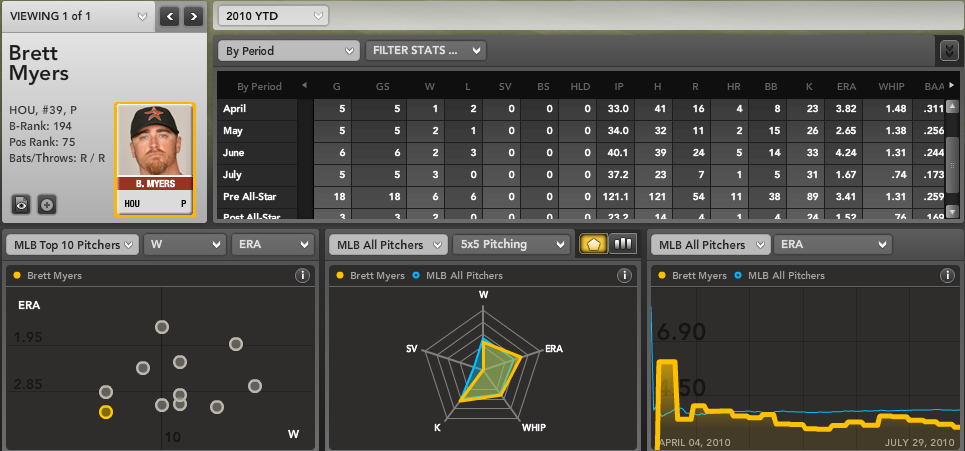
Throughout his career, Brett Myers has been synonymous with volatility. He posted a 200+ strikeout season as an ace starter in 2005, a 20+ save season as a decent closer in 2007, and a poor 4.84 ERA as a headache-inducing starter in 2009. Simply put, fantasy owners have no idea what they’re getting in the talented but hot-headed Myers in any given season.   
Remarkably, however, Myers is the model of consistency this season. He’s now pitched 23 consecutive games this season of at least six innings — a new Houston Astros record. He’s allowed three or fewer runs in 16 of those games.
The market has been slow to note the former ace’s recovery. He’s only owned in two-thirds of all fantasy leagues. For those doubting fantasy owners, Myers’ reputation for being untrustworthy has trumped a 3.21 ERA, a 1.22 WHIP, and 119 strikeouts in 157 innings. Myers’ numbers compare favorably to some of the biggest-name pitchers in the game.
Picture 23.png
His fine year led to a contract extension with the rebuilding Astros, who turned down offers for him before the trading deadline.
Myers should appreciate the fact that he’s no longer in Citizens Bank Park in Philadelphia, traditionally one of the most friendliest to sluggers. Last season, Myers gave up an astronomical 2.29 HRs every nine innings. This season, he’s only giving up 0.80 HRs per nine innings. The massive improvement has been aided by a slightly low 8.9% HR/FB, but also a better home environment, more induced grounders, and regression from a ridiculously unlucky HR/FB of 23.4% last year – which can’t possibly all be attributed to the Phillies’ home park.
Just as impressively, Myers seems to be getting better month-to-month. He’s no longer the strikeout master that he was five years ago, but his K-rate has been steadily rising: 6.27 K/9 in April, 6.88 in May, 7.36 in June, and 7.41 in July. 
Picture 25.png
Added up, Myers has a 3.87 xFIP this year, which indicates some good luck compared to his 3.21 ERA, but still very solid. Only 25 starters this season have a better xFIP than Myers.
If there’s one hole in Myers’ armor, it’s been wins. Despite going deep into games and not giving up many runs, Myers only has eight victories this year. It’s hardly his fault. Myers plays for a team that provides miserly run support. Still, the rest of Myers’ profile shows a pitcher who should be owned nearly universally in fantasy leagues.
For more insight to help you dominate your fantasy league, check out Bloomberg Sports’ fantasy kits.

(Video) Ballpark Figures: Stock Report

By Bloomberg Sports //

Ballpark Figures: Stock Report — Bloomberg Television’s Michele Steele and Bloomberg Sports Fantasy Analyst Rob Shaw go over the Bulls and Bears in Fantasy Baseball. Shaw says it’s a good time to buy low for Astros infielder Chris Johnson and Rays outfielder Matt Joyce, while Andruw Jones and Jeremy Guthrie should not be depended upon for fantasy value. For more fantasy insight, visit us at BloombergSports.com.

The Hidden Value of Seth Smith

By Eriq Gardner //
In the fantasy baseball lexicon, “platoon” is a dirty word. Few fantasy team owners want to hear that one of their players is being benched against either left-handed or right-handed pitching.
But in leagues that allow daily lineup adjustments and enough roster room to accommodate extra batters, platoons represent a tremendous buying opportunity.
Take Seth Smith.
sethsmith.png
Smith is a smooth-hitting left-handed batter in a crowded Colorado Rockies outfield. Because he competes for playing time with Carlos Gonzalez, Brad Hawpe, Dexter Fowler, and Ryan Spilborghs, Smith doesn’t play every day. That doesn’t make his playing time unpredictable, though. Throughout this season, Smith has consistently gotten starts against right-handed pitching. 
On those days, he’s been fantastic. In 56 games he’s started this season, Smith has posted an .840 OPS. To put that in context, it’s top 50 in the MLB this season, ahead of Alex Rios, Carlos Quentin, and Justin Upton, to name a few players who dwarf Smith in ownership percentage.
The fact that Smith has been so valuable in games he’s started shouldn’t come as much of a surprise. Over the years, Smith has feasted on right-handed pitching. Since 2008, Smith has an OPS of .911 against right-handed pitching. Only 28 batters with at least 400 AB in that time frame can claim a better record versus right-handed pitchers. He’s bested players like Ryan Braun, Chase Utley, and Evan Longoria in that category.
The reason that Smith doesn’t play every day? Well, a crowded Colorado Rockies outfield is one factor. Another is that Smith doesn’t fare as well against left-handed pitching. His career OPS versus lefties is .622, albeit in a relatively small sample size.
Still, given the opportunity to play Smith on days he’s starting, what fantasy owner couldn’t have used these stats to date: a .281 AVG, 11 HR, 31 RBI, and 36 Runs.
The stats are even more impressive when paired with a player who might have been activated in place of Smith when the Rockies outfielder had the day off. 
Let’s assume a team owner has gotten 56 games from Smith and another 45 games from a replacement-caliber player. What kind of stats would be required from Smith’s fantasy platoon partner to match Jayson Werth’s 2010 production of a .292 AVG, 15 HR, 64 Runs, and 56 RBIs? Answer: Not much. 
Werth is owned in nearly every league, whereas Smith is owned in less than 10% of leagues. Pairing Smith with another discounted player like J.D. Drew or Jason Kubel offers aggregated production that can potentially surpass the offerings of a player like Werth.
Consider this a market inefficiency if you’re in a league with daily transactions. For years, real-life MLB managers have been exploiting platoons. For owners in roster-flexible leagues willing to do some daily research on match-ups, having a fantasy platoon can be just as rewarding. 
For more on platoon splits, check out Bloomberg Sports’ Front Office

Closing Time in Washington

by Eno Sarris // 

We already talked about what happened in Octavio Dotel’s wake in Pittsburgh. Now it’s time to examine the new closer situation in D.C.

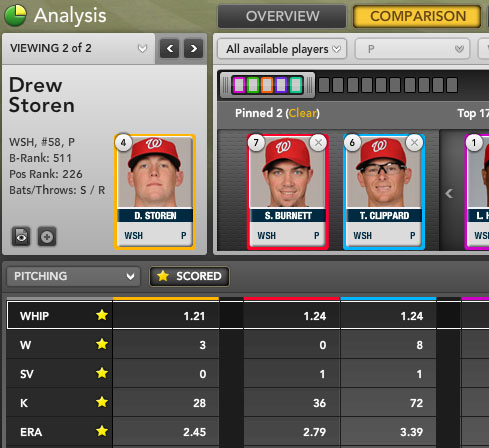
Matt Capps left for Minnesota and left an open job behind him. It’s not entirely clear who will assume the mantle there, though there is an early favorite. Drew Storen is thought to be the guy to become the closer in Washington, because he was drafted in the first round and was given the title of Closer of the Future. Was the hype warranted?

Yes and no. The no first: Storen is not currently showing any elite results. His strikeout rate (7.62 K/9), walk rate (3.84 BB/9) and groundball rate (37.9%) are all below average. He does have what might be described as a ‘closer’s arsenal,’ with a 94.5 MPH fastball, an 84.4 MPH slider, and an 82.5 MPH curveball. All three pitches rate as net positives according to the Pitch Type Values at FanGraphs.com, which use changes in the state of a game to evaluate each type of pitch. It’s also important to remember that Storen is only 33 innings into his major league career, and had a double-digit strikeout rate in the minor leagues (10.7 K/9).

StorenGrab.jpgElsewhere, Tyler Clippard has finally turned a nice strikeout rate from the minor leagues (9.2 K/9 career, with most of it starting, higher as a reliever) into good numbers in the major leagues this year (10.18 K/9). On the other hand, he has a scary walk rate, both this year (4.24 BB/9) and for his career (4.80 BB/9). Also, if Storen is a slight flyball pitcher (and this at risk of giving up deadly home runs) Clippard is ridiculously so (55.1% flyballs this year, 56.3% for his career).

Last but not least is the man that actually garnered the first post-Capps save: Sean Burnett. Burnett has no obvious flaws – his strikeout rate (8.38 K/9), walk rate (3.26 BB/9) and groundball rates (56.6%) are all better than average for a reliever, and passable for a closer. On the other hand, there’s the fact that his career rates (6.05 K/9, 4.17 BB/9 and 52.6% groundballs) are all below his current performance. Also worth noticing is his handedness. Southpaws are sometimes shunned by managers when it comes to picking a closer – there are only two lefties in the top 25 in saves right now. It probably has to do with the fact that lefties are more often used as specialists. Burnett’s platoon splits are also troublesome: In his career, he has struck out 11.15 per nine innings against lefties, but only 6.56 per nine against righties.

This is not an open-and-shut case. Storen doesn’t have the obvious flaws that Clippard does, and he also doesn’t have the platoon split that Burnett has shown so far. Those factors, plus Storen being the 10th pick in the draft and thus someone the club would more likely lean on, make him the man to pick up. Burnett may steal the odd save when a lefty-heavy lineup comes up in the ninth, but Storen should get most of the Nationals’ saves for the rest of this season, and in future seasons.

For more on Drew Storen and other closer candidates, check out Bloomberg Sports’ Fantasy Tools.