(Audio) Behind the Numbers w/ Dave Cameron

By Bloomberg Sports //*

Listen now! – (loads in new browser – 22 megs)

Behind the Numbers
Hosts: Rob Shaw and Wayne Parillo
Guest: Dave Cameron
About the Guest:
USSMariner.com co-founder, Fangraphs.com writer, and Wall Street Journal contributer.
Enjoy the podcast and make sure to follow him on twitter

Total Running Time: 21:08

Dave’s Wall Street Journal article we talk about during the podcast

High Level

  • Young Pitchers on the Hill & Better Coaching (1:01 – 5:46)
  • Defense, Baseball, and Situational Relievers (5:47 – 11:17)
  • What We Can Predict for Pitchers (12:11 – 16:21)
  • Adrian Beltre MVP, Hall of Famer, and SafeCo (18:04 – 20:24)
  • Fangraphs at SafeCo on September 4th (20:33 – 21:07)

Near Highlight a Minute

  • (1:01 – 2:04) Why it is NOT the Year of the Pitcher
  • (2:24 – 3:20) Are there a young rising stars on the hill?
  • (3:20 – 3:51) Why there are bigger, stronger pitchers on the mound
  • (3:56 – 4:40) Young pitchers & pin point control
  • (4:41 – 5:46) Minor League coaches & teaching wow to pitch
  • (5:47 – 6:46) How replacing managers is merely fluction bias
  • (6:54 – 8:30) Valuing situational relievers and using situational splits
  • (8:31 – 9:16) What it would take for a team to use only situational splits
  • (9:17 – 9:45) Educating the pitcher
  • (9:57 – 10:49) Defense and baseball – how Mariners have not failed
  • (10:50 – 11:17) Why all strategies succeed and fail
  • (11:32 – 12:10) Pitchers with ERAs under 3.00 and what it means
  • (12:11 – 14:07) Body types, pitching, and what we can predict
  • (14:08 – 15:21) How long is a pitcher’s shelf life?
  • (15:30 – 16:21) Strasburg v Kershaw
  • (16:27 – 17:44) Is Dave a journalist, blogger, or is it all just writing?
  • (18:04 – 18:54) Adrian Beltre for MVP and Hall of Famer?
  • (18:55 – 19:50) SafeCo and the right handed hitters mentality
  • (20:33 – 21:07) Doing an Event at SafeCo During September 4

Direct link to the conversation

More ways to get Behind the Numbers, talk to us, or just have a good time

The Value of Jorge de la Rosa

By Eriq Gardner //
This is the stage of the fantasy season where many competitors who compete in roto leagues become mindful of their innings caps. Some team owners have more innings left than others. For this reason, it’s often wise to look at a category like strikeouts in a different perspective.
You might have 850 strikeouts and your chief rival might only have 830. But don’t be certain you have the advantage. If that competitor of yours has more innings left to be pitched than you do, he can get more starts from his pitchers over the stretch run of the season and make up the gap.
One of the best ways to check your upside and downside in strikeouts is to treat it like a rate category. Take your team’s strikeout totals, multiply it by nine, and divide it by the number of innings accrued for your team to date. For a team with 850 strikeouts over 1000 innings, that translates to a K-per-9 rate of 7.65. Do the same for all your competitors. This will give you a better sense of how the standings in that category might move as some teams pitch more and other teams pitch less over the final six weeks.
If you find your team wanting, it may be time to look at options that will boost your team’s strikeout rate. With a dwindling number of innings, the goal becomes to maximize the efficiency of those innings.
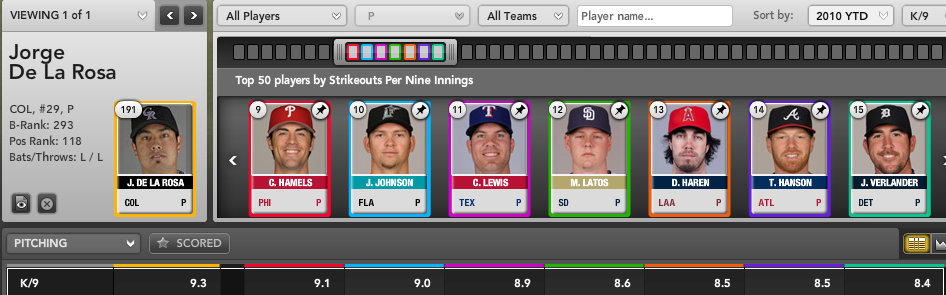
Which brings us to Jorge de la Rosa, who despite an ugly ERA at 4.99 and a woeful WHIP at 1.48, offers something that few pitchers can claim to do at this point of a season: The potential to move the needle in the strikeout category.
delarosa.png
Let’s show it.
Pretend we’re in a six-team league and our team is in last place in strikeout rate. We’ve pitched 1000 innings with a 1400-inning maximum. The strikeout rates of all the teams are as follows:
  • Team A: 7.30 K/9
  • Team B: 7.28 K/9
  • Team C: 7.26 K/9
  • Team D: 7.24 K/9
  • Team E: 7.22 K/9
  • Our Team: 7.20 K/9

Jorge de la Rosa’s strikeout rate is 9.24 per nine innings this year. It was 9.39 last year. Bloomberg Sports projects a conservative 8.8 over 55 innings the rest of the year. 

We’ll take that projection.
If we use de la Rosa for 55 innings on the way to the maximum instead of an alternative pitcher with a 6.5 K rate, what does that do to the team’s overall strikeout rate? I’ll spare you the math, but the answer is that our team increases its season strikeout rate from 7.20 to 7.29. It would be enough to gain four points in this particular league. 
Some leagues might not have a strikeout category this tight. In those leagues, de la Rosa may make less of a difference. (On the other hand, his xFIP of 3.71 this season points to other ways he could be valuable overall.) 
Still, in making final roster decisions heading into the home stretch, it’s helpful to do a closer inspection of the state of the standings by considering that teams often sit on unequal ground. 
In leagues where active teams all chase a specific innings goal, the distinction between a counting category and a rate category is rather illusory. Innings is merely a denominator that gets wiped out after teams arrive at a similar endpoint. 
But along the way, because each team has its own pace, it’s useful to measure a team’s efficiency along that journey. Maximizing a team’s strikeout rate by using a pitcher like de la Rosa could translate into a big stretch run and a fantasy league title.
For more information on high strikeout pitchers, check out Bloomberg Sports’ fantasy kits

Don’t Give Up On Jonathan Broxton

By Tommy Rancel //

Even before his days as the closer for the Los Angeles Dodgers, Jonathan Broxton was among the few relief aces in baseball. In 364.1 career innings of work, Broxton has a strikeout per nine innings rate (K/9) of 11.86, a walk per nine innings rate (BB/9) of 3.56, and a home run per nine innings rate (HR/9) of 0.52. Looking back in major league history, only Broxton and Billy Wagner have pitched more than 340 relief innings with a K/9 more than 11.5, a BB/9 less than 4.0, and a HR/9 less than 1.0.

In 2010, Broxton is doing more of the same. His K/9 is once again hovering around 11.0 (11.41). His BB/9 (3.42) and HR/9 (0.38) are actually less than his career levels. His 2.37 FIP (fielding independent pitching) is the fifth best among National League closers.

Everything is good, right? Wrong.

Just last week, Broxton was removed from his role as the Dodgers’ closer. His overall numbers look stellar, but in recent weeks things have not gone well for the 26-year-old. Since July 1, he has allowed 12 runs on 14 hits – including the only two home runs he has yielded all season. He gave up just eight runs in the first three months of the season. Add in Hong-Chih Kuo‘s impressive numbers (1.95 FIP), and you can’t really fault Joe Torre for making a move. That said, it is not time to jump ship on Broxton.

brox1.PNG

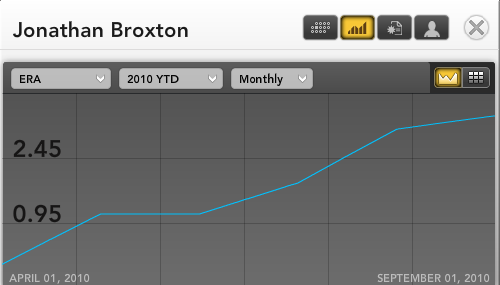
Currently, Broxton owns a 3.42 ERA. That is a full run more than his FIP. That’s largely due to all the additional baserunners getting on with hits. In 46.1 innings this year, he has allowed 44 hits. He allowed 44 hits all of last year in 76 innings. The good news is that of the 44 hits given up in 2010, 34 of them have been singles.

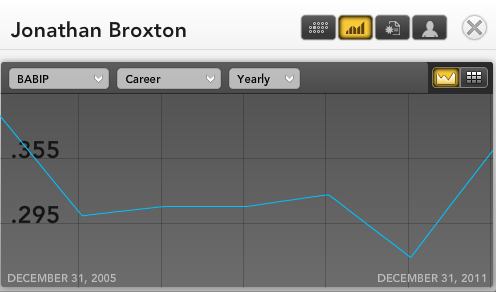
A groundball pitcher (46.1% career groundball rate), Broxton’s batting average on balls in play (BABIP) of .364 is absurdly high. His career BABIP is .325, while the league average is around .300. Even with a career number that is regularly above the league norm, a .364 BABIP is just ridiculous for a guy with Broxton’s stuff.

brox2.PNG

Speaking of stuff, it seems Broxton’s dominating combo of mid-90s fastball and high-80s slider has been less effective of late. Before July 1, his fastball registered a strike 67.4% of the time; the slider 78.1%. Since then, his strike percentage on the heater is down to 60.5%, and the slider to 67.3%.

If the Dodgers are continuing to use Broxton, they must feel he is healthy. His velocity readings have also remained steady through his struggles. With that said, Broxton’s troubles seem like an easy fix from the outside looking in. Whether it be something mechanical or mental, or maybe just a bounceback in luck, the big righty should rebound at some point. Keep him rostered as a high-strikeout setup man, and hope he wins his closer job back soon.

For more on Jonathan Broxton and his historic rates, check out Bloomberg Sports’ Fantasy Kits

(Video) Bloomberg Sports’ Ballpark Figures: Fantasy Headlines

By Bloomberg Sports //
*
Ballpark Figures: Fantasy Headlines
*– Bloomberg Television’s Michele Steele and Bloomberg Sports Fantasy Analyst Rob Shaw discuss the headlines from the weekend on the dismond. Shaw discusses Yankees killer Bryan Bullington, Twins hurler Kevin Slowey, who was removed from a no-hitter seven innings deep. Shaw also comments on the closer situations in Baltimore and Los Angeles, as well as the latest injury to Rich Harden. For more fantasy insight visit us at BloombergSports.com.

How to Replace Chipper Jones

By R.J. Anderson //

With Chipper Jones slated to miss the rest of the season, the big question is how fantasy owners and the Atlanta Braves can replace the future Hall of Famer.

Let’s begin with Atlanta. Jones’ injury further complicates an infield depth chart already stretched thin by Martin Prado’s presence on the disabled list since early August. All-Star reserve Omar Infante’s attention is focused on replacing Prado, leaving Brooks Conrad at third base. The 30-year-old has an interesting back story. A former eighth-round pick of the Houston Astros, Conrad made his major league debut with the Oakland Athletics in 2008 after qualifying for minor league free agency. He joined the Braves’ system before the 2009 season. In 128 plate appearances this season he’s hit .241/.315/.500, including a memorable grand slam to complete a comeback against the Cincinnati Reds.

If you’re an owner in a deep league, Conrad has the benefit of playing time, and has shown some power, socking seven homers with an impressive .259 Isolated Slugging (slugging percentage minus batting average) to date. Here are two other options to consider in deep fantasy leagues:

Chris Johnson

The Astros’ shining star this season, 25 year old Johnson is hitting .360 with 34 RBI in just 190 plate appearances. He’s owned in only 83% of ESPN leagues, suggesting he might be available in yours. It’s unreasonable to expect this level of performance to continue, as Johnson’s BABIP is well over .400, and his minor performance over five seasons was a mediocre .277/.315/.429. That’s probably closer to reality than his 2010 to date, but it is worth noting that Johnson was hitting .329/.362/.570 in Triple-A this season before getting the call.

Danny Valencia

Minnesota’s newest attempt at finding a solid hot corner holder since the Corey Koskie days is hitting .329 with a .375 on-base percentage. He’s owned in only 3% of ESPN leagues, yet over the last 30 days. Valencia is hitting .322/.361/.444, which dwarfs Evan Longoria’s .235/.336/.382 and Michael Young’s .257/.314/.477 offerings. That’s not to say Valencia is on their level, just that his performance over the last 30 days should have incited at least some interest.

valencia.jpg

Valencia is the better option if all things are equal, but Johnson playing in the weakest pitching division in the league should be given some thought too. If you’re looking for power rather than batting average help, Conrad’s your best bet.

For more on Danny Valencia and other potential pickups, check out Bloomberg Sports’ Fantasy Kits

Josh Thole’s On-Base Parade Hits New York

By Tommy Rancel //

The New York Mets are headed toward the end of another disappointing season. With that in mind, the next month and a half should be more about the future than the present. One player who could benefit from this shift is catcher Josh Thole.

tholecard.PNG

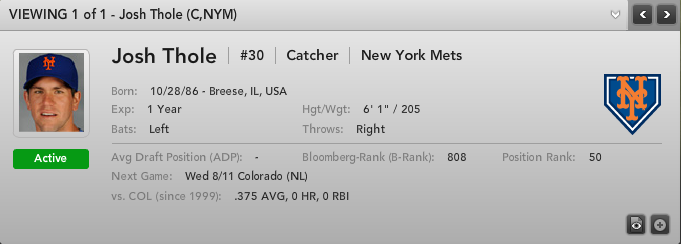
With a successful call-up in 2009 (.321/.356/.396 in 59 plate appearances) under his belt, and Rod Barajas’ injury, the young catcher has been receiving more playing time at the major league level – mostly as R.A. Dickey‘s personal catcher. As a fantasy player, he can help your team in batting average, and if your league counts the category, on-base percentage – two boosts you don’t normally expect from the catcher position.

Although he lacks power, Thole has shown the ability to get on base at every level. In six minor league seasons, he owns an on-base percentage of .378. In 48 major league games, he’s been on base more than 39% of the time.

After hitting .321 in his first 17 games last season, he is hitting .324 in 31 games this year. True to his contact-hitting label, the 23-year-old is making contact on 94.3% of the swings he takes. To put that in perspective, only two major leaguers who qualify for the batting title have a contact rate higher than Thole (Marco Scutaro and Juan Pierre).

tholestats.PNG

Of course, when any player hits for a high average in such a small sample size, there is a chance it could be due to luck or random fluctuation. To help us look into that, we can check Thole’s batting average on balls in play, or BABIP. Currently, his BABIP of .362 is well above the MLB average of .298. On the other hand, Thole has always had an above-average BABIP. In his minor league career, his BABIP is .326 – including a .359 mark last season.

Despite the high BABIP, the percentage of line drives hit by Thole is relatively normal. Since line drives are the type of batted ball most likely to fall for a hit, a high LD% would contribute to a flukishly high BABIP. In Thole’s case a 20.7% LD rate could be sustainable. In a bit of a surprise, the catcher has seen a decent number of hits come via the ground ball. Without great speed, this is one area where we might see some regression.

In addition to the average, Thole is walking 13.9% of the time – while striking out just 13.2% of the time. He is swinging at less than one-fifth of pitches out of the strike zone, and has whiffed on just 2% of his swings.

With good plate discipline, and the ability to slap the ball around the yard, Thole is a nice backup plan for any fantasy owner. Although he is only playing two or three times a week now, his playing time could increase as the Mets fall further out of contention. Despite the lack of power, his high OBP and AVG would be a welcomed addition to NL-only or deep mixed league squads.

For more on Josh Thole and other potential rookie pickups check out Bloomberg Sports’ Fantasy Kits

(Video) Bloomberg Sports’ Ballpark Figures: Hot Commodities

By Bloomberg Sports //

Ballpark Figures: Fantasy Headlines— Bloomberg Television’s Michele Steele and Bloomberg Sports Fantasy Analyst Rob Shaw discuss some sleepers in fantasy baseball. Shaw points to outfielders Dexter Fowler and Felix Pie as legitimate fantasy options. Rockies outfielder Fowler offers fantasy managers plenty of speed and runs. Pie offers the Orioles some pop as well as speed and a respectable batting average. Michele’s Steal is Ian Desmond of the Washington Nationals. On the very day that she predicts big things form him, he pops two home runs against the Marlins. For more fantasy insight, visit us at Bloombergsports.com.

Which Fantasy-Relevant Prospects Are on the Way?

by Eno Sarris //

In recent weeks, prospects like Chris Carter, Domonic Brown, Jeremy Hellickson and Logan Morrison have been called up to major leagues and we’ve been right on top of them. Which prospects are still in the minor leagues who might help your fantasy team down the stretch?

Looking at Baseball America’s midseason Top 25 prospects, one thing immediately becomes clear. There are a lot of guys down in HIgh-A ball who won’t be coming up any time soon. So, we’ll sort the list for age and proximity to the major leagues, because we want to find some names that will help fantasy owners in all sorts of leagues this year.

jennings.jpgNumber three on the list is Desmond Jennings in Tampa Bay’s organization. Other than shoulder and wrist injuries that set him back a little this year, and may have sapped some of his power, he’s been great. His career .297/.380/.441 line in the minor leagues shows that he can get on base and show decent power, but it’s the 163 stolen bases against only 31 caught stealings (84% success) in 400 games that are really eye-popping.

Unfortunately for Jennings, the major league outfield in Tampa Bay is pretty stacked, and there’s little room for him to accrue impactful playing time even if he is called up in September when the rosters expand. Fantasy owners desperate for speed can hold on to him, but a deep team like the Rays may not have much room for him to make an impact, barring a major injury.

Another September callup might be Dustin Ackley, an outfielder-turned-second baseman in the Seattle organization. Given the struggles of Jose Lopez, Ackley might even have some playing time available to him if the team shifts Chone Figgins back to third. Though Ackley doesn’t own a ton of minor league plate appearances (458), the 2nd overall pick in the 2009 draft has performed well after a few blips, and at 22 with three full years at college behind him, the team may push him. In Triple-A right now, Ackley is hitting .299/.388/.483 in a park that skews slightly toward pitchers. He has a little bit of extra-base power, but with few home runs (his overall ISO is a below-average .135)  and a little bit of speed (eight stolen bases in 109 games), and is an interesting speculative pick up for deep league managers needing help at second base. With the team looking to next year, the M’s could even call him up before September 1.

Tenth on the list is a lefty pitcher, Baltimore’s Zach Britton. The Orioles are a poor team looking to the future, so the table is set for Britton to come up at any point and contribute. While Britton is only striking out 5.84 batters per nine innings in Triple-A, 6.44 batters per nine cumulatively in 2010, and 6.83 batters per nine for his minor league career, he can induce groundballs by the bundle with his sinker. HIs career groundball percentage is 62.9% and that’s stayed constant throughout – that percentage is 62% in Triple-A. The rest of the Orioles’ bevy of pitching prospects are for the most part flyball pitchers. The team may want to try out a different approach, and deep league managers looking for pitching would do well to look Britton’s way. Now it looks like the Orioles might even go to a six-man rotation to see what they have in Britton.

So far, we’ve gone through Baseball America’s top 10 and found three guys who might be useful to deep league managers – but no immediate pickups for shallow mixed-leaguers. We’ll continue to cull the list for fantasy-relevant prospects for you in the next few days.

For more on Desmond Jennings, Dustin Ackley, Zach Britton and the rest of the top prospects in baseball, check out Bloomberg Sports’ Fantasy Tools.

(Video) Bloomberg Sports’ Ballpark Figures: Fantasy Headlines

By Bloomberg Sports //

Ballpark Figures: Fantasy Headlines — Bloomberg Television’s Michele Steele and Rob Shaw discuss some of the news and notes in Major League Baseball. Today’s topic includes the disappointing performance of Nationals phenom Stephen Strasburg, the hot start of Rays prospect Jeremy Hellickson, the potential of Diamondbacks young talent Sam Denel, and the latest setback for Rangers second baseman Ian Kinsler. For more fantasy insight please visit BloombergSports.com and follow us at Twitter.com/BloombergSports.

Justin Masterson and Brett Cecil Are Mirror Images

By R.J. Anderson //

There are only so many ways to make it to the major leagues. You
have to be good at something; whether it’s hitting for average or
power, pitching with great stuff or excellent command; or excelling at
defense. Two of the youngest and most promising American League
starters this season share quite a bit in common, both being talented
but still flawed pitchers. Those two SP: Brett Cecil and Justin Masterson.

When the Jays drafted the 6’1″ Cecil, he was finishing up his career
at the University of Maryland as a closer. In fact, he made fewer than
10 starts during his collegiate career, but showed promise as a
potential late-inning reliever who could be placed on the accelerated
path to a big league bullpen. The Jays selected him in the supplemental
phase of round one in 2007’s draft, and immediately converted him to
starting. He spent less than two seasons in the minors before being
promoted as a 22-year-old last year. Cecil went 7-4 with a 5.30 ERA in
17 starts.

On the other hand, Masterson came out of San Diego University and
the Boston Red Sox quickly groomed him as a swingman. He started 36
games in the minors while entering 17 others as a reliever. Promoted to
Boston, a team with strong starting pitching depth, he started only 15
games while entering 42 others out of the pen. He only became a
full-time starter after the Red Sox traded him to Cleveland last July.

Beyond those similarities, the biggest trait the two pitchers share
is an inability to retire opposite-handed batters. Masterson has held
righties to a .699 OPS this season; but lefties have a .462 slugging
percentage and .392 on-base percentage (.854 OPS) against him. When his
days as a set-up man are factored in, the difference holds true; a .626
OPS against righties, .848 OPS against lefties. Cecil, meanwhile, can
get lefties out – their career line against him is .232/.269/.388 – but
struggles with righties: .280/.353/.451. For a further illustration of
Cecil’s struggles, consider this:

cecil1.png

If you could combine the two pitchers, taking each of their
strengths and placing them into one pitcher, you would have someone
capable of retiring both hands without ease.Dr. Frankenstein isn’t
walking through the doors of a baseball facility anytime soon, though,
unless it’s to retrieve Shelley Duncan,
meaning the hopes of improvement hinge not on the advancements of
modern science and surgical precision, but on the ability of either
pitcher, or both, to make strides at adaption.

From
a scouting perspective, the better bet is Masterson. Cecil is short for
a starting pitcher, with a fastball that lives in the low-90s.
Masterson is no vintage Pedro, but his fastball moves faster and his
ability to rank among the league leaders in groundball rate during any
given season appears legitimate. Beyond that, Masterson is more likely
to face a bunch of right-handed hitters than Cecil. This season alone,
Masterson is facing righties roughly 46% of the time; Cecil is facing
lefties 22% of the time. As is the same with positional players, if you
have two at a position with extreme platoon splits and you can only
keep one, keep the one who will be useful more of the time.

One caveat: Masterson’s pitching motion, typically from a
three-quarters angle, might always invite a significant split. He’s a
fine player to own in AL-only leagues, but not an ideal choice for a
shallow mixed league.

For more information on Masterson, Cecil, and hundreds of other
players, and for dozens of tools to help you dominate your fantasy
league, check out Bloomberg Sports’ fantasy kits