What Stephen Strasburg Can Teach Fantasy Managers

by Eno Sarris //

The science surrounding young pitchers has never been set in stone. It’s come a long way since Rany Jazayerli first debuted Pitcher Abuse Points in 1998. The “discovery” that there was such a thing as too many pitches for a young pitcher then led to some new ways of thinking about young pitchers, pitch counts, and innings limits. Tom Verducci furthered the research with his own findings, called the Verducci Effect, that young starters that jumped more than 30 innings from year to year were more likely to end up injured.

Of course it’s not really that easy to just slap the 30-inning-increase limit on a young starter, especially when a team is in contention and under to pressure to win now. Plus, more rigorous research has not found such a hard cap to be completely useful for all pitchers. All innings are not created equal. More advanced studies look into pitches per inning and what types of pitches are more responsible for arm stress than others. The soft cap that many use in baseball is about 125% of the previous year’s innings total, but that number is more of a general benchmark than one that has the power of multiple research findings behind it.

The case of Stephen Strasburg offers a teaching moment. The upside of a pitcher like Strasburg made him a mid-round fantasy pick with the potential to return early-round value…provided he could put together enough major league innings. That was up for debate as his innings limits were reported to be around 140 to 150 IP – but no hard cap was reported in the media. Then this weekend, Strasburg grabbed his elbow and called the trainer to the mound, and his owners joined Nationals fans in a collective gasp.

StrasburgGrab.jpgWhat Strasburg teaches us is not necessarily that young pitchers are more likely to hit the disabled list with elbow injuries. Rather, it’s
that young pitchers are less likely to amass critical innings in the latter half of the season. Whether from a cap or from injury, they are just more likely to have their rotation spot skipped late in the year, or to be shut down completely.

Consider all the pitchers that have had the shutdown rumor associated into their name so far this year. Jaime Garcia, Mat Latos, Jonathon Niese, Mike Leake, Mike Minor and Strasburg himself have all been the object of innings-limits speculation from their front offices and the media alike. All of these men are good young pitchers that are vital to their fantasy teams. Jeremy Hellickson dominated in his first four big league starts. For his efforts, he got sent back to A-ball. The best-case scenario for fantasy owners the rest of this season is that he get recalled for a few September innings of middle relief.

Garcia has 141.1 innings already, and his career high came in A-ball with 155 innings. He might be good for another 25 innings by that measure, but it’s complicated by his Tommy John surgery last year, and subsequent 33.2 innings pitched. His manager specifically said that the team was not going to limit its excellent young starter, but he also used 175 innings in his statement. With the Cards in the race (52% chance of making the playoffs according to Baseball Prospectus and their playoff odds), they’ll probably push the limit with Garcia. 

Latos, on the other hand, is on a Padres team that is 95% likely to make the postseason, and they’ll need him in October. At 142.2 IP, he’s already well past last year’s 123 IP total and just a couple starts away from a soft cap situation. Since the Padres are far enough ahead, expect to see his starts skipped often down the stretch. Minor, on a Braves team with a 92% chance of making the playoffs, has already had his starts skipped. His 138.1 innings so far this year are well beyond the 110.2 innings he accumulated at Vanderbilt in 2009.  

Leake and Niese are more likely to be shut down. Leake racked up 161 IP between Arizona State and the Arizona Fall League last year, but with his recent struggles the team demoted him to the bullpen at 138 innings anyway. The Mets have already openly contemplated shutting him down. They also have a 0.5% chance of making the playoffs, meaning there’s no point risking it with their young right-hander. 

Innings caps are no reason to avoid young pitchers altogether, but they do represent another risk that isn’t inherent with veteran pitchers. Next year, when it comes time to decide between two pitchers of similar ilk, it’s worth giving the veteran a slight nudge forward if late-year innings will be crucial for your team. And if you reach the All-Star break with a hot hand like Strasburg or Leake in your fantasy rotation, start aggressively shopping him for a trade.

For more on Stephen Strasburg, Jaime Garcia, Mat Latos and other young pitchers, check out Bloomberg Sports’ Fantasy Tools.


Is Miguel Tejada Back?

By R.J. Anderson //

In late July, the Baltimore Orioles traded Miguel Tejada to the San Diego Padres. He’s hit .295/.360/.410 since, sparking endless stories on how rejuvenated and grateful the 2002 AL MVP is to be involved in a playoff push. The same media that comes down on Hanley Ramirez and Matt Kemp for single-play gaffes has allowed Tejada to skate by on, presumably, giving lackluster effort for nearly 100 games.

More amazing is how people are so quick to buy that Tejada is back to being an above-average player. Tejada is hitting for marginally more power than he was in Baltimore (.115 ISO to .092) and while he’s walking more often (9.3% versus 3.5%), he’s also striking out more (from 9.7% to 14.1%). Tejada has not sustained a walk rate over 9% since 2000 and that includes playing on good Oakland teams and bad Astros teams alike. The odds of him doing it with the Padres over any length of time are low.

Besides the walk rate, an increased batting average on balls in play is helping to buoy his line. In Baltimore, 28.2% of Tejada’s balls in play turned into hits; that number has spiked 33.3% have with the Padres (league average is usually around 30%). Tejada is actually hitting fewer grounders and more balls in the air with San Diego, which usually isn’t a great combination for improved BABIP, but he has improved his infield hit rate. Tejada had 10 with the Orioles, he’s got three with San Diego already. Perhaps he really is a man full of joy:

tejada1.jpg

Or not.

If that seems like a lot of negativity around Tejada’s future prospects, well, it is. Little optimism exists for a 36-year-old with a line of .292/.325/.417 over the past three seasons, moving to an extreme pitcher’s park no less. Nonetheless, being a shortstop again adds some value to his recent hot streak and moving from the American League East to the National League West could boost his player’s offensive value.

If you need a shortstop at this point in the season then you probably won’t have an active team for much longer, so add Tejada for nostalgia’s sake if you want because he’s available in more than 30% of ESPN leagues. If you’re a standard mixed league of 12 teams or less, though, pick up someone like Oakland’s Cliff Pennington instead.

For more on Miguel Tejada and other former MVPs in baseball, check out Bloomberg Sports’ Fantasy Tools.

D-Lee in The A-T-L

By R.J. Anderson //

With only six weeks remaining, the National League East race is heating up. The Atlanta Braves and Philadelphia Phillies are the only teams with realistic shots at hooking the title, but both have endured a rash of injuries in recent weeks. But while Ryan Howard and Chase Utley are now back for the Phillies, the Braves have lost Chipper Jones for the season and Troy Glaus is on the disabled list.

Counting on health with Jones and Glaus on the corners is like playing Russian roulette with a full clip. The Braves have responded by adding long-time Chicago Cubs first baseman Derrek Lee. A pending free agent, the Cubs received more value than they should have for Lee, but that aspect isn’t nearly as important for the short-term as what the Braves received.

Glaus owners in particular should be looking at adding Lee, as he’s still available in 6.5% of ESPN leagues. Lee’s seasonal line is a disappointing .247/.333/.410 with 16 homers and 65 runs batted in. One of the more telling differences between Lee’s magnificent 2009 season, in which he hit .306 with 35 homers and 91 RBI, and his 2010 campaign, is his strikeout rate. In about 100 fewer at-bats, Lee has struck out just five fewer times than he did all of last year. The soon-to-be 35-year-old is striking out at his highest rate since leaving the Marlins in 2003.

Lee is still walking and his non-home run power (22 doubles) is in line with 2006-2008 totals. The raisin in the sun is Lee’s batting average on balls in play. 29.1% of Lee’s balls in play are turning into hits, marking a career-low dating back to 1999 and more than 30 points below his previous low over the past five years. Batted ball data suggest a bit of a change in how Lee is hitting the ball, with a slight uptick in grounders over last year and a steady drop in flyballs. Lee is getting slightly fewer infield hits, but that comes with fewer infield flies too, a worthy trade-off in the big picture.

derreklee1.png

Graphic courtesy of Baseball-Reference

Being dropped into a pennant race could revitalize Lee’s spirit (and he has heated up lately) but do not expect him to hit like he did last year. Lee’s 2008 line of .291/.361/.462 line is probably a good best-case scenario for the last six weeks of 2010.

As for the other significant recent waiver acquisition, Pedro Feliz with the Cardinals, don’t bother unless you play in a fantasy league where the goal is to field the worst players. In that case, he is a keeper.

For more on Derrek Lee, Pedro Feliz, and other late-season adds, check out Bloomberg Sports’ Fantasy Kits.

More Fantasy-Relevant Prospects on the Way?

by Eno Sarris // 

Last week, we started going down Baseball America’s mid-season Top 25 list looking for prospects who might actually accrue some significant playing time in the major leagues this year. Though the risk with all prospects getting their first shot at the bigs is significant, the upside is also very enticing. Staying on top of these players may be a boon to your team, especially if your league standings are close enough to be impacted by a big final six weeks.

Eleventh on Baseball America’s list is a very interesting name that dovetails with a piece R.J. Anderson just penned. Michael Pineda is a great prospect in the Mariners organization, the team is playing for next year, and Seattle recently traded away Cliff Lee, so it would seem that there might be a place for Pineda. Unfortunately for Pineda, David Pauley was the one who got the call first. But the fact remains that the fifth starter for the Mariners right now, Luke French, owns a poor 59/39 K/BB ratio in 100+ major league innings. French also owns underwhelming rates in the minor leagues (MiLB career 5.8 K/9, 2.7 BB/9), so he could leave the rotation at any time.

PinedaGrab.jpgIf he does, Pineda could immediately become the newest impact pitching prospect, and an immediate pickup in most leagues. Right now, he’s putting up 8.9 K/9, 1.9 BB/9 and a 2.40 FIP in Triple-A, and that’s the worst strikeout rate he’s shown since he was 18 and in rookie ball. At 21, he’s always been precocious for his league, and the only (very slight) blemish on his record is a groundball percentage that has fallen slightly as he’s advanced levels. Still, at 43.4% right now, and 45.7% career, he could be fine. Just look at Tommy Hanson, who put up similar groundball rates (actually lower) in the minors, and is doing well with a 40% rate in the majors. Bryan Smith took a look at the evolution of groundball rates on FanGraphs recently, and it seems that the takeaway is that it’s not certain that Pineda will have the same struggles as flyballer Brian Matusz in Baltimore, just because they both had similar groundball rates in Triple-A. In fact, Bryan Smith provided this quote when asked about Pineda’s groundball rate: “It’s a normal trend for a right-handed power pitcher.
It’s also worth noting that Pineda plays in a home park that suppresses home runs on flyballs, and that few teams can match the Mariners great outfield defense. Watch for his pickup and pounce if you need pitching.

moustakas.jpgNext on the list is the Kansas City Royals’ Mike Moustakas, who has had a roller-coaster minor league ride. You might consider him in a dip right now, with a .266/.285/.432 battling line in Triple-A Omaha. But if you use MinorLeagueSplits.com to neutralize that line for bad luck (such as on balls in play) and park effects, it looks a lot nicer at .317/.333/.496. Moustakas once hit a trough like this before, as a 20-year-old in High-A ball (.254/.303/.432), but once again his adjusted line was much more palatable (.288/.334/.495). It looks like he runs into some park- and luck-created problems every once in a while, but the power has been there all along.

Two things you will notice when looking over his minor league record are his power and plate discipline. His isolated power for his minor league career is .209, which is already solid; it was an even more impressive .279 at Double-A last year, so his peak power is well above-average. The other thing you might notice is that  he doesn’t walk much. His 7% rate in the minor leagues got as high as 8.7% in Double-A, but after the usually inevitable drop in the major leagues, he may not be a great option in leagues that use OBP. Given his intermittent struggles in the minor leagues – luck-oriented or not – Moustakas may also not take the league by storm in his debut. He makes for a better keeper league choice than short-term pickup.      

For more on Michaels Pineda and Moustakas and the rest of the top prospects in baseball, check out Bloomberg Sports’ Fantasy Tools.
(Video) Bloomberg Sports’ Ballpark Figures: USA Today’s Steve Gardner

By Bloomberg Sports // Ballpark Figures: Stock Report– Bloomberg Television’s Michele Steele and Bloomberg Sports Fantasy Analyst Rob Shaw are talking baseball. For the details surrounding the K-Rod Mets saga, Jim Thome’s power display, the injured second base superstars, and Josh Willingham and Jacoby Ellsbury, Bloomberg Sports brings on USA Today baseball columnist Steve Gardner. For more fantasy insight visit the Fantasy Windup at USAToday.com as well as BloombergSports.com for your top notch data analysis.

Will Aroldis Chapman Help Your Fantasy Team This Year?

by Eno Sarris //

Continuing an ongoing series here, today we will look at another prospect from Baseball America’s midseason Top 25 list who may come up and impact your fantasy league.

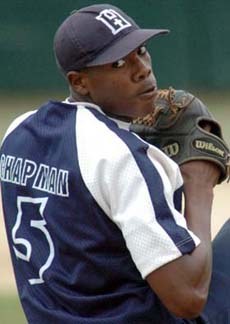
Just this January, Aroldis Chapman agreed to a six-year, $30.25 million contract with the Reds, amid legendary tales of velocity and dominance from the Cuban leagues. Even while signing he was described as ‘raw,’ despite being 22 years old – or roughly the age of a guy a year out of college. The team talked of refining his delivery and not rushing him, but after a good spring training, they assigned him to Triple-A and the countdown began.

True to his age, Chapman was ready for the upper levels of the minor leagues, as his 11.01 K/9 attests. But true to his unrefined label, Chapman also has had his struggles, as his 4.9 BB/9 can attest. In some ways, he fits the statistical profile of Edinson Volquez, his future partner in the Reds’ rotation. He throws gas, is a little wild, and is not a groundball pitcher (41.5% at Triple-A right now), much like Volquez.

aroldis-chapman-1.jpgIt’s hard to see if Chapman will develop control. He had 365 strikeouts and 203 walks in 327 Cuban innings, a 5.6 BB/9 that was a harbinger of his current struggles. That sort of wildness will limit his upside for sure, but gas like he throws will allow him to persevere as well.

We might look to Brandon Morrow for a true comp.
Though he is a right-handed pitcher, Morrow posted a 4.3 BB/9 in the minor leagues, and owns a 5.14 BB/9 so far in the major leagues. It’s taken him until
this year to fully harness his arsenal (his 10.4 K/9 is helping) to the
point where he has gotten his FIP (3.28) under four for the first time. If Chapman can continue to whittle that walk rate down to the mid-fours like Morrow, he might be okay.

But there are myriad reasons to be skeptical. First, Chapman’s walk rate this year dwarfs even Morrow’s – and Morrow had a BB/9 closer to four at Triple-A before it skyrocketed in the major leagues. Second, only eight pitchers in baseball that have a BB/9 over four are currently qualifying for the ERA title. In other words, only eight pitchers have had enough stuff to overcome such a terrible walk rate to survive as full-time rotation members so far this year. The odds are stacked against Chapman becoming a dominating pitcher even now that he’s shown his strikeout ability in the States. 

Morrow is a prescient comparison because Chapman is currently a reliever, much like Morrow used to be while in Seattle. The Reds converted their big Cuban asset, at least temporarily, to relief, and he’s closing in Triple-A. It may have been a move to get him on the major league roster, and with Francisco Cordero currently struggling (4.47 FIP, 5.80 BB/9), it may even mean a fantasy-relevant role will come Chapman’s way when he’s called up as roster expand Sept. 1. (One piece of good news is that his control has been better in relief, with his walk rate down to 4.15 BB/9.)

Because of his still-existent control problems, however, fantasy owners in mixed leagues should wait for concrete news on the subject before moving. Deeper league managers looking for saves could speculate with Chapman. But you’d have to think that Nick Masset (3.77 FIP, 9.6 K/9, 4.07 BB/9) is the next man in line for saves in that bullpen, especially with the Reds in prime playoff contention.

It looks like fantasy owners may have to wait another year to benefit from Chapman’s booming fastball.

For more on Aroldis Chapman and other potential pitcher pickups, check out Bloomberg Sports’ Fantasy Tools.
Arizona Diamondbacks’ New Man: Dan Hudson

By Tommy Rancel //

Before the July 31 non-waiver trade deadline, the Arizona Diamondbacks made a series of moves geared toward their future. One move in particular not only has potential for future reward, but is bringing back some results right now.

In terms of real-life analysis, the thought process behind the Edwin Jackson for Dan Hudson trade was to give up a year and a half of Jackson for six seasons of Hudson. Jackson is a talented pitcher, but he’s on his fifth major league team before the age of 27. He’s a nice piece at the back end of the rotation, but will make more than $8 million next season. Hudson may not have the raw ability that Jackson does, but he will earn around the league minimum for the next few seasons, likely for similar production.

After spending the 2008 season at the rookie level of the minor leagues, Hudson blew through all levels of the White Sox system in 2009 – earning a call-up to he majors after starting the year in low-A ball. He began 2010 at Triple-A, where he continued to post fantastic numbers – especially in the strikeout category. In 93.1 innings, he struck out 108 batters while walking just 31.

Hudson would make three unimpressive starts for the White Sox big club this season before the trade to Arizona. Again, while the move was made with the future in mind, Hudson has provided the Diamondbacks with favorable results in the present.

hudson.PNG

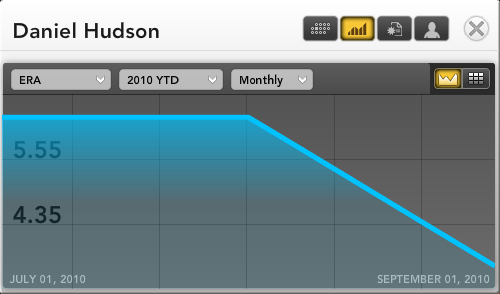
After four turns through the Arizona rotation, the 23-year-old right-hander is 3-1 with a 2.12 ERA. Hudson has struck out an impressive 27 batters in 29.1 innings with the D-Backs, while handing out just four walks.

One concern about Hudson, a flyball pitcher, moving to Arizona is home runs allowed. Chase Field is among the league’s friendliest home run parks. Since moving out west, Hudson has allowed four home runs (1.21 HR/9), and other Arizona pitchers in larger sample sizes have shows home run-heavy tendencies, so it is something that needs to be monitored long-term.

His current swinging strike percentage of 11% shows that his stuff thus far has been good enough to miss the bats of major league hitters. This is good news for his above-average strikeout rate, indicating that it’s more likely to be sustainable. Although he might be prone to the long ball, Hudson has kept the opposition off base in other ways, limiting the damage of the big fly.

Hudson is currently available on the waiver wire in most leagues. If you have the opening, the risk of claiming him is well worth the potential reward of adding an above-average starter as you head toward your fantasy playoffs – especially in deeper leagues.

For more on Daniel Hudson and other late season pick-ups, check out Bloomberg Sports’ Fantasy Kits.

Save Opps: Hisanori Takahashi

By Eriq Gardner //

Somewhere out there in fantasyland, a team owner is going to lose his league by a couple of saves — maybe the result of Francisco Rodriguez losing his temper, assaulting the father of his girlfriend, suffering a torn ligament in his thumb, and hitting the injury shelf for the season.
Those who play fantasy baseball are accustomed to fickle closers and the sometimes-aggravating, sometimes-fun pursuit of saves. Few of us, though, could have ever imagined a scenario this bizarre. The xFIP formula doesn’t account for off-the-field commotion.
On the optimistic side, somewhere out there in fantasyland, a team owner will win his league by a couple of saves — perhaps the result of a new job opportunity for new Mets closer Hisanori Takahashi. On Monday, he notched his first save, and afterward, manager Jerry Manuel tagged him as “the guy” going forward. He pitched a perfect 1 2/3 innings on Wednesday, further solidifying his role.

Takahashi is being picked up in many leagues with tight saves races. Can he keep the job?

takahashi1.png
The season has been a strange one for the Japanese import.
In April, the 35-year-old was an effective reliever in the middle of the Mets pen. Despite never having a particularly strong strikeout rate in Japan, Takahashi mastered American batters that month to the tune of 21 strikeouts in 14 innings. Credit an extremely odd pitch called the “shuuto” for Takahashi’s sudden emergence on the scene.
In late May, Takahashi was then switched into a starting pitching role. His first two starts were impressive. He shut out the fearsome New York Yankees. He then shut out the imposing Philadelphia Phillies. So far, so good.
In June, the wheels came off. He allowed six earned runs in four innings in the pitchers’ haven known as Petco Park against the San Diego Padres. He followed that up by allowing five earned runs in five innings to the Florida Marlins.

takahashi2.png

Ever since then, he’s followed form by being at times fantastic, and other times atrocious. 
Truth be told, there are some statistics that support the idea that Takahashi can hold the closer gig for the rest of the season. As a starter, his ERA is 5.01 with 54 Ks in 64.2 innings. But as a reliever, his ERA is 2.68 with 42 Ks in 37 IP. He’s clearly been more effective in the latter role.
On the other hand, regardless of Takahashi’s skills, he’s proven himself a bit unstable — not a good quality for a closer — plus he’s 35 years old and pitching for a team that’s fairly close to being mathematically eliminated from playoff contention.
Given the Mets’ place in the standings, the wise move for them to try Bobby Parnell out as closer. Parnell doesn’t have a “shuuto” pitch. Instead, he has a fastball that averages 96 MPH and has been known to reach near 100 MPH. Parnell is only 25 years old and is having a great season with 22 strikeouts to only 6 walks in 22 innings. He could easily be the Mets’ closer-of-the-future, a distinction that may mean something if the Mets are truly serious about voiding the rest of K-Rod’s contract.
For this reason, as a fantasy owner, we’d probably hang on to guys like Bobby Jenks or Jonathan Broxton — temporarily out of jobs as closers of the White Sox and Dodgers, respectively — before adding a newcomer like Takahashi. Then again, would it be shocking if Takahashi sticks these final weeks and leads some fantasy team to a championship? Of course not. In New York, clearly anything is possible.
For more on the closer carousel, check out Bloomberg Sports’ Fantasy Kits

(Video) Bloomberg Sports’ Ballpark Figures: Stock Report

By Bloomberg Sports // Ballpark Figures: Stock Report— Bloomberg Television’s Michele Steele and Bloomberg Sports Fantasy Analyst Rob Shaw discuss the Bulls and Bears in fantasy baseball. Shaw tells us that while Francisco Rodriguez comes out a loser, his replacement Hisanori Takahashi is shooting up in value. Homer Bailey find game earlier this week may be a taste of better things to come. Ryan Raburn is a power bat in the Tigers lineup. Pat Burrell’s bat right now is fool’s gold. Plus, Jason Vargas is a former Mets farmhand in a groove for the Mariners. For more insight follow us at Twitter.com/bloombergsports.

Who in the World is David Pauley?


By R.J. Anderson //

Quick, who replaced Cliff Lee in the Seattle Mariners’ rotation? Nope, not Erik Bedard or Michael Pineda. Try David Pauley. Who? The 27-year-old righty sports a 3.31 ERA through his first 10 appearances this season. With the Mariners already holding two fantasy league sleepers in their rotation this season – Jason Vargas and Doug Fister – could Pauley be the next pitcher to benefit from Seattle’s pitcher-friendly home park and excellent defense? Maybe.

Pauley has bounced around since being drafted in the eighth round of the 2001 draft by the San Diego Padres. Three years later, San Diego traded him to the Boston Red Sox in the Dave Roberts deal, who then sent him to the Baltimore Orioles five years later. After reaching minor league free agency this past winter, Pauley inked with the Mariners, where he probably did not expect to join a rotation stacked with names like Felix Hernandez, Bedard, and Lee. Yet, here he is.

Pauley had only 28 major league innings entering this season, with mixed results. His ERA was awful, and still is, but his underlying peripherals suggested he wasn’t that bad. For instance, his FIP this season is 3.91, whereas his career mark is 4.18. Even with a fastball that sits below 90 (check the chart below, he really does not throw hard), Pauley manages to get a league-average amount of whiffs, thanks to heavy usage of his change-up.

pauley1.png

In 85 minor league innings this season, Pauley posted a 3.68 ERA. The last time he flashed an ERA over 4.50 in the minors came in 2006, during his first stint in Triple-A. Since then he’s posted ERAs of 4.33, 3.55, 4.37, and the aforementioned 3.68. Most projection systems have Pauley with a much higher ERA than league average, but that seems harsh considering his ability to get groundballs while pitching in front of a grade-A defense and in a park that restricts power.

That doesn’t mean Pauley is a must-get in your league. He’s hardly that, but he is owned in less than 1% of ESPN leagues. So if you’re in an AL-only or deep mixed league, Pauley is worth a shot.

For more on David Pauley and other potential pitcher pickups, check out Bloomberg Sports’ Fantasy Kits