Logan Morrison Takes His Talents to South Beach

By Tommy Rancel //

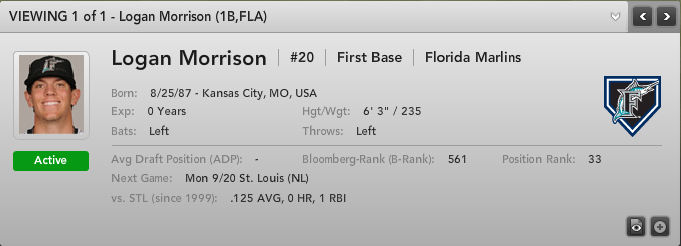
Although he has the size (6’3″/235) and he plays the positions (first base and corner outfield), Logan Morrison‘s game does not match his size. Still, that hasn’t stopped Morrison from being rated as a top-20 prospect in all of baseball by Baseball America for the past two years.

Morrison, 23, spent most of his minor league career as a first baseman. However, with Gaby Sanchez‘s solid play at first and Chris Coghlan‘s injury leaving a void in left field, Morrison has found a new home with the Marlins – at least temporarily. While his defensive responsibilities have shifted, Morrison is still doing what he does best – hit and get on base.

The Marlins rookie is hitting .310/.427/.492 in 225 plate appearances since getting called up from the minor leagues. With that said, his .310 batting average is largely fueled by an unsustainable .378 BABIP (batting average on balls in play), and he is not likely to carry a .919 OPS over 600 a full season. However, don’t mistake this hot start as just a fluke.

In more than 1900 minor league at-bats, Morrison hit .292/.383/.465. That’s a far cry from his current slash line, but still above-average. As mentioned, Morrison has the look of a hulk-smashing home run hitter, but that’s not a major part of his game – at least not yet. On the other hand, he has shown some solid doubles power, including 38 in 130 games at A-ball in 2008.

morrison.PNG

Currently, Morrison has a .182 ISO (Isolated Power – slugging percentage minus batting average) despite having just two major league home runs. Lacking the power to put the ball over the wall, he is simply spraying it all over the field. He has already racked up 18 doubles and five triples this year.

In addition to the gap power, Morrison is showing a very good batting eye, with a 16% walk rate. He is striking out 19.8% of the time, but his 20.7% O-Swing (swings at pitches outside of the strike zone) and 6.5% swinging strike percentage show further signs of a solid batting eye.

Because of his extra-base hits and the favorable walk rate, Morrison has already scored 36 runs despite playing in just 48 games.

While his red-hot slash line is not likely to be reproduced in the near future, Morrison looks ready for an everyday spot in the Marlins lineup next season. Whether it comes as a first baseman or an outfielder is unknown. But don’t let that stop you from picking him up right now in NL-only and mixed keeper leagues.

For more on Logan Morrison and potential NL keepers, check out Bloomberg Sports’ Fantasy Kits

The Case Against Carlos Gonzalez

By Eriq Gardner //

Carlos Gonzalez of the Colorado Rockies is having a very charmed season. By season’s end, he’ll have roughly 35 HRs, 25 SBs, 120 RBIs, 110 Runs, and a .340 batting average. These numbers arguably earn him the title as the season’s Fantasy MVP and gain him consideration as one of the top few picks heading into next year. The case in his favor looks strong, at first glance.
 
But beware. The young stud outfielder carries plenty of risk – and smart fantasy enthusiasts may be wise to stay away.

Let’s start out with the obvious: CarGo has been the beneficiary of tremendous luck this season.

The biggest knock against Gonzalez is his plate discipline. He strikes out 23% of the time and only takes a walk 6% of the time. This has added up to a .389 BABIP, which puts him only behind Josh Hamilton and Austin Jackson among players with regular playing time who have benefited from better luck on balls hit in play. Certainly, we can expect a higher-than-normal BABIP considering Gonzalez’ great speed, but not this high. Expected regression could knock anywhere from 40 to 60 points off that lofty .340 batting average.

As for power, don’t expect 35 HRs again. Yes, he’s the beneficiary of playing in the tremendous hitting environment of Coors Field. But then again, CarGo is rather below-average in hitting for fly balls. His 37% rate is below average, roughly on par with Rajai Davis.or Alberto Callaspo. He’s knocked 35 out of the park this year thanks to the fact that nearly 21% of his fly balls have gone for HRs. Only Joey Votto, Carlos Pena, Jose Bautista, and Adam Dunn sport a higher percentage. At 6’1” and 210 pounds, Carlos Gonzalez carries less body mass than those other four to support such massive power.

Carlos Gonzalez’ great luck in average and power has contributed to him reaching triple digits in both runs and RBIs. The team has another excellent player in Troy Tulowitzki, but the decline of Todd Helton and the departure of Brad Hawpe leaves the lineup dependent on youngsters like Ian Stewart, Dexter Fowler, Eric Young Jr. and Seth Smith to get on base in front of CarGo or reciprocally drive him home. Any slippage in the ability to get on base or knock balls out of the park will erode his ability to post elite context stats in runs and RBIs like the production he’s given this season.

That’s part 1 of the case against Carlos Gonzalez.

All of which might be acceptable but for two more glaring facts about Carlos Gonzalez: First, to put it simply, he’s never done this before. And second, his price tag in fantasy leagues is going to be through the roof coming off such a stellar year.

Yes, he was a very fine prospect coming up through the minors, is only 24-years-old, and is still growing. 


But the road to superstardom for young elite players is rarely a linear curve upwards. There are ups and downs. Ask Matt Kemp, who was the fantasy pundit’s darling at this time last year. No amount of production this year can help us ferret out whether Carlos Gonzalez is one of the elite players who will consistently have one stellar year after another like other potential first round picks or rather is merely a fine player having a career season. We still need more evidence – especially in light of all the good luck factors described above that have contributed to his superlative year.

Carlos Gonzalez has great upside, no doubt, and deserves to be honored for the season he is enjoying. But once the season completes, none of that matters going forward. The only question is what he’s going to do for an encore. Unfortunately, it seems likely that in drafts and auctions, the price of admission will be too high on this young player at a non-scarce position. Consider yourself warned.


For more on Carlos Gonzalez and other power/speed outfielders, check out Bloomberg Sports’ Fantasy Tools.


The Pro-CarGo Post

By Eno Sarris //

It’s a little tough to make the case for Carlos Gonzalez next year when you agree with many of the points made by the other side, in this case by Eriq Gardner. A lot of luck on the batted ball does go into most .340 batting averages, and Gonzalez has certainly seen a few balls clear the fence that haven’t before. He probably won’t put up the same season next year, that much we can grant.

CarGoGrab.jpg

But how much will he regress? If he regresses just a little bit, he could still be an outfielder with a .300 batting average and 25+/25+ numbers, which would probably make his owners happy even if they spent an early first-round pick on him.

The .389 BABIP is an eyesore to the sabremetrically-inclined fantasy fan. That number seems like it includes a lot of luck. But we also know that every player has their own ‘true’ BABIP level, based on their unique blend of speed and batted ball mix. Peter Bendix once created an xBABIP calculator to see what an expected BABIP might be, given these factors, and using that calculator we find that CarGo’s xBABIP this year is .349. The difference in hits would be 18 hits if he featured his xBABIP instead of his BABIP, and his batting average would instead be .308 instead of .341. Gonzalez could be a little less lucky and still have a strong batting average next year.

The fact that he is showing the best power in his career doesn’t necessarily mean that he won’t come close again next year. His ISO this year is .270, last year it was .241. In the minor leagues, it was .194 overall, but .291 in his final stop. If he retreats to an ISO between his last two major league numbers, he’ll be in among Mark Reynolds, Troy Tulowitzki, Carlos Quentin and Vernon Wells on the ISO leaderboard. His power likely won’t disappear completely in other words, especially if he still calls Coors Field home, since he has a career .292 ISO in 155 home games.

About his flyballs and the HR/FB rate, those numbers fluctuate from year to year. Last year, he hit 38.8% flyballs, and 16.7% HR/FB. This year, those numbers are 36.9% and 20.9%, respectively. In the minor leagues, his full-year flyball rates fluctuated from 30.7% to 43% at different stops. He could easily hit more flyballs next year, have fewer home runs per flyball, and not see a huge drop in his home run total.

One last note. Gardner mentions the lineup around Gonzalez as a negative, but it seems like more of a positive to this analyst. As Todd Helton and Clint Barmes have declined or shown their flaws, they have lost at-bats to younger players, and Ian Stewart, Dexter Fowler, Eric Young Jr. and Seth Smith all have upside beyond their current levels. Projecting an entire lineup is iffy either way, but let’s just say: Carlos Gonzalez is the number-three hitter for the Colorado Rockies. In 2009, the three-hitter for the Rockies accrued 92 runs and 100 RBI. As long as the offense stays somewhat similar and Gonzalez stays healthy, he will likely approach 100/100 numbers in those categories.

If you pro-rate out CarGo’s 2009 totals to 600 plate appearances – which is problematic considering he only accrued 317 PA, but let’s do this for the sake of comparison – he might have had 25 home runs and 30 stolen bases. Add a batting average close to .300, and you still have a very exciting young player worth a very high draft pick, especially in leagues that break out the outfielder positions and count CarGo as a center fielder.

Gonzalez’s numbers in 2011 might not look like 2010’s gaudy Triple Crown-contending statistics, but the power and speed are real, and there’s little reason to think that next year’s Rockies lineup won’t allow him to accrue 100 runs and 100 RBI yet again. He’s a great keeper and a great first-round investment next year. Auction managers should remember to temper their power expectations when bidding, but otherwise it’s all “go CarGo” here.

For more on Carlos Gonzalez and other power/speed outfielders, check out Bloomberg Sports’ Fantasy Tools.

Sean Rodriguez Waits on Deck in Tampa Bay

By Tommy Rancel //

About a year ago, Sean Rodriguez was introduced to Rays fans. Acquired by Tampa Bay in the Scott Kazmir trade – a move some saw as a white flag on the 2009 season and a salary dump – Rodriguez is helping the Bay area forget about their one-time ace.

Coming into this year’s camp, Rodriguez remained a relative unknown around Tampa Bay. However, the 25-year-old put on a power display in the spring, announcing his arrival. In addition to the pop, Rodriguez showed defensive versatility – a key to the Rays’ roster construction.

After that powerful spring that saw him rank among the Grapefruit League leaders in home runs and other categories, Rodriguez struggled early on. Through the end of May he was hitting just .224. The power we saw in spring did not translate, as he posted a .329 slugging percentage through the first two months. Not only was he lacking authority in his swing, Rodriguez was also hacking at every chance. In his first 219 at-bats, he struck out 64 times, while taking just six walks.

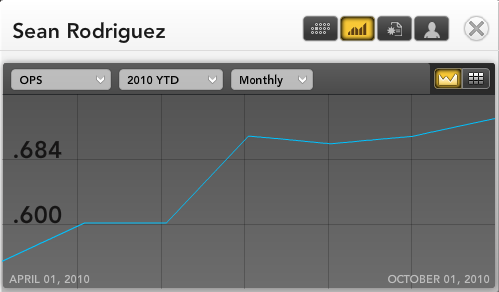
He’s made a charge since then, bumping his line up to he is hitting .257/.312/.411 in 351 PA. That’s while playing seven different positions for the Rays – making him one of just 36 players in MLB history to play seven positions and surpass 300 plate appearances in the same season.

srodops.PNG

Because of his positional flexibility and his smooth defensive abilities, the Rays may have granted Rodriguez more time than a player with less versatility. Their patience is paying off.

Since August 1, Rodriguez is hitting .250/.348/.425. After struggling with plate discipline early on, he walked 11 times in his last 91 plate appearances. His .227 Isolated Power (slugging percentage minus batting average), over the last 30 days ranks behind only the Pirates’ Neil Walker among second basemen.

Looking forward to 2011, the Rays are likely to have a few holes in their lineup. Without the ability to break the bank on the open market, the team will look to fill most of their vacancies from within. A full-time gig for Rodriguez could mean upwards of 20 home runs with multi-position eligibility, and some speed to boot. If you take that potential and add in his late-season surge, it would be a wise decision to start snatching up Sean Rodriguez in your keeper leagues right now.

For more on Sean Rodriguez and possible 2011 keepers in 2010, check out Bloomberg Sports’ Fantasy Kits

Historic Debut for Two Borderline Keepers

By Eno Sarris //

A seemingly innocuous and mostly playoff-irrelevant September matchup between the Mets and the Nationals produced an historic moment last week. That night was the first time both starting pitchers made their MLB debuts in the same game in Mets history.

Teams that are out of the playoff hunt produce these kinds of opportunities late in the season. Both Yunesky Maya and Dillon Gee would probably be seeing bullpen duty on a contender bearing down on the postseason, but here they are, giving owners in keeper leagues a small window in which to make a decision about their fantasy futures.

First, the things that these two guys have in common. Both are older starting pitchers making their debuts. Gee is 24, mostly because he spent almost the maximum amount of time in the minor leagues and his debut was almost forced by Rule V draft rules – he needed to be added to the 40-man roster . Maya didn’t arrive until age 28 after pitching in Cuba and only recently defecting.

Both are also considered borderline prospects. Maya saw more success in the Cuban leagues than his compatriot Aroldis Chapman, and also doesn’t own the booming fastball (or control problems) that the flashy left-hander has. Cuban statistics are hard to come by, but Maya posted an excellent win-loss record (48-29) and career ERA (2.51), won the Cuban leagues’ version of the Cy Young last year, and spawned reports of a four-pitch repertoire and a 92-mph sinking fastball. Here was a quote before the game from a Mets outfielder who had seen him in the minor leagues a week before:

“He was tough,” ex-Bison Lucas Duda said. “He mixed it
up well. We had a tough day. He would flip some [breaking balls] up
there. He would take something off. He was savvy out there. That’s what
made him tough to hit. His curveball was like 70 mph, to I think 65 mph
was his lowest radar speed. Different arm angles. Different speeds.
Then he was running it up there 90, 92 mph. We saw the radar gun and
were like, ‘What was that?’ You step in the box and he’s not throwing
slow. He’s throwing pretty firm. It was kind of a surprise when you
first got up there.”

Going from a two-game sample is a terrible idea, but much of what we’ve seen in his first two starts lined up with the scouting report. For example, the Mets broadcast team doubted the 91s and 92s on the gun in Washington and called Maya a ‘dart thrower’ with little deception in his delivery. The curve was considered a ‘Rambo curve,’ but then Keith Reynolds and Gary Cohen wondered if the fastball had enough giddyap to set up his off-speed offerings.

One key detail that came from Adam Rubin in the original article about Maya’s debut: “He throws a 92 mph power sinker that is challenging, although he actually was missing with that pitch against the Bisons.” The home run to Ike Davis was on that power sinker, as were a couple other extra-base hits. Overall, Maya had two whiffs on 35 fastballs in his first start, which doesn’t bode well (5.7% swinging strikes, and fastballs average around 6.7% across the league). Baseball usually works away from the fastball – it is the most-thrown pitch in the game – and if his fastball is missing spots and getting hammered, his upside is severely mitigated. In Maya’s second start, against the Braves, he lasted a solid six innings, but again showed a somewhat mediocre performance: four runs, five hits, three walks, a hit batsman, and just two strikeouts.
GeeGrab.jpgGee had the better first game, and also the larger sample of American baseball statistics to fall back on. The one thing that we know about Gee is that he has excellent control – he walked fewer than two batters per nine innings over his entire minor league career. The other thing we know is that he is a flyball pitcher – he never once got 50% of his balls on the ground, and his career 42.5% number in that category makes him a risk to yield lots of home runs.

When he’s been on in the minor leagues, he’s struck out enough batters to overcome the home runs he’s allowed. This year, however, he showed some interesting but conflicting pieces of information in Triple-A. He had the worst home run rate of his career, which isn’t surprising because of his flyball rate. But he also put up the best strikeout rate of his career, an 8.92 K/9 that would make him a great pitcher in the major leagues when paired with his excellent control. His minor league career strikeout rate of 7.83 K/9, so we’ll have to see how that translates to the big leagues.

Gee has a mediocre fastball like Maya, but he can command his changeup and curve and use them to get outs. They just might be decent out-pitches: Gee got 6 whiffs on 24 curves and sliders in his debut, and those pitches usually get 10% to 15% swinging strikes across baseball. For example, Gee’s numbers on those pitches are much better than the two whiffs he got on his fastball (a 4.8% swinging strike rate, 6.9% is average).

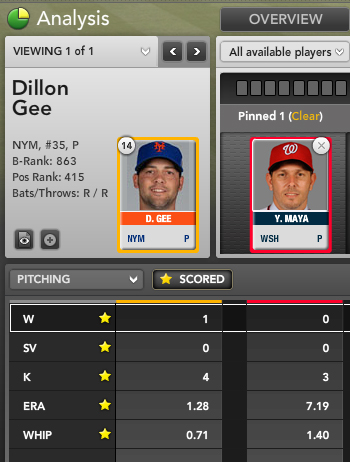
As for Gee’s results in his first two games? At first glance they look great: 12 IP, 1
R, 7 H, 1-0 record, 0.69 ERA. But seven walks against seven strikeouts, combined with facing the lowly Nats and Pirates, exacerbate the problem of focusing too much on such a small sample size.

Both of these pitchers have their upside mitigated by lack of dominant fastballs, and sussing out Maya’s future is complicated further by a lack of historical data on which to rely. Considering that Gee plays in a park that suppresses home runs, his flyball-oriented approach might just play well enough to help you down the stretch in a deeper league, and could make him a sleeper keeper candidate in deeper mixed or NL-only leagues.
For more on inexperienced pitchers like Yunesky Maya and Dillon Gee, check out Bloomberg Sports’ Fantasy Tools.

Rays Add Jake McGee to Major League Bullpen

By Tommy Rancel //

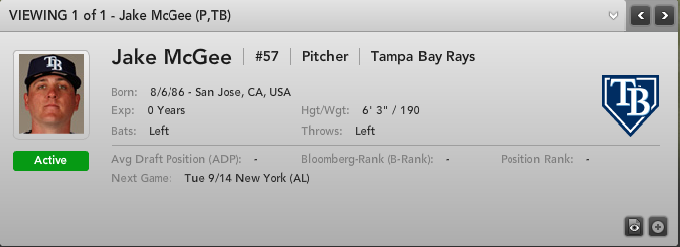
Before the 2008 season started, Jake McGee was named the 15th-best prospect in Major League Baseball by Baseball America. However, in the summer of ’08 McGee took a visit to a place no pitcher wants to go; Dr. James Andrews’ office. McGee would undergo Tommy John surgery – ending his season and wiping out nearly all of 2009.

Tommy John surgery is hardly a death sentence for young pitchers these days. Yes, the rehab is long and exhausting, but most come back and continue their careers. In 2010, McGee found himself where he left off in 2008, pitching for Double-A Montgomery. Although he went just 3-7 in 19 starts, his peripheral numbers were fantastic. He struck out 100 batters in 88.1 innings while allowing just 33 walks and 3 home runs.

After making his 19 Double-A starts, McGee was promoted to Triple-A Durham to work out of the bullpen. The Rays will likely say the move was made to limit the workload – and that is partially true – but one must wonder if this will end up as McGee’s permanent home.

Even before the injury, many had McGee pegged for a role in the bullpen. The lefty owns an excellent, mid-90s fastball, but has yet to find a consistent secondary offering. One really good pitch and two fringe pitches will get you by in a bullpen, but not a major league rotation.

In addition to the lack of secondary stuff, Jeremy Hellickson has risen through the ranks of the organization during McGee’s absence/return. Not only has Hellickson shot past McGee on prospect lists, he is also now blocking him in the pecking order of the Tampa Bay rotation.

That said, it is McGee who may be the most important Rays’ pitching prospect down the stretch in 2010.

mcgee.PNG

Upon his promotion to Durham, McGee was lights-out in the bullpen. In 17.1 innings, he allowed just one earned run while striking out 27 batters and giving up just three walks. Meanwhile, Hellickson has struggled in his transition to the bullpen.

Even before his struggles, Hellickson was not going to be used as your average relief pitcher. He was to pitch two or three times a week and was not expected to be brought into the middle of an inning. The rules for McGee are not likely to be the same.

With Randy Choate serving as the team’s only left-handed reliever, McGee should get some action as more than a lefty specialist – meaning coming into a game to face batters from either side of the plate, sometimes in the middle of an inning with runners on base. He will also likely to be used as needed instead of a pseudo schedule.

The one role the Rays have yet to fill this season is the one vacated by injured reliever J.P. Howell. Joaquin Benoit and Grant Balfour have been excellent set-up men, but neither is left-handed. In McGee, the Rays may finally have that lefty with the ability to get hitters of both handedness out.

If all goes well, it could be McGee and not Hellickson who plays the part David Price did in 2008. However, unlike Price, McGee’s time in the pen may not be temporary. There is no rush to add McGee in your single-year league right now. Indeed, McGee struggled mightily last night in his big league debut, throwing six straight balls before recording a strike, and generally looking very nervous.

But with the potential loss of Rafael Soriano as well as other key bullpen members like Benoit next season, McGee should be on your radar for fantasy bullpens of the future, and as a potential closer. He’s worth a pickup in keeper leagues.

For more on Jake McGee and the Tampa Bay Rays, check out Bloomberg Sports’ fantasy kits.

Is James McDonald a Treasure?

By R.J. Anderson //

James McDonald’s career has been anything but usual. Originally positioned as an outfielder, McDonald was converted to pitching during the 2006 season. He made his major league debut two years later in a relief capacity. Entering the 2009 season, the Dodgers deployed McDonald to the rotation, but quickly pulled the plug after four so-so efforts.

Most of the narrative about McDonald’s 2010 season rests in the minors. He made four appearances for the Blue Crew with one start before Ned Colletti shipped him to the Pirates along with another prospect for Octavio Dotel. The Dodgers still had illusions of postseason berth and yet the consensus at the time was something along the lines of, “That’s a bit too much for a reliever.” The consensus seven starts into McDonald’s career is now, “That was way too much for a reliever.”

McDonald’s performance is more responsible for the attitude shift than Dotel’s – although worsened peripherals have lead to an improved ERA – as the 25-year-old lanky righty has adapted well to the new environment. The Pirates have a reputation for their inability to develop power – read: strikeout – pitchers. McDonald may not possess a great American fastball, but he makes up for it with a freedom ringing curve and glistening change. Both of which have whiff rates over 13% since McDonald has began to don the black and yellow. Observe the portrait of a good McDonald start (i.e. mixing locations and keeping his offspeed stuff down):

mcdonald1.png

With all of this hype, McDonald’s 4.17 ERA looks unsavory, even sour. Where’s the fire with this smoke? The peripherals are ablaze; his FIP is 2.63 and his xFIP – which corrects his unsustainably low home run rate – is at 3.92. If he’s not giving up home runs, limiting his walks, and striking out most of the population, then how are teams scoring? Easy: the Pirates’ porous defense. That’s not just porous as in holey, but porous as in: the pitching staff is left saying, “Poor us.”

Neal Huntington and the rest of the Buccos’ front office is top notch – no, really – and fixing the defense should be the primary objective this offseason. It would certainly be hard to downgrade the leather. With that in mind, McDonald makes for an interesting case. Given the division and pitcher friendly ballpark, as well as extremely low costs, McDonald might be worth keeping in deeper National League only leagues, or at worst placing him on the watch list for next season.

For more on the Pittsburgh Piratesand their keeper prospects, check out Bloomberg Sports’ Fantasy Tools.

Is Luebke Worth Keeping?

By R.J. Anderson //

Cory Luebke started this season on the bottom side of most top 10 prospect lists centered around the San Diego Padres. The former first round pick from Ohio State University will never awe onlookers. He throws lefty and – insert the jokes here – his velocity ranges from 87-91 miles per hour despite throwing from a 6’4″ frame aged 25 years. Two starts into his Major League career and Luebke is raising his stock along with eyebrows. In 11 innings, he’s struck out 10 while walking three. His ERA is a sparkling 3.27 and more than 10% of his pitches have resulted in whiffs. Optimism is running wild for the former Buckeye, but will it continue?

In order to predict success for new major leaguers, analysts will start at one of two places: minor league stats or scouting reports. Let’s start at the latter. Most call Luebke a back of the rotation starter. A fancy way of saying he’s a pitchability (think of Greg Maddux/Tom Glavine as the kings of the throne) type but lacks something — something usually meaning a great fastball or put-away pitch. If Luebke possessed dime velocity and penny command he’d probably have the tag, “Frontline potential”.

The stats are more kind, but support the backend suggestion. Luebke’s strikeout rates reek of modesty since reaching the upper minors (his strikeout rates straddled the line between six and seven per nine innings pitched throughout) His walks per nine innings rates were fine — sitting below three — albeit a necessity with the rest of his skill set, and his ability to get groundballs is admirable. Most people’s problem with Luebke will be multi-layered. First, can he sustain success with his arsenal against the best hitters in the world; and next, how will he get right-handed batters out? Lastly, how does four-eyed vision really work?

luebke1.jpg

The early signs are positive but unfulfilling in their infancy. Luebke stands to benefit from an elite defense playing within a pitchers’ paradise. San Diego is the place to be; a place where someone with Luebke’s stuff can become more than a backend starter or an afterthought thanks to the environment. The phrase product of the environment can reign true and may. That’s why Luebke is interesting for the 2010 season, but not a must keep. Not yet at least.

For more on sleepers down the stretch, check out Bloomberg Sports’ Fantasy Tools.


Will Venable, Live from Petco Park

By Eno Sarris // 

Taking in a game at a new ballpark is one of those experiences that can take you back to being a kid again. Every corner is new, every angle needs to be explored, every dimension pored over. And that park will never be as vibrant, as exciting, and the grass will never seem as green again. It’s a great feeling.

Petco.jpgLast night, I was lucky enough to visit Petco Park for the first time, and even luckier to take in a game between a division-leading Padres team and a surging second-place Giants team. The stadium held up to inspection, as the beach in the outfield, the Western Metal building, and the many different layers combined to make an excellent modern collage of game-going.

The players were mostly veterans in the midst of a pennant race, but an exciting young player with power and speed stepped to the plate in the third inning against Matt Cain, waited out a pitch or two, and then deposited a 93 MPH fastball down the middle over the deepest fence in the park. Hitting a ball 400 feet in Petco can make people remember your name.

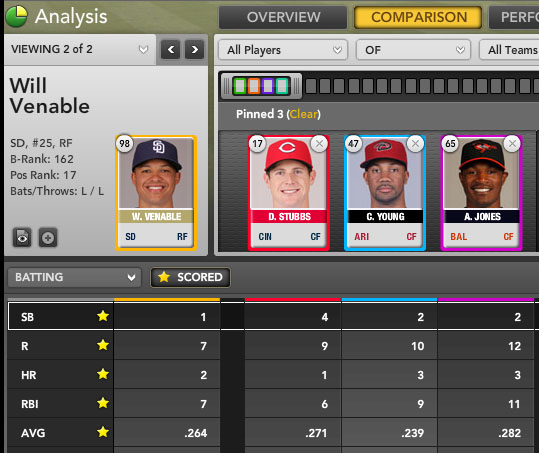
Will Will Venable live up to the promise of that deep home run? His main flaw was still obvious in the limited one-game sample: he struck out in his other two plate appearances and is striking out in more a third of his at-bats on the year. In fact, had Venable accrued enough at-bats this year to qualify for the batting title, he would currently be sporting the third-worst strikeout rate in the league. That will continue to work against his batting average (now .224, despite a fairly neutral .295 batting average on balls in play) if he doesn’t improve.

We’ve seen some players with power and speed and a high strikeout rate succeed – Chris Young and Mike Cameron come to mind – but Venable isn’t locked in at those rates just yet. He didn’t really show this problem in the minor leagues – a 20.1% strikeout doesn’t seem to predict a 30% strikeout rate in the major leagues. If Venable can make the strides that Young made when he cut his rate from 30.7% in 2009 to 23.6% this year, he should make similar strides in batting average. On the other hand, Drew Stubbs provides a foil in this matter – he posted a 27.3% strikeout rates in the minor leagues and 30.9% so far in the majors.

Unfortunately, with age comes wisdom, and we have to be realistic about Venable’s power, even as we hope he can beef up the contact skills. His isolated slugging rate (slugging minus batting average) in the minor leagues was only .152 – just about average for the major leagues. He’s edged that higher recently, but he’s still only at .169 for his career. That’s about the level of Adam Jones (.163 ISO this year) and Stubbs (.169 ISO this year), and not really in Young’s neighborhood (.202 carer ISO). One thing in Venable’s favor is that he’s put up this ISO despite a tiny 59 park factor for home runs by lefties in his home park. In that way, Venable is a more valuable commodity for the Padres than for fantasy owners.

VenableGrab.jpgOn the plus side for fantasy owners, though, Venable can definitely steal a base. He’s had an incredible 84.6% success rate on stolen bases in the major leagues, backed up by a similarly impressive 83.5% success rate in the minor leagues. He’s not a volume guy – he’s never stolen more than 21 in a given season – but he should continue to have success on the level of someone like Chase Utley, who has stolen 90 bases with an 87.3% success rate over 3600+ career at-bats.
 
Looking at Venable’s whole profile, we see a player who hasn’t necessarily shown the contact problems that Drew Stubbs has shown over his career, but does walk more (and strike out more) than Adam Jones and show similar power and speed. He does not really seem to have the power of Chris Young, and he has a power-sapping home park. He belongs in this group of young outfielders with power, speed and flaws.

If you’re in a keeper league, Venable and Stubbs are roughly in the same boat (even if you give Venable the higher likelihood of curbing the strikeouts): worthy adds for NL-only and deep mixed league formats, not worth the efforts in shallow mixed leagues or leagues that count on-base percentage and other, more sabermetrically-advanced offensive stats.

For more on this group of young toolsy outfielders and their keeper prospects, check out Bloomberg Sports’ Fantasy Tools.

How to Make Enemies and Influence Standings

By Eriq Gardner //

By now, many competitors have fallen out of contention in your fantasy baseball league, and may be chasing other pursuits, like fantasy football. For those of us still in the hunt, things can get very competitive and best yet, very strategic.

In rotisserie-format leagues, teams are looking to gain as many points possible. But that’s not the only way to win. If you’re sitting in second place, a few points out of the lead, any point your top rival loses is just as good as a point you yourself gain. It’s the points differential that counts. Not the total number of points accrued.

There are a few ways to indirectly influence your competitors’ standings position.

First, make sure your other leaguemates (the ones who have no real shot) are still paying attention to the league. They may not have a chance at first place, but in particular categories, they may still hold the power to beat your rival. So do whatever is necessary to get them engaged again. Attack their pride. Make fun of them for finishing last. Whatever. The point is that under certain circumstances, the indifference of others can be costly.

Second, pick your battles. For example, you might have an equal shot at gaining points in runs and RBI, but if you’re chasing your rival in runs but not RBIs you may wish to focus on the runs category. The upside there would be +1 for you and -1 for your rival. It’d be worth putting all your eggs in that basket with a high likelihood of success, rather than spreading risk by chasing both with a 50% probability of gaining +1 in runs and a 50% probability of gaining +1 in RBI.

Furthermore, you may wish to push your competitor to chase certain categories. For example, steals or wins — two categories that least correlate to the others. If you pick up a speedster to create the appearance you’re going after your rival in steals, he may respond by likewise doing the same. Perhaps his focus on steals might hurt his standing in RBI, since players who steal a lot of bases often don’t drive in many runs. In other words, examine every angle when considering the impact of your moves.

Third, and this may sound crazy, but there may be a time when it becomes prudent to drop a star player. Let’s say you comfortably have the lead in saves, but your rival is in the midst of a heated battle in that category. Heath Bell does less good for you on your team than he might do on another team, so long as it isn’t your rival’s team. If you play in a league that’s paying attention, and your rival doesn’t have a high waiver priority, it could be beneficial to just drop Heath Bell and hope someone other than your rival, competing with him in saves, picks up the Padres closer.

Clearly, not all of these tactics are “nice.” They won’t win many friends. But hopefully, there will at least be respect earned from a hard-fought season.

For more on fantasy baseball wisdom, check out Bloomberg Sports’ Fantasy Tools.