Carlos Pena, First Base Bargain?

By Tommy Rancel //

Despite being the Tampa Bay Rays all-time home run leader, Carlos Pena was the second-most important Rays player to sign with a new team at the winter meetings. Carl Crawford got the big bucks from the Boston Red Sox, and Pena is looking to make a big comeback with the Chicago Cubs in 2011.

A crown jewel in the Andrew Friedman collection, Pena went from first-round bust to MVP candidate in the span of one season. In his first year (2007) with the (Devil) Rays, the first baseman smashed 46 home runs and drove in 121 runs – both single-season franchise records. Unsurprisingly, he was unable to top those numbers in any of the next three seasons, but still managed an impressive OPS of .884 in his time with the Rays.

Pena became the franchise all-time home run leader this past season. His 144 home runs in a Rays uniform also rank as the sixth highest total in baseball since 2007.

For all the good done – on and off the field – during his time with the Rays, Pena ended his career with the Rays on a down note. Just three years removed from his breakout campaign, Los hit just .195/.325/.409 in 2010.

Aside from the massive number of strikeouts which are typical for a three outcome hitter (home runs, walks, and strikeouts), groundball outs were also a problem for Pena this past season. His 44.9% groundball rate was his highest total in any full-season.

The last thing you want from primary home run hitter is nearly half the balls he puts in play staying on the ground. His slash line (AVG/OBP/SLG) on grounders was an abysmal .137/.137/.151. The .137 BA represents the second-lowest average on groundballs (min. 100 PA) in the majors, owing to Pena’s lack of speed, and teams shifting on him to prevent right-side grounders from scooting through the infield.

Though he may be on the downside of his career, Pena’s power is still a threat. Aside from the terrible slash line, the strikeouts, and high number of grounders, Pena still managed to hit 28 home runs last year. Also consider, he is moving from a below-average hitter’s park for left-handed batters to one of the friendlier parks for lefties. According to statcorner.com, Tropicana Field had a home run park factor of 89 for LHB (neutral is 100). Wrigley Field, on the other hand, had a park factor of 119. NL Central pitching is likely to be easier to handle than that seen in the AL East too.

After whiffing (literally) on his chance of a big payday this off-season, Pena gets another chance with this one-year, $10 million deal with the Cubs. With contract motivation, a ton of natural power, a home run friendly environment, and even reuniting with hitting guru Rudy Jaramillo, Pena could be poised for another 30-plus home run campaign.

For fantasy owners who don’t want to pay premium prices for a first baseman, Pena could be a good sleeper. At a stacked position, and coming of a down year, he could get lost in the shuffle in some leagues. While Adrian Gonzalez, Albert Pujols, and Joey Votto go early, you can focus on a weaker position (say, shortstop Troy Tulowitzki) in the first few rounds and target Pena as a mid-to-late-round selection in mixed leagues.

Jason Bartlett to San Diego

By R.J. Anderson //

Jason Bartlett’s name popped up in trade rumors more than nearly any other ballplayer in the land. No longer will that be the case, as the Tampa Bay Rays have reportedly traded Bartlett to the San Diego Padres for relief pitchers Adam Russell and Cesar Ramos.

Let’s begin with the fantasy implications for the Padres. Bartlett immediately steps in as their starting shortstop, diminishing whatever value Everth Cabrera may have held. The 31-year-old Bartlett hangs his fantasy hat on a strong 2009 (.320, 14 HR, 66 RBI, 90 R, 30 SB), when he benefited from an inflated batting average on balls in play (.364 – league average is typically near .300). His 2010 season (.254, 4 HR, 47 RBI, 71 R, 11 SB) represented a hasty step-back, one that resembles what folks should expect moving forward.

Stepping into an arctic offensive environment at Petco Park is unlikely to help. There are some slivers of good news, though: Petco is harshest on left-handed power hitters (Bartlett is neither left-handed nor a power hitter) and a bounceback in steals could be in the works (Bartlett stole at least 20 in three straight years before only taking 11 bags in 2010). A hidden source of upside with Bartlett in the National League West is the large number of left-handed starting pitchers; Bartlett typically feasts off lefties. He struggles against righties, though, and is a good bet to miss two weeks a season with a lower body injury.

In Bartlett’s place, the Rays will insert one-time top prospect Reid Brignac. A left-handed hitter with a better glove and more power potential than Bartlett, Brignac hit .256/.307/.385 with eight homers in 326 plate appearances last season. Brignac becomes an intriguing option in AL-only leagues and potentially a mixed league option if he improves on his plate approach.

As for the pitchers: Ramos is the less interesting of the two. He could be nothing more than a middle reliever or a situational lefty. However, Russell could be a sleeper candidate for saves, given that most of Tampa Bay’s bullpen graduated to free agency, including all of their set-up men and closer Rafael Soriano. Russell is a big guy (6’8″) with a mid-90s fastball that sinks. In 54 career big league innings he’s struck out 54 batters, and his minor league track record also augurs well in that regard.

Russell’s exact role will be determined later this off-season, and might not be solidified until the 2011 season has begun. But he might very well provide the most fantasy value next year among players involved in this deal.

Miguel Tejada Heads Back To NorCal

By Tommy Rancel //

San Francisco Giants’ general manager Brian Sabean has a type: aging middle infielders. From Omar Vizquel and Ray Durham to Juan Uribe and Edgar Renteria, Sabean always seems to find a past-his-prime infielder that puts a little twinkle in his eye. His latest move follows that blueprint: the signing 36-year-old Miguel Tejada to a one-year deal worth $6.5 million.

Tejada is familiar with the Bay Area, having spent the first seven years of his career with the Oakland Athletics. Unfortunately, the production he put up as a member of the A’s is just a memory.

In recent seasons, he has transformed from a slugging run-producer to a contact-driven, league-average hitter with a little pop left in the bat. From 1998 to 2006, Tejada averaged 26 home runs and 105 RBI a year. Since then, he’s averaged just 15 home runs and 76 RBI per year.

On the other hand, 15 home runs, 75 RBI, and 80 runs scored would be a pretty solid season, given the weak current group of MLB shortstops. The only two players to top those marks in 2010 were Hanley Ramirez and Troy Tulowitzki – the two best offensive shortstops in the game.

Also working in Tejada’s favor is durability. He’s averaged 151 games played over the past four years, while averaging more 40 extra-base hits a season. The question for the Giants is, can he handle 140 games at shortstop? But as a fantasy owner, he’s also earned his SS eligibility for 2011.

After the top tier of Ramirez, Tulowitzki, and the second level of Stephen Drew, Starlin Castro, and Jose Reyes, the remaining NL options have as many – if not more – offensive question marks than Tejada in 2011.

If you are unable to land one of the top guys early on draft day, sit back and wait. Odds are the latest Sabean Special will be available later as a potential starter. The risk of Tejada completely deteriorating is real, but the minimal cost in terms of a draft pick with the likelihood of league average production should be worth it in NL-only leagues; his counting stat potential even makes him a decent choice at the end of a mixed-league draft.

Brewers, Blue Jays Swap Shaun Marcum for Brett Lawrie

By Tommy Rancel //

Tucked behind the announcement of Jayson Werth‘s monster contract with the Washington Nationals, the Milwaukee Brewers acquired starting pitcher Shaun Marcum from the Toronto Blue Jays in exchange for top prospect infielder Brett Lawrie.

Marcum returned in 2010 after missing the entire 2009 major league season due to Tommy John surgery. Once a death sentence for pitchers, Marcum is the latest in a long line of post-Tommy John success stories. He made 31 starts for the Jays, tossing 195.1 innings – both career highs. He never had much of a fastball to begin with, but his velocity returned to the high 80s.

Had Marcum been able to make 30 starts and toss 200 innings with mediocre results, it would’ve still been considered a successful comeback. Meanwhile, he not only returned healthy, but very effective. After posting a 3.39 ERA in 25 starts back in 2008, he went 13-8 with a 3.64 ERA in 2010. The 13 victories also qualify as a career high.

Without the natural ability to blow hitters away with a blazing fastball, Marcum has relied on one of the best change-ups in the game to get hitters out. While throwing the pitch more than 25% of the time in 2010, he was able to get a swing and a miss a jaw-dropping 28.1% of the time.

Because of the pitch’s effectiveness, Marcum has been able to have great success against left-handed batters, defying the usual platoon disadvantage. Last season, LHB hit just .190/.233/.299 against him. So pronounced was Marcum’s reverse split that Tampa Bay Rays manager Joe Maddon employed a reverse-platoon lineup against him that featured mostly right-handed batters.

In addition to the unhittable change-up, Marcum exhibited above-average control. His strikeout rate near 7.5 strikeouts per nine (K/9) was slightly above the league average (7.13) while his walk rate of 1.98 was well below (3.28).In fact Marcum posted the 6th-best strikeout-to-walk ratio in the league, topping even the likes of Cy Young winner Felix Hernandez – while pitching in a tougher ballpark, in a tougher division.

Marcum, 29 as of opening day, should be on your list of #2 starters headed in 2010 – he’s that good. The recovery from surgery looked complete last year. Also, consider that the shift to the National League – more specifically the NL Central – should benefit Marcum going forward.

On the Toronto side, it is unknown who replaces Marcum in the rotation; in Brett Lawrie, they did receive Milwaukee’s top prospect. Last season as a 20-year-old in Double-A, Lawrie hit .285/.346/.449. He hasn’t shown much home run power, yet still smacked 59 extra-base hits last year.

Thus far, Lawrie has played second base exclusively in the minor leagues. That said, there are some who say he is destined for the corner outfield in the future. There is also some speculation that Toronto may have acquired the native Canadian in order to flip him in a package for another piece. In any event, there is little chance that he has a significant fantasy impact in 2011 – outside of a potential September call-up.

Werth to Washington

By R.J. Anderson //

Separating current value from future value is a must in the world of transaction analysis; less so in the fantasy world, where so many leagues go with limited (or no) stability from year-to-year. Understanding that is paramount to understanding the negative reaction to Jayson Werth’s signing in the real world. The common critical points arising are that seven years is too long for someone Werth’s age (31), that $126 million is too much, and that the Nationals will not benefit from this deal when they are nearing competitor status. And yet, none of that matters in the fantasy world.

Werth is one of baseball’s best right fielders offensively or defensively. Over the last three seasons he’s hit .279/.376/.513 while averaging 29 home runs per season, 84 runs batted in, and 8 steals. His ability to steal bases and play defense is important to note. Whereas a player like Adam Dunn – whom Werth ostensibly replaces in the Nationals’ lineup – derives much of his value from hitting home runs and drawing walks – like Werth — receives criticism for his skill set that ages poorly, Werth is more athletic and should age better. That does not mean Werth will live up to that line this season, though, it just means don’t expect a sudden collapse.

What everyone should expect is for Werth’s new ballpark to limit his home runs. Not egregiously, but a few here and there. Citizen’s Bank Park is one of the kindest to right-handed batters in the game. Nationals Park isn’t mean to them, but it’s not nearly as charitable. The other aspect of the Nationals’ organization that may affect Werth is the talent around him. Werth batted behind Chase Utley and Ryan Howard last season, sometimes far enough behind that he didn’t benefit fully from their ability to reach base. With Washington, he figures to bat ahead of or directly behind Josh Willingham and Ryan Zimmerman, who both got on base roughly 39% of the time last season.

With young talent like Danny Espinoza, Ian Desmond, and of course Bryce Harper potentially filling out the Washington lineup sooner than later, there’s a chance Werth can continue to knock in 85-plus a season to along with 25 or so home runs and a .275 or so batting average. He shouldn’t rise up your charts because of this signing, but he shouldn’t fall either.

For more on Jayson Werth, check out Bloomberg Sports’ Front Office.  

var OutbrainPermaLink=’http://bloombergsports.mlblogs.com/archives/2010/11/brandon-belt-is-buckled-in-and-ready-to-go.html’;
var OB_Template = “mlbblogs”;
var OB_demoMode = false;
var OBITm = “1241712535489”;
var OB_langJS =’http://widgets.outbrain.com/lang_en.js’;
if ( typeof(OB_Script)!=’undefined’ )
OutbrainStart();
else {
var OB_Script = true;
var str = ”;
document.write(str);
}

How the Adrian Gonzalez Trade Shakes Up the Rankings

By Eriq Gardner //

Quick brain tease — Now that Adrian Gonzalez has been traded to the Boston Red Sox, how does his prospective value in fantasy leagues compare to Miguel Cabrera, Joey Votto, and Mark Teixeira?
A week ago, Gonzalez would clearly be somewhat behind those players in the rankings. Now? It’s not so clear. And the ambiguousness could make a major impact on fantasy baseball, influencing not only Gonzalez’s stock, but also valuations on Troy Tulowitzki, Robinson Cano, and pretty much all superstars heading into the 2011 season.
But first, let’s take a quick look at Gonzo himself.
For the past several seasons, Gonzalez has been one of the most consistent players in baseball — a 30-plus HR slugger with the ability to hit for average and get on base. If he’s never ranked in the top 5 among 1B, it’s largely because of environmental context, playing in the most pitcher-friendly ballpark in the majors with teammates who struggle to get on base and knock him in. Despite the handicaps, Gonzalez has averaged around 100 RBI and 100 runs scored for the past four seasons.
During that time, Gonzalez has 90 homers in road games — more than anybody else in the game. Only Albert Pujols during that time had a better road OPS. 
Gonzalez is not just moving away from a pitcher-friendly ballpark; he’s moving to a home stadium that will be kind to his talents. According to Baseball-Reference, he’ll be moving away from a ballpark in Petco that depresses production by left-handers by 10% and moving to a ballpark in Fenway Park that boosts production by left-handers by 6%. The parks factor difference between the two stadiums was enough to cut his HR total by roughly six homers per season. Adjusting his batting average to the new environment also yields shockingly great results — his .298 average in San Diego would have translated to a .323 average in Boston.
Gonzalez will also be playing in a superior lineup in Boston. Last season, he led the NL with the highest batting average (.407) with runners in scoring position. One has got to figure that the move to Boston will boost his RBI totals. Dan Syzmborski, who runs ZiPS projections at Baseball Think Factory, recently credited Gonzalez with an extra 14 RBI in his forecast for the upcoming season, which may be a conservative assessment.
In sum, it’s easy to imagine, assuming good health, that Gonzalez could be good for 35-plus HR, 115 RBI (or more), and a .300-plus AVG. That certainly puts him in the same ballpark of value as Miguel Cabrera and Joey Votto.
Many people still prefer those latter two, but for what legitimate reasons? Gonzalez’s off-season shoulder surgery? The fact that he hasn’t yet shown he can handle Boston fans and media? Perhaps, but almost everyone around baseball thinks that Gonzalez is a hard worker who won’t fold under pressure, and he recently passed a physical that was a prerequisite to the transaction.
Regardless of where exactly he ranks, it’s clear there’s more depth at the top-end of the 1B pool, and basic economics state that more supply translates to falling prices.
Let’s take an example.

Pretend we’re in the middle of the first round and an owner has the choice between Votto and Tulowitzki. A week ago, the consensus would be for Votto. Now? Does a drafter choose Votto when his competition can take the roughly equal Gonzo a few picks later? Does choosing Votto make sense when other 1B like Teixeira and Ryan Howard may now be available in the 2nd round, as a result of being pushed down in the rankings? Tulo’s edge over other shortstops should be given more credit given the increased strength and depth at first base.

In other words, we’ve just seen a major shakeup in talent scarcity. And it’s not just at the 1B position either. 
The fact that Gonzalez will be manning 1B means that Kevin Youkilis will be playing 3B — which is a big boost to a position that’s been suffering in recent years. Now, all those considering Alex Rodriguez at the end of the 1st round will have to consider the possibility of getting Youkilis a couple of rounds later. We’ll speculate that someone like Robinson Cano may begin to look more appealing at the end of the 1st round with drafters seeing more options at 1B and 3B and looking to fill out the rest of their lineup first.
In short, the move by Adrian Gonzalez from San Diego to Boston is a big rock thrown into an unsettled pond. It’s going to take several months to really measure the impact of this move on fantasy baseball valuations heading into 2011.

Juan Uribe Joins the Dodgers

By R.J. Anderson //

The Dodgers have been one of the most active teams this off-season. All of their moves to date had focused on bolstering their rotation: re-signing Ted Lilly and Hiroki Kuroda, then signing free agent Jon Garland. Their latest is an attempt to solidify their middle infield (specifically second base) while weakening a division rival. They believe they’ve done so by signing Juan Uribe to a three-year deal worth $21 million.

The shift away from shortstop and to second base actually limits Uribe’s real world value. Uribe’s defensive skill set is the opposite of David Eckstein’s. His arm gives him the ability to make long, tough throws, meaning he should be playing on the left side of the infield.

Uribe’s offensive value should be unaffected by the park change and he remains a safe bet to hit 15 to 20 home runs during any season where he amasses 500-plus plate appearances. Not everything in Uribe’s offensive game is that dependable or worthwhile, though, as his slash line over the last three seasons is a combined .261/.312/.443. That batting average and on-base percentage are weak, even for a middle infielder.

Making matters worse is Uribe’s unpredictable aging curve. He turns 32 in July and carries a history of problematic conditioning. Now, those issues were a few seasons ago, and perhaps it is unfair to place the sins of a younger (and possibly less dedicated) Uribe upon this version. Being this is the first comfortable contract Uribe has bagged in a while, though, the possibility remains that he could become a little too relaxed about his work ethic.

Nevertheless, Uribe remains a decent mixed league option for 2011 at shortstop and second base (he also qualifies at third base), thanks to his steady power output. Just don’t expect much if your league values on-base percentage in any form.

For more on Juan Uribe, check out Bloomberg Sports’ Front Office.  

var OutbrainPermaLink=’http://bloombergsports.mlblogs.com/archives/2010/11/brandon-belt-is-buckled-in-and-ready-to-go.html’;
var OB_Template = “mlbblogs”;
var OB_demoMode = false;
var OBITm = “1241712535489”;
var OB_langJS =’http://widgets.outbrain.com/lang_en.js’;
if ( typeof(OB_Script)!=’undefined’ )
OutbrainStart();
else {
var OB_Script = true;
var str = ”;
document.write(str);
}

Derek Jeter Will Be Valuable For Fantasy Owners in 2011

By Eriq Gardner //

Derek Jeter has been a popular topic on this website of late. R.J. Anderson recently pointed to the icon’s bleak future and Eno Sarris explained why the shortstop would have dwindling value if he left the Yankees.
Here’s the contrarian viewpoint: Jeter will bounce back in a big way in 2011. Much of the explanation on why this will be the case is grounded upon a few points I’ve made in recent posts. 
First, while it’s true that the production of past-their-prime All Stars gradually diminishes over time, rarely does it so happen in straight linear fashion from one year to the next. 
Last season, Jeter had a .270 batting average, the lowest mark of any full season in his career. In fact, Jeter has never hit below .290 in a full season until 2010 and he has topped .300 in 11 of his 16 seasons. In figuring out what Jeter is likely to do next season, do we look at last year and see it as the beginning of a trend, or do we look at the past several years and go with the larger body of work? The smart method is to split the middle. He may not reach .300, but he’ll hit higher than .270.
Despite the fact that Jeter hit only .270 last season, he still managed to score 111 times and total 67 RBI. A batting average that regresses positively towards career norms would mean more hits and more times on base. More hits likely means more RBI. More times on base means a greater opportunity to score. Even if Jeter left the Yankees, and suffered from less talented teammates hitting around him, the damage to his Runs and RBI would be mitigated by having having more success at the plate.
Second, talent at shortstop is atrociously bad these days. Jeter may be on the decline, but his production hasn’t fallen off at the same rate as the production of his peers at the shortstop position. Jeter isn’t the same 20/20 player he was in 2004. However, back then, he was competing against seven other shortstops with at least 20 HR. Last season, only four shortstops hit 20 homers. Jeter’s numbers may be slipping, but his positional strength hasn’t moved much.
But let’s examine that point further. Sarris asks whether anyone would pick pick Jeter over Alexei RamirezStephen Drew, or Elvis Andrus. Here’s a thought exercise. Let’s take this projected line for Jeter in 2011:.292 AVG, 87 Runs, 57 RBI, 10 HR, 20 SB — a fairly modest projection given Jeter’s career norms. Yet it still measures favorably compared to what Ramirez, Drew, and Andrus did last season.
Of course, those three players are younger and perceived as having some room to grow. But do they really hold more upside than Jeter? 
Jeter is only one year away from coming off a season in which he hit .334 with 18 HR and 30 SB. Not even the most optimistic projections give Ramirez, Drew, and Andrus a shot at producing those kinds of numbers in 2011. We know that Jeter hit those marks at age 35. It might not be likely he’ll do it again at age 37, but one has got to figure he still maintains greater potential to approach those numbers than some of the others. Both Ramirez and Drew have been in the big leagues for a few years and so we can project what they’ll do with a good deal of confidence. Andrus is an exciting youngster, but hasn’t yet shown the ability to hit for high average and is coming off a season where he didn’t hit a single home run.
But the fact that smart folks are willing to entertain the thought of moving Jeter down a peg or two in the shortstop rankings — especially if he leaves New York — moves me to the most crucial point.
For years, Jeter may have been slightly overdrafted thanks to reputation and the uniform he wore. This off-season, he’s experiencing the worst streak of bad publicity in his Hall of Fame career. Obviously, this means his draft price will fall despite all the arguments presented above that show why Jeter’s potential value hasn’t significantly changed. A falling price creates a better investment opportunity.
One can debate whether Jeter deserves $20 million a year at the age of 40 years old. But as a short-term fantasy buy in a year of high positional scarcity, he’s a solid option.
For more on Derek Jeter and other shortstops, check out Bloomberg Sports’ Front Office.

Not Bullish On Jeter In a New Uniform

by Eno Sarris //

Things are getting heated in the negotiations between Derek Jeter and the Yankees. Over the holiday week, Brian Cashman dropped this bomb in typically understated fashion:

“We understand his contributions to the franchise and our offer has taken them into account,” Cashman said. “We’ve
encouraged him to test the market and see if there’s something he
would prefer other than this. If he can, fine. That’s the way it
works.”

That is the way it works, but of course the baseball blogosphere took the tidbit and ran with it. Some of the fake baseball cards created by Beckett.com were chilling, and the prospect of Jeter in another uniform should be doubly chilling to fantasy players planning on snapping up Jeter as a bounce-back shortstop in 2011.

R.J. Anderson did a fine job taking a look at the historical precedent that 37-year old shortstops have provided in his article on Jeter earlier in the month. The most damning paragraph:

In June, Jeter will turn 37. No shortstop (defined by
having played at least 50% of their games at the position along with 300
plate appearances) aged at least 37 has ever hit more than nine home
runs in a season. Since 1970, only 20 shortstops met that qualification
after turning 37, with the highest batting average being .295, the
highest on-base percentage being .367, and the highest slugging
percentage being .419. Over the last three seasons, Jeter’s line:
.301/.369/.414. Meanwhile, only two of those players finished with an
OPS above the league’s average.

Looking at Jeter’s combination of BABIP and batting average last year (.307 BABIP, .270 batting average), you might wonder where some optimistic batting average projections are coming from. Bill James has him projected at .295, for example. On the other hand, Jeter is still athletic, has a much better career BABIP (.356), and could easily find himself batting closer to .300 next year.

And yet, if Jeter ends up in a different uniform, he probably won’t be a great bounceback pick. Three important statistics that have always been in Jeter’s favor could then work against him: plate appearances, runs and RBI.

If Jeter were to don a new uniform in 2011, the most vulnerable statistic would be runs scored. Since Jeter joined the Yankees’ lineup for good fifteen years ago, he’s averaged 112 runs per season. That’s meant that even in his worst seasons, he’s been a boon in the category. The Yankees lineup has driven him in prolifically, and last year that offense scored the most runs in baseball (859). The offenses on the two teams that have been linked to Jeter, the Giants and Orioles, weren’t even close. In fact, the Giants (697 runs) scored only 81% of the runs that the Yankees scored.jetercardgiants.jpg

Let’s say we walk the runs and RBI projections for Jeter back 15% – after all Jeter would improve those two lineups ostensibly – and the package looks a little worse. Now we’re talking about a player that will gather around 85 runs and 50 RBI.

And there’s one last caveat. The projections we’ve been using here – Bill James’ on FanGraphs – use 703 plate appearances. A 37-year-old shortstop has never amassed 700 plate appearances. Omar Vizquel‘s 659 plate appearances in 2006 is tied with Luke Appling‘s effort in 1946 as the most ever by a 37-year-old at the position. Only nine other men have ever crossed the 600 plate appearance threshold. If we remove another 50 plate appearances to place Jeter in the middle of the best old shortstops ever, now we’re hoping that Jeter can get to double-digits in homers and steals, and worrying that he might not garner even 80 runs and 45 RBI.

Later in 2011 drafts, you may be looking at Jeter among some shortstops that are at least five years younger than him. Would you pick Jeter over Alexei Ramirez (.280, 18 HR, 80 R, 78 RBI, 12 SB), Stephen Drew (projected for .270, 16 HR, 82 R, 67 RBI and 8 SB), or Elvis Andrus (.274, 2 HR, 82 R, 43 RBI, 34 SB)?

The answer to that question will depend, of course, on the actual draft positions required to grab each of the shortstops in question. But, looking at the runs and RBI totals of this projected crew, it doesn’t look like Jeter would be the same old Jeter in a new uniform. Fantasy managers looking to grab Jeter as a value should join the throng hoping that Jeter will re-up with the Yankees.

For more on Derek Jeter and other shortstops, check out Bloomberg Sports’ Front Office.

Who is Tsuyoshi Nishioka?

By Eriq Gardner //

The Minnesota Twins have a chance to sign Tsuyoshi Nishioka, after winning the exclusive rights to negotiate a contract with the 26-year-old Japanese infielder.
Will Nishioka be a sleeper heading into the 2011 season?
The answer might depend, in part, on Nishioka’s position eligibility. He played shortstop for the Chiba Lotte Marines in Japan, but the Twins are said to be considering him as a replacement for Orlando Hudson at second base. But that’s not set in stone yet. The Twins are also rumored to be exploring trading J.J. Hardy, and many fantasy league service providers could give Nishioka shortstop credentials anyway, thanks to his time spent at the position last year in Japan.

shortstopsrunscreated1.png

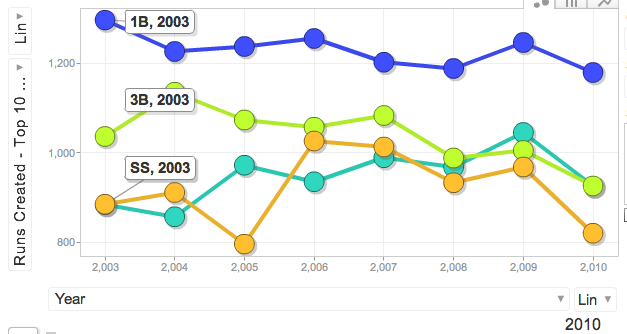
It may seem like a small point, but the difference between second base and shortstop could mean a lot as far as his value in 2011 fantasy baseball.
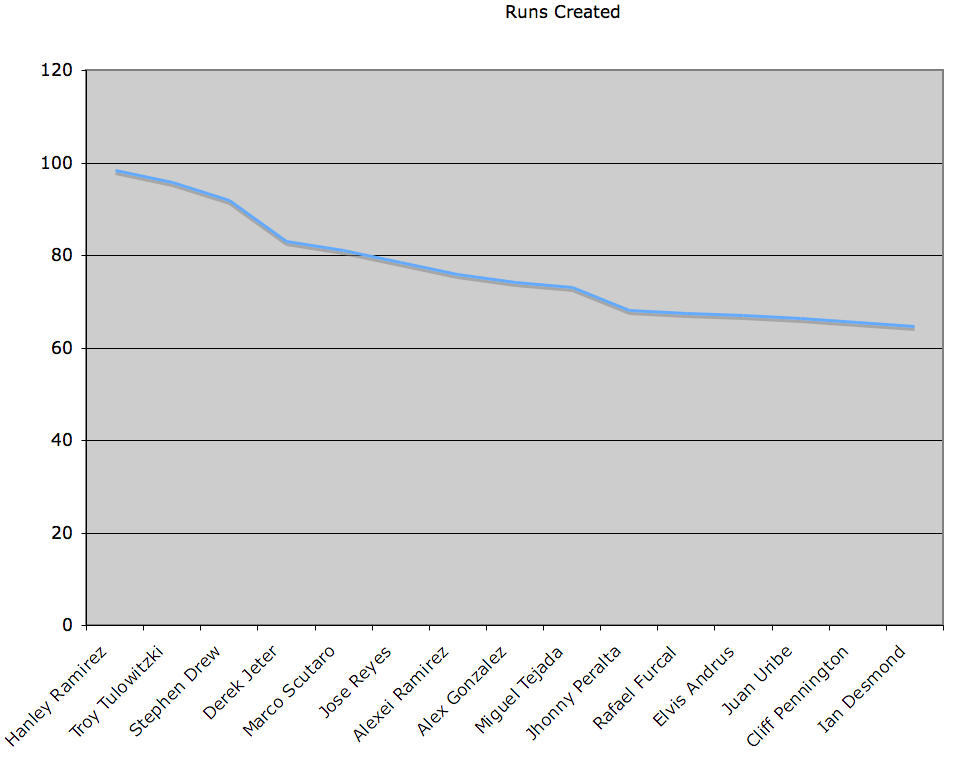
Talent at shortstop, after all, is extremely thin. Even Hanley Ramirez and Troy Tulowitzki couldn’t help the league’s top 10 shortstops from posting the fewest amount of runs created in any time since 2006. Compared to their peers at second base and third base, shortstops are clearly are the worst run producers in the infield. (See chart.) 
Take a look at the top options at shortstop and you will see a mixture of aging veterans like Derek Jeter, Jimmy Rollins, and Rafael Furcal and a gaggle of slightly younger types like Alexei Ramirez and Stephen Drew who aren’t quite superstars. 
Last year in Japan, Nishioka hit 11 HR, had 22 SB, scored 121 times, and put up a .346/.423/.482 slash line. We’d be lying if we claimed to have seen a second of this guy play, but judging by the stats alone, the comparables to Ryan Theriot or Chone Figgins sound reasonable. That might not sound like much. Others make the case there’s a shade of Ichiro Suzuki in him. Again, he’ll have to be graded on a curve depending on where he gains eligibility.

shortstopsrunscreated2.png

Assuming he does get credit for his ability to play shortstop, he may very well be worthy of early speculation. After the top players at shortstop, the talent curve becomes relatively flat (See chart #2). We believe this means it’s best to either invest a lot on a premium player like Hanley or Tulo or wait until the very end of drafts to secure a shortstop who can come close to average production at a fraction of the price.
Fantasy managers who opt for the latter course will likely want a shortstop who brings some upside. Being an unknown quantity isn’t quite the same as having upside, but Nishioka has at least shown a very good batting eye and an ability to run the bases. The Twins will also have an opening near the top of their lineup with the likely departure of Hudson. Since Nishioka will be slightly off the radar at the opening of the season, the price may be right to gamble on hitting it big with this Japanese import.
For more on more fantasy baseball sleepers, check out Bloomberg Sports’ Front Office