Worth The Hype? A Look At Jason Heyward

By Tommy Rancel //

A mid-season power outage (which coincided with a thumb sprain) left Jason Heyward short of the power expectations some had for the windshield-shattering prospect. Before his original thumb injury (which occurred in lay May), Heyward smashed nine home runs in his first 158 plate appearances with a .580 slugging percentage. Post-injury, he hit nine home runs in 485 plate appearances and slugged just .414. Even with a few nagging injuries, the man-child posted a slash line (AVG/OBP/SLG) of .277/.393/.456 with 52 extra-base hits over his first 623 major league plate appearances.

Despite having a batting average below .280, Heyward displayed excellent on-base skills with an OBP of near .400. His lack of age and experience did not prevent him from showing a a mature batting eye, walking nearly 15% of the time. While his batting average came it at .277, Heyward was very successful when putting the ball in play.

His batting average on balls in play (BABIP) of .335 was well above the league average which falls around .300. Normally, when a player hits for such a high BABIP it is a cause for concern in regards to regression; however, in the case of the athletic and hard-hitting Heyward regression is not automatic.

Heyward maintained a higher-than-usual BABIP with a relatively normal line drive rate. Sometimes when a player hits an unsustainable amount of line drives, a quick and steep regression is likely to follow. In this case, the J-Hey Kid had a high BABIP with a large amount of groundballs. For a player without speed (remember back to our article on Joey Votto) this could be a problem. Meanwhile, Heyward has good speed even though large amounts of steals have never been a part of his game. That said, Heyward could still see some batting average fluctuation.
 
Some owners may have concerns about Heyward’s durability. In addition to the thumb sprain that landed him on the disabled list, he also battled some knee and groin issues The good news is in the 320 plate appearances after his stint on the disabled list. he hit .302 with seven home runs.. Even if he becomes a player who takes an annual 15-day vacation because of nagging injuries, the level of production when healthy makes up for it.

Though he is no longer the unknown phenom, Heyward is one of the most exciting young players in baseball. And though he did not take many steal attempts, the potential for a 25HR/15SB season is still there. Even with the lingering thumb issue, target him in the mid-rounds of your draft as a solid OF2 or OF3 option depending on the size of your league.
 

Figuring Out Booms And Busts In 2011

By Eriq Gardner //

There’s tremendous profit to be made in betting on players who have just come off of miserable years and staying away from those who have just enjoyed fantastic seasons. 
Let’s show by example.
Heading into last season, some players had momentum from the 2009 season while others were being dismissed as showing warts. Let’s call the first class of players “Group A” and the second class of players “Group B.”
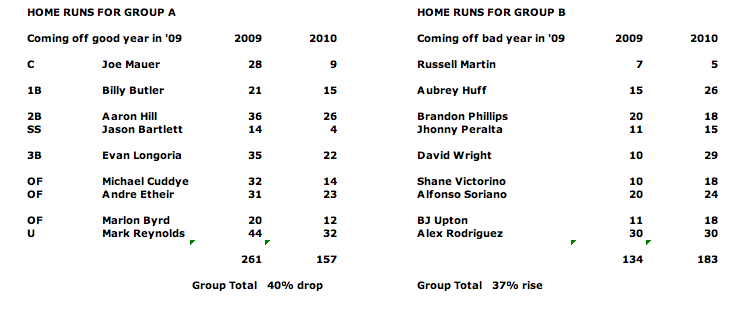
To assemble a team of Group A All-Stars, we looked at which relatively healthy players at each position had the largest percentage of their 2007-2009 HR total in the ’09 year of this three-year sample. This team consisted of Joe Mauer, Billy Butler, Aaron Hill, Jason Bartlett, Evan Longoria, Michael Cuddyer, Andre Ethier, Marlon Byrd, and Mark Reynolds.
And to assemble a team of Group B All-Stars, we looked at which relatively healthy players had the smallest percentage of their 2007-2009 HR total in the ”09 year of the three year sample. This team consisted of Russell Martin, Aubrey Huff, Brandon Phillips, Jhonny Peralta, David Wright, Shane Victorino, Alfonso Soriano, BJ Upton, and Alex Rodriguez.
Heading into the 2010 season, almost everyone would have bet on Group A to dominate Group B in HRs that year. Together, Group A slugged 261 HRs in 2009 whereas Group B only slugged 134. 
Guess what? By the end of 2010, Group B had more home runs than Group A. Take a look…
momentumvtrackrecord.png
Certainly not every player experienced what’s known in the trade as “regression to the mean.” But as a whole, Group A’s power numbers dropped 40 percent while Group B’s power numbers rose by 37 percent.
Most people know that players coming off of great seasons tend to be overvalued into the next season, but does everyone really give this phenomenon its proper due? Young players who do great are said to be on the rise. Older players who do poorly are said to be on the decline. But often, the production shifts we see from one year to the next are largely statistical noise. It might be more important to take a larger three year sample when considering who to roster in fantasy leagues.
With that said, let’s take a look at potential Group A All-Stars heading into the 2011 season. These are players whose 2008-2010 HR total is most heavily weighted to last season. Something to be aware about before investing to heavily in players like Robinson Cano, Joey Votto, Vernon Wells, and Corey Hart.
GroupA2011.png
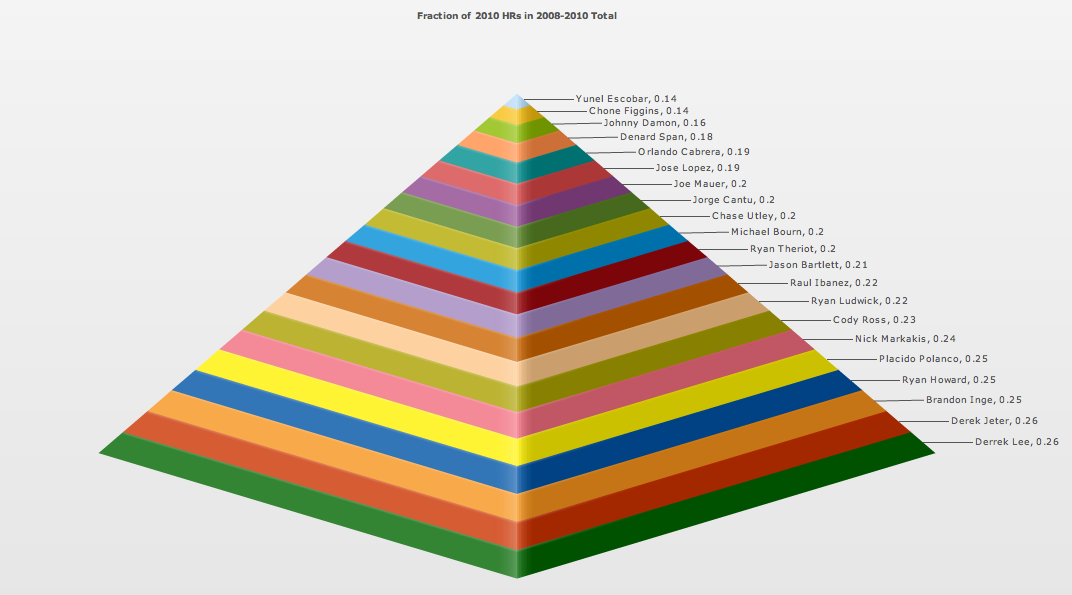
And here’s a look at potential Group B All-Stars heading into the 2011 season. These are players whose 2008-2010 HR total is least heavily weighted to last season. Some players whose HR production could regress towards the positive side include Yunel Escobar, Johnny Damon, Jose Lopez, Joe Mauer, Chase Utley, Nick Markakis, Ryan Howard, Derek Jeter, and Derrek Lee. All of these players are going for less in drafts heading into this season than a year ago.
GroupB2011.png

Fantasy Baseball and the Yankees Fifth Starter

by Eno Sarris // 

Most teams fudge the fifth starter from year to year, hoping that that a young prospect or retread veteran takes the reins and provides the team for just enough for the team to win games at a decent clip. The Yankees are no different in this regard – and yet they’ve had some decent fifth starters over the years. Some even rose to fantasy relevance.

Well, not many. Phil Hughes, in his 2007 debut and again in 2009, might have been the best. Sergio Mitre and Ivan Nova were decent enough to find a few spot starts in mixed leagues last season. Otherwise, it’s been a bad stretch.

Joining the fun over the past week are Bartolo Colon and Freddy Garcia. That’s a pretty terrible group of veteran options. The best strikeout rate of the crew over the past two years was Garcia’s 5.95 K/9 in 2009 (the average across baseball hovers around seven K/9). That’s being a little unfair to Mitre, who is a groundball inducer (58.7% groundballs career, 40% about average). But still, aside from Garcia’s 59 innings in 2009, Nova’s 4.36 FIP in 42 innings last year (a number on the ERA scale that attempts to strip out batted-ball luck) was the best of the bunch (4.10 is about league average).

It’s a tough group. Garcia’s lost about five MPH off of his peak fastball and now uses his 88 MPH four-seam heater only 30.2% of the time, or less than any non-knuckleballer in the league last year. His 157 innings were also almost 100 more than he’d managed in a single season since 2006. He’ll need help even if he’s decent, and Colon, who has only managed 200 total innings since 2007, might not be the one to manage it. Mitre might be the man, but his career 4.72 FIP is not impressive and he had the worst groundball rate of his career last year.

Could Ivan Nova or a young man behind him step to the fore? The problem with Nova is that he’s never shown the upside to approach the league average in either K/9 or BB/9, even in the minor leagues. If his control was better, he might be able to take advantage of an okay ground-ball rate, but he hasn’t shown strong control.

On the farm, Dellin Betances, has buckets of upside. He’s managed double-digit strikeout rates thanks to his mid-nineties fastball and impressive curve. He’s also 22 and has only pitched 14 1/3 innings of Double-A ball, so he needs more seasoning. Ditto for 19-year-old Manny Banuelos, who opened eyes at the Arizona Fall League last fall.

Considering how badly last year’s veteran fifth starter worked out (Javier Vazquez), it’s hard to put much stock in the reclamation projections (Garcia and Colon). Instead, expect Garcia and Mitre to split much of the time. If Mitre recovers his old groundball rate, he might actually be the best of the crew… until the young ones are ready.

Lackey’s Lacking Season

By R.J. Anderson //

#avg_ls_inline_popup { position:absolute; z-index:9999; padding: 0px 0px; margin-left: 0px; margin-top: 0px; width: 240px; overflow: hidden; word-wrap: break-word; color: black; font-size: 10px; text-align: left; line-height: 13px;}
Theo Epstein and the Boston Red Sox shocked the baseball world when they signed free agent starter John Lackey last offseason. Lackey’s first season in Beantown is categorized as a failure because of a relatively high ERA as he topped 4.00 for the first time since 2004. The perception and ERA seem to stem from a shoddy first half while his second half looked like typical Lackey:

First Half: 18 GS, 113 IP, 4.78 ERA, 1.48 SO/BB
Second Half: 15 GS, 102 IP, 3.97 ERA, 3.38 SO/BB

Taking either half as an indication of Lackey’s true talent would be a mistake. The narrative may suggest Lackey felt more comfortable in Boston over the second half or grew accustomed to the division, but more likely is that he benefitted from a weaker schedule. After making seven starts versus playoff teams in the first half, Lackey made three starts against them the rest of the way. That’s not to say Lackey’s performances did improve in a vacuum, they did, just that they may have been aided by the schedule makers.

One anecdotal aspect which may carry truth in Lackey feeling better about his curveball later in the season. Perhaps this is just another case of creating a story after the results, but Lackey’s hammer is his finest secondary pitch, so it would make sense if he struggled without a great feel for the pitch.

Heading forward, Lackey will continue to pitch in an offensive friendly environment against some of the best teams in baseball — and that’s just the division schedule. Still, most fielding independent metrics had Lackey outpitching his ERA last season. Usually, the peripherals will win out, so don’t be surprised if Lackey has a positively Lackey season once again in 2011.

David Aardsma, Brandon League and the Bullpen Handcuff

By Eno Sarris //

Fantasy football players are used to the concept of the handcuff. Because the running back position is highly volatile, fantasy players in that sport will draft both a team’s starting running back, as well as his backup. The most volatile position in fantasy baseball is the closer. Fantasy baseball players should consider the handcuff when it comes to their bullpen options.

Up in Seattle, David Aardsma has found success the past two years. Over that span, he’s struck out more than a batter per inning and posted a 2.90 ERA, while racking up 69 saves. Even with his sub-optimal walk rate (over four batters per nine innings both years) and flyball tendencies (35.1% GB career – spacious Safeco Field and Seattle’s great outfield defense have helped him immensely), he’s been dependable, for the most part.

Except that he’s also spent some time in the trainer’s room. He didn’t officially hit the DL last season, but he did miss two weeks with an oblique strain. Then, this off-season, he had hip surgery. The most recent report has him available in mid-April, but that’s an early prognosis. The surgery was a little more extensive than the M’s had hoped, and hip surgeries can be difficult. Aardsma is a question mark going into the season.

Cue the handcuff. Brandon League doesn’t quite have the strikeout rate you’d like from your closer (6.72 K/9 career), but he’s one of the most extremely groundball pitchers in the game (62.2% GB career), meaning he’ll limit extra-base hits. He also shows pretty good control (3.20 BB/9 career). League has improved his strikeout rate lately (9.16 K/9 in 2009). He also filled in for Aardsma last year, accruing six saves. His splitter is a plus-pitch and his fastball averages more than 95 MPH. He’s a strong handcuff.

The best way to take advantage of this plan is to identify places where the backup is a solid pitcher and the bullpen won’t disintegrate into an open competition once the closer goes down. Other handcuff options around the league include Florida – pick Leo Nunez and Clay Hensley late – or Atlanta – Craig Kimbrel is the favorite, but Jonny Venters lurks. In a way, though, the Seattle pen is ideal. You can stash Aardsma on your DL if you’ve got a spot there, play League early on, and take your time making a decision as more information flows in.  

As many as one-third of baseball’s closers lose their job to injury or poor performance every year. Waiting until late in the game and picking an iffy closer and his handcuff will net you plenty of saves, at a reduced cost. Steal the strategy from fantasy football, and reap the benefits. 

What’s The Value of HRs When Fewer Are Hitting Them?

By Eriq Gardner //

When most competitors figure out who to draft in fantasy baseball leagues this year, they typically attempt to judge a player’s prospective stats. Will player X hit 35 HR this year or merely 25? How will player Y adapt to his new playing environment now that he is moving from a ballpark that favors pitchers to one that favors hitters?
But those questions aren’t the only ones that determine a player’s prospective value. A player can produce a carbon copy of last season and still hold remarkably different value from one year to the next. That’s because the value of accumulated stats is ever-shifting.
Let’s give an example by considering the shifting fantasy value of “Mr. Consistency” Adam Dunn. One will hardly find a better player in baseball like Dunn who reproduces his stat line from one year to the next. Check out his HR totals over the last six seasons: 40, 40, 40, 40, 38, 38.
In 2010, Dunn hit 38 HR, tabbed 103 RBI, scored 85 runs, didn’t steal any bases, and had a .260 average.
It was a nearly identical season compared to his 2009, when he hit 38 HR, tabbed 105 RBI, scored 81 runs, didn’t steal any bases, and had a .267 average. 
And yet, according to Baseball Monster, which tabulates the comparative fantasy value of players in baseball, Dunn went from being the 115th most valuable player in 2009 to the 57th most valuable player in 2010 in a standard 12-team 5×5 league. Quite a difference!
To understand why Dunn made a huge leap in fantasy value, without really doing much different, it takes an appreciation of larger macro-trends around baseball.
Last season, there was 4,613 HR hit throughout MLB. That represented a 8.5% drop in HR production from the 2009 season when players hit 5,042 HR. In fact, HR activity was at its lowest point since 1993. Maybe it’s a tougher performance-enhancing drug testing regime, or maybe MLB switched the type of balls they use, or maybe there’s a whole series of other, more subtle reasons. Whatever the reason, homers became a much rarer commodity.
This influences fantasy baseball.
For example, in 2008, the blog Rotoauthority.com did a study of the stats needed to be ahead in each category. According to Tim Dierkes, he concluded that 313 HR were needed to finish 2nd or 3rd in the HR category. If Dierkes did another study based on last year’s results, we’d bet good money that the threshold would be much lower. In one league we competed in last year, in a similar format to the one Dierkes studied, the team that finished first in HR slugged just 258 of them; the team that finished second in slugged only 218.
A season where it takes 300 HR to win is a lot different than a season where it takes 200 HR to win. In the former, Adam Dunn’s 40 HR bring his owner 13% to the needed total. In the latter, Adam Dunn’s 40 HR bring his owner 20% to the needed total.
If you can bank 40 HR from a slugger, that certainly takes on added value, especially considering that each HR also produces at least one RBI, a run, and a hit. 
But keep in mind that the threshold for players being merely average in the power category has also changed. Five seasons ago, players with at least 500 plate appearances averaged 20 HR. Sixty-eight percent of them fell somewhere between 8 and 32 HR. Last season, players with at least 500 plate appearances averaged 18 HR. Sixty-eight percent of them fell between between 8 and 29 HR. The difference between the haves and have-nots has shrunk. Hitting 22 HR now is akin to hitting 25 HR a few years ago.
Let’s assume these macro-trends in baseball continue, and consider the significance. 
For players who far out-slug the competition, these individuals have great value in fantasy leagues. But be careful about penalizing players whose production appears to have slipped a bit. Relatively speaking, they might be just as good as ever.

King of the Fantasy Shorstops: Troy Tulowitzki or Hanley Ramirez?

by Eno Sarris //

In a recent fantasy baseball industry draft put on by FOXSports.com, your faithful Bloomberg Sports correspondent had the third pick. Going into it, I figured I would be fine with either of the great shortstops at the top of the draft – a five-category offensive player at the most difficult position is a nice way to start your team. True to my preparation, Troy Tulowitzki went second and I quickly clicked Hanley Ramirez with a smile. What would I have done if I had been faced with the second pick, though?

Last year, the contributions in the fantasy categories may have barely favored the Floridian. Tulo put up a .315 average with 27 home runs, 11 stolen bases, 89 runs and 95 RBI. Hanley hit .300 with 21 home runs, 32 stolen bases, 92 runs and 76 RBI. While the batting average statistic looks like a notch in Tulowitzki’s belt, Ramirez actually accrued 15 more hits than the Rockies shortstop. At issue was the fact that Tulowitzki was hurt for a month and only came to the plate 529 times, vs. Ramirez’s 619. Give Ramirez a tiny nudge for crossing the 600 PA threshold for the fifth time in as many years, and he gets the overall nod, too.

tuloramirez.jpgObviously, it’s close. Some of the difference will come from how you value stolen bases. Even coming off his peak (51 stolen bases in 2006-2007), Ramirez has averaged more than 30 per season for three seasons. While it’s tempting to pencil Tulowitzki in for 15 stolen bases or more next season, it’s worth noticing that his success rate is not impressive (62.6%). That means that he’s below the break-even point (you want to be successful at least two-thirds of the time, value-wise) and may get the green light less often. Two hand injuries in the last three years might also discourage his coaches from sending him.

So we turn to next year and the projections. Bill James has Tulowitzki down for a .296 batting average, 27 home runs, 11 stolen bases, 96 runs and 93 RBI in a virtual carbon-copy of his 2010 effort (though in 597 plate appearances). He has Ramirez bouncing back from a three-year decline in isolated slugging percentage, as he thinks the Florida shortstop will put up a .312 batting average, 25 home runs, 33 stolen bases, 108 runs, and 80 RBI (in 658 plate appearances). If these projections hold, Ramirez is an easy pick.

The last caveat is that the 26-year-old Tulowitzki is obviously on his way up, while Hanley Ramirez has shown a decline in some key statistics. After putting up .230 and .239 ISOs in 2007 and 2008, he has dropped down to .201 and .175 respectively the last two years. Some of it may be from some normal fluctuation in his flyball percentage – though he hit a career-low 32.7% of his contact in the air last year, that number was 41.5% the year before and 36.7% in 2008. It looks like his speed is a little more dependable than his power because of this oscillation. It’s also a little premature to assume the 27-year-old Ramirez is in a decline phase.

These two excellent shortstops will be leaving your draft boards early in the first round, and for good reason. A comparison seems to suggest that it’s a matter of taste: If you’d rather take a nudge in power and hope your shortstop continues to make an impact in the speed categories, Tulowitzki is your man. If you’d rather make sure to get close to 30 steals, and risk that the power is only OK rather than elite, then Ramirez is your man. You’ll probably be happy either way.

Who Will Emerge from the Crowded Jays’ Pen?

by Eno Sarris // 

What a week it has been for the Toronto Blue Jays. First, they traded Vernon Wells to the Angels for Mike Napoli and Juan Rivera, shedding Wells’ considerable salary. Then the flipped Napoli on to the Rangers for reliever Frank Francisco. Paired with the other pickups of the off-season, Francisco makes for a newly crowded bullpen. As always, for fantasy purposes the million-dollar question is “Who will close?”

The first reliever with closing experience acquired by the Jays this off-season was Octavio Dotel, who came with 105 career saves and a double-digit career strikeout rate (10.95 K/9). Given the state of the Jays’ pen at that time, our Tommy Rancel was right to name him the favorite for saves this season. His 4.09 walks per nine innings and some major struggles vs. left-handed hitters remained serious concerns, though.

Perhaps it was Dotel’s wonky control that led the Jays to go out and get Jon Rauch a couple weeks later. While he doesn’t own the same strikeout punch as Dotel (7.34 career K/9, and a slower fastball that hovers around 91 mph), Rauch had also closed before (47 career saves) and shown much better control (2.80 career BB/9). He proved himself as a capable closer in Washington and Minnesota before, so maybe he’d make for a good backup plan.

Now, enter Francisco to the discussion. He’s a little more Dotel than Rauch – he has shown a 10.01 K/9 and 4.03 BB/9 over his career – but like both he has experience in the closer role. Francisco is six years younger than Dotel, who has also lost at least three miles per hour off of his peak fastball speed, and he’s got more punch than Rauch. On the other hand, the former Ranger has only averaged 53 1/3 innings in his “healthy” seasons and lost all of 2005 to surgery. Will there be an open competition for the role?  

JaysPen.jpgThere’s one big asterisk that tilts the scale quickly towards Francisco. You want your closer to be able to get batters out no matter which side of the plate they call home. Look at the chart above, and you’ll see that both Rauch and Dotel see their effectiveness dive against lefties, while Francisco’s statistics are more stable.

Of course, Francisco’s health is an open question and the team will likely need to call upon more than one of these options during the course of the year. Going into the season, however, Francisco is the favorite for saves. Plan your drafts accordingly.

A Tale of Two Base Stealers

By R.J. Anderson //
#avg_ls_inline_popup { position:absolute; z-index:9999; padding: 0px 0px; margin-left: 0px; margin-top: 0px; width: 240px; overflow: hidden; word-wrap: break-word; color: black; font-size: 10px; text-align: left; line-height: 13px;}
Rajai
Davis
and Coco Crisp entered the 2010 season as teammates on the
Oakland Athletics. The pair has since split up — with Oakland trading
Davis to the Toronto Blue Jays during the off-season — but still remain
two of the biggest basestealing targets for fantasy players.

Many aspects of a player’s game are analyzed when a player changes
teams. Where he fits in the lineup, how his offensive style will fit in
the park, and whether the new division includes an increased level of
competition. Rarely is team philosophy taken account. In Davis’s case,
how the Jays allow him to play on the basepaths is critical to how you value him in your draft. In 2010, Davis stole 50 bases — more
than Carl Crawford, Ichiro, and every American League player except
Juan Pierre. Meanwhile, the entire Jays team stole just 58 bases last season. The Jays only
had one player with double-digit steals (Fred Lewis)…and Davis just took his job.

Since the Jays’ offense was built around home runs, it’s hard
to say whether the team will pull the reins in on Davis’ running game or if the low stolen bases total was simply a result of the team’s makeup last year.
Davis is a very efficient thief (79% for his career), so there’s no objective reason to hold him back.

Meanwhile, the oft-injured Crisp remains an Athletic. The serial
stealer made the most of his 127 stolen base opportunities (defined as
a situation where the runner is on first or second with the next base
open) and attempted 35 steals. For a reference point, each of the 16
players with more steals each had at least 40 more opportunities.
Expect that rate to drop, as Crisp averaged about 29 steal attempts per
season when he was with Boston — and those three seasons came before
he hit the wrong side of 30. There could also be concerns about playing
time, as the Athletics have added to their outfield depth with the acquisitions of David DeJesus and Josh Willingham (not to mention presumptive DH Hideki Matsui).

Even with the questions about team philosophy, take Davis if you have to choose between the pair. He’s not much of an offensive player by real-life standards, but he should still give even your standard mixed league team a strong stolen base boost.

Kansas City Royals Buy Low on Jeff Francis

By Tommy Rancel //
 
Looking to fill a vacancy in their 2011 rotation, the Kansas City Royals signed former Colorado Rockies left-hander Jeff Francis.
The one-year pact comes with a $2 million guarantee and could be worth
$4 million with incentives. The signing comes with a small risk, but
could end up rewarding Kansas City for their minimal gamble.
 
Francis. 30, missed all of 2009 recovering from shoulder surgery
(torn labrum). He returned to make 19 starts (20 appearances) in 2010, going
4-6 with a 5.00 ERA. With a career 55-50 record, and an ERA that sits at
4.77, Francis is not coming to Kansas City to replace Zack Greinke‘s production.
But he could be a league-average or better starter for the Royals.
Though his ERA in over 100 innings of work last season was 5.00,
advanced metrics suggest his pitching performance was closer to that of a
3.75-4.00 ERA.
The biggest issue for Francis in 2010 was stranding baserunners. His
left-on-base percentage (LOB%) was 64.5%. The league average is
generally around 72%, and Francis’s career mark is 70.5%. With outside factors
such as defense contributing to a pitcher’s LOB%, it seems Francis was a
bit unlucky here.

Francis’ style is that of a classic soft-tossing left-hander. His
fastball tops out in the high-80s, and he doesn’t rack up a ton of
strikeouts. In fact, he has largely been below average in the punchout
category. What he does do well is locate his average stuff and generate a
lot of groundballs. In 2010, he posted the highest groundball rate of
his career (47%) in addition to regaining what velocity he had before
the surgery.

Since he has no one particular strength, Francis has to do a couple
of things well in order to earn a rotation spot in fantasy leagues.
Outside the main concern of health, Francis must maintain his stellar
history of keeping baserunners to a minimum with a good walk rate.
Moving from Coors Field for Kauffman Stadium could also have a positive
effect on his home run rate. With the potential for a positive ERA
regression, the one-time 17-game winner becomes a buy-low candidate at
the end of AL-only drafts. You can leave him undrafted in standard mixed
leagues.