Steve Phillips On A-Rod, Jose Reyes, Madoff, and More

Steve Phillips

A-Rod Almost Signed with the Mets?

Sitting down with Steve Phillips gave us the opportunity to re-look at a major “What If?” for the New York Mets.

Imagine the 2011 Mets infield of Wright, A-Rod, and Reyes.  After expressing interest to play for the Mets in 2000, A Rod’s then-agent Scott Boras and Mets GM Steve Phillips discussed the possibility.  Before the numbers were even reached, Boras demanded these perks, amongst others, for A-Rod:          

  1. A tent in Spring Training for A-Rod Apparel and Merchandise.
  2. A personal suite in the stadium.
  3. A private office for his marketing representative to work during the day.
  4. Permission to use the team logo.

Phillips felt uncomfortable giving A-Rod such special attention.  He memorably, and regrettably, gave A-Rod the “24-plus-1” label that succinctly defined the divide that A-Rod’s contract could bring to the Mets and between other superstars such as Mike Piazza.

What is still debated, however, is as soon as Phillips heard about A-Rod’s demands, he pulled out faster than a snowman melts in July. The real “What if?” revolves around putting the contract on the table, and telling A-Rod to take it or leave it. What if Phillips had at least offered a 180 million dollar deal, with none of the perks? Would A-Rod have taken a pay and perk cut to play for a winning team that he loved ever since he was a child? We’ll never know for sure.

A-Rod signed with Texas for the memorable contract of 10 years at 252 million.  Why not $250 million? Because then it wouldn’t be exactly double the previous high contract in sports, a titled previously owned by Kevin Garnett at $126 million.

Jose Reyes

Under Steve Phillips, Jose Reyes was drafted and began what appears to be the start of a prolific career with the Mets. As Steve Phillips says, he is the “most exciting player in baseball.” The question is, will the Mets try and resign Reyes now before he hits free-agency, will they trade him to try and get something out of him, or do they take the two draft picks?

Steve Phillips says that the two draft picks wouldn’t cut it for Reyes if he was still the Mets GM, as he believes he could get a lot more than that through a mid-season trade. In fact, he says that the sooner the Mets trade him, the better, because it will eliminate any shards of hope Mets fans have for a playoff run sooner rather than later.

When asked if he would personally re-sign Jose Reyes as the GM, Phillips says he absolutely would sign him, but he would protect the contract by addressing Reyes’s history of frequent injuries by having incentives for Reyes to stay on the field, measured by statistics such as plate appearances and games played.  

Just yesterday, we discovered that Jose Reyes is not willing to negotiate a contract with the Mets during the season, making it seem all the more likely that Jose Reyes will not be a Met next season, and the Mets will end up with the two draft picks.

This is especially a real blow to the Mets because if they were able to negotiate with Reyes mid-season, they could get a better idea if they actually have a chance of signing him and of trading him, but now that’s all in the dark. The Mets will have to wait until the seasons over, which works against them because they simply can’t compete with teams like the Yankees on the free agent market while in the financial condition that they’ve been in since the Madoff scandal.

Players will sometimes choose to play with a team they love at a pay cut of a couple of millions of dollars, but likely not the size pay-cut he would take by signing with the Mets.

On the Wilpon Madoff Relationship

Phillips a long-time Mets General Manager (1997-2003), touched briefly on the much-talked about Mets ownership. In the news recently, Mets owner Fred Wilpon has come under fire due to his connection to Bernie Madoff.

Phillips recalls that the Madoff name was not unfamiliar in the organization, stating that he “heard Bernie Madoff’s name every week.” The former GM went on to explain that Madoff served as an “investment vehicle” in the organization, to defer payment on player contracts and serve other financial functions for the Mets. 

When asked about Fred Wilpon’s involvement, Phillips stated that he would honestly be surprised that Wilpon “smelled something fishy.” Wilpon is fighting to keep the team head on, bringing in minority share holders such as hedge fund manager David Einhorn. Of this Phillips noted that Fred would like to keep the organization in the family, citing his son, COO, Jeff Wilpon.

Overall, Phillips said that he thinks Wilpon will keep ownership of the team, citing Fred as a “do the next right thing type of guy.” Steve Phillips can be heard on SIRIUS XM Radio on the Mad Dog and Fantasy Sports Network.
Bloomberg Sports’ Robert Shaw sits down to talk with Steve Phillips about life, baseball and the state of the New York Metropolitans.

Phillips a long-time Mets General Manager (1997-2003), touched briefly on the much-talked about Mets ownership. In the news recently, Mets owner Fred Wilpon has come under fire due to his connection to Bernie Madoff.

Phillips recalls that the Madoff name was not unfamiliar in the organization, stating that he “heard Bernie Madoff’s name every week.” The former GM went on to explain that Madoff served as an “investment vehicle” in the organization, to defer payment on player contracts and serve other financial functions for the Mets. 

When asked about Fred Wilpon’s involvement, Phillips stated that he would honestly be surprised that Wilpon “smelled something fishy.” Wilpon is fighting to keep the team head on, bringing in minority share holders such as hedge fund manager David Einhorn. Of this Phillips noted that Fred would like to keep the organization in the family, citing his son, COO, Jeff Wilpon.

Overall, Phillips said that he thinks Wilpon will keep ownership of the team, citing Fred as a “do the next right thing type of guy.”

Steve Phillips can be heard on SIRIUS XM Radio on the Mad Dog and Fantasy Sports Network.
Is Andrew Miller Worth The Time?

By R.J. Anderson //

Andrew Miller’s career has been anything but picturesque. When Detroit nabbed Miller in the top 10 of the 2006 draft, he appeared to be an integral part of the future. Left-handed starters with the arsenal Miller displayed don’t come around too often, so it was understandable when the Marlins demanded the Tigers build a package around Miller and Cameron Maybin before they would part with Miguel Cabrera.

Miller’s time with the Marlins wasn’t pretty. He walked more a batter every other inning and while the strikeout totals were impressive, it’s hard to escape jam after jam when you continue to give away bases. Eventually, the Marlins, sensing Miller was hopeless, spun him to Boston for another pitcher, Dustin Richardson. Miller has since spent his career in Triple-A, working on improving what ails his control. The common theory is that he nibbles too much, thus running up his pitch count and leading to the walks. Supposedly a new pre-game preparation has Miller becoming more aggressive early in the game.

Whatever the reasons for a recent stretch of strong performances are, Miller finally found himself back in the majors earlier this week. With Clay Buchholz on the disabled list, Miller was called upon to take his rotation spot. His first start, against the Padres, concluded after 5 2/3 innings pitched, he walked three, struck out six, and allowed three earned runs on seven hits (including a home run).

It wasn’t the prettiest start, as the Padres offense tends to be hapless, but with Miller’s next few starts also scheduled against National League teams, he could be worth picking up. Even if he struggles, Boston’s offense could net him a win or two. And, should everything go right in Miller’s development, he could provide above-average contributions the rest of the way.


For access to the top baseball analytics and fantasy tool Bloomberg Sports Front Office visit BloombergSports.com

What To Do About Ian Desmond

By Eno Sarris //

The more we learn, the less we know. For example, we know about batting average on balls in play (BABIP). We know that the league BABIP is usually around .300, and that a player’s unique mix of batted balls can be used to judge a player’s specific expected BABIP (xBABIP). But what happens when a player with some major league track record in the bank is showing a poor batting average but a BABIP that is just about luck-neutral?

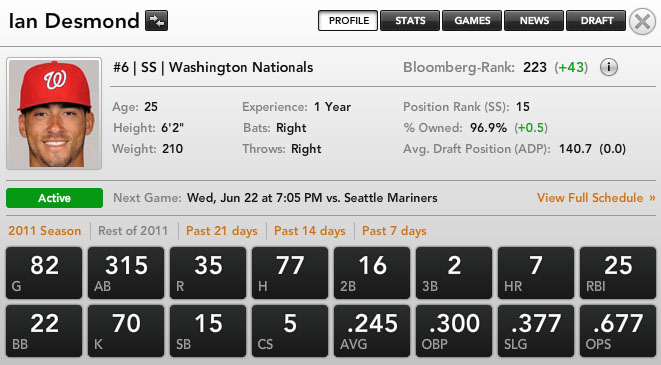
Consider Ian Desmond. The shortstop is flawed, but he had power and speed while coming up in the minor leagues, and power and speed at shortstop is almost always playable in fantasy baseball. The problem with Ian Desmond right now is that he has a .234 batting average to go with his three home runs and 20 stolen bases. And his BABIP is .295. And his xBABIP is .286. He’s not unlucky on batted balls right now, but he has a batting average that’s thirty points under his career number in the category. Why?

Obviously, BABIP is not the only component of batting average. The elements that go into a batting average are diverse. Contact is part of it – you have to make contact to get the ball in play. Power is also part of it – power can turn a liner to the shortstop into a liner into short center field. Plate discipline is also a component. You want to avoid swinging at pitches outside of the zone, and you want to make contact on pitches inside the zone. In all three of these categories, there’s some hope for Desmond owners.

At first glance, contact is a problem for Desmond. He’s striking out in a quarter of his at-bats right now and his whiff rate (8.8%) is above average (8.4% this year). But already there’s something not quite right. He’s only slightly more likely to swing and miss than the average player, but his strikeout rate is 5% above average. Given that fact, and the fact that Desmond has improved his whiff rate over last year (10%), it seems likely that Desmond will strike out a little less often going forward.

Power is also not going Desmond’s way right now. He has a below-average ISO (slugging percentage minus batting average) right now and has shown better power numbers in the past. In fact his current ISO (.098) would be his lowest number since rookie ball. His minor league ISO was .129 and his Double-A ISOs were both above .155. His major league ISO is .131. And power is the last statistic to stabilize over the course of a season. Give him a good week and he may find his power stroke once again. All it takes is a few doubles.

Lastly, though Desmond does not have great plate discipline, he has made improvements. He is reaching at balls outside the zone less than he has in his career (29.3% this year, 31.4% career, 29.5% is average this year). He’s also making more contact than he has in his career (80.3% this year, 79.2% career, 81% is average this year). Maybe he’s a little too passive right now – he’s only swinging at 63.2% of pitches within the zone, and league-wide that number is 64.7% and his personal career number is 65.5%. But he’s not reaching, and just a few more swings at solid pitches within the zone could really help.

Give Desmond a little more power – possibly from swinging at a few more pitches within the zone – and subtract a few strikeouts, and his batting average will improve. Given the fact that he’ll probably still strike out more than the average player and still won’t show much better than average power, his batting average won’t be awesome. But with power and speed, at shortstop, a .250+ batting average would work in most leagues. If it won’t work for your team, you’re probably best off looking for a new man in the middle.

For the best fantasy baseball analysis and insight please visit BloombergSports.com

Albert Pujols Out 4-6 Weeks; Who Are Possible Replacements?

By Tommy Rancel //

When Albert Pujols left the field clutching his left wrist this weekend, millions of fantasy owners across the world felt his pain. Despite the “down” season, the three-time National League MVP was hitting .279 with 17 home runs and 45 RBI thus far. The 17 home runs were third best in the NL while the 45 RBI were good enough for a top-10 ranking. In the month of June, Pujols began to turn it on with a .317 batting average to go along with eight home runs and a slugging percentage of .778!

Pujols owners scrambling to the waiver wire know they will not find anything close to the machine – even in season where he has not been at his best. Nevertheless, the search for lost production must begin somewhere.  With that in mind, here are a few names to keep in mind…

Casey Kotchman – Because of his market (Tampa Bay) and the fact that he has yet to qualify for the batting leaderboards, Kotchman’s 2011 has largely flown under the radar. After an abysmal 2010 in Seattle, the local product is hitting .345 with an OPS of .878 through 57 games. Kotchman will not provide you with much power (three home runs), and some question how long he can continue to hit for a high average; however, as a temporary solution, his long-term output does not matter. It also helps that he is available in most mixed leagues and will not require a trade.

Mark Trumbo – The addition of Russell Branyan has cut into Trumbo’s playing time, but not to the point where you shouldn’t consider him as the Angels’ primary first baseman. He is available in nearly half the standard mixed leagues, and unlike Kotchman, he is a source of power in Pujols’ absence. His batting average and on-base percentage are lackluster, but he has hit 25 extra-base hits including 12 home runs. Depending on your team’s needs, Kotchman (average and on-base percentage) and Trumbo (power) are quick fixes for cheap in most standard mixed leagues.

Anthony Rizzo – In NL-Only leagues and those with 18-plus teams, the options are less fruitful. Meanwhile, a young slugger like Anthony Rizzo could be available with plenty of upside. San Diego’s first baseman of the future registered three hits in his first three games; however, logged just one hit over the past week. While his bat has gone cold, the rookie has shown a fantastic eye at the plate which should keep his slumps relatively short. A beast in the minor leagues, his power may take a dip in Petco park, but the upside and availability in deep leagues makes him a target nonetheless.

For more on Albert Pujols and potential options check out Bloomberg Sports Free-Agent Finder and Trade Analyzer

Closer Report: The Next In Line

The Future Closers

BY ROB SHAW

@RobShawSports

Al Alburquerque, RP, Tigers

With 40 strikeouts in just 24 innings, Alburquerque is striking out batters at a historic pace.  He is a bit wild with 16 walks, but it’s a battle for the opposition to even put a bat on the ball.  I don’t think he’ll be closing by year’s end, but somewhere down the line someone is bound to give this 24-year old a shot at shutting the door.


Antonio Bastardo, RP, Phillies

This 25-year old southpaw is equally effective against right-handers and left-handers.  He has not surrendered a run in his last 11 appearances; in fact, he has allowed just one hit over that period.  If Ryan Madson were to falter, I think Bastardo would pick up the saves for the Phillies.


Brian Sanches, RP, Marlins

While Marlins closer Leo Nunoz has hit a wall, Brian Sanches is cruising with a 1.93 ERA.  The 32-year old veteran may not be the most attractive long-term option in Miami, but he has been the most effective over the last two seasons.  In 2010, Sanchez offered a 2,26 ERA with a 1.10 WHIP.  He can get wild at times and he has yet to pick up a save throughout his entire career, but if judging on results this season, Sanchez is the best relief option for the Marlins.


Daniel Bard, RP, Red Sox

Though he only boasts five career saves, there is a lot to like about Daniel Bard.  He strikes out more than a batter per inning, he has immaculate control, and the opposition can’t touch him.  He may be the very reason why the Red Sox have not locked up current closer Jonathan Papelbon to a long-term extension.  If Papelbon struggles, don’t be surprised to see the Red Sox turn to Bard a year earlier than expected.


David Hernandez, RP, Diamondbacks

Many baseball fans thought the Diamondbacks were crazy for trading away a slugging corner infielder in return for a couple of live arms that neither started or closed games.  However, at this moment the D-Backs front office looks brilliant as David Hernandez, a failed starter with the Orioles, is dominating in middle relief in the desert.


A scoreless inning on Thursday night resulted in his third win of the season, while lowering his ERA to 2.73.  Hernandez still has some work to do on his control, but he throws in the high 90s racking up plenty of strikeouts while limiting the amount of hits he surrenders.  Should the injury-prone JJ Putz miss some time due to injury, Hernandez will add to his total of two saves this season.


Is 2011 the Year of the Reliever?

By E. Gardner //

Time to give relievers some love.

It’s no secret that in the past few seasons, pitching has gotten stronger. One trend that hasn’t been remarked upon in 2011 is that relievers as a class are having a banner year.

Relievers are known as a fickle bunch, and sure, there’s been some attention paid to the closer carousel for the Dodgers, Blue Jays, Cardinals, among other teams, but overall, closers are having a pretty solid season. There’s currently 17 pitchers on pace for 35 saves. Last season, only 11 ended up with that total. Among the 17 pitchers who are on that 35-save pace, every single one of them has an ERA under 4.

But it’s not just closers who are providing value this season.

Throughout baseball, relievers this season have an ERA at 3.65. That compares to the collective ERA of starters at 3.94.

Compare this to last year: In 2010, relievers had an ERA at 3.93; starters had an ERA at 4.15.

In other words, the ERA of starters have dropped two tenths of a run, but the ERA of relievers have dropped nearly four tenths of a run.

Perhaps the most valuable reliever this season was hardly drafted, is still not universally owned, doesn’t have many saves, and yet, according to nearly every player rater measuring value in fantasy leagues, is atop such pitchers as Felix Hernandez, CC Sabathia, Jon Lester, and Tim Lincecum.

We’re talking about Jonny Venters, and if you don’t believe us about his value in 2011 to date, check out ESPN’s player rater for confirmation.

Venters currently has a microscopic ERA at 0.618, an infinitesimal WHIP at 0.8015, and is also contributing in wins (4) and saves (3). His 47 strikeouts this season (in under 44 innings) are also impressive. It’s only two less than teammate and Cy Young candidate Jair Jurrjens.

But Venters isn’t alone.

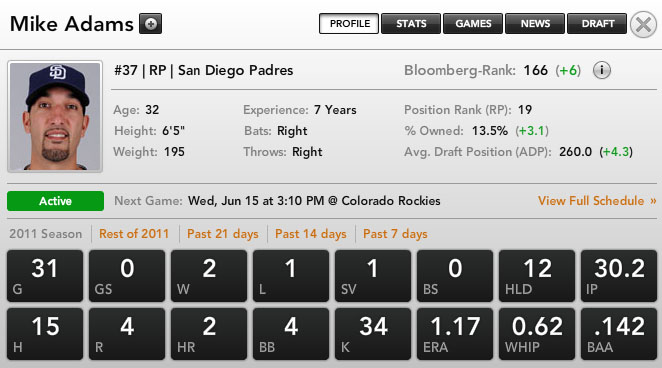
For those looking for help in ERA, there are pitchers like Mike Adams, Eric O’Flaherty, Aaron Crow, and Antonio Bastardo, who all rank as top-25 contributors in the category this season — even with diminished innings. These guys are available in most leagues.

For those looking for help in WHIP, there are pitchers like Daniel Bard and Tyler Clippard who are producing more in WHIP than even the most elite starters. Again, these guys come free in most leagues.

Undoubtedly, as pitching has grown stronger in baseball, fantasy competitors must chase an ERA in the low-3’s and a WHIP around 1.2 to be successful. Leaning on elite relievers has grown more important than ever.

For access to the top baseball analytics and fantasy tool Bloomberg Sports Front Office visit BloombergSports.com

Are They Hall of Famers? Part 2: Helton, Damon, Ortiz, Reyes, Crawford, Cabrera, Verlander, and Sabathia

Are They Hall of Famers?

Part 2

Johnny Damon– Labeled clutch, a winner, and one of the top leadoff hitters of his generation, it is surprising to learn that Johnny Damon has only made two All-Star appearances over his 17-year career.  That tells us that Damon was never the dominant left-fielder of his generation, and will likely put an end to his bid for a spot in the Hall of Fame.  However, the door is not closed yet.


Damon is just 357 hits shy of 3,000 for his career and he does not appear to be slowing down that much either.  Other personal milestones that will shortly be reached are 1600 hits and 400 steals.  If Damon can hand around for another three seasons, his longevity as well as his World Series heroics may result in a Hall of Fame plaque.


Todd Helton– A .324 career average screams Hall of Fame worthy.  However, for the first time Hall of Fame voters will have to take into account the Coors Field impact.  Helton is a .355 career hitter at home compared to just .292 on the road.  Also, when it comes to power 209 home runs were swatted at home, compared to 133 on the road.


So Helton is a dominant first baseman when playing at home, but more of a Mark Grace type hitter when on the road.  Considering he failed to reach any of the common Hall of Fame milestones such as 3,000 hits or 500 home runs, I do not see Helton as a Hall of Famer.


David Ortiz– As a long-time designated hitter, David Ortiz would need at least 500 home runs in order to gain admission to the Hall of Fame.  Considering he is currently 134 home runs shy of that total and has been linked to performance-enhancing drugs, Ortiz will likely have to settle as a Red Sox legend, but not a Hall of Famer.


On the Path:


Roy Halladay– The dominant pitcher of his era, Halladay has won two Cy Young awards and won 20 or more games on three occasions.  With 178 wins compared to just 89 losses, Halladay will probably need just another season or two of dominance to win over the Hall of Fame voters.


CC Sabathia– A very durable ace for the Yankees, Sabathia has the best chance of 300 wins with 165 already under his belt.  He will need another four or five 15-18 win seasons to guarantee a spot in the Hall of Fame.


Justin Verlander– So far so good for this young hurler.  Verlander has been durable and dominant.  He has put together a couple of no-hitters, won an AL Rookie of the Year, and made three All-Star teams.  The problem with Verlander is that he is so young, so he’ll need to stay healthy and effective for another 6-8 years.


Carl Crawford– A move to Boston should only help his chances.  Crawford has a Gold Glove, four All-Star appearances, more than 1500 hits and 400 steals, which is incredible for someone just 29 years old.  As long as he stays healthy, Crawford has every chance of making the Hall of Fame as one of the most consistent hitters of his generation.


Jose Reyes– Despite all of the injuries zapping Jose Reyes over the years, the 28-year old shortstop compares well to Carl Crawford.  He has made three All-Star games and will have every chance of making many more.


If he can hit around .300 for a good five to six years while hitting at the top of the lineup with 100-plus runs and 40-plus steals, Reyes will boast some very impressive numbers by the time he reaches his mid-30s.  It’s a gamble on his durability, but I see Reyes making the Hall of Fame.


Miguel Cabrera– Though he has yet to win an MVP, Miguel Cabrera has been a dominant player through his first eight seasons.  He will need at least four or five more in order to be considered for the Hall of Fame, but the good news is that at just 28-years old, Cabrera could end up playing another ten seasons assuming he stays healthy.


Are They Hall of Famers? Part 1: Chipper, Thome, Vladimir, Vizquel, Posada

Are They Hall of Famers?

Part 1

Definitely:


Derek Jeter– Just six hits away from 3,000 hits, plus the high average and World Series heroics, Jeter is a first ballot Hall of Famer.


Chipper Jones– The dominant third baseman of his era, Chipper Jones was not just a winner, but he posted All-Star production annually.  Jones has already surpassed 440 home runs and 2500 hits, all while batting .305 for his career.  It will also be interesting to see how long Jones plays considering he remains one of the top bats in the Braves lineup to this date.


Jim Thome- Just seven home runs shy of 600 home runs, Thome has never been linked to steroid abuse.


Ivan Rodriguez– His extended career has driven down his batting average, but Pudge was as dominant a catcher as we’ve seen.  He is just 162 hits shy of 3,000 with 311 career home runs, all from a catcher who was also best known for defense.


Ichiro– One of the greatest hitters to ever take the field, had Ichiro come to the States sooner, he probably would have challenged Pete Rose’s all-time record for hits.


Albert Pujols– He has dominated the Majors for 10 seasons, which is enough already to warrant inclusion in the Hall of Fame.


Mo Rivera– The greatest closer of all-time, Rivera has kept his ERA sub-2.00 for seven of the last eight seasons.  He is just 25 saves shy of 600 for his career.  By the time he retires, he may have 700 under his belt.


Up for Debate:


Vladimir Guerrero– An MVP who has played in nine All-Star games and boasts a .318 career average.  Guerrero may have been a DH late in his career, but in his prime he boasted the best arm in baseball.  He offered a great blend of power and speed, all while hitting for a high average.  He was the dominant right-fielder of his era.


Alex Rodriguez– This is not about the statistics, but whether the Hall of Fame voters are willing to enshrine an admitted steroid abuser.  The counter argument is that he played the second half of his career clean at a Hall of Fame level.


Jorge Posada– Certainly one of the top catchers of his era, but by no means the dominant catcher (think Pudge, Piazza, and Mauer).  That explains why he only played in five All-Star games throughout his career.  While Posada will get plenty of credit for playing on a winner, it is worth noting that the Yankees catcher was actually at his worst when it came to playing in the post-season.  His career statistics don’t measure up to Carlton Fisk and Gary Carter.  I don’t see Posada as a Hall of Famer, though he will be honored plenty by the Yankees for years to come.


Omar Vizquel– Still playing in the Major Leagues as a surprisingly high level, Omar Vizquel is a very underrated shortstop who is worthy of enshrinement in Cooperstown.  He dominated defensively during his era with 11 gold-glove awards, while also making three All-Star teams.


Vizquel compares very well to Ozzie Smith, but lacks the big personality.  Vizquel has accumulated 1,423 runs, 2,823 hits, and 401 steals while batting .273 for his career.  Not bad at all for someone who earned his paycheck with his fielder’s glove.


Unless he reaches 3,000 career hits by the time he retires, I see Vizquel hanging on the Hall of Fame ballot for nearly a decade before he finally earns the ticket to Cooperstown.

The Legend of Ruggiano?

By R.J. Anderson //

It wasn’t too long ago when Sam Fuld was the darling of the baseball community. Fuld, a small speedy outfielder with an interesting back story, took the league by storm with a combination of base hits and defensive wizardry. Since then, a massive slump has left Fuld on the bench and another longtime minor league outfielder in the spotlight.

The Rays acquired Justin Ruggiano in a 2006 trade with the Los Angeles Dodgers. The Texas A&M product looked to be a throw-in with the chance to turn into a bench player down the road, but attitude and performance issues led to him being removed from the 40-man roster in the spring. Out of options, but clearly not optimism, Ruggiano put in his work at Triple-A, hitting .301/.382/.514 with six home runs in 167 plate appearances.  Ruggiano is encroaching on 50 plate appearances and has an OPS over 1000 and three home runs to show for it so far, leading some to wonder whether they should try to ride the wave, much like they did with Fuld.

It’s a risky proposition, more so in Ruggiano’s case than Fuld, because of the timing. With the Super Two date quickly passing, Brandon Guyer—who was already recalled once this season—could be in line for a promotion. Not only that, but arguably the Rays top prospect, Desmond Jennings—should arrive in St. Petersburg within the next four weeks, and the only logical spot for him to play is left field, unless the Rays trade B.J. Upton by then.

In danger of stating the obvious: Ruggiano is not going to keep this pace up. His career Triple-A line is .289/.362/.472 and he has proved prone to the strikeout. It’s a nice story, and for a short-term fix, he could provide some power, but don’t start sewing the Legend of Ruggiano shirts just yet.

For access to the top baseball analytics and fantasy tool Bloomberg Sports Front Office visit BloombergSports.com

Thinking Ahead: The Trade Deadline and Bullpens

by Eno Sarris // 

The MLB trade deadline isn’t for another six weeks. That doesn’t mean that it won’t make waves in fantasy baseball sooner than that. There are a couple players in particular that are very likely to move. With these players, it makes sense for both teams to make the trade sooner rather than later in order to get the most value, whether it be in prospects or production.

The Padres are nine games out and at the bottom of the National League West division. Their closer, Heath Bell, is a one of the elite bullpen arms in baseball. He’s also a free agent at the end of the year and is already the highest-paid player on a cash-strapped team. Former GM Jim Bowden recently said that Bell is the player most likely to be traded, and with good reason it seems.

Behind Bell are a couple arms worth owning if he’s going to leave town. Most likely, Mike Adams is next in line. The righty is working on his fourth straight year with more than a strikeout per inning. He also has great control. That mix has produced a 1.71 ERA over that time span — he’s really good. There is one caveat with the 32-year-old, however: he’s only under team control for one more year. Luke Gregerson, on the other hand, is under control for three more years and is also excellent. He’s managed a strikeout per inning over the first three years of his career, and even if his ERA isn’t as pristine as Adams’ (3.14), he gets good ground balls (48.1% career) and has one of the best sliders in the game. If only he was healthy — a strained oblique has felled him at the wrong moment. Then again, Gregerson uses his slider almost twice as much as his fastball, and some of my recent research has shown that heavy slider usage can lead to injury. Adams is the safer pick overall.

In New York, the Mets are eight games back. Even if they only have two teams in front of them, one of them has an historic rotation and the other is stacked with young talent. Add in some much-publicized monetary issues, and it just doesn’t seem like the Mets need Francisco Rodriguez to stick around. The sticking point is a $17.5 million vesting option for next year, and a limited no-trade that allows him to block a trade to ten mystery teams. But if the Mets can find a team that’s not on the list and has an established closer (in order to keep his option from vesting), there’s an immediate match, and the team is highly motivated to make such a deal.

Behind Rodriguez, there isn’t an easy solution. Well, there is, but it isn’t very forward-looking. 38-year-old reclamation project Jason Isringhausen is the obvious set-up man and the team leader in holds. Some fans have hopes for Bobby Parnell as the closer of the future, but the flame-thrower has terrible control. No other reliever has stepped to the fore, although hometown hero Pedro Beato has an interesting pitching mix. He still doesn’t have the strikeout punch of a closer right now, though. Even with Isringhausen’s mediocre strikeout and walk rates, and advanced age, he’s probably the dude once K-Rod leaves town.

The trade deadline comes July 31st. By thinking ahead, you might just own two newly minted closers by then.

For the best fantasy baseball analysis and insight please visit BloombergSports.com