Category: Dailies
Josh Willingham: The Hammer Moves to Oakland
by Eno Sarris //
Josh Willingham will be 32 next season and in his final year of arbitration, but the Oakland Athletics saw enough there to trade two fringe prospects for him on Thursday. Perhaps they liked his consistency at the plate.
 For the last four years, the Hammer’s full-year statistics in some key categories have not wavered much. Check out his walk rate – it has gone from a ‘low’ four years ago at 10.9% to a high of 14.9% last year. His strikeout rate has stayed in a tight range, 23% to 24.3%, and his isolated slugging percentage has been between .192 and .237 over the past four years. The overall package is one that doesn’t wow anyone from a fantasy perspective (he’s never hit more than 26 home runs or better than .277). But Willingham works well as a late-round mixed league outfielder or a stable deep-league bat. He’s predictable.
How will he fare in his new digs? His FanGraphs splits show that he’s a pull hitter – he has a .810 career slugging percentage to left field (compared to .320 to right field). The Nationals’ park was 337 feet to left field and 377 feet to left-center, so it counts as good news that the Oakland Coliseum is 330 feet to left and 367 to left-center. However, dimensions aren’t everything – the Nationals’ park had a 100 park factor for home runs by a righty last year, and the Coliseum a 77 in that category (ESPN’s three-year park factor for all batters was .872). Whether it’s the weather or some other factor, it was definitely difficult for righties to hit it out of the Coliseum last year. So it’s not likely that Willingham will set a career high in home runs at his age and in that ballpark.
In return for Willingham, the Nationals will receive two prospects who were not among Baseball America’s top 10 for the Athletics. Right-handed reliever O’ Henry Rodriguez throws gas (98.8 MPH on the fastball, career) and can strike batters out (more than a strikeout per inning every stop). But he’s also had some trouble with control (4.26 BB/9 IP in his short MLB career, 6.6 BB/9 IP in the minor leagues). If his high but manageable major league walk rate holds, he could be a force at the back of a pen. Drew Storen will likely get most of the save chances for the Nats to begin the season, though.
Minor league outfielder Corey Brown projects as a fourth outfielder and injury fill-in, though with some potential to eke out a starting corner outfield job at some point. As a three-year college hitter, his numbers need to be taken with a grain of salt, but he’s done well at Double-A in a mostly-neutral run environment for two years now (.269/.348/.488 and .320/.415/.502 in 2009 and 2010 in the Texas league, respectively). He walks (11.3% career), has power (.225 career ISO), and speed (48 stolen bases against only eight caught stealing). The problem is that he doesn’t make great contact (31%), so don’t bet on a good batting average. He’s improved that number recently (it’s hovered around 28% the last two years), but the major leagues will boost those strikeouts and keep Brown from being a mixed-league option, at least for now.
With Willingham’s muted upside, Rodriguez’s control issues, and Brown’s strikeouts, each player has a flaw that makes for a tough draft decision. Pick up Willingham late in standard mixed leagues; take a wait-and-see approach on Rodriguez and Brown.
Cardinals Nab Old First Baseman Lance Berkman for the Outfield
by Eno Sarris //
Perhaps the title provides a little clue about the probability that this move works out well for St. Louis. While the deal was short (one year), the dollars were perhaps surprisingly high ($8 million) for a move that flies in the face of some poor trends in Lance Berkman‘s production over the past few years.
Age is a bitter beast that comes for us all. Since Berkman turned 32 in 2006, he’s turned south in a pronounced way. He had 665 plate appearances that year, right in line with his career production. Then, in 2009, he stepped to the plate 563 times. Last year? 481 times. Along the way, he had knee surgery and had some arthritic changes in the joint that don’t bode well for his mobility in the outfield.
Though defense doesn’t factor in to fantasy numbers directly in most leagues, it can have secondary effects. Berkman may find that he can’t play daily in the outfield on that knee – he hasn’t patrolled the outfield regularly since 2007, and that was only for 31 games. He also hasn’t been rated as a positive defender in the outfield since 2003 – what happens when Tony La Russa gets tired of watching Berkman muff fly balls?
All of this is before we even look at Berkman’s offensive statistics, which have also shown decline. Since 2008, Berkman has seen his isolated power decline (.255 ISO down to .166) while his BABIP has also dropped (.341 down to .282). While BABIP is often used as a stat to suss out luck on batted balls, players do have some control over the number, usually tied to their speed and their ability to rack up line drives. The numbers, in this case, line up with what we can see with our eyes: Berkman has lost a step and a little bat speed.
We shouldn’t be surprised. Only 18 first basemen over 35 have put up better than an .800 OPS since 1975, and only Mark McGwire, Andres Galarraga, Jeff Bagwell and Carlos Delgado hit more than 30 home runs beyond that age. Berkman failed to put up an .800 OPS for the first time since he’s become a major league regular, so he’s in danger of repeating that feat. As for the second part, he’s only managed 30 home runs five times in his career – the last was in 2007. He probably won’t make that group a quintet.
The Big Puma has always had a great approach at the plate, so in leagues that count on-base percentage, he may still be a boon this season. More traditional leagues should spend no more than a late-round pick on Berkman.
What’s Brad Lidge’s Status Update After the Cliff Lee Signing?

Russell Nathan Coltrane Jeanson Martin in the Bronx
by Eno Sarris //
The man with a lot of names is bringing his game to River Avenue: Russell Martin has agreed to a one-year contract with the Yankees. He’s not much of a consolation prize for losing out on Cliff Lee, but Martin still fills a need, and may even enjoy a bit of a bounceback in the Bronx. The move also means a lot for the organization, as minor as the signing might seem.
The team had already announced that Jorge Posada would function mostly as the designated hitter in 2011. He hasn’t hit well as a DH in the past (.223/.336/.361), but being relieved of the rigors of catching might allow him to play more often and have a mini-resurgence of his own. At the very least, it rids the Yankees of Posada’s subpar defense behind the dish. By announcing the move early, the Yankees basically admitted that they would spend the off-season looking for a solution at the position.
The speculation to date had been that the team would play Jesus Montero for the lion’s share of the at-bats at the position – speculation based on the strength of Montero’s bat. That bat is impressive: Montero just hit .289/.353/.517 in Triple-A, with 21 home runs…as a 20-year-old. That’s made even greater by the fact that the International League is one of the minors’ toughest places for offense.
Unfortunately, Montero isn’t known for his work behind the plate, and even after four years spent shoring up his footwork and receiving ability, he may not be long for the position. Some prospect gurus, like Kevin Goldstein of Baseball Prospectus, are more blunt about his flaws. Goldstein has also pointed out that Montero would be larger than any other catcher in the game. Now with Lee in Philadelphia, Montero might actually be the main chip in a trade to net another starter for the Yankees. He’s gone from Opening Day starter to a possible trade candidate in the span of a month or two.
Cue Russ Martin. After peaking with a .293/.374/.469 line (with 19 home runs and 21 stolen bases) in 2007, Martin has seen his statistics wither away – down to last year’s .248/.347/.332 with five home runs and six stolen bases in a career-low 387 plate appearances. The good news is that Martin has retained his excellent eye at the plate – he continues to walk (12.9% career) and not strike out too much (15.8% career).
Mostly, he’s lost his power and speed. His speed may not return – it’s rare for a catcher to continue stealing bases long into his career, and Martin is coming off of a leg injury. Martin never had much power: At his peak (.176 ISO in 2007) he was only slightly above average (.150 most years). The last two years, his power has been middle-infield-esque, though (.079 and .085 ISO respectively).
Can he return to respectability in that category? Maybe. The park factor for right-handed home runs in Los Angeles was 92 last year, and in New York it was 110. To take advantage of the friendly confines, Martin will have to get more balls in the air. If he, perhaps, puts up a flyball percentage like the one he showed in 2007 (34.1%) rather than the one he had last year (28.3%), he could see a few more big flies in 2011.
With a little step back in strikeouts (last year’s 18.4% was a career high), and slightly better luck on balls in play (.287 BABIP last year, .302 career), Martin’s batting average might also improve in 2011. With his walk rate as it is, he’s still a boon in leagues that count on-base percentage. And even with reduced speed, he should steal a handful of bases. Martin is a decent bet for a slight bounceback. He’s a worthy late-round flyer in mixed leagues.
Cliff Lee Finally Signs…with the Phillies
By R.J. Anderson //
Jayson Werth signing a $126 million deal with the Nationals figured to be the surprise of the off-season. Instead, Cliff Lee has outdone his former teammate by signing with the team they once shared. For all the talk about the Rangers and Yankees dueling over the ace’s services, in the end Philadelphia walked away with the biggest catch of the off-season.
Lee joins Roy Halladay, Roy Oswalt, and Cole Hamels to form possibly the best rotation in modern history (as Dave Cameron showed here, this rotation is comparable to the Atlanta Braves of the early-to-mid 1990s). Of course, fantasy owners are more interested in how Lee fares rather than the foursome as a whole. In particular, there’s a thought that looking at Lee’s time in Philly represents an accurate projection of what to expect from the 32-year-old.
Those stats include 12 starts in 2009, with 79 innings pitched (roughly six and a half innings per start, even though that’s impossible), a 3.39 ERA, a strikeout-to-walk ratio of 7.4, and a win-loss record of 7-4. Believe it or not, Lee is probably better than some of those stats suggest. Over the past three seasons he’s compiled a 2.98 ERA, a 48-25 record, and a 5.64 strikeout-to-walk ratio between four different teams.
A stretch of dominance like Lee’s is hard to replicate for too long. Even Greg Maddux couldn’t keep up the frantic pace he posted from 1995 to 1997 (96 starts, 687 innings pitched, 53-17 win-loss, 2.21 ERA, and a 7.46 SO/BB, while walking fewer than one batter per nine innings pitched); Maddux’s 1998 included a 2.22 ERA, 18-9 record, and a 4.53 strikeout-to-walk ratio. Fall off? Hardly, but expecting a slight stepback is safer for expectations than holding Lee to his own superhuman track record. The table below shows how each of the top five pitching seasons (as determined by K/BB ratio) fared in K/BB and ERA the next season. Each pitcher saw his strikeout-to-walk ratio decline and his ERA increase (with one exception), a sign that Lee probably won’t upon his historic 2010 season:
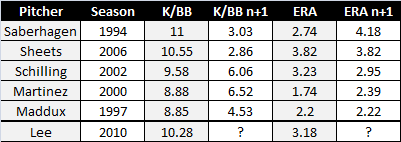
Double-digit wins (wins are heavily influenced by factors beyond a pitcher’s control), 200-plus innings, and a sub-3.50 ERA seem reasonable enough. And given that it’s Lee, there is a chance he might blow those conservative projections away. He’ll be one of the first pitchers off the board come draft time – as will three of his rotation mates. Deservedly so.
Chicago White Sox (Finally) Acquire Adam Dunn
By Tommy Rancel //
Following what seems like years of courting by the Chicago White Sox, as well as years of resisting becoming a designated hitter in the American League, Adam Dunn signed a four-year deal, $56 million to slug on Chicago’s South Side. Whether it was a change of heart or the $56 million being waved in front of his 31-year-old eyes, Dunn now says he’s not only willing to DH, but play whatever position the White Sox ask of him.
Dunn could be asked to use his butcher’s knife glove at first base along with his time at DH. Luckily for fantasy owners, his defense is not a factor. He’ll keep his first base eligibility for 2011 at least; his offensive game is so strong that he’s well worth a spot in mixed league lineups even if he eventually loses that eligibility.
In seasons past, Dunn has been one of the more underrated hitters in the game. This is largely because his batting average has been mediocre (or worse), despite the many home runs launched from his bat. Dunn also walks a lot and strikeouts a ton. The walks are underrated in many circles and the strikeouts are seen as a huge negative to some. Still, the total package is a valuable one, in fantasy and even more so in real life.
The Big Donkey has hit at least 38 home runs in each of the last seven seasons. He is the only major leaguer who can say that. Over those seven seasons, he’s averaged 40 bombs a season with 101 runs driven in. Even though he is as slow as his nickname would suggest, his fantastic on-base skills (.381 career OBP), frequent homers and underrated durability (he’s missed 10 games or less in each of the past seven seasons) have helped him average 94 runs scored a year since 2004.
Also working in Dunn’s favor this season will be a switch to one of the more hitter-friendly parks in the AL. His new home, U.S. Cellular Field, rated as the top home run ballpark in 2010. Nationals Park ranked 15th last season.
On the other hand, there are some concerns about Dunn going into next season. He will be playing in the AL for the first time and will also be DHing for the first time on a regular basis. Add in the fact that old-player skills (walks, strikeouts, home runs) do not tend to age gracefully, and there are some concerns about a Pat Burrell-like slide.
Still, we must give Dunn the benefit of the doubt. His durability and colossal power – in conjunction with a move to “the Cell” – put him among the game’s top projected sluggers in 2011. His position in the field and lineup are to be determined; however his status as a top fantasy option remains intact as a member of the Chicago White Sox.
MLB Season in Review: Baltimore Orioles Pitchers
By Eriq Gardner //
Carlos Pena, First Base Bargain?
By Tommy Rancel //
Despite being the Tampa Bay Rays all-time home run leader, Carlos Pena was the second-most important Rays player to sign with a new team at the winter meetings. Carl Crawford got the big bucks from the Boston Red Sox, and Pena is looking to make a big comeback with the Chicago Cubs in 2011.
A crown jewel in the Andrew Friedman collection, Pena went from first-round bust to MVP candidate in the span of one season. In his first year (2007) with the (Devil) Rays, the first baseman smashed 46 home runs and drove in 121 runs – both single-season franchise records. Unsurprisingly, he was unable to top those numbers in any of the next three seasons, but still managed an impressive OPS of .884 in his time with the Rays.
Pena became the franchise all-time home run leader this past season. His 144 home runs in a Rays uniform also rank as the sixth highest total in baseball since 2007.
For all the good done – on and off the field – during his time with the Rays, Pena ended his career with the Rays on a down note. Just three years removed from his breakout campaign, Los hit just .195/.325/.409 in 2010.
Aside from the massive number of strikeouts which are typical for a three outcome hitter (home runs, walks, and strikeouts), groundball outs were also a problem for Pena this past season. His 44.9% groundball rate was his highest total in any full-season.
The last thing you want from primary home run hitter is nearly half the balls he puts in play staying on the ground. His slash line (AVG/OBP/SLG) on grounders was an abysmal .137/.137/.151. The .137 BA represents the second-lowest average on groundballs (min. 100 PA) in the majors, owing to Pena’s lack of speed, and teams shifting on him to prevent right-side grounders from scooting through the infield.
Though he may be on the downside of his career, Pena’s power is still a threat. Aside from the terrible slash line, the strikeouts, and high number of grounders, Pena still managed to hit 28 home runs last year. Also consider, he is moving from a below-average hitter’s park for left-handed batters to one of the friendlier parks for lefties. According to statcorner.com, Tropicana Field had a home run park factor of 89 for LHB (neutral is 100). Wrigley Field, on the other hand, had a park factor of 119. NL Central pitching is likely to be easier to handle than that seen in the AL East too.
After whiffing (literally) on his chance of a big payday this off-season, Pena gets another chance with this one-year, $10 million deal with the Cubs. With contract motivation, a ton of natural power, a home run friendly environment, and even reuniting with hitting guru Rudy Jaramillo, Pena could be poised for another 30-plus home run campaign.
For fantasy owners who don’t want to pay premium prices for a first baseman, Pena could be a good sleeper. At a stacked position, and coming of a down year, he could get lost in the shuffle in some leagues. While Adrian Gonzalez, Albert Pujols, and Joey Votto go early, you can focus on a weaker position (say, shortstop Troy Tulowitzki) in the first few rounds and target Pena as a mid-to-late-round selection in mixed leagues.
Jason Bartlett to San Diego
By R.J. Anderson //
Jason Bartlett’s name popped up in trade rumors more than nearly any other ballplayer in the land. No longer will that be the case, as the Tampa Bay Rays have reportedly traded Bartlett to the San Diego Padres for relief pitchers Adam Russell and Cesar Ramos.
Let’s begin with the fantasy implications for the Padres. Bartlett immediately steps in as their starting shortstop, diminishing whatever value Everth Cabrera may have held. The 31-year-old Bartlett hangs his fantasy hat on a strong 2009 (.320, 14 HR, 66 RBI, 90 R, 30 SB), when he benefited from an inflated batting average on balls in play (.364 – league average is typically near .300). His 2010 season (.254, 4 HR, 47 RBI, 71 R, 11 SB) represented a hasty step-back, one that resembles what folks should expect moving forward.
Stepping into an arctic offensive environment at Petco Park is unlikely to help. There are some slivers of good news, though: Petco is harshest on left-handed power hitters (Bartlett is neither left-handed nor a power hitter) and a bounceback in steals could be in the works (Bartlett stole at least 20 in three straight years before only taking 11 bags in 2010). A hidden source of upside with Bartlett in the National League West is the large number of left-handed starting pitchers; Bartlett typically feasts off lefties. He struggles against righties, though, and is a good bet to miss two weeks a season with a lower body injury.
In Bartlett’s place, the Rays will insert one-time top prospect Reid Brignac. A left-handed hitter with a better glove and more power potential than Bartlett, Brignac hit .256/.307/.385 with eight homers in 326 plate appearances last season. Brignac becomes an intriguing option in AL-only leagues and potentially a mixed league option if he improves on his plate approach.
As for the pitchers: Ramos is the less interesting of the two. He could be nothing more than a middle reliever or a situational lefty. However, Russell could be a sleeper candidate for saves, given that most of Tampa Bay’s bullpen graduated to free agency, including all of their set-up men and closer Rafael Soriano. Russell is a big guy (6’8″) with a mid-90s fastball that sinks. In 54 career big league innings he’s struck out 54 batters, and his minor league track record also augurs well in that regard.
Russell’s exact role will be determined later this off-season, and might not be solidified until the 2011 season has begun. But he might very well provide the most fantasy value next year among players involved in this deal.
Miguel Tejada Heads Back To NorCal
By Tommy Rancel //
San Francisco Giants’ general manager Brian Sabean has a type: aging middle infielders. From Omar Vizquel and Ray Durham to Juan Uribe and Edgar Renteria, Sabean always seems to find a past-his-prime infielder that puts a little twinkle in his eye. His latest move follows that blueprint: the signing 36-year-old Miguel Tejada to a one-year deal worth $6.5 million.
Tejada is familiar with the Bay Area, having spent the first seven years of his career with the Oakland Athletics. Unfortunately, the production he put up as a member of the A’s is just a memory.
In recent seasons, he has transformed from a slugging run-producer to a contact-driven, league-average hitter with a little pop left in the bat. From 1998 to 2006, Tejada averaged 26 home runs and 105 RBI a year. Since then, he’s averaged just 15 home runs and 76 RBI per year.
On the other hand, 15 home runs, 75 RBI, and 80 runs scored would be a pretty solid season, given the weak current group of MLB shortstops. The only two players to top those marks in 2010 were Hanley Ramirez and Troy Tulowitzki – the two best offensive shortstops in the game.
Also working in Tejada’s favor is durability. He’s averaged 151 games played over the past four years, while averaging more 40 extra-base hits a season. The question for the Giants is, can he handle 140 games at shortstop? But as a fantasy owner, he’s also earned his SS eligibility for 2011.
After the top tier of Ramirez, Tulowitzki, and the second level of Stephen Drew, Starlin Castro, and Jose Reyes, the remaining NL options have as many – if not more – offensive question marks than Tejada in 2011.
If you are unable to land one of the top guys early on draft day, sit back and wait. Odds are the latest Sabean Special will be available later as a potential starter. The risk of Tejada completely deteriorating is real, but the minimal cost in terms of a draft pick with the likelihood of league average production should be worth it in NL-only leagues; his counting stat potential even makes him a decent choice at the end of a mixed-league draft.
 Bloomberg Sports